REVIEW 2 major objections 6 minor 71 references
Applying Cognitive Design Patterns to General LLM Agents
T0 review · 2 major / 6 minor · reviewed 2026-08-15 · deepseek-v4-flash
Pith's one-line read Recurring cognitive design patterns from classical AI architectures can identify functional gaps in LLM agents and point to concrete research directions toward general intelligence.
desk verdict A useful position paper that gives the LLM-agent field a concrete comparative vocabulary; its main weakness is that the pattern-presence judgments driving its predictions are under-specified, but the predictions are framed as testable questions, not proven claims. read the letter →
The pith
A machine-rendered reading of the paper's core claim, the machinery that carries it, and where it could break.
The reading
What carries the argument
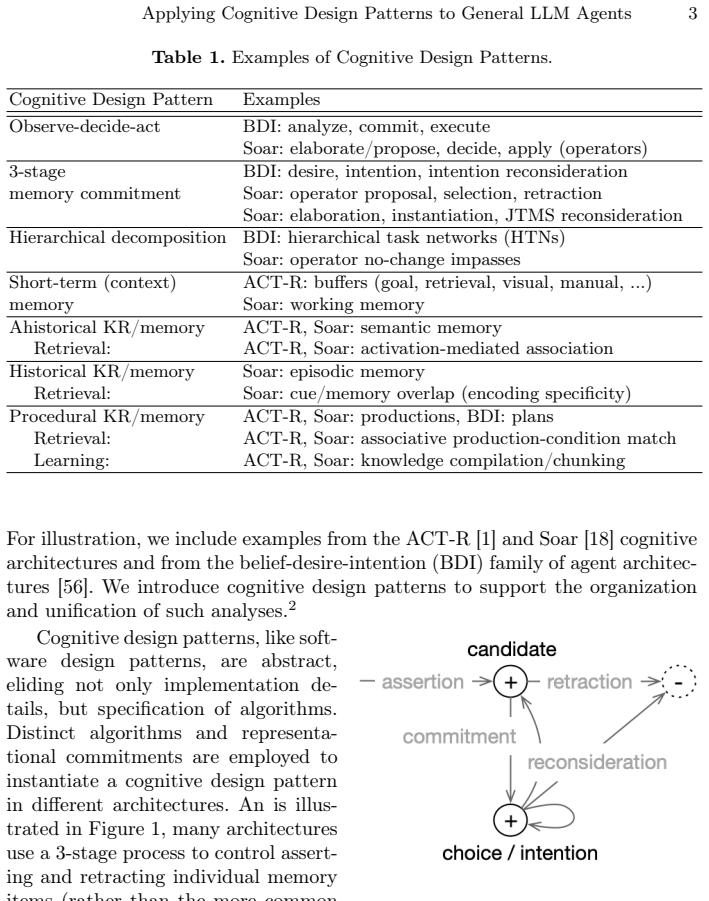
The central object is the cognitive design pattern: an abstract, implementation-independent description of a function, process, or memory that recurs across agent and cognitive architectures, comparable to a software design pattern. Its analytical work is to make functionally equivalent mechanisms recognizable across very different systems—for instance, treating a truth-maintenance-based reconsideration process and a decision-theoretic intention reconsideration as instances of the same function. The paper deploys this machinery through a three-stage commitment cycle (candidate generation, selection or commitment, reconsideration), through the episodic-memory characteristics of encoding specificity and cue-based retrieval, and through the knowledge-compilation pattern of caching expensive reasoning results; these are then used to generate predictions for LLM agents.
What would settle it
Run a controlled benchmark comparing ReAct with a ReAct variant that adds an explicit commitment and reconsideration step, and separately compare a Generative-Agents-style memory using semantic-similarity retrieval against one with deliberate cue construction; if neither intervention improves outcomes, the claim that these pattern gaps limit LLM agents would be contradicted.
Extended reading notes
Core claim
On the paper's own terms, the discovery is that the functional decompositions accumulated in decades of cognitive-architecture research are not tied to specific implementations but recur across belief-desire-intention agents, ACT-R, and Soar; viewed this way, they provide a catalog of functions that should appear in any agent aimed at general intelligence. Applying that catalog to current LLM agents exposes specific missing pieces: ReAct implements observe-decide-act without an explicit commitment step, Generative Agents' memory lacks cue-based retrieval and encoding specificity, and neither reconsideration of commitments nor online knowledge compilation is part of the mainstream. The paper argues this is not coincidence but a consequence of omitting well-established cognitive functions.
Load-bearing premise
The load-bearing assumption is that the functional decomposition of classical cognitive architectures transfers to language-model agents at the same level of abstraction; if an LLM's behavior is emergent and cannot be meaningfully decomposed into these functional roles, the gap analysis loses its predictive value.
Editorial extensions
If this is right
- Adding an explicit commitment step to ReAct-style observe-decide-act loops becomes a concrete, testable intervention predicted to improve reasoning outcomes over ReAct alone.
- Adding deliberate retrieval-cue construction and context-specific encoding to LLM episodic memories should change when and what agents recall, beyond semantic-similarity relevance.
- Reconsideration of commitments should be built into LLM agents that make explicit plans, allowing non-monotonic redirection instead of continuing a stale intention.
- Online knowledge compilation—caching the results of expensive multi-step reasoning for later reuse—should become a central mechanism in large reasoning models, with utility problems emerging as a research topic.
- Step-wise reflection, a newly identified pattern intrinsic to LLM computation, can be distinguished from metacognitive reflection and carries a distinctive risk of unbounded recursive self-evaluation.
Reading between the lines
- If the mapping method is sound, it can serve as a generative checklist: any new agentic framework can be audited against the pattern catalog to predict which cognitive functions are missing before empirical testing.
- A natural extension would test whether introducing encoding-specificity-style contextual cues in Generative-Agents-style retrieval changes long-horizon behavior, a prediction the paper only states as a research question.
- The analysis implies that non-monotonic reasoning and commitment management, not just context length or tool use, will become binding constraints on LLM agent generality.
- One could build a benchmark of pattern violations—for example, tasks where an agent must abandon a goal—to measure whether frameworks with explicit reconsideration outperform those without.
Signed reviews
Editorial analysis
A structured set of objections, weighed in public.
Referee Report
Summary. The paper introduces the notion of "cognitive design patterns"—abstract descriptions of recurring functions, processes, and representations found across classical cognitive architectures such as ACT-R, Soar, and BDI agents—and applies this lens to contemporary Agentic LLM systems. It analyzes ReAct and Generative Agents as case studies, argues that ReAct lacks an explicit commitment step, evaluates Generative Agents against a checklist of episodic-memory characteristics adapted from Nuxoll and Laird, and identifies reconsideration and knowledge compilation as under-explored patterns. It also proposes "step-wise reflection" as a candidate novel pattern. The central claim is that mapping Agentic LLM systems onto cognitive design patterns enables predictions of current gaps and points toward future research directions for general LLM agents.
Significance. If the pattern-mapping methodology were equipped with a reliable operational test for pattern presence, the framework would provide a useful comparative analytic tool for a fast-moving field where much work is ad hoc and disconnected from prior architecture research. The paper has real strengths: it draws on a substantial body of prior comparative architecture work, grounds the episodic-memory analysis in a well-known published criterion set (Table 3), and it issues concrete, falsifiable predictions, notably the question in §3.1 of whether adding explicit commitment to ReAct improves reasoning outcomes. It also names underexplored areas, such as online knowledge compilation, that are plausible research opportunities. The main weakness is that the central predictive claim currently rests on an under-specified mapping from systems to patterns, so the gap analyses are not yet reproducible or falsifiable as stated.
major comments (2)
- [§2 and §3.1] The paper gives no operational criterion for deciding whether a given Agentic LLM system instantiates a cognitive design pattern. The patterns are defined abstractly, "eliding not only implementation details, but specification of algorithms" (§2), and Table 2's footnote states that the table "does not distinguish full vs. partial realizations" (§3.1, footnote 3). Yet the entire ReAct analysis depends on precisely such a distinction: the paper asserts that ReAct "lacks the step that explicitly makes commitments" (§3.1). At a functional level, ReAct's action output can be read as a decision to execute one action, i.e., an implicit commitment made at every step; the absence of commitment is only meaningful if "commitment" is defined as a persistent, separately represented intention with an explicit commitment process. Nothing in the pattern definition fixes this level of abstraction. Because the paper's novelty is its predictive use of pattern-gap analysis, this is a load-bearing issue: without an independent, testable criterion for pattern presence, the predicted gap in ReAct and similar claims are not falsifiable from the current definitions. I recommend that the authors add an explicit definition of pattern instantiation at a chosen level of abstraction, with examples of how to verify presence or absence in an LLM-based system (e.g., by probe prompts, architectural inspection, or behavioral tests).
- [§3.1, Table 3] The scoring of Generative Agents in Table 3 is not derived from a stated evaluation procedure, and at least one score appears to rest on a design-description rather than on behavior. In particular, "Encoding specificity: Partial" is justified by the comment that retrieval "uses semantic similarity, not encoding specificity." But whether semantic similarity can implement cue-based context matching is an empirical question, not a definitional one: a semantic-similarity retrieval function over contextualized embeddings could, in principle, approximate encoding-specificity effects. Similarly, "Deliberate: No" is asserted on the basis that "[a]gents cannot deliberately attempt to construct cues or retrieve memories," but no experimental probe is described that would establish this inability over the space of prompts the system might receive. Since Table 3 is the paper's most detailed worked example of pattern-gap analysis, the absence of an evaluation protocol makes the gap claims vulnerable to the objection that they are artifacts of annotation granularity. I ask the authors to specify, for each row of Table 3, the evidence or test that would justify a Yes/Partial/No verdict.
minor comments (6)
- [§2] There is a typo in the sentence "An is illustrated in Figure 1" near the discussion of the 3-stage commitment pattern; it should read "As is illustrated in Figure 1."
- [§3.2] The sentence "LLMs alone are not consisent or reliable in producing non-monotonic reasoning steps" contains a misspelling of "consistent."
- [§3.2] The phrase "reconsideration for intentions or commitments in Agentic LLMs could allow an the agent to periodically assess" contains an extra article "an" before "the agent."
- [§3.1, Table 3] The "Autonoetic" row uses a question mark as its Table 3 value, but the table's legend does not define "?" as a distinct category from "Yes," "No," "Partial," and "Semi."
- [§3.2] The statement that "direct, online caching of LLM responses in natural language has not yet become widely researched" is in tension with the paper's own description of Reflexion, which "caches its reflections in a memory to be used in subsequent trials." If reflections are considered distinct from responses, that distinction should be stated explicitly; otherwise the sentence reads as a contradiction.
- [Footnote 2] The footnote contains a doubled article: "The the recognition of common patterns occurring across cognitive and agent architectures goes back many years."
Circularity Check
No significant circularity: the pattern catalog is used as an analytic lens on external systems, and the claimed gap predictions are conditional research questions, not consequences of fitted parameters or self-citation chains.
full rationale
The paper contains no equations and no fitted parameters. Its central claim is that a catalog of recurring cognitive functions, drawn from prior comparative analyses of cognitive architectures (including some by the present authors), can be used to identify gaps in Agentic LLM systems. The evaluation targets external systems (ReAct and Generative Agents), and the pattern definitions are applied as an interpretive framework rather than derived from those systems. The ReAct "missing commitment" and Generative Agents "partial encoding specificity" conclusions are judgments about level of abstraction, and the questions they raise, such as whether introducing commitment in ReAct would improve reasoning outcomes, are empirical and not forced by the definitions. Self-citations appear, for example Table 3 is adapted from Nuxoll and Laird, but the underlying criteria, such as encoding specificity, are grounded in external cognitive psychology literature (Tulving and Thomson), and the cited source is not used to forbid alternatives or to make the gap conclusion true by stipulation. Any weakness in operationalizing pattern presence is a falsifiability or correctness concern, not a circularity concern.
Assumptions & free parameters
assumptions (4)
- domain assumption The patterns abstracted from Soar, ACT-R, and BDI are meaningful functional units for general intelligence.
- domain assumption LLM-based agents can be decomposed and evaluated using the same functional criteria as symbolic cognitive architectures.
- domain assumption The Nuxoll and Laird episodic memory criteria are the appropriate normative benchmark for LLM agent memory.
- domain assumption The selected example systems are representative of the Agentic LLM research mainstream.
invented entities (1)
-
step-wise reflection
Cite this review
Pith. "Pith review of Applying Cognitive Design Patterns to General LLM Agents." pith.science (2026). https://pith.science/paper/IT3OXCVK
@misc{pith2026250507087,
  author       = {Pith},
  title        = {Pith review of: Applying Cognitive Design Patterns to General LLM Agents},
  year         = {2026},
  howpublished = {\url{https://pith.science/paper/IT3OXCVK}},
  note         = {Machine review of arXiv:2505.07087}
}
read the original abstract
One goal of AI (and AGI) is to identify and understand specific mechanisms and representations sufficient for general intelligence. Often, this work manifests in research focused on architectures and many cognitive architectures have been explored in AI/AGI. However, different research groups and even different research traditions have somewhat independently identified similar/common patterns of processes and representations or "cognitive design patterns" that are manifest in existing architectures. Today, AI systems exploiting large language models (LLMs) offer a relatively new combination of mechanisms and representations available for exploring the possibilities of general intelligence. This paper outlines a few recurring cognitive design patterns that have appeared in various pre-transformer AI architectures. We then explore how these patterns are evident in systems using LLMs, especially for reasoning and interactive ("agentic") use cases. Examining and applying these recurring patterns enables predictions of gaps or deficiencies in today's Agentic LLM Systems and identification of subjects of future research towards general intelligence using generative foundation models.
Figures

Reference graph
Works this paper leans on
-
[42]
Transactions on Machine Learning Research2835-8856 (2023)
Sumers, T.R., Yao, S., Narasimhan, K., Griffiths, T.L.: Cognitive Architectures for Language Agents. Transactions on Machine Learning Research2835-8856 (2023)
work page 2023
-
[1]
Psychological review111(4), 1036 (2004)
Anderson, J.R., Bothell, D., Byrne, M.D., Douglass, S., Lebiere, C., Qin, Y.: An integrated theory of the mind. Psychological review111(4), 1036 (2004)
2004
-
[2]
Besta, M., Blach, N., Kubicek, A., Gerstenberger, R., Podstawski, M., Gianinazzi, L., Gajda, J., Lehmann, T., Niewiadomski, H., Nyczyk, P., Hoefler, T.: Graph of Thoughts: Solving Elaborate Problems with Large Language Models. In: Proc. of 38th Annual AAAI Conference on Artificial Intelligence. AAAI Press, Vancouver (Feb 2024)
work page 2024
-
[3]
Transactions on Machine Learning Research (Mar 2025)
Bhambri, S., Verma, M., Kambhampati, S.: Do Think Tags Really Help LLMs Plan? A Critical Evaluation of ReAct-Style Prompting. Transactions on Machine Learning Research (Mar 2025)
work page 2025
-
[4]
Bubeck, S., Chandrasekaran, V., Eldan, R., Gehrke, J., Horvitz, E., Kamar, E., Lee,P.,Lee,Y.T.,Li,Y.,Lundberg,S.,Nori,H.,Palangi,H.,Ribeiro,M.T.,Zhang, Y.: Sparks of Artificial General Intelligence: Early experiments with GPT-4 (Apr 2023), http://arxiv.org/abs/2303.12712, arXiv:2303.12712 [cs]
arXiv 2023
-
[5]
In: Proceedings of the 12th interna- tional joint conference on Artificial intelligence - Volume 1
Bylander, T.: Complexity results for planning. In: Proceedings of the 12th interna- tional joint conference on Artificial intelligence - Volume 1. pp. 274–279. IJCAI’91, Morgan Kaufmann Publishers Inc., San Francisco, CA, USA (Aug 1991)
work page 1991
-
[6]
In: 14th Conference on Behavior Representation in Modeling and Simulation 2005
Cohen, M.A., Ritter, F.E., Haynes, S.R.: Herbal: A high-level language and devel- opment environment for developing cognitive models in Soar. In: 14th Conference on Behavior Representation in Modeling and Simulation 2005. pp. 231–236. Sim- ulation Interoperability Standards Organization (Dec 2005)
work page 2005
-
[7]
Crossman, J., Wray, R.E., Jones, R.M., Lebiere, C.: A High Level Symbolic Repre- sentation for Behavior Modeling. In: Gluck, K. (ed.) Proceedings of 2004 Behavior Representation in Modeling and Simulation Conference. Arlington, VA (2004)
work page 2004
Show all 71 references
-
[8]
DeepSeek-AI: DeepSeek-R1: Incentivizing Reasoning Capability in LLMs via Reinforcement Learning (Jan 2025), http://arxiv.org/abs/2501.12948, arXiv:2501.12948 [cs]
2025 arXiv
-
[9]
ACM Trans
Dong, Y., Jiang, X., Jin, Z., Li, G.: Self-Collaboration Code Generation via Chat- GPT. ACM Trans. Softw. Eng. Methodol.33(7), 189:1–189:38 (Sep 2024)
2024
-
[10]
Artificial Intelligence12, 231–272 (1979)
Doyle, J.: A truth maintenance system. Artificial Intelligence12, 231–272 (1979)
1979
-
[11]
Artificial Intelligence3, 251–288 (Jan 1972)
Fikes, R.E., Hart, P.E., Nilsson, N.J.: Learning and executing generalized robot plans. Artificial Intelligence3, 251–288 (Jan 1972)
1972
-
[12]
In: Proc
Gao, J., Ding, X., Cui, Y., Zhao, J., Wang, H., Liu, T., Qin, B.: Self-Evolving GPT: A Lifelong Autonomous Experiential Learner. In: Proc. of ACL 2024 (2024)
2024
-
[13]
In: Van Lehn, K
Genesereth, M.R.: A Comparative Analysis of Some Simple Architectures for Au- tonomous Agents. In: Van Lehn, K. (ed.) Architectures for Intelligence, pp. 279–
-
[14]
MIT Press, Cambridge, MA (1988)
Gärdenfors, P.: Knowledge in Flux. MIT Press, Cambridge, MA (1988)
1988
-
[15]
AI Magazine27(2), 57–70 (2006)
Jones, R., Wray, R.E.: Comparative Analysis of Frameworks for Knowledge- Intensive Intelligent Agents. AI Magazine27(2), 57–70 (2006)
2006
-
[16]
In: PMLR Vol 235: 41st International Conf
Kambhampati, S., Valmeekam, K., Guan, L., Verma, M., Stechly, K., Bhambri, S., Saldyt, L.P., Murthy, A.B.: Position: LLMs Can’t Plan, But Can Help Planning in LLM-Modulo Frameworks. In: PMLR Vol 235: 41st International Conf. on Machine Learning. vol. 235, pp. 22895–22907. Vien...
2024
-
[17]
Artificial Intelligence Review53(1), 17–94 (2020)
Kotseruba, I., Tsotsos, J.K.: 40 years of cognitive architectures: Core cognitive abil- ities and practical applications. Artificial Intelligence Review53(1), 17–94 (2020)
2020
-
[18]
MIT Press, Cambridge, MA (2012) 12 Robert E
Laird, J.E.: The Soar Cognitive Architecture. MIT Press, Cambridge, MA (2012) 12 Robert E. Wray, James R. Kirk, and John E. Laird
2012
-
[19]
(eds.): Proc
Laird, J.E., Lebiere, C., Reitter, D., Rosenbloom, P.S., Stocco, A. (eds.): Proc. of 2023 AAAI Fall Symposia: Integration of Cognitive Architectures and Generative Models. AAAI Fall Symposium Series, AAAI Press, Washington, DC. (2023)
2023
-
[20]
AI Magazine38(4), 13–26 (2017)
Laird, J.E., Lebiere, C., Rosenbloom, P.S.: A Standard Model of the Mind: Toward a Common Computational Framework across Artificial Intelligence, Cognitive Sci- ence, Neuroscience, and Robotics. AI Magazine38(4), 13–26 (2017)
2017
-
[21]
(eds.) The Soar Papers: Research on Integrated Intelligence, vol
Laird,J.E.,Newell,A.:Auniversalweakmethod.In:Rosenbloom,P.S.,Laird,J.E., Newell, A. (eds.) The Soar Papers: Research on Integrated Intelligence, vol. 1, pp. 245–292. MIT Press, Cambridge, MA (1983)
1983
-
[22]
Machine Learning1(1), 11–46 (1986)
Laird, J.E., Rosenbloom, P.S., Newell, A.: Chunking in Soar: The anatomy of a general learning mechanism. Machine Learning1(1), 11–46 (1986)
1986
-
[23]
LangChain: LangGraph (2025), https://langchain-ai.github.io/langgraph/
2025
-
[24]
I Want It That Way
Lawless, C., Schoeffer, J., Le, L., Rowan, K., Sen, S., St. Hill, C., Suh, J., Sar- rafzadeh, B.: “I Want It That Way”: Enabling Interactive Decision Support Using Large Language Models and Constraint Programming. ACM Trans. Interact. In- tell. Syst. 14(3), 22:1–22:33 (Sep 2024)
2024
-
[25]
In: Ku, L.W., Martins, A., Srikumar, V
Leidinger, A., Van Rooij, R., Shutova, E.: Are LLMs classical or nonmonotonic reasoners? Lessons from generics. In: Ku, L.W., Martins, A., Srikumar, V. (eds.) Proceedings of the 62nd Annual Meeting of the Association for Computational Linguistics (Volume 2: Short Papers). pp. ...
2024
-
[26]
Luo, J., Zhang, W., Yuan, Y., Zhao, Y., Yang, J., Gu, Y., Wu, B., Chen, B., Qiao, Z., Long, Q., Tu, R., Luo, X., Ju, W., Xiao, Z., Wang, Y., Xiao, M., Liu, C., Yuan, J., Zhang, S., Jin, Y., Zhang, F., Wu, X., Zhao, H., Tao, D., Yu, P.S., Zhang, M.: Large Language Model Agents:...
2025 arXiv
-
[27]
Artificial Intelligence42(2), 363–391 (Mar 1990)
Minton, S.: Quantitative results concerning the utility of explanation-based learn- ing. Artificial Intelligence42(2), 363–391 (Mar 1990)
1990
-
[28]
Machine Learning1(1), 47–80 (1986)
Mitchell, T.M., Keller, R.M., Kedar-Cabelli, S.V.: Explanation-based learning: A unifying view. Machine Learning1(1), 47–80 (1986)
1986
-
[29]
In: Proceedings of the AAAI Conference on Artificial In- telligence
Mohan, S., Laird, J.E.: Learning Goal-Oriented Hierarchical Tasks from Situated Interactive Instruction. In: Proceedings of the AAAI Conference on Artificial In- telligence. vol. 28, pp. 387–394. AAAI Press (2014)
2014
-
[30]
Cog- nitive Systems Research17-18, 34–48 (Jul 2012)
Nuxoll, A.M., Laird, J.E.: Enhancing intelligent agents with episodic memory. Cog- nitive Systems Research17-18, 34–48 (Jul 2012)
2012
-
[31]
OpenAI: OpenAI o1 System Card (Dec 2024), http://arxiv.org/abs/2412.16720, arXiv:2412.16720 [cs]
2024 arXiv
-
[32]
Packer, C., Wooders, S., Lin, K., Fang, V., Patil, S.G., Stoica, I., Gon- zalez, J.E.: MemGPT: Towards LLMs as Operating Systems (Feb 2024), http://arxiv.org/abs/2310.08560, arXiv:2310.08560 [cs]
2024 arXiv
-
[33]
In: Proceedings of 2023 ACM Symposium on User Interface Software and Technology (UIST)
Park, J.S., O’Brien, J.C., Cai, C.J., Morris, M.R., Liang, P., Bernstein, M.S.: Gen- erative Agents: Interactive Simulacra of Human Behavior. In: Proceedings of 2023 ACM Symposium on User Interface Software and Technology (UIST). pp. 1–22. Association for Computing Machinery, ...
2023
-
[34]
Pink, M., Wu, Q., Vo, V.A., Turek, J., Mu, J., Huth, A., Toneva, M.: Position: Episodic Memory is the Missing Piece for Long-Term LLM Agents (Feb 2025), http://arxiv.org/abs/2502.06975, arXiv:2502.06975 [cs]
2025 arXiv
-
[35]
In: Applying Cognitive Design Patterns to General LLM Agents 13 Duh, K., Gomez, H., Bethard, S
Prasad, A., Koller, A., Hartmann, M., Clark, P., Sabharwal, A., Bansal, M., Khot, T.: ADaPT: As-Needed Decomposition and Planning with Language Models. In: Applying Cognitive Design Patterns to General LLM Agents 13 Duh, K., Gomez, H., Bethard, S. (eds.) Findings of the Associ...
2024
-
[36]
In: 2024 2nd International Conference on Foundation and Large Lan- guage Models (FLLM)
Renze, M., Guven, E.: Self-Reflection in LLM Agents: Effects on Problem-Solving Performance. In: 2024 2nd International Conference on Foundation and Large Lan- guage Models (FLLM). pp. 476–483. Dubai (Nov 2024)
2024
-
[37]
Journal of Experimental & Theoretical Artificial Intelligence16(4), 261–293 (Oct 2004)
Schut, M., Wooldridge, M., Parsons, S.: The theory and practice of intention re- consideration. Journal of Experimental & Theoretical Artificial Intelligence16(4), 261–293 (Oct 2004)
2004
-
[38]
In: Proc
Shao, Y., Jiang, Y., Kanell, T.A., Xu, P., Khattab, O., Lam, M.S.: Assisting in Writing Wikipedia-like Articles From Scratch with Large Language Models. In: Proc. of 2024 Conf. of the North American Chapter of the Association for Compu- tational Linguistics: Human Language Tec...
2024
-
[39]
In: 37th Conference on Neural Information Processing Systems (Mar 2023)
Shinn, N., Cassano, F., Berman, E., Gopinath, A., Narasimhan, K., Yao, S.: Re- flexion: Language Agents with Verbal Reinforcement Learning. In: 37th Conference on Neural Information Processing Systems (Mar 2023)
2023
-
[40]
In: Twenty-Ninth International Joint Conference on Artificial Intelligence
Silva, L.d., Meneguzzi, F., Logan, B.: BDI Agent Architectures: A Survey. In: Twenty-Ninth International Joint Conference on Artificial Intelligence. vol. 5, pp. 4914–4921. Yokohama/Virtual (Jul 2020)
2020
-
[41]
Autonomous Robots (Aug 2023)
Singh, I., Blukis, V., Mousavian, A., Goyal, A., Xu, D., Tremblay, J., Fox, D., Thomason, J., Garg, A.: ProgPrompt: program generation for situated robot task planning using large language models. Autonomous Robots (Aug 2023)
2023
-
[43]
Sypherd, C., Belle, V.: Practical Considerations for Agentic LLM Systems (Dec 2024), http://arxiv.org/abs/2412.04093, arXiv:2412.04093 [cs]
2024 arXiv
-
[44]
Human Factors: The Journal of the Human Factors and Ergonomics Society 45(1), 61–76 (2003)
Taatgen, N.A., Lee, F.J.: Production compilation: A simple mechanism to model complex skill acquisition. Human Factors: The Journal of the Human Factors and Ergonomics Society 45(1), 61–76 (2003)
2003
-
[45]
Machine Learning5, 299–348 (1990)
Tambe, M., Newell, A., Rosenbloom, P.S.: The problem of expensive chunks and its solution by restricting expressiveness. Machine Learning5, 299–348 (1990)
1990
-
[46]
In: Gluck, K
Taylor, G., Wray, R.E.: Behavior Design Patterns: Engineering Human Behavior Models. In: Gluck, K. (ed.) 2004 Behavioral Representation in Modeling and Sim- ulation Conference. Arlington, VA (2004)
2004
-
[47]
Oxford University Press (1983)
Tulving, E.: Elements of Episodic Memory. Oxford University Press (1983)
1983
-
[48]
Psychological Review80(5), 352–373 (1973)
Tulving, E., Thomson, D.M.: Encoding specificity and retrieval processes in episodic memory. Psychological Review80(5), 352–373 (1973)
1973
-
[49]
Transactions on Machine Learning Research (2024)
Wang, G., Xie, Y., Jiang, Y., Mandlekar, A., Xiao, C., Zhu, Y., Fan, L., Anandku- mar, A.: Voyager: An Open-Ended Embodied Agent with Large Language Models. Transactions on Machine Learning Research (2024)
2024
-
[50]
In: Advances in Neural Information Processing Systems
Wang, P., Li, Z., Zhang, N., Xu, Z., Yao, Y., Jiang, Y., Xie, P., Huang, F., Chen, H.: WISE: Rethinking the Knowledge Memory for Lifelong Model Editing of Large Language Models. In: Advances in Neural Information Processing Systems. vol. 37, pp. 53764–53797. Vancouver (Dec 2024)
2024
-
[51]
arXiv (Nov 2022)
Wang, R., Jansen, P., Côté, M.A., Ammanabrolu, P.: ScienceWorld: Is your Agent Smarter than a 5th Grader? In: EMNLP 2022. arXiv (Nov 2022)
2022
-
[52]
In: Proceedings of the 37th International Conference on Neural Information Processing Systems
Wang, W., Dong, L., Cheng, H., Liu, X., Yan, X., Gao, J., Wei, F.: Augmenting language models with long-term memory. In: Proceedings of the 37th International Conference on Neural Information Processing Systems. pp. 74530–74543. NIPS ’23, Curran Associates Inc., Red Hook, NY, ...
2023
-
[53]
In: ICLR 2023
Wang, X., Wei, J., Schuurmans, D., Le, Q., Chi, E., Narang, S., Chowdhery, A., Zhou, D.: Self-Consistency Improves Chain of Thought Reasoning in Language Models. In: ICLR 2023. arXiv (Mar 2023)
2023
-
[54]
Proceedings of the AAAI Conference on Artificial Intelligence38(17), 19189–19196 (Mar 2024)
Wang,Y.,Chu,Z.,Ouyang,X.,Wang,S.,Hao,H.,Shen,Y.,Gu,J.,Xue,S.,Zhang, J., Cui, Q., Li, L., Zhou, J., Li, S.: LLMRG: Improving Recommendations through Large Language Model Reasoning Graphs. Proceedings of the AAAI Conference on Artificial Intelligence38(17), 19189–19196 (Mar 2024)
2024
-
[55]
In: NeurIPS 2022
Wei, J., Wang, X., Schuurmans, D., Bosma, M., Ichter, B., Xia, F., Chi, E., Le, Q.V., Zhou, D.: Chain-of-Thought Prompting Elicits Reasoning in Large Language Models. In: NeurIPS 2022. vol. 35, pp. 24824–24837 (2022)
2022
-
[56]
MIT Press, Cambridge, MA (2000)
Wooldridge, M.J.: Reasoning about Rational Agents. MIT Press, Cambridge, MA (2000)
2000
-
[57]
Computer Networks and ISDN Systems 28, 167–178
Wray, R.E., Chong, R., Phillips, J., Rogers, S., Walsh, W., Laird, J.E.: Organizing information in Mosaic: A classroom experiment. Computer Networks and ISDN Systems 28, 167–178. See: http://ai.eecs.umich.edu/cogarch0 (1995)
1995
-
[58]
Journal of Artificial Intelligence Research19, 355–398 (2003)
Wray, R.E., Laird, J.E.: An architectural approach to consistency in hierarchical execution. Journal of Artificial Intelligence Research19, 355–398 (2003)
2003
-
[59]
In: Proceedings of the Conference on Language Modeling 2024
Wu, Q., Bansal, G., Zhang, J., Wu, Y., Li, B., Zhu, E.E., Jiang, L., Zhang, X., Zhang, S., Awadallah, A., White, R.W., Burger, D., Wang, C.: AutoGen: Enabling Next-Gen LLM Applications via Multi-Agent Conversation. In: Proceedings of the Conference on Language Modeling 2024. P...
2024
-
[60]
Wu, Y., Liang, S., Zhang, C., Wang, Y., Zhang, Y., Guo, H., Tang, R., Liu, Y.: From Human Memory to AI Memory: A Survey on Memory Mechanisms in the Era of LLMs (Apr 2025), http://arxiv.org/abs/2504.15965, arXiv:2504.15965 [cs]
2025 arXiv
-
[61]
In: ICLR 2025 Workshops: Reasoning and Planning for LLMs
Wu, Y., Hu, Z.: LLMs Are Not Good Strategists, Yet Memory-Enhanced Agency Boosts Reasoning. In: ICLR 2025 Workshops: Reasoning and Planning for LLMs. Singapore (Mar 2025)
2025
-
[62]
Xu, F., Hao, Q., Zong, Z., Wang, J., Zhang, Y., Wang, J., Lan, X., Gong, J., Ouyang, T., Meng, F., Shao, C., Yan, Y., Yang, Q., Song, Y., Ren, S., Hu, X., Li, Y., Feng, J., Gao, C., Li, Y.: Towards Large Reasoning Models: A Survey of Reinforced Reasoning with Large Language Mo...
2025 arXiv
-
[63]
Xu, W., Liang, Z., Mei, K., Gao, H., Tan, J., Zhang, Y.: A-MEM: Agentic Memory for LLM Agents (Feb 2025), http://arxiv.org/abs/2502.12110, arXiv:2502.12110 [cs]
2025 arXiv
-
[64]
In: Advances in Neural Information Processing Systems
Xue, S., Huang, Z., Liu, J., Lin, X., Ning, Y., Jin, B., Li, X., Liu, Q.: Decompose, Analyze and Rethink: Solving Intricate Problems with Human-like Reasoning Cy- cle. In: Advances in Neural Information Processing Systems. vol. 37, pp. 357–385 (Dec 2024)
2024
-
[65]
Yao, S., Yu, D., Zhao, J., Shafran, I., Griffiths, T.L., Cao, Y., Narasimhan, K.: Tree of Thoughts: Deliberate Problem Solving with Large Language Models (May 2023), http://arxiv.org/abs/2305.10601, arXiv:2305.10601 [cs]
2023 arXiv
-
[66]
In: The Eleventh Interna- tional Conference on Learning Representations, ICLR 2023
Yao, S., Zhao, J., Yu, D., Du, N., Shafran, I., Narasimhan, K.R., Cao, Y.: ReAct: Synergizing Reasoning and Acting in Language Models. In: The Eleventh Interna- tional Conference on Learning Representations, ICLR 2023. Kigali, Rwanda (2023)
2023
-
[67]
Zaharia, M., Khattab, O., Chen, L., Davis, J.Q., Miller, H., Potts, C., Zou, J., Carbin, M., Frankle, J., Rao, N., Ghodsi, A.: The Shift from Models to Compound AI Systems (Feb 2024), http://bair.berkeley.edu/blog/2024/02/18/compound-ai- systems/ Applying Cognitive Design Patt...
2024
-
[68]
Proceedings of the AAAI Conference on Artificial In- telligence 38(17), 19632–19642 (Mar 2024)
Zhao, A., Huang, D., Xu, Q., Lin, M., Liu, Y.J., Huang, G.: ExpeL: LLM Agents Are Experiential Learners. Proceedings of the AAAI Conference on Artificial In- telligence 38(17), 19632–19642 (Mar 2024)
2024
-
[69]
Proceedings of the AAAI Conference on Artificial Intelligence38(17), 19724–19731 (Mar 2024)
Zhong, W., Guo, L., Gao, Q., Ye, H., Wang, Y.: MemoryBank: Enhancing Large Language Models with Long-Term Memory. Proceedings of the AAAI Conference on Artificial Intelligence38(17), 19724–19731 (Mar 2024)
2024
-
[70]
In: Proceedings of the AAAI Conference on Artificial Intelligence
Zhu, F., Simmons, R.: Bootstrapping Cognitive Agents with a Large Language Model. In: Proceedings of the AAAI Conference on Artificial Intelligence. vol. 38, pp. 655–663. AAAI Press, Vancouver (Mar 2024)
2024
-
[299]
Lawrence Erlbaum, Hillsdale NJ (1991)
1991
Reviewed August 15, 2026 · model on record in the stance chip above.
Discussion (0). Continue with ORCID to comment.