REVIEW 4 major objections 5 minor 17 references
KOKKAI DOC: An LLM-driven framework for scaling parliamentary representatives
T0 review · 4 major / 5 minor · reviewed 2026-08-15 · deepseek-v4-flash
Pith's one-line read The paper claims that an LLM pipeline—summarizing opinion segments, embedding them, automatically extracting controversy axes, and projecting legislators onto each axis—scales Japanese Diet members' policy stances with high rank…
desk verdict Useful, transparent extension of L(u)PIN; the validation is too selective to support the 'robustly' claim, but the paper deserves serious review. read the letter →
The pith
A machine-rendered reading of the paper's core claim, the machinery that carries it, and where it could break.
The reading
What carries the argument
The mechanism that carries the argument is the projection of a legislator's average sentence embedding onto the line connecting the embeddings of two LLM-generated reference summaries, one for each pole of an automatically extracted controversy axis. The LLM first produces a labelled axis from the speech summaries (e.g., 'should Japan restart nuclear power plants'), then a prompt asks for a short speech a politician with a 'for' stance would give and one a politician with an 'against' stance would give; those two texts are embedded and define the scale. Each member's projected position on that line is the stance score, so the entire method reduces to consistency between the LLM's summarization, its axis extraction, and the geometric assumption that semantic opposition in embedding space aligns with real political opposition.
What would settle it
Take a topic with a known expert ordering, replace the LLM-generated 'for' and 'against' reference summaries with paraphrases that say the opposite of the intended pole (e.g., a 'pro-nuclear' summary that lists only safety concerns), and check whether the party ordering from the projections flips accordingly; if the ordering does not respond, or if paraphrasing the reference summaries changes the Spearman correlation by more than the gap between the method and the baseline, the result depends on the exact LLM output rather than on the speeches.
Extended reading notes
Core claim
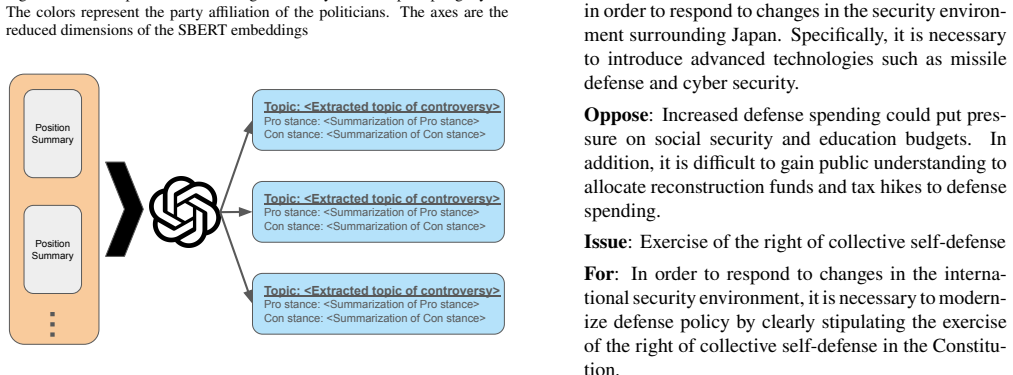
The paper's central claim is that a largely automated LLM pipeline can replace manual anchor selection and produce reliable, issue-specific ideological scaling for an entire parliament. Opinion-based speech segments, isolated by a fine-tuned classifier, are summarized by an LLM into a uniform format; the summaries are embedded with a sentence-transformer model. The same LLM reads those summaries and proposes axes of controversy—such as whether the Self-Defense Forces should be written into the constitution or whether nuclear plants should restart—each with one 'for' and one 'against' description. Embeddings of these polar descriptions act as the two ends of a scale, and each legislator's score is the scalar projection of their embedding onto the line between the two ends. The authors argue that the resulting ordering of parties tracks expert judgements, that the summarization step removes the excessive dispersion seen in earlier embeddings, and that projecting each year's party-average embedding onto the same axes reveals credible diachronic movement.
Load-bearing premise
The load-bearing assumption is that the LLM's automatically generated pro and con reference summaries for each extracted axis faithfully represent the true opposing positions in that controversy, so that the direction between their embeddings is the direction of real political disagreement; if those summaries are biased or off-topic, the projection scores are meaningless even when the embedding arithmetic is correct.
Editorial extensions
If this is right
- On the two axes where a direct baseline comparison is reported, the method's Spearman correlations with expert party orderings exceed L(u)PIN's: 0.9286 vs 0.8857 for acknowledging the JSDF in the constitution, and 0.9642 vs 0.4857 for restarting nuclear power plants.
- Because axes are extracted from speech summaries rather than hand-picked, the pipeline can scale representatives on controversies the researcher may not have anticipated, which the paper presents as removing manual bias from axis selection.
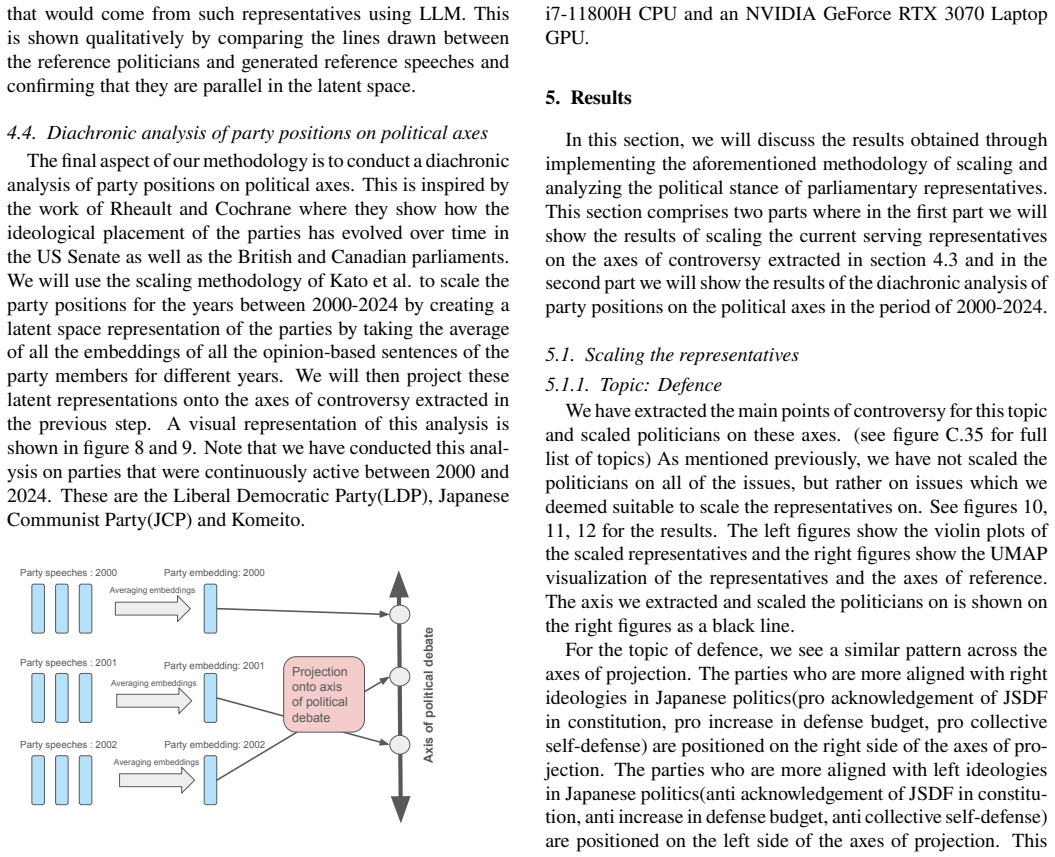
- Projecting per-year party averages onto the same axes yields a diachronic series for 2000–2024 that the paper aligns with events such as the 2011 Fukushima disaster, the 2014 Crimea invasion, and shifts in coalition government, demonstrating dynamic tracking rather than a static snapshot.
- The framework is intended to operate end-to-end at low cost—the paper reports about 103 USD in API usage on a consumer laptop—and the results are published on a public web application aimed at Japanese voters.
Reading between the lines
- If the central claim holds, the same recipe should transfer to any parliament with digitised transcripts and an LLM API; a straightforward test is applying it to another country's speeches and comparing with existing expert or manifesto-based estimates.
- The negative Spearman result on consumption-tax reduction (−0.7, driven by one party placed on the wrong side) suggests the method can fail on specific axes while the overall LCS ratio looks acceptable; reporting per-party deviations would clarify whether such flips are noise or a systematic failure mode.
- The diachronic series mixes genuine party movement with year-to-year changes in which members spoke and how much; the appendix's table of speech segments per party-year shows large fluctuations, so a stronger design would weight or control for speaker composition.
- Since the references come from the LLM itself, the 'automatic' axes may encode the model's prior expectations about Japanese politics rather than structure discovered purely from the speeches; comparing axes extracted from the same summaries by two different LLMs would test this.
Signed reviews
Editorial analysis
A structured set of objections, weighed in public.
Referee Report
Summary. The paper proposes KOKKAI DOC, an LLM-driven framework for scaling the issue stances of Japanese parliamentary representatives from Diet speech data. The framework adds three components to the earlier L(u)PIN method: (1) de-noising speech segments by summarizing them with GPT4o-mini before embedding with SBERT; (2) automatically extracting axes of political controversy by prompting GPT4o-mini with the stance summaries; and (3) a diachronic analysis that projects year-by-year party mean embeddings onto the extracted axes. The authors validate the cross-sectional scaling by comparing party-level orderings against expert orderings from the Japanese NPO Mielka using Spearman, Kendall, and LCS ratios, report qualitative PMI-based cluster analysis, and provide event-based interpretations of the diachronic trajectories. The paper also describes a public web application (kokkaidoc.com) that presents the results.
Significance. If the validation were sound, this would be a useful and relatively low-cost contribution to text-based political scaling: it automates axis selection, shows a plausible de-noising effect of LLM summarization, and extends the analysis to temporal dynamics. The authors are unusually transparent about costs and make their data pipeline and web application publicly available. The diachronic party trajectories for LDP, JCP, and Komeito over 2000-2024, interpreted through historical events, are a compelling qualitative demonstration. However, the current quantitative validation is too thin to support the paper's central claim of a 'robust and accurate' framework: it relies on a single external expert source, a hand-picked subset of axes, point estimates without uncertainty quantification, and party-average rather than representative-level comparisons. The paper's significance would be substantially higher if the validation were made comprehensive and if the claims were calibrated to the evidence.
major comments (4)
- [§4.3 and §5] The quantitative validation is performed on a hand-picked subset of extracted axes, and the paper gives no count of how many axes were extracted versus used. Section 4.3 states that 'some of the extracted axes were not suitable for scaling as they were very vague or did not directly relate to the topic of interest' and that 'in section 5, we will only show the results where we decided that the extracted axes were appropriate.' Because the two headline correlations in Table 4 (0.9286 for JSDF acknowledgement, 0.9642 for restarting nuclear plants) are computed on axes selected after seeing the results, the reported agreement with Mielka could reflect researcher filtering rather than the framework's automatic behavior. Please report the full set of extracted axes, the number used versus rejected, and the correlation values for all axes, including those deemed unsuitable.
- [§6.1.1 and Table 4] The quantitative evidence consists of three point estimates of rank correlation for three topics, with no confidence intervals, significance tests, or sensitivity analyses. The consumption tax row shows Spearman rho = -0.7; the text explains this by noting that 'the Reiwa party is placed on the opposite side of the ordering,' but with roughly seven to eight parties in the comparison, a single inverted party flips the sign. This negative result cannot be dismissed as a minor anomaly when the paper claims the methodology 'robustly' scales stances. Please report bootstrap or permutation-based confidence intervals for all correlations, state the number of parties n in each row, and discuss the consumption tax case as a substantive failure mode rather than an explanation of a single discrepant party.
- [§4.3] The axis endpoints are generated by GPT4o-mini from stance summaries that GPT4o-mini itself produced, and the projection of a legislator onto the line between those endpoints assumes that the reference summaries faithfully represent the true opposing endpoints of the controversy. Because the same model produces both the summaries and the axis text, a systematic bias in the model's summarization behavior (for example, a tendency toward generic or stylized pro/con statements) would contaminate both the embeddings and the axis direction, and the reported correlations with expert orderings cannot rule this out. Please include an ablation that uses a different model for summarization versus axis extraction, or a hand-coded axis validation, to demonstrate that the results are not simply an artifact of model self-consistency.
- [§5.1, §6.1, and Table 4] The quantitative validation is performed at the party-average level: Table 4 compares the ordering of party means against Mielka's party-level expert orderings. However, the paper claims to scale 'parliamentary representatives' and the violin plots in Figures 10-19 show substantial within-party dispersion. The representative-level claim is therefore validated only indirectly. Please provide an individual-level evaluation where possible (for example, comparison with any available individual-level reference data or at least within-party rank consistency checks), or explicitly scope the claim as a party-level scaling method.
minor comments (5)
- [Abstract and §7] The abstract and Section 7 contain the typo 'teh web application'; Figure 14's caption says 'Figtures'; Section 6.2 has 'assocaited' and Section 6.1 has 'dissimation.'
- [Figure 17 caption] The caption of Figure 17 is garbled: 'Representatives who have a pro stance lower right on the upper side of the UMAP visualization' should be reworded to describe the pro and anti positions consistently with the other figure captions.
- [Table 4] Table 4 does not report the number of parties compared for each topic; this number is needed to interpret the rank correlations and is particularly important for the consumption tax row with its negative values.
- [§4.2] The paper should state how many times GPT4o-mini was sampled for each summary and for each axis extraction, since prompt randomness could affect both the embeddings and the generated axis endpoints; no variance information is reported.
- [§4.1 and References] The abbreviation 'L(u)PIN' is used in the title and Section 4.1 but is not expanded or defined in the text; define it at first use. The Mielka reference is cited as a URL only and should include an access date and a description of the data collection methodology.
Circularity Check
Moderate self-citation for the axis-projection method; independent Mielka validation keeps the central scaling claim from being circular.
-
self citation load bearing
[Section 4.3, Automatic extraction of the axis of controversy]
"These extracted axes are used to generate reference summaries from a politician with an ideological stance of interest. Referring to the work of Kato et al., they show that generating sentences that would come from a politician with a specific ideological stance and using the embedding of such speeches is an effective method of scaling politicians on an axis of our choice."
The validity of the entire projection step is imported from the authors' own prior paper (Kato et al., 2024) rather than established independently in this manuscript. The current paper then compares its results with that same prior work in Table 4, making part of the evaluation a self-comparison built on a self-cited premise. However, the expert (Mielka) orderings are external, and the scaling is not fitted to those labels, so the central claim retains independent empirical content; this is load-bearing self-citation rather than a definitional reduction.
full rationale
The stance scaling is not constructed from the Mielka expert orderings: axes are extracted from GPT4o-mini summaries of legislators' speeches, reference summaries are generated for those axes, and representatives are projected onto the resulting embedding line; the Mielka data enter only in Section 6.1 as an external validation benchmark. Therefore the two headline correlations (0.9286 and 0.9642) are not fitted parameters renamed as predictions. The main circularity-adjacent element is the self-citation in Section 4.3: the legitimacy of using LLM-generated reference speeches to define the projection axis is justified by the authors' prior L(u)PIN paper rather than re-established here, and Table 4 compares the new method against that same prior work. Because the Mielka comparison is external and the scaling parameters are not derived from the expert labels, the central claim has independent content, so the score is moderate rather than high. The paper's own disclosure that only researcher-approved axes are shown in Section 5 is a selection threat to external validity, but it is disclosed and does not make the reported orderings definitionally equal to the expert labels.
Assumptions & free parameters
free parameters (2)
- Evaluated-axis subset =
hand-picked subset of extracted axes (e.g., 3 of 4 for defence, 3 of 5 for economy)
- Summarization prompt style =
context + few-shot prompt
assumptions (4)
- domain assumption The fine-tuned BERT classifier (trained on 1,439 hand-labeled segments) correctly identifies opinion-based speech segments in Japanese Diet records.
- domain assumption The Sentence-BERT embedding of an LLM summary preserves the politician's issue stance on the topic.
- domain assumption Mielka's expert ordering of party positions is a valid ground truth for Japanese party stances.
- domain assumption The averaging of party-member summary embeddings by year yields a meaningful diachronic party position.
Cite this review
Pith. "Pith review of KOKKAI DOC: An LLM-driven framework for scaling parliamentary representatives." pith.science (2026). https://pith.science/paper/URKXOAJO
@misc{pith2026250507118,
  author       = {Pith},
  title        = {Pith review of: KOKKAI DOC: An LLM-driven framework for scaling parliamentary representatives},
  year         = {2026},
  howpublished = {\url{https://pith.science/paper/URKXOAJO}},
  note         = {Machine review of arXiv:2505.07118}
}
read the original abstract
This paper introduces an LLM-driven framework designed to accurately scale the political issue stances of parliamentary representatives. By leveraging advanced natural language processing techniques and large language models, the proposed methodology refines and enhances previous approaches by addressing key challenges such as noisy speech data, manual bias in selecting political axes, and the lack of dynamic, diachronic analysis. The framework incorporates three major innovations: (1) de-noising parliamentary speeches via summarization to produce cleaner, more consistent opinion embeddings; (2) automatic extraction of axes of political controversy from legislators' speech summaries; and (3) a diachronic analysis that tracks the evolution of party positions over time. We conduct quantitative and qualitative evaluations to verify our methodology. Quantitative evaluations demonstrate high correlation with expert predictions across various political topics, while qualitative analyses reveal meaningful associations between language patterns and political ideologies. This research aims to have an impact beyond the field of academia by making the results accessible by the public on teh web application: kokkaidoc.com. We are hoping that through our application, Japanese voters can gain a data-driven insight into the political landscape which aids them to make more nuanced voting decisions. Overall, this work contributes to the growing body of research that applies LLMs in political science, offering a flexible and reliable framework for scaling political positions from parliamentary speeches. But also explores the practical applications of the research in the real world to have real world impact.
Figures


Figures from the paper (24 more)




Reference graph
Works this paper leans on
-
[7]
URL: https://arxiv.org/abs/2412.06864, arXiv:2412.06864
Political-llm: Large language models in political science. URL: https://arxiv.org/abs/2412.06864, arXiv:2412.06864. Linegar, M., Kocielnik, R., Alvarez, R.M.,
-
[10]
McInnes, L., Healy, J., Saul, N., Grossberger, L.,
3389/fpos.2023.1257092. McInnes, L., Healy, J., Saul, N., Grossberger, L.,
arXiv 2023
-
[12]
https://kokkai.ndl.go.jp/api.html
Diet proceedings search system api specifications for search. https://kokkai.ndl.go.jp/api.html. URL: https:// kokkai.ndl.go.jp/api.html. accessed: 2025-01-15. Poole, K.T., Rosenthal, H.,
work page 2025
-
[14]
Understanding Politics via Contextualized Discourse Processing
Understanding politics via contextualized discourse processing. arXiv:2012.15784. Rashed,A.,Kutlu,M.,Darwish,K.,Elsayed,T.,Bayrak,C.,2022.Embeddings- based clustering for target specific stances: The case of a polarized turkey. arXiv:2005.09649. Reimers, N., Gurevych, I.,
work page Pith review arXiv 2012
-
[15]
Sentence-bert: Sentence embeddings using siamese bert-networks. arXiv:1908.10084. Rheault, L., Cochrane, C.,
arXiv 1908
-
[16]
Word embeddings for the analysis of ideo- logicalplacementinparliamentarycorpora. PoliticalAnalysis28, 112–133. doi:10.1017/pan.2019.26. Slapin, J.B., Proksch, S.O.,
-
[18]
URL:https: //huggingface.co/tohoku-nlp/bert-base-japanese-v3
tohoku-nlp/bert-base-japanese-v3. URL:https: //huggingface.co/tohoku-nlp/bert-base-japanese-v3. Wu,P.Y.,Nagler,J.,Tucker,J.A.,Messing,S.,2023. Largelanguagemodelscan be used to estimate the latent positions of politicians.arXiv:2303.12057. 38
arXiv 2023
- [722]
Show all 17 references
-
[1938]
Biometrika 30, 81–93
A new measure of rank correla- tion. Biometrika 30, 81–93. URL: https://doi.org/10. 1093/biomet/30.1-2.81, doi: 10.1093/biomet/30.1-2.81, arXiv:https://academic.oup.com/biomet/article-pdf/30/1-2/81/423380/30-1-2-81.pdf. van Lange, M., Futselaar, R.,
-
[1985]
American Journal of Political Science 29, 357–384
A spatial model for legislative roll call analysis. American Journal of Political Science 29, 357–384. URL:http: //www.jstor.org/stable/2111172. Poole, K.T., Rosenthal, H.,
-
[2018]
American Political Science Review 112, 31–48
Positioning under alternative electoral systems: Evidence from japanese candidate election manifestos. American Political Science Review 112, 31–48. doi:10.1017/S0003055417000399. Church, K.W., Hanks, P.,
-
[2019]
Contribu- tionstoContemporaryHistory59,140–156
Debating evil: Using word embeddings to analyzeparliamentarydebatesonwarcriminalsinthenetherlands. Contribu- tionstoContemporaryHistory59,140–156. doi: 10.51663/pnz.59.1.07. Laver,M.,Benoit,K.,Garry,J.,2003. Extractingpolicypositionsfrompolitical texts using words as data. Ame...
2003 doi
-
[2020]
Government and Opposition 55, 184–201
The intensity of government–opposition divideasmeasuredthroughlegislativespeechesandwhatwecanlearnfrom it: Analyses of japanese parliamentary debates, 1953–2013. Government and Opposition 55, 184–201. doi:10.1017/gov.2018.15. Diaf, S., Döpke, J., Fritsche, U., Rockenbach, I.,
1953 doi
-
[2021]
National Diet Library,
Political text scaling meets computational semantics.arXiv:1904.06217. National Diet Library,
1904 arXiv
-
[2022]
European Journal of Political Economy 75, 102179
Sharks and minnows in a shoal of words: Measuring latent ideological positions based on text mining techniques. European Journal of Political Economy 75, 102179. doi:https://doi.org/10.1016/j.ejpoleco.2022.102179. Kato, K., Purnomo, A., Cochrane, C., Saqur, R.,
2022
- [2023]
-
[2024]
URL: https://arxiv.org/abs/2405
L(u)pin: Llm-based political ideology nowcasting. URL: https://arxiv.org/abs/2405. 07320, arXiv:2405.07320. KENDALL, M.G.,
Reviewed August 15, 2026 · model on record in the stance chip above.
Discussion (0). Continue with ORCID to comment.