REVIEW 3 major objections 4 minor 1 cited by
Tracing the evolution of eccentric precessing binary black holes: a hybrid approach
T0 review · 3 major / 4 minor · reviewed 2026-08-15 · deepseek-v4-flash
Pith's one-line read For eccentric, precessing black-hole binaries, one empirical transition velocity keeps tilt errors below $10^{-2}$.
desk verdict First public hybrid code for eccentric precessing tilts at infinity; useful and honest, but the headline error claim rests on a common-mode convergence test. read the letter →
The pith
A machine-rendered reading of the paper's core claim, the machinery that carries it, and where it could break.
The reading
What carries the argument
The carrying mechanism is the hybrid evolution interface. Backward evolution starts at a high reference frequency with orbit-averaged post-Newtonian equations—3PN in nonspinning terms and 2PN in spinning terms—and switches to precession-averaged equations once the orbit-averaged orbital velocity drops to $v_{\mathrm{trans}} = -0.05 q^2 + 0.06$, with $q\le 1$ the mass ratio. The same empirical formula used in the quasicircular case sets the transition; the precession-averaged stage needs no eccentricity-dependent modification, and it is initialized with the Newtonian eccentric angular momentum $L = m_1 m_2 \sqrt{1-e^2}/v$. The accuracy argument is carried by a convergence test: comparing tilts obtained with $v_{\mathrm{trans}}$ and $0.5 v_{\mathrm{trans}}$ gives a bound on the error introduced by the choice of transition point, and that bound is below $10^{-2}$ in the cosine tilts for the successful evolutions.
What would settle it
Take the same 1963 validation binaries and evolve them backwards without orbit averaging—for example by directly integrating the post-Newtonian equations of motion or using osculating elements—and compare the cosine tilts at infinity. If for a sizable fraction of binaries the tilts shift by more than about $10^{-2}$ relative to the orbit-averaged hybrid result, the claimed accuracy of the code is not yet established.
Extended reading notes
Core claim
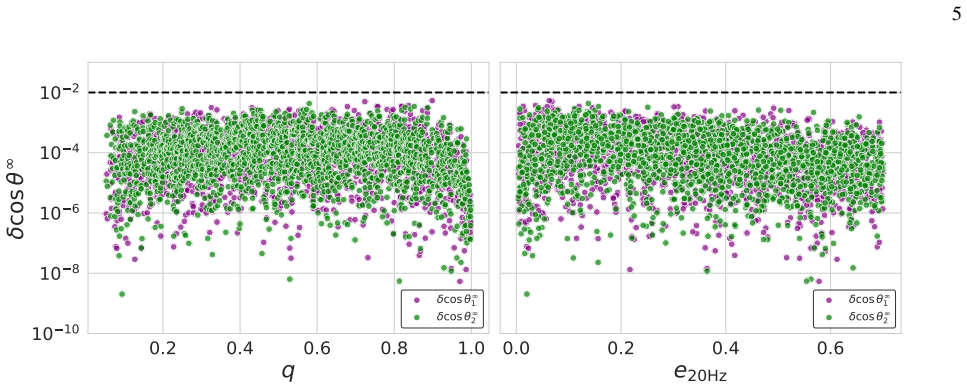
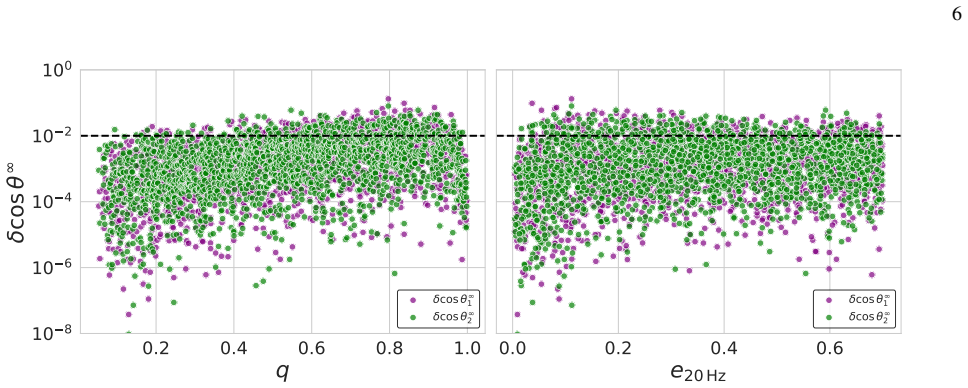
The central claim, stated as the authors would state it, is that the quasicircular hybrid code's transition orbital velocity remains serviceable when eccentricity is included. Out of 2000 simulated binaries with starting eccentricities up to 0.7 at 20 Hz, 1963 evolve backwards all the way to $0.5 v_{\mathrm{trans}}$ without triggering the internal consistency checks; for those, the difference in $\cos\theta^\infty_A$ obtained with $v_{\mathrm{trans}}$ versus $0.5 v_{\mathrm{trans}}$ never exceeds $10^{-2}$, peaking at $5.37\times 10^{-3}$ for the primary tilt and $4.30\times 10^{-3}$ for the secondary tilt. A separate sample of 1000 highly eccentric binaries (starting eccentricities 0.7–0.99) yields 166 completed evolutions, and all show differences below the same $10^{-2}$ tolerance. The paper also reports that the hybrid result can differ from a precession-averaged-only eccentric evolution by up to order unity in cosine tilts, and that treating a binary as quasicircular changes the cosine tilts by at least $10^{-2}$ for 542 of the 1963 binaries. The authors therefore claim the hybrid scheme is a needed improvement over precession-averaged-only eccentric evolution, while explicitly deferring verification of the orbit-averaged equations at the very high backward-evolution eccentricities (mostly above 0.9, some above 0.999) to future work.
Load-bearing premise
The load-bearing premise is that the orbit-averaged post-Newtonian equations stay accurate at the very high eccentricities (mostly $e>0.9$, up to above $0.999$) reached during backward evolution; the paper defers checking this against evolution without orbit averaging to future work.
Editorial extensions
If this is right
- For mildly eccentric binaries that reach the detector band, spin tilts at infinity can now be computed with errors below the statistical uncertainties expected in the next observing run, so formation-channel comparisons need no longer assume circular orbits.
- Earlier eccentric studies that used only precession-averaged evolution can mis-estimate cosine tilts by up to order unity; the hybrid evolution removes most of that systematic shift.
- Ignoring eccentricity changes the cosine tilts by at least $10^{-2}$ for roughly a quarter of the tested binaries, so eccentric binaries require the new code rather than the quasicircular one.
- For binaries with very large eccentricity at formation, the tilt at infinity is not always the right reference point; the code and the derived bound indicate when evolving to a finite separation is the better approximation.
Reading between the lines
- If the deferred non-orbit-averaged check confirms the orbit-averaged equations at high eccentricities, the same hybrid split should translate to higher post-Newtonian orders as those become available, potentially pushing eccentric tilt errors to the $10^{-3}$ accuracy expected for third-generation detectors.
- Because the precession-averaged stage is insensitive to eccentricity at leading order, the same transition-velocity scheme could be reused to compute other asymptotic quantities for eccentric binaries, such as final spin directions or precession-phase distributions, with only the initialization changed.
- The runtime study suggests the code gets cheaper as starting eccentricity grows, so population-level studies of dynamically formed, highly eccentric binaries could generate large tilt-at-infinity samples at modest computational cost.
Signed reviews
Editorial analysis
A structured set of objections, weighed in public.
Referee Report
Summary. The paper presents a hybrid post-Newtonian (PN) scheme to compute the spin tilts at infinity for eccentric, precessing binary black holes, extending the publicly available tilts_at_infinity code. The method evolves binaries backward in time using orbit-averaged PN equations at small separations and switches to precession-averaged evolution at large separations. The transition orbital velocity is taken to be the same empirical quasicircular expression, v_trans = -0.05 q^2 + 0.06 (Eq. (2)). The central claim is that this choice yields acceptably small errors in the eccentric case, quantified by differences between the tilts obtained with v_trans and 0.5 v_trans: for 1963 successful binaries the maximum difference in cosine tilts is 5.37e-3, below the 1e-2 tolerance. The paper also compares the hybrid evolution with quasicircular and precession-averaged-only evolution, finding order-unity differences in some cases, and discusses when tilts at infinity are a good proxy for tilts at formation, including a bound derived in Appendix B.
Significance. If the accuracy claims hold, this is a valuable and timely contribution: it supplies the first public code for computing tilts at infinity for eccentric precessing binaries, with a large validation set, quantitative convergence checks, and an explicit discussion of limitations. The strength of the paper is its transparency and the fact that the transition velocity is not refitted to eccentric binaries, so the validation is an external test of a parameter borrowed from the quasicircular analysis. The paper also ships publicly available code and derives an analytical bound on tilt changes at high eccentricity. The main concern is that the headline accuracy claim is built on a convergence test that is insensitive to systematic errors in the orbit-averaged evolution at the high eccentricities reached during backward evolution, and the paper's own PN-truncation estimates suggest that the total systematic error may exceed the stated 1e-2 tolerance.
major comments (3)
- [Sec. III A, Fig. 2, Sec. VI] The validation of v_trans is a common-mode test. The differences in cosine tilts obtained with v_trans and 0.5 v_trans are computed using the same orbit-averaged evolution in both branches, so any systematic error in the orbit-averaged PN equations at the high eccentricities shown in Fig. 2 (mostly e > 0.9, with some values above 0.999) cancels in the reported differences. Therefore the comparison establishes convergence with respect to the transition velocity, but it does not establish the absolute accuracy of the computed tilts at infinity. The paper explicitly defers a comparison with non-orbit-averaged evolution to future work (Secs. III A and VI), yet the abstract states that the quasicircular transition frequency 'gives acceptably small errors' without this qualifier. I request either a direct comparison with a non-orbit-averaged integration for a subset of the 1963 binaries, or a clear restriction of the accuracy claim to 'errors due to the choice of transition velocity' in the abstract and conclusions.
- [Sec. III A, Fig. 3] The paper's own PN-order checks imply that the total systematic error in the hybrid tilts is likely larger than the 1e-2 tolerance. The comparison between 2.5PN and 3PN nonspinning terms gives differences above 1e-2 for 236 binaries in cosine tilt 1 and 226 binaries in cosine tilt 2 out of the 1963 successful binaries, and the authors estimate that the truncation error from the missing 3.5PN nonspinning terms is 'a few times 1e-2.' In addition, the introduction states that the missing 2.5PN spin-orbit terms produced differences as large as about 0.1 in the quasicircular case. These estimates are not reconciled with the claim that the code achieves errors below the anticipated O5 statistical uncertainties. A quantitative error budget that combines the transition-velocity sensitivity with the PN-truncation uncertainties is needed before the central accuracy claim can be accepted. At minimum, the conclusions should state what accuracy is actually demonstrated, rather than implying a total error below 1e-2.
- [Sec. III B] The very-high-eccentricity validation is based on a strongly selected subset. Of the 1000 binaries with e_20Hz in [0.7, 0.99], only 166 successfully complete the evolution, while 834 fail the code's internal consistency checks at the initial conditions. The claim that this subpopulation also has differences below 1e-2 therefore applies only to binaries that pass those checks, which may not be representative of the full eccentric parameter space. The main text should state this selection effect prominently wherever the 166-binary result is presented, and the abstract's general 'eccentric, precessing binaries' phrasing should be qualified by the demonstrated range of initial eccentricities.
minor comments (4)
- [Abstract and Eq. (2)] The abstract refers to the 'transition frequency' while Eq. (2) defines a transition orbital velocity; please use the two terms consistently, since the frequency is derived from the velocity via f = v^3/(pi M).
- [Sec. III A, paragraph on stopped binaries] The discussion of the nine binaries that stop before reaching v_trans reports a detailed error estimate for only one of them; the statement that 'one still gets good accuracy in most cases' is based on a single example and should be flagged as such.
- [Fig. 2] The text states that most eccentricities at transition are above 0.9, but the figure does not use color or symbol size to indicate which binaries have differences near the 1e-2 tolerance; a version with a color scale for the differences would make the correlation between large eccentricity and convergence-test residuals visible.
- [Appendix B] The bound is derived using the leading-order Peters expressions for da/dt and de^2/dt, while the orbital evolution in the code includes higher PN terms; the text estimates that the corrections are below 3% for the binaries considered, but this is not a proof for all parameter space. Please state explicitly that the bound is approximate when it is applied in Sec. V.
Circularity Check
No significant circularity: the quasicircular transition-velocity input is an external fit, tested on an independent eccentric population rather than refit to the target.
full rationale
The paper's central numerical claim is that the quasicircular transition orbital velocity v_trans = -0.05 q^2 + 0.06 transfers to eccentric binaries with errors below 1e-2. This is not circular: v_trans was empirically fitted in the authors' prior quasicircular work [20], and the present paper does not refit it to eccentric tilts; instead it tests the transfer on 1963 (and 166 high-eccentricity) binaries by comparing tilts obtained with v_trans and 0.5 v_trans. That comparison is a convergence check on the transition location, not a derivation of the target from the input. The precession-averaged segment is unchanged from [20] except for the eccentric initialization of L, and the orbit-averaged segment is a separate PN code [30] based on published equations; neither is defined in terms of the eccentric tilts at infinity being reported. The paper explicitly defers checking the orbit-averaged approximation at the high eccentricities reached in backward evolution (Secs. III A and VI), but that is an acknowledged accuracy limitation, not a circular reduction. No equation in the paper reduces to itself by construction, and no fitted parameter is renamed as a prediction. The self-citations to [20] and [30] provide tools and inputs, but they are used as given and validated in the new regime rather than invoked to forbid alternatives. Therefore no significant circularity is present.
Assumptions & free parameters
free parameters (1)
- Effective transition orbital velocity v_trans(q) = -0.05 q^2 + 0.06 =
coefficients -0.05 and 0.06, from quasicircular calibration in Ref. [20]
assumptions (4)
- domain assumption 2PN spin-orbit and spin-spin, 3PN nonspinning orbit-averaged dynamics from Refs. [33,34,36,37] provide an accurate description of eccentric precessing binaries.
- domain assumption Orbit averaging remains valid for eccentricities close to 1 reached during backward evolution.
- domain assumption The precession-averaged equations are insensitive to eccentricity and give a well-defined tilt-at-infinity limit for eccentric binaries.
- standard math Leading-order Peters relation for eccentricity evolution suffices for the bounds and L_{e to 1} estimates in Section V and Appendix B.
Cite this review
Pith. "Pith review of Tracing the evolution of eccentric precessing binary black holes: a hybrid approach." pith.science (2026). https://pith.science/paper/5ZJDUFTP
@misc{pith2026250507238,
  author       = {Pith},
  title        = {Pith review of: Tracing the evolution of eccentric precessing binary black holes: a hybrid approach},
  year         = {2026},
  howpublished = {\url{https://pith.science/paper/5ZJDUFTP}},
  note         = {Machine review of arXiv:2505.07238}
}
read the original abstract
To describe a general bound binary black hole system, we need to consider orbital eccentricity and the misalignment of black holes' spin vectors with respect to the orbital angular momentum. While binary black holes produced through many formation channels have negligible eccentricity close to merger, they often have a non-negligible eccentricity at formation, and dynamical interactions could produce binaries with non-negligible eccentricity in the bands of current and proposed gravitational-wave (GW) detectors. Another quantity that carries information about the formation channel is the angle between each black hole's spin vector and the binary's orbital angular momentum (referred to as the spin tilt) at formation. The spin tilts inferred in GW astronomy are usually those when the binary is in the band of a GW detector, but these can differ significantly from those at formation. Therefore, it is necessary to evolve the binary back in time to compute the tilts at formation. For many formation scenarios, the tilts in the formal limit of infinite orbital angular momentum, also known as tilts at infinity, are a good approximation to those at formation. We thus generalize the publicly available \texttt{tilts\_at\_infinity} code to compute the tilts at infinity for eccentric, spin-precessing binaries. This code employs hybrid post-Newtonian evolution, starting with orbit-averaged evolution for higher frequencies and then transitioning to precession-averaged evolution to compute the tilts at infinity. We find that the transition frequency used in the quasicircular case still gives acceptably small errors in the eccentric case, and show that eccentricity and hybrid evolution both have a significant effect on the tilts at infinity for many binaries. Finally, we give examples of cases where the tilts at infinity are and are not a good approximation to the tilts at formation in the eccentric case.
Figures

Figures from the paper (4 more)


Forward citations
Cited by 1 Pith paper
-
Coincident morphological transitions in precessing black-hole binaries
Every coincident double or triple spin-morphology transition in post-Newtonian black-hole binaries is derived analytically, giving closed-form radii (rwide, rUD±) and parameter conditions for five allowed cases and on...
Reference graph
Works this paper leans on
-
[1]
J. Aasiet al.(LIGO Scientific Collaboration), Classical Quan- tum Gravity32, 074001 (2015), arXiv:1411.4547 [gr-qc]
arXiv 2015
-
[2]
F. Acerneseet al.(Virgo Collaboration), Classical Quantum Gravity32, 024001 (2015), arXiv:1408.3978 [gr-qc]
arXiv 2015
-
[3]
Abbottet al.(LIGO Scientific Collaboration, Virgo Collab- oration, and KAGRA Collaboration), Phys
R. Abbottet al.(LIGO Scientific Collaboration, Virgo Collab- oration, and KAGRA Collaboration), Phys. Rev. X13, 041039 (2023), arXiv:2111.03606 [gr-qc]
arXiv 2023
-
[4]
T. Akutsuet al.(KAGRA), Prog. Theor. Exp. Phys2021, 05A101 (2021), arXiv:2005.05574 [physics.ins-det]
arXiv 2021
-
[5]
B. P. Abbottet al.(KAGRA Collaboration, LIGO Scientific Collaboration, and Virgo Collaboration), Living Rev. Relativ- ity23, 3 (2020), arXiv:1304.0670 [gr-qc]
arXiv 2020
-
[6]
Punturoet al., Classical Quantum Gravity27, 194002 (2010)
M. Punturoet al., Classical Quantum Gravity27, 194002 (2010)
work page 2010
-
[7]
Evanset al., arXiv:2109.09882 [astro-ph.IM] (2021)
M. Evanset al., arXiv:2109.09882 [astro-ph.IM] (2021)
arXiv 2021
-
[8]
Colpiet al.(LISA Collaboration), arXiv:2402.07571 [astro- ph.CO] (2024)
M. Colpiet al.(LISA Collaboration), arXiv:2402.07571 [astro- ph.CO] (2024)
arXiv 2024
Show all 53 references
-
[9]
Mapelli, inHandbook of Gravitational Wave Astronomy, edited by C
M. Mapelli, inHandbook of Gravitational Wave Astronomy, edited by C. Bambi, S. Katsanevas, and K. D. Kokkotas (2021) p. 16
2021
-
[10]
Abbottet al.(LIGO Scientific Collaboration, Virgo Collab- oration, and KAGRA Collaboration), Phys
R. Abbottet al.(LIGO Scientific Collaboration, Virgo Collab- oration, and KAGRA Collaboration), Phys. Rev. X13, 011048 (2023), arXiv:2111.03634 [astro-ph.HE]
2023 arXiv
-
[11]
Stevenson, C
S. Stevenson, C. P. L. Berry, and I. Mandel, Mon. Not. R. As- tron. Soc.471, 2801 (2017), arXiv:1703.06873 [astro-ph.HE]
2017 arXiv
-
[12]
P. C. Peters, Phys. Rev.136, B1224 (1964)
1964
-
[13]
I. M. Romero-Shaw, P. D. Lasky, and E. Thrane, Astrophys. J. Lett.921, L31 (2021), arXiv:2108.01284 [astro-ph.HE]
2021 arXiv
-
[14]
Gayathri, J
V . Gayathri, J. Healy, J. Lange, B. O’Brien, M. Szczep- anczyk, I. Bartos, M. Campanelli, S. Klimenko, C. O. Lousto, and R. O’Shaughnessy, Nature Astron.6, 344 (2022), arXiv:2009.05461 [astro-ph.HE]
2022 arXiv
-
[15]
I. M. Romero-Shaw, P. D. Lasky, E. Thrane, and J. Calderón Bustillo, Astrophys. J. Lett.903, L5 (2020), arXiv:2009.04771 [astro-ph.HE]
2020 arXiv
-
[16]
I. M. Romero-Shaw, P. D. Lasky, and E. Thrane, Astrophys. J. 940, 171 (2022), arXiv:2206.14695 [astro-ph.HE]
2022 arXiv
-
[17]
Gupteet al., arXiv:2404.14286 [gr-qc] (2024)
N. Gupteet al., arXiv:2404.14286 [gr-qc] (2024)
2024 arXiv
-
[18]
M. d. L. Planas, A. Ramos-Buades, C. García-Quirós, H. Estel- lés, S. Husa, and M. Haney, arXiv:2504.15833 [gr-qc] (2025)
2025
-
[19]
Fumagalli, I
G. Fumagalli, I. Romero-Shaw, D. Gerosa, V . De Renzis, K. Kritos, and A. Olejak, Phys. Rev. D110, 063012 (2024), arXiv:2405.14945 [astro-ph.HE]
2024 arXiv
-
[20]
N. K. Johnson-McDaniel, S. Kulkarni, and A. Gupta, Phys. Rev. D106, 023001 (2022), arXiv:2107.11902 [astro-ph.HE]
2022 arXiv
-
[21]
Mould and D
M. Mould and D. Gerosa, Phys. Rev. D105, 024076 (2022), arXiv:2110.05507 [astro-ph.HE]
2022 arXiv
-
[22]
A. M. Knee, J. McIver, and M. Cabero, Astrophys. J.928, 21 (2022), arXiv:2109.14571 [gr-qc]
2022 arXiv
-
[23]
Kulkarni, N
S. Kulkarni, N. K. Johnson-McDaniel, K. S. Phukon, N. V . Krishnendu, and A. Gupta, Phys. Rev. D109, 043002 (2024), arXiv:2308.05098 [astro-ph.HE]
2024 arXiv
-
[24]
Kleinet al., arXiv:2204.03423 [astro-ph.HE] (2022)
A. Kleinet al., arXiv:2204.03423 [astro-ph.HE] (2022)
2022 arXiv
-
[25]
Pratten, P
G. Pratten, P. Schmidt, H. Middleton, and A. Vecchio, Phys. Rev. D108, 124045 (2023), arXiv:2307.13026 [gr-qc]
2023 arXiv
-
[26]
Fumagalli and D
G. Fumagalli and D. Gerosa, Phys. Rev. D108, 124055 (2023), arXiv:2310.16893 [gr-qc]
2023 arXiv
-
[27]
Kritos, V
K. Kritos, V . Strokov, V . Baibhav, and E. Berti, Phys. Rev. D 110, 043023 (2024), arXiv:2210.10055 [astro-ph.HE]
2024 arXiv
-
[28]
Gerosa, G
D. Gerosa, G. Fumagalli, M. Mould, G. Cavallotto, D. P. Mon- roy, D. Gangardt, and V . De Renzis, Phys. Rev. D108, 024042 (2023), arXiv:2304.04801 [gr-qc]
2023 arXiv
-
[29]
LIGO-Virgo-KAGRA Algorithm Library - LALSuite, free soft- ware (GPL) (2025)
2025
-
[30]
K. S. Phukon, N. K. Johnson-McDaniel, A. Singh, and A. Gupta, arXiv:2504.20543 [gr-qc] (2025)
2025
-
[31]
eccentric_bbh_evolution_lalsuite git repository,https: //gitlab.com/Amiteshh/eccentric_bbh_ evolution_lalsuite/
-
[32]
Damour and N
T. Damour and N. Deruelle, Ann. Inst. Henri Poincaré Phys. Théor.43, 107 (1985)
1985
-
[33]
Memmesheimer, A
R.-M. Memmesheimer, A. Gopakumar, and G. Schäfer, Phys. Rev. D70, 104011 (2004), arXiv:gr-qc/0407049
2004 arXiv
-
[34]
K. G. Arun, L. Blanchet, B. R. Iyer, and S. Sinha, Phys. Rev. D 80, 124018 (2009), arXiv:0908.3854 [gr-qc]
2009 arXiv
-
[35]
Loutrel and N
N. Loutrel and N. Yunes, Classical Quantum Gravity34, 044003 (2017), arXiv:1607.05409 [gr-qc]
2017 arXiv
-
[36]
Klein and P
A. Klein and P. Jetzer, Phys. Rev. D81, 124001 (2010), arXiv:1005.2046 [gr-qc]
2010 arXiv
-
[37]
Klein, Y
A. Klein, Y . Boetzel, A. Gopakumar, P. Jetzer, and L. de Vittori, Phys. Rev. D98, 104043 (2018), arXiv:1801.08542 [gr-qc]
2018 arXiv
- [38]
-
[39]
Kesden, D
M. Kesden, D. Gerosa, R. O’Shaughnessy, E. Berti, and U. Sperhake, Phys. Rev. Lett.114, 081103 (2015), arXiv:1411.0674 [gr-qc]
2015 arXiv
-
[40]
Gerosa, M
D. Gerosa, M. Kesden, U. Sperhake, E. Berti, and R. O’Shaughnessy, Phys. Rev. D92, 064016 (2015), arXiv:1506.03492 [gr-qc]
2015 arXiv
-
[41]
Gerosa, U
D. Gerosa, U. Sperhake, and J. V ošmera, Classical Quantum Gravity34, 064004 (2017), arXiv:1612.05263 [gr-qc]
2017 arXiv
-
[42]
H. Yu, S. Ma, M. Giesler, and Y . Chen, Phys. Rev. D102, 123009 (2020), arXiv:2007.12978 [gr-qc]
2020 arXiv
-
[43]
Blanchet, G
L. Blanchet, G. Faye, Q. Henry, F. Larrouturou, and D. Trestini, Phys. Rev. Lett.131, 121402 (2023), arXiv:2304.11185 [gr-qc]
2023 arXiv
-
[44]
X. Liu, Z. Cao, and Z.-H. Zhu, Classical Quantum Gravity41, 195019 (2024), arXiv:2310.04552 [gr-qc]
2024 arXiv
-
[45]
Gamba, D
R. Gamba, D. Chiaramello, and S. Neogi, Phys. Rev. D110, 024031 (2024), arXiv:2404.15408 [gr-qc]
2024 arXiv
-
[46]
Ireland, O
B. Ireland, O. Birnholtz, H. Nakano, E. West, and M. Cam- panelli, Phys. Rev. D100, 024015 (2019), arXiv:1904.03443 [gr-qc]
2019 arXiv
-
[47]
Loutrel, S
N. Loutrel, S. Liebersbach, N. Yunes, and N. Cornish, Clas- sical Quantum Gravity36, 025004 (2019), arXiv:1810.03521 [gr-qc]
2019 arXiv
-
[48]
Fumagalli, N
G. Fumagalli, N. Loutrel, D. Gerosa, and M. Boschini, arXiv:2502.06952 [gr-qc] (2025)
2025 arXiv
-
[49]
Samanta, S
R. Samanta, S. Tanay, and L. C. Stein, Phys. Rev. D108, 124039 (2023), arXiv:2210.01605 [gr-qc]
2023 arXiv
-
[50]
J. D. Hunter, Comput. Sci. Eng.9, 90 (2007)
2007
-
[51]
C. R. Harriset al., Nature (London)585, 357 (2020), arXiv:2006.10256 [cs.MS]
2020 arXiv
-
[52]
McKinney, inProceedings of the 9th Python in Science Con- ference, edited by S
W. McKinney, inProceedings of the 9th Python in Science Con- ference, edited by S. van der Walt and J. Millman (2010) pp. 51 – 56
2010
-
[53]
Virtanenet al., Nat
P. Virtanenet al., Nat. Methods17, 261 (2020), arXiv:1907.10121 [cs.MS]
2020 arXiv
Reviewed August 15, 2026 · model on record in the stance chip above.
Discussion (0). Continue with ORCID to comment.