REVIEW 2 major objections 5 minor 25 references
Conceptual Design Report of the SUPAX Experiment
T0 review · 2 major / 5 minor · reviewed 2026-08-15 · deepseek-v4-flash
Pith's one-line read A prototype haloscope using a superconducting cavity excludes previously unexplored dark photons around 35 µeV with kinetic mixing down to χ = 5×10⁻¹⁴, and the full SUPAX design projects sensitivity to the QCD axion band.
desk verdict A credible haloscope design report with a genuinely new dark-photon exclusion, but the limit's confidence level is compromised by a data-dependent re-scan threshold. read the letter →
The pith
A machine-rendered reading of the paper's core claim, the machinery that carries it, and where it could break.
The reading
What carries the argument
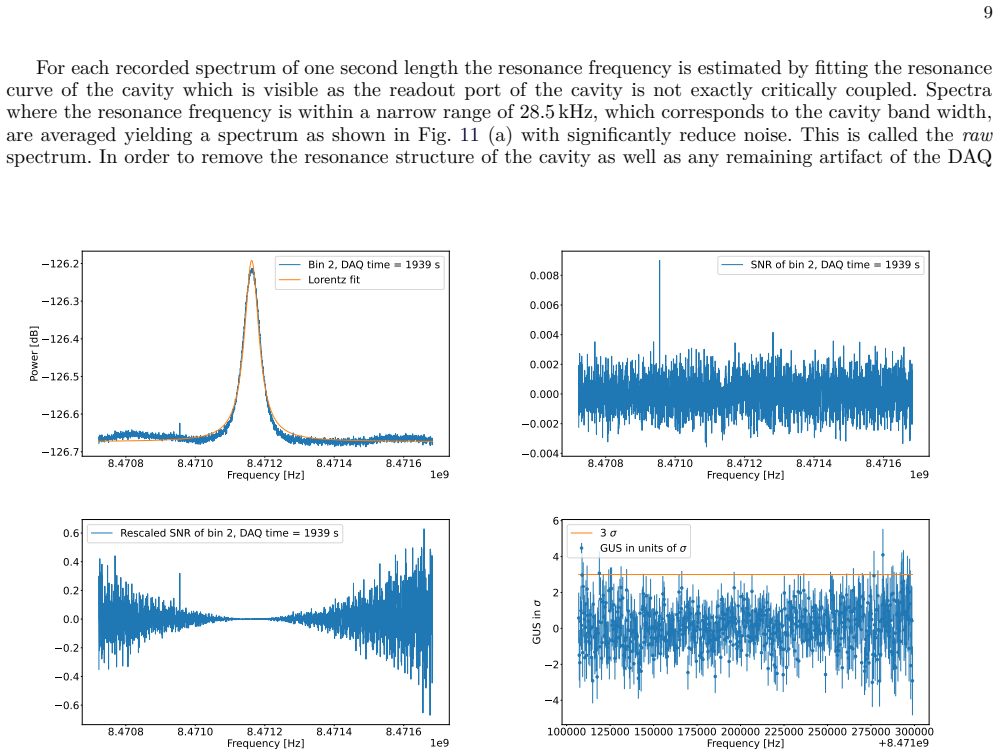
The load-bearing object is the tunable superconducting cavity: a copper body shaped as a tetracontagon (a 40-sided polygon), coated with superconducting tape, whose $\mathrm{TM}_{010}$ mode is read out through a weakly coupled port. Coarse tuning comes from a piezo-actuated off-center dielectric rod; fine tuning comes from changing helium gas pressure inside the cryostat, which shifts the dielectric constant and moves the resonance frequency by $-27.45\,\mathrm{kHz/mbar}$. The signal-search chain, following the analysis procedure of reference [23], removes the cavity response with a Savitzky-Golay filter, rescales spectra by the expected dark-photon conversion power, combines frequency bins into a grand unified spectrum, and converts a null result into a 95% CL limit using a re-scan threshold set to the largest observed fluctuation.
What would settle it
The limit could be checked by injecting a calibrated, narrow-band tone through the weakly coupled cavity port at a level corresponding to $\chi \approx 5\times10^{-14}$ and verifying that the full analysis chain recovers it at the expected signal-to-noise ratio; a second check is to recompute the limit with the re-scan threshold fixed before looking at the data (for instance, at 5σ) rather than at the largest observed 4.1σ fluctuation.
Extended reading notes
Core claim
The paper claims that a haloscope using superconducting cavities can simultaneously reach previously unexplored dark-photon parameter space in prototype form and project sensitivity to the QCD axion band in the final design. The prototype, a copper cavity coated with NbN operated in a 14 T field at 2 K, achieved a quality factor of $Q \approx 3\times10^5$ and scanned a 300 kHz band around 8.471 GHz by varying helium pressure. From a null result, the analysis sets 95% CL upper limits on the kinetic mixing parameter in the range $\chi$ between $1\times10^{-14}$ and $5\times10^{-14}$ for dark photon masses near 35 µeV, assuming random polarization. The full experiment is designed around three combined cylindrical cavities with tetracontagon cross-sections, ReBCO-coated superconducting surfaces, and simultaneous multi-frequency scanning between 2 and 7.2 GHz.
Load-bearing premise
The result depends on the rule used to decide when a bump is a candidate: that rule was set to the largest fluctuation seen in the same data that produced the limit, and the smoothing step is assumed not to remove a real signal.
Editorial extensions
If this is right
- If the full experiment performs as designed, SUPAX will scan axion masses from 8 to 30 µeV over roughly 80 weeks of data taking starting in 2026, with sensitivity reaching the QCD axion band.
- The verified pressure-tuning mechanism, with a measured response of −27.45 kHz/mbar, gives a 550 kHz scan range per 20 mbar pressure change, which allows the mechanical tuning to use coarse steps.
- The prototype's dark-photon limit already establishes the readout chain (cavity, cryogenic amplifier, spectrum analyzer, and analysis software) as ready for the final experiment's axion search.
- Because the dark-photon search needs no magnetic field, the same cavity technology can run as a standalone dark-photon experiment in the gaps between axion scans.
- With superconducting coatings, the design target $Q_0 \approx 4.5\times10^5$ would improve the scanning speed by roughly an order of magnitude over the normal-conducting copper configuration.
Reading between the lines
- The quoted limit would be more reliable if the re-scan threshold were fixed before the data were examined; a blind analysis would test whether the 4.1σ threshold contributes to the result.
- The pressure-tuning mechanism is generic and could be adopted by other cryogenic cavity searches, since helium gas tuning avoids moving parts in the high-field region.
- A simple extension of the prototype scan beyond 300 kHz, using the same linear pressure response, could cover a substantially wider dark-photon mass window at similar sensitivity before the full experiment turns on.
- The quality factor of superconducting cavities at these frequencies may be limited by surface defects and coating inhomogeneities; direct comparisons of NbN and ReBCO coatings in the same cavity geometry would test whether the design $Q_0$ is achievable.
Signed reviews
Editorial analysis
A structured set of objections, weighed in public.
Referee Report
Summary. The paper is a conceptual design report for SUPax, a haloscope experiment combining a 12 T magnet, tunable superconducting cavities, and quantum-limited readout to search for axion-like particles in the 8–30 µeV mass range. It also reports on a prototype dark-photon search performed with an 8.47 GHz cavity at 2 K, from which the authors derive upper limits on the kinetic mixing parameter around mass 35 µeV, with a headline value of about 5×10^-14, and project future axion sensitivity reaching the QCD axion band. The manuscript includes technical design details, prototype hardware characterization, data-acquisition and analysis descriptions, and a comparison to existing limits.
Significance. If the dark-photon exclusion is statistically sound, the prototype result is a useful proof of principle: it covers a previously unexplored mass/coupling region, and the full design provides a concrete, falsifiable projection for a next-generation haloscope. The paper also gives useful detail on multi-cavity tuning, superconducting coatings, and an end-to-end analysis chain. However, the central quantitative claim depends on a data-dependent re-scan threshold, so the 95% CL statement is not currently certified. The projected sensitivities rest on unverified assumptions about quantum-limited readout and high-Q cavities, which is acceptable for a design report only if clearly labeled.
major comments (2)
- [Section 5.3, Eq. (5)] The 95% CL dark-photon exclusion shown in Fig. 13 is not statistically justified because the re-scan threshold is taken from the same dataset used to derive the limit. After stating that no re-scans were performed, the authors set Θ to the largest observed fluctuation (4.1σ) and define R_T = Θ + Φ^{-1}(0.95) = 5.7; since Θ is a random draw from the noise realization, the quoted confidence level does not correspond to the coverage of the resulting interval. The paper should either use a pre-specified threshold, incorporate a trials factor for the scanned frequency range, and calibrate coverage with Monte Carlo or injected-signal studies, or present Fig. 13 as an expected/median sensitivity rather than an observed 95% CL exclusion. The numerical bias may be moderate, but no calibration check is provided.
- [Section 5.3] The analysis is not self-contained: the 'dark photon conversion power profile' used to produce the rescaled spectra is never defined, and Eq. (5) introduces quantities |χ0| and R̃_g^l without giving the expected signal SNR as a function of the kinetic mixing parameter and cavity parameters such as volume, quality factor, mode overlap, noise temperature, and polarization averaging. As a result, the mapping from the measured spectra to the limits in Fig. 13 cannot be reproduced or checked. Please include the full signal model and all numerical inputs.
minor comments (5)
- [Section 2.2/2.3] The text says each cavity has a dedicated readout chain and that the system is implemented two times in parallel, while Section 2.2 describes three cavities and Fig. 2 indicates C1–C3; the number of cavities and readout chains should be reconciled.
- [Section 2.2 and Section 6] The design description mentions 'three triple-cavities' in Section 2.2 and 'both cavities' in the Conclusion; please clarify the intended number of cavities and scan configurations.
- [Section 5.3 / Fig. 13] The text quotes a scanned frequency band of 150 kHz around f0, but the horizontal range shown in Fig. 13 spans about 120 kHz; please reconcile the stated and plotted scan range.
- [Fig. 12] The statement that the normalized-power distribution 'follows nicely a gaussian' would be more informative with a fit result, a χ²/dof value, and a statement of the number of independent frequency bins, since adjacent bins in the grand unified spectrum are not independent.
- [Section 3, Fig. 3] The projected sensitivity curves rest on assumptions such as quantum-limited readout and ReBCO-coated cavities with Q0 ≈ 4.5×10^5; these are appropriate as design goals, but the text should state explicitly which curves are demonstrated by the prototype and which are assumed for the final experiment.
Assumptions & free parameters
free parameters (1)
- Re-scan threshold Θ =
4.1σ
assumptions (3)
- domain assumption Haloscope signal power formula (Eq. 1) assumes resonant axion-photon conversion and a Maxwell-Boltzmann dark matter velocity distribution.
- domain assumption The system noise temperature model with added noise NA ≥ 0.5 (standard quantum limit) is used for sensitivity projections.
- domain assumption Dark photon kinetic mixing model and local dark matter density ρ_a = 0.45 GeV/cm³ are used for the limit interpretation.
Cite this review
Pith. "Pith review of Conceptual Design Report of the SUPAX Experiment." pith.science (2026). https://pith.science/paper/AER2BPJ7
@misc{pith2026250507541,
  author       = {Pith},
  title        = {Pith review of: Conceptual Design Report of the SUPAX Experiment},
  year         = {2026},
  howpublished = {\url{https://pith.science/paper/AER2BPJ7}},
  note         = {Machine review of arXiv:2505.07541}
}
abstract
The SUPerconduction AXion search experiment (Supax) is a haloscope designed to probe axion-like particles (ALPs) as candidates for dark matter and solutions to the strong CP problem. ALPs are predicted to couple to photons, allowing their detection through resonant conversion in electromagnetic cavities placed within strong magnetic fields. \Supax employs a 12 T magnetic field and tunable superconducting cavities with resonance frequencies ranging from 2\,GHz to 7.2\,GHz, enabling the exploration of axion masses between 8\,$\mu$eV and 30\,$\mu$eV. The tuning mechanism, based on piezo motors and gas-pressure regulation, allows for simultaneous scanning of up to three frequencies, significantly improving search efficiency. This paper presents the technical design of the Supax experiment, preliminary R\&D efforts, and results from prototype experiments. In particular, we exclude dark photons with masses around $35\,\mu$eV with a kinetic mixing parameter $\chi > 5\cdot 10^{-14}$, i.e. a region of parameter space which has not been previously explored.
Figures


Figures from the paper (6 more)




Reference graph
Works this paper leans on
-
[1]
R. D. Peccei and H. R. Quinn, Phys. Rev. Lett.38, 1440 (1977)
1977
-
[2]
Weinberg, Phys
S. Weinberg, Phys. Rev. Lett.40, 223 (1978)
1978
-
[3]
Wilczek, Phys
F. Wilczek, Phys. Rev. Lett.40, 279 (1978)
1978
-
[4]
P. W. Graham, I. G. Irastorza, S. K. Lamoreaux, A. Lindner, and K. A. van Bibber, Ann. Rev. Nucl. Part. Sci.65, 485 (2015), arXiv:1602.00039 [hep-ex]
arXiv 2015
-
[5]
C. B. Adamset al., inSnowmass 2021(2022) arXiv:2203.14923 [hep-ex]
arXiv 2022
-
[6]
M. A. Shifman, A. I. Vainshtein, and V. I. Zakharov, Nucl. Phys. B166, 493 (1980)
1980
-
[7]
J. E. Kim, Phys. Rev. Lett.43, 103 (1979)
1979
-
[8]
M. Dine, W. Fischler, and M. Srednicki, Phys. Lett. B104, 199 (1981)
1981
Show all 25 references
-
[9]
Ballouet al.(OSQAR), Phys
R. Ballouet al.(OSQAR), Phys. Rev. D92, 092002 (2015), arXiv:1506.08082 [hep-ex]
2015 arXiv
- [10]
-
[11]
Wagneret al.(ADMX), Phys
A. Wagneret al.(ADMX), Phys. Rev. Lett.105, 171801 (2010), arXiv:1007.3766 [hep-ex]
2010 arXiv
-
[12]
B. M. Brubaker,First results from the HAYSTAC axion search, Ph.D. thesis, Yale U. (2017), arXiv:1801.00835 [astro-ph.CO]
2017 arXiv
-
[13]
Rettaroliet al.(QUAX), Phys
A. Rettaroliet al.(QUAX), Phys. Rev. D110, 022008 (2024), arXiv:2402.19063 [physics.ins-det]
2024 arXiv
-
[14]
Ahyouneet al., JHEP04, 113 (2025), arXiv:2403.07790 [hep-ex]
S. Ahyouneet al., JHEP04, 113 (2025), arXiv:2403.07790 [hep-ex]
2025
-
[15]
Majorovitset al.(MADMAX interest Group), J
B. Majorovitset al.(MADMAX interest Group), J. Phys. Conf. Ser.1342, 012098 (2020), arXiv:1712.01062 [physics.ins-det]
2020 arXiv
-
[16]
N. M. Rapidis (HAYSTAC), in14th Patras Workshop on Axions, WIMPs and WISPs(2018) arXiv:1809.05913 [physics.ins-det]
2018 arXiv
-
[17]
Golmet al., IEEE Trans
J. Golmet al., IEEE Trans. Appl. Supercond.32, 1500605 (2022), arXiv:2110.01296 [hep-ex]
2022 arXiv
-
[18]
Leith, M
S. Leith, M. Vogel, J. Fan, E. Seiler, R. Ries, and X. Jiang, Superconductor Science and Technology34, 025006 (2021)
2021
-
[19]
Leith,Schriftenreihe der Arbeitsgruppe des Lehrstuhls f¨ ur Oberfl¨ achen- und Werkstofftechnologie im Institut f¨ ur Werkstofftechnik, Ph.D
S. Leith,Schriftenreihe der Arbeitsgruppe des Lehrstuhls f¨ ur Oberfl¨ achen- und Werkstofftechnologie im Institut f¨ ur Werkstofftechnik, Ph.D. thesis, Universit¨ at Siegen, Siegen (2021)
2021
-
[20]
Brun and F
R. Brun and F. Rademakers, Nucl. Instrum. Meth. A389, 81 (1997)
1997
-
[21]
Rsa application programming interface,
“Rsa application programming interface,”https://www.tek.com/en/support/software/application/ rsa-application-programming-interface-api-64-bit-linux-candidate-v01322016, version: V0.13.220.16
-
[22]
Schmieden, T
K. Schmieden, T. Schneemann, M. Schott, M. Unni, H. Bekker, A. Wickenbrock, and D. Budker, (2024), arXiv:2412.14958 [cond-mat.supr-con]
2024 arXiv
-
[23]
Brubaker, L
B. Brubaker, L. Zhong, S. Lamoreaux, K. Lehnert, and K. van Bibber, Phys. Rev. D96, 123008 (2017), arXiv:1706.08388 [astro-ph.IM]
2017 arXiv
-
[24]
Savitzky and M
A. Savitzky and M. J. E. Golay, Anal. Chem.36, 1627 (2002)
2002
-
[25]
cajohare/axionlimits: Axionlimits,
C. O’Hare, “cajohare/axionlimits: Axionlimits,”https://cajohare.github.io/AxionLimits/(2020)
2020
Reviewed August 15, 2026 · model on record in the stance chip above.
Discussion (0). Continue with ORCID to comment.