REVIEW 3 major objections 5 minor 51 references
Learning Treatment Allocations with Risk Control Under Partial Identifiability
T0 review · 3 major / 5 minor · reviewed 2026-08-15 · deepseek-v4-flash
Pith's one-line read A policy-learning method certifies, with finite samples, that treatment risk stays below a chosen tolerance even when the risk is only partially identified.
desk verdict Promising combination of sensitivity weights and conformal risk control, but Theorem 4.3's proof has a load-bearing in-sample/out-of-sample gap and the RCT setting has an identification error. read the letter →
The pith
A machine-rendered reading of the paper's core claim, the machinery that carries it, and where it could break.
The reading
What carries the argument
The load-bearing object is the miscalibration weight $W^\Gamma$. It is built from the nominal assignment odds (observational case) or selection odds (trial case) together with the assumed miscalibration factor $\Gamma$, and Lemma 4.1 shows that multiplying the observed loss $L$ by $W^\Gamma$ gives an upper bound on the unidentifiable population and treatment risks. The method then learns a policy from one split of the data by minimizing an empirical estimate of the population-risk bound subject to a nominal treatment-risk constraint, and uses a second split to compute a finite-sample upper confidence bound on the treatment risk (for instance via the Bentkus bound), choosing the tightest tolerance $t_n$ that still satisfies $\tau>T^\alpha_n(t')$ for all smaller tolerances. The proof of Theorem 4.3 runs the confidence-bound event and the equality assumption for $\pi(X;\tau)$ together to show that violation of the target risk has probability at most $\alpha$.
What would settle it
Simulate a randomized trial in which an unobserved variable shifts both trial selection and outcome, so the trial covariate distribution differs from the target population. Run the method with $\Gamma=1$, evaluate the true treatment risk $T(\pi)$ on the target distribution over many datasets, and check whether fewer than $1-\alpha$ of the runs satisfy $T(\pi)\le\tau$; if not, the RCT certification in Theorem 4.3 fails.
Extended reading notes
Core claim
The central claim is Theorem 4.3: if the nominal policy $\pi(X;\tau)$ obtained from the empirical constrained problem (12) satisfies its treatment-risk constraint with equality, then the policy $\pi(X;t_n)$ selected by the empirical tolerance (14) satisfies $P(T(\pi)\le \tau \mid S=s)\ge 1-\alpha$ for any degree of miscalibration up to a prespecified $\Gamma$. Here $T(\pi)=P_\pi(L=1\mid A=1,S=0)$ is the treatment risk, and $S=s$ is the sampling condition (observational data for $s=0$ or randomized trial data for $s=1$). The argument converts an unidentifiable risk into an upper bound via importance weights $W^\Gamma$, then controls that upper bound in finite samples. The experiments illustrate the resulting trade-off between lowering population risk and keeping treatment risk under $\tau$, on simulated data and on the STAR and IST trials.
Load-bearing premise
The central load-bearing premise is that the nominal odds are miscalibrated by at most the chosen $\Gamma$ and that, in the trial case, the trial covariate distribution matches the target population; if either fails, the certification is unsupported.
Editorial extensions
If this is right
- With finite sample sizes, the learned policy is certified to keep treatment risk below $\tau$ with probability at least $1-\alpha$, without assuming point identification.
- The user trades off population benefit against non-maleficence: smaller $\tau$ treats fewer patients and raises population risk, as shown in the synthetic and STAR results.
- The guarantee holds simultaneously for all miscalibration levels up to $\Gamma$, so a defensible $\Gamma$ (for example, benchmarked by omitting covariates) makes the policy robust to unmeasured confounding or selection.
- The same procedure handles observational data, randomized trial data, and the mixed case where an observational study is conducted on a study population that differs from the target.
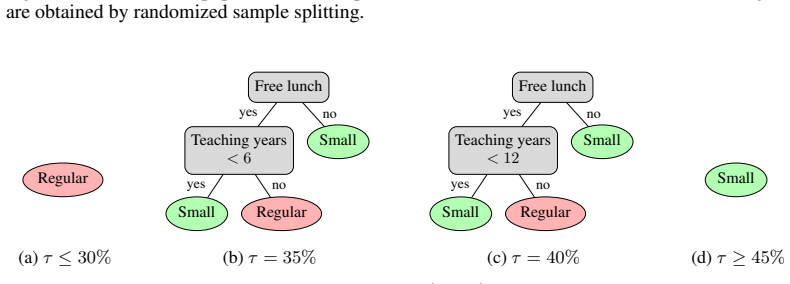
- Applying the method to STAR and IST data yields simple fast-and-frugal decision-tree policies whose estimated treatment risk stays below $\tau$ across random splits.
Reading between the lines
- Beyond the paper: for randomized trial data, the certification inherits the assumption that the trial covariate distribution matches the target population, because the policy's treatment-probability denominator $p_\pi(A=1\mid S=0)$ is identified from trial data only when $p(x\mid S=1)=p(x\mid S=0)$; if selection into the trial shifts the covariate mix, the claimed RCT guarantee is not supported by
- Beyond the paper: the finite-sample guarantee is conditional on $\Gamma$ actually bounding the unknown odds; the paper benchmarks $\Gamma$ by omitting covariates, but if the true unmeasured factor has a larger effect than those benchmarks, the guarantee has no force.
- Beyond the paper: the same split-sample risk-control logic could be applied subgroup-wise; the paper notes that aggregate control may be insufficient for fairness, so stratifying by sensitive covariates is a natural next step.
- Beyond the paper: the Bentkus bound is tight for binary losses, but for non-binary or high-variance losses other confidence bounds could tighten the method, as Remark 4.4 hints.
Signed reviews
Editorial analysis
A structured set of objections, weighed in public.
Referee Report
Summary. The paper proposes a method for learning treatment-allocation policies that minimize population risk subject to a constraint on the treatment risk, defined as the probability of a non-beneficial outcome among treated patients. The method is designed for settings in which the treatment risk is not point-identifiable, either because of unmeasured confounding in observational data or because of unmeasured selection into a randomized trial. The authors model the degree of miscalibration of the propensity or selection odds by a parameter Gamma, derive upper bounds on the population and treatment risks (Lemma 4.1), and then use sample splitting: the first half of the data, D_m, is used to learn a family of policies indexed by a nominal tolerance t; the second half, D_n, is used to construct an upper confidence bound on the treatment risk of each policy and to select an empirical tolerance t_n (Algorithm 1, Theorem 4.3). The paper also reports simulation experiments and applications to the STAR and International Stroke Trial datasets.
Significance. If the central finite-sample guarantee were established, the paper would make a useful contribution: it extends distribution-free risk-control ideas from prediction sets to policy learning under partial identifiability, while keeping the policy class interpretable. The miscalibration model via odds-ratio bounds is clearly stated and the empirical evaluation is extensive, including both confounding and selection-bias settings. The authors also correctly identify that the treatment risk is not point-identifiable in either data regime and that a certification statement must account for this. However, the main theoretical result, Theorem 4.3, has a proof gap that is load-bearing, and the randomized-trial extension has an identifiability problem. These issues affect the paper's central claim, so the contribution is currently not established.
major comments (3)
- [Theorem 4.3, Eq. (18)] The proof of Theorem 4.3 relies on the inequality t ≥ T(t), derived in Eq. (18) by taking expectations of the empirical constraint in (12). This step is valid only if T(t) is defined as the marginal expectation E[V(t)] averaged over the training split D_m. But the guarantee (8) is about the treatment risk of the realized policy conditional on the data, i.e., E[V(t)|D_m]. For the conditional risk, the in-sample constraint bE_m[V(t)] ≤ t gives no bound; conditional on D_m, the sample mean can be below t while the population mean is above t. Consequently the chain 'T(t_n) > τ implies t_n ≥ T(t_n) > τ' is invalid. If T(t) is instead read as the marginal expectation, then (13) and the final event control the risk averaged over D_m, not the risk of the returned policy, which is a strictly weaker statement than (8). The equality assumption on π(X;τ) does not repair this, because it is an equality of the empirical constraint, not of the conditional risk.
- [Remark 4.2 and Lemma 4.1 (RCT case)] For randomized trial data, the denominator pπ(A=1|S=0) in Lemma 4.1 and in Eq. (11) is not identifiable from trial data under the paper's own model (4), because the trial covariate distribution p(x|S=1) need not equal the target distribution p(x|S=0). Remark 4.2 writes pπ(A=1|S=0) = ∫1(π(x)=1)p(x|S=s)dx; when s=1, the right-hand side is the treatment probability under the trial covariate distribution, not the target-population quantity. The weight W^Γ in (11) also contains p(S=1)/p(S=0), which is not specified or bounded. As a result, the upper bound (9) for the RCT case is not computable from the available data, and the STAR and IST experiments in Section 5.2 and Appendices A.4–A.5 do not have a supported finite-sample guarantee unless an additional assumption equating target and trial covariate distributions is introduced.
- [Theorem 4.3, equality assumption] Theorem 4.3 is conditional on the nominal policy π(X;τ) achieving the constraint in (12) with equality. Since (12) is an inequality constraint, equality is a data-dependent event whose probability is neither controlled nor guaranteed by Algorithm 1. If the constraint is inactive, the proof's step T(τ)=τ fails, and the theorem gives no certificate. The authors should either justify that equality can be enforced by construction (e.g., by choosing τ on a grid where the constraint binds) or provide a proof that does not require this condition.
minor comments (5)
- [Section 2] There are typos in the text describing the DAGs: 'were' should be 'where' and 'unbserved' should be 'unobserved'.
- [Algorithm 1] Step 2 loops over t in the continuum (0,1); the practical implementation uses a finite grid, but this discretization and its effect on the guarantee should be stated explicitly.
- [Eq. (14)] The definition of t_n as an arg min subject to a constraint involving all t' ≤ t presumes a well-defined feasible set; since T_n^α(t) need not be monotone, the authors should discuss existence, uniqueness, and computation of t_n.
- [Appendix B, Theorem B.1] The proof concludes that E[V_{n+1}(t_n)|E=1] ≤ τ and says this holds with probability at least 1−α; the probabilistic statement should be made precise, since E[V_{n+1}|E=1] is a conditional expectation over the data, not a random variable with an obvious coverage interpretation.
- [Remark 4.4] The Bentkus bound is described for binary losses, but the paper does not discuss whether the bound in (13) needs to hold simultaneously over t for the proof of Theorem 4.3; a clarifying sentence would help.
Circularity Check
No significant circularity: the finite-sample certification is an external conformal-style argument; the flagged issues are identifiability and conditioning gaps, not circular reductions.
full rationale
The paper's derivation chain is self-contained against external benchmarks. Lemma 4.1 derives upper bounds on R(pi) and T(pi) from the miscalibration model (6)-(7) via importance weighting; these are inequalities with W^Gamma constructed from Gamma, not assumed conclusions. The finite-sample certificate in Theorem 4.3 follows the argument of Bates et al. (2021), which the paper credits, using a user-specified tau and alpha and a confidence bound (15) that is external to the authors. The empirical tolerance tn is chosen conservatively so that tau exceeds the upper bound for all smaller tolerances; no fitted parameter is later relabeled as a prediction. The only self-citation (Ek and Zachariah 2024, Appendix A.2) is used to benchmark Gamma in an illustrative sensitivity analysis and is paired with Huang et al. (2021); it is not load-bearing for the theorem. Two non-circular concerns should be weighed separately. Remark 4.2 asserts identifiability of p_pi(A=1|S=0) from trial data by writing it as an integral of p(x|S=s); under the paper's own model (4), p(x|S=1) need not equal p(x|S=0), so the RCT guarantee is unsupported as stated. Also, Eq. (18) applies an unconditional expectation to an in-sample constraint and concludes t >= T(t); for the realized data-dependent policy T(t) is conditional on D_m, so the step conflates marginal and conditional risk. Both are correctness risks, not circular reductions of the claim to its inputs.
Assumptions & free parameters
free parameters (3)
- Gamma, degree of miscalibration =
Gamma=2 in confounding and selection experiments; benchmarked 1.5 to 1.7 for STAR propensity; Gamma=1 for STAR and IST…
- Vmax, upper limit on the weighted loss V(t) =
Not specified in the text
- p(S=1)/p(S=0), selection ratio in RCT weights =
Not specified
assumptions (5)
- domain assumption Causal factorization in Eqs. (3) and (4) with unobserved U affecting treatment or selection and outcome.
- domain assumption Odds-ratio miscalibration bounds in Eqs. (6) and (7) hold for all X,U with a known Gamma.
- ad hoc to paper The nominal policy pi(X;tau) from Eq. (12) achieves its empirical constraint with equality.
- ad hoc to paper For RCT data, p_pi(A=1|S=0) is computable as the integral of 1(pi(x)=1) over p(x|S=s).
- standard math Data are i.i.d. and the random split into D_m and D_n is independent.
Cite this review
Pith. "Pith review of Learning Treatment Allocations with Risk Control Under Partial Identifiability." pith.science (2026). https://pith.science/paper/QLW5U3Z2
@misc{pith2026250508378,
  author       = {Pith},
  title        = {Pith review of: Learning Treatment Allocations with Risk Control Under Partial Identifiability},
  year         = {2026},
  howpublished = {\url{https://pith.science/paper/QLW5U3Z2}},
  note         = {Machine review of arXiv:2505.08378}
}
read the original abstract
Learning beneficial treatment allocations for a patient population is an important problem in precision medicine. Many treatments come with adverse side effects that are not commensurable with their potential benefits. Patients who do not receive benefits after such treatments are thereby subjected to unnecessary harm. This is a `treatment risk' that we aim to control when learning beneficial allocations. The constrained learning problem is challenged by the fact that the treatment risk is not in general identifiable using either randomized trial or observational data. We propose a certifiable learning method that controls the treatment risk with finite samples in the partially identified setting. The method is illustrated using both simulated and real data.
Figures


Figures from the paper (10 more)




Reference graph
Works this paper leans on
-
[1]
C.M. Achilles, Helen Pate Bain, Fred Bellott, Jayne Boyd-Zaharias, Jeremy Finn, John Folger, John Johnston, and Elizabeth Word. Tennessee's Student Teacher Achievement Ratio (STAR) project , 2008. URL https://doi.org/10.7910/DVN/SIWH9F
-
[2]
Externally valid policy choice
Christopher Adjaho and Timothy Christensen. Externally valid policy choice. arXiv preprint arXiv:2205.05561v3, 1, 2023
arXiv 2023
-
[3]
Anastasios N Angelopoulos, Stephen Bates, Adam Fisch, Lihua Lei, and Tal Schuster. Conformal risk control. arXiv preprint arXiv:2208.02814, 2022
arXiv 2022
-
[4]
Recursive partitioning for heterogeneous causal effects
Susan Athey and Guido Imbens. Recursive partitioning for heterogeneous causal effects. Proceedings of the National Academy of Sciences, 113 0 (27): 0 7353--7360, 2016
2016
-
[5]
Policy learning with observational data
Susan Athey and Stefan Wager. Policy learning with observational data. Econometrica, 89 0 (1): 0 133--161, 2021
2021
-
[6]
Distribution-free, risk-controlling prediction sets
Stephen Bates, Anastasios Angelopoulos, Lihua Lei, Jitendra Malik, and Michael Jordan. Distribution-free, risk-controlling prediction sets. Journal of the ACM (JACM), 68 0 (6): 0 1--34, 2021
work page 2021
-
[7]
Safe policy learning through extrapolation: Application to pre-trial risk assessment
Eli Ben-Michael, D James Greiner, Kosuke Imai, and Zhichao Jiang. Safe policy learning through extrapolation: Application to pre-trial risk assessment. Journal of the American Statistical Association, pages 1--23, 2025
2025
-
[8]
Intelligible models for healthcare: Predicting pneumonia risk and hospital 30-day readmission
Rich Caruana, Yin Lou, Johannes Gehrke, Paul Koch, Marc Sturm, and Noemie Elhadad. Intelligible models for healthcare: Predicting pneumonia risk and hospital 30-day readmission. In Proceedings of the 21th ACM SIGKDD international conference on knowledge discovery and data mining, pages 1721--1730, 2015
2015
Show all 51 references
-
[9]
Optimal discrete decisions when payoffs are partially identified
Timothy Christensen, Hyungsik Roger Moon, and Frank Schorfheide. Optimal discrete decisions when payoffs are partially identified. arXiv preprint arXiv:2204.11748v2, 2023
2023
-
[10]
Individualized decision-making under partial identification: Three perspectives, two optimality results, and one paradox
Yifan Cui. Individualized decision-making under partial identification: Three perspectives, two optimality results, and one paradox. Harvard Data Science Review, 3 0 (3), 2021
2021
-
[11]
Risk controlled decision trees and random forests for precision medicine
Kevin Doubleday, Jin Zhou, Hua Zhou, and Haoda Fu. Risk controlled decision trees and random forests for precision medicine. Statistics in medicine, 41 0 (4): 0 719--735, 2022
2022
-
[12]
Doubly robust policy evaluation and learning
Miroslav Dud \' k, John Langford, and Lihong Li. Doubly robust policy evaluation and learning. In Proceedings of the 28th International Conference on International Conference on Machine Learning, pages 1097--1104, 2011
2011
-
[13]
Externally valid policy evaluation from randomized trials using additional observational data
Sofia Ek and Dave Zachariah. Externally valid policy evaluation from randomized trials using additional observational data. In The Thirty-eighth Annual Conference on Neural Information Processing Systems, 2024. URL https://openreview.net/forum?id=2pgc5xDJ1b
2024
-
[14]
Simple heuristics that make us smart
Gerd Gigerenzer, Peter M Todd, the ABC Research Group, et al. Simple heuristics that make us smart. Oxford University Press, 2000
2000
-
[15]
The international stroke trial (ist): a randomised trial of aspirin, subcutaneous heparin, both, or neither among 19 435 patients with acute ischaemic stroke
International Stroke Trial Collaborative Group et al. The international stroke trial (ist): a randomised trial of aspirin, subcutaneous heparin, both, or neither among 19 435 patients with acute ischaemic stroke. The Lancet, 349 0 (9065): 0 1569--1581, 1997
1997
-
[16]
Harrell Jr, Karel GM Moons, Thomas PA Debray, and Johannes B Reitsma
Jeroen Hoogland, Joanna IntHout, Michail Belias, Maroeska M Rovers, Richard D Riley, Frank E. Harrell Jr, Karel GM Moons, Thomas PA Debray, and Johannes B Reitsma. A tutorial on individualized treatment effect prediction from randomized trials with a binary endpoint. Statistic...
2021
-
[17]
Off-policy risk assessment in contextual bandits
Audrey Huang, Liu Leqi, Zachary Lipton, and Kamyar Azizzadenesheli. Off-policy risk assessment in contextual bandits. Advances in Neural Information Processing Systems, 34: 0 23714--23726, 2021
2021
-
[18]
Sensitivity analysis for the generalization of experimental results
Melody Y Huang. Sensitivity analysis for the generalization of experimental results. Journal of the Royal Statistical Society Series A: Statistics in Society, page qnae012, 03 2024
2024
-
[19]
From temporary help jobs to permanent employment: what can we learn from matching estimators and their sensitivity? Journal of applied econometrics, 23 0 (3): 0 305--327, 2008
Andrea Ichino, Fabrizia Mealli, and Tommaso Nannicini. From temporary help jobs to permanent employment: what can we learn from matching estimators and their sensitivity? Journal of applied econometrics, 23 0 (3): 0 305--327, 2008
2008
-
[20]
Causal inference in statistics, social, and biomedical sciences
Guido W Imbens and Donald B Rubin. Causal inference in statistics, social, and biomedical sciences. Cambridge university press, 2015
2015
-
[21]
Balanced policy evaluation and learning
Nathan Kallus. Balanced policy evaluation and learning. Advances in neural information processing systems, 31, 2018
2018
-
[22]
What's the harm? sharp bounds on the fraction negatively affected by treatment
Nathan Kallus. What's the harm? sharp bounds on the fraction negatively affected by treatment. Advances in Neural Information Processing Systems, 35: 0 15996--16009, 2022
2022
-
[23]
Minimax-optimal policy learning under unobserved confounding
Nathan Kallus and Angela Zhou. Minimax-optimal policy learning under unobserved confounding. Management Science, 67 0 (5): 0 2870--2890, 2021
2021
-
[24]
Removing hidden confounding by experimental grounding
Nathan Kallus, Aahlad Manas Puli, and Uri Shalit. Removing hidden confounding by experimental grounding. Advances in neural information processing systems, 31, 2018
2018
-
[25]
Classification in the wild: The science and art of transparent decision making
Konstantinos V Katsikopoulos, Ozgur Simsek, Marcus Buckmann, and Gerd Gigerenzer. Classification in the wild: The science and art of transparent decision making. MIT Press, 2021
2021
-
[26]
Who should be treated? empirical welfare maximization methods for treatment choice
Toru Kitagawa and Aleksey Tetenov. Who should be treated? empirical welfare maximization methods for treatment choice. Econometrica, 86 0 (2): 0 591--616, 2018
2018
-
[27]
Experimental estimates of education production functions
Alan B Krueger. Experimental estimates of education production functions. The quarterly journal of economics, 114 0 (2): 0 497--532, 1999
1999
-
[28]
Distribution-free predictive inference for regression
Jing Lei, Max G’Sell, Alessandro Rinaldo, Ryan J Tibshirani, and Larry Wasserman. Distribution-free predictive inference for regression. Journal of the American Statistical Association, 113 0 (523): 0 1094--1111, 2018
2018
-
[29]
Trustworthy policy learning under the counterfactual no-harm criterion
Haoxuan Li, Chunyuan Zheng, Yixiao Cao, Zhi Geng, Yue Liu, and Peng Wu. Trustworthy policy learning under the counterfactual no-harm criterion. In International Conference on Machine Learning, pages 20575--20598. PMLR, 2023
2023
-
[30]
Identification problems in the social sciences and everyday life
Charles F Manski. Identification problems in the social sciences and everyday life. Southern Economic Journal, 70 0 (1): 0 11--21, 2003
2003
-
[31]
Statistical treatment rules for heterogeneous populations
Charles F Manski. Statistical treatment rules for heterogeneous populations. Econometrica, 72 0 (4): 0 1221--1246, 2004
2004
-
[32]
Identification for prediction and decision
Charles F Manski. Identification for prediction and decision. Harvard University Press, 2007
2007
-
[33]
Quasi-oracle estimation of heterogeneous treatment effects
Xinkun Nie and Stefan Wager. Quasi-oracle estimation of heterogeneous treatment effects. Biometrika, 108 0 (2): 0 299--319, 2021
2021
-
[34]
Elements of causal inference: foundations and learning algorithms
Jonas Peters, Dominik Janzing, and Bernhard Sch \"o lkopf. Elements of causal inference: foundations and learning algorithms. The MIT Press, 2017
2017
-
[35]
Performance guarantees for individualized treatment rules
Min Qian and Susan A Murphy. Performance guarantees for individualized treatment rules. Annals of statistics, 39 0 (2): 0 1180, 2011
2011
-
[36]
Stop explaining black box machine learning models for high stakes decisions and use interpretable models instead
Cynthia Rudin. Stop explaining black box machine learning models for high stakes decisions and use interpretable models instead. Nature machine intelligence, 1 0 (5): 0 206--215, 2019
2019
-
[37]
The international stroke trial database
Peter AG Sandercock, Maciej Niewada, Anna Cz onkowska, and International Stroke Trial Collaborative Group. The international stroke trial database. Trials, 12 0 (1): 0 101, 2011
2011
-
[38]
Perspective on ‘harm’in personalized medicine
Aaron L Sarvet and Mats J Stensrud. Perspective on ‘harm’in personalized medicine. American Journal of Epidemiology, page kwad162, 2023
2023
-
[39]
Origin and uses of primum non nocere—above all, do no harm! The Journal of Clinical Pharmacology, 45 0 (4): 0 371--377, 2005
Cedric M Smith. Origin and uses of primum non nocere—above all, do no harm! The Journal of Clinical Pharmacology, 45 0 (4): 0 371--377, 2005
2005
-
[40]
Counterfactual risk minimization: Learning from logged bandit feedback
Adith Swaminathan and Thorsten Joachims. Counterfactual risk minimization: Learning from logged bandit feedback. In International Conference on Machine Learning, pages 814--823. PMLR, 2015
2015
-
[41]
A distributional approach for causal inference using propensity scores
Zhiqiang Tan. A distributional approach for causal inference using propensity scores. Journal of the American Statistical Association, 101 0 (476): 0 1619--1637, 2006
2006
-
[42]
Decision curve analysis: a novel method for evaluating prediction models
Andrew J Vickers and Elena B Elkin. Decision curve analysis: a novel method for evaluating prediction models. Medical Decision Making, 26 0 (6): 0 565--574, 2006
2006
-
[43]
Algorithmic learning in a random world
Vladimir Vovk, Alexander Gammerman, and Glenn Shafer. Algorithmic learning in a random world. Springer Science & Business Media, 2005
2005
-
[44]
Estimation and inference of heterogeneous treatment effects using random forests
Stefan Wager and Susan Athey. Estimation and inference of heterogeneous treatment effects using random forests. Journal of the American Statistical Association, 113 0 (523): 0 1228--1242, 2018
2018
-
[45]
Learning optimal personalized treatment rules in consideration of benefit and risk: with an application to treating type 2 diabetes patients with insulin therapies
Yuanjia Wang, Haoda Fu, and Donglin Zeng. Learning optimal personalized treatment rules in consideration of benefit and risk: with an application to treating type 2 diabetes patients with insulin therapies. Journal of the American Statistical Association, 113 0 (521): 0 1--13, 2018
2018
-
[46]
All of statistics: a concise course in statistical inference
Larry Wasserman. All of statistics: a concise course in statistical inference. Springer Science & Business Media, 2013
2013
-
[47]
Epidemiology by Design: A Causal Approach to the Health Sciences
Daniel Westreich. Epidemiology by Design: A Causal Approach to the Health Sciences. Oxford University Press, Incorporated, 2019. ISBN 9780190665760
2019
-
[48]
Optimal decision rules under partial identification
Kohei Yata. Optimal decision rules under partial identification. arXiv preprint arXiv:2111.04926v4, 2025
2025 arXiv
-
[49]
A robust method for estimating optimal treatment regimes
Baqun Zhang, Anastasios A Tsiatis, Eric B Laber, and Marie Davidian. A robust method for estimating optimal treatment regimes. Biometrics, 68 0 (4): 0 1010--1018, 2012
2012
-
[50]
Using decision lists to construct interpretable and parsimonious treatment regimes
Yichi Zhang, Eric B Laber, Anastasios Tsiatis, and Marie Davidian. Using decision lists to construct interpretable and parsimonious treatment regimes. Biometrics, 71 0 (4): 0 895--904, 2015
2015
-
[51]
Estimating individualized treatment rules using outcome weighted learning
Yingqi Zhao, Donglin Zeng, A John Rush, and Michael R Kosorok. Estimating individualized treatment rules using outcome weighted learning. Journal of the American Statistical Association, 107 0 (499): 0 1106--1118, 2012
2012
Reviewed August 15, 2026 · model on record in the stance chip above.
Discussion (0). Continue with ORCID to comment.