REVIEW 3 major objections 5 minor 89 references
Extracting Visual Plans from Unlabeled Videos via Symbolic Guidance
T0 review · 3 major / 5 minor · reviewed 2026-08-15 · deepseek-v4-flash
Pith's one-line read From unlabeled play video, symbolic A* planning plus image retrieval outperforms diffusion video-generation planners for robot manipulation, with 53% higher aggregate success on real-robot tasks and 35x faster plan generation.
desk verdict Useful systems paper with a wrong-signed Eq. 3 that must be fixed; otherwise the central mechanism is not reproducible as written. read the letter →
The pith
A machine-rendered reading of the paper's core claim, the machinery that carries it, and where it could break.
The reading
What carries the argument
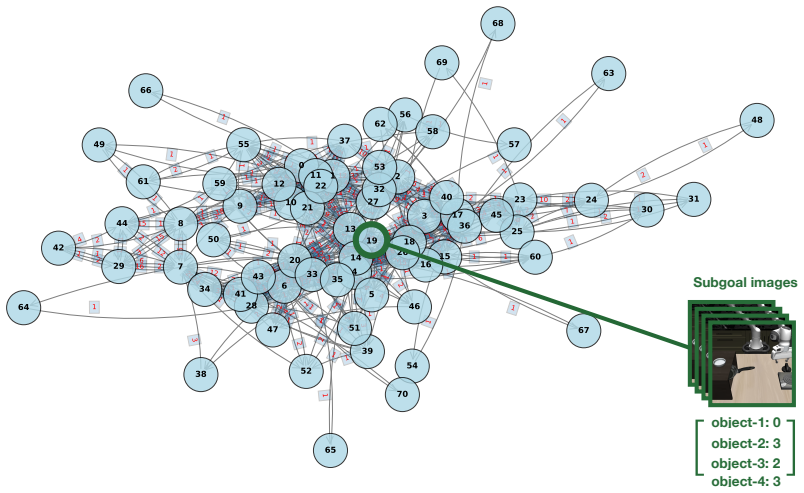
The load-bearing mechanism is the symbolic transition graph constructed from stable-state segmentation. Stable states are identified by summing object-centric frame-to-frame cosine similarities from a pretrained vision-language encoder, smoothing, and applying non-maximum suppression to find peaks; each skill is a transition between two peaks. Agglomerative clustering with Silhouette-score model selection turns the peak frames into per-object discrete symbolic states, and nearest-neighbor classifiers label every frame, so a demonstration becomes a chain of (before, after) symbolic transitions. At test time A* search over this graph produces a symbolic path, and a contrastively trained reachability estimator $R(s,s_g)$, trained with a state-only InfoNCE objective, scores whether the current state can reach a candidate goal; beam search then selects image subgoals satisfying a reachability threshold. This is the identity that carries the argument: planning happens in a small discrete symbol space, while physical consistency is delegated to retrieval plus a learned reachability filter.
What would settle it
Record a play trajectory in which a task-relevant object's visual appearance has no obvious change between two skills (for example, a bowl is moved across an empty table and then a pot is picked up while the bowl stays put). If the summed similarity peak detector finds no boundary at that transition, the symbolic graph will merge the two skills into one edge, and the visual plan will skip the second subgoal; that failure would falsify the segmentation premise.
Extended reading notes
Core claim
The central claim, stated on the paper's own terms, is that a symbolic abstraction of object states can carry the full burden of high-level visual planning. From unlabeled play data, Vis2Plan detects stable states by peak-finding on summed cosine similarities of object-centric features, clusters those states per object via unsupervised clustering, and labels each frame with a nearest-neighbor classifier, yielding symbolic transitions of the form (before, after). These transitions form a directed graph; at test time a next-symbolic-state predictor proposes candidate successors from the current image, A* search selects the shortest symbolic path to the user's goal, and a beam search over dataset images maximizes cumulative learned reachability under a threshold to select a physically consistent image plan. A goal-conditioned policy then executes action chunks toward each image subgoal in closed loop. The paper reports that this pipeline outperforms a diffusion video-generation planner by 53% aggregate success in real-robot settings and is $35\times$ faster at generating visual plans.
Load-bearing premise
The whole pipeline treats every stable-state boundary found by peak detection over summed object-centric feature similarities as a genuine skill boundary; if any sub-skill ends or begins without producing a clear similarity peak, the symbolic graph receives a wrong or missing edge and the downstream plan fails regardless of the low-level policy.
Editorial extensions
If this is right
- Without any language labels, task annotations, or video generators, a robot can assemble a multi-goal visual plan by searching a learned symbolic graph and retrieving dataset images.
- Physical consistency of subgoals comes from a learned reachability filter over real images, not from generative sampling, so planned subgoals are photo-realistic and inspectable by construction.
- Because planning is A* over a compact graph, plan generation is near real-time in the reported setups, making closed-loop hierarchical control practical.
- The approach inherits its ceiling from the low-level goal-conditioned policy; improving that policy or collecting more training data directly raises end-to-end success, as the paper itself notes.
Reading between the lines
- If the symbolic extraction scales, the same graph could answer counterfactuals, such as which sequence of object states would realize a goal combination not observed in the data, by checking whether that combination exists as a node set.
- The learned reachability score could double as a progress reward for downstream reinforcement learning or as an execution-time safety check, since it already encodes which states are reachable from a given observation.
- A natural extension is to let a vision-language model propose object names and goal symbols, replacing the human-provided object list and the user-specified symbolic goal; this would push toward open-vocabulary play data but would inherit vision-language hallucination risk.
- The paper's reachability threshold could serve as a cheap automated proxy for physical plausibility in future visual-planning evaluations, independent of task success metrics.
Signed reviews
Editorial analysis
A structured set of objections, weighed in public.
Referee Report
Summary. The paper proposes Vis2Plan, a hierarchical visual planning framework that extracts discrete symbolic state transitions from unlabeled play videos using pretrained vision foundation models, builds a directed symbolic transition graph, performs A* search over symbolic states, and then retrieves and filters real image frames as visual subgoals using a contrastive-RL reachability estimator. At execution time, a goal-conditioned low-level policy follows the resulting image subgoal sequence. The authors evaluate Vis2Plan on LIBERO simulation tasks and on a real robot kitchen setup, reporting higher success rates than the AVDC video-generation planner and other graph-based baselines, as well as much faster plan generation. The central claim is that symbolic guidance plus reachability-filtered image retrieval replaces video-generation planners with a faster, more interpretable, and physically consistent visual planner, without requiring language labels on the play data.
Significance. If the reported behavior is real, Vis2Plan would be a useful contribution: it removes the need for task labels, gives inspectable symbolic plans, and produces photo-realistic subgoal images from the dataset rather than hallucinated generated frames. The final task-success evaluation is external to the planning modules, so the headline comparison is not circular. The real-robot results and the 35x speed advantage over AVDC are concrete, falsifiable claims. However, the paper provides no code, and the formal specification of the reachability-filtered subgoal selection is internally inconsistent, which makes it impossible to verify that the reported experiments were produced by the mechanism as written. The plan-quality analysis in Table 3 is also partially circular because it uses the paper's own reachability estimator, which is also used to augment the GSR and UVD-graph baselines.
major comments (3)
- [Section 3.3, Eq. (3); Algorithm 1] The reachability-filtered subgoal selection is internally inconsistent. Section 3.2 defines Rψ so that higher values indicate better physical reachability, and defines δ = min(Rψ(ot, ot+)) over adjacent training pairs. Eq. (3) then maximizes −Σ Rψ, i.e., it minimizes the sum of reachability scores, and imposes Rψ(Oi, Oi+1) ≤ δ. Since δ is the lowest score observed for a reachable transition, the constraint admits only pairs at or below the worst reachable score, which is the opposite of a reachability filter. Literally implemented, Eq. (3) should select the least reachable subgoal images and should collapse task success, not produce the reported 0.71 real-robot average. Algorithm 1 (line 15) contradicts Eq. (3) by maximizing Σ Rψ subject to Rψ ≤ δ. The authors must correct Eq. (3) and reconcile it with Algorithm 1 (the likely intended form is arg max Σ Rψ with constraint Rψ ≥ δ), and should clarify which objective was actually used in the experiments.
- [Section 4, Table 3; Section 3.2] The high-level plan-quality evaluation uses the paper's own reachability estimator to determine whether a plan is 'meaningful'. The text says that Rψ and δ from Eq. (3) are used to decide whether every adjacent subgoal pair is physically achievable, and Table 3 reports 'high-level plan success rate' for all methods. Because Rψ is trained on the same play data and because the GSR and UVD-graph baselines are augmented with that same estimator in their graph construction, this metric is not an independent measure of physical consistency. At best it measures agreement with Vis2Plan's own reachability model. The claim of 'physically consistent' subgoals should be supported by an external criterion, such as human annotation or downstream task success, rather than by the model used to build the plans.
- [Section 3.1; Appendix B.1, Eq. (4)] The entire symbolic transition graph depends on stable-state identification via non-maximum suppression on summed SigLIP2 cosine similarities, but the paper provides no quantitative evaluation of segmentation quality. If peaks are missed or spurious, the symbolic graph contains incorrect edges and the high-level plan fails regardless of the low-level policy. Please report segmentation precision/recall against known subskill boundaries in LIBERO, or a sensitivity analysis over the smoothing and NMS parameters, to support the claim that the discovered symbols reliably capture the relevant stable states.
minor comments (5)
- [Abstract and Section 4] The abstract's '53% higher aggregate success rate' is ambiguous: comparing Vis2Plan's 0.71 average with AVDC's 0.18 in Table 2 is a 53-percentage-point difference, not a 53% relative improvement. Please state the comparison basis explicitly.
- [Section 4, Table 1] Table 1 contains many entries rendered as '0.±0.', which appear to be truncated '0.00±0.00' values. The missing digits should be restored, and the text should refer to Table 1 (not Table 3) when discussing the simulation success rates.
- [Section 3.2, Eq. (1)] Equation (1) is missing an '=' sign after L_MC-InfoNCE(Rψ), and the E subscript is not separated from the loss name. Please fix the equation formatting.
- [Appendix B.1, Eq. (4)] In Eq. (4), the symbol K is used both for the number of object categories and for the set of NMS-selected peaks. This is confusing and should be renamed.
- [References and prose] The real-robot section refers to 'GC-Diffuser' instead of 'GC-Diffusion'; Section 3.1 has a doubled colon ('challenging due to::'); and the OptiTrack reference in [93] contains the placeholder text 'or whichever you used', which should be removed before publication.
Circularity Check
Partial circularity: high-level plan quality is scored by the same fitted reachability estimator and threshold that Eq. 3 optimizes, so Vis2Plan's 1.0 plan-quality scores are guaranteed by construction; real-robot task success remains an external metric.
-
fitted input called prediction
[Section 4 'Visual Plan Quality Analysis' (Table 3), using Rψ and δ from Section 3.2 and Eq. 3 in Section 3.3]
"In our evaluation protocol, we allowed each planner to generate up to 20 plan sequences (represented as image frames) and manually inspected whether each sequence was “meaningful.”. We use the reachability estimatorRψ and the reachability thresholdδ in Eq. 3 to dertmine if the plan is meaningful: every adjacent subgoal pair should be physically achievable. The primary evaluation metric was the high-level plan success rate (the ratio of making “meaningful.” visual plans)."
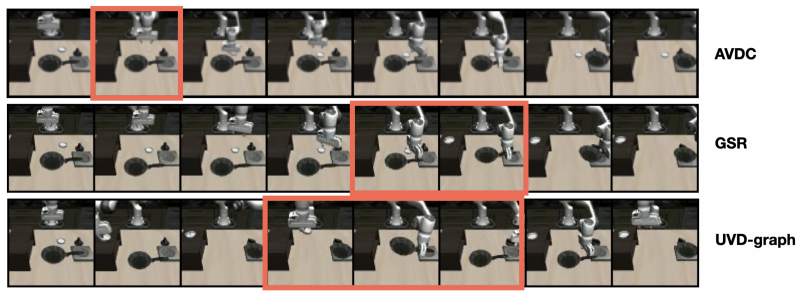
Eq. 3 is the planner's visual-subgoal selection rule: arg max τO −∑ Rψ(Oi,Oi+1) with constraint Rψ(Oi,Oi+1)≤δ for all adjacent pairs. The plan-quality metric then declares a plan 'meaningful' exactly when adjacent pairs satisfy Rψ/δ. Thus Vis2Plan's generated plans pass the meaningfulness test by construction: the beam search enforces the same inequality used as the evaluation criterion. The perfect 1.00 scores in Table 3 therefore measure internal consistency of the fitted estimator, not an external property such as physical achievability. This is a fitted module used both as the planner's objective/constraint and as the evaluator's definition of success, so the 'high-level plan quality' prediction is forced.
full rationale
Vis2Plan's headline real-robot claim is measured by physical task completion, an external criterion independent of the symbolic planner and reachability estimator, so it is not circular. I found no load-bearing self-citation: [61] and [92] are related-work/baseline citations only, and no uniqueness theorem or ansatz is imported from the authors' prior work. The one exhibited circular step is the Visual Plan Quality Analysis: the paper defines 'meaningful' plans using Rψ and δ, the same fitted reachability module and threshold that Eq. 3 uses as the objective and constraint for visual-subgoal selection. Because Vis2Plan's planner explicitly enforces that constraint on every adjacent pair, its perfect 1.00 plan-quality scores in Table 3 are guaranteed by the evaluation rule itself rather than by independent evidence of physical attainability. The GSR and UVD-graph baselines are also augmented with this same Rψ in Appendix B.5, further entangling the comparison. This does not undermine the externally measured task-success rates, but it means the paper's plan-quality comparison is partially circular. The Eq. 3 sign inconsistency (maximizing minus the reachability sum while constraining Rψ≤δ) is a correctness/reproducibility concern, not a circularity, and is not counted in the score.
Assumptions & free parameters
free parameters (4)
- Reachability threshold delta =
min(Rpsi(ot,ot+)) over play data
- Number of object-state clusters per object =
chosen by Silhouette score, not reported
- Stable-state peak selection parameters =
not reported
- Beam search width and A* cost terms =
not reported
assumptions (5)
- domain assumption Unlabeled play demonstrations come from a rational teleoperator with latent intent and contain all state transitions needed for the test goals.
- domain assumption Cosine similarity of SigLIP2 object-centric features is a valid indicator of whether an object is being manipulated or is in a stable state.
- domain assumption The state-only MC-InfoNCE objective learns a reachability score proportional to the true discounted state-occupancy measure of the low-level policy.
- standard math A* graph search on the learned symbolic graph is sound and a shortest symbolic path corresponds to a feasible task plan.
- domain assumption The KNN classifiers trained on cluster labels correctly label every frame's symbolic state.
Cite this review
Pith. "Pith review of Extracting Visual Plans from Unlabeled Videos via Symbolic Guidance." pith.science (2026). https://pith.science/paper/JUV5PMHX
@misc{pith2026250508444,
  author       = {Pith},
  title        = {Pith review of: Extracting Visual Plans from Unlabeled Videos via Symbolic Guidance},
  year         = {2026},
  howpublished = {\url{https://pith.science/paper/JUV5PMHX}},
  note         = {Machine review of arXiv:2505.08444}
}
abstract
Visual planning, by offering a sequence of intermediate visual subgoals to a goal-conditioned low-level policy, achieves promising performance on long-horizon manipulation tasks. To obtain the subgoals, existing methods typically resort to video generation models but suffer from model hallucination and computational cost. We present Vis2Plan, an efficient, explainable and white-box visual planning framework powered by symbolic guidance. From raw, unlabeled play data, Vis2Plan harnesses vision foundation models to automatically extract a compact set of task symbols, which allows building a high-level symbolic transition graph for multi-goal, multi-stage planning. At test time, given a desired task goal, our planner conducts planning at the symbolic level and assembles a sequence of physically consistent intermediate sub-goal images grounded by the underlying symbolic representation. Our Vis2Plan outperforms strong diffusion video generation-based visual planners by delivering 53\% higher aggregate success rate in real robot settings while generating visual plans 35$\times$ faster. The results indicate that Vis2Plan is able to generate physically consistent image goals while offering fully inspectable reasoning steps.
Figures


Figures from the paper (12 more)





Reference graph
Works this paper leans on
-
[1]
P.-C. Ko, J. Mao, Y . Du, S.-H. Sun, and J. B. Tenenbaum. Learning to act from actionless videos through dense correspondences. arXiv preprint arXiv:2310.08576, 2023
arXiv 2023
- [2]
-
[3]
Z. Xu, Q. Qiu, and Y . She. Vilp: Imitation learning with latent video planning.IEEE Robotics and Automation Letters, 2025
2025
-
[4]
Y . Qin, Z. Shi, J. Yu, X. Wang, E. Zhou, L. Li, Z. Yin, X. Liu, L. Sheng, J. Shao, et al. Worldsim- bench: Towards video generation models as world simulators. arXiv preprint arXiv:2410.18072, 2024. 9
arXiv 2024
-
[5]
M. Attarian, A. Gupta, Z. Zhou, W. Yu, I. Gilitschenski, and A. Garg. See, plan, predict: Language-guided cognitive planning with video prediction. arXiv preprint arXiv:2210.03825, 2022
arXiv 2022
-
[6]
X. Lin, Z. Huang, Y . Li, J. B. Tenenbaum, D. Held, and C. Gan. Diffskill: Skill abstraction from differentiable physics for deformable object manipulations with tools. In International Conference on Learning Representations
-
[7]
Y . Hu, Y . Guo, P. Wang, X. Chen, Y .-J. Wang, J. Zhang, K. Sreenath, C. Lu, and J. Chen. Video prediction policy: A generalist robot policy with predictive visual representations. arXiv preprint arXiv:2412.14803, 2024
arXiv 2024
-
[8]
Z. Xing, Q. Dai, Z. Weng, Z. Wu, and Y .-G. Jiang. Aid: Adapting image2video diffusion models for instruction-guided video prediction. arXiv preprint arXiv:2406.06465, 2024
arXiv 2024
Show all 89 references
-
[10]
Favero, L
A. Favero, L. Zancato, M. Trager, S. Choudhary, P. Perera, A. Achille, A. Swaminathan, and S. Soatto. Multi-modal hallucination control by visual information grounding. In Proceedings of the IEEE/CVF Conference on Computer Vision and Pattern Recognition, pages 14303–14312, 2024
2024
-
[11]
Y . Bang, S. Cahyawijaya, N. Lee, W. Dai, D. Su, B. Wilie, H. Lovenia, Z. Ji, T. Yu, W. Chung, et al. A multitask, multilingual, multimodal evaluation of chatgpt on reasoning, hallucination, and interactivity. arXiv preprint arXiv:2302.04023, 2023
2023 arXiv
-
[12]
Mei, G.-N
A. Mei, G.-N. Zhu, H. Zhang, and Z. Gan. Replanvlm: Replanning robotic tasks with visual language models. IEEE Robotics and Automation Letters , 9(11):10201–10208, 2024. doi: 10.1109/LRA.2024.3471457
2024
-
[14]
J. Gao, B. Sarkar, F. Xia, T. Xiao, J. Wu, B. Ichter, A. Majumdar, and D. Sadigh. Physi- cally grounded vision-language models for robotic manipulation. In 2024 IEEE International Conference on Robotics and Automation (ICRA), pages 12462–12469. IEEE, 2024
2024
-
[15]
Sermanet, T
P. Sermanet, T. Ding, J. Zhao, F. Xia, D. Dwibedi, K. Gopalakrishnan, C. Chan, G. Dulac- Arnold, S. Maddineni, N. J. Joshi, et al. Robovqa: Multimodal long-horizon reasoning for robotics. In 2024 IEEE International Conference on Robotics and Automation (ICRA), pages 645–652. I...
2024
-
[16]
B. Li, P. Wu, P. Abbeel, and J. Malik. Interactive task planning with language mod- els. Transactions on Machine Learning Research , 2025. ISSN 2835-8856. URL https: //openreview.net/forum?id=VmfWywWuYQ
2025
-
[17]
Z. J. Cui, Y . Wang, N. M. M. Shafiullah, and L. Pinto. From play to policy: Conditional behavior generation from uncurated robot data. arXiv preprint arXiv:2210.10047, 2022
2022 arXiv
-
[18]
J. Fu, A. Kumar, O. Nachum, G. Tucker, and S. Levine. D4rl: Datasets for deep data-driven reinforcement learning, 2020
2020
-
[19]
Lynch, M
C. Lynch, M. Khansari, T. Xiao, V . Kumar, J. Tompson, S. Levine, and P. Sermanet. Learning latent plans from play. In Conference on robot learning, pages 1113–1132. Pmlr, 2020. 10
2020
-
[20]
Rosete-Beas, O
E. Rosete-Beas, O. Mees, G. Kalweit, J. Boedecker, and W. Burgard. Latent plans for task- agnostic offline reinforcement learning. In Conference on Robot Learning, pages 1838–1849. PMLR, 2023
2023
-
[21]
S. Park, D. Ghosh, B. Eysenbach, and S. Levine. HIQL: Offline goal-conditioned RL with latent states as actions. In Thirty-seventh Conference on Neural Information Processing Systems, 2023. URL https://openreview.net/forum?id=cLQCCtVDuW
2023
-
[22]
Blank, M
N. Blank, M. Reuss, M. Rühle, Ö. E. Ya ˘gmurlu, F. Wenzel, O. Mees, and R. Lioutikov. Scaling robot policy learning via zero-shot labeling with foundation models. arXiv preprint arXiv:2410.17772, 2024
2024 arXiv
-
[23]
Athalye, N
A. Athalye, N. Kumar, T. Silver, Y . Liang, T. Lozano-Pérez, and L. P. Kaelbling. Predicate invention from pixels via pretrained vision-language models. arXiv preprint arXiv:2501.00296, 2024
2024
-
[24]
B. Wang, J. Zhang, S. Dong, I. Fang, and C. Feng. Vlm see, robot do: Human demo video to robot action plan via vision language model. arXiv preprint arXiv:2410.08792, 2024
2024
-
[26]
Konidaris, L
G. Konidaris, L. P. Kaelbling, and T. Lozano-Perez. From skills to symbols: Learning symbolic representations for abstract high-level planning. Journal of Artificial Intelligence Research, 61: 215–289, 2018
2018
-
[27]
Grounds and D
M. Grounds and D. Kudenko. Combining reinforcement learning with symbolic planning. In European Symposium on Adaptive Agents and Multi-Agent Systems , pages 75–86. Springer, 2005
2005
-
[28]
T. Silver. Neuro-Symbolic Learning for Bilevel Robot Planning. PhD thesis, Massachusetts Institute of Technology, 2024
2024
-
[29]
D. P. Bertsekas, D. A. Castanon, et al. Adaptive aggregation methods for infinite horizon dynamic programming. 1988
1988
-
[30]
L. P. Kaelbling and T. Lozano-Pérez. Hierarchical task and motion planning in the now. In2011 IEEE International Conference on Robotics and Automation, pages 1470–1477. IEEE, 2011
2011
-
[31]
Aeronautiques, A
C. Aeronautiques, A. Howe, C. Knoblock, I. D. McDermott, A. Ram, M. Veloso, D. Weld, D. W. Sri, A. Barrett, D. Christianson, et al. Pddl| the planning domain definition language. Technical Report, Tech. Rep., 1998
1998
-
[34]
Ahmetoglu, M
A. Ahmetoglu, M. Y . Seker, J. Piater, E. Oztop, and E. Ugur. Deepsym: Deep symbol generation and rule learning for planning from unsupervised robot interaction. Journal of Artificial Intelligence Research, 75:709–745, 2022
2022
-
[35]
James, B
S. James, B. Rosman, and G. Konidaris. Autonomous learning of object-centric abstractions for high-level planning. In Proceedings of the The Tenth International Conference on Learning Representations, 2022
2022
-
[36]
Cheng and D
S. Cheng and D. Xu. Guided skill learning and abstraction for long-horizon manipulation. In Deep Reinforcement Learning Workshop NeurIPS 2022, 2022. 11
2022
-
[37]
Asai and A
M. Asai and A. Fukunaga. Classical planning in deep latent space: Bridging the subsymbolic- symbolic boundary. In Proceedings of the aaai conference on artificial intelligence, volume 32, 2018
2018
-
[38]
Asai and A
M. Asai and A. Fukunaga. Classical planning in deep latent space: From unlabeled images to pddl (and back). In NeSy, 2017
2017
-
[39]
M. Asai, H. Kajino, A. Fukunaga, and C. Muise. Classical planning in deep latent space. Journal of Artificial Intelligence Research, 74:1599–1686, 2022
2022
-
[40]
Chitnis, T
R. Chitnis, T. Silver, J. B. Tenenbaum, T. Lozano-Perez, and L. P. Kaelbling. Learning neuro- symbolic relational transition models for bilevel planning. In 2022 IEEE/RSJ International Conference on Intelligent Robots and Systems (IROS), pages 4166–4173. IEEE, 2022
2022
-
[41]
Shao, H.-R
J.-J. Shao, H.-R. Hao, X.-W. Yang, and Y .-F. Li. Learning for long-horizon planning via neuro-symbolic abductive imitation. arXiv preprint arXiv:2411.18201, 2024
2024 arXiv
-
[42]
Ahmetoglu, E
A. Ahmetoglu, E. Oztop, and E. Ugur. Symbolic manipulation planning with discovered object and relational predicates. IEEE Robotics and Automation Letters, 2025
2025
-
[43]
Liang, N
Y . Liang, N. Kumar, H. Tang, A. Weller, J. B. Tenenbaum, T. Silver, J. F. Henriques, and K. Ellis. Visualpredicator: Learning abstract world models with neuro-symbolic predicates for robot planning. arXiv preprint arXiv:2410.23156, 2024
-
[44]
M. Han, Y . Zhu, S.-C. Zhu, Y . N. Wu, and Y . Zhu. Interpret: Interactive predicate learning from language feedback for generalizable task planning. arXiv preprint arXiv:2405.19758, 2024
2024 arXiv
-
[45]
W. Liu, N. Nie, R. Zhang, J. Mao, and J. Wu. Blade: Learning compositional behaviors from demonstration and language. In Conference on Robot Learning (CoRL), 2024
2024
-
[46]
Fang, B.-R
X. Fang, B.-R. Huang, J. Mao, J. Shone, J. B. Tenenbaum, T. Lozano-Pérez, and L. P. Kaelbling. Keypoint abstraction using large models for object-relative imitation learning. arXiv preprint arXiv:2410.23254, 2024
2024 arXiv
-
[47]
Silver, S
T. Silver, S. Dan, K. Srinivas, J. B. Tenenbaum, L. Kaelbling, and M. Katz. Generalized planning in pddl domains with pretrained large language models. In Proceedings of the AAAI conference on artificial intelligence, volume 38, pages 20256–20264, 2024
2024
-
[48]
Y . Hu, F. Lin, T. Zhang, L. Yi, and Y . Gao. Look before you leap: Unveiling the power of gpt-4v in robotic vision-language planning. arXiv preprint arXiv:2311.17842, 2023
2023 arXiv
-
[49]
Z. Yang, C. Garrett, D. Fox, T. Lozano-Pérez, and L. P. Kaelbling. Guiding long-horizon task and motion planning with vision language models. arXiv preprint arXiv:2410.02193, 2024
2024 arXiv
-
[50]
Z. Wang, R. Shen, and B. C. Stadie. Wonderful team: Zero-shot physical task planning with visual llms. Transactions on Machine Learning Research
-
[51]
Hakhamaneshi, R
K. Hakhamaneshi, R. Zhao, A. Zhan, P. Abbeel, and M. Laskin. Hierarchical few-shot imitation with skill transition models. arXiv preprint arXiv:2107.08981, 2021
2021 arXiv
-
[52]
Lippi, P
M. Lippi, P. Poklukar, M. C. Welle, A. Varava, H. Yin, A. Marino, and D. Kragic. Latent space roadmap for visual action planning of deformable and rigid object manipulation. In 2020 IEEE/RSJ International Conference on Intelligent Robots and Systems (IROS) , pages 5619–5626, 2...
2020
-
[53]
Rosete-Beas, O
E. Rosete-Beas, O. Mees, G. Kalweit, J. Boedecker, and W. Burgard. Latent plans for task- agnostic offline reinforcement learning. In Conference on Robot Learning, pages 1838–1849. PMLR, 2023. 12
2023
-
[54]
Shin and Y
W. Shin and Y . Kim. Guide to control: Offline hierarchical reinforcement learning using subgoal generation for long-horizon and sparse-reward tasks. In IJCAI, pages 4217–4225, 2023
2023
-
[55]
Schmidt, D
C. Schmidt, D. Gammelli, J. Harrison, M. Pavone, and F. Rodrigues. Offline hierarchical reinforcement learning via inverse optimization. arXiv preprint arXiv:2410.07933, 2024
2024 arXiv
-
[56]
Sharma, M
A. Sharma, M. Sharma, N. Rhinehart, and K. M. Kitani. Directed-info gail: Learning hierar- chical policies from unsegmented demonstrations using directed information. arXiv preprint arXiv:1810.01266, 2018
2018 arXiv
-
[57]
Clinton and R
J. Clinton and R. Lieck. Planning transformer: Long-horizon offline reinforcement learning with planning tokens, 2024. URL https://arxiv.org/abs/2409.09513
2024 arXiv
-
[58]
C. Wu, H. Hu, Y . Yang, N. Zhang, and C. Zhang. Planning, fast and slow: Online reinforce- ment learning with action-free offline data via multiscale planners. In Forty-first Interna- tional Conference on Machine Learning , 2024. URL https://openreview.net/forum? id=HwVZbPbMjw
2024
-
[59]
B. Li, T. Silver, S. Scherer, and A. Gray. Bilevel learning for bilevel planning.arXiv preprint arXiv:2502.08697, 2025
2025 arXiv
-
[60]
J. Li, C. Tang, M. Tomizuka, and W. Zhan. Hierarchical planning through goal-conditioned offline reinforcement learning. IEEE Robotics and Automation Letters , 7(4):10216–10223, 2022
2022
-
[63]
X. Mao, G. Giudici, C. Coppola, K. Althoefer, I. Farkhatdinov, Z. Li, and L. Jamone. Dexskills: Skill segmentation using haptic data for learning autonomous long-horizon robotic manipulation tasks. In 2024 IEEE/RSJ International Conference on Intelligent Robots and Systems (IR...
2024
-
[64]
Pertsch, O
K. Pertsch, O. Rybkin, F. Ebert, S. Zhou, D. Jayaraman, C. Finn, and S. Levine. Long-horizon visual planning with goal-conditioned hierarchical predictors. Advances in Neural Information Processing Systems, 33:17321–17333, 2020
2020
-
[65]
Nair and C
S. Nair and C. Finn. Hierarchical foresight: Self-supervised learning of long-horizon tasks via visual subgoal generation. arXiv preprint arXiv:1909.05829, 2019
1909 arXiv
-
[66]
W. Wan, Y . Zhu, R. Shah, and Y . Zhu. Lotus: Continual imitation learning for robot manipulation through unsupervised skill discovery. In 2024 IEEE International Conference on Robotics and Automation (ICRA), pages 537–544, 2024. doi:10.1109/ICRA57147.2024.10611129
2024
-
[67]
Y . Zhu, P. Stone, and Y . Zhu. Bottom-up skill discovery from unsegmented demonstrations for long-horizon robot manipulation. IEEE Robotics and Automation Letters, 7(2):4126–4133, 2022
2022
-
[68]
A. Ajay, S. Han, Y . Du, S. Li, A. Gupta, T. Jaakkola, J. Tenenbaum, L. Kaelbling, A. Srivastava, and P. Agrawal. Compositional foundation models for hierarchical planning. Advances in Neural Information Processing Systems, 36:22304–22325, 2023
2023
-
[69]
S. Zhou, Y . Du, J. Chen, Y . Li, D.-Y . Yeung, and C. Gan. Robodreamer: Learning compositional world models for robot imagination. In International Conference on Machine Learning, pages 61885–61896. PMLR, 2024. 13
2024
-
[70]
Du and L
Y . Du and L. P. Kaelbling. Position: Compositional generative modeling: A single model is not all you need. In Forty-first International Conference on Machine Learning, 2024
2024
-
[71]
C. Wang, L. Fan, J. Sun, R. Zhang, L. Fei-Fei, D. Xu, Y . Zhu, and A. Anandkumar. Mimicplay: Long-horizon imitation learning by watching human play. arXiv preprint arXiv:2302.12422, 2023
2023 arXiv
-
[72]
S. Bai, K. Chen, X. Liu, J. Wang, W. Ge, S. Song, K. Dang, P. Wang, S. Wang, J. Tang, et al. Qwen2. 5-vl technical report. arXiv preprint arXiv:2502.13923, 2025
2025 arXiv
-
[73]
N. Ravi, V . Gabeur, Y .-T. Hu, R. Hu, C. Ryali, T. Ma, H. Khedr, R. Rädle, C. Rolland, L. Gustafson, et al. Sam 2: Segment anything in images and videos. arXiv preprint arXiv:2408.00714, 2024
2024 arXiv
-
[74]
Tschannen, A
M. Tschannen, A. Gritsenko, X. Wang, M. F. Naeem, I. Alabdulmohsin, N. Parthasarathy, T. Evans, L. Beyer, Y . Xia, B. Mustafa, et al. Siglip 2: Multilingual vision-language en- coders with improved semantic understanding, localization, and dense features. arXiv preprint arXiv:...
2025 arXiv
-
[75]
Z. Du, X. Wang, G. Zhou, and Q. Wang. Fast and unsupervised action boundary detection for action segmentation. In Proceedings of the IEEE/CVF Conference on Computer Vision and Pattern Recognition, pages 3323–3332, 2022
2022
-
[76]
Palumbo, M
E. Palumbo, M. Vandenhirtz, A. Ryser, I. Daunhawer, and J. E. V ogt. From logits to hierarchies: Hierarchical clustering made simple. arXiv preprint arXiv:2410.07858, 2024
2024
-
[77]
Adaloglou, F
N. Adaloglou, F. Michels, H. Kalisch, and M. Kollmann. Exploring the limits of deep image clustering using pretrained models. arXiv preprint arXiv:2303.17896, 2023
2023 arXiv
-
[78]
Gadetsky, Y
A. Gadetsky, Y . Jiang, and M. Brbic. Let go of your labels with unsupervised transfer.arXiv preprint arXiv:2406.07236, 2024
2024 arXiv
-
[79]
Walter, K
B. Walter, K. Bala, M. Kulkarni, and K. Pingali. Fast agglomerative clustering for rendering. In 2008 IEEE Symposium on Interactive Ray Tracing, pages 81–86. IEEE, 2008
2008
-
[80]
P. J. Rousseeuw. Silhouettes: a graphical aid to the interpretation and validation of cluster analysis. Journal of computational and applied mathematics, 20:53–65, 1987
1987
-
[81]
Aineto, S
D. Aineto, S. Jiménez, and E. Onaindia. Learning strips action models with classical planning. In Proceedings of the International Conference on Automated Planning and Scheduling, volume 28, pages 399–407, 2018
2018
-
[82]
Silver, R
T. Silver, R. Chitnis, J. Tenenbaum, L. P. Kaelbling, and T. Lozano-Pérez. Learning symbolic operators for task and motion planning. In 2021 IEEE/RSJ International Conference on Intelligent Robots and Systems (IROS), pages 3182–3189. IEEE, 2021
2021
-
[83]
Sliwowski and D
D. Sliwowski and D. Lee. Conditionnet: Learning preconditions and effects for execution monitoring. IEEE Robotics and Automation Letters, 2024
2024
-
[84]
Eysenbach, T
B. Eysenbach, T. Zhang, S. Levine, and R. R. Salakhutdinov. Contrastive learning as goal- conditioned reinforcement learning. Advances in Neural Information Processing Systems, 35: 35603–35620, 2022
2022
-
[85]
Zheng, B
C. Zheng, B. Eysenbach, H. Walke, P. Yin, K. Fang, R. Salakhutdinov, and S. Levine. Stabi- lizing contrastive rl: Techniques for robotic goal reaching from offline data. arXiv preprint arXiv:2306.03346, 2023
2023 arXiv
-
[86]
Zheng, R
C. Zheng, R. Salakhutdinov, and B. Eysenbach. Contrastive difference predictive coding. arXiv preprint arXiv:2310.20141, 2023. 14
2023
-
[87]
X. Hu, B. Liu, X. Liu, and Q. Liu. Adaflow: Imitation learning with variance-adaptive flow- based policies. arXiv preprint arXiv:2402.04292, 2024
2024 arXiv
-
[88]
B. Liu, Y . Zhu, C. Gao, Y . Feng, Q. Liu, Y . Zhu, and P. Stone. Libero: Benchmarking knowledge transfer for lifelong robot learning. Advances in Neural Information Processing Systems, 36, 2024
2024
-
[89]
Z. Fu, T. Z. Zhao, and C. Finn. Mobile aloha: Learning bimanual mobile manipulation with low-cost whole-body teleoperation. arXiv preprint arXiv:2401.02117, 2024
2024 arXiv
-
[90]
Yin and P
Z.-H. Yin and P. Abbeel. Offline imitation learning through graph search and retrieval, 2024. URL https://arxiv.org/abs/2407.15403
2024 arXiv
-
[91]
Zhang, Y
Z. Zhang, Y . Li, O. Bastani, A. Gupta, D. Jayaraman, Y . J. Ma, and L. Weihs. Universal visual decomposer: Long-horizon manipulation made easy. In 2024 IEEE International Conference on Robotics and Automation (ICRA), pages 6973–6980. IEEE, 2024
2024
-
[92]
Kujanpää, J
K. Kujanpää, J. Pajarinen, and A. Ilin. Hierarchical imitation learning with vector quantized models. In International Conference on Machine Learning, pages 17896–17919. PMLR, 2023
2023
-
[93]
OptiTrack Motion Capture System
NaturalPoint, Inc. OptiTrack Motion Capture System. NaturalPoint, Inc., Corvallis, OR, USA,
-
[95]
The Mimicplay dataset contains 33 human play demonstrations averaging 7 minutes each (30 frames per second)
LIBERO kitchen demonstrations: We use the demonstrations collected by Mimicplay [71]. The Mimicplay dataset contains 33 human play demonstrations averaging 7 minutes each (30 frames per second). 2) Real kitchen demonstrations: The robot teleoperation data is collected using an...
-
[96]
GMM" refer to the MLP-based Gaussian mixture model, whereas those prefixed with
to illustrate the node structure. Figure 13: Overview of contrastive RL value network architecture (reachability network). We follow the implmentation suggestions in work [85] and modify it to state-only variant. Low-level goal-conditioned policies The low-level policy should ...
-
[2025]
Hardware version: Prime 13W (or whichever you used)
URL https://optitrack.com. Hardware version: Prime 13W (or whichever you used);. 15 Contents A Experiment details 16 B Vis2Plan details 18 C Visual Planning Results 23 A Experiment details A.1 Simulation environment A.1.1 Setups The simulation tasks are selected from the Kitch...
Reviewed August 15, 2026 · model on record in the stance chip above.
Discussion (0). Continue with ORCID to comment.