REVIEW 4 major objections 5 minor 34 references
Strategy-Augmented Planning for Large Language Models via Opponent Exploitation
T0 review · 4 major / 5 minor · reviewed 2026-08-15 · deepseek-v4-flash
Pith's one-line read An LLM agent can exploit unseen opponent strategies in an RTS game by outsourcing strategy evaluation to a small network trained offline.
desk verdict Useful lightweight opponent-exploitation framework for LLM agents, but the generalization claim is overstated because the 'unseen' strategies are an in-distribution split of the same LLM-generated library. read the letter →
The pith
A machine-rendered reading of the paper's core claim, the machinery that carries it, and where it could break.
The reading
What carries the argument
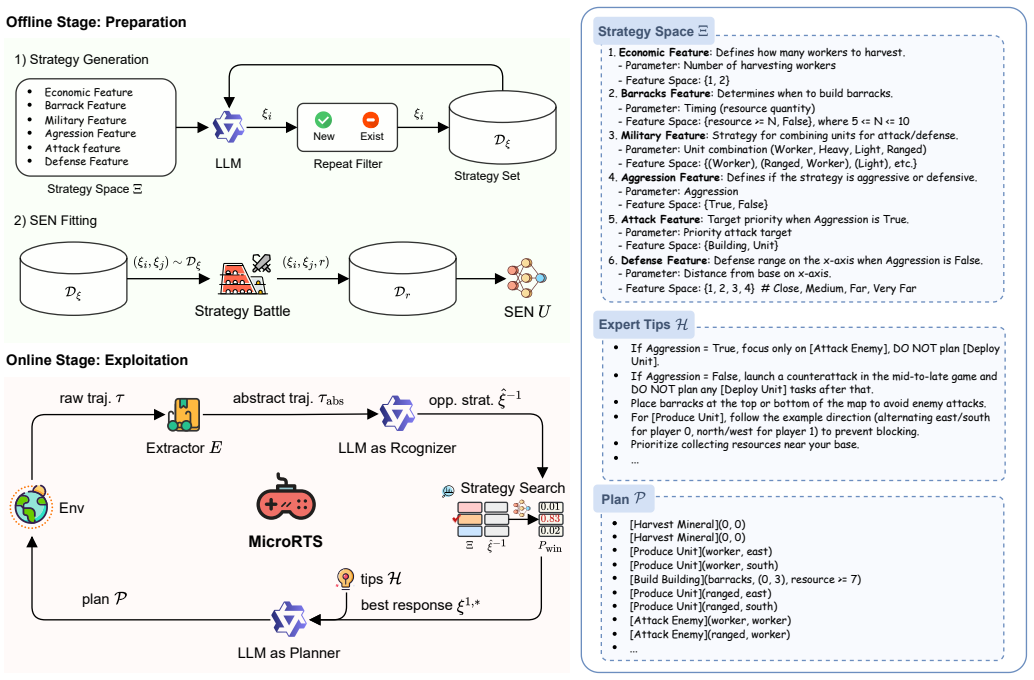
The engine is the Strategy Evaluation Network (SEN): a three-layer MLP that takes two encoded strategy vectors and outputs a win probability, trained with binary cross-entropy on paired battle results. Around it sit three supports: an LLM-based strategy generator that populates the strategy space with diverse verbal strategies, a trajectory summarizer that compresses raw game logs into feature-aligned summaries, and an online re-planning loop that re-recognizes the opponent every $k$ steps and greedily re-selects the best response via $\xi^{1,*} = \arg\max_{\xi^1 \in \Xi} U(\xi^1, \hat{\xi}^{-1})$. Expert tips bridge the gap between the selected macro-strategy and the concrete abstract-action plan the LLM must emit. The network's low-dimensional input is what lets the whole pipeline be fitted from only 900 battles.
What would settle it
Build an opponent whose style deliberately falls outside the six-feature space—for example, alternating between aggressive and defensive phases within a single episode—and measure SAP's recognition accuracy and win rate. If the best-response search no longer beats the prompting baselines, the generalization claim fails. A cheaper check is to retrain SEN on different 30-strategy subsets and see whether the 93.3% best-response win rate against held-out strategies is stable or collapses.
Extended reading notes
Core claim
On the paper's own terms, the central discovery is that opponent exploitation can be decomposed into two tractable tasks: representing strategies by six explicitly defined features, and learning a function $U(\xi_1,\xi_{-1})$ that predicts the probability that one strategy beats another. With 900 battle outcomes among 30 seen strategies, the fitted network supports best-response search over the whole strategy space, including 20 strategies never seen in training, and the resulting agent wins 97.00% on average against plan-level and strategy-level baselines on the 8x8 map. The best-response search alone achieves a 93.3% win rate against true unseen opponent strategies. The paper attributes the higher win rate against unseen strategies to the seen set containing stronger strategies, so the key claim is not that unseen opponents are easy but that the evaluator generalizes across the defined space.
Load-bearing premise
The load-bearing premise is that the six hand-designed strategy features cover every opponent behavior SAP will face, and that a network trained on only 30 strategies and 900 battles predicts best responses across the entire strategy space, including the 20 unseen strategies.
Editorial extensions
If this is right
- LLM agents can become competitive in unfamiliar real-time games without game-specific training data; the learned evaluator supplies the missing expertise.
- The low dimensionality of the strategy representation keeps offline cost small (50 strategies, 900 battles), so adapting the pipeline to a new map mainly means re-running strategy generation and battle collection, not a large reinforcement-learning run.
- An opponent catalogue is not required in advance: the defined strategy space plus greedy best-response search extrapolates to styles never seen during training.
- Re-planning every $k$ steps makes the agent adaptive within an episode, and the ablation results indicate that shorter intervals strengthen exploitation.
- Wherever a strategy can be verbalized in a low-dimensional feature space, the same two-stage design should transfer to other adversarial planning domains, as the paper claims.
Reading between the lines
- The hand-crafted six-feature space is the likely ceiling of the approach: if the method is right, learning the strategy embedding itself would widen the range of representable behaviors without redesigning features.
- The 16% false-positive rate in the SEN confusion matrix indicates that some predicted winning counter-strategies are actually losing; a hedged fallback that tests the top two candidates for a short window before committing could reduce those losses.
- Because the agent re-recognizes only every $k$ steps, it treats the opponent as approximately stationary within that interval; opponents that switch styles mid-episode would stress that assumption and may require shorter intervals or explicit change-point detection.
- An equal-strength comparison between seen and unseen strategies would be needed to separate the evaluator's generalization from the paper's observation that the seen strategy set happens to contain stronger strategies.
Signed reviews
Editorial analysis
A structured set of objections, weighed in public.
Referee Report
Summary. The paper introduces Strategy-Augmented Planning (SAP), a two-stage framework for opponent exploitation in adversarial games. In an offline stage, LLMs generate a strategy library inside a hand-coded six-feature strategy space, pairwise strategy battles are simulated, and a small MLP (the Strategy Evaluation Network, SEN) is trained to predict win probabilities between strategy vectors. In the online stage, a trajectory summarizer and an LLM recognizer map the opponent's behavior to a strategy, the SEN is greedily searched over the full strategy space for a best response, and the selected strategy plus expert tips prompt an LLM planner to emit abstract actions. Experiments in MicroRTS on 8x8 and 16x16 maps report that SAP beats the LLM baselines, reaches 97.0% average win rate against the other tested methods, performs competitively with RL agents against scripted AIs, and generalizes to 20 held-out strategies. The paper claims a 85.35% improvement over the Tips-augmented baseline and a 93.3% best-response win rate in the SEN evaluation.
Significance. If the results hold, the contribution is significant: a low-dimensional learned strategy evaluator could replace substantial hand-crafted domain knowledge in grounding LLM planners, and the explicit strategy space makes the opponent-modeling process interpretable. The paper has real strengths: the final win rates are obtained by actually playing games rather than by the SEN's own predictions; the scripted-AI comparison is an external benchmark taken from prior RL work; the code is released; and the ablation of the SEN component (SAP w/o SEN in Table VI) supports the claim that the learned evaluator adds value. However, the current evidence does not yet establish the strong generalization and competitiveness claims, because the unseen strategies are in-distribution with the training library, the statistical basis is minimal, and the full-space search in Eq. (7) is evaluated only inside the support of the hand-coded features.
major comments (4)
- [IV-A, Table IV, Table VI] All win rates are reported as point estimates without episode counts, variance measures, or significance tests. The headline 85.35% improvement and the 92.50% SAP average in Table VI cannot be assessed for reliability; for instance, the 2.22 percentage-point gap between SAP (92.50%) and SAP-EPE (90.28%) in Table VI cannot be distinguished from sampling error unless the per-cell episode count is reported and a paired test is provided. Please report N for every cell, include standard errors or confidence intervals, and run paired tests, including for the 93.3% best-response rate in Fig. 4(b) and for the scripted-AI comparisons in Fig. 3.
- [IV-A and III-C2] The 'unseen' strategies are a random split of the 50-strategy LLM-generated library, so they are generated by the same Eq. (3) prompt and live inside the same hand-coded six-feature space Xi. This makes the held-out evaluation an in-distribution interpolation test, not a test of generalization to opponent behaviors outside Xi. Because Eq. (7) searches the entire strategy space, the claim of robust generalization to 'novel, unseen strategies' is stronger than the evidence; the authors should add opponents whose feature vectors are deliberately outside the training ranges or that are produced by a different generative procedure, and report recognition accuracy on such opponents.
- [III-B2, III-C2, IV-B2] The SEN is trained on 900 outcomes among only 30 seen strategies, but Eq. (7) greedily searches all of Xi. The paper provides no evidence that U extrapolates beyond the support of the training strategy vectors: the confusion matrix in Fig. 4(a) is a split of the same 900-outcome dataset, and Fig. 4(b) evaluates best-response selection when the true opponent strategy is provided, not after the recognizer of Eq. (9). Please report the accuracy of the recognizer itself, test SEN on out-of-distribution strategy pairs, and quantify how many of the maximizing strategies found by Eq. (7) use combinations of feature values that are not represented in the training library.
- [Eq. (4) and IV-A] The number of episodes N per strategy pair is never specified, and the treatment of draws is unclear: Eq. (4) defines r_ij as an expected result over N episodes, while later win rates such as Table IV appear to be binary win/loss percentages and Fig. 3 explicitly includes ties. Since the SEN is trained with binary cross-entropy on r_ij, the encoding of draws and the choice of N directly affect the network's training target and the reported win rates; please state N, the tie-handling rule, and the symmetry assumption r_ij = r_ji more precisely.
minor comments (5)
- [IV-A] The strategy update interval k is used in Algorithm 2 and mentioned in Section III, but its value in the experiments is never reported; please state k for both the 8x8 and 16x16 experiments and explain how SAP-EPE in Table VI differs from the default k.
- [IV-A] The text says the SEN architecture is a 'Multi-Layer Perception'; this should read 'Multi-Layer Perceptron'.
- [III-A and Fig. 1] The six strategy features are described in an unlabeled bullet list and referenced from Fig. 1; the list should be numbered or given a section number, and the discrete ranges should be stated in the text as well as in the figure.
- [Eqs. (4) and (6)] The notation is confusing: Eq. (4) writes the expectation with a subscript 'NX R' that is undefined, and Eq. (6) conditions U on r_ij even though r_ij is the target being predicted. Please rewrite these equations with clean conditioning on the two strategy vectors.
- [Table IV] The Avg column is the mean over all opponent columns except the diagonal, but this is not stated; add a table note and also state the per-cell number of episodes.
Circularity Check
No circularity: SEN is fitted to offline battle outcomes, and headline win rates are measured by real games rather than by the SEN itself.
full rationale
Walked the derivation chain in Sections III and IV. The SEN U is trained via BCE loss (Eq. 6) on outcome data r_ij obtained from actual simulated battles (Eq. 4), where plans are generated by the LLM (Eq. 5). The online best-response search (Eq. 7) then uses this fixed network to rank strategies; the reported 85.35% improvement and the 93.3% best-response win rate against unseen strategies are measured by playing games, not by re-using SEN outputs as the metric. The 20 unseen strategies are a random split of the same 50-strategy library, so they are a genuine holdout from SEN fitting even though they share the hand-defined feature space; this is a limitation on the scope of the generalization claim (extrapolation outside the six-feature space is untested), but it is not a circular reduction: no equation defines the claimed result in terms of itself, no fitted parameter is renamed as a prediction, and no load-bearing conclusion rests on a self-citation. The hand-authored strategy space and expert tips inject domain knowledge, but they are inputs to the pipeline, not outputs that are then presented as derived predictions.
Assumptions & free parameters
free parameters (4)
- Strategy update interval k =
200 environment steps (per Fig 3 caption)
- Number of generated strategies K =
50 (30 seen, 20 unseen)
- Episode count N for strategy-outcome data =
not reported
- Strategy feature definitions and ranges =
e.g., economic {1,2}, barracks timing {resource>=5..10, False}, defense {1,2,3,4}
assumptions (5)
- domain assumption The six hand-defined semantic dimensions (economic, barracks, military, aggression, attack, defense) form a sufficient strategy space for MicroRTS.
- domain assumption The trajectory summarizer E preserves enough information for the LLM to map observed play onto the correct strategy vector.
- domain assumption The SEN trained on 30 seen strategies generalizes to the full strategy space Xi including unseen strategies.
- ad hoc to paper Expert tips H are needed to bridge strategy-to-plan translation.
- domain assumption Game symmetry makes win rate player-position symmetric (rij = rji).
invented entities (2)
-
Strategy Evaluation Network (SEN)
independent evidence
-
Explicit strategy space Xi with six semantic features
Cite this review
Pith. "Pith review of Strategy-Augmented Planning for Large Language Models via Opponent Exploitation." pith.science (2026). https://pith.science/paper/WTCGV2QZ
@misc{pith2026250508459,
  author       = {Pith},
  title        = {Pith review of: Strategy-Augmented Planning for Large Language Models via Opponent Exploitation},
  year         = {2026},
  howpublished = {\url{https://pith.science/paper/WTCGV2QZ}},
  note         = {Machine review of arXiv:2505.08459}
}
abstract
Efficiently modeling and exploiting opponents is a long-standing challenge in adversarial domains. Large Language Models (LLMs) trained on extensive textual data have recently demonstrated outstanding performance in general tasks, introducing new research directions for opponent modeling. Some studies primarily focus on directly using LLMs to generate decisions based on the elaborate prompt context that incorporates opponent descriptions, while these approaches are limited to scenarios where LLMs possess adequate domain expertise. To address that, we introduce a two-stage Strategy-Augmented Planning (SAP) framework that significantly enhances the opponent exploitation capabilities of LLM-based agents by utilizing a critical component, the Strategy Evaluation Network (SEN). Specifically, in the offline stage, we construct an explicit strategy space and subsequently collect strategy-outcome pair data for training the SEN network. During the online phase, SAP dynamically recognizes the opponent's strategies and greedily exploits them by searching best response strategy on the well-trained SEN, finally translating strategy to a course of actions by carefully designed prompts. Experimental results show that SAP exhibits robust generalization capabilities, allowing it to perform effectively not only against previously encountered opponent strategies but also against novel, unseen strategies. In the MicroRTS environment, SAP achieves a $85.35\%$ performance improvement over baseline methods and matches the competitiveness of reinforcement learning approaches against state-of-the-art (SOTA) rule-based AI. Our code is available at https://github.com/hsushuai/SAP.
Figures


Figures from the paper (2 more)


Reference graph
Works this paper leans on
-
[1]
Starcraft ii: A new challenge for reinforcement learning,
O. Vinyals, T. Ewalds, S. Bartunov, P. Georgiev, A. S. Vezhnevets, M. Yeo, A. Makhzani, H. Küttler, J. Agapiou, J. Schrittwieser et al. , “Starcraft ii: A new challenge for reinforcement learning,”arXiv preprint arXiv:1708.04782, 2017
arXiv 2017
-
[2]
S. Huang, S. Ontañón, C. Bamford, and L. Grela, “Gym- µrts: Toward affordable full game real-time strategy games research with deep reinforcement learning,” in 2021 IEEE Conference on Games (CoG), Copenhagen, Denmark, August 17-20, 2021. IEEE, 2021, pp. 671–678. [Online]. Available: https://doi.org/10.1109/CoG52621.2021.9619076
arXiv 2021
-
[3]
The combinatorial multi-armed bandit problem and its application to real-time strategy games,
S. Ontanón, “The combinatorial multi-armed bandit problem and its application to real-time strategy games,” in Proceedings of the AAAI Conference on Artificial Intelligence and Interactive Digital Entertain- ment, vol. 9, no. 1, 2013, pp. 58–64
work page 2013
-
[4]
Opponent modeling in deep reinforcement learning,
H. He, J. Boyd-Graber, K. Kwok, and H. Daumé III, “Opponent modeling in deep reinforcement learning,” in International conference on machine learning . PMLR, 2016, pp. 1804–1813
work page 2016
-
[5]
Bayes’ bluff: opponent modelling in poker,
F. Southey, M. Bowling, B. Larson, C. Piccione, N. Burch, D. Billings, and C. Rayner, “Bayes’ bluff: opponent modelling in poker,” in Pro- ceedings of the Twenty-First Conference on Uncertainty in Artificial Intelligence, ser. UAI’05. Arlington, Virginia, USA: AUAI Press, 2005, p. 550–558
work page 2005
-
[6]
Game theory-based opponent modeling in large imperfect-information games,
S. Ganzfried and T. Sandholm, “Game theory-based opponent modeling in large imperfect-information games,” in The 10th International Con- ference on Autonomous Agents and Multiagent Systems-Volume 2, 2011, pp. 533–540
work page 2011
-
[7]
A survey of opponent modeling in adversarial domains,
S. Nashed and S. Zilberstein, “A survey of opponent modeling in adversarial domains,” Journal of Artificial Intelligence Research, vol. 73, pp. 277–327, 2022
work page 2022
-
[8]
A robust and opponent-aware league training method for starcraft ii,
R. Huang, X. Wu, H. Yu, Z. Fan, H. Fu, Q. Fu, and W. Yang, “A robust and opponent-aware league training method for starcraft ii,” Advances in Neural Information Processing Systems , vol. 36, 2024
work page 2024
Show all 34 references
-
[9]
Language mod- els are few-shot learners,
T. Brown, B. Mann, N. Ryder, M. Subbiah, J. D. Kaplan, P. Dhariwal, A. Neelakantan, P. Shyam, G. Sastry, A. Askell et al., “Language mod- els are few-shot learners,” Advances in neural information processing systems, vol. 33, pp. 1877–1901, 2020
1901
-
[10]
Large lan- guage models are zero-shot reasoners,
T. Kojima, S. S. Gu, M. Reid, Y . Matsuo, and Y . Iwasawa, “Large lan- guage models are zero-shot reasoners,” Advances in neural information processing systems, vol. 35, pp. 22 199–22 213, 2022
2022
-
[11]
Large language models play starcraft ii: Benchmarks and a chain of summarization approach,
W. Ma, Q. Mi, Y . Zeng, X. Yan, Y . Wu, R. Lin, H. Zhang, and J. Wang, “Large language models play starcraft ii: Benchmarks and a chain of summarization approach,” arXiv preprint arXiv:2312.11865 , 2023
2023 arXiv
-
[12]
Agent-pro: Learning to evolve via policy-level reflection and optimization,
W. Zhang, K. Tang, H. Wu, M. Wang, Y . Shen, G. Hou, Z. Tan, P. Li, Y . Zhuang, and W. Lu, “Agent-pro: Learning to evolve via policy-level reflection and optimization,” arXiv preprint arXiv:2402.17574 , 2024
2024 arXiv
-
[13]
Exploring large language models for communication games: An empirical study on werewolf,
Y . Xu, S. Wang, P. Li, F. Luo, X. Wang, W. Liu, and Y . Liu, “Exploring large language models for communication games: An empirical study on werewolf,” arXiv preprint arXiv:2309.04658 , 2023
2023 arXiv
-
[14]
A survey on large language model based autonomous agents,
L. Wang, C. Ma, X. Feng, Z. Zhang, H. Yang, J. Zhang, Z. Chen, J. Tang, X. Chen, Y . Linet al., “A survey on large language model based autonomous agents,” Frontiers of Computer Science , vol. 18, no. 6, p. 186345, 2024
2024
-
[15]
Understanding the planning of llm agents: A survey,
X. Huang, W. Liu, X. Chen, X. Wang, H. Wang, D. Lian, Y . Wang, R. Tang, and E. Chen, “Understanding the planning of llm agents: A survey,” arXiv preprint arXiv:2402.02716 , 2024
2024 arXiv
-
[16]
Hugginggpt: Solving ai tasks with chatgpt and its friends in hugging face,
Y . Shen, K. Song, X. Tan, D. Li, W. Lu, and Y . Zhuang, “Hugginggpt: Solving ai tasks with chatgpt and its friends in hugging face,” Advances in Neural Information Processing Systems , vol. 36, 2024
2024
-
[17]
Plan-and-solve prompting: Improving zero-shot chain-of-thought reasoning by large language models,
L. Wang, W. Xu, Y . Lan, Z. Hu, Y . Lan, R. K.-W. Lee, and E.-P. Lim, “Plan-and-solve prompting: Improving zero-shot chain-of-thought reasoning by large language models,” arXiv preprint arXiv:2305.04091, 2023
2023 arXiv
-
[18]
Chain-of-thought prompting elicits reasoning in large language models,
J. Wei, X. Wang, D. Schuurmans, M. Bosma, F. Xia, E. Chi, Q. V . Le, D. Zhou et al. , “Chain-of-thought prompting elicits reasoning in large language models,” Advances in neural information processing systems , vol. 35, pp. 24 824–24 837, 2022
2022
-
[19]
React: Synergizing reasoning and acting in language models,
S. Yao, J. Zhao, D. Yu, N. Du, I. Shafran, K. Narasimhan, and Y . Cao, “React: Synergizing reasoning and acting in language models,” arXiv preprint arXiv:2210.03629, 2022
2022 arXiv
-
[20]
Tree of thoughts: Deliberate problem solving with large language models,
S. Yao, D. Yu, J. Zhao, I. Shafran, T. Griffiths, Y . Cao, and K. Narasimhan, “Tree of thoughts: Deliberate problem solving with large language models,” Advances in Neural Information Processing Systems , vol. 36, 2024
2024
-
[21]
Large language models as com- monsense knowledge for large-scale task planning,
Z. Zhao, W. S. Lee, and D. Hsu, “Large language models as com- monsense knowledge for large-scale task planning,” Advances in Neural Information Processing Systems , vol. 36, 2024
2024
-
[22]
Reasoning with language model is planning with world model,
S. Hao, Y . Gu, H. Ma, J. J. Hong, Z. Wang, D. Z. Wang, and Z. Hu, “Reasoning with language model is planning with world model,” arXiv preprint arXiv:2305.14992, 2023
2023 arXiv
-
[23]
Llm a*: Human in the loop large language models enabled a* search for robotics,
H. Xiao and P. Wang, “Llm a*: Human in the loop large language models enabled a* search for robotics,” arXiv preprint arXiv:2312.01797, 2023
2023 arXiv
-
[24]
Pddl| the planning domain definition language,
C. Aeronautiques, A. Howe, C. Knoblock, I. D. McDermott, A. Ram, M. Veloso, D. Weld, D. W. Sri, A. Barrett, D. Christianson et al., “Pddl| the planning domain definition language,” Technical Report, Tech. Rep., 1998
1998
-
[25]
Llm+ p: Empowering large language models with optimal planning proficiency,
B. Liu, Y . Jiang, X. Zhang, Q. Liu, S. Zhang, J. Biswas, and P. Stone, “Llm+ p: Empowering large language models with optimal planning proficiency,” arXiv preprint arXiv:2304.11477 , 2023
2023 arXiv
-
[26]
Dynamic planning with a llm,
G. Dagan, F. Keller, and A. Lascarides, “Dynamic planning with a llm,” arXiv preprint arXiv:2308.06391 , 2023
2023 arXiv
-
[27]
Lever- aging pre-trained large language models to construct and utilize world models for model-based task planning,
L. Guan, K. Valmeekam, S. Sreedharan, and S. Kambhampati, “Lever- aging pre-trained large language models to construct and utilize world models for model-based task planning,” Advances in Neural Information Processing Systems, vol. 36, pp. 79 081–79 094, 2023
2023
-
[28]
Towards offline opponent modeling with in-context learning,
Y . Jing, K. Li, B. Liu, Y . Zang, H. Fu, Q. FU, J. Xing, and J. Cheng, “Towards offline opponent modeling with in-context learning,” in The Twelfth International Conference on Learning Representations , 2023
2023
-
[29]
Limited information opponent modeling,
Y . Lv, Y . Yu, Y . Zheng, J. Hao, Y . Wen, and Y . Yu, “Limited information opponent modeling,” in International Conference on Artificial Neural Networks. Springer, 2023, pp. 511–522
2023
-
[30]
Modeling others using oneself in multi-agent reinforcement learning,
R. Raileanu, E. Denton, A. Szlam, and R. Fergus, “Modeling others using oneself in multi-agent reinforcement learning,” in International conference on machine learning . PMLR, 2018, pp. 4257–4266
2018
-
[31]
Machine theory of mind,
N. Rabinowitz, F. Perbet, F. Song, C. Zhang, S. A. Eslami, and M. Botvinick, “Machine theory of mind,” in International conference on machine learning . PMLR, 2018, pp. 4218–4227
2018
-
[32]
The minds of many: Opponent modeling in a stochastic game
F. B. V on Der Osten, M. Kirley, and T. Miller, “The minds of many: Opponent modeling in a stochastic game.” in IJCAI, 2017, pp. 3845– 3851
2017
-
[33]
Enhancing language model rationality with bi-directional deliberation reasoning,
Y . Zhang, S. Mao, W. Wu, Y . Xia, T. Ge, M. Lan, and F. Wei, “Enhancing language model rationality with bi-directional deliberation reasoning,” arXiv preprint arXiv:2407.06112 , 2024
2024 arXiv
-
[34]
Transformers as policies for variable action envi- ronments,
N. Zwingenberger, “Transformers as policies for variable action envi- ronments,” 2023
2023
Reviewed August 15, 2026 · model on record in the stance chip above.
Discussion (0). Continue with ORCID to comment.