REVIEW 3 major objections 5 minor 63 references
InfoPO: On Mutual Information Maximization for Large Language Model Alignment
T0 review · 3 major / 5 minor · reviewed 2026-08-15 · deepseek-v4-flash
Pith's one-line read InfoPO aligns LLMs by maximizing mutual information, not Bradley-Terry odds
desk verdict InfoPO's rejected-response term is constant under the paper's own sampling model, so the loss reduces to SFT on chosen responses and the reverse-KL theorem is unproven. read the letter →
The pith
A machine-rendered reading of the paper's core claim, the machinery that carries it, and where it could break.
The reading
What carries the argument
The load-bearing object is the NWJ estimator of conditional mutual information, $I(Y;C|X) \ge \mathbb{E}[f] - \mathbb{E}[e^f] + 1$, used with the critic $f_\phi(x,c) = \beta \log(\pi_\theta(y|x)/\pi_{\mathrm{ref}}(y|x))$. With that critic, InfoNCE becomes exactly the DPO loss, and NWJ becomes $L_{\mathrm{InfoPO}} = -\log \pi_\theta(y_w|x) + \pi_\theta(y_l|x)/\pi_{\mathrm{ref}}(y_l|x)$. This identity is what lets the paper move from a contrastive, margin-based objective to a direct keep-chosen, gently-demote-rejected objective. Theorem 4.1 then claims that minimizing this loss is equivalent to minimizing the reverse KL divergence $D_{\mathrm{KL}}(\pi_\theta \| \pi_{\mathrm{chosen}})$, the mode-seeking behavior the paper argues alignment should have. The machinery simultaneously explains DPO as a special case and supplies the replacement objective.
What would settle it
Train InfoPO on a preference dataset and measure the empirical average of $\pi_\theta(y_l|x)/\pi_{\mathrm{ref}}(y_l|x)$ over the rejected responses at each checkpoint. If this average stays at $1$ and the gradient contribution of that term is numerically zero while the loss trajectory matches training on $-\log \pi_\theta(y_w|x)$ alone, then the rejected-response mechanism is not doing the unlearning work the paper claims.
Extended reading notes
Core claim
The central claim is that direct preference optimization can be reframed as mutual-information maximization. DPO's loss is exactly an InfoNCE estimator of the conditional mutual information between response and preference label given the prompt when the critic is $\beta \log(\pi_\theta/\pi_{\mathrm{ref}})$. Swapping in the NWJ estimator gives the InfoPO objective $L_{\mathrm{InfoPO}} = -\log \pi_\theta(y_w|x) + \pi_\theta(y_l|x)/\pi_{\mathrm{ref}}(y_l|x)$. The first term keeps the chosen response probable; the second produces a smaller, more conservative gradient on rejected responses than DPO's reciprocal-probability gradient. The paper proves that minimizing this loss encourages mode-seeking behavior via reverse KL divergence between the model and the chosen-response distribution, and shows empirically that this preserves chosen likelihoods while improving reasoning, coding, and chat benchmarks.
Load-bearing premise
The load-bearing premise is that the rejected-response penalty in the InfoPO loss actually pushes the model during training; if rejected responses are effectively sampled from the reference distribution, the average penalty is constant, its gradient is zero, and the method reduces to supervised fine-tuning on chosen responses.
Editorial extensions
If this is right
- If InfoPO is correct, preference alignment can be performed without assuming the Bradley-Terry model, so the chosen-response likelihood decline is addressed by construction rather than by an added regularization term.
- The reverse-KL characterization implies InfoPO concentrates probability mass on a focused set of high-reward responses, which the paper argues is the right inductive bias for reasoning and task-specific generation.
- Because the loss contains an explicit chosen-response log-likelihood term, InfoPO should require fewer manually tuned regularization hyperparameters than methods that add NLL penalties on top of a contrastive loss.
- The reported gains on GSM8K, MATH, HumanEval, and MBPP suggest that preference fine-tuning with InfoPO preserves pretrained reasoning abilities while still improving instruction following and chat quality.
Reading between the lines
- A direct comparison the paper leaves implicit: InfoPO trained on preference pairs should be compared against plain supervised fine-tuning on the chosen responses alone; if the rejected-response term has zero expected gradient, the two should match.
- The mutual-information framing suggests a family of alignment losses indexed by MI estimator; interpolating between InfoNCE and NWJ could trade bias for variance in a controlled way, though the paper does not explore this.
- If reverse-KL mode-seeking is what the loss implements, InfoPO should reduce the entropy of generated responses relative to the reference model; measuring generation diversity across training would test this prediction.
Signed reviews
Editorial analysis
A structured set of objections, weighed in public.
Referee Report
Summary. The paper proposes InfoPO, a preference fine-tuning method for LLMs based on maximizing conditional mutual information I(Y;C|X) with the NWJ estimator, claiming to avoid the Bradley-Terry assumption. The method is derived as L_InfoPO = -log πθ(yw|x) + πθ(yl|x)/πref(yl|x), with a stated advantage that it prevents the chosen-response likelihood from decreasing. The authors reinterpret DPO as InfoNCE-based MI maximization, provide a gradient analysis to motivate conservative unlearning of rejected responses, prove a theorem that InfoPO minimizes reverse KL to the chosen-response distribution (Theorem 4.1), and report experiments on reasoning, chat, and summarization benchmarks where InfoPO outperforms DPO and SimPO.
Significance. If the central derivation and theorem were correct, the MI-maximization perspective on preference learning could be a useful conceptual contribution, and the empirical gains on reasoning benchmarks would be of practical interest. The paper also ships a relatively simple training objective and reports evaluations across multiple models and tasks. However, the significance is entirely conditional on the validity of the derivation of Eq. (13) and the proof of Theorem 4.1, which are the load-bearing components of the paper. As detailed in the major comments, those components fail under the paper's own stated sampling model, so the proposed method does not actually perform preference learning in expectation.
major comments (3)
- [§4.1 and §4.3, Eq. (13)] Under the sampling model stated in §4.1 ('we sample x~p(x), (yw,c)~π(y,c=1|x), and (yl,c)~πref(y|x)p(c|x)'), the second term of L_InfoPO has zero expected gradient. For any normalized πθ, E_{yl~πref}[πθ(yl|x)/πref(yl|x)] = 1, so the population objective is E[-log πθ(yw|x)] plus a constant. The InfoPO objective therefore reduces to supervised fine-tuning on the chosen responses, with no preference contrast and no 'conservative unlearning' of rejected responses. Any finite-sample effect of the second term is noise, not a designed preference signal. This invalidates the paper's central claim of a BT-free preference learning method.
- [§4.3, Eqs. (9), (12), (13)] The derivation of Eq. (13) from the NWJ bound (Eq. (12)) is algebraically inconsistent unless β=1 and several constant terms are dropped. Substituting the critic f = β log(πθ/πref) from Eq. (9) into the NWJ objective yields -β log(πθ(yw|x)/πref(yw|x)) + (πθ(yl|x)/πref(yl|x))^β - 1, which contains β and the reference-policy term for the chosen response. Eq. (13) contains neither β nor log πref(yw). The paper never states that β is fixed to 1, and Appendix B.2 describes searching β in [0.5, 1.0, 2.0] for 'our InfoPO' although the loss in Eq. (13) has no β parameter. The claimed objective does not follow from the stated estimator.
- [Appendix A, Eq. (23) and Theorem 4.1] The proof of Theorem 4.1 is invalid. Eq. (23) is E_{π_chosen}[-log πθ] + E_{π_ref}[πθ/π_ref]. The second term equals 1 identically, so the expression is forward cross-entropy from the chosen distribution to πθ plus a constant. The reverse KL divergence D_KL(πθ || π_chosen) is E_{πθ}[log(πθ/π_chosen)], which is a different functional; the 'change of variables' from Eq. (18) to Eq. (23) is not derived and is not valid. Consequently Theorem 4.1's claim that InfoPO minimizes reverse KL is unproven, and the mode-seeking interpretation lacks support.
minor comments (5)
- [§4.1, Eq. (9)] The critic fϕ(x,c) is written as independent of c; clarify whether the preference label c has any role in the critic or whether the contrast is entirely carried by the choice of yw versus yl in the expectation.
- [§4.3, Eq. (12)] The constant '+1' in the NWJ estimator disappears without comment in Eq. (13). While constants do not affect the gradient, the paper should state that this is an intentional omission for clarity.
- [Appendix B.2] The hyperparameter description 'For SimPO and our InfoPO, the β in SimPO was selected through a search within the range of [0.5, 1.0, 2.0]' is ambiguous. Since Eq. (13) contains no β or length-normalization parameter, it should be stated explicitly which hyperparameters were tuned for InfoPO and how the length normalization mentioned in the same paragraph enters the loss.
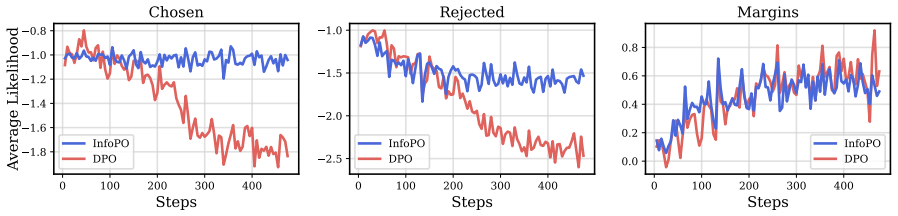
- [Figures 1 and 2] The quantity 'Margins' is not defined in the text or captions. Specify whether it is the difference in average log-likelihoods, the reward margin, or something else, and report the standard errors or number of runs, since the curves appear to be based on a single training run.
- [Table 1] On Mistral-7B, CPO achieves a GSM8K score of 33.06, which is higher than InfoPO's 32.07; the text's claim that InfoPO consistently outperforms all baselines is therefore overstated. Please qualify the claim or perform significance testing across multiple seeds.
Circularity Check
Under the paper's own sampling model, the rejected-response term in Eq. (13) has expectation 1 for every policy, so InfoPO reduces to SFT on chosen responses; Theorem 4.1's proof labels the same constant as reverse KL.
-
self definitional
[Section 4.1 (sampling model, Eq. 8 context) and Section 4.3 (Eq. 13)]
"we sample x∼ p(x), (yw, c)∼ π(y, c = 1| x), and (yl, c)∼ πref (y| x)p(c| x). ... By using the preference datasets and the parameterized critic in Equation (9), we have the following InfoPO objective on preference pairs: LInfoPO(θ; x, yw, yl) = − logπθ(yw|x) +πθ(yl|x)/πref (yl|x)."
With y_l drawn from π_ref, the second term is an importance-weighting identity: E_{y_l∼π_ref}[π_θ(y_l|x)/π_ref(y_l|x)] = ∑_y π_ref(y|x) π_θ(y|x)/π_ref(y|x) = ∑_y π_θ(y|x) = 1. Hence the expected InfoPO loss is E[−log π_θ(y_w|x)] + 1, which is exactly supervised fine-tuning on chosen responses, and the gradient of the rejected term is zero in expectation. The NWJ estimator's exp term is forced to 1 by the critic choice f = β log(π_θ/π_ref) in Eq. (9); the claimed 'conservative unlearning' of rejected responses is therefore zero by construction. Any finite-sample gradient from the second term is noise, not a designed preference signal.
-
self definitional
[Appendix A, proof of Theorem 4.1, Eq. (23)]
"Analogous to the approach used for density ratio estimation and using a change of variables, we can formalize the reverse KL objective as follows: Eπchosen [− logπθ(y|x)] + Eπref [ πθ(yl|x) πref (yl|x) ] , (23)"
The reverse KL D_KL(π_θ || π_chosen) = E_{π_θ}[log π_θ − log π_chosen], but Eq. (23) is E_{π_chosen}[−log π_θ] + E_{π_ref}[π_θ/π_ref]. The second expectation is identically 1 for any normalized π_θ, so Eq. (23) is forward cross-entropy plus a constant, not reverse KL. The theorem's conclusion is not derived; it is imported by labeling Eq. (23) 'the reverse KL objective.' Minimizing InfoPO is therefore claimed to be mode-seeking reverse-KL minimization only because the proof defines it to be so.
full rationale
The circularity is not a matter of the empirical benchmarks; the evaluations against GSM8K, MATH, AlpacaEval, etc. are external and could be valid even if the derivation failed. The circularity is in the derivation chain. Section 4.1 fixes the sampling model y_l ∼ π_ref(y|x), and Eq. (9) fixes the NWJ critic to f = β log(π_θ/π_ref). Substituting that critic into the NWJ bound (Eq. 12) makes the exp term (π_θ(y_l)/π_ref(y_l))^β. Since y_l is averaged over π_ref, this term is exactly 1 for any normalized π_θ (at β=1). Thus the expected InfoPO objective is E[−log π_θ(y_w|x)] + 1, which is SFT on chosen responses; the rejected-response gradient is zero in expectation. The paper's central claim that InfoPO 'decreases the likelihood of the rejected response' or performs 'conservative unlearning' is therefore not a property of the derived objective—it is an artifact of finite-sample noise. The same reduction appears in the proof of Theorem 4.1: Eq. (23) calls E_{π_chosen}[−log π_θ] + E_{π_ref}[π_θ/π_ref] the 'reverse KL objective,' but the second summand is identically 1 and the first is forward cross-entropy. The theorem's conclusion is assumed by labeling this expression 'reverse KL.' No parameter is fitted to a subset and then predicted (the method is parameter-free apart from hyperparameters), and no load-bearing self-citation is involved, so the score reflects the definitional reduction of the central objective rather than citation practices.
Assumptions & free parameters
free parameters (2)
- beta (critic temperature) =
search range [0.5, 1.0, 2.0]
- response likelihood normalization =
average per-token log probability
assumptions (4)
- domain assumption The rejected response yl is sampled from the reference policy pi_ref for the InfoPO objective
- ad hoc to paper The critic f = beta log(pi_theta/pi_ref) is a valid parameterization for the NWJ estimator
- ad hoc to paper The change of variables from Equation (18) to Equation (23) is valid
- standard math Z(x) = 1 in Equation (21)
Cite this review
Pith. "Pith review of InfoPO: On Mutual Information Maximization for Large Language Model Alignment." pith.science (2026). https://pith.science/paper/JIHRMEGI
@misc{pith2026250508507,
  author       = {Pith},
  title        = {Pith review of: InfoPO: On Mutual Information Maximization for Large Language Model Alignment},
  year         = {2026},
  howpublished = {\url{https://pith.science/paper/JIHRMEGI}},
  note         = {Machine review of arXiv:2505.08507}
}
read the original abstract
We study the post-training of large language models (LLMs) with human preference data. Recently, direct preference optimization and its variants have shown considerable promise in aligning language models, eliminating the need for reward models and online sampling. Despite these benefits, these methods rely on explicit assumptions about the Bradley-Terry (BT) model, which makes them prone to overfitting and results in suboptimal performance, particularly on reasoning-heavy tasks. To address these challenges, we propose a principled preference fine-tuning algorithm called InfoPO, which effectively and efficiently aligns large language models using preference data. InfoPO eliminates the reliance on the BT model and prevents the likelihood of the chosen response from decreasing. Extensive experiments confirm that InfoPO consistently outperforms established baselines on widely used open benchmarks, particularly in reasoning tasks.
Figures


Reference graph
Works this paper leans on
-
[1]
URL: " 'urlintro :=
ENTRY address author booktitle chapter edition editor howpublished institution journal key month note number organization pages publisher school series title type volume year eprint doi pubmed url lastchecked label extra.label sort.label short.list INTEGERS output.state before.all mid.sentence after.sentence after.block STRINGS urlintro eprinturl eprintpr...
-
[2]
write newline
" write newline "" before.all 'output.state := FUNCTION n.dashify 't := "" t empty not t #1 #1 substring "-" = t #1 #2 substring "--" = not "--" * t #2 global.max substring 't := t #1 #1 substring "-" = "-" * t #2 global.max substring 't := while if t #1 #1 substring * t #2 global.max substring 't := if while FUNCTION word.in bbl.in capitalize " " * FUNCT...
-
[3]
Sungsoo Ahn, Shell Xu Hu, Andreas Damianou, Neil D Lawrence, and Zhenwen Dai. 2019. Variational information distillation for knowledge transfer. In Proceedings of the IEEE/CVF conference on computer vision and pattern recognition, pages 9163--9171
work page 2019
-
[4]
Jacob Austin, Augustus Odena, Maxwell Nye, Maarten Bosma, Henryk Michalewski, David Dohan, Ellen Jiang, Carrie Cai, Michael Terry, Quoc Le, et al. 2021. Program synthesis with large language models. arXiv preprint arXiv:2108.07732
arXiv 2021
-
[5]
Mohammad Gheshlaghi Azar, Zhaohan Daniel Guo, Bilal Piot, Remi Munos, Mark Rowland, Michal Valko, and Daniele Calandriello. 2024. A general theoretical paradigm to understand learning from human preferences. In International Conference on Artificial Intelligence and Statistics, pages 4447--4455. PMLR
2024
-
[6]
Philip Bachman, R Devon Hjelm, and William Buchwalter. 2019. Learning representations by maximizing mutual information across views. Advances in neural information processing systems, 32
work page 2019
-
[7]
Yuntao Bai, Andy Jones, Kamal Ndousse, Amanda Askell, Anna Chen, Nova DasSarma, Dawn Drain, Stanislav Fort, Deep Ganguli, Tom Henighan, et al. 2022. Training a helpful and harmless assistant with reinforcement learning from human feedback. arXiv preprint arXiv:2204.05862
arXiv 2022
-
[8]
David Barber and Felix Agakov. 2004. The im algorithm: a variational approach to information maximization. Advances in neural information processing systems, page 201
work page 2004
Show all 63 references
-
[9]
Mohamed Ishmael Belghazi, Aristide Baratin, Sai Rajeshwar, Sherjil Ozair, Yoshua Bengio, Aaron Courville, and Devon Hjelm. 2018. Mutual information neural estimation. In International conference on machine learning, pages 531--540
2018
-
[10]
Stella Biderman, Hailey Schoelkopf, Quentin Gregory Anthony, Herbie Bradley, Kyle O’Brien, Eric Hallahan, Mohammad Aflah Khan, Shivanshu Purohit, USVSN Sai Prashanth, Edward Raff, et al. 2023. Pythia: A suite for analyzing large language models across training and scaling. In ...
2023
-
[11]
Ralph Allan Bradley and Milton E Terry. 1952. Rank analysis of incomplete block designs: I. the method of paired comparisons. Biometrika, pages 324--345
1952
-
[12]
Huayu Chen, Guande He, Hang Su, and Jun Zhu. 2024. Noise contrastive alignment of language models with explicit rewards. arXiv preprint arXiv:2402.05369
2024 arXiv
-
[13]
Mark Chen, Jerry Tworek, Heewoo Jun, Qiming Yuan, Henrique Ponde De Oliveira Pinto, Jared Kaplan, Harri Edwards, Yuri Burda, Nicholas Joseph, Greg Brockman, et al. 2021. Evaluating large language models trained on code. arXiv preprint arXiv:2107.03374
2021 arXiv
-
[14]
Ting Chen, Simon Kornblith, Mohammad Norouzi, and Geoffrey Hinton. 2020. A simple framework for contrastive learning of visual representations. In International conference on machine learning, pages 1597--1607. PMLR
2020
-
[15]
Paul F Christiano, Jan Leike, Tom Brown, Miljan Martic, Shane Legg, and Dario Amodei. 2017. Deep reinforcement learning from human preferences. Advances in neural information processing systems, 30
2017
-
[16]
Ganqu Cui, Lifan Yuan, Ning Ding, Guanming Yao, Wei Zhu, Yuan Ni, Guotong Xie, Zhiyuan Liu, and Maosong Sun. 2023. Ultrafeedback: Boosting language models with high-quality feedback. arXiv preprint arXiv:2310.01377
2023 arXiv
-
[17]
Monroe D Donsker and SR Srinivasa Varadhan. 1983. Asymptotic evaluation of certain markov process expectations for large time. iv. Communications on pure and applied mathematics, pages 183--212
1983
-
[18]
Abhimanyu Dubey, Abhinav Jauhri, Abhinav Pandey, Abhishek Kadian, Ahmad Al-Dahle, Aiesha Letman, Akhil Mathur, Alan Schelten, Amy Yang, Angela Fan, et al. 2024. The llama 3 herd of models. arXiv preprint arXiv:2407.21783
2024 arXiv
-
[19]
Logan Engstrom, Andrew Ilyas, Shibani Santurkar, Dimitris Tsipras, Firdaus Janoos, Larry Rudolph, and Aleksander Madry. 2020. Implementation matters in deep policy gradients: A case study on ppo and trpo. In International Conference on Learning Representations
2020
-
[20]
Kawin Ethayarajh, Winnie Xu, Niklas Muennighoff, Dan Jurafsky, and Douwe Kiela. 2024. Kto: Model alignment as prospect theoretic optimization. arXiv preprint arXiv:2402.01306
2024 arXiv
-
[21]
Benjamin Eysenbach, Julian Ibarz, Abhishek Gupta, and Sergey Levine. 2019. Diversity is all you need: Learning skills without a reward function. In 7th International Conference on Learning Representations, ICLR 2019
2019
-
[22]
Leo Gao, Jonathan Tow, Baber Abbasi, Stella Biderman, Sid Black, Anthony DiPofi, Charles Foster, Laurence Golding, Jeffrey Hsu, Alain Le Noac'h, Haonan Li, Kyle McDonell, Niklas Muennighoff, Chris Ociepa, Jason Phang, Laria Reynolds, Hailey Schoelkopf, Aviya Skowron, Lintang S...
2023 doi
-
[23]
Shangmin Guo, Biao Zhang, Tianlin Liu, Tianqi Liu, Misha Khalman, Felipe Llinares, Alexandre Rame, Thomas Mesnard, Yao Zhao, Bilal Piot, et al. 2024. Direct language model alignment from online ai feedback. arXiv preprint arXiv:2402.04792
2024 arXiv
-
[24]
Albert Q Jiang, Alexandre Sablayrolles, Arthur Mensch, Chris Bamford, Devendra Singh Chaplot, Diego de las Casas, Florian Bressand, Gianna Lengyel, Guillaume Lample, Lucile Saulnier, et al. 2023 a . Mistral 7b. arXiv preprint arXiv:2310.06825
2023 arXiv
-
[25]
Dongfu Jiang, Xiang Ren, and Bill Yuchen Lin. 2023 b . Llm-blender: Ensembling large language models with pairwise ranking and generative fusion. arXiv preprint arXiv:2306.02561
2023 arXiv
-
[26]
Diederik P Kingma. 2014. Adam: A method for stochastic optimization. arXiv preprint arXiv:1412.6980
2014 arXiv
-
[27]
Tianqi Liu, Yao Zhao, Rishabh Joshi, Misha Khalman, Mohammad Saleh, Peter J Liu, and Jialu Liu. 2023. Statistical rejection sampling improves preference optimization. In The Twelfth International Conference on Learning Representations
2023
-
[28]
Martin Q Ma, Yao-Hung Hubert Tsai, Paul Pu Liang, Han Zhao, Kun Zhang, Ruslan Salakhutdinov, and Louis-Philippe Morency. 2021. Conditional contrastive learning for improving fairness in self-supervised learning. arXiv preprint arXiv:2106.02866
2021 arXiv
-
[29]
Yu Meng, Mengzhou Xia, and Danqi Chen. 2024. Simpo: Simple preference optimization with a reference-free reward. arXiv preprint arXiv:2405.14734
2024 arXiv
-
[30]
R \'e mi Munos, Michal Valko, Daniele Calandriello, Mohammad Gheshlaghi Azar, Mark Rowland, Zhaohan Daniel Guo, Yunhao Tang, Matthieu Geist, Thomas Mesnard, Andrea Michi, et al. 2023. Nash learning from human feedback. arXiv preprint arXiv:2312.00886
2023 arXiv
-
[31]
XuanLong Nguyen, Martin J Wainwright, and Michael I Jordan. 2010. Estimating divergence functionals and the likelihood ratio by convex risk minimization. IEEE Transactions on Information Theory, pages 5847--5861
2010
-
[32]
Aaron van den Oord, Yazhe Li, and Oriol Vinyals. 2018. Representation learning with contrastive predictive coding. arXiv preprint arXiv:1807.03748
2018 arXiv
-
[33]
Long Ouyang, Jeffrey Wu, Xu Jiang, Diogo Almeida, Carroll Wainwright, Pamela Mishkin, Chong Zhang, Sandhini Agarwal, Katarina Slama, Alex Ray, et al. 2022. Training language models to follow instructions with human feedback. Advances in neural information processing systems, p...
2022
-
[34]
Arka Pal, Deep Karkhanis, Samuel Dooley, Manley Roberts, Siddartha Naidu, and Colin White. 2024. Smaug: Fixing failure modes of preference optimisation with dpo-positive. arXiv preprint arXiv:2402.13228
2024 arXiv
-
[35]
Richard Yuanzhe Pang, Weizhe Yuan, Kyunghyun Cho, He He, Sainbayar Sukhbaatar, and Jason Weston. 2024. Iterative reasoning preference optimization. arXiv preprint arXiv:2404.19733
2024 arXiv
-
[36]
Ryan Park, Rafael Rafailov, Stefano Ermon, and Chelsea Finn. 2024. Disentangling length from quality in direct preference optimization. arXiv preprint arXiv:2403.19159
2024 arXiv
-
[37]
Ben Poole, Sherjil Ozair, Aaron Van Den Oord, Alex Alemi, and George Tucker. 2019. On variational bounds of mutual information. In International Conference on Machine Learning, pages 5171--5180
2019
-
[38]
Rafael Rafailov, Archit Sharma, Eric Mitchell, Christopher D Manning, Stefano Ermon, and Chelsea Finn. 2024. Direct preference optimization: Your language model is secretly a reward model. Advances in Neural Information Processing Systems, 36
2024
-
[39]
Corby Rosset, Ching-An Cheng, Arindam Mitra, Michael Santacroce, Ahmed Awadallah, and Tengyang Xie. 2024. Direct nash optimization: Teaching language models to self-improve with general preferences. arXiv preprint arXiv:2404.03715
2024 arXiv
-
[40]
John Schulman, Filip Wolski, Prafulla Dhariwal, Alec Radford, and Oleg Klimov. 2017. Proximal policy optimization algorithms. arXiv preprint arXiv:1707.06347
2017 arXiv
-
[41]
Jiaming Song and Stefano Ermon. 2020. Understanding the limitations of variational mutual information estimators. In International Conference on Learning Representations
2020
-
[42]
Nisan Stiennon, Long Ouyang, Jeffrey Wu, Daniel Ziegler, Ryan Lowe, Chelsea Voss, Alec Radford, Dario Amodei, and Paul F Christiano. 2020. Learning to summarize with human feedback. Advances in Neural Information Processing Systems, 33:3008--3021
2020
-
[43]
Fahim Tajwar, Anikait Singh, Archit Sharma, Rafael Rafailov, Jeff Schneider, Tengyang Xie, Stefano Ermon, Chelsea Finn, and Aviral Kumar. 2024. Preference fine-tuning of llms should leverage suboptimal, on-policy data. arXiv preprint arXiv:2404.14367
2024 arXiv
-
[44]
Yunhao Tang, Zhaohan Daniel Guo, Zeyu Zheng, Daniele Calandriello, R \'e mi Munos, Mark Rowland, Pierre Harvey Richemond, Michal Valko, Bernardo \'A vila Pires, and Bilal Piot. 2024. Generalized preference optimization: A unified approach to offline alignment. arXiv preprint a...
2024 arXiv
-
[45]
Yao Hung Hubert Tsai, Tianqin Li, Martin Q Ma, Han Zhao, Kun Zhang, Louis Philippe Morency, and Ruslan Salakhutdinov. 2022. Conditional contrastive learning with kernel. In ICLR
2022
-
[46]
Michael Tschannen, Josip Djolonga, Paul K Rubenstein, Sylvain Gelly, and Mario Lucic. 2019. On mutual information maximization for representation learning. arXiv preprint arXiv:1907.13625
2019 arXiv
-
[47]
Lewis Tunstall, Edward Beeching, Nathan Lambert, Nazneen Rajani, Kashif Rasul, Younes Belkada, Shengyi Huang, Leandro von Werra, Cl \'e mentine Fourrier, Nathan Habib, et al. 2023. Zephyr: Direct distillation of lm alignment. arXiv preprint arXiv:2310.16944
2023 arXiv
-
[48]
Michael V \"o lske, Martin Potthast, Shahbaz Syed, and Benno Stein. 2017. Tl; dr: Mining reddit to learn automatic summarization. In Proceedings of the Workshop on New Frontiers in Summarization, pages 59--63
2017
-
[49]
Chaoqi Wang, Yibo Jiang, Chenghao Yang, Han Liu, and Yuxin Chen. 2024. Beyond reverse KL: generalizing direct preference optimization with diverse divergence constraints. In The Twelfth International Conference on Learning Representations
2024
-
[50]
Teng Xiao, Mingxiao Li, Yige Yuan, Huaisheng Zhu, Chao Cui, and Vasant Honavar. 2024 a . How to leverage demonstration data in alignment for large language model? a self-imitation learning perspective. In Proceedings of the 2024 Conference on Empirical Methods in Natural Langu...
2024
-
[51]
Teng Xiao and Donglin Wang. 2021. A general offline reinforcement learning framework for interactive recommendation. In Proceedings of the AAAI Conference on Artificial Intelligence, pages 4512--4520
2021
-
[52]
Teng Xiao, Yige Yuan, Zhengyu Chen, Mingxiao Li, Shangsong Liang, Zhaochun Ren, and Vasant G Honavar. 2025. Simper: A minimalist approach to preference alignment without hyperparameters. arXiv preprint arXiv:2502.00883
2025 arXiv
-
[53]
Teng Xiao, Yige Yuan, Huaisheng Zhu, Mingxiao Li, and Vasant G Honavar. 2024 b . Cal-dpo: Calibrated direct preference optimization for language model alignment. In The Thirty-eighth Annual Conference on Neural Information Processing Systems
2024
-
[54]
Wei Xiong, Hanze Dong, Chenlu Ye, Han Zhong, Nan Jiang, and Tong Zhang. 2023. Gibbs sampling from human feedback: A provable kl-constrained framework for rlhf. arXiv preprint arXiv:2312.11456
2023 arXiv
-
[55]
Haoran Xu, Amr Sharaf, Yunmo Chen, Weiting Tan, Lingfeng Shen, Benjamin Van Durme, Kenton Murray, and Young Jin Kim. 2024 a . Contrastive preference optimization: Pushing the boundaries of llm performance in machine translation. ICML
2024
-
[56]
Shusheng Xu, Wei Fu, Jiaxuan Gao, Wenjie Ye, Weilin Liu, Zhiyu Mei, Guangju Wang, Chao Yu, and Yi Wu. 2024 b . Is dpo superior to ppo for llm alignment? a comprehensive study. arXiv preprint arXiv:2404.10719
2024 arXiv
-
[57]
Lifan Yuan, Ganqu Cui, Hanbin Wang, Ning Ding, Xingyao Wang, Jia Deng, Boji Shan, Huimin Chen, Ruobing Xie, Yankai Lin, et al. 2024 a . Advancing llm reasoning generalists with preference trees. arXiv preprint arXiv:2404.02078
2024 arXiv
-
[58]
Weizhe Yuan, Richard Yuanzhe Pang, Kyunghyun Cho, Sainbayar Sukhbaatar, Jing Xu, and Jason Weston. 2024 b . Self-rewarding language models. arXiv preprint arXiv:2401.10020
2024 arXiv
-
[59]
Yao Zhao, Rishabh Joshi, Tianqi Liu, Misha Khalman, Mohammad Saleh, and Peter J Liu. 2023. Slic-hf: Sequence likelihood calibration with human feedback. arXiv preprint arXiv:2305.10425
2023 arXiv
-
[60]
Rui Zheng, Shihan Dou, Songyang Gao, Yuan Hua, Wei Shen, Binghai Wang, Yan Liu, Senjie Jin, Qin Liu, Yuhao Zhou, et al. 2023. Secrets of rlhf in large language models part i: Ppo. arXiv preprint arXiv:2307.04964
2023 arXiv
-
[61]
@esa (Ref
\@ifxundefined[1] #1\@undefined \@firstoftwo \@secondoftwo \@ifnum[1] #1 \@firstoftwo \@secondoftwo \@ifx[1] #1 \@firstoftwo \@secondoftwo [2] @ #1 \@temptokena #2 #1 @ \@temptokena \@ifclassloaded agu2001 natbib The agu2001 class already includes natbib coding, so you should ...
-
[62]
\@lbibitem[] @bibitem@first@sw\@secondoftwo \@lbibitem[#1]#2 \@extra@b@citeb \@ifundefined br@#2\@extra@b@citeb \@namedef br@#2 \@nameuse br@#2\@extra@b@citeb \@ifundefined b@#2\@extra@b@citeb @num @parse #2 @tmp #1 NAT@b@open@#2 NAT@b@shut@#2 \@ifnum @merge>\@ne @bibitem@firs...
-
[63]
accepted
@open @close @open @close and [1] URL: #1 \@ifundefined chapter * \@mkboth \@ifxundefined @sectionbib * \@mkboth * \@mkboth\@gobbletwo \@ifclassloaded amsart * \@ifclassloaded amsbook * \@ifxundefined @heading @heading NAT@ctr thebibliography [1] @ \@biblabel @NAT@ctr \@bibset...
Reviewed August 15, 2026 · model on record in the stance chip above.
Discussion (0). Continue with ORCID to comment.