REVIEW 3 major objections 4 minor 76 references
Reinforcement Learning meets Masked Video Modeling : Trajectory-Guided Adaptive Token Selection
T0 review · 3 major / 4 minor · reviewed 2026-08-15 · deepseek-v4-flash
Pith's one-line read A learned token sampler watches how video tokens move and keeps the motion-rich ones visible, so masked video autoencoders can pre-train with up to 95% of tokens hidden and still fine-tune to strong action-recognition accuracy.
desk verdict A genuinely new adaptive-masking recipe with solid empirical gains over two baselines, but the PPO objective as written is not a valid PPO update, and that flaw sits at the center of the paper's main methodological claim. read the letter →
The pith
A machine-rendered reading of the paper's core claim, the machinery that carries it, and where it could break.
The reading
What carries the argument
The central object is TATS, a two-branch module whose policy branch runs Trajectory Attention (a linear-complexity attention that pools features along the probabilistic path of each token between frames) through a linear layer and softmax to produce a categorical distribution over space-time tokens, while a value branch predicts expected reward from the mean token representation. Sampling visible tokens from that distribution defines the mask. PPO with a clipped objective, a value loss, and an entropy term updates the sampler using reconstruction error as reward, and an alternating freeze-and-unfreeze schedule lets the autoencoder and sampler co-train from scratch. The machinery's job is to turn 'mask the right tokens' into a learnable policy rather than a hand-designed heuristic.
What would settle it
Compare the tokens TATS keeps visible against tokens marked by dense optical flow or frame differencing on a held-out set of videos: if the intersection-over-union between selected tokens and true motion regions is no better than random, and downstream accuracy is unchanged when the reward is shuffled, the claim that trajectory-guided selection drives the gains would be falsified.
Extended reading notes
Core claim
The central claim is that a trajectory-aware token sampler (TATS) can be inserted into a masked video autoencoder and optimized end-to-end with PPO so that it learns to select motion-centric space-time tokens. The reward for the sampler is the autoencoder's reconstruction error: tokens that are hard to reconstruct are treated as informative and worth keeping visible. With this reward and a two-phase alternating update scheme that keeps the two networks stable when trained from scratch, the paper reports that pre-training under mask ratios 0.85, 0.90, and 0.95 yields fine-tuned action-recognition accuracy above both a random tube-masking baseline and a REINFORCE-trained adaptive sampler, across UCF101, HMDB51, Kinetics-400, and Something-Something v2, with pre-training memory lower than the adaptive baseline.
Load-bearing premise
The load-bearing premise is that reconstruction error measures informativeness: the sampler is rewarded for keeping tokens that are hard to reconstruct, assuming those are exactly the motion-bearing tokens; if hard-to-reconstruct tokens are instead noisy or rare patches, the selection target is wrong.
Editorial extensions
If this is right
- Adaptive trajectory-based masking makes very aggressive masking practical: at mask ratios up to 0.95, fine-tuned action-recognition accuracy stays above that of fixed or randomly masked baselines trained at the same ratio.
- The learned masking policy transfers across datasets, so pre-training on one benchmark and fine-tuning on another gives consistent accuracy gains over the baselines in most settings.
- No optical flow or external semantic model is required; the trajectory signal is learned from raw video, keeping the pre-training pipeline self-contained and its memory use comparable to a standard masked video autoencoder.
- The two-phase PPO training recipe provides a stable way to jointly optimize a masking policy and the reconstruction network that supplies its reward, which is the main obstacle to adaptive masking in this setting.
- The TATS module can be dropped into an existing masked autoencoder architecture without changing the reconstruction target or the encoder-decoder design.
Reading between the lines
- Beyond the paper's comparisons, the reconstruction-error reward is doing double duty: it selects tokens and also acts as a curriculum signal, and it would be worth testing whether a cheap motion estimate such as frame differencing produces the same masks.
- Because TATS only needs token trajectories, the same recipe could apply to masked image modeling with pseudo-motion from augmentations or multi-view images, or to point-cloud and 3D token streams where trajectories are explicit.
- The alternating PPO schedule is a general template for any masking policy whose reward comes from a co-trained reconstruction network; a testable consequence is that replacing the categorical sampler with a differentiable Gumbel-softmax relaxation should match its performance if the reconstruction-error reward premise is correct.
- If the reward is replaced by shuffled or noise-corrupted reconstruction errors, the selected masks and downstream accuracy should degrade; if they do not, reconstruction error is not the informative signal the paper claims.
Signed reviews
Editorial analysis
A structured set of objections, weighed in public.
Referee Report
Summary. The paper proposes TATS (Trajectory-Aware Adaptive Token Sampler), a token-selection module for masked video autoencoders, and a training recipe that alternates between optimizing the MAE and TATS with a PPO-style objective. TATS uses Trajectory Attention to define a per-token sampling distribution, masks space-time tokens accordingly, and is trained with a reward based on the reconstruction error of the masked tokens. The authors report fine-tuned action recognition results on UCF101, HMDB51, a K400 subset, a SSv2 subset, and full SSv2 at mask ratios 0.85/0.90/0.95, claiming consistent gains over VideoMAE and AdaMAE with pretraining memory below AdaMAE. They also provide ablations on attention type, decoder depth, reconstruction loss, TA block count, and memory usage, plus qualitative mask visualizations.
Significance. If the methodological issues are resolved, the work is a useful step toward learned, input-adaptive masking in video masked autoencoders. The paper provides internally consistent comparisons with baselines trained under the same schedule, releases source code, evaluates on four benchmarks with a large-scale SSv2 run, and includes qualitative evidence that the learned masks concentrate on moving regions. The memory comparison against AdaMAE is a concrete practical contribution. However, the central theoretical novelty, the PPO-based joint training, is not correctly specified in the current equations, and the UCF101/HMDB51 results are confounded by hyperparameter selection on the same datasets. The significance of the empirical claims therefore cannot be fully assessed in the present form.
major comments (3)
- [Section 3.3, Eq. (7)-(8); Algorithm 1] The PPO surrogate in Eq. (8) is not a valid policy-gradient objective as written. In Phase 1 the stored episode contains pi_theta_old(Im|X) and the reward LR(phi) for the masked set Im actually used. In Phase 2 the current policy samples a new set Im' and Eq. (8) sets r(theta)=pi_theta(Im'|X)/pi_theta_old(Im|X). A valid importance ratio for PPO must be pi_theta(a|s)/pi_old(a|s) for the same action a whose reward is used; here the numerator is evaluated at Im' while the denominator and the reward correspond to Im, so the ratio mixes probabilities of two different actions and the stored baseline psi_old is not the baseline of Im'. Consequently J_CLIP is not a surrogate for any well-defined policy-gradient objective, and the claim that PPO stabilizes joint training is unsupported by the equations. Please correct the update (e.g., use r(theta)=pi_theta(Im|X)/pi_old(Im|X) with the stored episodes, or sample a fresh set and recompute the reward), and define the probability of a full masked set under the without-replacement categorical sampling of Section 3.2, since it is not the product of per-token probabilities.
- [Supplementary Section 8.2, Tables 5 and 6; Table 1] The fine-tuning results on UCF101 and HMDB51 in Table 1 are not independent of hyperparameter selection. Tables 5 and 6 select (mo,k) and (c1,c2,c3) by minimizing reconstruction error on UCF101 and HMDB51, and the same datasets' downstream accuracies are then reported in Table 1. Although the selection uses an unsupervised reconstruction criterion rather than action labels, it is still a form of model selection on the datasets whose fine-tuning numbers are the headline results, and the baselines are run with default configurations. Please either tune hyperparameters on a held-out validation split (or on K400/SSv2 only) before reporting UCF101/HMDB51, or provide an explicit argument that reconstruction-error-based selection cannot bias the reported downstream comparison.
- [Section 3.3] The reward design assumes that reconstruction error is a valid proxy for token informativeness: tokens with low reconstruction error are called redundant, while motion-centric tokens are assumed to have high reconstruction error. This premise is asserted rather than demonstrated, and the whole policy objective rests on it. If high reconstruction error instead reflects noise, occlusion, or rare static texture, the sampler would not select motion. The paper should supply quantitative evidence for the proxy, for example by correlating TATS-selected tokens with optical flow or annotated motion regions, or by including an ablation with a reversed/inverted reward to show that the direction of the reward, not just the added capacity, drives the gains.
minor comments (4)
- [Section 3.2 and Algorithm 1, line 10] The text and pseudocode write Im = Iv, but Im should be the complement of Iv; as written, the masked and visible sets are identical.
- [Section 4.2, item 2 vs Table 3b] The text says the best decoder depth is '# Blocks = 1' with 81.75%, but Table 3b reports 81.75% for '# Blocks = 4' and 81.46% for '# Blocks = 1'. Please reconcile the text and table.
- [Eq. (7)] The entropy term H(X,pi_theta)(.) is not defined; write H(pi_theta(.|X)) and state whether it is averaged over the sampled set or over all tokens.
- [Abstract and Section 5; Table 3c] The claim that pretraining is memory efficient should be qualified as relative to AdaMAE only: Table 3c shows a saving of less than 1 GB over AdaMAE and an increase of about 4.4 GB over VideoMAE.
Circularity Check
No significant circularity: the paper's central results are empirical measurements against external baselines, not quantities derived from their own inputs by construction.
full rationale
The paper's central claims are empirical: TATS is trained with the PPO-style objective in Eqs. (7)-(8), and its value is measured by fine-tuning accuracy in Tables 1, 2, and 9. Those accuracies are not algebraic consequences of the reward definition or of the hyperparameters, so there is no equation-level circularity. The reward design in Sec. 3.3, where reconstruction error is used as a proxy for informativeness, is an explicit assumption rather than a derivation; the further claim that high reconstruction error corresponds to motion-centric tokens is testable and is supported only by qualitative mask visualizations, so it is not true by definition. The supplementary hyperparameter tuning of (mo, k) and (c1, c2, c3) on UCF101 and HMDB51 (Tables 5 and 6), followed by fine-tuning reports on those same datasets, is a mild selection loop, but it is not a fitted parameter renamed as a prediction: the reported accuracies are measured outcomes, and the transfer results to Kinetics-400 and Something-Something v2 provide independent evidence that the configuration is not solely selected on the reported datasets. The PPO importance ratio in Eq. (8) compares probabilities of different masked sets, pi_theta(Im'|X) / pi_theta_old(Im|X), which is not the standard importance-sampling ratio for a single recorded action; however, this is a correctness and soundness concern about the training recipe, not a circularity in the derivation chain. There are no load-bearing self-citations: Trajectory Attention, VideoMAE, AdaMAE, and PPO are all external prior works cited as component sources, and none is used to justify the paper's own conclusions. Overall, the derivation and evaluation chain is not circular.
Assumptions & free parameters
free parameters (5)
- mo (epochs to train MAE only before TATS) =
10
- k (TATS update interval in steps) =
1
- c1 (policy loss coefficient) =
1e-4
- c2 (value loss coefficient) =
1e-4
- c3 (entropy coefficient) =
1e-4
assumptions (3)
- domain assumption Reconstruction error is a valid proxy for token informativeness: low-error tokens are redundant, high-error tokens are motion-centric.
- domain assumption Trajectory Attention captures real motion trajectories without a motion-specific objective.
- domain assumption The alternating freeze/unfreeze PPO recipe converges stably and the hyperparameters tuned on UCF101 transfer to other datasets.
Cite this review
Pith. "Pith review of Reinforcement Learning meets Masked Video Modeling : Trajectory-Guided Adaptive Token Selection." pith.science (2026). https://pith.science/paper/XM6Z7PS5
@misc{pith2026250508561,
  author       = {Pith},
  title        = {Pith review of: Reinforcement Learning meets Masked Video Modeling : Trajectory-Guided Adaptive Token Selection},
  year         = {2026},
  howpublished = {\url{https://pith.science/paper/XM6Z7PS5}},
  note         = {Machine review of arXiv:2505.08561}
}
read the original abstract
Masked video modeling~(MVM) has emerged as a highly effective pre-training strategy for visual foundation models, whereby the model reconstructs masked spatiotemporal tokens using information from visible tokens. However, a key challenge in such approaches lies in selecting an appropriate masking strategy. Previous studies have explored predefined masking techniques, including random and tube-based masking, as well as approaches that leverage key motion priors, optical flow and semantic cues from externally pre-trained models. In this work, we introduce a novel and generalizable Trajectory-Aware Adaptive Token Sampler (TATS), which models the motion dynamics of tokens and can be seamlessly integrated into the masked autoencoder (MAE) framework to select motion-centric tokens in videos. Additionally, we propose a unified training strategy that enables joint optimization of both MAE and TATS from scratch using Proximal Policy Optimization (PPO). We show that our model allows for aggressive masking without compromising performance on the downstream task of action recognition while also ensuring that the pre-training remains memory efficient. Extensive experiments of the proposed approach across four benchmarks, including Something-Something v2, Kinetics-400, UCF101, and HMDB51, demonstrate the effectiveness, transferability, generalization, and efficiency of our work compared to other state-of-the-art methods.
Figures


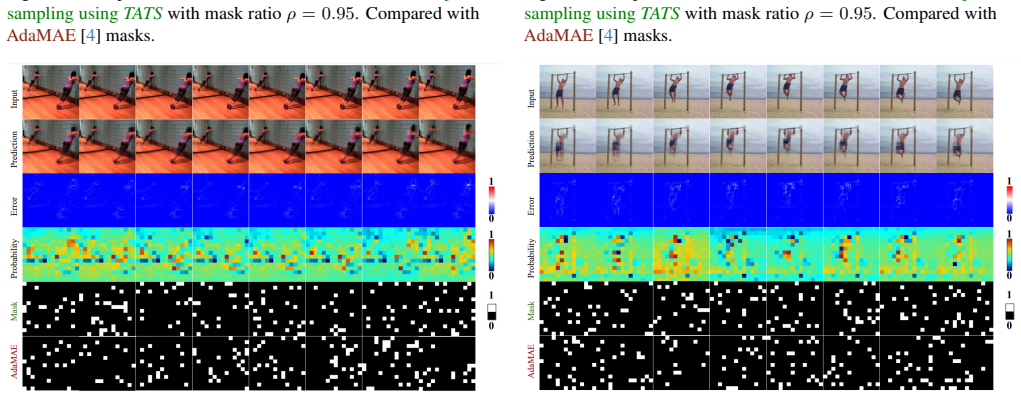
Figures from the paper (6 more)



Reference graph
Works this paper leans on
-
[1]
Pulkit Agrawal, Joao Carreira, and Jitendra Malik. Learning to see by moving. In Proceedings of the IEEE international conference on computer vision, pages 37–45, 2015. 3
work page 2015
-
[2]
Self-supervised object detection from egocentric videos
Peri Akiva, Jing Huang, Kevin J Liang, Rama Kovvuri, Xingyu Chen, Matt Feiszli, Kristin Dana, and Tal Hassner. Self-supervised object detection from egocentric videos. In 2023 IEEE/CVF International Conference on Computer Vi- sion (ICCV), pages 5202–5214, 2023. 1
work page 2023
-
[3]
Self- supervised Object-centric Learning for Videos
G¨orkay Aydemir, Weidi Xie, and Fatma G ¨uney. Self- supervised Object-centric Learning for Videos. In Advances in Neural Information Processing Systems, 2023. 1
work page 2023
-
[4]
Adamae: Adaptive masking for efficient spatiotempo- ral learning with masked autoencoders
Wele Gedara Chaminda Bandara, Naman Patel, Ali Gho- lami, Mehdi Nikkhah, Motilal Agrawal, and Vishal M Pa- tel. Adamae: Adaptive masking for efficient spatiotempo- ral learning with masked autoencoders. In Proceedings of the IEEE/CVF Conference on Computer Vision and Pattern Recognition, pages 14507–14517, 2023. 1, 2, 3, 4, 5, 6, 7, 8
work page 2023
-
[5]
Clustering on the unit hypersphere using von mises-fisher distributions
Arindam Banerjee, Inderjit S Dhillon, Joydeep Ghosh, Suvrit Sra, and Greg Ridgeway. Clustering on the unit hypersphere using von mises-fisher distributions. Journal of Machine Learning Research, 6(9), 2005. 3
work page 2005
-
[6]
Beit: Bert pre-training of image transformers
Hangbo Bao, Li Dong, Songhao Piao, and Furu Wei. Beit: Bert pre-training of image transformers. In International Conference on Learning Representations, 2022. 1, 3
work page 2022
-
[7]
Improving masked autoencoders by learning where to mask
Haijian Chen, Wendong Zhang, Yunbo Wang, and Xiaokang Yang. Improving masked autoencoders by learning where to mask. In Chinese Conference on Pattern Recognition and Computer Vision (PRCV), pages 377–390. Springer, 2023. 1, 3
work page 2023
-
[8]
Generative pretraining from pixels
Mark Chen, Alec Radford, Rewon Child, Jeffrey Wu, Heewoo Jun, David Luan, and Ilya Sutskever. Generative pretraining from pixels. In Proceedings of the 37th International Confer- ence on Machine Learning, pages 1691–1703. PMLR, 2020. 3
work page 2020
Show all 76 references
-
[9]
Dynamonet: Dynamic action and motion network
Ali Diba, Vivek Sharma, Luc Van Gool, and Rainer Stiefelha- gen. Dynamonet: Dynamic action and motion network. In Proceedings of the IEEE/CVF international conference on computer vision, pages 6192–6201, 2019. 3
2019
-
[10]
Peco: Perceptual codebook for bert pre-training of vision transformers
Xiaoyi Dong, Jianmin Bao, Ting Zhang, Dongdong Chen, Weiming Zhang, Lu Yuan, Dong Chen, Fang Wen, Nenghai Yu, and Baining Guo. Peco: Perceptual codebook for bert pre-training of vision transformers. In Proceedings of the AAAI Conference on Artificial Intelligence, pages 552–560,
-
[11]
An image is worth 16x16 words: Transformers for image recognition at scale
Alexey Dosovitskiy, Lucas Beyer, Alexander Kolesnikov, Dirk Weissenborn, Xiaohua Zhai, Thomas Unterthiner, Mostafa Dehghani, Matthias Minderer, Georg Heigold, Syl- vain Gelly, Jakob Uszkoreit, and Neil Houlsby. An image is worth 16x16 words: Transformers for image recognition ...
2021
-
[12]
Motion- guided masking for spatiotemporal representation learning
David Fan, Jue Wang, Shuai Liao, Yi Zhu, Vimal Bhat, Hec- tor Santos-Villalobos, Rohith MV , and Xinyu Li. Motion- guided masking for spatiotemporal representation learning. In Proceedings of the IEEE/CVF International Conference on Computer Vision, pages 5619–5629, 2023. 3, 4
2023
-
[13]
A large-scale study on unsupervised spatiotemporal representation learning
Christoph Feichtenhofer, Haoqi Fan, Bo Xiong, Ross Gir- shick, and Kaiming He. A large-scale study on unsupervised spatiotemporal representation learning. In Proceedings of the IEEE/CVF conference on computer vision and pattern recognition, pages 3299–3309, 2021. 3
2021
-
[14]
Masked autoencoders as spatiotemporal learners
Christoph Feichtenhofer, Yanghao Li, Kaiming He, et al. Masked autoencoders as spatiotemporal learners. Advances in neural information processing systems, 35:35946–35958,
-
[15]
Evolved part masking for self-supervised learning
Zhanzhou Feng and Shiliang Zhang. Evolved part masking for self-supervised learning. In Proceedings of the IEEE/CVF Conference on Computer Vision and Pattern Recognition , pages 10386–10395, 2023. 3
2023
-
[16]
Self-supervised video representation learn- ing with odd-one-out networks
Basura Fernando, Hakan Bilen, Efstratios Gavves, and Stephen Gould. Self-supervised video representation learn- ing with odd-one-out networks. In Proceedings of the IEEE conference on computer vision and pattern recognition, pages 3636–3645, 2017. 3
2017
-
[17]
Omnimae: Single model masked pretraining on images and videos
Rohit Girdhar, Alaaeldin El-Nouby, Mannat Singh, Kalyan Vasudev Alwala, Armand Joulin, and Ishan Misra. Omnimae: Single model masked pretraining on images and videos. In Proceedings of the IEEE/CVF Conference on Computer Vision and Pattern Recognition (CVPR) , pages 10406–1041...
2023
-
[18]
Reinforcement learning for language mod- els
Yoav Goldberg. Reinforcement learning for language mod- els. URL https : / / gist . github . com / yoavg / 6bff0fecd65950898eba1bb321cfbd81, 2023. 5
2023
-
[19]
Unsupervised learning of spatiotemporally coherent metrics
Ross Goroshin, Joan Bruna, Jonathan Tompson, David Eigen, and Yann LeCun. Unsupervised learning of spatiotemporally coherent metrics. In Proceedings of the IEEE international conference on computer vision, pages 4086–4093, 2015. 3
2015
-
[20]
The” something something” video database for learning and evaluating visual common sense
Raghav Goyal, Samira Ebrahimi Kahou, Vincent Michal- ski, Joanna Materzynska, Susanne Westphal, Heuna Kim, Valentin Haenel, Ingo Fruend, Peter Yianilos, Moritz Mueller- Freitag, et al. The” something something” video database for learning and evaluating visual common sense. In...
2017
-
[21]
Video repre- sentation learning by dense predictive coding
Tengda Han, Weidi Xie, and Andrew Zisserman. Video repre- sentation learning by dense predictive coding. In Proceedings of the IEEE/CVF international conference on computer vision workshops, pages 0–0, 2019. 3
2019
-
[22]
Self- supervised co-training for video representation learning
Tengda Han, Weidi Xie, and Andrew Zisserman. Self- supervised co-training for video representation learning. Ad- vances in neural information processing systems, 33:5679– 5690, 2020. 1
2020
-
[23]
Masked autoencoders are scalable 9 vision learners
Kaiming He, Xinlei Chen, Saining Xie, Yanghao Li, Piotr Doll´ar, and Ross Girshick. Masked autoencoders are scalable 9 vision learners. In Proceedings of the IEEE/CVF conference on computer vision and pattern recognition , pages 16000– 16009, 2022. 1, 3
2022
-
[24]
Using self-supervised learning can improve model robustness and uncertainty
Dan Hendrycks, Mantas Mazeika, Saurav Kadavath, and Dawn Song. Using self-supervised learning can improve model robustness and uncertainty. In Advances in Neural In- formation Processing Systems. Curran Associates, Inc., 2019. 1
2019
-
[25]
Mgmae: Motion guided masking for video masked autoencoding
Bingkun Huang, Zhiyu Zhao, Guozhen Zhang, Yu Qiao, and Limin Wang. Mgmae: Motion guided masking for video masked autoencoding. In Proceedings of the IEEE/CVF In- ternational Conference on Computer Vision, pages 13493– 13504, 2023. 2, 3, 4
2023
-
[26]
Everest: Efficient masked video autoencoder by removing redundant spatiotemporal tokens
Sunil Hwang, Jaehong Yoon, Youngwan Lee, and Sung Ju Hwang. Everest: Efficient masked video autoencoder by removing redundant spatiotemporal tokens. In International Conference on Machine Learning, 2024. 3
2024
-
[27]
Categorical reparameterization with gumbel-softmax
Eric Jang, Shixiang Gu, and Ben Poole. Categorical reparameterization with gumbel-softmax. arXiv preprint arXiv:1611.01144, 2016. 3
2016 arXiv
-
[28]
What to hide from your students: Attention- guided masked image modeling
Ioannis Kakogeorgiou, Spyros Gidaris, Bill Psomas, Yannis Avrithis, Andrei Bursuc, Konstantinos Karantzalos, and Nikos Komodakis. What to hide from your students: Attention- guided masked image modeling. In Computer Vision – ECCV 2022, pages 300–318, Cham, 2022. Springer Natur...
2022
-
[29]
The kinetics hu- man action video dataset
Will Kay, Joao Carreira, Karen Simonyan, Brian Zhang, Chloe Hillier, Sudheendra Vijayanarasimhan, Fabio Viola, Tim Green, Trevor Back, Paul Natsev, et al. The kinetics hu- man action video dataset. arXiv preprint arXiv:1705.06950,
-
[30]
Bert: Pre-training of deep bidirectional transform- ers for language understanding
Jacob Devlin Ming-Wei Chang Kenton and Lee Kristina Toutanova. Bert: Pre-training of deep bidirectional transform- ers for language understanding. In Proceedings of NAACL- HLT, pages 4171–4186, 2019. 1, 3
2019
-
[31]
Hmdb: a large video database for human motion recognition
Hildegard Kuehne, Hueihan Jhuang, Est ´ıbaliz Garrote, Tomaso Poggio, and Thomas Serre. Hmdb: a large video database for human motion recognition. In2011 International conference on computer vision , pages 2556–2563. IEEE,
-
[32]
Unsupervised representation learning by sorting sequences
Hsin-Ying Lee, Jia-Bin Huang, Maneesh Singh, and Ming- Hsuan Yang. Unsupervised representation learning by sorting sequences. In Proceedings of the IEEE international confer- ence on computer vision, pages 667–676, 2017. 3
2017
-
[33]
Semmae: Semantic-guided mask- ing for learning masked autoencoders
Gang Li, Heliang Zheng, Daqing Liu, Chaoyue Wang, Bing Su, and Changwen Zheng. Semmae: Semantic-guided mask- ing for learning masked autoencoders. Advances in Neural Information Processing Systems, 35:14290–14302, 2022. 1, 3
2022
-
[34]
Uniform masking: Enabling mae pre-training for pyramid- based vision transformers with locality
Xiang Li, Wenhai Wang, Lingfeng Yang, and Jian Yang. Uniform masking: Enabling mae pre-training for pyramid- based vision transformers with locality. arXiv preprint arXiv:2205.10063, 2022. 1, 3
2022 arXiv
-
[35]
Deep predictive coding networks for video prediction and unsu- pervised learning
William Lotter, Gabriel Kreiman, and David Cox. Deep predictive coding networks for video prediction and unsu- pervised learning. In International Conference on Learning Representations, 2017. 3
2017
-
[36]
Cl-mae: Curriculum-learned masked autoencoders
Neelu Madan, Nicolae-C ˘at˘alin Ristea, Kamal Nasrollahi, Thomas B Moeslund, and Radu Tudor Ionescu. Cl-mae: Curriculum-learned masked autoencoders. In Proceedings of the IEEE/CVF Winter Conference on Applications of Com- puter Vision, pages 2492–2502, 2024. 1, 3
2024
-
[37]
Deep multi-scale video prediction beyond mean square error
Michael Mathieu, Camille Couprie, and Yann LeCun. Deep multi-scale video prediction beyond mean square error. In 4th International Conference on Learning Representations, ICLR 2016, 2016. 3
2016
-
[38]
Shuffle and learn: unsupervised learning using temporal order veri- fication
Ishan Misra, C Lawrence Zitnick, and Martial Hebert. Shuffle and learn: unsupervised learning using temporal order veri- fication. In Computer Vision–ECCV 2016: 14th European Conference, Amsterdam, The Netherlands, October 11–14, 2016, Proceedings, Part I 14, pages 527–544. Sp...
2016
-
[39]
Oswald, Alexander Kirillov, Cees G
Duy Kien Nguyen, Yanghao Li, Vaibhav Aggarwal, Martin R. Oswald, Alexander Kirillov, Cees G. M. Snoek, and Xinlei Chen. R-MAE: Regions meet masked autoencoders. In The Twelfth International Conference on Learning Representa- tions, 2024. 3
2024
-
[40]
Maxime Oquab, Timoth´ee Darcet, Theo Moutakanni, Huy V . V o, Marc Szafraniec, Vasil Khalidov, Pierre Fernandez, Daniel Haziza, Francisco Massa, Alaaeldin El-Nouby, Russell Howes, Po-Yao Huang, Hu Xu, Vasu Sharma, Shang-Wen Li, Wojciech Galuba, Mike Rabbat, Mido Assran, Nicola...
-
[41]
Learning features by watching objects move
Deepak Pathak, Ross Girshick, Piotr Doll´ar, Trevor Darrell, and Bharath Hariharan. Learning features by watching objects move. In Proceedings of the IEEE conference on computer vision and pattern recognition, pages 2701–2710, 2017. 3
2017
-
[42]
Keeping your eye on the ball: Trajectory at- tention in video transformers
Mandela Patrick, Dylan Campbell, Yuki Asano, Ishan Misra, Florian Metze, Christoph Feichtenhofer, Andrea Vedaldi, and Joao F Henriques. Keeping your eye on the ball: Trajectory at- tention in video transformers. Advances in neural information processing systems, 34:12493–12506...
2021
-
[43]
Spatiotempo- ral contrastive video representation learning
Rui Qian, Tianjian Meng, Boqing Gong, Ming-Hsuan Yang, Huisheng Wang, Serge Belongie, and Yin Cui. Spatiotempo- ral contrastive video representation learning. In Proceedings of the IEEE/CVF conference on computer vision and pattern recognition, pages 6964–6974, 2021. 3
2021
-
[44]
Learning transferable visual models from natural language supervi- sion
Alec Radford, Jong Wook Kim, Chris Hallacy, Aditya Ramesh, Gabriel Goh, Sandhini Agarwal, Girish Sastry, Amanda Askell, Pamela Mishkin, Jack Clark, et al. Learning transferable visual models from natural language supervi- sion. In International conference on machine learning, ...
2021
-
[45]
Zero-shot text-to-image generation
Aditya Ramesh, Mikhail Pavlov, Gabriel Goh, Scott Gray, Chelsea V oss, Alec Radford, Mark Chen, and Ilya Sutskever. Zero-shot text-to-image generation. In International confer- ence on machine learning , pages 8821–8831. Pmlr, 2021. 3
2021
-
[46]
Proximal policy optimization algo- rithms
John Schulman, Filip Wolski, Prafulla Dhariwal, Alec Rad- ford, and Oleg Klimov. Proximal policy optimization algo- rithms. arXiv preprint arXiv:1707.06347, 2017. 2, 3, 5, 8
2017 arXiv
-
[47]
Adversarial masking for self-supervised learning
Yuge Shi, N Siddharth, Philip Torr, and Adam R Kosiorek. Adversarial masking for self-supervised learning. In Interna- 10 tional Conference on Machine Learning, pages 20026–20040. PMLR, 2022. 3
2022
-
[48]
Ucf101: A dataset of 101 human actions classes from videos in the wild
Khurram Soomro, Amir Roshan Zamir, and Mubarak Shah. Ucf101: A dataset of 101 human actions classes from videos in the wild. arXiv preprint arXiv:1212.0402, 2012. 6, 1
2012 arXiv
-
[49]
Learning video representations using contrastive bidirectional transformer
Chen Sun, Fabien Baradel, Kevin Murphy, and Cordelia Schmid. Learning video representations using contrastive bidirectional transformer. arXiv preprint arXiv:1906.05743,
1906 arXiv
-
[50]
Masked motion encoding for self-supervised video representation learning
Xinyu Sun, Peihao Chen, Liangwei Chen, Changhao Li, Thomas H Li, Mingkui Tan, and Chuang Gan. Masked motion encoding for self-supervised video representation learning. In Proceedings of the IEEE/CVF Conference on Computer Vision and Pattern Recognition, pages 2235–2245, 2023. 3, 4
2023
-
[51]
Raft: Recurrent all-pairs field transforms for optical flow
Zachary Teed and Jia Deng. Raft: Recurrent all-pairs field transforms for optical flow. In Computer Vision–ECCV 2020: 16th European Conference, Glasgow, UK, August 23–28, 2020, Proceedings, Part II 16, pages 402–419. Springer, 2020. 2, 3, 4, 8
2020
-
[52]
Video- MAE: Masked autoencoders are data-efficient learners for self-supervised video pre-training
Zhan Tong, Yibing Song, Jue Wang, and Limin Wang. Video- MAE: Masked autoencoders are data-efficient learners for self-supervised video pre-training. In Advances in Neural Information Processing Systems, 2022. 1, 2, 3, 4, 6, 7, 8
2022
-
[53]
Neural discrete representation learning
Aaron Van Den Oord, Oriol Vinyals, et al. Neural discrete representation learning. Advances in neural information pro- cessing systems, 30, 2017. 3
2017
-
[54]
Attention is all you need
A Vaswani. Attention is all you need. Advances in Neural Information Processing Systems, 2017. 4
2017
-
[55]
Extracting and composing robust features with denoising autoencoders
Pascal Vincent, Hugo Larochelle, Yoshua Bengio, and Pierre- Antoine Manzagol. Extracting and composing robust features with denoising autoencoders. In Proceedings of the 25th Inter- national Conference on Machine Learning, page 1096–1103, New York, NY , USA, 2008. Association ...
2008
-
[56]
An- ticipating visual representations from unlabeled video
Carl V ondrick, Hamed Pirsiavash, and Antonio Torralba. An- ticipating visual representations from unlabeled video. In Proceedings of the IEEE conference on computer vision and pattern recognition, pages 98–106, 2016. 3
2016
-
[57]
Tracking emerges by col- orizing videos
Carl V ondrick, Abhinav Shrivastava, Alireza Fathi, Sergio Guadarrama, and Kevin Murphy. Tracking emerges by col- orizing videos. In Proceedings of the European conference on computer vision (ECCV), pages 391–408, 2018. 3
2018
-
[58]
Self-supervised spatio-temporal representation learning for videos by predicting motion and appearance statistics
Jiangliu Wang, Jianbo Jiao, Linchao Bao, Shengfeng He, Yunhui Liu, and Wei Liu. Self-supervised spatio-temporal representation learning for videos by predicting motion and appearance statistics. In Proceedings of the IEEE/CVF con- ference on computer vision and pattern recogni...
2019
-
[59]
Videomae v2: Scaling video masked autoencoders with dual masking
Limin Wang, Bingkun Huang, Zhiyu Zhao, Zhan Tong, Yinan He, Yi Wang, Yali Wang, and Yu Qiao. Videomae v2: Scaling video masked autoencoders with dual masking. In Proceed- ings of the IEEE/CVF Conference on Computer Vision and Pattern Recognition, pages 14549–14560, 2023. 1, 2, 3
2023
-
[60]
Bevt: Bert pretraining of video transformers
Rui Wang, Dongdong Chen, Zuxuan Wu, Yinpeng Chen, Xiyang Dai, Mengchen Liu, Yu-Gang Jiang, Luowei Zhou, and Lu Yuan. Bevt: Bert pretraining of video transformers. In Proceedings of the IEEE/CVF conference on computer vision and pattern recognition, pages 14733–14743, 2022. 1, 3
2022
-
[61]
Masked video distillation: Rethinking masked feature mod- eling for self-supervised video representation learning
Rui Wang, Dongdong Chen, Zuxuan Wu, Yinpeng Chen, Xiyang Dai, Mengchen Liu, Lu Yuan, and Yu-Gang Jiang. Masked video distillation: Rethinking masked feature mod- eling for self-supervised video representation learning. In Proceedings of the IEEE/CVF conference on computer visi...
2023
-
[62]
Unsupervised learning of visual representations using videos
Xiaolong Wang and Abhinav Gupta. Unsupervised learning of visual representations using videos. In Proceedings of the IEEE international conference on computer vision, pages 2794–2802, 2015. 3
2015
-
[63]
Learning correspondence from the cycle-consistency of time
Xiaolong Wang, Allan Jabri, and Alexei A Efros. Learning correspondence from the cycle-consistency of time. In Pro- ceedings of the IEEE/CVF conference on computer vision and pattern recognition, pages 2566–2576, 2019. 3
2019
-
[64]
Masked feature predic- tion for self-supervised visual pre-training
Chen Wei, Haoqi Fan, Saining Xie, Chao-Yuan Wu, Alan Yuille, and Christoph Feichtenhofer. Masked feature predic- tion for self-supervised visual pre-training. In Proceedings of the IEEE/CVF Conference on Computer Vision and Pattern Recognition, pages 14668–14678, 2022. 1, 3
2022
-
[65]
Learning and using the arrow of time
Donglai Wei, Joseph J Lim, Andrew Zisserman, and William T Freeman. Learning and using the arrow of time. In Proceedings of the IEEE conference on computer vision and pattern recognition, pages 8052–8060, 2018. 3
2018
-
[66]
Efficient vision- language pre-training by cluster masking
Zihao Wei, Zixuan Pan, and Andrew Owens. Efficient vision- language pre-training by cluster masking. In Proceedings of the IEEE/CVF Conference on Computer Vision and Pattern Recognition, pages 26815–26825, 2024. 3
2024
-
[67]
Williams
Ronald J. Williams. Simple statistical gradient-following algorithms for connectionist reinforcement learning. Machine Learning, 8:229–256, 1992. 2, 4, 5
1992
-
[68]
Slow feature analysis: Unsupervised learning of invariances
Laurenz Wiskott and Terrence J Sejnowski. Slow feature analysis: Unsupervised learning of invariances. Neural com- putation, 14(4):715–770, 2002. 3
2002
-
[69]
Masked frequency modeling for self-supervised visual pre-training
Jiahao Xie, Wei Li, Xiaohang Zhan, Ziwei Liu, Yew-Soon Ong, and Chen Change Loy. Masked frequency modeling for self-supervised visual pre-training. In The Eleventh Inter- national Conference on Learning Representations, 2023. 1, 3
2023
-
[70]
Simmim: A simple framework for masked image modeling
Zhenda Xie, Zheng Zhang, Yue Cao, Yutong Lin, Jianmin Bao, Zhuliang Yao, Qi Dai, and Han Hu. Simmim: A simple framework for masked image modeling. In Proceedings of the IEEE/CVF conference on computer vision and pattern recognition, pages 9653–9663, 2022. 1, 3
2022
-
[71]
How mask mat- ters: Towards theoretical understandings of masked autoen- coders
Qi Zhang, Yifei Wang, and Yisen Wang. How mask mat- ters: Towards theoretical understandings of masked autoen- coders. Advances in Neural Information Processing Systems, 35:27127–27139, 2022. 3
2022
-
[72]
Image BERT pre-training with online tokenizer
Jinghao Zhou, Chen Wei, Huiyu Wang, Wei Shen, Cihang Xie, Alan Yuille, and Tao Kong. Image BERT pre-training with online tokenizer. In International Conference on Learning Representations, 2022. 1, 3 11 Reinforcement Learning meets Masked Video Modeling : Trajectory-Guided Ada...
2022
-
[73]
Each video depicts a single action with a duration ranging from 2 to 6 seconds
Datasets Something-Something V2 (SSv2) [20] is a curated video dataset for human action classification, comprising 174 classes and a total of 220,847 videos. Each video depicts a single action with a duration ranging from 2 to 6 seconds. SSv2 is a motion-focused dataset, where...
-
[74]
Data Preprocessing Our data processing pipeline closely follows AdaMAE [4] for pre-training
Additional Implementation Details 8.1. Data Preprocessing Our data processing pipeline closely follows AdaMAE [4] for pre-training. We extract 16 frames of dimension 224× 224 from the videos, using a temporal stride of 4 (K400) and 2 (HMDB51/UCF101/SSv2), with the starting fra...
-
[75]
Large Scale Pre-training Results We conduct pre-training (400 epochs) and finetuning (100 epochs) of our model on full SSv2 [20] dataset forρ = 0.95 on 8 Nvidia A100 GPUs. In order to ensure fairness in comparison, we also pre-train (400 epochs) and finetune (100 epochs) both ...
-
[76]
Mask Visualization Here we show visualizations adaptive sampling learned by our TATS module across benchmark dataset for different mask ratiosρ ={0.95, 0.9, 0.85} in Figure 4, 5, 6, 7, 8, 9, 10, 11, 12, 13, 14, 15. In all of these Figures, first row represents input video fram...
Reviewed August 15, 2026 · model on record in the stance chip above.
Discussion (0). Continue with ORCID to comment.