REVIEW 4 major objections 5 minor 31 references
Robust Indoor Localization via Conformal Methods and Variational Bayesian Adaptive Filtering
T0 review · 4 major / 5 minor · reviewed 2026-08-15 · deepseek-v4-flash
Pith's one-line read Variational Bayesian learning, Huber M-estimation, and sliding-window conformal outlier detection can keep indoor localization accurate in non-Gaussian noise, reducing worst-case positioning error from 6.87 m to 0.35 m.
desk verdict A genuinely new engineering combination with a solid Monte Carlo study, but both theoretical guarantees are broken and the field experiment is too vague to verify; reject after review, not desk-reject. read the letter →
The pith
A machine-rendered reading of the paper's core claim, the machinery that carries it, and where it could break.
The reading
What carries the argument
The load-bearing mechanism is the filter-aware conformal outlier detector. At each time step it forms a non-conformity score from the normalized innovation, $s_k = \|z_k - H\hat{x}_{k|k-1}\|_{S_k^{-1}}$ with $S_k = HP_{k|k-1}H^\top + R_k$, and compares it with the sliding-window quantile $\hat{q}_k$ over the past $w$ scores. A score above $\hat{q}_k$ triggers covariance inflation, $R_k \leftarrow \gamma R_k$ for $\gamma > 1$, which dampens the suspect measurement while preserving filter stability. Variational Bayesian inference, using an inverse-Wishart prior on $R_k$, supplies the adaptive noise covariance; the Huber weight function handles mild outliers before the conformal layer fires. This stack is what converts a distribution-free prediction-set method into a real-time robust filtering update.
What would settle it
Run the conformal outlier detection layer on a long recorded geomagnetic walk with known outliers injected at random positions, fixing $\alpha$ in advance, and compare the empirical rate at which clean samples are flagged with $\alpha$. If the empirical false-alarm rate systematically exceeds the nominal level, or if the empirical coverage of the sliding-window prediction sets falls below $1 - \alpha - O(1/\sqrt{w})$, the modified exchangeability assumption is violated and the central statistical claim fails.
Extended reading notes
Core claim
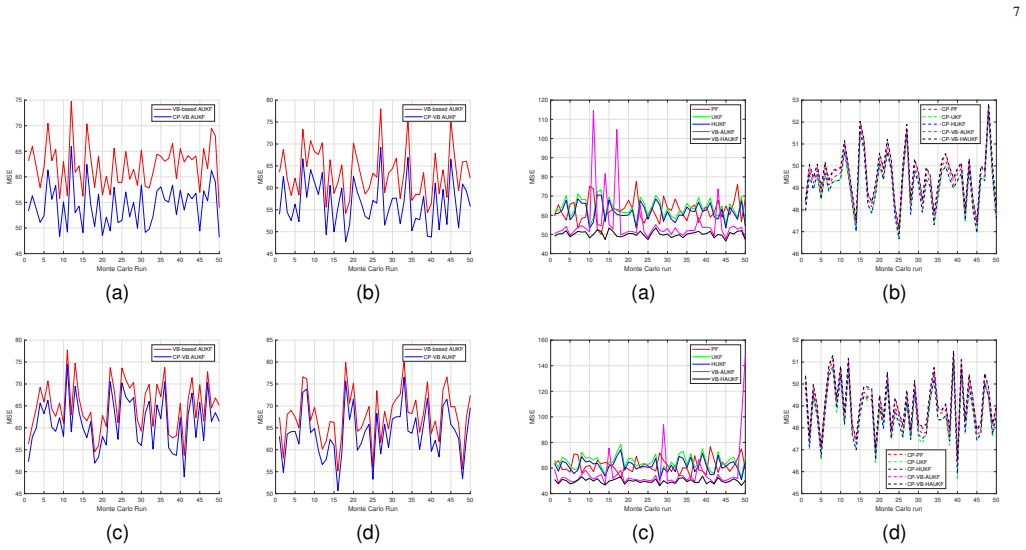
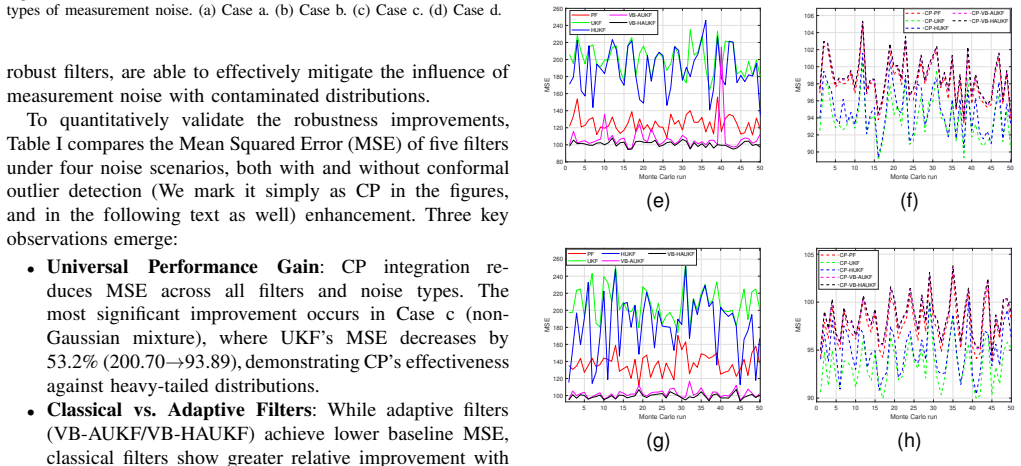
The paper demonstrates, through Monte Carlo simulations and a real geomagnetic/inertial experiment, that wrapping a robust filter with a sliding-window conformal outlier detector improves estimation under non-Gaussian and outlier-contaminated noise. Its theoretical contributions are a proof that the Huber-modified posterior covariance remains positive semi-definite and a proof that the sliding-window conformal threshold has coverage $\mathbb{P}(s_k \le \hat{q}_k) \ge 1 - \alpha - O(1/\sqrt{w})$ under a modified exchangeability assumption. In the reported experiments the full VB-Huber-AUKF plus conformal detector achieves the lowest mean squared error in every noise scenario, and the largest relative gains appear in heavy-tailed mixture noise cases.
Load-bearing premise
The load-bearing premise is that the non-conformity scores in each sliding calibration window of size $w+1$ are approximately exchangeable; the paper assumes this without testing it, and both the coverage guarantee and the user-controlled false-alarm rate depend on it.
Editorial extensions
If this is right
- A user can set a target false-alarm rate $\alpha$ for outlier rejection and expect the detection threshold to adapt to changing signal statistics without retraining.
- The conformal layer is portable: the paper's simulations show it reduces mean squared error for PF, UKF, HUKF, VB-AUKF, and VB-HAUKF, so existing filters can be hardened by wrapping them with the same detector.
- The largest improvements occur where Gaussian assumptions fail hardest: in the heavy-tailed mixture-noise case, UKF's mean MSE drops by 53.2%.
- The $O(1/\sqrt{w})$ coverage gap makes the adaptivity-versus-guarantee tradeoff explicit: a longer window tightens the statistical bound, while a shorter window tracks environmental changes faster.
- If the field experiment is representative, this filter stack can keep geomagnetic fingerprint positioning errors below roughly one-third of a meter on a 3-meter grid.
Reading between the lines
- The conformal layer is not Kalman-specific; any estimator that can produce a predictive mean and covariance could be wrapped with the same normalized-innovation threshold, including particle filters or learned positioning models.
- The modified exchangeability assumption is the untested hinge. A direct empirical coverage audit on recorded geomagnetic walks with injected outliers would show whether the nominal $1-\alpha$ false-alarm rate survives real nonstationarity.
- A soft alternative to the binary covariance-inflation rule would weight measurements continuously by the conformal score, potentially reducing variance near the decision boundary.
- Persistent threshold violations could double as a sensor-health signal, flagging a drifting magnetometer or a changed environment rather than a single bad measurement.
Signed reviews
Editorial analysis
A structured set of objections, weighed in public.
Referee Report
Summary. The paper proposes a hierarchical framework for robust indoor localization that combines variational Bayesian (VB) parameter learning, Huber M-estimation, and a conformal outlier detection (COD) layer. The central claims are: (i) VB-UKF adaptively estimates state and noise covariances; (ii) Huber weighting suppresses mild outliers while preserving positive semi-definiteness of the posterior covariance; and (iii) COD provides a distribution-free, user-controlled false-alarm guarantee through a sliding-window conformal threshold. The theoretical part includes Theorem 1 on Huber-weighted covariance and Theorem 2 on time-varying coverage for sliding-window conformal prediction. The experiments use a Univariate Nonstationary Growth Model (UNGM) with four noise scenarios and a geomagnetic fingerprint indoor localization testbed; the reported results show consistent MSE reductions when the COD layer is added and an improvement in fingerprint matching accuracy from 81.25% to 93.75% with positioning errors reduced from 0.62–6.87 m to 0.03–0.35 m. The paper frames these results as evidence that the framework provides statistically rigorous confidence intervals and robust outlier mitigation in non-Gaussian environments.
Significance. If the claimed coverage guarantee were valid, the integration of VB adaptation, Huber robustness, and conformal outlier detection would be a useful contribution to robust indoor localization under non-Gaussian noise. The UNGM Monte Carlo comparison is a genuine empirical study and the reported MSE gains are internally consistent with the paper's algorithmic claims. However, the load-bearing theoretical result—the sliding-window conformal coverage guarantee—is not established: the proof in Appendix B is mathematically invalid, and the 'Modified Exchangeability Assumption' on which it depends is asserted without empirical or theoretical support for autocorrelated, nonstationary geomagnetic/IMU streams. Moreover, the experiments do not measure the advertised coverage or false-alarm rate, so the central statistical claim remains unverified. The paper also does not provide code or data, which limits reproducibility.
major comments (4)
- [§III-C2 and Appendix B, Eq. (31)] The proof of Theorem 2 is invalid as written. The sequence D_k = I{s_k ≤ qhat_k} − (1−α) is not a martingale difference sequence with respect to the natural filtration, because qhat_k depends on the calibration window C_k and hence on past scores; E[I{s_k ≤ qhat_k} | F_{k−1}] = P(s_k ≤ qhat_k | F_{k−1}) is a random variable that is generally not equal to 1−α. Azuma–Hoeffding therefore cannot be applied to this sequence. In addition, the normalization step does not yield the claimed pointwise bound: a concentration inequality for (1/(K−w)) Σ D_k would control an average over time, not the marginal probability P(s_k ≤ qhat_k) in Eq. (31). The proof also cites reference [31] as the source of a 'weakly dependent sequences' inequality, but [31] is the jackknife+ paper, which does not contain such a result.
- [Appendix B, 'Modified Exchangeability Assumption'] The coverage guarantee rests entirely on the assumption that the non-conformity scores in C_k ∪ {s_k} are approximately exchangeable within temporal blocks of size w+1. This assumption is stated without any empirical validation or literature support for geomagnetic and inertial measurement streams, which are strongly autocorrelated and nonstationary. It is essentially the same exchangeability condition that conformal prediction requires, so the proof does not derive the guarantee; it assumes it. Consequently, the advertised 'user-controlled false alarm rate' and the claim of working 'without making assumptions about the underlying noise distribution' are not established. A concrete test would be to report empirical coverage and false-alarm rates on labeled outliers under Cases c/d and on the real geomagnetic data, which the paper does not provide.
- [§IV-A, Table I and §IV-B] The empirical evaluation does not test the central statistical claim. The UNGM experiments report only MSE values; no empirical coverage of the conformal interval, no false-alarm rate, and no precision/recall against labeled outliers are given. The Introduction's claim of '95% outlier detection precision with controlled false alarms' is not supported by any table or figure in the paper. The real-world experiment in Section IV-B reports only single-point matching accuracy (81.25% to 93.75%) and an error range (0.62–6.87 m to 0.03–0.35 m), without specifying the number of test points, the experimental protocol, the number of independent runs, or comparisons against the baseline filters used in simulation. As a result, the empirical study cannot substitute for the missing coverage guarantee.
- [Eq. (27) and §III-C2] The non-conformity score in Eq. (27) is defined through a linearized innovation covariance H P H^T + R_k, but the filtering framework is an unscented filter with a nonlinear measurement function h(·). The paper never defines H for the UNGM or for the geomagnetic experiment, and it does not explain how Eq. (27) relates to the UKF innovation covariance P_zz computed in Eq. (15). If H is a Jacobian, its definition is missing; if H is intended as a linearization, its use in an unscented filter needs justification. This makes the actual conformal scores used in the experiments ambiguous and hinders reproducibility.
minor comments (5)
- [Section III-C2 vs. Appendix B] The main text labels the coverage result as Theorem 2, while Appendix B labels the same result as Theorem 3; the numbering should be reconciled.
- [Eq. (29)] The quantile definition in Eq. (29) is not the standard conformal quantile. Standard split conformal uses the ⌈(w+1)(1−α)⌉-th order statistic of the calibration scores; writing it as an empirical quantile at level ⌈(w+1)(1−α)⌉/w is inaccurate for finite w and should be corrected or justified.
- [Section III-B, paragraph before Eq. (12)] The text says the variational framework 'maximizes the Kullback-Leibler divergence' between the variational distribution and the posterior; this should be 'minimizes the KL divergence' (equivalently, maximizes the ELBO), otherwise the exposition is technically wrong.
- [Figures 2, 4, 5, and 6] Several figures lack full axis labels or explicit descriptions of the plotted quantities (e.g., Figure 2's 'Value' axis and Figure 6's 'Error' axis are not defined in the text); the caption of Figure 2 mentions 20 test samples but does not describe how the conformal interval is constructed from those samples, which limits reproducibility.
- [Section V and Abstract] The paper states that 'Sections IV–V describe the experimental setup and results, followed by conclusions in Section V,' which conflates Section V with both results and conclusions; the structure should be clarified.
Circularity Check
Theorem 2's coverage guarantee is partially circular: the Appendix B proof assumes approximate exchangeability of the extended window and defines the centered indicator as a martingale difference, which is the very coverage property to be established.
-
self definitional
[Appendix B, 'Modified Exchangeability Assumption' (proof of Theorem 2 / Eq. (31))]
"Assume the scores in the extended window Ck∪{ sk} are approximately exchangeable within any temporal block of size w + 1 . This weakens the i.i.d. assumption while preserving local stationarity."
The theorem's conclusion is P(s_k ≤ qhat_k) ≥ 1−α−O(1/√w). In conformal prediction, exchangeability of the calibration scores together with the test score is precisely the condition that produces such coverage; it is not a consequence derived from the filter or from geomagnetic data. The paper advertises 'finite-sample coverage bounds for non-exchangeable time series' as a contribution, but the proof begins by assuming approximate exchangeability of C_k∪{s_k}. Thus the advertised robustness to non-exchangeability is the premise, not a derived property.
-
self definitional
[Appendix B, 'Coverage Analysis' (proof of Theorem 2)]
"Define the martingale difference sequence: Dk = I{sk≤ qhat_k}− (1− α)"
Calling D_k a martingale difference sequence is equivalent to assuming E[I{s_k ≤ qhat_k} | past] = 1−α at every step, which is exactly the conditional coverage statement the theorem must prove. Since qhat_k is the empirical quantile of the past scores in C_k, D_k is not a martingale difference unless the conclusion is assumed. The subsequent Azuma–Hoeffding bound and O(1/√w) rate therefore restate the assumed coverage rather than derive it.
full rationale
The empirical comparisons in Section IV are self-contained and are not fitted to the framework's own outputs; the VB and Huber components are standard and are not circular. The circularity is confined to the conformal coverage theorem, which is the paper's main theoretical novelty. Theorem 2 / Eq. (31) is supposed to guarantee a user-controlled false-alarm rate for the outlier detector, but the Appendix B proof imports the conclusion in two places: first by assuming approximate exchangeability of the extended window C_k∪{s_k}, and second by defining the centered indicator D_k as a martingale difference sequence, which is the coverage property to be shown. Because the advertised 'statistically rigorous confidence intervals' and 'user-controlled false alarm rate' rest on Theorem 2, the central theoretical claim is partially circular. The simulation and field experiments provide independent evidence of MSE and accuracy improvements, but the paper never measures coverage or false-alarm rate against labeled outliers, so those experiments do not supply the missing derivation. No load-bearing self-citation chain was found; the one self-citation, reference [30], is background for geomagnetic fingerprint similarity and is additionally corroborated by the authors' own collected data.
Assumptions & free parameters
free parameters (7)
- Huber threshold delta =
1.345 sigma
- Conformal miscoverage rate alpha =
0.05 in examples
- Sliding window size w
- Covariance inflation factor gamma
- VB forgetting factor rho
- UKF spread parameter kappa
- VB iteration count N
assumptions (4)
- ad hoc to paper Approximate exchangeability of non-conformity scores in sliding windows (block exchangeability)
- domain assumption Measurement noise covariance follows an inverse-Wishart prior with conjugate updates
- domain assumption State-space model with zero-mean Gaussian process and measurement noise before adaptation
- domain assumption Geomagnetic fingerprints are stable over months for the same path
Cite this review
Pith. "Pith review of Robust Indoor Localization via Conformal Methods and Variational Bayesian Adaptive Filtering." pith.science (2026). https://pith.science/paper/6LYTAH24
@misc{pith2026250508639,
  author       = {Pith},
  title        = {Pith review of: Robust Indoor Localization via Conformal Methods and Variational Bayesian Adaptive Filtering},
  year         = {2026},
  howpublished = {\url{https://pith.science/paper/6LYTAH24}},
  note         = {Machine review of arXiv:2505.08639}
}
read the original abstract
Indoor localization is critical for IoT applications, yet challenges such as non-Gaussian noise, environmental interference, and measurement outliers hinder the robustness of traditional methods. Existing approaches, including Kalman filtering and its variants, often rely on Gaussian assumptions or static thresholds, limiting adaptability in dynamic environments. This paper proposes a hierarchical robust framework integrating Variational Bayesian (VB) parameter learning, Huber M-estimation, and Conformal Outlier Detection (COD) to address these limitations. First, VB inference jointly estimates state and noise parameters, adapting to time-varying uncertainties. Second, Huber-based robust filtering suppresses mild outliers while preserving Gaussian efficiency. Third, COD provides statistical guarantees for outlier detection via dynamically calibrated thresholds, ensuring a user-controlled false alarm rate. Theoretically, we prove the Semi-positive Definiteness of Huber-based Kalman filtering covariance and the coverage of sliding window conformal prediction. Experiments on geomagnetic fingerprint datasets demonstrate significant improvements: fingerprint matching accuracy increases from 81.25% to 93.75%, and positioning errors decrease from 0.62-6.87 m to 0.03-0.35 m. Comparative studies further validate the framework's robustness, showing consistent performance gains under non-Gaussian noise and outlier conditions.
Figures


Figures from the paper (4 more)


Reference graph
Works this paper leans on
-
[31]
Pre dictive inference with the jackknife+,
R. Barber, E. Candes, A. Ramdas, and R. Tibshirani, “Pre dictive inference with the jackknife+,” Annals of Statistics , 2022
work page 2022
-
[1]
Enabling intelligent connectivity: A survey of secure isac in 6g netw orks,
X. Zhu, J. Liu, L. Lu, T. Zhang, T. Qiu, C. Wang, and Y . Liu, “ Enabling intelligent connectivity: A survey of secure isac in 6g netw orks,” IEEE Communications Surveys & Tutorials , 2024
2024
-
[2]
Indoor events monitoring using channel state information time series,
Q. Xu, Y . Han, B. Wang, M. Wu, and K. R. Liu, “Indoor events monitoring using channel state information time series,” IEEE Internet of Things Journal , vol. 6, no. 3, pp. 4977–4990, 2019
work page 2019
-
[3]
Kalman filter: historical ove rview and review of its use in robotics 60 years after its creation,
C. Urrea and R. Agramonte, “Kalman filter: historical ove rview and review of its use in robotics 60 years after its creation,” Journal of Sensors, vol. 2021, no. 1, p. 9674015, 2021
work page 2021
-
[4]
V ariational inference based distribut ed noise adaptive bayesian filter,
H. Lin and C. Hu, “V ariational inference based distribut ed noise adaptive bayesian filter,” Signal Processing, vol. 178, p. 107775, 2021
work page 2021
-
[5]
Minimax robust dete ction: Classic results and recent advances,
M. Fauß, A. M. Zoubir, and H. V . Poor, “Minimax robust dete ction: Classic results and recent advances,” IEEE Transactions on signal Processing, vol. 69, pp. 2252–2283, 2021
work page 2021
-
[6]
Smart anomaly detection in sens or systems: A multi-perspective review,
L. Erhan, M. Ndubuaku, M. Di Mauro, W. Song, M. Chen, G. For tino, O. Bagdasar, and A. Liotta, “Smart anomaly detection in sens or systems: A multi-perspective review,” Information Fusion , vol. 67, pp. 64–79, 2021
work page 2021
-
[7]
G. Guo, R. Chen, F. Y e, Z. Liu, S. Xu, L. Huang, Z. Li, and L. Q ian, “A robust integration platform of wi-fi rtt, rss signal, and m ems-imu for locating commercial smartphone indoors,” IEEE Internet of Things Journal, vol. 9, no. 17, pp. 16 322–16 331, 2022
work page 2022
Show all 31 references
-
[8]
Bluetoot h 5.1: An analysis of direction finding capability for high-precis ion location services,
G. Pau, F. Arena, Y . E. Gebremariam, and I. Y ou, “Bluetoot h 5.1: An analysis of direction finding capability for high-precis ion location services,” Sensors, vol. 21, no. 11, p. 3589, 2021
2021
-
[9]
An experimental study on direction fi nding of bluetooth 5.1: Indoor vs outdoor,
P . Sambu and M. Won, “An experimental study on direction fi nding of bluetooth 5.1: Indoor vs outdoor,” in 2022 IEEE Wireless Communica- tions and Networking Conference (WCNC) . IEEE, 2022, pp. 1934– 1939
2022
-
[10]
Indoor geom agnetic positioning using the enhanced genetic algorithm-based ex treme learning machine,
M. Sun, Y . Wang, S. Xu, H. Y ang, and K. Zhang, “Indoor geom agnetic positioning using the enhanced genetic algorithm-based ex treme learning machine,” IEEE Transactions on Instrumentation and Measurement , vol. 70, pp. 1–11, 2021
2021
-
[11]
Indoor localiz ation using mind evolutionary algorithm-based geomagnetic posi tioning and smartphone imu sensors,
M. Sun, Y . Wang, W. Joseph, and D. Plets, “Indoor localiz ation using mind evolutionary algorithm-based geomagnetic posi tioning and smartphone imu sensors,” IEEE Sensors Journal , vol. 22, no. 7, pp. 7130–7141, 2022
2022
-
[12]
Calibration and compensatio n of anchor positions for uwb indoor localization,
M. Qi, B. Xue, and W. Wang, “Calibration and compensatio n of anchor positions for uwb indoor localization,” IEEE Sensors Journal , 2023
2023
-
[13]
Recent advances in wsn-based indoor local ization: A systematic review of emerging technologies, methods, chal lenges and trends,
N. S. Ahmad, “Recent advances in wsn-based indoor local ization: A systematic review of emerging technologies, methods, chal lenges and trends,” IEEE Access , 2024
2024
-
[14]
Adaptive fading-memory receding-horizon fil ters and smoother for linear discrete time-varying systems,
B. Kwon, “Adaptive fading-memory receding-horizon fil ters and smoother for linear discrete time-varying systems,” Applied Sciences , vol. 12, no. 13, p. 6692, 2022
2022
-
[15]
Interacting multip le model based on maximum correntropy kalman filter,
X. Fan, G. Wang, J. Han, and Y . Wang, “Interacting multip le model based on maximum correntropy kalman filter,” IEEE Transactions on Circuits and Systems II: Express Briefs , vol. 68, no. 8, pp. 3017–3021, 2021
2021
-
[16]
A gaussian sum filter for pulsar navigation: Pr ocessing single photon arrival time measurements,
P .-T. Chen, D. S. Bayard, R. F. Sharrow, W. A. Majid, B. A. Dunst, and J. L. Speyer, “A gaussian sum filter for pulsar navigation: Pr ocessing single photon arrival time measurements,” IEEE Transactions on Control Systems Technology, vol. 31, no. 6, pp. 2499–2514, 2023
2023
-
[17]
An improved robus t filter method for sins/dvl system with earth frame error mode l,
D. Wang, B. Wang, H. Huang, and Y . Y ao, “An improved robus t filter method for sins/dvl system with earth frame error mode l,” IEEE Transactions on V ehicular Technology, 2024
2024
-
[18]
A variational bayesian-base d unscented kalman filter with both adaptivity and robustness,
K. Li, L. Chang, and B. Hu, “A variational bayesian-base d unscented kalman filter with both adaptivity and robustness,” IEEE Sensors Jour- nal, vol. 16, no. 18, pp. 6966–6976, 2016
2016
-
[19]
V ariationa l bayesian- based robust cubature kalman filter with application on sins /gps inte- grated navigation system,
X. Liu, X. Liu, Y . Y ang, Y . Guo, and W. Zhang, “V ariationa l bayesian- based robust cubature kalman filter with application on sins /gps inte- grated navigation system,” IEEE Sensors Journal , vol. 22, no. 1, pp. 489–500, 2021
2021
-
[20]
Real-time outlier detectio n applied to a doppler velocity log sensor based on hybrid autoencoder and recurrent neural network,
N. Davari and A. P . Aguiar, “Real-time outlier detectio n applied to a doppler velocity log sensor based on hybrid autoencoder and recurrent neural network,” IEEE Journal of Oceanic Engineering , vol. 46, no. 4, pp. 1288–1301, 2021
2021
-
[21]
V ariational bayesian and g eneralized maximum-likelihood based adaptive robust nonlinear filter ing frame- work,
B. Y ang, H. Wang, and Z. Shi, “V ariational bayesian and g eneralized maximum-likelihood based adaptive robust nonlinear filter ing frame- work,” Signal Processing, vol. 215, p. 109271, 2024
2024
-
[22]
Impact of the rise of artificial intelligence in radiology: what do r adiologists think?
Q. Waymel, S. Badr, X. Demondion, A. Cotten, and T. Jacqu es, “Impact of the rise of artificial intelligence in radiology: what do r adiologists think?” Diagnostic and interventional imaging , vol. 100, no. 6, pp. 327– 336, 2019
2019
-
[23]
A tutorial on conformal predicti on
G. Shafer and V . V ovk, “A tutorial on conformal predicti on.” Journal of Machine Learning Research , vol. 9, no. 3, 2008
2008
-
[24]
Conformal prediction for natural language processing: A s urvey,
M. Campos, A. Farinhas, C. Zerva, M. A. Figueiredo, and A . F. Martins, “Conformal prediction for natural language processing: A s urvey,” Transactions of the Association for Computational Linguis tics, vol. 12, pp. 1497–1516, 2024
2024
-
[25]
Conformal prediction for time series,
C. Xu and Y . Xie, “Conformal prediction for time series, ” IEEE transactions on pattern analysis and machine intelligence , vol. 45, no. 10, pp. 11 575–11 587, 2023
2023
-
[26]
Conformal p redictive safety filter for rl controllers in dynamic environments,
K. J. Strawn, N. Ayanian, and L. Lindemann, “Conformal p redictive safety filter for rl controllers in dynamic environments,” IEEE Robotics and Automation Letters , vol. 8, no. 11, pp. 7833–7840, 2023
2023
-
[27]
S afe perception-based control under stochastic sensor uncerta inty using con- formal prediction,
S. Y ang, G. J. Pappas, R. Mangharam, and L. Lindemann, “S afe perception-based control under stochastic sensor uncerta inty using con- formal prediction,” in 2023 62nd IEEE Conference on Decision and Control (CDC). IEEE, 2023, pp. 6072–6078
2023
-
[28]
Multi-view conformal learning for he terogeneous sen- sor fusion,
E. Garcia-Ceja, “Multi-view conformal learning for he terogeneous sen- sor fusion,” arXiv preprint arXiv:2402.12307 , 2024
2024 arXiv
-
[29]
Rob ust bayesian optimization via localized online conformal pred iction,
D. Kim, M. Zecchin, S. Park, J. Kang, and O. Simeone, “Rob ust bayesian optimization via localized online conformal pred iction,” IEEE Transactions on Signal Processing , 2025
2025
-
[30]
Geomagnetis m-based indoor navigation by offloading strategy in nb-iot,
D. Liu, S. Guo, Y . Y ang, Y . Shi, and M. Chen, “Geomagnetis m-based indoor navigation by offloading strategy in nb-iot,” IEEE Internet of Things Journal, vol. 6, no. 3, pp. 4074–4084, 2018
2018
Reviewed August 15, 2026 · model on record in the stance chip above.
Discussion (0). Continue with ORCID to comment.