REVIEW 4 major objections 5 minor 71 references
The structure and migration of twin boundaries in tetragonal $\beta$-Sn: an application of machine learning based interatomic potentials
T0 review · 4 major / 5 minor · reviewed 2026-08-15 · deepseek-v4-flash
Pith's one-line read Machine-learning interatomic potentials that reproduce electron micrographs of deformation twins in β-Sn reveal that both (301) and (101) twin boundaries migrate by small double-layer disconnection steps, and expose low-energy asymmetric…
desk verdict First atomistic study of twin migration in beta-Sn, with two solid ML potentials and a real TEM anchor; the missing DFT validation of twin-boundary energetics is a genuine but addressable weakness. read the letter →
The pith
A machine-rendered reading of the paper's core claim, the machinery that carries it, and where it could break.
The reading
What carries the argument
The load-bearing mechanism is the twinning disconnection, a line defect that combines a step in the twin boundary with a Burgers vector, coupling boundary motion to macroscopic shear; the specific object is the $h^{(2)}$ disconnection, a step two interatomic planes tall with a small Burgers vector that produces the measured coupling factor near $-0.1$. The companion machinery is bicrystallography: the $\Sigma_2$ dichromatic pattern of the β-Sn lattice, built from two interpenetrating body-centered tetragonal lattices, places the (301) and (101) coherent twin boundaries exactly $90^\circ$ apart when the axial ratio has its ideal value, and predicts zero twinning shear. The non-ideal $c/a$ ratio breaks that symmetry, generating the observed misorientation angles, the finite Burgers vectors of the twinning disconnections, and the disclination character of asymmetric facets. That geometric framework, together with the energies computed from the new potentials, explains why PA/AP facets are stable low-energy features and why they appear at specific angles in twin microstructures.
What would settle it
A converged density-functional-theory calculation of the (301) and (101) coherent twin boundary energies in β-Sn would settle the potential transferability question: the MTP and RANN potentials predict these energies near 57–79 mJ m$^{-2}$ with (301) lower, while MEAM predicts (101) lower, and the paper reports that its DFT attempts did not converge. An independent DFT result that places either energy outside this window, or reverses the ordering, would indicate the ML potentials' twin-boundary description is wrong.
Extended reading notes
Core claim
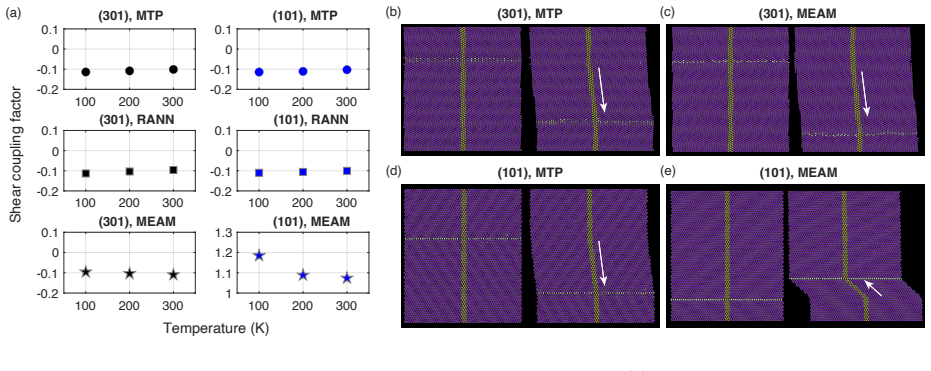
The central claim is that twin boundaries in tetragonal β-Sn migrate by the nucleation and glide of $h^{(2)}$ twinning disconnections: steps two interatomic planes high carrying a small Burgers vector, which yields a negative shear coupling factor of about $-0.1$ for both the (301) and the (101) coherent twin boundary. The paper further claims that twin growth in β-Sn proceeds through low-energy asymmetric facets, called PA/AP interfaces, in which a prismatic $\{101\}$ plane of one grain joins an A-type $\{100\}$ plane of the other, and that these facets accumulate and release twinning disconnections, giving twin growth flexibility. The support comes from comparing newly fitted machine-learning potentials (MTP and RANN) with high-resolution TEM of deformation twins: the simulated structures, including a semi-coherent near-(101) growth interface, match the micrographs, whereas the earlier MEAM potential does not reproduce the (101) migration mode. If correct, this resolves the longstanding question of how β-Sn twins grow atom by atom and provides interface energies, coupling factors, and critical stresses for use in mesoscale deformation models.
Load-bearing premise
The machine-learning potentials must be accurate for twin-boundary and disconnection environments even though no explicit twin or grain boundary structures appear in their training data; if the potentials represent the twin boundary energy landscape incorrectly, the predicted facet stabilities, energies, and migration mechanisms would all be unreliable.
Editorial extensions
If this is right
- The (301) and (101) twin boundaries should be treated as sharing the same $h^{(2)}$-mediated migration mechanism with a common shear coupling factor near $-0.1$, as earlier inferred from diffraction geometry and now directly observed in simulations.
- Mesoscale models of twinning in β-Sn now have quantitative inputs: twin boundary energies around 57–79 mJ m$^{-2}$, AP facet energies near 55–88 mJ m$^{-2}$, and critical flow stresses ranging from a few MPa for (301) up to roughly 50 MPa for (101) with the MTP.
- Equilibrium Wulff shapes of (301) and (101) twin inclusions should contain PA/AP facets, so these asymmetric interfaces belong in any geometric model of twin growth.
- Simulation studies that use the MEAM potential for β-Sn twinning should be revisited, since MEAM predicts a different mechanism for (101) migration and does not produce the experimentally observed semi-coherent growth interface.
- The released MTP and RANN potentials are suitable for modeling other extended-defect phenomena in tin, including phase transformations, dislocation-grain boundary interactions, and detwinning.
Reading between the lines
- We infer that the near-zero shear coupling factor, combined with the extremely low flow stress for (301) migration (about 0–5 MPa with the MTP), implies that twin boundary motion should be an easy deformation channel in β-Sn at low temperatures; this follows from the paper's numbers but is not a claim the paper itself tests.
- Because the ML potentials were trained without any explicit twin boundary or disconnection structures, the paper's success suggests that the same training recipe may transfer to other low-symmetry metals; a direct test would be to fit an MTP for another body-centered tetragonal material and check whether its twin boundaries migrate through the same $h^{(2)}$ mechanism.
- The paper's observation that long AP facets in prior experiments (around 50 nm) are an order of magnitude longer than simulated facets hints that a different accommodation mechanism, perhaps misfit dislocation networks, operates at larger scales; the authors note this as open, and our inference is that testing it requires simulations with box sizes of hundreds of nanometers.
Signed reviews
Editorial analysis
A structured set of objections, weighed in public.
Referee Report
Summary. The paper develops two machine-learning interatomic potentials (an MTP and a RANN potential) for β-Sn, trains them on a DFT database spanning multiple phases, defects, and perturbed configurations, and uses them to study the structure, energy, and shear-coupled migration of (301) and (101) coherent twin boundaries (CTBs). The simulations predict that both CTBs migrate by double-layer h(2) disconnections with small negative shear coupling factors around -0.1, and that low-energy asymmetric PA/AP facets form during twin growth. These predictions are compared against high-resolution TEM observations of a deformed (101)-oriented single crystal, where a semi-coherent near-(101) growth facet is observed and reproduced in simulation under an inferred K2 loading state. The authors also perform bicrystallographic analysis with oiLAB and lattice-matching calculations, and compare the ML potentials against a MEAM potential. The potentials, training data, and sample inputs are made publicly available.
Significance. If the central claims hold, this is the first direct atomistic characterization of twin-boundary migration in a tetragonal metal, and it provides a mechanistic explanation for the experimentally observed faceted twin morphologies in β-Sn. The paper's strengths include: (1) two independently trained ML potentials that agree on the main twinning features, (2) a publicly available training database and potentials, which directly supports reproducibility, (3) a direct comparison to HRTEM and diffraction data, including a quantitative step-height/spacing analysis, (4) a bicrystallographic framework that ties the observed facets and disconnections to the dichromatic pattern, and (5) an explicit discussion of several remaining limitations. The discovery of PA/AP facets as low-energy interfaces analogous to PB/BP facets in HCP metals is an interesting and potentially transferable concept.
major comments (4)
- [Sec. 3.1 and Sec. S.1] The DFT validation of the (301) and (101) CTB energies is reported as 'unable to converge' with no further details on the attempted calculation parameters (e.g., k-point sampling, smearing, or relaxation protocol). This missing support is load-bearing because the training set described in Sec. S.1 includes bulk, surfaces, point defects, and perturbed configurations, but not explicit twin boundaries or disconnection environments. The only ab initio check provided, the stacking-fault comparison in Fig. S1, does not directly constrain twin-boundary or disconnection energetics. The authors should either supply converged DFT reference energies for at least the two CTBs (perhaps using smaller supercells or a different electronic-structure approach), or alternatively provide a sensitivity analysis showing how the predicted energy ordering, h(2) disconnection stability, and AP/PA facet energies vary under plausible changes to the potential. Without this, the quantitative predictions in Table 1 and the mechanism in Fig. 6 remain unverified in the very environments they are meant to describe.
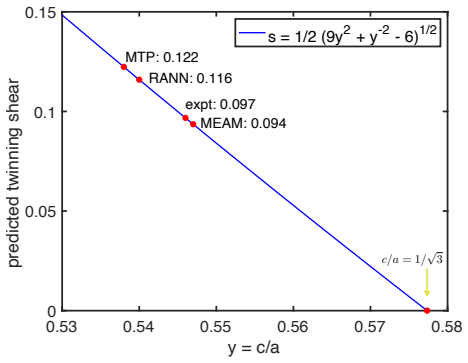
- [Sec. 3.2, Table 1, and Fig. 4] The c/a ratios of the MTP and RANN potentials are 0.538 and 0.540, respectively, versus the experimental 0.546, and the geometric twinning shear in Fig. 4 consequently increases from the experimental 0.097 to 0.116-0.122 at 0 K. While the 300 K coupling factors are close to the experimental value, the 0 K values are about 20% more negative. The statement 'less than 5% variation between theory and simulation for 0 K data' compares the simulations to the geometric formula, not to the experimental value; the experimentally relevant comparison is to the measured or inferred value of about -0.1. The authors should quantify the sensitivity of the predicted coupling factor to c/a and to the underestimated C44 elastic constant (Table S1), and explicitly discuss why the finite-temperature values, rather than the 0 K values, are the appropriate comparison to the experimental coupling factor. This would clarify whether the residual discrepancy reflects the potentials' lattice-parameter error or a genuine mechanistic difference.
- [Sec. 3.3 and Fig. 7] The experimental validation relies on a single twin boundary, and the loading state (K2 shear) used to reproduce the observed semi-coherent near-(101) growth morphology is inferred from the morphology itself rather than measured. In addition, the HRTEM images do not atomically resolve individual h(2) disconnections; the comparison is based on an estimated total step height and an average defect spacing. As written, the paper presents the h(2) disconnection mechanism and the coupling-factor sign/magnitude as simulation predictions that are 'consistent with' the experiments, but it should be stated more prominently that the experiments do not directly confirm the atomic-scale mechanism. The authors could strengthen this discussion by suggesting concrete experimental methods (e.g., atomic-resolution STEM or in-situ straining experiments with diffraction contrast) that could directly image the h(2) disconnections or measure the coupling factor, and by noting which of the simulated features are robust predictions versus inferred interpretations.
- [Sec. 4 and Conclusions] The discovery claim for PA/AP facets as low-energy interfaces important to twin growth in β-Sn is based on simulation-predicted facet structures and on angular matching to prior TEM micrographs that do not have atomic resolution. The authors themselves note in Sec. 4 that 'atomic resolution in the TEM data would be needed' and that the character of AP/PA interfaces 'has yet to be directly confirmed with atomic resolution.' Because this is one of the three headline contributions stated in the Introduction and Conclusion, the claim should be explicitly qualified in the abstract and conclusions, or additional evidence should be provided—for example, image simulations of the proposed AP/PA structure compared to the experimental micrographs, or a quantitative analysis of the facet angle distribution. As it stands, the tone of the abstract ('a discovery of low energy asymmetric PA/AP interfaces important to twin growth') is stronger than the current evidence supports.
minor comments (5)
- [SI, Sec. S.3] The heading 'Addition atomistic data' should read 'Additional atomistic data'.
- [Sec. 3.2, Eq. (3)] The symbol γ is used both for the c/a ratio in Eq. (3) and for interface energy throughout the text and Table 1; this notational clash could confuse readers. Consider using a different symbol for the axial ratio, such as η or ζ.
- [Sec. 3.3, Fig. 7a] The red angular marker 'calibrated to MTP simulation data' is not described with a numerical uncertainty; adding the MTP-predicted angle and the experimental measurement uncertainty on the marker itself would make the 2° deviation easier to interpret.
- [Table 1] The experimental coupling-factor entries mix sources with different sign conventions (e.g., -0.0982 [54], |β| = 0.0978 [2], 0.113 [3]). Citing all three without a unified sign convention may confuse readers; a short footnote explaining the convention would help.
- [Sec. 3.3, p. 18] The text says 'the (1 0 1) twin boundary exhibits a larger yield strain and flow stress for migration than the (3 0 1) twin boundary by at least an order of magnitude', but the yield strains of 0.01 versus 0.001 are different by exactly an order of magnitude and the flow stresses differ by more; 'by at least an order of magnitude' is slightly imprecise.
Circularity Check
No significant circularity: twin-boundary structures and migration mechanisms are genuine predictions from DFT-trained ML potentials and are benchmarked against independent TEM observations.
full rationale
The central derivation chain is not circular. The MTP and RANN potentials are fitted to DFT energies and forces over bulk, strained, defect, surface, and perturbed configurations, and the twin-boundary structures, energies, coupling factors, h(2) disconnection mechanisms, and PA/AP facet energetics are computed after fitting and are not included among the fitted targets. The shear coupling factors are measured from migration simulations and compared to the independent twinning-shear formula of Christian et al.; the agreement is approximate and not enforced by construction. The TEM comparison in Section 3.3 is an external benchmark: the experimental misorientation, step height, and defect spacing are measured quantities, and the simulation snapshots are produced by the unmodified MTP. The AP/PA facet discovery is supported by a geometry-based Lattice Matching calculation in addition to the ML potentials, and the claim that these facets appear in prior micrographs is an experimental identification rather than a fitted result. The paper contains self-citations (e.g., the second-generation RANN potential built on Nitol et al. 2023, and oiLAB from Admal et al. 2022), but these are methodological and none is invoked as an unverified premise that forces the twinning conclusions. The failed DFT convergence check for the (301) and (101) CTB energies, and the statement that AP facet character has not yet been confirmed with atomic resolution, are explicit limitations on validation; they weaken confidence in transferability but do not mean the predictions were defined in terms of the conclusions. Accordingly, no step in the derivation reduces by construction to its inputs, and the circularity score is 0.
Assumptions & free parameters
free parameters (3)
- MTP parameters (level expansion, cutoff, moment tensor coefficients) =
lev_max=18, rc=5.0 Å; coefficients optimized on 3615 DFT configurations
- RANN network parameters (weights and biases) =
29x12x1 architecture; trained on 20,007 DFT configurations
- AP/PA interface energy probe width =
0.5 nm
assumptions (5)
- domain assumption DFT (PBE-GGA) is an accurate reference for beta-Sn energetics, including defect configurations.
- domain assumption The DFT training database is representative enough to generalize to twin boundary and disconnection environments not explicitly included in training.
- domain assumption The disconnection framework (Hirth et al. [20]) describes twin boundary migration in beta-Sn.
- domain assumption Christian's formula for twinning shear (Eq. 3) applies to beta-Sn.
- domain assumption The GRIP grand canonical optimization samples the global minimum energy GB structures.
invented entities (1)
-
PA/AP (Prismatic-A-plane) facets
independent evidence
Cite this review
Pith. "Pith review of The structure and migration of twin boundaries in tetragonal $\beta$-Sn: an application of machine learning based interatomic potentials." pith.science (2026). https://pith.science/paper/G3MYIU4T
@misc{pith2026250508732,
  author       = {Pith},
  title        = {Pith review of: The structure and migration of twin boundaries in tetragonal $\beta$-Sn: an application of machine learning based interatomic potentials},
  year         = {2026},
  howpublished = {\url{https://pith.science/paper/G3MYIU4T}},
  note         = {Machine review of arXiv:2505.08732}
}
abstract
Although atomistic simulations have contributed significantly to our understanding of twin boundary structure and migration in metals and alloys with hexagonal close packed (HCP) crystal structures, few direct atomistic studies of twinning have been conducted for other types of low symmetry materials, in large part due to a lack of reliable interatomic potentials. In this work, we examine twin boundary structure and migration in a tetragonal material, $\beta$-Sn, comparing high resolution Transmission Electron Microscopy (TEM) images of deformation twins in $\beta$-Sn to the results of direct atomistic simulations using multiple interatomic potentials. ML-based potentials developed in this work are found to give results consistent with our experimental data, revealing faceted twin boundary structures formed by the nucleation and motion of twinning disconnections. We use bicrystallographic methods in combination with atomistic simulations to analyze the structure, energy and shear coupled migration of observed twin facets in $\beta$-Sn. In analogy to Prismatic-Basal (PB/BP) interfaces in HCP metals, we discover low energy asymmetric Prismatic-A-plane (PA/AP) interfaces important to twin growth in $\beta$-Sn. A Moment Tensor Potential (MTP) and Rapid Artificial Neural Network (RANN) interatomic potential suitable for studying twinning and phase transformations in Sn are made publicly available as part of this work.
Figures


Figures from the paper (13 more)




Reference graph
Works this paper leans on
- [1]
-
[2]
Direct observation of twinning in tin lamellae
K.-N. Tu and D. Turnbull, “Direct observation of twinning in tin lamellae”,Acta Metallurgica 18 (1970) 915–929
work page 1970
-
[3]
Christian, The Theory of Transformations in Metals and Alloys , (Newnes, 2002)
J. Christian, The Theory of Transformations in Metals and Alloys , (Newnes, 2002)
work page 2002
-
[4]
Deformation behavior of tin and some tin alloys
F. Yang and J. Li, “Deformation behavior of tin and some tin alloys”, Journal of Materials Science: Materials in Electronics 18 (2007) 191–210
work page 2007
-
[5]
Cryogenic in situ microcompression testing of Sn
A. Lupinacci, J. Kacher, A. Eilenberg, A. Shapiro, P. Hosemann, and A. Minor, “Cryogenic in situ microcompression testing of Sn”, Acta Materialia 78 (2014) 56–64
work page 2014
-
[6]
R. Pokharel, B. Clausen, D. J. Savage, et al. , “Microstructure characterization and elastic-plastic self- consistent simulation studies of anisotropic deformation of β-tin”, International Journal of Plasticity 168 (2023) 103658
work page 2023
-
[7]
Calibration and validation of the foundation for a multiphase strength model for tin
T. Nguyen, L. Burakovsky, S. J. Fensin, et al. , “Calibration and validation of the foundation for a multiphase strength model for tin”, Journal of Applied Physics 135 (2024) 225105
work page 2024
-
[8]
A surprising proliferation of detwinning inβ-tin at extreme loading rates
W. Schill, J. Lind, J. Brown, et al., “A surprising proliferation of detwinning inβ-tin at extreme loading rates”, Scripta Materialia 264 (2025) 116727
work page 2025
Show all 71 references
-
[9]
Microscale deformation behavior of bicrystal boundaries in pure tin (Sn) using micropillar compression
C. S. Kaira, S. S. Singh, A. Kirubanandham, and N. Chawla, “Microscale deformation behavior of bicrystal boundaries in pure tin (Sn) using micropillar compression”, Acta Materialia 120 (2016) 56– 67
2016
-
[10]
Characterization of tri-lab β-tin (Sn)
H. Lim, Z. Casias, J. Carroll, C. Battaile, J. Lane, and S. Fensin, “Characterization of tri-lab β-tin (Sn)”, tech. rep., Sandia National Lab.(SNL-NM), Albuquerque, NM (United States), 2022. 29
2022
-
[11]
Measurements of the grain boundary energy and anisotropy in tin
D. J. Rowenhorst and P. W. Voorhees, “Measurements of the grain boundary energy and anisotropy in tin”, Metallurgical and Materials Transactions A 36 (2005) 2127–2135
2005
-
[12]
The orientation imaging microscopy of lead-free Sn-Ag solder joints
A. U. Telang and T. R. Bieler, “The orientation imaging microscopy of lead-free Sn-Ag solder joints”, JOM 57 (2005) 44–49
2005
-
[13]
Beta-tin grain formation in aluminum-modified lead-free solder alloys
K. N. Reeve and C. A. Handwerker, “Beta-tin grain formation in aluminum-modified lead-free solder alloys”, Journal of Electronic Materials 47 (2018) 61–76
2018
-
[14]
Electrodeposition current density induced texture and grain boundary engineering in Sn coatings for enhanced corrosion resistance
A. Gupta and C. Srivastava, “Electrodeposition current density induced texture and grain boundary engineering in Sn coatings for enhanced corrosion resistance”, Corrosion Science 194 (2022) 109945
2022
-
[15]
Hybrid additive manufacturing of island grain bicrystals
L. G. Ware, B. S. Herstein, Y. Zhang, H. Z. Bilheux, and Z. C. Cordero, “Hybrid additive manufacturing of island grain bicrystals”, in TMS 2022 151st Annual Meeting & Exhibition Supplemental Proceedings , pp. 1033–1043, Springer. 2022
2022
-
[16]
Spontaneous whisker growth on lead-free solder finishes
K. N. Tu and J. C. M. Li, “Spontaneous whisker growth on lead-free solder finishes”, Materials Science and Engineering A 409 (2005) 131–139, Special issue: Micromechanics of Advanced Materials II
2005
-
[17]
A model of Sn whisker growth by coupled plastic flow and grain boundary diffusion
E. J. Buchovecky, N. Du, and A. F. Bower, “A model of Sn whisker growth by coupled plastic flow and grain boundary diffusion”, Applied Physics Letters 94 (2009) 191904
2009
-
[18]
Whisker growth in Sn coatings: A review of current status and future prospects
P. Jagtap and P. Kumar, “Whisker growth in Sn coatings: A review of current status and future prospects”, Journal of Electronic Materials 50 (2021) 735–766
2021
-
[19]
Growth twins and deformation twins in metals
I. J. Beyerlein, X. Zhang, and A. Misra, “Growth twins and deformation twins in metals”, Annual Review of Materials Research 44 (2014) 329–363
2014
-
[20]
Disconnections and other defects associated with twin interfaces
J. Hirth, J. Wang, and C. Tom´ e, “Disconnections and other defects associated with twin interfaces”, Progress in Materials Science 83 (2016) 417–471
2016
-
[21]
Twin-solute, twin-dislocation and twin-twin interactions in magne- sium
Y. Yue, J. Wang, and J.-F. Nie, “Twin-solute, twin-dislocation and twin-twin interactions in magne- sium”, Journal of Magnesium and Alloys 11 (2023) 3427–3462
2023
-
[22]
Three-dimensional character of the deformation twin in magnesium
Y. Liu, P. Tang, M. Gong, R. McCabe, J. Wang, and C. Tom´ e, “Three-dimensional character of the deformation twin in magnesium”, Nature Communications 10 (2019) 3308
2019
-
[23]
The effects of stress, temperature and facet struc- ture on growth of{10¯12} twins in Mg: A molecular dynamics and phase field study
M. Gong, J. Graham, V. Taupin, and L. Capolungo, “The effects of stress, temperature and facet struc- ture on growth of{10¯12} twins in Mg: A molecular dynamics and phase field study”, Acta Materialia 208 (2021) 116603
2021
-
[24]
Atomistic-informed phase field modeling of magnesium twin growth by disconnections
Y. Hu, D. M. Kochmann, and B. Runnels, “Atomistic-informed phase field modeling of magnesium twin growth by disconnections”, Acta Materialia 284 (2025) 120564
2025
-
[25]
Formation and stability of long basal-prismatic facets in Mg
K. Dang, S. Wang, M. Gong, R. J. McCabe, J. Wang, and L. Capolungo, “Formation and stability of long basal-prismatic facets in Mg”, Acta Materialia 185 (2020) 119–128
2020
-
[26]
Semiempirical, quantum mechanical calculation of hydrogen embrittle- ment in metals
M. S. Daw and M. I. Baskes, “Semiempirical, quantum mechanical calculation of hydrogen embrittle- ment in metals”, Physical Review Letters 50 (Apr, 1983) 1285–1288. 30
1983
-
[27]
Embedded-atom method: Derivation and application to impurities, surfaces, and other defects in metals
M. S. Daw and M. I. Baskes, “Embedded-atom method: Derivation and application to impurities, surfaces, and other defects in metals”, Physical Review B 29 (Jun, 1984) 6443–6453
1984
-
[28]
Modified embedded-atom potentials for cubic materials and impurities
M. I. Baskes, “Modified embedded-atom potentials for cubic materials and impurities”, Physical Review B 46 (1992) 2727
1992
-
[29]
Structural stability and lattice defects in copper: Ab initio, tight-binding, and embedded-atom calculations
Y. Mishin, M. J. Mehl, D. A. Papaconstantopoulos, A. F. Voter, and J. D. Kress, “Structural stability and lattice defects in copper: Ab initio, tight-binding, and embedded-atom calculations”, Physical Review B 63 (2001) 224106
2001
-
[30]
EAM potential for magnesium from quantum mechanical forces
X.-Y. Liu, J. B. Adams, F. Ercolessi, and J. A. Moriarty, “EAM potential for magnesium from quantum mechanical forces”, Modelling and Simulation in Materials Science and Engineering 4 (1996) 293
1996
-
[31]
Detwinning mechanisms for growth twins in face-centered cubic metals
J. Wang, N. Li, O. Anderoglu, X. Zhang, A. Misra, J. Huang, and J. Hirth, “Detwinning mechanisms for growth twins in face-centered cubic metals”, Acta Materialia 58 (2010) 2262–2270
2010
-
[32]
Atomic structures of symmetric tilt grain boundaries in hexagonal close packed (hcp) crystals
J. Wang and I. J. Beyerlein, “Atomic structures of symmetric tilt grain boundaries in hexagonal close packed (hcp) crystals”, Modelling and Simulation in Materials Science and Engineering 20 (2012) 024002
2012
-
[33]
Atomistic simulations of pure tin based on a new modified embedded-atom method interatomic potential
W. S. Ko, D. H. Kim, Y. J. Kwon, and M. H. Lee, “Atomistic simulations of pure tin based on a new modified embedded-atom method interatomic potential”, Metals 8 (2018) 900
2018
-
[34]
Performance and cost assessment of machine learning interatomic potentials
Y. Zuo, C. Chen, X. Li, et al. , “Performance and cost assessment of machine learning interatomic potentials”, The Journal of Physical Chemistry A 124 (2020) 731–745
2020
-
[35]
Machine-learning interatomic potentials for materials science
Y. Mishin, “Machine-learning interatomic potentials for materials science”, Acta Materialia 214 (2021) 116980
2021
-
[36]
Hybrid interatomic potential for Sn
M. S. Nitol, K. Dang, S. J. Fensin, M. I. Baskes, D. E. Dickel, and C. D. Barrett, “Hybrid interatomic potential for Sn”, Physical Review Materials 7 (2023) 043601
2023
-
[37]
LAMMPS — a flexible simulation tool for particle- based materials modeling at the atomic, meso, and continuum scales
A. P. Thompson, H. M. Aktulga, R. Berger, et al., “LAMMPS — a flexible simulation tool for particle- based materials modeling at the atomic, meso, and continuum scales”, Computer Physics Communica- tions 271 (2022) 108171
2022
-
[38]
Ab-initio simulations of materials using VASP: Density-functional theory and beyond
J. Hafner, “Ab-initio simulations of materials using VASP: Density-functional theory and beyond”, Journal of Computational Chemistry 29 (2008) 2044–2078
2008
-
[39]
Generalized gradient approximation made simple
J. P. Perdew, K. Burke, and M. Ernzerhof, “Generalized gradient approximation made simple”,Physical Review Letters 77 (1996) 3865
1996
-
[40]
Visualization and analysis of atomistic simulation data with OVITO – the open visual- ization tool
A. Stukowski, “Visualization and analysis of atomistic simulation data with OVITO – the open visual- ization tool”, Modelling and Simulation in Materials Science and Engineering 18 (2009) 015012
2009
-
[41]
Robust structural identification via polyhedral template matching
P. M. Larsen, S. Schmidt, and J. Schiøtz, “Robust structural identification via polyhedral template matching”, Modelling and Simulation in Materials Science and Engineering 24 (2016) 055007. 31
2016
-
[42]
Moment tensor potentials: A class of systematically improvable interatomic potentials
A. V. Shapeev, “Moment tensor potentials: A class of systematically improvable interatomic potentials”, Multiscale Modeling & Simulation 14 (2016) 1153–1173, arXiv:1512.06054 [physics.comp-ph]
2016 arXiv
-
[43]
The MLIP package: moment tensor potentials with MPI and active learning
I. S. Novikov, K. Gubaev, E. V. Podryabinkin, and A. V. Shapeev, “The MLIP package: moment tensor potentials with MPI and active learning”, Machine Learning: Science and Technology 2 (2020) 025002
2020
-
[44]
LAMMPS implementation of rapid artificial neural network derived interatomic potentials
D. Dickel, M. Nitol, and C. Barrett, “LAMMPS implementation of rapid artificial neural network derived interatomic potentials”, Computational Materials Science 196 (2021) 110481
2021
-
[45]
Grand canonically optimized grain boundary phases in hexagonal close-packed titanium
E. Chen, T. W. Heo, B. C. Wood, M. Asta, and T. Frolov, “Grand canonically optimized grain boundary phases in hexagonal close-packed titanium”, Nature Communications 15 (2024) 7049
2024
-
[46]
Survey of computed grain boundary properties in face-centered cubic metals: I. Grain boundary energy
D. L. Olmsted, S. M. Foiles, and E. A. Holm, “Survey of computed grain boundary properties in face-centered cubic metals: I. Grain boundary energy”, Acta Materialia 57 (2009) 3694–3703
2009
-
[47]
Extra variable in grain boundary description
J. Hickman and Y. Mishin, “Extra variable in grain boundary description”, Physical Review Materials 1 (2017) 010601
2017
-
[48]
Predicting phase behavior of grain boundaries with evolutionary search and machine learning
Q. Zhu, A. Samanta, B. Li, R. E. Rudd, and T. Frolov, “Predicting phase behavior of grain boundaries with evolutionary search and machine learning”, Nature Communications 9 (2018) 467
2018
-
[49]
The atomic simulation environment—a Python library for working with atoms
A. H. Larsen, J. J. Mortensen, J. Blomqvist, et al. , “The atomic simulation environment—a Python library for working with atoms”, Journal of Physics: Condensed Matter 29 (2017) 273002
2017
-
[50]
Role of the mesoscale in migration kinetics of flat grain boundaries
C. Race, J. von Pezold, and J. Neugebauer, “Role of the mesoscale in migration kinetics of flat grain boundaries”, Physical Review B 89 (2014) 214110
2014
-
[51]
An interferometric study of grain boundary grooves in tin
H. Mykura, “An interferometric study of grain boundary grooves in tin”, Acta Metallurgica 3 (1955) 436–441
1955
-
[52]
Effect of twin grain boundary on the diffusion of Cu in bulk β-Sn
S. Hao and H. Li, “Effect of twin grain boundary on the diffusion of Cu in bulk β-Sn”, Computational Materials Science 226 (2023) 112200
2023
-
[53]
Free energy of grain boundary phases: Atomistic calculations for Σ5 (310) [001] grain boundary in Cu
R. Freitas, R. E. Rudd, M. Asta, and T. Frolov, “Free energy of grain boundary phases: Atomistic calculations for Σ5 (310) [001] grain boundary in Cu”, Physical Review Materials 2 (2018) 093603
2018
-
[54]
Grain boundary mediated plasticity: On the evaluation of grain boundary migration-shear coupling
K. D. Molodov and D. A. Molodov, “Grain boundary mediated plasticity: On the evaluation of grain boundary migration-shear coupling”, Acta Materialia 153 (2018) 336–353
2018
-
[55]
Grain-boundary kinetics: A unified approach
J. Han, S. L. Thomas, and D. J. Srolovitz, “Grain-boundary kinetics: A unified approach”, Progress in Materials Science 98 (2018) 386–476
2018
-
[56]
Optimal transportation of grain boundaries: A forward model for predicting migration mechanisms
I. Chesser, E. Holm, and B. Runnels, “Optimal transportation of grain boundaries: A forward model for predicting migration mechanisms”, Acta Materialia 210 (2021) 116823
2021
-
[57]
Grain boundary migration in polycrystals
G. S. Rohrer, I. Chesser, A. R. Krause, S. K. Naghibzadeh, Z. Xu, K. Dayal, and E. A. Holm, “Grain boundary migration in polycrystals”, Annual Review of Materials Research 53 (2023) 347–369
2023
-
[58]
An atomistic survey of shear coupling in asymmetric 32 tilt grain boundaries and interpretation using the disconnections framework
H. Joshi, I. Chesser, B. Runnels, and N. C. Admal, “An atomistic survey of shear coupling in asymmetric 32 tilt grain boundaries and interpretation using the disconnections framework”, Acta Materialia 275 (2024) 119994
2024
-
[59]
Coupling grain boundary motion to shear deformation
J. W. Cahn, Y. Mishin, and A. Suzuki, “Coupling grain boundary motion to shear deformation”, Acta Materialia 54 (2006) 4953–4975
2006
-
[60]
Shear-driven motion of Mg{10¯12} twin boundaries via disconnection terrace nucleation, growth, and coalescence
D. E. Spearot, L. Capolungo, and C. N. Tom´ e, “Shear-driven motion of Mg{10¯12} twin boundaries via disconnection terrace nucleation, growth, and coalescence”, Physical Review Materials 3 (2019) 053606
2019
-
[61]
Determination of all misorientations of tetragonal lattices with low multiplicity; connec- tion with Mallard’s rule of twinning
H. Grimmer, “Determination of all misorientations of tetragonal lattices with low multiplicity; connec- tion with Mallard’s rule of twinning”, Acta Crystallographica A 59 (2003) 287–296
2003
-
[62]
Twinning by reticular pseudo-merohedry in trigonal, tetragonal and hexagonal crystals
H. Grimmer and K. Kunze, “Twinning by reticular pseudo-merohedry in trigonal, tetragonal and hexagonal crystals”, Acta Crystallographica A 60 (2004) 220–232
2004
-
[63]
Interface dislocations and grain boundary discon- nections using smith normal bicrystallography
N. C. Admal, T. Ahmed, E. Martinez, and G. Po, “Interface dislocations and grain boundary discon- nections using smith normal bicrystallography”, Acta Materialia 240 (2022) 118340
2022
-
[64]
On the importance of prismatic/basal interfaces in the growth of ( ¯1012) twins in hexagonal close packed crystals
B. Xu, L. Capolungo, and D. Rodney, “On the importance of prismatic/basal interfaces in the growth of ( ¯1012) twins in hexagonal close packed crystals”, Scripta Materialia 68 (2013) 901–904, arXiv:1301.1902 [cond-mat.mtrl-sci]
2013 arXiv
-
[65]
Interface structures and twinning mechanisms of twins in hexagonal metals
M. Gong, J. P. Hirth, Y. Liu, Y. Shen, and J. Wang, “Interface structures and twinning mechanisms of twins in hexagonal metals”, Materials Research Letters 5 (2017) 449–464
2017
-
[66]
An analytical model of interfacial energy based on a lattice-matching interatomic energy
B. Runnels, I. J. Beyerlein, S. Conti, and M. Ortiz, “An analytical model of interfacial energy based on a lattice-matching interatomic energy”, Journal of the Mechanics and Physics of Solids 89 (2016) 174–193
2016
-
[67]
A relaxation method for the energy and morphology of grain boundaries and interfaces
B. Runnels, I. J. Beyerlein, S. Conti, and M. Ortiz, “A relaxation method for the energy and morphology of grain boundaries and interfaces”, Journal of the Mechanics and Physics of Solids 94 (2016) 388–408
2016
-
[68]
The growth of twins in tin single crystals as observed by transmission electron microscopy
J. Fourie, F. Weinberg, and F. Boswell, “The growth of twins in tin single crystals as observed by transmission electron microscopy”, Acta Metallurgica 8 (1960) 851–863
1960
-
[69]
Why are{10¯12} twins profuse in magnesium?
H. El Kadiri, C. D. Barrett, J. Wang, and C. N. Tom´ e, “Why are{10¯12} twins profuse in magnesium?”, Acta Materialia 85 (2015) 354–361
2015
-
[70]
Machine learning models for predictive materials science from fundamental physics: An application to titanium and zirconium
M. S. Nitol, D. E. Dickel, and C. D. Barrett, “Machine learning models for predictive materials science from fundamental physics: An application to titanium and zirconium”, Acta Materialia 224 (2022) 117347
2022
-
[71]
W. F. Gale and T. C. Totemeier, eds., Smithells Metals Reference Book , 8th ed., (Elsevier, 2003). 33 S. Supplementary Information S.1. Interatomic potentials Training database. A diverse DFT training database was generated to fit the ML potentials. Mul- tiple allotropes of Sn...
2003
Reviewed August 15, 2026 · model on record in the stance chip above.
Discussion (0). Continue with ORCID to comment.