Elevated Hall Responses as Indicators of Edge Reconstruction
Pith reviewed 2026-05-22 15:22 UTC · model grok-4.3
The pith
Edge reconstruction in the ν=1 quantum Hall state can enhance both electrical and thermal Hall conductances beyond twice their standard values.
A machine-rendered reading of the paper's core claim, the machinery that carries it, and where it could break.
Core claim
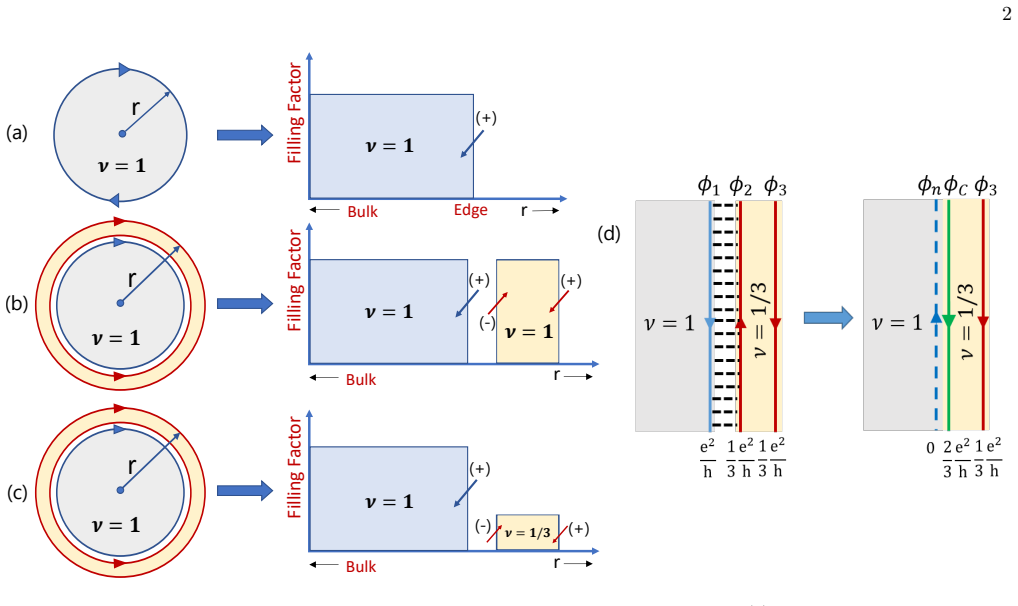
In the ν=1 quantum Hall state, edge reconstructions that place both upstream charge modes and upstream neutral modes along the boundary, when measured in multi-terminal geometries, cause the electrical Hall conductance and the thermal Hall conductance to exceed twice the quantized values dictated by bulk-boundary correspondence.
What carries the argument
Coexistence of upstream charge and neutral modes in a multi-terminal geometry, which redistributes currents and heat flows so that measured Hall responses exceed the standard quantized limits.
If this is right
- Electrical Hall conductance can rise above 2e²/h
- Thermal Hall conductance can rise above twice π²k_B²T/3h
- The size of the enhancement supplies a direct experimental signature of edge reconstruction
- Multi-terminal setups make the deviations from quantization especially visible
Where Pith is reading between the lines
- The same mode-coexistence mechanism may produce detectable enhancements in other filling factors that also support edge reconstruction
- Varying the number or placement of terminals could map which mode configurations produce the largest signals
- The effect offers one route to distinguish among competing pictures of integer quantum Hall edge structure
Load-bearing premise
The analysis assumes particular upstream and downstream mode arrangements are realized at the edge without deriving them from microscopic energetics or disorder.
What would settle it
A multi-terminal measurement on a ν=1 sample that records electrical Hall conductance remaining at or below e²/h, or thermal Hall conductance at or below π²k_B²T/3h, would show that the predicted enhancement from upstream modes does not occur.
Figures

read the original abstract
We investigate edge reconstruction scenarios in the $\nu = 1$ quantum Hall state, focusing on configurations with upstream and downstream charge and neutral modes. Our analysis shows that the coexistence of upstream charge and neutral modes in a multi-terminal geometry can cause pronounced deviations from the expected quantized values of electrical ($e^2/h$) and thermal ($\pi^2 k_\text{B}^{2}T/3h$) Hall conductance dictated by bulk-boundary correspondence. In particular, we find that both electrical and thermal Hall conductances can be significantly enhanced -- exceeding twice their unreconstructed values -- offering a clear diagnostic of edge reconstruction.
Editorial analysis
A structured set of objections, weighed in public.
Referee Report
Summary. The paper investigates edge reconstruction in the ν=1 quantum Hall state, focusing on configurations with upstream and downstream charge and neutral modes. It shows that coexistence of these modes in a multi-terminal geometry causes pronounced deviations from the quantized electrical (e²/h) and thermal (π² k_B²T/3h) Hall conductances expected from bulk-boundary correspondence, with both quantities significantly enhanced—exceeding twice their unreconstructed values—as a diagnostic of edge reconstruction.
Significance. If the posited mode configurations are realized, the work would offer a potentially useful experimental signature for detecting edge reconstruction via elevated Hall responses in multi-terminal devices, extending beyond standard chiral edge mode expectations in quantum Hall systems.
major comments (1)
- [Analysis of mode configurations and multi-terminal geometry] The central enhancement claim (exceeding twice the unreconstructed values) is obtained by positing specific upstream/downstream charge and neutral mode arrangements for the reconstructed ν=1 edge. These are introduced as scenarios rather than derived from the bulk Hamiltonian, edge energetics, or disorder potential, making the quantitative factors dependent on chosen velocities, tunneling amplitudes, and geometry (see the analysis of multi-terminal setups).
minor comments (1)
- [Abstract] The abstract could more explicitly note that the enhancements are for specific assumed configurations rather than general predictions.
Simulated Author's Rebuttal
We thank the referee for the careful reading of our manuscript and the constructive feedback. We address the major comment below.
read point-by-point responses
-
Referee: [Analysis of mode configurations and multi-terminal geometry] The central enhancement claim (exceeding twice the unreconstructed values) is obtained by positing specific upstream/downstream charge and neutral mode arrangements for the reconstructed ν=1 edge. These are introduced as scenarios rather than derived from the bulk Hamiltonian, edge energetics, or disorder potential, making the quantitative factors dependent on chosen velocities, tunneling amplitudes, and geometry (see the analysis of multi-terminal setups).
Authors: We agree that the mode configurations are introduced as plausible scenarios for the reconstructed ν=1 edge, motivated by prior theoretical work on edge reconstruction rather than derived from a specific bulk Hamiltonian or disorder potential in this study. Our focus is on the resulting multi-terminal transport signatures, which we show can serve as a diagnostic for reconstruction when upstream charge and neutral modes coexist. The calculations demonstrate that the enhancement of electrical and thermal Hall conductances beyond twice the quantized values is a robust outcome of the counterpropagating modes, although the precise numerical factor does depend on velocities, tunneling amplitudes, and geometry. In the revised manuscript we have added explicit discussion of these phenomenological assumptions, their grounding in the existing literature on ν=1 edge reconstruction, and a brief parameter scan confirming that the exceedance of twice the unreconstructed values occurs for a range of physically reasonable choices. revision: partial
Circularity Check
No circularity: modeling of mode configurations yields independent predictions from stated assumptions
full rationale
The paper examines edge reconstruction in the ν=1 state by positing specific upstream/downstream charge and neutral mode arrangements in multi-terminal setups and computing resulting electrical and thermal Hall conductances. These arrangements are introduced as scenarios for analysis rather than derived from a self-referential fit or prior self-citation that encodes the target enhancement. The reported deviations (exceeding twice the unreconstructed values) follow directly from the chosen velocities, couplings, and geometry within the Landauer-Büttiker or scattering formalism; they do not reduce to the inputs by construction. No self-definitional equations, fitted-parameter predictions, or load-bearing self-citations appear in the derivation chain. The analysis remains self-contained against external benchmarks of edge-mode transport.
Axiom & Free-Parameter Ledger
axioms (2)
- domain assumption Bulk-boundary correspondence holds for the unreconstructed ν=1 state, giving quantized electrical Hall conductance e²/h and thermal Hall conductance π² k_B²T/3h.
- domain assumption Edge modes can be classified as charge or neutral and assigned definite upstream or downstream propagation directions.
Lean theorems connected to this paper
-
IndisputableMonolith/Cost/FunctionalEquation.leanwashburn_uniqueness_aczel unclear?
unclearRelation between the paper passage and the cited Recognition theorem.
coexistence of upstream charge and neutral modes ... both electrical and thermal Hall conductances can be significantly enhanced -- exceeding twice their unreconstructed values
-
IndisputableMonolith/Foundation/AlexanderDuality.leanalexander_duality_circle_linking unclear?
unclearRelation between the paper passage and the cited Recognition theorem.
edge reconstruction scenarios in the ν=1 quantum Hall state, focusing on configurations with upstream and downstream charge and neutral modes
What do these tags mean?
- matches
- The paper's claim is directly supported by a theorem in the formal canon.
- supports
- The theorem supports part of the paper's argument, but the paper may add assumptions or extra steps.
- extends
- The paper goes beyond the formal theorem; the theorem is a base layer rather than the whole result.
- uses
- The paper appears to rely on the theorem as machinery.
- contradicts
- The paper's claim conflicts with a theorem or certificate in the canon.
- unclear
- Pith found a possible connection, but the passage is too broad, indirect, or ambiguous to say the theorem truly supports the claim.
Reference graph
Works this paper leans on
-
[1]
+1, -1, +1 +1, -1, +1 Ballistic 9/7 9/5 3 3 9/7 9/5 3 3 +1, -1 with QPC 8/9 8/5 8 2 8/9 8/5 8 2 +1 7/9 1 7/2 1 7/9 1 7/2 1
-
[2]
+1/3, -1/3, +1 +1/3, -1/3, +1 Ballistic 65/63 65/57 13/9 5/3 9/7 9/5 3 3 +1/3, -1/3 with QPC 32/81 32/57 32/9 2/3 8/9 8/5 8 2 +1 7/23 1/3 7/4 1/3 7/9 1 7/2 1
-
[3]
+1/3, 0, +2/3 +1/3, 0, +2/3 Ballistic 1 1 1 1 8+˜v2 (˜v+1)2 +3 8+˜v2 5−(˜v−1)2 8+˜v2 4−˜v2 3 +1/3 with QPC 1/3 1/3 1 1/3 (4+3˜v) (˜v+2)2 (4+3˜v) (˜v+1)2 +3 2 + 3˜v 2 1 TABLE II. shows both the transverse and longitudinal electrical (in units ofe 2/h) and thermal conductance (in units of (π2k2 BT /3h) for a QH state with a bulk filling fractionν B = 1 and ...
-
[4]
Quantum Systems in Low Dimen- sions
is the electrical (thermal) conductance measured between the probeV 3 andV 6 (T3 andT 6). The possibility for charge (thermal) Hall conductance values to exceed the corresponding two-terminal counterpartG(G Q) is indicated by pink and blue colored blocks. IN et = e2 h 2(νB −2ν d)νdtνut + (ν2 B −3ν Bνd + 3ν2 d)(νdt +ν ut) ν2 B + 3νd(νd −ν B)−2ν dt(νB + 2νu...
work page 2025
-
[5]
X. G. Wen, Gapless boundary excitations in the quantum hall states and in the chiral spin states, Phys. Rev. B43, 11025 (1991)
work page 1991
-
[6]
A. Bid, N. Ofek, H. Inoue, M. Heiblum, C. L. Kane, V. Umansky, and D. Mahalu, Observation of neutral modes in the fractional quantum hall regime, Nature466, 585 (2010)
work page 2010
-
[7]
E. V. Deviatov, A. Lorke, G. Biasiol, and L. Sorba, En- ergy transport by neutral collective excitations at the quantum hall edge, Phys. Rev. Lett.106, 256802 (2011)
work page 2011
- [8]
- [9]
-
[10]
V. Venkatachalam, S. Hart, L. Pfeiffer, K. West, and A. Yacoby, Local thermometry of neutral modes on the quantum hall edge, Nature Physics8, 676 (2012)
work page 2012
- [11]
-
[12]
E. Grosfeld and S. Das, Probing the neutral edge modes in transport across a point contact via thermal effects in the read-rezayi non-abelian quantum hall states, Phys. Rev. Lett.102, 106403 (2009)
work page 2009
-
[13]
P. Degiovanni, C. Grenier, G. F` eve, C. Altimiras, H. le Sueur, and F. Pierre, Plasmon scattering approach to energy exchange and high-frequency noise inν= 2 quantum hall edge channels, Phys. Rev. B81, 121302 (2010)
work page 2010
- [14]
-
[15]
C. Altimiras, H. le Sueur, U. Gennser, A. Anthore, A. Ca- vanna, D. Mailly, and F. Pierre, Chargeless heat trans- port in the fractional quantum hall regime, Phys. Rev. Lett.109, 026803 (2012)
work page 2012
-
[16]
M. Banerjee, M. Heiblum, A. Rosenblatt, Y. Oreg, D. E. Feldman, A. Stern, and V. Umansky, Observed quanti- zation of anyonic heat flow, Nature545, 75 (2017)
work page 2017
-
[17]
M. Banerjee, M. Heiblum, V. Umansky, D. E. Feldman, Y. Oreg, and A. Stern, Observation of half-integer ther- mal hall conductance, Nature559, 205 (2018)
work page 2018
-
[18]
S. K. Srivastav, R. Kumar, C. Sp˚ ansl¨ att, K. Watanabe, T. Taniguchi, A. D. Mirlin, Y. Gefen, and A. Das, Van- ishing thermal equilibration for hole-conjugate fractional quantum hall states in graphene, Phys. Rev. Lett.126, 216803 (2021)
work page 2021
-
[19]
S. K. Srivastav, M. R. Sahu, K. Watanabe, T. Taniguchi, S. Banerjee, and A. Das, Universal quantized thermal conductance in graphene, Science Advances5, eaaw5798 (2019)
work page 2019
-
[20]
S. K. Srivastav, R. Kumar, C. Sp˚ ansl¨ att, K. Watanabe, T. Taniguchi, A. D. Mirlin, Y. Gefen, and A. Das, Deter- mination of topological edge quantum numbers of frac- tional quantum hall phases by thermal conductance mea- surements, Nature Communications13, 5185 (2022)
work page 2022
-
[21]
I. C. Fulga, Y. Oreg, A. D. Mirlin, A. Stern, and D. F. Mross, Temperature enhancement of thermal hall con- ductance quantization, Phys. Rev. Lett.125, 236802 (2020)
work page 2020
-
[22]
R. A. Melcer, B. Dutta, C. Sp˚ ansl¨ att, J. Park, A. D. Mirlin, and V. Umansky, Absent thermal equilibration on fractional quantum hall edges over macroscopic scale, Nature Communications13, 376 (2022)
work page 2022
-
[23]
R. A. Melcer, S. Konyzheva, M. Heiblum, and V. Uman- sky, Direct determination of the topological thermal con- ductance via local power measurement, Nature Physics 19, 327 (2023)
work page 2023
-
[24]
R. A. Melcer, A. Gil, A. K. Paul, P. Tiwari, V. Uman- sky, M. Heiblum, Y. Oreg, A. Stern, and E. Berg, Heat conductance of the quantum hall bulk, Nature625, 489 (2024)
work page 2024
-
[25]
D. B. Chklovskii, B. I. Shklovskii, and L. I. Glazman, Electrostatics of edge channels, Phys. Rev. B46, 4026 (1992)
work page 1992
-
[26]
J. Dempsey, B. Y. Gelfand, and B. I. Halperin, Electron- electron interactions and spontaneous spin polarization in quantum hall edge states, Phys. Rev. Lett.70, 3639 (1993)
work page 1993
-
[27]
C. d. C. Chamon and X. G. Wen, Sharp and smooth boundaries of quantum hall liquids, Phys. Rev. B49, 8227 (1994)
work page 1994
-
[28]
Meir, Composite edge states in theν=2/3 fractional quantum hall regime, Phys
Y. Meir, Composite edge states in theν=2/3 fractional quantum hall regime, Phys. Rev. Lett.72, 2624 (1994)
work page 1994
-
[29]
D. B. Chklovskii, Structure of fractional edge states: A composite-fermion approach, Phys. Rev. B51, 9895 (1995)
work page 1995
-
[30]
X. Wan, K. Yang, and E. H. Rezayi, Reconstruction of fractional quantum hall edges, Phys. Rev. Lett.88, 056802 (2002)
work page 2002
-
[31]
X. Wan, E. H. Rezayi, and K. Yang, Edge reconstruction in the fractional quantum hall regime, Phys. Rev. B68, 125307 (2003)
work page 2003
-
[32]
Y. N. Joglekar, H. K. Nguyen, and G. Murthy, Edge re- constructions in fractional quantum hall systems, Phys. Rev. B68, 035332 (2003)
work page 2003
-
[33]
J. Wang, Y. Meir, and Y. Gefen, Edge reconstruction in theν=2/3 fractional quantum hall state, Phys. Rev. Lett.111, 246803 (2013)
work page 2013
- [34]
-
[35]
C. L. Kane, M. P. A. Fisher, and J. Polchinski, Random- ness at the edge: Theory of quantum hall transport at fillingν=2/3, Phys. Rev. Lett.72, 4129 (1994)
work page 1994
-
[36]
C. L. Kane and M. P. A. Fisher, Impurity scattering and transport of fractional quantum hall edge states, Phys. Rev. B51, 13449 (1995)
work page 1995
-
[37]
I. Protopopov, Y. Gefen, and A. Mirlin, Transport in a disorderedν= 2/3 fractional quantum hall junction, Annals of Physics385, 287 (2017)
work page 2017
-
[38]
J. Park, A. D. Mirlin, B. Rosenow, and Y. Gefen, Noise on complex quantum hall edges: Chiral anomaly and heat diffusion, Phys. Rev. B99, 161302 (2019)
work page 2019
-
[39]
C. Sp˚ ansl¨ att, J. Park, Y. Gefen, and A. D. Mirlin, Topo- logical classification of shot noise on fractional quantum hall edges, Phys. Rev. Lett.123, 137701 (2019)
work page 2019
-
[40]
J. Park, C. Sp˚ ansl¨ att, Y. Gefen, and A. D. Mirlin, Noise on the non-abelianν= 5/2 fractional quantum hall edge, Phys. Rev. Lett.125, 157702 (2020)
work page 2020
-
[41]
C. Nosiglia, J. Park, B. Rosenow, and Y. Gefen, Incoher- ent transport on theν= 2/3 quantum hall edge, Phys. Rev. B98, 115408 (2018)
work page 2018
-
[42]
C. Sp˚ ansl¨ att, J. Park, Y. Gefen, and A. D. Mirlin, Con- ductance plateaus and shot noise in fractional quantum hall point contacts, Phys. Rev. B101, 075308 (2020)
work page 2020
-
[43]
C. Sp˚ ansl¨ att, Y. Gefen, I. V. Gornyi, and D. G. Polyakov, Contacts, equilibration, and interactions in fractional quantum hall edge transport, Phys. Rev. B104, 115416 (2021)
work page 2021
- [44]
- [45]
- [46]
-
[47]
S. Manna and A. Das, Experimentally motivated order of length scales affect shot noise, Phys. Rev. B112, 195128 (2025)
work page 2025
- [48]
- [49]
-
[50]
R. Willett, J. P. Eisenstein, H. L. St¨ ormer, D. C. Tsui, A. C. Gossard, and J. H. English, Observation of an even- denominator quantum number in the fractional quantum hall effect, Phys. Rev. Lett.59, 1776 (1987)
work page 1987
-
[51]
M. Yutushui, A. Stern, and D. F. Mross, Identifying the ν= 5 2 topological order through charge transport mea- surements, Phys. Rev. Lett.128, 016401 (2022). 12
work page 2022
-
[52]
J. Park, C. Sp˚ ansl¨ att, and A. D. Mirlin, Fingerprints of anti-pfaffian topological order in quantum point contact transport, Phys. Rev. Lett.132, 256601 (2024)
work page 2024
-
[53]
R. Bhattacharyya, M. Banerjee, M. Heiblum, D. Mahalu, and V. Umansky, Melting of interference in the fractional quantum hall effect: Appearance of neutral modes, Phys. Rev. Lett.122, 246801 (2019)
work page 2019
-
[54]
M. Goldstein and Y. Gefen, Suppression of interference in quantum hall mach-zehnder geometry by upstream neu- tral modes, Phys. Rev. Lett.117, 276804 (2016)
work page 2016
-
[55]
N. Paradiso, S. Heun, S. Roddaro, L. Sorba, F. Beltram, G. Biasiol, L. N. Pfeiffer, and K. W. West, Imaging frac- tional incompressible stripes in integer quantum hall sys- tems, Phys. Rev. Lett.108, 246801 (2012)
work page 2012
-
[56]
N. Pascher, C. R¨ ossler, T. Ihn, K. Ensslin, C. Reichl, and W. Wegscheider, Imaging the conductance of integer and fractional quantum hall edge states, Phys. Rev. X4, 011014 (2014)
work page 2014
-
[57]
O. Shtanko, K. Snizhko, and V. Cheianov, Nonequilib- rium noise in transport across a tunneling contact be- tweenν= 2 3 fractional quantum hall edges, Phys. Rev. B89, 125104 (2014)
work page 2014
- [58]
-
[59]
U. Roy, S. Manna, S. Chakraborty, K. Watanabe, T. Taniguchi, A. Das, M. Goldstein, Y. Gefen, and A. Das, Half-integer thermal conductance in integer quantum hall states, Nature Communications17, 2853 (2026)
work page 2026
-
[60]
E. Bocquillon, V. Freulon, J.-. M. Berroir, P. Degiovanni, B. Pla¸ cais, A. Cavanna, Y. Jin, and G. F` eve, Separation of neutral and charge modes in one-dimensional chiral edge channels, Nature Communications4, 1839 (2013)
work page 2013
-
[61]
B. J. Overbosch and C. Chamon, Long tunneling contact as a probe of fractional quantum hall neutral edge modes, Phys. Rev. B80, 035319 (2009)
work page 2009
-
[62]
N. Batra and D. E. Feldman, Different fractional charges from auto- and cross-correlation noise in quantum hall states without upstream modes, Phys. Rev. Lett.132, 226601 (2024)
work page 2024
-
[63]
Y. C. Chung, M. Heiblum, and V. Umansky, Scattering of bunched fractionally charged quasiparticles, Phys. Rev. Lett.91, 216804 (2003)
work page 2003
-
[64]
A. Bid, N. Ofek, M. Heiblum, V. Umansky, and D. Ma- halu, Shot noise and charge at the 2/3 composite frac- tional quantum hall state, Phys. Rev. Lett.103, 236802 (2009)
work page 2009
- [65]
-
[66]
R. Sabo, I. Gurman, A. Rosenblatt, F. Lafont, D. Banitt, J. Park, M. Heiblum, Y. Gefen, V. Umansky, and D. Mahalu, Edge reconstruction in fractional quantum hall states, Nature Physics13, 491 (2017)
work page 2017
- [67]
-
[68]
L. Saminadayar, D. C. Glattli, Y. Jin, and B. Eti- enne, Observation of thee/3 fractionally charged laugh- lin quasiparticle, Phys. Rev. Lett.79, 2526 (1997)
work page 1997
-
[69]
R. de Picciotto, M. Reznikov, M. Heiblum, V. Uman- sky, G. Bunin, and D. Mahalu, Direct observation of a fractional charge, Nature389, 162 (1997)
work page 1997
-
[70]
M. Reznikov, R. d. Picciotto, T. G. Griffiths, M. Heiblum, and V. Umansky, Observation of quasipar- ticles with one-fifth of an electron’s charge, Nature399, 238 (1999)
work page 1999
-
[71]
A. M. Chang, Chiral luttinger liquids at the fractional quantum hall edge, Rev. Mod. Phys.75, 1449 (2003)
work page 2003
- [72]
-
[73]
M. Heiblum and D. E. Feldman, Edge probes of topo- logical order, International Journal of Modern Physics A 35, 2030009 (2020)
work page 2020
discussion (0)
Sign in with ORCID, Apple, or X to comment. Anyone can read and Pith papers without signing in.