Derivative-free optimization is competitive for aerodynamic design optimization in moderate dimensions
Pith reviewed 2026-05-22 16:14 UTC · model grok-4.3
The pith
Derivative-free optimization methods are competitive with derivative-based methods for aerodynamic design optimization in moderate dimensions.
A machine-rendered reading of the paper's core claim, the machinery that carries it, and where it could break.
Core claim
Systematic tests on the NACA0012 and RAE2822 airfoils plus the ONERA M6 wing demonstrate that derivative-free methods remain competitive with adjoint-based derivative methods and outperform them in higher-dimensional design spaces.
What carries the argument
Direct comparison of selected derivative-free and derivative-based optimizers paired with a high-fidelity flow solver on three canonical aerodynamic geometries.
If this is right
- Adjoint solvers are not required to achieve competitive results in aerodynamic shape optimization.
- Derivative-free methods scale better than adjoint methods once design dimensionality increases.
- Aerodynamic optimization becomes accessible in settings where adjoint implementations are unavailable or mesh-sensitive.
- Modern derivative-free strategies provide a robust practical alternative for routine design work.
Where Pith is reading between the lines
- The same pattern may appear in other engineering optimization tasks that rely on expensive simulations with noisy or unavailable gradients.
- Pairing derivative-free methods with surrogate models could extend the observed advantage to even higher dimensions.
- Repeating the benchmark with different flow solvers would test how solver-specific the competitiveness result is.
Load-bearing premise
The particular derivative-free and derivative-based algorithms chosen, along with the flow solver and mesh treatment, form a fair comparison that extends beyond the three test cases.
What would settle it
If derivative-free methods underperform the adjoint-based methods on additional aerodynamic shapes, different mesh resolutions, or higher-dimensional variants of the same problems, the competitiveness claim would not hold.
Figures


read the original abstract
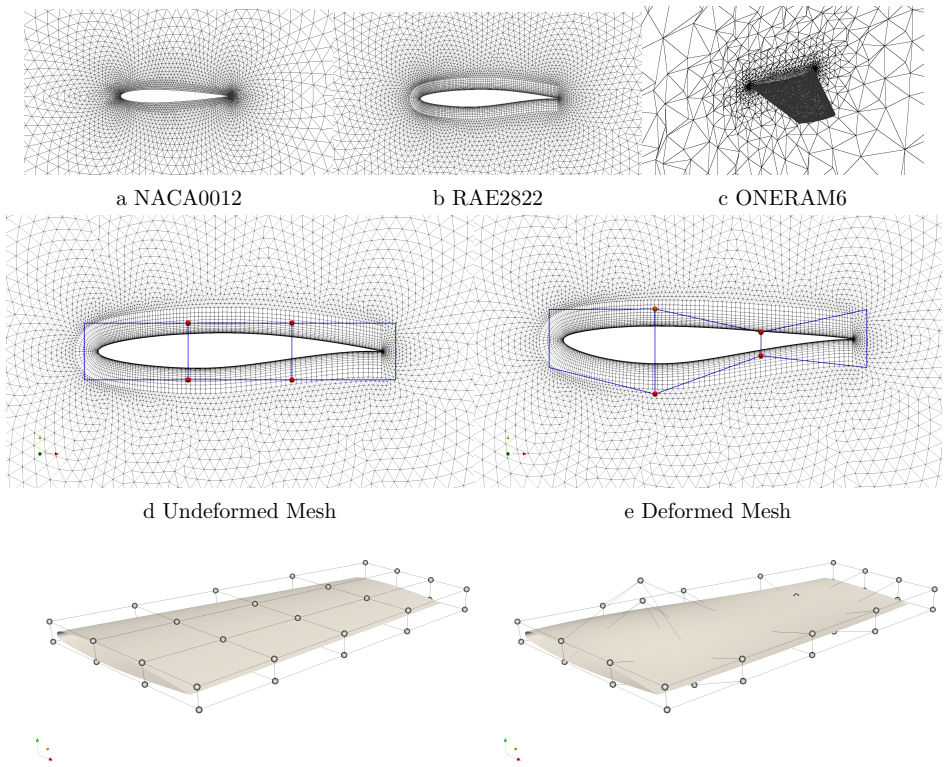
Aerodynamic design optimization is an important problem in aircraft design that depends on the interplay between a numerical optimizer and a high-fidelity flow physics solver. Derivative-based, first and (quasi) second order, optimization techniques are the de facto choice, particularly given the availability of the adjoint method and its ability to efficiently compute gradients at the cost of just one solution of the forward problem. However, implementation of the adjoint method requires careful mathematical treatment, and its sensitivity to changes in mesh quality limits widespread applicability. Derivative-free approaches are often overlooked for large scale optimization, citing their lack of scalability in higher dimensions and/or the lack of practical interest in globally optimal solutions that they often target. However, breaking free from an adjoint solver can be paradigm-shifting in broadening the applicability of aerodynamic design optimization. We provide a systematic benchmarking of a select sample of widely used derivative-based and derivative-free optimization algorithms on the design optimization of three canonical aerodynamic bodies, namely, the NACA0012 and RAE2822 airfoils, and the ONERAM6 wing. Our results demonstrate that derivative-free methods are competitive with derivative-based methods, while outperforming them consistently in the high-dimensional setting. These findings highlight the practical competitiveness of modern derivative-free strategies, offering a scalable and robust alternative for aerodynamic design optimization when adjoint-based gradients are unavailable or unreliable.
Editorial analysis
A structured set of objections, weighed in public.
Referee Report
Summary. The manuscript benchmarks a selection of derivative-free and derivative-based optimization algorithms on aerodynamic shape optimization for the NACA0012 airfoil, RAE2822 airfoil, and ONERA M6 wing. It concludes that derivative-free methods are competitive with derivative-based approaches overall and outperform them consistently in the high-dimensional regime, offering a scalable alternative when adjoint gradients are unavailable or unreliable due to mesh sensitivity.
Significance. If the benchmarking results hold under scrutiny, the work could broaden the practical toolkit for aerodynamic design optimization by reducing dependence on adjoint implementations. This is particularly relevant for moderate-dimensional problems where global search or robustness to implementation details matters, and it challenges the prevailing view that derivative-free methods are inherently unscalable for such applications.
major comments (3)
- [Abstract] Abstract: The central claim that derivative-free methods 'outperform them consistently in the high-dimensional setting' is load-bearing for the paper's contribution, yet the abstract provides no quantitative tables, convergence histories, error bars, or explicit design-variable counts for the three cases. Without these, it is impossible to verify whether the ONERA M6 case actually reaches a regime (e.g., >50 variables) that qualifies as high-dimensional or to assess statistical significance of the reported outperformance.
- [Results] Results section (presumed §4 or equivalent): The comparison's fairness hinges on the derivative-based baselines using efficient adjoint gradients rather than finite differences or suboptimal implementations; the manuscript must explicitly state the gradient computation method, mesh-convergence criteria, and solver settings for each algorithm to ensure the observed competitiveness is not an artifact of implementation details.
- [Introduction] §1 and abstract: The title emphasizes 'moderate dimensions' while the abstract asserts high-dimensional superiority; this tension requires a clear statement of the exact design-variable counts used in each test case together with scaling plots or a fourth, higher-dimensional example (e.g., full aircraft configuration) to support generalization beyond the NACA0012/RAE2822/ONERAM6 suite.
minor comments (2)
- [Abstract] Abstract: Include one or two key quantitative metrics (e.g., final drag reduction or iteration counts) to give readers an immediate sense of the performance differences.
- [Methods] Notation: Ensure consistent use of symbols for objective functions and design variables across the methods comparison; a short nomenclature table would improve readability.
Simulated Author's Rebuttal
We thank the referee for the constructive feedback, which helps clarify the presentation of our benchmarking results. We address each major comment point by point below and will revise the manuscript accordingly where appropriate.
read point-by-point responses
-
Referee: [Abstract] Abstract: The central claim that derivative-free methods 'outperform them consistently in the high-dimensional setting' is load-bearing for the paper's contribution, yet the abstract provides no quantitative tables, convergence histories, error bars, or explicit design-variable counts for the three cases. Without these, it is impossible to verify whether the ONERA M6 case actually reaches a regime (e.g., >50 variables) that qualifies as high-dimensional or to assess statistical significance of the reported outperformance.
Authors: We agree that the abstract would benefit from more quantitative context to support the central claim. In the revised manuscript, we will update the abstract to explicitly state the design-variable counts used in each case (NACA0012: 16 variables; RAE2822: 24 variables; ONERA M6: 64 variables) and briefly note the observed performance trends with reference to the detailed results in Section 4. Due to length constraints, full tables, convergence histories, and any available error bars from repeated runs remain in the results section, where they can be properly presented and discussed. revision: yes
-
Referee: [Results] Results section (presumed §4 or equivalent): The comparison's fairness hinges on the derivative-based baselines using efficient adjoint gradients rather than finite differences or suboptimal implementations; the manuscript must explicitly state the gradient computation method, mesh-convergence criteria, and solver settings for each algorithm to ensure the observed competitiveness is not an artifact of implementation details.
Authors: We concur that full transparency on implementation details is essential for a fair comparison. The revised manuscript will include an expanded description in the results section (and a new subsection on numerical setup) stating that all derivative-based methods employ adjoint gradients computed within the SU2 CFD solver, with mesh convergence enforced to a residual tolerance of 10^{-6} and consistent solver settings (e.g., CFL number, iteration limits) across algorithms. This will confirm that finite differences were not used and that the competitiveness is not an artifact of suboptimal gradient computation. revision: yes
-
Referee: [Introduction] §1 and abstract: The title emphasizes 'moderate dimensions' while the abstract asserts high-dimensional superiority; this tension requires a clear statement of the exact design-variable counts used in each test case together with scaling plots or a fourth, higher-dimensional example (e.g., full aircraft configuration) to support generalization beyond the NACA0012/RAE2822/ONERAM6 suite.
Authors: We acknowledge the apparent tension between the title and abstract wording. The title uses 'moderate dimensions' to describe the overall problem class (tens to low hundreds of variables), while the abstract highlights the relative advantage observed in the highest-dimensional case within our suite. In the revision, we will add explicit design-variable counts in both the introduction and abstract, along with a brief scaling discussion referencing the progression across the three cases. We do not include a fourth example such as a full aircraft configuration in the current study, as the chosen canonical cases already demonstrate the trend from low to higher dimensions; adding a substantially more complex geometry would require new validation and is beyond the scope of this benchmarking paper. revision: partial
Circularity Check
Empirical benchmark with no derivation chain or self-referential reductions
full rationale
This is an empirical benchmarking paper comparing selected DFO and derivative-based optimizers on three fixed aerodynamic test cases (NACA0012, RAE2822, ONERAM6). No equations, first-principles derivations, or predictions appear in the provided text. Performance claims rest on observed objective values and iteration counts from external flow solvers, not on quantities fitted or defined inside the study itself. No self-citation load-bearing steps, uniqueness theorems, or ansatzes are invoked. The work therefore contains no circular steps of the enumerated kinds and remains self-contained against its external benchmarks.
Axiom & Free-Parameter Ledger
axioms (1)
- domain assumption The three chosen aerodynamic bodies (NACA0012, RAE2822, ONERA M6) and the associated flow solvers constitute a sufficient test suite for assessing optimizer competitiveness in moderate dimensions.
Reference graph
Works this paper leans on
-
[1]
Maximilian Balandat, Brian Karrer, Daniel Jiang, Samuel Daulton, Ben Letham, An- drew G Wilson, and Eytan Bakshy. Botorch: A framework for efficient monte-carlo bayesian optimization.Advances in neural information processing systems, 33:21524– 21538, 2020
work page 2020
-
[2]
Actively learning deep gaus- sian process models for failure contour and probability estimation
Annie S Booth, Robert Gramacy, and Ashwin Renganathan. Actively learning deep gaus- sian process models for failure contour and probability estimation. InAIAA SCITECH 2024 Forum, page 0577, 2024. doi: 10.2514/6.2024-0577
-
[3]
Annie S Booth, S Ashwin Renganathan, and Robert B Gramacy. Contour location for reliability in airfoil simulation experiments using deep gaussian processes.The Annals of Applied Statistics, 19(1):191–211, 2025. doi: 10.1214/24-AOAS1951
-
[4]
A python surrogate modeling framework with derivatives
Mohamed Amine Bouhlel, John T Hwang, Nathalie Bartoli, R´ emi Lafage, Joseph Morlier, and Joaquim RRA Martins. A python surrogate modeling framework with derivatives. Advances in Engineering Software, 135:102662, 2019. doi: 10.1016/j.advengsoft.2019.03. 005
-
[5]
Aerodynamic design optimization and shape exploration using generative adversarial networks
Wei Chen, Kevin Chiu, and Mark Fuge. Aerodynamic design optimization and shape exploration using generative adversarial networks. InAIAA SciTech Forum, 2019. doi: 10.2514/6.2019-2351
-
[6]
Andrew R. Conn, Nicholas I. M. Gould, and Philippe L. Toint.Trust Region Methods. Society for Industrial and Applied Mathematics (SIAM), Philadelphia, PA, 2000. ISBN 978-0-89871-460-9. doi: 10.1137/1.9780898719857
-
[7]
Racheal M. Erhard and Juan J. Alonso. Multi-fidelity bayesian optimization of a coaxial rotor for evtol aircraft. InAIAA SciTech Forum, 2024. doi: 10.2514/6.2024-2506
-
[8]
High-dimensional bayesian optimization with sparse axis-aligned subspaces
David Eriksson and Martin Jankowiak. High-dimensional bayesian optimization with sparse axis-aligned subspaces. InUncertainty in Artificial Intelligence, pages 493–503. PMLR, 2021
work page 2021
-
[9]
David Eriksson, Michael Pearce, Jacob Gardner, Ryan D Turner, and Matthias Poloczek. Scalable global optimization via local bayesian optimization.Advances in neural infor- mation processing systems, 32, 2019
work page 2019
-
[10]
Peter I. Frazier. A tutorial on bayesian optimization.arXiv preprint arXiv:1807.02811,
work page internal anchor Pith review Pith/arXiv arXiv
-
[11]
doi: 10.48550/arXiv.1807.02811
work page internal anchor Pith review Pith/arXiv arXiv doi:10.48550/arxiv.1807.02811
-
[12]
Bayesian optimization with inequality constraints
Jacob R Gardner, Matt J Kusner, Zhixiang Eddie Xu, Kilian Q Weinberger, and John P Cunningham. Bayesian optimization with inequality constraints. InICML, volume 2014, pages 937–945, 2014
work page 2014
-
[13]
Cambridge University Press, 2023
Roman Garnett.Bayesian Optimization. Cambridge University Press, 2023. ISBN 9781108425780. doi: 10.1017/9781108348973. 23
-
[14]
Snopt: An sqp algorithm for large-scale constrained optimization.SIAM review, 47(1):99–131, 2005
Philip E Gill, Walter Murray, and Michael A Saunders. Snopt: An sqp algorithm for large-scale constrained optimization.SIAM review, 47(1):99–131, 2005
work page 2005
-
[15]
Gill, Walter Murray, and Margaret H
Philip E. Gill, Walter Murray, and Margaret H. Wright.Practical Optimization. SIAM,
-
[16]
doi: 10.1137/1.9781611975604
-
[17]
Ziyao Guo, Kai Wang, George Cazenavette, Hui Li, Kaipeng Zhang, and Yang You
Stewart Greenhill, Santu Rana, Sunil Gupta, Pratibha Vellanki, and Svetha Venkatesh. Bayesian optimization for adaptive experimental design: A review.IEEE access, 8: 13937–13948, 2020. doi: 10.1109/ACCESS.2020.2966228
-
[18]
Predictive entropy search for multi-objective bayesian optimization
Daniel Hern´ andez-Lobato, Jose Hernandez-Lobato, Amar Shah, and Ryan Adams. Predictive entropy search for multi-objective bayesian optimization. InInternational conference on machine learning, pages 1492–1501. PMLR, 2016
work page 2016
-
[19]
Hoffman, and Zoubin Ghahramani
Jos´ e Miguel Hern´ andez-Lobato, Matthew W. Hoffman, and Zoubin Ghahramani. Predic- tive entropy search for efficient global optimization of black-box functions. InAdvances in Neural Information Processing Systems, pages 918–926, 2014
work page 2014
-
[20]
Raymond M. Hicks and Peter A. Henne. Wing design by numerical optimization.Journal of Aircraft, 15(7):407–412, 1978. doi: 10.2514/3.58379
-
[21]
W. M. Hsu, J. F. Hughes, and H. Kaufman. Direct manipulation of free-form deformations. ACM SIGGRAPH Computer Graphics, 26(2):177–184, 1992. doi: 10.1145/142920.134036
-
[22]
Antony Jameson. Aerodynamic design via control theory.Journal of Scientific Computing, 3(3):233–260, 1988. doi: 10.1007/BF01061285
-
[23]
Antony Jameson. Origins and further development of the jameson–schmidt–turkel scheme.AIAA Journal, 55(5):1487–1510, 2017. doi: doi.org/10.2514/1.J055493
-
[24]
Timothy M. S. Jim, Ghifari A. Faza, Pramudita S. Palar, and Koji Shimoyama. Bayesian optimization of a low-boom supersonic wing planform.AIAA Journal, 59(11):4514–4529,
-
[25]
doi: 10.2514/1.J060225
-
[26]
Donald R Jones, Cary D Perttunen, and Bruce E Stuckman. Lipschitzian optimization without the lipschitz constant.Journal of Optimization Theory and Applications, 79(1): 157–181, 1993. doi: 10.1007/BF00941892
-
[27]
Jones, Matthias Schonlau, and William J
Donald R. Jones, Matthias Schonlau, and William J. Welch. Efficient global optimization of expensive black-box functions.Journal of Global Optimization, 13(4):455–492, 1998. doi: 10.1023/A:1008306431147
-
[28]
Abhishek Kundu, H. G. Matthies, and M. I. Friswell. Probabilistic optimization of engineering systems with prescribed target design in a reduced parameter space.Com- putational Methods in Applied Mechanics and Engineering, 339:640–660, 2018. doi: 10.1016/j.cma.2018.03.041
-
[29]
Constrained bayesian optimization with noisy experiments
Benjamin Letham, Brian Karrer, Guilherme Ottoni, and Eytan Bakshy. Constrained bayesian optimization with noisy experiments. 2019. 24
work page 2019
-
[30]
Robert Michael Lewis and Virginia Torczon. Pattern search algorithms for bound constrained minimization.SIAM Journal on optimization, 9(4):1082–1099, 1999. doi: 10.1137/S1052623496300507
-
[31]
High dimensional bayesian optimization via restricted projection pursuit models
Chun-Liang Li, Kirthevasan Kandasamy, Barnab´ as P´ oczos, and Jeff Schneider. High dimensional bayesian optimization via restricted projection pursuit models. InArtificial Intelligence and Statistics, pages 884–892. PMLR, 2016
work page 2016
-
[32]
Jichao Li, Mengqi Zhang, Joaquim R. R. A. Martins, and Chang Shu. Efficient aerody- namic shape optimization with deep-learning-based geometric filtering.AIAA Journal, 58(10):4243–4259, 2020. doi: 10.2514/1.J059254
-
[33]
Jichao Li, Xiaosong Du, and Joaquim R. R. A. Martins. Machine learning in aerodynamic shape optimization.Progress in Aerospace Sciences, 134:100849, 2022. doi: 10.1016/j. paerosci.2022.100849
work page doi:10.1016/j 2022
-
[34]
Ruo-Lin Liu, Qiang Zhao, Xian-Jun He, Xin-Yi Yuan, Wei-Tao Wu, and Ming-Yu Wu. Airfoil optimization based on multi-objective bayesian optimization.Journal of Mechan- ical Science and Technology, 36(11):5561–5573, 2022. doi: 10.1007/s12206-022-1020-y
-
[35]
Practical bayesian optimization
Daniel James Lizotte. Practical bayesian optimization. 2008
work page 2008
-
[36]
Andr´ e L. Marchildon and David W. Zingg. Gradient-enhanced bayesian optimization with application to aerodynamic shape optimization. InAIAA Aviation Forum and ASCEND 2024, 2024. doi: 10.2514/6.2024-4405
-
[37]
A bayesian framework for the shape optimization of atmospheric reentry vehicles
Azzurra Meo, Alessandro Aponte, Alessandro Munaf` o, Giulio Gori, and Marco Panesi. A bayesian framework for the shape optimization of atmospheric reentry vehicles. In AIAA Aviation Forum and ASCEND, 2024. American Institute of Aeronautics and Astronautics Inc, AIAA, 2024. doi: 10.2514/6.2024-3563
-
[38]
Stephen G. Nash. Newton-type minimization via the lanczos method.SIAM Journal on Numerical Analysis, 21(4):770–788, 1984. doi: 10.1137/0721052
-
[39]
A framework for bayesian optimization in embedded subspaces
Amin Nayebi, Alexander Munteanu, and Matthias Poloczek. A framework for bayesian optimization in embedded subspaces. InInternational Conference on Machine Learning, pages 4752–4761. PMLR, 2019
work page 2019
-
[40]
J. A. Nelder and R. Mead. A simplex method for function minimization.The Computer Journal, 7(4):308–313, 1965. doi: 10.1093/comjnl/7.4.308
-
[41]
Jorge Nocedal and Stephen J Wright.Numerical optimization. Springer, 1999
work page 1999
-
[42]
The nelder-mead simplex procedure for function minimization.Technometrics, 17(1):45–51, 1975
Donald M Olsson and Lloyd S Nelson. The nelder-mead simplex procedure for function minimization.Technometrics, 17(1):45–51, 1975
work page 1975
-
[43]
University of Colorado at Boulder, 1989
Emmanuel Omotayo Omojokun.Trust region algorithms for optimization with nonlinear equality and inequality constraints. University of Colorado at Boulder, 1989. 25
work page 1989
-
[44]
Francisco Palacios, Juan Alonso, Karthikeyan Duraisamy, Michael Colonno, Jason Hicken, Aniket Aranake, Alejandro Campos, Sean Copeland, Thomas Economon, Amrita Lonkar, Trent Lukaczyk, and Thomas Taylor. Stanford University Unstructured (SUˆ2): An open-source integrated computational environment for multi-physics simulation and design. In51st AIAA Aerospac...
-
[45]
M. J. D. Powell. A direct search optimization method that models the objective and constraint functions by linear interpolation. In S. Gomez and J.-P. Hennart, editors, Advances in Optimization and Numerical Analysis, volume 275 ofMathematics and Its Applications, pages 51–67. Springer, 1994. doi: 10.1007/978-94-015-8330-5 4
-
[46]
Nestor V. Queipo, Raphael T. Haftka, Wei Shyy, Tapabrata Goel, Rajiv Vaidyanathan, and Paul K. Tucker. Surrogate-based analysis and optimization.Progress in Aerospace Sciences, 41(1):1–28, 2005. doi: 10.1016/j.paerosci.2005.02.001
-
[47]
Deep gaussian process enabled surrogate models for aerodynamic flows
Dushhyanth Rajaram, Tejas G Puranik, Ashwin Renganathan, WoongJe Sung, Olivia J Pinon-Fischer, Dimitri N Mavris, and Arun Ramamurthy. Deep gaussian process enabled surrogate models for aerodynamic flows. InAIAA scitech 2020 forum, page 1640, 2020. doi: 10.2514/6.2020-1640
-
[48]
Dushhyanth Rajaram, Tejas G Puranik, S Ashwin Renganathan, WoongJe Sung, Olivia Pinon Fischer, Dimitri N Mavris, and Arun Ramamurthy. Empirical assess- ment of deep gaussian process surrogate models for engineering problems.Journal of Aircraft, 58(1):182–196, 2021. doi: 10.2514/1.C036026
-
[49]
Carl Edward Rasmussen and Christopher K. I. Williams.Gaussian Processes for Machine Learning. The MIT Press, 2006. ISBN 9780262182539. doi: 10.7551/mitpress/3206.001. 0001
-
[50]
Thomas A. Reist, David Koo, David W. Zingg, Pascal Bochud, Philippe Castonguay, and David Leblond. Cross-validation of high-fidelity aerodynamic shape optimization methodologies for aircraft wing-body optimization.AIAA Journal, 58(6):2581–2595,
-
[51]
doi: 10.2514/1.J059091
-
[52]
Efficient reliability analysis with multifidelity gaussian processes and normalizing flows
Ashwin Renganathan. Efficient reliability analysis with multifidelity gaussian processes and normalizing flows. InAIAA SCITECH 2024 Forum, page 0576, 2024. doi: 10.2514/ 6.2024-0576
work page 2024
-
[53]
qpots: Efficient batch multiobjective bayesian optimization via pareto optimal thompson sampling
Ashwin Renganathan and Kade Carlson. qpots: Efficient batch multiobjective bayesian optimization via pareto optimal thompson sampling. InInternational Conference on Artificial Intelligence and Statistics, pages 4051–4059. PMLR, 2025
work page 2025
-
[54]
S Ashwin Renganathan, Romit Maulik, and Jai Ahuja. Enhanced data efficiency using deep neural networks and gaussian processes for aerodynamic design optimization. Aerospace Science and Technology, 111:106522, 2021. doi: 10.1016/j.ast.2021.106522. 26
-
[55]
S Ashwin Renganathan, Vishwas Rao, and Ionel M Navon. Camera: A method for cost-aware, adaptive, multifidelity, efficient reliability analysis.Journal of Computational Physics, 472:111698, 2023. doi: 10.1016/j.jcp.2022.111698
-
[56]
Thomas W. Sederberg and Scott R. Parry. Free-form deformation of solid geometric models.SIGGRAPH Comput. Graph., 20(4):151–160, 1986. doi: 10.1145/15922.15903
-
[57]
Taking the Human Out of the Loop: A Review of Bayesian Optimization.Proceedings of the IEEE
Bobak Shahriari, Kevin Swersky, Ziyu Wang, Ryan P Adams, and Nando De Freitas. Taking the human out of the loop: A review of bayesian optimization.Proceedings of the IEEE, 104(1):148–175, 2015. doi: 10.1109/JPROC.2015.2494218
-
[58]
Haris Moazam Sheikh, Tess A. Callan, Kealan J. Hennessy, and Philip S. Marcus. Optimization of the shape of a hydrokinetic turbine’s draft tube and hub assembly using design-by-morphing with bayesian optimization.Computer Methods in Applied Mechanics and Engineering, 401:115654, 2022. doi: 10.1016/j.cma.2022.115654
-
[59]
Philippe R. Spalart and Steven R. Allmaras. A one-equation turbulence model for aerodynamic flows.AIAA Journal, 30(4):439–446, 1992. doi: 10.2514/6.1992-439
-
[60]
Ali Tfaily, Youssef Diouane, Nathalie Bartoli, and Michael Kokkolaras. Bayesian optimization with hidden constraints for aircraft design.Structural and Multidisciplinary Optimization, 67(G–2024–10):123, 2024. doi: 10.1007/s00158-024-03833-8
-
[61]
William R Thompson. On the likelihood that one unknown probability exceeds another in view of the evidence of two samples.Biometrika, 25(3-4):285–294, 1933. doi: 10.2307/ 2332286
work page 1933
-
[62]
Pauli Virtanen, Ralf Gommers, Travis E Oliphant, Matt Haberland, Tyler Reddy, David Cournapeau, Evgeni Burovski, Pearu Peterson, Warren Weckesser, Jonathan Bright, et al. Scipy 1.0: fundamental algorithms for scientific computing in python.Nature methods, 17(3):261–272, 2020
work page 2020
-
[63]
Max-value entropy search for efficient Bayesian opti- mization
Zi Wang and Stefanie Jegelka. Max-value entropy search for efficient Bayesian opti- mization. InProceedings of the 34th International Conference on Machine Learning, volume 70, pages 3627–3635. PMLR, 2017
work page 2017
-
[64]
Ziyu Wang, Frank Hutter, Masrour Zoghi, David Matheson, and Nando De Feitas. Bayesian optimization in a billion dimensions via random embeddings.Journal of Artificial Intelligence Research, 55:361–387, 2016. doi: 10.1613/jair.4806
-
[65]
D. Y. Xu, Y. Shen, W. Huang, Z. Y. Guo, H. Zhang, and D. F. Xu. Parametric modelling and variable-fidelity bayesian optimization of aerodynamics for a reusable flight vehicle. Fluid Dynamics, 59(6):123–135, 2024. doi: 10.1134/S0015462824603814
-
[66]
Ciyou Zhu, Richard H. Byrd, Peihuang Lu, and Jorge Nocedal. Algorithm 778: L-bfgs-b: Fortran subroutines for large-scale bound-constrained optimization.ACM Transactions on Mathematical Software, 23(4):550–560, 1997. doi: 10.1145/279232.279236. 27
discussion (0)
Sign in with ORCID, Apple, or X to comment. Anyone can read and Pith papers without signing in.