REVIEW 3 major objections 5 minor 98 references
Measuring the Cosmic Ray Spectrum with Next Generation Neutrino Detectors
T0 review · 3 major / 5 minor · reviewed 2026-08-15 · deepseek-v4-flash
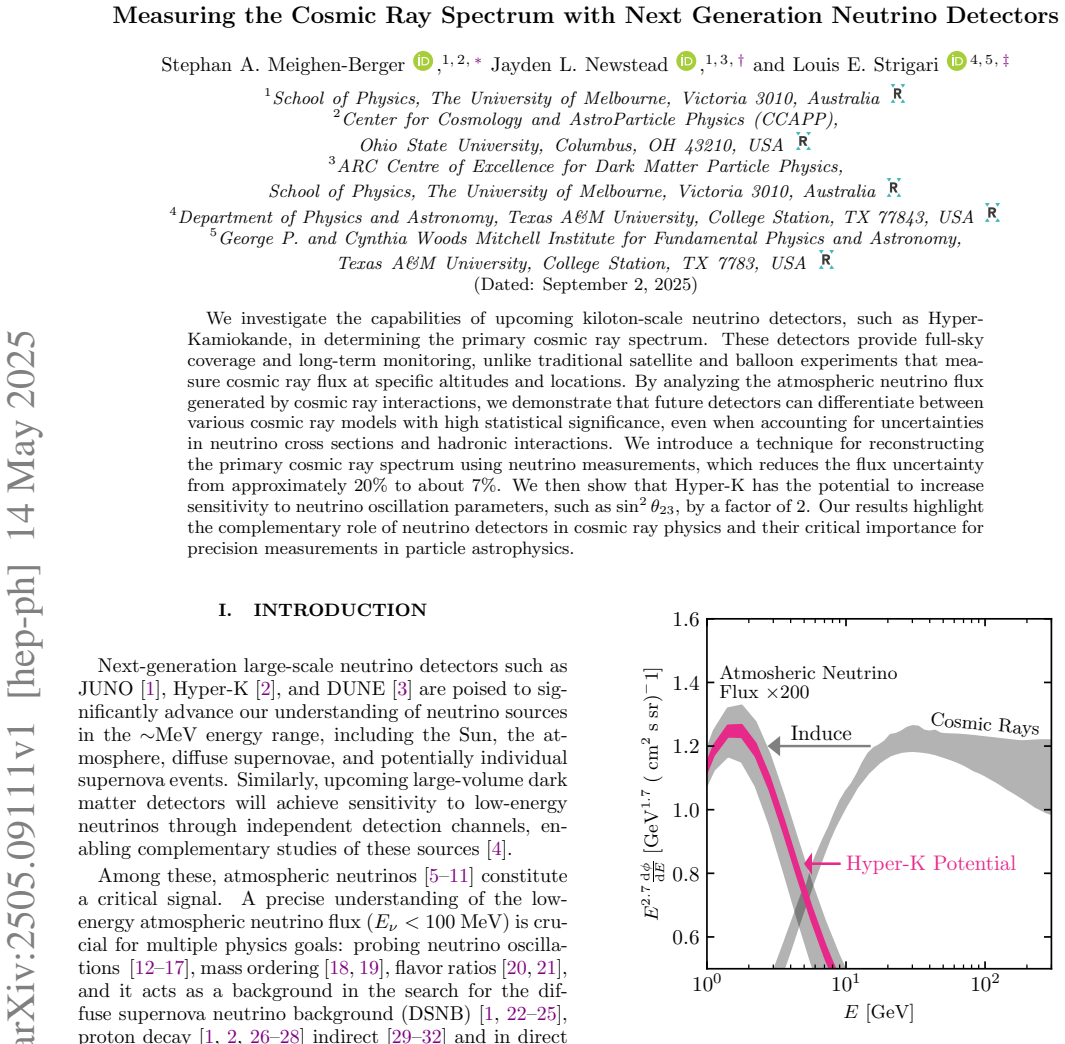
Pith's one-line read This paper claims that Hyper-Kamiokande, from atmospheric neutrinos alone, can distinguish competing cosmic ray models, reconstruct the primary spectrum to 5–10% precision, and roughly double sensitivity to the neutrino mixing parameter…
desk verdict A genuinely reversed CR-to-neutrino sensitivity study with a coherent framework, but the abstract overclaims hadronic-interaction coverage and the headline flux precision is an idealized template-fit number. read the letter →
The pith
A machine-rendered reading of the paper's core claim, the machinery that carries it, and where it could break.
The reading
What carries the argument
The load-bearing tool is a template-unfolding scheme: inject single proton lines at seven primary energies (2, 5, 17, 53, 167, 528, and 1670 GeV), propagate each through the MCEq cascade-equation simulation to obtain neutrino flux templates, rescale the HKKM11 and low-energy fluxes, then fit the predicted all-sky Hyper-K event rates with a χ² that carries a 10% Gaussian neutrino-oxygen cross-section systematic. The model-discrimination analysis uses a Poisson maximum-likelihood test statistic q with the overall normalization free and the cross section nuisance-parameterized.
What would settle it
Feed helium primaries at the measured AMS abundance (about 10–20%) through the same MCEq shower calculation instead of treating them as protons, and compare the resulting neutrino spectra between 0.1 and 10 GeV with the proton-only templates; if the helium-inclusive spectra differ by more than the quoted 5–10% per energy bin, the reconstructed primary spectrum in the paper's Figure 5 is biased and the 7% flux-uncertainty claim does not hold.
Extended reading notes
Core claim
The paper claims that a kiloton-scale water Cherenkov detector such as Hyper-Kamiokande can, from atmospheric neutrino events alone, act as a cosmic ray observatory. With a 10-year exposure and the neutrino-oxygen cross section fixed to a 10% Gaussian uncertainty, the predicted event rates give statistical power below 1%, enough to tell injected primary models apart: HKKM New at 1.1σ, PAMELA at 2.1σ, and HKKM Old at ≥5σ against an AMS baseline. Fitting seven injected proton lines as neutrino-flux templates unfolds the primary spectrum to 5–10% per energy bin, cutting the atmospheric neutrino flux uncertainty from 15–25% to about 7%. Using that improved flux in a simplified sin²θ₂₃ analysis turns a systematics-limited measurement into one that reaches 50–73% of Super-Kamiokande's current uncertainty, and would approach 1% precision if the flux uncertainty were negligible.
Load-bearing premise
The helium component of cosmic rays (10–20% of primaries) is assumed to produce the same neutrino spectrum as protons; if it does not, the reconstructed spectrum and the claimed 7% precision are biased.
Editorial extensions
If this is right
- With one 10-year Hyper-K exposure, the atmospheric neutrino sample becomes a continuous full-sky cosmic ray monitor covering primary energies from about 1 GeV to 1 TeV, complementing balloon and satellite missions that sample specific altitudes and times.
- Reducing the atmospheric neutrino flux uncertainty from 15–25% to 5–10% removes a dominant systematic for sin²θ₂₃; the paper finds the 7% case reaches 50–73% of Super-K's uncertainty, while a 0% flux uncertainty would push the parameter to about 1%.
- The same reduction sharpens background predictions for diffuse supernova neutrino searches, proton decay searches, and dark matter detection, all of which are normalized to the atmospheric neutrino flux.
- The analysis is not limited to Hyper-K: the paper states the same reconstruction should work for JUNO and DUNE, whose different locations add independent geomagnetic and solar-modulation systematics.
Reading between the lines
- If the neutrino-oxygen cross-section uncertainty can be pushed from 10% toward 3%, the same data become sensitive to the helium component of cosmic rays, effectively turning neutrino detectors into composition monitors; that sensitivity is a consequence of the paper's numbers, not a demonstrated result.
- A multi-detector joint fit across Hyper-K, JUNO, and DUNE could break the degeneracies the paper notes between neighboring proton-line templates, plausibly pushing reconstruction precision below the 5% floor quoted here.
- Because the paper's flux is solar-cycle averaged, a time-resolved version of the unfolding could track solar modulation over the 11-year cycle, using the same machinery with time-binned data.
Signed reviews
Editorial analysis
A structured set of objections, weighed in public.
Referee Report
Summary. The paper proposes that next-generation kiloton-scale neutrino detectors, using Hyper-Kamiokande as a concrete example, can measure the primary cosmic ray spectrum through atmospheric neutrinos. The authors simulate 10 years of CC νe and νμ events, compare neutrino spectra produced by injecting different primary CR models (AMS, PAMELA, HKKM Old/New), and define a maximum-likelihood test statistic q with a free normalization and a 10% cross-section nuisance. They report model-discrimination sensitivities from 1.1σ to over 5σ. They then reconstruct the primary CR spectrum by fitting seven single-proton-line neutrino templates to the pseudo-data, claiming a reduction in flux uncertainty from roughly 20% to about 7%. Finally, they use the reconstructed spectra in a simplified sin²θ23 analysis, reporting a factor-of-2 improvement in sensitivity when the CR flux uncertainty is reduced from 15% to 7%. The paper closes with an outlook for JUNO, DUNE, and other detectors.
Significance. If the quantitative claims are correct, this is a useful and timely demonstration that atmospheric neutrino detectors can serve as complementary cosmic-ray monitors, with full-sky coverage and long-term stability, and that improved CR knowledge can sharpen oscillation measurements. The paper's strengths include a coherent closed-loop simulation pipeline (MCEq with multiple hadronic models, HKKM11 plus low-energy FLUKA/CORSIKA fluxes, GENIE cross sections, nuCraft oscillograms), a meaningful cross-check of the injected models against external AMS/PAMELA data, and clear figures that show the energy-dependent nature of the discriminating power. The central idea is credible and the analysis is reproducible in structure. The main weaknesses are that the headline test statistic and the template reconstruction do not actually propagate the hadronic-interaction uncertainties that the abstract claims are accounted for, and the helium-composition approximation is asserted rather than demonstrated. These issues are fixable within the scope of the paper, but they affect the central quantitative claims.
major comments (3)
- [Abstract and Section IV (Fig. 3)] The abstract states that the models can be differentiated 'even when accounting for uncertainties in neutrino cross sections and hadronic interactions,' but the test statistic q in Section IV is maximized only over an overall normalization and a 10% Gaussian cross-section nuisance, and Figure 3's caption explicitly says 'holding the interaction model fixed.' The hadronic-model spread shown in Appendix A (SIBYLL 2.3, EPOS-LHC, QGSJET-II, DPMJET-III) is not propagated into q. This matters most for the smallest claimed discrimination: HKKM New versus AMS is only 1.1–1.4σ at Eν ∈ [1,10] GeV, where Ref. [75] places hadronic-model uncertainty at about 5%. A correlated shape nuisance from the hadronic-model spread could plausibly erase that signal. The authors should either propagate the Appendix A bands through q or revise the abstract and Section IV claims to state that the significances are conditional on a fixed hadronic interaction model.
- [Section V and Figure 5] The claimed reduction of the neutrino flux uncertainty from ~20% to ~7% is obtained from a closure test: the pseudo-data and the seven template spectra are both generated with the same MCEq/HKKM machinery, and the fit includes only a 10% cross-section nuisance and a free normalization. This measures how well the seven-parameter template model can be constrained internally, not the absolute uncertainty of the atmospheric neutrino flux. The comparison to Super-K's 14.3% and 7.8% flux uncertainties (Ref. [90]) is therefore not apples-to-apples. The paper should explicitly label the 5–10% result as model-conditional and should add hadronic-model and composition uncertainties before claiming a reduction to ~7% total uncertainty.
- [Section II and Figure 5] The assumption that the neutrino spectrum produced by helium cosmic rays is identical to that from protons, with the statement that differences 'do not affect our results,' is not supported by any quantitative test. Helium is 10–20% of the primary flux, and the paper itself notes in Section II that shower observables differ between proton- and helium-initiated showers. If helium produces a different neutrino spectral shape, the reconstructed primary spectrum in Figure 5 and the quoted 5–10% uncertainties could be biased. A dedicated MCEq comparison of proton-only versus proton+helium injections, or the inclusion of a helium-shape nuisance parameter in the Section V fit, is needed before the reconstruction claim can be taken at face value.
minor comments (5)
- [Section III] The name 'Sybill 2.3' appears in the text, but the standard spelling is 'Sibyll 2.3' as used in Refs. [68,69].
- [Section IV] The sentence 'This implies that Hyper-K's statistical uncertainty is below 1%' refers to the total event count, but the energy-binned shape uncertainties used in the q analysis are larger; this distinction should be stated explicitly.
- [Appendix A] The bands in Figure A.1 show count ratios for different interaction models, but the text does not specify how the band width is computed (e.g., envelope versus standard deviation across models) or whether the atmospheric-model variation (CORSIKA US Standard versus NRLMSISE-00) is included in those bands.
- [Section VI] The statement that the 7% uncertainty case achieves '50%-73% of the uncertainty in Super-K's sin2θ23 measurement' is unclear; please specify whether this is relative to the 15% benchmark used in the paper or to the published Super-K result, and define the comparison procedure.
- [Equation (1)] The detection efficiency ε is described as 80%, but the paper does not state whether angular resolution and energy resolution are folded into the event-rate calculation or the likelihood; if they are neglected, this should be stated as an approximation.
Circularity Check
No significant circularity: the analysis is a Monte Carlo sensitivity and closure study; unpropagated hadronic-model and helium assumptions are limitations, not circular reductions.
full rationale
The paper's central claims are projected sensitivities, not retroactive predictions. Section IV injects AMS/PAMELA/HKKM primary spectra into the same HKKM11/MCEq forward model that defines the templates, then computes a likelihood-ratio test statistic; this is a standard Monte Carlo closure test, so the reported significances are conditional on that model but not circular. Section V performs a template fit of seven proton-line neutrino spectra to a pseudo-data set generated with the same forward machinery; the quoted 5-10% uncertainty is therefore an internal measure of statistical and cross-section-nuisance precision, not an absolute calibration that includes hadronic-model spread. Two caveats belong in the correctness column, not the circularity column: the Figure 3 caption states 'holding the interaction model fixed' while the abstract claims hadronic-interaction uncertainties are accounted for, and Appendix A shows hadronic-model bands without propagating them into q or the Section V fit; likewise the proton-only helium assumption in Section II is an idealization that is asserted not to affect results. No fitted parameter is renamed as a prediction, no load-bearing claim depends solely on a self-citation (the cited low-energy flux and solar-cycle works are published external calculations), and the model inputs (AMS, PAMELA, HKKM) are independent external data sets. Hence no circular reduction is exhibited.
Assumptions & free parameters
free parameters (2)
- Template proton-line energy set =
7 lines at 2, 5, 17, 53, 167, 528, 1670 GeV
- Overall normalization nuisance =
Free parameter in the maximum-likelihood ratio
assumptions (5)
- domain assumption HKKM11 solar-cycle-averaged flux, rescaled by MCEq ratios, provides a valid baseline atmospheric neutrino flux.
- domain assumption Helium-induced showers produce the same neutrino spectrum as proton-induced showers.
- domain assumption The four hadronic models used span the true hadronic interaction uncertainty.
- domain assumption GENIE G18_10a_02_11b provides the correct neutrino-oxygen cross section for water in the 100 MeV to 10 GeV range.
- standard math The cascade-equation formalism in MCEq correctly maps a primary CR spectrum to the neutrino flux.
Cite this review
Pith. "Pith review of Measuring the Cosmic Ray Spectrum with Next Generation Neutrino Detectors." pith.science (2026). https://pith.science/paper/C3ZSYDB6
@misc{pith2026250509111,
  author       = {Pith},
  title        = {Pith review of: Measuring the Cosmic Ray Spectrum with Next Generation Neutrino Detectors},
  year         = {2026},
  howpublished = {\url{https://pith.science/paper/C3ZSYDB6}},
  note         = {Machine review of arXiv:2505.09111}
}
abstract
We investigate the capabilities of upcoming kiloton-scale neutrino detectors, such as Hyper-Kamiokande, in determining the primary cosmic ray spectrum. These detectors provide full-sky coverage and long-term monitoring, unlike traditional satellite and balloon experiments that measure cosmic ray flux at specific altitudes and locations. By analyzing the atmospheric neutrino flux generated by cosmic ray interactions, we demonstrate that future detectors can differentiate between various cosmic ray models with high statistical significance, even when accounting for uncertainties in neutrino cross sections and hadronic interactions. We introduce a technique for reconstructing the primary cosmic ray spectrum using neutrino measurements, which reduces the flux uncertainty from approximately 20\% to about 7\%. We then show that Hyper-K has the potential to increase sensitivity to neutrino oscillation parameters, such as $\sin^2\theta_{23}$, by a factor of 2. Our results highlight the complementary role of neutrino detectors in cosmic ray physics and their critical importance for precision measurements in particle astrophysics.
Figures


Figures from the paper (2 more)


Reference graph
Works this paper leans on
-
[75]
A. Fedynitch and M. Huber, Data-driven hadronic in- teraction model for atmospheric lepton flux calculations, Phys. Rev. D 106, 083018 (2022), arXiv:2205.14766 [astro-ph.HE]
arXiv 2022
- [90]
- [1]
- [2]
- [3]
-
[4]
J. Aalbers et al. , A next-generation liquid xenon obser- vatory for dark matter and neutrino physics, J. Phys. G 50, 013001 (2023), arXiv:2203.02309 [physics.ins-det]
arXiv 2023
-
[5]
Aglietta et al
M. Aglietta et al. (NUSEX), Experimental study of at- mospheric neutrino flux in the NUSEX experiment, EPL 8, 611 (1989)
1989
-
[6]
Becker-Szendy et al
R. Becker-Szendy et al. , The Electron-neutrino and muon-neutrino content of the atmospheric flux, Phys. Rev. D 46, 3720 (1992)
1992
Show all 98 references
-
[7]
W. W. M. Allison et al. (Soudan 2), Measurement of the L/E distributions of atmospheric neutrinos in Soudan 2 and their interpretation as neutrino oscillations, Phys. Rev. D 68, 113004 (2003), arXiv:hep-ex/0307069
2003 arXiv
-
[8]
M. C. Gonzalez-Garcia, M. Maltoni, and J. Rojo, De- termination of the atmospheric neutrino fluxes from atmospheric neutrino data, JHEP 10, 075, arXiv:hep- ph/0607324
-
[9]
Wendell et al
R. Wendell et al. (Super-Kamiokande), Atmospheric neutrino oscillation analysis with sub-leading effects in Super-Kamiokande I, II, and III, Phys. Rev. D81, 092004 (2010), arXiv:1002.3471 [hep-ex]
2010 arXiv
-
[10]
Abbasi et al
R. Abbasi et al. (IceCube), Measurement of the atmo- spheric neutrino energy spectrum from 100 GeV to 400 TeV with IceCube, Phys. Rev. D 83, 012001 (2011), arXiv:1010.3980 [astro-ph.HE]
2011 arXiv
-
[11]
M. G. Aartsen et al. (IceCube), Measurement of the Atmospheric νe flux in IceCube, Phys. Rev. Lett. 110, 151105 (2013), arXiv:1212.4760 [hep-ex]
2013 arXiv
-
[12]
Fukuda et al
Y. Fukuda et al. (Super-Kamiokande), Evidence for os- cillation of atmospheric neutrinos, Phys. Rev. Lett. 81, 1562 (1998), arXiv:hep-ex/9807003
1998 arXiv
-
[13]
Adrian-Martinez et al
S. Adrian-Martinez et al. (KM3Net), Letter of in- tent for KM3NeT 2.0, J. Phys. G 43, 084001 (2016), arXiv:1601.07459 [astro-ph.IM]
2016 arXiv
-
[14]
Li et al
Z. Li et al. (Super-Kamiokande), Measurement of the tau neutrino cross section in atmospheric neutrino oscilla- tions with Super-Kamiokande, Phys. Rev. D 98, 052006 (2018), arXiv:1711.09436 [hep-ex]
2018 arXiv
-
[15]
M. G. Aartsen et al. (IceCube), Measurement of Atmo- spheric Tau Neutrino Appearance with IceCube Deep- Core, Phys. Rev. D 99, 032007 (2019), arXiv:1901.05366 [hep-ex]
2019 arXiv
-
[16]
Esteban, M
I. Esteban, M. C. Gonzalez-Garcia, M. Maltoni, T. Schwetz, and A. Zhou, The fate of hints: updated global analysis of three-flavor neutrino oscillations, JHEP 09, 178, arXiv:2007.14792 [hep-ph]
2007 arXiv
-
[17]
S. A. Meighen-Berger, J. F. Beacom, N. F. Bell, and M. J. Dolan, New signal of atmospheric tau neutrino appear- ance: Sub-GeV neutral-current interactions in JUNO, Phys. Rev. D 109, 092006 (2024), arXiv:2311.01667 [hep- ph]
2024 arXiv
-
[18]
M. G. Aartsen et al. (IceCube-Gen2), Combined sensi- tivity to the neutrino mass ordering with JUNO, the Ice- Cube Upgrade, and PINGU, Phys. Rev. D 101, 032006 (2020), arXiv:1911.06745 [hep-ex]
2020
-
[19]
Aiello et al
S. Aiello et al. (KM3NeT), Determining the neu- trino mass ordering and oscillation parameters with KM3NeT/ORCA, Eur. Phys. J. C 82, 26 (2022), arXiv:2103.09885 [hep-ex]
2022 arXiv
-
[20]
Fukuda et al
Y. Fukuda et al. (Kamiokande), Atmospheric muon- neutrino / electron-neutrino ratio in the multiGeV en- ergy range, Phys. Lett. B 335, 237 (1994)
1994
-
[21]
Fukuda et al
Y. Fukuda et al. (Super-Kamiokande), Measurement of a small atmospheric muon-neutrino / electron-neutrino ratio, Phys. Lett. B433, 9 (1998), arXiv:hep-ex/9803006
1998 arXiv
-
[22]
Horiuchi, J
S. Horiuchi, J. F. Beacom, and E. Dwek, The Dif- fuse Supernova Neutrino Background is detectable in Super-Kamiokande, Phys. Rev. D 79, 083013 (2009), arXiv:0812.3157 [astro-ph]
2009 arXiv
-
[23]
J. F. Beacom, The Diffuse Supernova Neutrino Back- ground, Ann. Rev. Nucl. Part. Sci. 60, 439 (2010), arXiv:1004.3311 [astro-ph.HE]
2010 arXiv
-
[24]
Gando et al
A. Gando et al. (KamLAND), A study of extraterres- trial antineutrino sources with the KamLAND detector, Astrophys. J. 745, 193 (2012), arXiv:1105.3516 [astro- ph.HE]
2012 arXiv
-
[25]
Abe et al
K. Abe et al. (Super-Kamiokande), Diffuse supernova neutrino background search at Super-Kamiokande, Phys. Rev. D 104, 122002 (2021), arXiv:2109.11174 [astro- ph.HE]
2021
-
[26]
Abe et al
S. Abe et al. (KamLAND), Precision Measurement of Neutrino Oscillation Parameters with KamLAND, Phys. Rev. Lett. 100, 221803 (2008), arXiv:0801.4589 [hep-ex]
2008 arXiv
-
[27]
Abe et al
K. Abe et al. (Super-Kamiokande), Search for proton de- cay via p → e+π0 and p → µ+π0 in 0.31 megaton ·years exposure of the Super-Kamiokande water Cherenkov de- tector, Phys. Rev. D95, 012004 (2017), arXiv:1610.03597 [hep-ex]
2017 arXiv
-
[28]
Abi et al
B. Abi et al. (DUNE), Deep Underground Neutrino Ex- periment (DUNE), Far Detector Technical Design Re- port, Volume II: DUNE Physics (2020), arXiv:2002.03005 [hep-ex]
2020
-
[29]
Olivares-Del Campo, C
A. Olivares-Del Campo, C. Bœhm, S. Palomares- Ruiz, and S. Pascoli, Dark matter-neutrino interactions through the lens of their cosmological implications, Phys. Rev. D 97, 075039 (2018), arXiv:1711.05283 [hep-ph]
2018 arXiv
-
[30]
C. A. Arg¨ uelles, A. Diaz, A. Kheirandish, A. Olivares- Del-Campo, I. Safa, and A. C. Vincent, Dark matter annihilation to neutrinos, Rev. Mod. Phys. 93, 035007 (2021), arXiv:1912.09486 [hep-ph]
2021 arXiv
-
[31]
Abe et al
K. Abe et al. (Super-Kamiokande), Indirect search for dark matter from the Galactic Center and halo with the Super-Kamiokande detector, Phys. Rev. D 102, 072002 (2020), arXiv:2005.05109 [hep-ex]
2020
-
[32]
N. F. Bell, M. J. Dolan, and S. Robles, Dark matter pollution in the Diffuse Supernova Neutrino Background, JCAP 11, 060, arXiv:2205.14123 [hep-ph]. 8
-
[33]
L. E. Strigari, Neutrino Coherent Scattering Rates at Di- rect Dark Matter Detectors, New J. Phys. 11, 105011 (2009), arXiv:0903.3630 [astro-ph.CO]
2009 arXiv
-
[34]
Billard, L
J. Billard, L. Strigari, and E. Figueroa-Feliciano, Impli- cation of neutrino backgrounds on the reach of next gen- eration dark matter direct detection experiments, Phys. Rev. D 89, 023524 (2014), arXiv:1307.5458 [hep-ph]
2014 arXiv
-
[35]
C. A. J. O’Hare, New Definition of the Neutrino Floor for Direct Dark Matter Searches, Phys. Rev. Lett. 127, 251802 (2021), arXiv:2109.03116 [hep-ph]
2021 arXiv
-
[36]
Aguilar et al
M. Aguilar et al. (AMS), Precision Measurement of the Proton Flux in Primary Cosmic Rays from Rigidity 1 GV to 1.8 TV with the Alpha Magnetic Spectrometer on the International Space Station, Phys. Rev. Lett. 114, 171103 (2015)
2015
-
[37]
Y. S. Yoon et al., Cosmic-Ray Proton and Helium Spectra from the First CREAM Flight, Astrophys. J. 728, 122 (2011), arXiv:1102.2575 [astro-ph.HE]
2011 arXiv
-
[38]
Adriani et al
O. Adriani et al. (PAMELA), PAMELA Measurements of Cosmic-ray Proton and Helium Spectra, Science 332, 69 (2011), arXiv:1103.4055 [astro-ph.HE]
2011 arXiv
-
[39]
Abe et al
K. Abe et al. , Measurements of cosmic-ray proton and helium spectra from the BESS-Polar long-duration bal- loon flights over Antarctica, Astrophys. J.822, 65 (2016), arXiv:1506.01267 [astro-ph.HE]
2016 arXiv
-
[40]
Aguilar et al
M. Aguilar et al. (AMS), Precision Measurement of the Helium Flux in Primary Cosmic Rays of Rigidities 1.9 GV to 3 TV with the Alpha Magnetic Spectrometer on the International Space Station, Phys. Rev. Lett. 115, 211101 (2015)
2015
-
[42]
T. K. Gaisser, Spectrum of cosmic-ray nucleons, kaon production, and the atmospheric muon charge ratio, As- tropart. Phys. 35, 801 (2012), arXiv:1111.6675 [astro- ph.HE]
2012 arXiv
-
[43]
T. K. Gaisser, T. Stanev, and S. Tilav, Cosmic Ray En- ergy Spectrum from Measurements of Air Showers, Front. Phys. (Beijing) 8, 748 (2013), arXiv:1303.3565 [astro- ph.HE]
2013 arXiv
-
[44]
Honda, Atmospheric Neutrino Flux Calculation with NRLMSISE-00 Atmosphere Model and New Cosmic Ray Observations, JPS Conf
M. Honda, Atmospheric Neutrino Flux Calculation with NRLMSISE-00 Atmosphere Model and New Cosmic Ray Observations, JPS Conf. Proc. 12, 010008 (2016)
2016
-
[45]
Honda, T
M. Honda, T. Kajita, K. Kasahara, and S. Midorikawa, Improvement of low energy atmospheric neutrino flux cal- culation using the jam nuclear interaction model, Physi- cal Review D 83, 123001 (2011)
2011
-
[46]
D. Heck, J. Knapp, J. N. Capdevielle, G. Schatz, and T. Thouw, CORSIKA: A Monte Carlo code to simulate extensive air showers (1998)
1998
-
[47]
Fedynitch, R
A. Fedynitch, R. Engel, T. K. Gaisser, F. Riehn, and T. Stanev, Calculation of conventional and prompt lep- ton fluxes at very high energy, EPJ Web Conf. 99, 08001 (2015), arXiv:1503.00544 [hep-ph]
2015 arXiv
-
[48]
Evans, D
J. Evans, D. G. Gamez, S. D. Porzio, S. S¨ oldner- Rembold, and S. Wren, Uncertainties in Atmo- spheric Muon-Neutrino Fluxes Arising from Cosmic- Ray Primaries, Phys. Rev. D 95, 023012 (2017), arXiv:1612.03219 [astro-ph.HE]
2017 arXiv
-
[49]
Moraal, Cosmic-Ray Modulation Equations, Space Sci
H. Moraal, Cosmic-Ray Modulation Equations, Space Sci. Rev. 176, 299 (2013)
2013
-
[50]
Wester et al
T. Wester et al. (Super-Kamiokande), Atmospheric neu- trino oscillation analysis with neutron tagging and an ex- panded fiducial volume in Super-Kamiokande I–V, Phys. Rev. D 109, 072014 (2024), arXiv:2311.05105 [hep-ex]
2024 arXiv
-
[51]
Zhuang, L
Y. Zhuang, L. E. Strigari, and R. F. Lang, Time variation of the atmospheric neutrino flux at dark matter detec- tors, Phys. Rev. D 105, 043001 (2022), arXiv:2110.14723 [hep-ph]
2022 arXiv
-
[52]
K. J. Kelly, P. A. N. Machado, N. Mishra, L. E. Strigari, and Y. Zhuang, Solar cycle effects in future measure- ments of low-energy atmospheric neutrinos, Phys. Rev. D 108, 123019 (2023), arXiv:2304.04689 [hep-ph]
2023 arXiv
-
[53]
Buitink et al
S. Buitink et al. , Performance of SKA as an air shower observatory, PoS ICRC2021, 415 (2021)
2021
-
[54]
Flaggs, A
B. Flaggs, A. Coleman, and F. G. Schr¨ oder, Studying the mass sensitivity of air-shower observables using sim- ulated cosmic rays, Phys. Rev. D 109, 042002 (2024), arXiv:2306.13246 [hep-ph]
2024 arXiv
-
[55]
Asakimori, T
K. Asakimori, T. H. Burnett, M. L. Cherry, K. Chevli, M. J. Christ, S. Dake, J. H. Derrickson, W. F. Fountain, M. Fuki, J. C. Gregory, T. Hayashi, R. Holynski, J. Iwai, A. Iyono, J. Johnson, M. Kobayashi, J. Lord, O. Miya- mura, K. H. Moon, B. S. Nilsen, H. Oda, T. Ogata, E. D...
1998
-
[56]
A. V. Apanasenko et al. (RUNJOB), Composition and energy spectra of cosmic ray primaries in the en- ergy range 10**13-eV/particle to approximately 10**15- eV/particle observed by Japanese Russian joint balloon experiment, Astropart. Phys. 16, 13 (2001)
2001
-
[57]
T. K. Gaisser, R. Engel, and E. Resconi, Cosmic rays and particle physics (Cambridge University Press, 2016)
2016
-
[58]
Matthews, A Heitler model of extensive air showers, Astropart
J. Matthews, A Heitler model of extensive air showers, Astropart. Phys. 22, 387 (2005)
2005
-
[59]
Engel, D
R. Engel, D. Heck, and T. Pierog, Extensive air show- ers and hadronic interactions at high energy, Ann. Rev. Nucl. Part. Sci. 61, 467 (2011)
2011
-
[60]
P. G. Edwards, R. J. Protheroe, and E. Rawinski, The muon component of gamma-ray-initiated air showers, Journal of Physics G: Nuclear Physics 11, L101 (1985)
1985
-
[61]
Dembinski et al., The Muon Puzzle in air showers and its connection to the LHC, PoS ICRC2021, 037 (2021)
H. Dembinski et al., The Muon Puzzle in air showers and its connection to the LHC, PoS ICRC2021, 037 (2021)
2021
-
[62]
Cazon, R
L. Cazon, R. Concei¸ c˜ ao, and F. Riehn, Universality of the muon component of extensive air showers, JCAP 03, 022, arXiv:2210.13407 [hep-ph]
-
[63]
Richard et al
E. Richard et al. (Super-Kamiokande), Measurements of the atmospheric neutrino flux by Super-Kamiokande: en- ergy spectra, geomagnetic effects, and solar modulation, Phys. Rev. D 94, 052001 (2016), arXiv:1510.08127 [hep- ex]
2016 arXiv
-
[64]
Battistoni, A
G. Battistoni, A. Ferrari, T. Montaruli, and P. R. Sala, The atmospheric neutrino flux below 100-MeV: The FLUKA results, Astropart. Phys. 23, 526 (2005)
2005
-
[65]
Lipari, Lepton spectra in the earth’s atmosphere, As- tropart
P. Lipari, Lepton spectra in the earth’s atmosphere, As- tropart. Phys. 1, 195 (1993)
1993
-
[66]
Bossard, H
G. Bossard, H. J. Drescher, N. N. Kalmykov, S. Ostapchenko, A. I. Pavlov, T. Pierog, E. A. Vish- nevskaya, and K. Werner, Cosmic ray air shower char- acteristics in the framework of the parton based Gribov- 9 Regge model NEXUS, Phys. Rev. D 63, 054030 (2001), arXiv:hep-ph/0009119
2001 arXiv
-
[67]
Bergmann, R
T. Bergmann, R. Engel, D. Heck, N. N. Kalmykov, S. Ostapchenko, T. Pierog, T. Thouw, and K. Werner, One-dimensional Hybrid Approach to Extensive Air Shower Simulation, Astropart. Phys. 26, 420 (2007), arXiv:astro-ph/0606564
2007 arXiv
-
[68]
Riehn, H
F. Riehn, H. P. Dembinski, R. Engel, A. Fedynitch, T. K. Gaisser, and T. Stanev, The hadronic interaction model SIBYLL 2.3c and Feynman scaling, PoSICRC2017, 301 (2018), arXiv:1709.07227 [hep-ph]
2018 arXiv
-
[69]
Riehn, R
F. Riehn, R. Engel, A. Fedynitch, T. K. Gaisser, and T. Stanev, Hadronic interaction model Sibyll 2.3d and extensive air showers, Phys. Rev. D 102, 063002 (2020), arXiv:1912.03300 [hep-ph]
2020 arXiv
-
[70]
Pierog, I
T. Pierog, I. Karpenko, J. M. Katzy, E. Yatsenko, and K. Werner, EPOS LHC: Test of collective hadronization with data measured at the CERN Large Hadron Collider, Phys. Rev. C 92, 034906 (2015), arXiv:1306.0121 [hep- ph]
2015 arXiv
-
[71]
Ostapchenko, Monte Carlo treatment of hadronic in- teractions in enhanced Pomeron scheme: I
S. Ostapchenko, Monte Carlo treatment of hadronic in- teractions in enhanced Pomeron scheme: I. QGSJET-II model, Phys. Rev. D 83, 014018 (2011), arXiv:1010.1869 [hep-ph]
2011 arXiv
-
[72]
Roesler, R
S. Roesler, R. Engel, and J. Ranft, The Monte Carlo event generator DPMJET-III, in International Confer- ence on Advanced Monte Carlo for Radiation Physics, Particle Transport Simulation and Applications (MC
-
[73]
Fedynitch, Cascade equations and hadronic interac- tions at very high energies , Ph.D
A. Fedynitch, Cascade equations and hadronic interac- tions at very high energies , Ph.D. thesis, KIT, Karlsruhe, Dept. Phys. (2015)
2015
-
[74]
J. M. Picone, A. E. Hedin, D. P. Drob, and A. C. Aikin, NRLMSISE-00 empirical model of the atmosphere: Sta- tistical comparisons and scientific issues, Journal of Geo- physical Research (Space Physics) 107, 1468 (2002)
2002
-
[76]
Honda, T
M. Honda, T. Kajita, K. Kasahara, S. Midorikawa, and T. Sanuki, Calculation of atmospheric neutrino flux us- ing the interaction model calibrated with atmospheric muon data, Phys. Rev. D 75, 043006 (2007), arXiv:astro- ph/0611418
2007
-
[77]
Fukuda et al
Y. Fukuda et al. (Super-Kamiokande), The Super- Kamiokande detector, Nucl. Instrum. Meth. A 501, 418 (2003)
2003
-
[78]
Bian et al
J. Bian et al. (Hyper-Kamiokande), Hyper-Kamiokande Experiment: A Snowmass White Paper, in Snowmass 2021 (2022) arXiv:2203.02029 [hep-ex]
2022 arXiv
-
[79]
Ashie et al
Y. Ashie et al. (Super-Kamiokande), A Measurement of atmospheric neutrino oscillation parameters by SUPER- KAMIOKANDE I, Phys. Rev. D 71, 112005 (2005), arXiv:hep-ex/0501064
2005 arXiv
-
[80]
Shiozawa (Super-Kamiokande), Reconstruction algo- rithms in the Super-Kamiokande large water Cherenkov detector, Nucl
M. Shiozawa (Super-Kamiokande), Reconstruction algo- rithms in the Super-Kamiokande large water Cherenkov detector, Nucl. Instrum. Meth. A 433, 240 (1999)
1999
-
[81]
Drakopoulou, G
E. Drakopoulou, G. A. Cowan, M. D. Needham, S. Playfer, and M. Taani, Application of machine learning techniques to lepton energy reconstruction in water Cherenkov detectors, JINST 13 (04), P04009, arXiv:1710.05668 [physics.ins-det]
-
[82]
Jiang et al
M. Jiang et al. (Super-Kamiokande), Atmospheric Neu- trino Oscillation Analysis with Improved Event Recon- struction in Super-Kamiokande IV, PTEP 2019, 053F01 (2019), arXiv:1901.03230 [hep-ex]
2019 arXiv
-
[83]
Andreopoulos et al
C. Andreopoulos et al. , The GENIE Neutrino Monte Carlo Generator, Nucl. Instrum. Meth. A 614, 87 (2010), arXiv:0905.2517 [hep-ph]
2010 arXiv
-
[84]
Andreopoulos, C
C. Andreopoulos, C. Barry, S. Dytman, H. Gallagher, T. Golan, R. Hatcher, G. Perdue, and J. Yarba, The GENIE Neutrino Monte Carlo Generator: Physics and User Manual, (2015), arXiv:1510.05494 [hep-ph]
2015 arXiv
-
[85]
Tena-Vidal et al
J. Tena-Vidal et al. (GENIE), Neutrino-nucleon cross- section model tuning in GENIE v3, Phys. Rev. D 104, 072009 (2021), arXiv:2104.09179 [hep-ph]
2021 arXiv
-
[86]
Zhou and J
B. Zhou and J. F. Beacom, First detailed calculation of atmospheric neutrino foregrounds to the diffuse super- nova neutrino background in Super-Kamiokande, Phys. Rev. D 109, 103003 (2024), arXiv:2311.05675 [hep-ph]
2024 arXiv
-
[87]
Alpat, The results of alpha magnetic spectrometer (ams) experiment in space, Nuclear Physics B - Proceed- ings Supplements 110, 179 (2002)
B. Alpat, The results of alpha magnetic spectrometer (ams) experiment in space, Nuclear Physics B - Proceed- ings Supplements 110, 179 (2002)
2002
-
[88]
A. D. Panov, J. H. Adams, H. S. Ahn, G. L. Bash- inzhagyan, J. W. Watts, J. P. Wefel, J. Wu, O. Ganel, T. G. Guzik, V. I. Zatsepin, I. Isbert, K. C. Kim, M. Christl, E. N. Kouznetsov, M. I. Panasyuk, E. S. Seo, N. V. Sokolskaya, J. Chang, W. K. H. Schmidt, and A. R. Fazely, En...
2009 arXiv
-
[89]
Haino et al
S. Haino et al. , Measurements of primary and atmo- spheric cosmic - ray spectra with the BESS-TeV spec- trometer, Phys. Lett. B 594, 35 (2004), arXiv:astro- ph/0403704
2004
-
[91]
Wallraff and C
M. Wallraff and C. Wiebusch, Calculation of oscilla- tion probabilities of atmospheric neutrinos using nu- Craft, Comput. Phys. Commun. 197, 185 (2015), arXiv:1409.1387 [astro-ph.IM]
2015 arXiv
-
[92]
Agostini et al
M. Agostini et al. (Borexino), Modulations of the Cosmic Muon Signal in Ten Years of Borexino Data, JCAP 02, 046, arXiv:1808.04207 [hep-ex]
-
[93]
Kitagawa et al
H. Kitagawa et al. (Super-Kamiokande), Measurements of the charge ratio and polarization of cosmic-ray muons with the Super-Kamiokande detector, Phys. Rev. D 110, 082008 (2024), arXiv:2403.08619 [hep-ex]
2024 arXiv
-
[94]
M. G. Aartsen et al. (IceCube), Characterization of the Atmospheric Muon Flux in IceCube, Astropart. Phys. 78, 1 (2016), arXiv:1506.07981 [astro-ph.HE]
2016 arXiv
-
[95]
The IceCube Neutrino Observatory - Contribu- tions to ICRC 2017 Part III: Cosmic Rays (2017) arXiv:1710.01194 [astro-ph.HE]
2017 arXiv
-
[96]
Tilav, T
S. Tilav, T. K. Gaisser, D. Soldin, and P. Desiati (Ice- Cube), Seasonal variation of atmospheric muons in Ice- Cube, PoS ICRC2019, 894 (2020), arXiv:1909.01406 [astro-ph.HE]
2020 arXiv
-
[97]
Aiello et al
S. Aiello et al. (KM3NeT), Atmospheric muons measured with the KM3NeT detectors in comparison with updated numeric predictions, Eur. Phys. J. C 84, 696 (2024), arXiv:2403.11946 [astro-ph.HE]. 10
2024 arXiv
-
[98]
G´ ora (Pierre Auger), Muon measurements at the Pierre Auger Observatory, SciPost Phys
D. G´ ora (Pierre Auger), Muon measurements at the Pierre Auger Observatory, SciPost Phys. Proc. 15, 020 (2024), arXiv:2209.13392 [astro-ph.HE]
2024 arXiv
- [2000]
Reviewed August 15, 2026 · model on record in the stance chip above.
Discussion (0). Continue with ORCID to comment.