REVIEW 4 major objections 6 minor 73 references
PDE: Gene Effect Inspired Parameter Dynamic Evolution for Low-light Image Enhancement
T0 review · 4 major / 6 minor · reviewed 2026-08-15 · deepseek-v4-flash
Pith's one-line read Resetting trained parameters to random values can improve low-light enhancement for over 30% of images, and per-image parameter evolution counters the effect.
desk verdict Real observation and a useful dynamic-conv module, but the gene-effect mitigation claim is unsupported because the DGE metric is interpreted backwards. read the letter →
The pith
A machine-rendered reading of the paper's core claim, the machinery that carries it, and where it could break.
The reading
What carries the argument
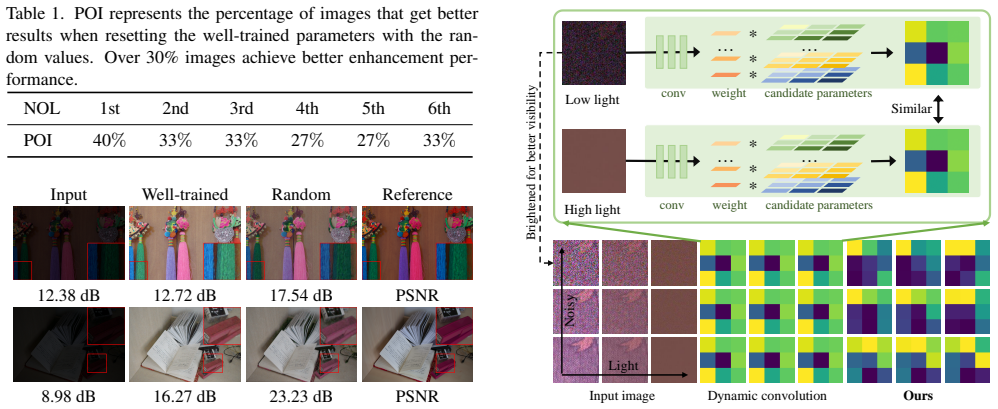
The load-bearing mechanism is the parameter orthogonal generation (POG) technique. For each target parameter, POG learns an embedding, normalizes it, and builds an orthogonal basis via the reflection matrix $B_p = I - 2 N_p N_p^T$, so the basis embeddings are orthogonal to one another. Given an input feature, a two-layer MLP with softmax produces weights, and each parameter embedding is a weighted sum of the orthogonal bases, decoded by another MLP into the actual convolution weights. Orthogonality is what distinguishes PDE from ordinary dynamic convolution: it prevents the candidate parameter embeddings from becoming similar and collapsing to a static parameter set, which the paper identifies as the failure mode of prior dynamic-parameter methods. The PDE module itself is a plug-in bottleneck block inserted after attention in decoder stages, chosen because attention layers show the strongest gene effect.
What would settle it
On a fixed low-light enhancement model and test set, compute per-image PSNR for the original model and for models with each candidate layer reset to random values, and count how many images improve; if that fraction is near zero across layers, the gene effect as defined does not exist. For the PDE claim, repeat the same count after adding PDE: if the fraction of improving images does not decrease while DGE decreases, the paper's mitigation claim is measuring output sensitivity rather than the gene effect itself.
Extended reading notes
Core claim
The paper's central claim is that static parameters are the source of the gene effect: after training, a fixed weight set is well matched to some images and maladaptive for others, to the point that random weights can beat the learned weights on particular inputs. The paper documents this by resetting attention-layer parameters of Restormer to random values and finding that over 30% of images improve, with up to 40% improving for the first detected layer. To counteract the effect, PDE evolves parameters for each input image: a bottleneck dynamic block generates per-image convolution weights, and POG constructs orthogonal basis embeddings so that the weighted combination of bases cannot converge to a single similar parameter set. Experiments report that adding PDE to existing low-light enhancement networks lowers the proposed DGE metric, defined as the average logarithmic MSE between original and reset outputs, and improves enhancement quality, with Restormer+Ours reaching 21.88 dB PSNR on LOL-v1 versus 20.91 dB for the base model.
Load-bearing premise
The load-bearing assumption is that the DGE metric, which averages the output difference between the original model and a model with parameters reset to random values, actually measures the gene effect, because a small DGE is interpreted as less gene effect even though the gene effect is defined as random reset improving some images.
Editorial extensions
If this is right
- If static parameters cause the gene effect, any low-light enhancement model that applies one learned weight set to all images carries an inherent performance ceiling that random resetting can expose.
- Adding PDE as a plug-in module requires about 10k fine-tuning steps versus 320k for original training, so existing models could be upgraded at low cost.
- The gene effect appears across several architectures, including SNR-Net, LLformer, Retinexmamba, Retinexformer, and CIDNet, suggesting the phenomenon is general across low-light enhancement models.
- Pruning methods do not remove the gene effect and can collapse enhancement quality on synthetic data, implying that the affected parameters cannot simply be deleted.
- Orthogonal generation is the key technical ingredient: replacing POG with static convolutions or plain dynamic convolution gives smaller gains in the ablation study.
Reading between the lines
- The same random-reset probe could be run on other ill-posed image-restoration tasks, such as dehazing, deraining, or super-resolution, to test whether the static-parameter explanation is specific to low-light enhancement or general across restoration domains.
- A sharper test than DGE would be to measure the fraction of images whose PSNR improves after random reset before and after PDE training; a method that truly removes the gene effect should lower that fraction, not merely change output distances.
- The hyperparameter study suggests a natural extension: making the effective number of candidate parameters, controlled by the embedding dimension $D_e$ and bottleneck width $D_m$, adaptive per image rather than fixed.
- If random parameter mutations are sometimes beneficial per image, a stochastic inference strategy that samples several parameter sets and selects the best output might outperform the single deterministic PDE output, though the paper does not explore this.
Signed reviews
Editorial analysis
A structured set of objections, weighed in public.
Referee Report
Summary. The paper reports a phenomenon dubbed the 'gene effect' in low-light image enhancement: for certain images, resetting trained network parameters to random values yields better enhancement (higher PSNR) than the learned parameters. The authors attribute this to static parameters, propose a 'parameter dynamic evolution' (PDE) module with 'parameter orthogonal generation' (POG) to mitigate the effect, and report PSNR improvements on LOL-v1, LOL-v2-real, and LOL-v2-synthetic benchmarks. The central conceptual claim is that PDE mitigates the gene effect, evaluated with a newly defined DGE metric (Eq. 6) that measures output difference before/after parameter reset.
Significance. If the core claims were established, the paper would contribute a new observation (random parameter resets sometimes improve LLIE outputs) and a practical plug-and-play dynamic convolution module that yields consistent, if modest, PSNR gains on standard paired benchmarks. The method is simple and the empirical enhancement improvements in Table 5 are interesting independent of the biological analogy. However, the significance is substantially weakened because the paper's evaluation of gene-effect mitigation rests on a metric (DGE) that appears to measure the wrong quantity and is interpreted in a way that is internally inconsistent with the paper's own definition of the gene effect. The orthogonality construction in POG also lacks a clear mathematical guarantee in the main text. These issues affect the manuscript's central narrative, not just its presentation.
major comments (4)
- [Section 5.2, Eq. (6)] The DGE metric does not measure the gene effect as defined. The gene effect (Abstract; Section 3) is the event that resetting parameters to random values improves enhancement performance with respect to the ground truth. Eq. (6) computes the average PSNR between the original model output F(xj) and the reset-model output Fi(xj); it never involves the ground truth. A high DGE means the reset changes the output little, which is exactly the regime where a random reset cannot improve quality over the learned model. A low DGE means the reset changes the output substantially, which is a necessary condition for the gene effect (improvement) to occur, but it can also mean large degradation. The paper's interpretation in Section 5.2 ('A larger value of DGE ... indicating more gene effects. Conversely, a smaller DGE implies weaker gene effects.') is therefore backwards relative to the definition. Since every gene-effect-mitigation claim in Tables 3 and 4 and the ablation reasoning are based on DGE reduction, the central claim that PDE mitigates the gene effect is not supported by the presented evidence.
- [Section 4.2, Eq. (2)] The orthogonal basis construction is mathematically unclear and likely inconsistent. The paper defines Np as normalized embeddings of shape N × De and then writes Bp = I − 2 Np Np^T. With Np ∈ R^{N×De}, the product Np Np^T is N × N, so Bp is an N × N matrix, not the claimed Bp ∈ R^{N×De×De}. The Householder-reflection form I − 2 v v^T is defined for a single unit vector v, not for a matrix, and no argument is given for why this operation yields orthogonal bases for each parameter. The main text defers the 'theory guarantee' to the supplementary material, but the property is load-bearing for POG's claimed ability to 'prevent the excessive expression of similar parameters.' Please clarify the dimensions and provide a proof or a precise statement in the main text.
- [Table 3] The DGE values for Restormer+Ours are reported as 45.09 on both LOL-v1 and LOL-v2-real. Given that these are different test sets with different image distributions, obtaining identical values to two decimal places is implausible and suggests a typo or a calculation error. Please verify the reported DGE values and correct any mistakes, as this table is central to the gene-effect-mitigation claim.
- [Table 2] The observation that 'dynamic parameters exhibit weaker gene effects compared to static parameters' is presented through Table 2, but the table does not define what the numeric entries mean (e.g., PSNR change after reset? improvement fraction? units?) and the sign convention is ambiguous. Without a clear definition, the reader cannot assess the strength of the observation, and the subsequent causal attribution of the gene effect to static parameters in Section 3.1 rests on this unspecified evidence.
minor comments (6)
- [Section 2.1] The text says 'gama correction' in the first paragraph; it should read 'gamma correction.'
- [Section 5.2] The DGE formula in Eq. (6) is introduced after the sentence 'we use the method in motivation experiments and observations (Section 3.1) to detect gene effect,' but Section 3.1 does not define DGE; consider moving the metric definition earlier or explicitly referencing Eq. (6) in Section 3.1.
- [Table 4] Entries such as '11.00 / ——-' and '7.98 / ——-' are used without explanation; please add a footnote stating what the dash denotes (e.g., failed to produce meaningful results or omitted due to collapse).
- [Tables 5–8] The main quantitative tables report single-run PSNR/SSIM values without standard deviations or significance tests. Given that some improvements are small (e.g., 20.91 to 21.88 dB), please report variance across at least three runs or a statistical test to confirm the gains are not due to random variation.
- [Section 4.2] The notation 'Np^T' is ambiguous: if Np is N × De, then Np^T is De × N, and the product Np Np^T is N × N as noted; please clarify the intended operation and correct the dimensions in Eq. (2) and the surrounding text.
- [Figure 1] The figure caption lists numeric values (e.g., '12.24 dB 9.39 dB') without explaining what they represent; adding a legend or clarifying the PSNR values in each panel would improve readability.
Circularity Check
No significant circularity; the DGE metric raises validity concerns but is not a circular reduction.
full rationale
No circular step is exhibited. The paper's main claims are tested against external benchmarks (LOL-v1, LOL-v2-real, LOL-v2-syn) and compared with published methods; PDE and POG parameters are trained end-to-end and evaluated on held-out test sets, so no predicted quantity is reinserted as an input. The 'gene effect' is an empirical observation, and the attribution to static parameters is an inference rather than a definition. The self-defined DGE metric (Eq. 6) does raise a validity concern: it measures output similarity between original and reset models, whereas the gene effect is defined as random reset improving enhancement relative to the ground truth, so DGE is not obviously a faithful proxy and may even be directionally misleading. However, that is a correctness/measurement issue, not circularity: DGE is not fitted to the target result, and the enhancement tables (Table 5) stand independently of DGE. There are no load-bearing self-citations; references to dynamic convolution and pruning are external. The score of 1 reflects the minor weight placed on an author-defined metric in the interpretive claim, not any derivation that reduces to its own input.
Assumptions & free parameters
free parameters (2)
- Dm =
32, ablated with 4, 8, 16
- De =
64, ablated with 16, 32
assumptions (4)
- domain assumption Dynamic parameters exhibit weaker gene effects than static parameters.
- ad hoc to paper The gene effect in neural networks is analogous to biological gene mutation and recombination.
- standard math Bp = I - 2 Np Np^T produces orthogonal basis embeddings.
- domain assumption Fine-tuning for 10k steps is sufficient to integrate PDE.
Cite this review
Pith. "Pith review of PDE: Gene Effect Inspired Parameter Dynamic Evolution for Low-light Image Enhancement." pith.science (2026). https://pith.science/paper/ZOZIZWCF
@misc{pith2026250509196,
  author       = {Pith},
  title        = {Pith review of: PDE: Gene Effect Inspired Parameter Dynamic Evolution for Low-light Image Enhancement},
  year         = {2026},
  howpublished = {\url{https://pith.science/paper/ZOZIZWCF}},
  note         = {Machine review of arXiv:2505.09196}
}
read the original abstract
Low-light image enhancement (LLIE) is a fundamental task in computational photography, aiming to improve illumination, reduce noise, and enhance image quality. While recent advancements focus on designing increasingly complex neural network models, we observe a peculiar phenomenon: resetting certain parameters to random values unexpectedly improves enhancement performance for some images. Drawing inspiration from biological genes, we term this phenomenon the gene effect. The gene effect limits enhancement performance, as even random parameters can sometimes outperform learned ones, preventing models from fully utilizing their capacity. In this paper, we investigate the reason and propose a solution. Based on our observations, we attribute the gene effect to static parameters, analogous to how fixed genetic configurations become maladaptive when environments change. Inspired by biological evolution, where adaptation to new environments relies on gene mutation and recombination, we propose parameter dynamic evolution (PDE) to adapt to different images and mitigate the gene effect. PDE employs a parameter orthogonal generation technique and the corresponding generated parameters to simulate gene recombination and gene mutation, separately. Experiments validate the effectiveness of our techniques. The code will be released to the public.
Figures


Figures from the paper (5 more)


Reference graph
Works this paper leans on
-
[70]
Kindling the darkness: A practical low-light image enhancer
Yonghua Zhang, Jiawan Zhang, and Xiaojie Guo. Kindling the darkness: A practical low-light image enhancer. Pro- ceedings of the ACM International Conference on MultiMe- dia, pages 1632–1640, 2019. 2, 7, 8
work page 2019
-
[1]
Retinexmamba: Retinex-based mamba for low-light image enhancement
Jiesong Bai, Yuhao Yin, and Qiyuan He. Retinexmamba: Retinex-based mamba for low-light image enhancement. arXiv preprint arXiv:2405.03349 , pages 1–15, 2024. 1, 2, 6, 7
arXiv 2024
-
[2]
Zeroq: A novel zero shot quantization framework
Yaohui Cai, Zhewei Yao, Zhen Dong, Amir Gholami, Michael W Mahoney, and Kurt Keutzer. Zeroq: A novel zero shot quantization framework. Proceedings of the IEEE/CVF Conference on Computer Vision and Pattern Recognition (CVPR), pages 13169–13178, 2020. 6
work page 2020
-
[3]
Retinexformer: One-stage retinex-based transformer for low-light image enhancement
Yuanhao Cai, Hao Bian, Jing Lin, Haoqian Wang, Radu Timofte, and Yulun Zhang. Retinexformer: One-stage retinex-based transformer for low-light image enhancement. Proceedings of the IEEE/CVF International Conference on Computer Vision (ICCV), pages 12504–12513, 2023. 1, 2, 6, 7, 8
work page 2023
-
[4]
Frivolous Units: Wider Networks Are Not Really That Wide
Stephen Casper, Xavier Boix, Vanessa D’Amario, Christo- pher Rodriguez, Ling Guo, Kasper Vinken, and Gabriel Kreiman. Removable and/or repeated units emerge in overparametrized deep neural networks. arXiv preprint arXiv:1912.04783, pages 1–9, 2019. 2, 4
work page Pith review arXiv 1912
-
[5]
Dynamic convolu- tion: Attention over convolution kernels
Yinpeng Chen, Xiyang Dai, Mengchen Liu, Dongdong Chen, Lu Yuan, and Zicheng Liu. Dynamic convolu- tion: Attention over convolution kernels. Proceedings of the IEEE/CVF Conference on Computer Vision and Pattern Recognition (CVPR), pages 11030–11039, 2020. 2, 4
work page 2020
-
[6]
A simple and effective histogram equalization approach to image enhancement
Hengda Cheng and XJ Shi. A simple and effective histogram equalization approach to image enhancement. Digital Signal Processing, pages 158–170, 2004. 2
work page 2004
- [7]
Show all 73 references
-
[8]
Genetics and the origin of species
Theodosius Dobzhansky. Genetics and the origin of species
-
[9]
You only need one color space: An efficient network for low-light image enhancement
Yixu Feng, Cheng Zhang, Pei Wang, Peng Wu, Qingsen Yan, and Yanning Zhang. You only need one color space: An efficient network for low-light image enhancement. arXiv preprint arXiv:2402.05809, pages 1–9, 2024. 6, 7, 8
2024 arXiv
-
[10]
The perceptron: A probabilistic model for information storage and organization in the brain
Rosenblatt Frank. The perceptron: A probabilistic model for information storage and organization in the brain. Psycho- logical Review, page 386, 1958. 5
1958
-
[11]
Learning a simple low-light image enhancer from paired low-light instances
Zhenqi Fu, Yan Yang, Xiaotong Tu, Yue Huang, Xinghao Ding, and Kai-Kuang Ma. Learning a simple low-light image enhancer from paired low-light instances. Proceedings of the IEEE/CVF Conference on Computer Vision and Pattern Recognition (CVPR), pages 22252–22261, 2023. 8
2023
-
[12]
Mambair: A simple baseline for image restoration with state-space model
Hang Guo, Jinmin Li, Tao Dai, Zhihao Ouyang, Xudong Ren, and Shu-Tao Xia. Mambair: A simple baseline for image restoration with state-space model. arXiv preprint arXiv:2402.15648, pages 1–19, 2024. 1, 2
2024 arXiv
-
[13]
Lime: Low-light im- age enhancement via illumination map estimation
Xiaojie Guo, Yu Li, and Haibin Ling. Lime: Low-light im- age enhancement via illumination map estimation. IEEE Transactions on Image Processing (TIP) , pages 982–993,
-
[14]
Learning both weights and connections for efficient neural network
Song Han, Jeff Pool, John Tran, and William Dally. Learning both weights and connections for efficient neural network. Advances in Neural Information Processing Systems , pages 1–9, 2015. 6
2015
-
[15]
Importance estimation for neural network pruning
Li Hao, Kadav Asim, Durdanovic Igor, Samet Hanan, and Graf HansPeter. Importance estimation for neural network pruning. International Conference on Learning Representa- tions (ICLR), pages 1–12, 2017. 6, 7
2017
-
[16]
Filter pruning via geometric median for deep convolutional neural networks acceleration
Yang He, Ping Liu, Ziwei Wang, Zhilan Hu, and Yi Yang. Filter pruning via geometric median for deep convolutional neural networks acceleration. Proceedings of the IEEE Conference on Computer Vision and Pattern Recognition (CVPR), pages 4340–4349, 2019. 6, 7
2019
-
[17]
Matrix Analysis
Roger A Horn and Charles R Johnson. Matrix Analysis . Cambridge University Press, 1990. 5
1990
-
[18]
Global structure-aware diffusion pro- cess for low-light image enhancement
Jinhui Hou, Zhiyu Zhu, Junhui Hou, Hui Liu, Huanqiang Zeng, and Hui Yuan. Global structure-aware diffusion pro- cess for low-light image enhancement. Advances in Neural Information Processing Systems, pages 79734–79747, 2024. 2, 7
2024
-
[19]
Krr-cnn: kernels redundancy reduction in convolu- tional neural networks
El Houssaine Hssayni, Nour-Eddine Joudar, and Mohamed Ettaouil. Krr-cnn: kernels redundancy reduction in convolu- tional neural networks. Neural Computing and Applications, pages 2443–2454, 2022. 2, 4
2022
-
[20]
Effi- cient contrast enhancement using adaptive gamma correction with weighting distribution
ShihChia Huang, FanChieh Cheng, and YiSheng Chiu. Effi- cient contrast enhancement using adaptive gamma correction with weighting distribution. IEEE Transactions on Image Processing (TIP), pages 1032–1041, 2012. 2
2012
-
[21]
Low-light image enhancement with wavelet-based diffusion models
Hai Jiang, Ao Luo, Haoqiang Fan, Songchen Han, and Shuaicheng Liu. Low-light image enhancement with wavelet-based diffusion models. ACM Transactions on Graphics (TOG), pages 1–14, 2023. 1, 2
2023
-
[22]
Enlightengan: Deep light enhancement without paired supervision
Yifan Jiang, Xinyu Gong, Ding Liu, Yu Cheng, Chen Fang, Xiaohui Shen, Jianchao Yang, Pan Zhou, and Zhangyang Wang. Enlightengan: Deep light enhancement without paired supervision. IEEE Transactions on Image Process- ing (TIP), pages 2340–2349, 2021. 1, 2, 7
2021
-
[23]
A multiscale retinex for bridging the gap between color images and the human observation of scenes
Daniel J Jobson, Zia-ur Rahman, and Glenn A Woodell. A multiscale retinex for bridging the gap between color images and the human observation of scenes. IEEE Transactions on Image Processing (TIP), pages 965–976, 1997. 2
1997
-
[24]
Properties and performance of a center/surround retinex
Daniel J Jobson, Zia-ur Rahman, and Glenn A Woodell. Properties and performance of a center/surround retinex. IEEE Transactions on Image Processing (TIP) , pages 451– 462, 1997. 2
1997
-
[25]
Evolutionary rate at the molecular level
Motoo Kimura et al. Evolutionary rate at the molecular level. Nature, pages 624–626, 1968. 3, 4
1968
-
[26]
Contrast en- hancement based on layered difference representation of 2d histograms
Chulwoo Lee, Chul Lee, and Chang-Su Kim. Contrast en- hancement based on layered difference representation of 2d histograms. IEEE Transactions on Image Processing (TIP), pages 5372–5384, 2013. 8
2013
-
[27]
Low-light image and video enhancement using deep learning: A sur- vey
Chongyi Li, Chunle Guo, Linghao Han, Jun Jiang, Ming- ming Cheng, Jinwei Gu, and Chen Change Loy. Low-light image and video enhancement using deep learning: A sur- vey. IEEE Transactions on Pattern Analysis and Machine Intelligence (TPAMI), pages 9396–9416, 2022. 1
2022
-
[28]
Learning to enhance low-light image via zero-reference deep curve esti- mation
Chongyi Li, Chunle Guo, and Chen Change Loy. Learning to enhance low-light image via zero-reference deep curve esti- mation. IEEE Transactions on Pattern Analysis and Machine Intelligence (TPAMI), pages 4225–4238, 2022. 2, 8
2022
-
[29]
Structure-revealing low-light image en- hancement via robust retinex model
Mading Li, Jiaying Liu, Wenhan Yang, Xiaoyan Sun, and Zongming Guo. Structure-revealing low-light image en- hancement via robust retinex model. IEEE Transactions on Image Processing (TIP), pages 2828–2841, 2018. 2
2018
-
[30]
Recurrent exposure generation for low-light face detection
Jinxiu Liang, Jingwen Wang, Yuhui Quan, Tianyi Chen, Ji- aying Liu, Haibin Ling, and Yong Xu. Recurrent exposure generation for low-light face detection. IEEE Transactions on Multimedia, pages 1609–1621, 2021. 1, 2
2021
-
[31]
Benchmarking low-light image enhance- ment and beyond
Jiaying Liu, Dejia Xu, Wenhan Yang, Minhao Fan, and Haofeng Huang. Benchmarking low-light image enhance- ment and beyond. International Journal of Computer Vision, pages 1153–1184, 2021. 1, 2
2021
-
[32]
Perceptual quality assessment for multi-exposure image fusion
Kede Ma, Kai Zeng, and Zhou Wang. Perceptual quality assessment for multi-exposure image fusion. IEEE Trans- actions on Image Processing (TIP), pages 3345–3356, 2015. 8
2015
-
[33]
Deeplpf: Deep local para- metric filters for image enhancement
Sean Moran, Pierre Marza, Steven McDonagh, Sarah Parisot, and Gregory Slabaugh. Deeplpf: Deep local para- metric filters for image enhancement. Proceedings of the IEEE/CVF Conference on Computer Vision and Pattern Recognition (CVPR), pages 12826–12835, 2020. 2
2020
-
[34]
The mechanism of mendelian heredity
Thomas Hunt Morgan, Alfred Henry Sturtevant, Her- mann Joseph Muller, and Calvin Blackman Bridges. The mechanism of mendelian heredity. 1923. 2, 3, 4
1923
-
[35]
Artificial transmutation of the gene
Hermann J Muller. Artificial transmutation of the gene. Sci- ence, pages 84–87, 1927. 3
1927
-
[36]
Data-free quantization through weight equal- ization and bias correction
Markus Nagel, Mart van Baalen, Tijmen Blankevoort, and Max Welling. Data-free quantization through weight equal- ization and bias correction. Proceedings of the IEEE/CVF International Conference on Computer Vision (ICCV), pages 1325–1334, 2019. 7
2019
-
[37]
Lateral gene transfer and the nature of bacterial inno- vation
Howard Ochman, Jeffrey G Lawrence, and Eduardo A Gro- isman. Lateral gene transfer and the nature of bacterial inno- vation. nature, pages 299–304, 2000. 3
2000
-
[38]
Quadrants dynamic histogram equalization for contrast enhancement
Chen Hee Ooi and Nor Ashidi Mat Isa. Quadrants dynamic histogram equalization for contrast enhancement. IEEE Transactions on Consumer Electronics , pages 2552–2559,
-
[39]
Contrast limited adaptive his- togram equalization image processing to improve the detec- tion of simulated spiculations in dense mammograms
Etta D Pisano, Shuquan Zong, Bradley M Hemminger, Marla DeLuca, R Eugene Johnston, Keith Muller, M Patricia Brae- uning, and Stephen M Pizer. Contrast limited adaptive his- togram equalization image processing to improve the detec- tion of simulated spiculations in dense mammo...
1998
-
[40]
Adaptive histogram equalization and its variations
Stephen M Pizer, E Philip Amburn, John D Austin, Robert Cromartie, Ari Geselowitz, Trey Greer, Bart ter Haar Romeny, John B Zimmerman, and Karel Zuiderveld. Adaptive histogram equalization and its variations. Com- puter Vision, Graphics, and Image Processing , pages 355– 368, 1987. 2
1987
-
[41]
Retinex-inspired unrolling with cooperative prior architecture search for low-light image enhancement
Liu Risheng, Ma Long, Zhang Jiaao, Fan Xin, and Luo Zhongxuan. Retinex-inspired unrolling with cooperative prior architecture search for low-light image enhancement. Proceedings of the IEEE/CVF Conference on Computer Vi- sion and Pattern Recognition (CVPR), 2021. 8
2021
-
[42]
Saurabh Saini and P. J. Narayanan. Specularity factorization for low light enhancement. Proceedings of the IEEE/CVF Conference on Computer Vision and Pattern Recognition (CVPR), pages 1–12, 2024. 7
2024
-
[43]
Nighttime visibility en- hancement by increasing the dynamic range and suppression of light effects
Aashish Sharma and Robby T Tan. Nighttime visibility en- hancement by increasing the dynamic range and suppression of light effects. Proceedings of the IEEE/CVF Conference on Computer Vision and Pattern Recognition (CVPR), pages 11977–11986, 2021. 2
2021
-
[44]
Classification- driven dynamic image enhancement
Vivek Sharma, Ali Diba, Davy Neven, Michael S Brown, Luc Van Gool, and Rainer Stiefelhagen. Classification- driven dynamic image enhancement. pages 4033–4041,
-
[45]
Adaptive dy- namic filtering network for image denoising
Hao Shen, Zhong-Qiu Zhao, and Wandi Zhang. Adaptive dy- namic filtering network for image denoising. Proceedings of the AAAI Conference on Artificial Intelligence (AAAI), pages 2227–2235, 2023
2023
-
[46]
Ddet: Dual-path dynamic enhancement network for real-world image super-resolution
Yukai Shi, Haoyu Zhong, Zhijing Yang, Xiaojun Yang, and Liang Lin. Ddet: Dual-path dynamic enhancement network for real-world image super-resolution. IEEE Signal Process- ing Letters, pages 481–485, 2020
2020
-
[47]
Image super-resolution via dynamic net- work
Chunwei Tian, Xuanyu Zhang, Qi Zhang, Mingming Yang, and Zhaojie Ju. Image super-resolution via dynamic net- work. CAAI Transactions on Intelligence Technology, pages 837–849, 2024. 3
2024
-
[48]
Deep learning and the information bottleneck principle
Naftali Tishby and Noga Zaslavsky. Deep learning and the information bottleneck principle. 2015 IEEE Information Theory Workshop, pages 1–5, 2015. 5
2015
-
[49]
On the evaluation of illumination compensation algorithms
Vassilios V onikakis, Rigas Kouskouridas, and Antonios Gasteratos. On the evaluation of illumination compensation algorithms. Multimedia Tools and Applications, pages 1–21,
-
[50]
Underexposed photo enhance- ment using deep illumination estimation
Ruixing Wang, Qing Zhang, Chiwing Fu, Xiaoyong Shen, Weishi Zheng, and Jiaya Jia. Underexposed photo enhance- ment using deep illumination estimation. Proceedings of the IEEE/CVF Conference on Computer Vision and Pattern Recognition (CVPR), pages 6849–6857, 2019. 2
2019
-
[51]
Nat- uralness preserved enhancement algorithm for non-uniform illumination images
Shuhang Wang, Jin Zheng, Hai-Miao Hu, and Bo Li. Nat- uralness preserved enhancement algorithm for non-uniform illumination images. IEEE Transactions on Image Process- ing (TIP), pages 3538–3548, 2013. 2, 8
2013
-
[52]
Ultra-high-definition low-light image enhancement: A benchmark and transformer-based method
Tao Wang, Kaihao Zhang, Tianrun Shen, Wenhan Luo, Bjorn Stenger, and Tong Lu. Ultra-high-definition low-light image enhancement: A benchmark and transformer-based method. Proceedings of the AAAI Conference on Artificial Intelli- gence (AAAI), pages 2654–2662, 2023. 2, 6, 7
2023
-
[53]
Gladnet: Low-light enhancement network with global awareness
Wenjing Wang, Chen Wei, Wenhan Yang, and Jiaying Liu. Gladnet: Low-light enhancement network with global awareness. IEEE International Conference on Automatic Face and Gesture Recognition, pages 751–755, 2018. 2
2018
-
[54]
Zero-reference low-light enhancement via physical quadru- ple priors
Wenjing Wang, Huan Yang, Jianlong Fu, and Jiaying Liu. Zero-reference low-light enhancement via physical quadru- ple priors. Proceedings of the IEEE/CVF Conference on Computer Vision and Pattern Recognition (CVPR) , pages 26057–26066, 2024. 7
2024
-
[55]
Low-light image enhancement with normalizing flow
Yufei Wang, Renjie Wan, Wenhan Yang, Haoliang Li, Lap- Pui Chau, and Alex Kot. Low-light image enhancement with normalizing flow. Proceedings of the AAAI Conference on Artificial Intelligence (AAAI), pages 2604–2612, 2022. 8
2022
-
[56]
Low-light image enhancement with illumination-aware gamma correction and complete image modelling network
Yinglong Wang, Zhen Liu, Jianzhuang Liu, Songcen Xu, and Shuaicheng Liu. Low-light image enhancement with illumination-aware gamma correction and complete image modelling network. Proceedings of the IEEE/CVF Inter- national Conference on Computer Vision (ICCV) , pages 13128–13...
2023
-
[57]
A real-time image processor with combining dynamic contrast ratio en- hancement and inverse gamma correction for pdp
Zhiguo Wang, Zhihu Liang, and Chunliang Liu. A real-time image processor with combining dynamic contrast ratio en- hancement and inverse gamma correction for pdp. Displays, pages 133–139, 2009. 2
2009
-
[58]
Deep retinex decomposition for low-light enhance- ment
Chen Wei, Wenjing Wang, Wenhan Yang, and Jiaying Liu. Deep retinex decomposition for low-light enhance- ment. British Machine Vision Conference (BMVC) , pages 1–12, 2018. 1, 2, 7
2018
-
[59]
Mamballie: Implicit retinex-aware low light enhancement with global-then-local state space
Jiangwei Weng, Zhiqiang Yan, Ying Tai, Jianjun Qian, Jian Yang, and Jun Li. Mamballie: Implicit retinex-aware low light enhancement with global-then-local state space. arXiv preprint arXiv:2405.16105, pages 1–12, 2024. 2
2024 arXiv
-
[60]
Diffir: Efficient diffusion model for image restoration
Bin Xia, Yulun Zhang, Shiyin Wang, Yitong Wang, Xing- long Wu, Yapeng Tian, Wenming Yang, and Luc Van Gool. Diffir: Efficient diffusion model for image restoration. Pro- ceedings of the IEEE/CVF Conference on Computer Vision and Pattern Recognition (CVPR), pages 13095–13105, 2023. 1
2023
-
[61]
Snr-aware low-light image enhancement
Xiaogang Xu, Ruixing Wang, Chiwing Fu, and Jiaya Jia. Snr-aware low-light image enhancement. Proceedings of the IEEE/CVF Conference on Computer Vision and Pattern Recognition (CVPR), pages 17714–17724, 2022. 2, 6, 7, 8
2022
-
[62]
Unified dynamic convolutional network for super-resolution with variational degradations
Yusyuan Xu, Shouyao Roy Tseng, Yu Tseng, Hsienkai Kuo, and Yi-Min Tsai. Unified dynamic convolutional network for super-resolution with variational degradations. Proceed- ings of the IEEE/CVF Conference on Computer Vision and Pattern Recognition (CVPR), pages 12496–12505, 2020. 1
2020
-
[63]
Condconv: Conditionally parameterized convolu- tions for efficient inference
Brandon Yang, Gabriel Bender, Quoc V Le, and Jiquan Ngiam. Condconv: Conditionally parameterized convolu- tions for efficient inference. Advances in Neural Information Processing Systems, pages 1–11, 2019. 2, 4
2019
-
[64]
Sparse gradient regularized deep retinex network for robust low-light image enhancement
Wenhan Yang, Wenjing Wang, Haofeng Huang, Shiqi Wang, and Jiaying Liu. Sparse gradient regularized deep retinex network for robust low-light image enhancement. IEEE Transactions on Image Processing (TIP), pages 2072–2086,
-
[65]
Diff-retinex: Rethinking low-light image enhance- ment with a generative diffusion model
Xunpeng Yi, Han Xu, Hao Zhang, Linfeng Tang, and Ji- ayi Ma. Diff-retinex: Rethinking low-light image enhance- ment with a generative diffusion model. Proceedings of the IEEE/CVF International Conference on Computer Vision (ICCV), pages 12302–12311, 2023. 2
2023
-
[66]
Learning enriched features for fast image restoration and enhancement
Syed Waqas Zamir, Aditya Arora, Salman Khan, Munawar Hayat, Fahad Shahbaz Khan, MingHsuan Yang, and Ling Shao. Learning enriched features for fast image restoration and enhancement. IEEE Transactions on Pattern Analysis and Machine Intelligence (TPAMI), pages 1934–1948, 2022. 2
1934
-
[67]
Restormer: Efficient transformer for high-resolution image restoration
Syed Waqas Zamir, Aditya Arora, Salman Khan, Mu- nawar Hayat, Fahad Shahbaz Khan, and Ming-Hsuan Yang. Restormer: Efficient transformer for high-resolution image restoration. Proceedings of the IEEE/CVF Conference on Computer Vision and Pattern Recognition (CVPR) , pages 5728–...
2022
-
[68]
Learning a single convolutional super-resolution network for multiple degradations
Kai Zhang, Wangmeng Zuo, and Lei Zhang. Learning a single convolutional super-resolution network for multiple degradations. Proceedings of the IEEE/CVF Conference on Computer Vision and Pattern Recognition (CVPR) , pages 3262–3271, 2018. 1
2018
-
[69]
Llemamba: Low-light enhancement via relighting-guided mamba with deep unfolding network
Xuanqi Zhang, Haijin Zeng, Jinwang Pan, Qiangqiang Shen, and Yongyong Chen. Llemamba: Low-light enhancement via relighting-guided mamba with deep unfolding network. arXiv preprint arXiv:2406.01028, pages 1–12, 2024. 2
2024 arXiv
-
[71]
Beyond brightening low-light images
Yonghua Zhang, Xiaojie Guo, Jiayi Ma, Wei Liu, and Jiawan Zhang. Beyond brightening low-light images. International Journal of Computer Vision, pages 1013–1037, 2021. 2
2021
-
[72]
Rethinking bottleneck structure for efficient mobile network design
Daquan Zhou, Qibin Hou, Yunpeng Chen, Jiashi Feng, and Shuicheng Yan. Rethinking bottleneck structure for efficient mobile network design. European Conference on Computer Vision (ECCV), pages 680–697, 2020. 5
2020
-
[73]
Glare: Low light image enhancement via generative latent feature based codebook retrieval
Han Zhou, Wei Dong, Xiaohong Liu, Shuaicheng Liu, Xiongkuo Min, Guangtao Zhai, and Jun Chen. Glare: Low light image enhancement via generative latent feature based codebook retrieval. In Proceedings of the European Con- ference on Computer Vision (ECCV) , pages 1–19, 2024. 2, 8
2024
Reviewed August 15, 2026 · model on record in the stance chip above.
Discussion (0). Continue with ORCID to comment.