Moving towards informative and actionable social media research
Pith reviewed 2026-05-22 15:40 UTC · model grok-4.3
The pith
Social media research must shift from isolated causal effects to mechanistic explanations of collective outcomes.
A machine-rendered reading of the paper's core claim, the machinery that carries it, and where it could break.
Core claim
The authors claim that causal research on social media remains inconclusive because socio-technical systems involve coupled networks, feedback loops, and collective phenomena that violate the assumptions of both observational studies and randomized controlled trials. Drawing parallels to disciplines that have confronted comparable challenges, they propose integrating the strengths of these methods while explicitly acknowledging their limits. The central advance is to move beyond isolated linear effects toward mechanistic accounts that explain how platforms generate collective outcomes at societal scale.
What carries the argument
Mechanistic explanations of how social media platforms generate collective outcomes, built by combining observational and experimental approaches.
If this is right
- Combining observational studies with targeted experiments can strengthen causal claims about platform effects.
- Focusing on mechanisms rather than isolated effects better accounts for feedback loops and collective behavior.
- Lessons from complex-system fields like climate science can guide more robust social media research designs.
- This shift would produce findings that are more directly usable for platform governance and public policy.
Where Pith is reading between the lines
- Platform companies could use mechanistic models to test design changes before deployment at full scale.
- Regulators might prioritize funding for studies that track emergent network-level patterns over single-variable trials.
- The approach could extend to related domains such as online misinformation dynamics or algorithmic amplification of content.
- Long-term tracking of collective metrics like opinion clusters might reveal whether interventions actually alter system behavior.
Load-bearing premise
That insights and methods from climate science and epidemiology can transfer productively to social media despite differences in underlying systems and data availability.
What would settle it
A large-scale application of the proposed integrated approach to an outcome such as political polarization that still produces conflicting or inconclusive results on societal-scale effects.
Figures

read the original abstract
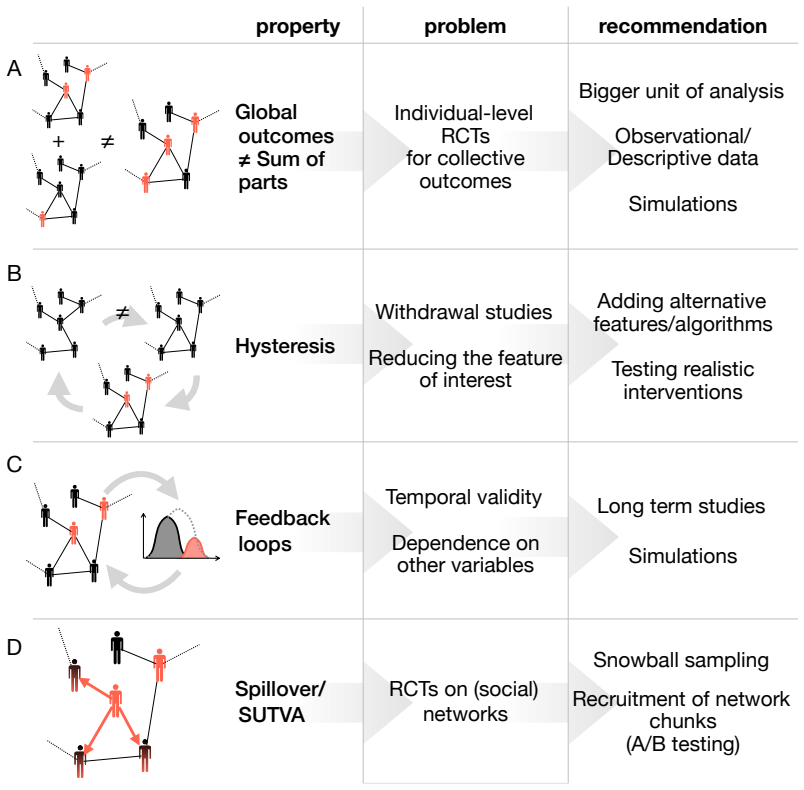
Social media is nearly ubiquitous in modern life, raising concerns about its societal impacts -- from mental health and polarization to violence and democratic disruption. Yet research on its causal effects is still inconclusive: Various methods, spanning observational to experimental, can yield seemingly conflicting results. Considering the complexity of such socio-technical systems, with coupled networks, feedback loops and collective phenomena, this may not be surprising. Here, we enumerate and examine the features of social media as a complex system that challenge our ability to infer causality at societal scales. Attempts to ascertain and summarize causal effects have tended to prioritize findings from randomized controlled trials (RCTs). However, like observational studies, RCTs rely on assumptions that may frequently be violated in the context of social media, especially regarding societal outcomes at scale. Drawing on insight from disciplines that have faced similar challenges, like climate-science or epidemiology, we propose a path forward that combines the strengths of observational and experimental approaches while acknowledging the limitations of each. Progress, we argue, requires moving beyond isolated, linear effects to mechanistic explanations of how social media platforms generate collective outcomes.
Editorial analysis
A structured set of objections, weighed in public.
Referee Report
Summary. The manuscript is a position paper arguing that causal inference in social media research remains inconclusive due to the complex socio-technical features of platforms, including coupled networks, feedback loops, and collective phenomena. It critiques both observational studies and RCTs for relying on assumptions that are frequently violated at societal scales, and proposes combining their strengths while shifting focus to mechanistic explanations of how platforms generate collective outcomes, drawing on approaches from climate science and epidemiology.
Significance. If the proposed shift to mechanistic modeling can be operationalized, the work could help move social media research toward more robust, actionable insights on issues like polarization and democratic disruption by addressing limitations of linear-effect studies.
major comments (2)
- [path forward proposal] The section proposing the path forward asserts that insights from climate science and epidemiology can be productively transferred to social media without providing a concrete mapping of how mechanistic models would be identified or validated given platform opacity, non-stationary algorithms, and incomplete user graphs. This premise is load-bearing for the central claim but remains unexamined.
- [features of social media as a complex system] The enumeration of complex-system challenges (coupled networks, feedback loops) is presented as explaining conflicting results, yet the manuscript offers no worked example or falsifiability criterion showing how a mechanistic model would resolve a specific societal-scale outcome under these constraints.
minor comments (1)
- [abstract and introduction] The abstract and main text repeat the phrase 'collective outcomes' without defining the term or distinguishing it from individual-level effects.
Simulated Author's Rebuttal
We thank the referee for their constructive review and for recognizing the potential significance of shifting social media research toward mechanistic explanations. We address each major comment below, noting where revisions will strengthen the manuscript while preserving its position-paper scope.
read point-by-point responses
-
Referee: The section proposing the path forward asserts that insights from climate science and epidemiology can be productively transferred to social media without providing a concrete mapping of how mechanistic models would be identified or validated given platform opacity, non-stationary algorithms, and incomplete user graphs. This premise is load-bearing for the central claim but remains unexamined.
Authors: We agree that the current draft presents the transfer at a conceptual level and does not fully operationalize identification or validation steps under the listed constraints. In revision we will expand the path-forward section with a brief mapping: for example, using ensemble-style uncertainty quantification (as in climate modeling) to bound effects under non-stationary algorithms, and proxy-based sensitivity analyses for incomplete graphs. We will also note that full validation will often require collaboration with platforms or use of synthetic environments, consistent with the paper's emphasis on acknowledging limitations rather than claiming immediate solutions. revision: yes
-
Referee: The enumeration of complex-system challenges (coupled networks, feedback loops) is presented as explaining conflicting results, yet the manuscript offers no worked example or falsifiability criterion showing how a mechanistic model would resolve a specific societal-scale outcome under these constraints.
Authors: The manuscript is a position paper whose primary aim is to diagnose why linear causal estimates remain inconclusive; it does not claim to deliver a ready-to-apply model. To respond to the request for illustration, we will add a short hypothetical worked example focused on polarization. The example will sketch a mechanistic structure that incorporates network coupling and feedback, then outline observable signatures (e.g., divergence from linear dose-response predictions) that could serve as a falsifiability check against both observational and experimental data. This addition will be framed as illustrative rather than exhaustive. revision: partial
Circularity Check
Position statement with no derivations or self-referential reductions
full rationale
The manuscript is a position paper that enumerates challenges in social media causality research and advocates transferring mechanistic modeling approaches from climate science and epidemiology. It contains no equations, fitted parameters, uniqueness theorems, or derivation chains. The central proposal rests on external disciplinary analogies rather than any self-citation load-bearing step or ansatz smuggled from prior author work. No step reduces by construction to its own inputs; the text functions as an open call for new research directions without closed logical loops.
Axiom & Free-Parameter Ledger
axioms (1)
- domain assumption Social media constitutes a complex system with coupled networks, feedback loops, and collective phenomena that violate standard causal inference assumptions.
Lean theorems connected to this paper
-
IndisputableMonolith/Foundation/RealityFromDistinction.leanreality_from_one_distinction unclear?
unclearRelation between the paper passage and the cited Recognition theorem.
Progress, we argue, requires moving beyond isolated, linear effects to mechanistic explanations of how social media platforms generate collective outcomes.
-
IndisputableMonolith/Cost/FunctionalEquation.leanwashburn_uniqueness_aczel unclear?
unclearRelation between the paper passage and the cited Recognition theorem.
Drawing on insight from disciplines that have faced similar challenges, like climate-science or epidemiology, we propose a path forward that combines the strengths of observational and experimental approaches
What do these tags mean?
- matches
- The paper's claim is directly supported by a theorem in the formal canon.
- supports
- The theorem supports part of the paper's argument, but the paper may add assumptions or extra steps.
- extends
- The paper goes beyond the formal theorem; the theorem is a base layer rather than the whole result.
- uses
- The paper appears to rely on the theorem as machinery.
- contradicts
- The paper's claim conflicts with a theorem or certificate in the canon.
- unclear
- Pith found a possible connection, but the passage is too broad, indirect, or ambiguous to say the theorem truly supports the claim.
Reference graph
Works this paper leans on
-
[1]
Global social network penetration rate as of april 2024, by region [graph]
We Are Social, M., DataReportal. Global social network penetration rate as of april 2024, by region [graph]. in statista. (2024). Retrieved December 12, 2024, from https://www.statista.com/statistics/269615/social-network-penetration-by-region/
work page 2024
-
[2]
Lewandowsky, S. & Pomerantsev, P. Technology and democracy: a paradox wrapped in a contradiction inside an irony.Memory, Mind & Media1(2022)
work page 2022
-
[3]
Allington, D., Duffy, B., Wessely, S., Dhavan, N. & Rubin, J. Health-protective be- haviour, social media usage and conspiracy belief during the COVID-19 public health emergency.Psychological Medicine(2020)
work page 2020
-
[4]
Orben, A., Przybylski, A. K., Blakemore, S.-J. & Kievit, R. A. Windows of developmen- tal sensitivity to social media.Nature Communications13, 1649 (2022)
work page 2022
-
[5]
Valkenburg, P. M., Meier, A. & Beyens, I. Social media use and its impact on adolescent mental health: An umbrella review of the evidence.Current opinion in psychology44, 58–68 (2022)
work page 2022
-
[6]
Kubin, E. & V on Sikorski, C. The role of (social) media in political polarization: a systematic review.Annals of the International Communication Association45, 188–206 (2021)
work page 2021
-
[7]
Kursuncu, U.et al.Modeling Islamist extremist communications on social media using contextual dimensions.Proceedings of the ACM on Human-Computer Interaction3, 1–22 (2019)
work page 2019
-
[8]
Gerbaudo, P.et al.Angry Posts Mobilize: Emotional Communication and Online Mobi- lization in the Facebook Pages of Western European Right-Wing Populist Leaders.Social Media + Society9, 20563051231163327 (2023). 26
work page 2023
-
[9]
Lorenz-Spreen, P., Oswald, L., Lewandowsky, S. & Hertwig, R. A systematic review of worldwide causal and correlational evidence on digital media and democracy.Nature human behaviour7, 74–101 (2023)
work page 2023
-
[10]
Orben, A., Meier, A., Dalgleish, T. & Blakemore, S.-J. Mechanisms linking social media use to adolescent mental health vulnerability.Nature Reviews Psychology1–17 (2024)
work page 2024
-
[11]
Teague, S.et al.Digital Media Use and Child Health and Development: A Systematic Review and Meta-Analysis.JAMA Pediatrics(2026). URLhttps://jamanetwork. com/journals/jamapediatrics/fullarticle/2845518
-
[12]
Angrist, J. D., Imbens, G. W. & Rubin, D. B. Identification of causal effects using instru- mental variables.Journal of the American statistical Association91, 444–455 (1996)
work page 1996
-
[13]
The unintended consequences of internet diffusion: Evidence from Malaysia
Miner, L. The unintended consequences of internet diffusion: Evidence from Malaysia. Journal of Public Economics132, 66–78 (2015)
work page 2015
-
[14]
Sabatini, F. & Sarracino, F. Online social networks and trust.Social Indicators Research 142, 229–260 (2019)
work page 2019
-
[15]
Enikolopov, R., Makarin, A. & Petrova, M. Social media and protest participation: Evi- dence from russia.Econometrica88, 1479–1514 (2020)
work page 2020
-
[16]
Geraci, A., Nardotto, M., Reggiani, T. & Sabatini, F. Broadband internet and social capital.Journal of Public Economics206, 104578 (2022)
work page 2022
-
[17]
Bursztyn, L., Egorov, G., Enikolopov, R. & Petrova, M. Social media and xenophobia: evidence from russia. Tech. Rep., National Bureau of Economic Research (2019)
work page 2019
-
[18]
M ¨uller, K. & Schwarz, C. Fanning the flames of hate: Social media and hate crime. Journal of the European Economic Association19, 2131–2167 (2021)
work page 2021
-
[19]
Lelkes, Y ., Sood, G. & Iyengar, S. The hostile audience: The effect of access to broadband internet on partisan affect.American Journal of Political Science61, 5–20 (2017). 27
work page 2017
-
[20]
Schaub, M. & Morisi, D. V oter mobilisation in the echo chamber: Broadband internet and the rise of populism in europe.European Journal of Political Research59, 752–773 (2020)
work page 2020
-
[21]
Braghieri, L., Levy, R. & Makarin, A. Social media and mental health.American Eco- nomic Review112, 3660–3693 (2022)
work page 2022
-
[22]
Bail, C. A.et al.Exposure to opposing views on social media can increase political polarization.Proceedings of the National Academy of Sciences115, 9216–9221 (2018)
work page 2018
-
[23]
Levy, R. Social media, news consumption, and polarization: Evidence from a field ex- periment.American economic review111, 831–870 (2021)
work page 2021
-
[24]
Allcott, H., Braghieri, L., Eichmeyer, S. & Gentzkow, M. The welfare effects of social media.American Economic Review110, 629–676 (2020)
work page 2020
-
[25]
Asimovic, N., Nagler, J., Bonneau, R. & Tucker, J. A. Testing the effects of facebook usage in an ethnically polarized setting.Proceedings of the National Academy of Sciences 118, e2022819118 (2021)
work page 2021
-
[26]
Allcott, H.et al.The effects of facebook and instagram on the 2020 election: A deacti- vation experiment.Proceedings of the National Academy of Sciences121, e2321584121 (2024)
work page 2020
-
[27]
Guess, A. M., Barber ´a, P., Munzert, S. & Yang, J. The consequences of online partisan media.Proceedings of the National Academy of Sciences118, e2013464118 (2021)
work page 2021
-
[28]
Kelly, C. A. & Sharot, T. Web-browsing patterns reflect and shape mood and mental health.Nature Human Behaviour1–14 (2024)
work page 2024
-
[29]
i finally felt i had the tools to control these urges
Lyngs, U.et al.“i finally felt i had the tools to control these urges”: Empowering students to achieve their device use goals with the reduce digital distraction workshop. InProceed- ings of the CHI Conference on Human Factors in Computing Systems, 1–23 (2024)
work page 2024
-
[30]
Guess, A. M.et al.Reshares on social media amplify political news but do not detectably affect beliefs or opinions.Science381, 404–408 (2023). 28
work page 2023
-
[31]
Guess, A. M.et al.How do social media feed algorithms affect attitudes and behavior in an election campaign?Science381, 398–404 (2023)
work page 2023
-
[32]
Nyhan, B.et al.Like-minded sources on facebook are prevalent but not polarizing.Nature 620, 137–144 (2023)
work page 2023
-
[33]
Beknazar-Yuzbashev, G., Jim´enez-Dur´an, R., McCrosky, J. & Stalinski, M. Toxic content and user engagement on social media: Evidence from a field experiment (2025)
work page 2025
-
[34]
Piccardi, T.et al.Reranking partisan animosity in algorithmic social media feeds alters affective polarization.Science390, eadu5584 (2025). URLhttps://www.science. org/doi/10.1126/science.adu5584
-
[35]
Gauthier, G., Hodler, R., Widmer, P. & Zhuravskaya, E. The political effects of X’s feed algorithm.Nature1–8 (2026). URLhttps://www.nature.com/articles/ s41586-026-10098-2
work page 2026
-
[36]
Social media and adolescent health (2023)
National Academies of Sciences, Engineering, and Medicine and others. Social media and adolescent health (2023)
work page 2023
-
[37]
Budak, C., Nyhan, B., Rothschild, D. M., Thorson, E. & Watts, D. J. Misunderstanding the harms of online misinformation.Nature630, 45–53 (2024)
work page 2024
-
[38]
Friemel, T. N. & Neuberger, C. The public sphere as a dynamic network.Communication Theory33, 92–101 (2023). URLhttps://academic.oup.com/ct/article/ 33/2-3/92/7204103
work page 2023
-
[39]
Bayer, J. B., Tri ˆeu, P. & Ellison, N. B. Social media elements, ecologies, and effects. Annual Review of Psychology71, 471–497 (2020)
work page 2020
-
[40]
Anderson, P. W. More is different: Broken symmetry and the nature of the hierarchical structure of science.Science177, 393–396 (1972)
work page 1972
-
[41]
Ladyman, J., Lambert, J. & Wiesner, K. What is a complex system?European Journal for Philosophy of Science3, 33–67 (2013). 29
work page 2013
-
[42]
H.et al.Causal inference on human behaviour.Nature Human Behaviour8, 1448–1459 (2024)
Bailey, D. H.et al.Causal inference on human behaviour.Nature Human Behaviour8, 1448–1459 (2024)
work page 2024
-
[43]
Rubin, D. B. Estimating causal effects of treatments in randomized and nonrandomized studies.Journal of Educational Psychology66, 688–701 (1974)
work page 1974
-
[44]
Angrist, J. D. & Pischke, J.-S. The Credibility Revolution in Empirical Economics: How Better Research Design Is Taking the Con out of Econometrics.Journal of Economic Perspectives24, 3–30 (2010). URLhttps://www.aeaweb.org/articles?id= 10.1257%2Fjep.24.2.3&form=MG0AV3
work page 2010
-
[45]
Imbens, G. W. & Rubin, D. B.Causal Inference for Statistics, Social, and Biomedical Sciences: An Introduction(Cambridge University Press, 2015), 1 edn. URLhttps://www.cambridge.org/core/product/identifier/ 9781139025751/type/book
work page 2015
-
[46]
Abrahamsson, S.et al.Smartphone bans, student outcomes and mental health smart- phone bans, student outcomes and mental health * (2024). URLhttps://ssrn. com/abstract=4735240
work page 2024
-
[47]
Angrist, J. & Imbens, G. Identification and Estimation of Local Average Treatment Ef- fects. Tech. Rep. t0118, National Bureau of Economic Research, Cambridge, MA (1995). URLhttp://www.nber.org/papers/t0118.pdf
work page 1995
-
[48]
Hern ´an, M. & Robins, J. M.Causal inference: what if(Taylor and Francis, Boca Raton, 2020), first edition edn
work page 2020
-
[49]
Deaton, A. & Cartwright, N. Understanding and misunderstanding randomized controlled trials.Social Science & Medicine210, 2–21 (2018)
work page 2018
-
[50]
Cook, T. D. Twenty-six assumptions that have to be met if single random assign- ment experiments are to warrant “gold standard” status: A commentary on Deaton and Cartwright.Social Science & Medicine210, 37–40 (2018). 30
work page 2018
-
[51]
Lundberg, I., Johnson, R. & Stewart, B. M. What Is Your Estimand? Defining the Tar- get Quantity Connects Statistical Evidence to Theory.American Sociological Review 86, 532–565 (2021). URLhttps://journals.sagepub.com/doi/10.1177/ 00031224211004187
work page 2021
-
[52]
Iyengar, S., Lelkes, Y ., Levendusky, M., Malhotra, N. & Westwood, S. J. The Origins and Consequences of Affective Polarization in the United States.Annual Review of Political Science22, 129–146 (2019). URLhttps://www.annualreviews.org/doi/ 10.1146/annurev-polisci-051117-073034
-
[53]
Mekacher, A., Falkenberg, M. & Baronchelli, A. The systemic impact of deplatforming on social media.PNAS Nexus2, pgad346 (2023). URL https://academic.oup.com/pnasnexus/article/doi/10.1093/ pnasnexus/pgad346/7329980
work page 2023
-
[54]
Bond, R. M.et al.A 61-million-person experiment in social influence and political mo- bilization.Nature489, 295–298 (2012)
work page 2012
-
[55]
Jones, J. J., Bond, R. M., Bakshy, E., Eckles, D. & Fowler, J. H. Social influence and political mobilization: Further evidence from a randomized experiment in the 2012 U.S. presidential election.PLOS ONE12, e0173851 (2017). URLhttps://dx.plos. org/10.1371/journal.pone.0173851
-
[56]
Baumgartner, S. E. On the stabilization of media effects after repeated expo- sure: consequences for media effects research.Communication Theoryqtaf017 (2025). URLhttps://academic.oup.com/ct/advance-article/doi/ 10.1093/ct/qtaf017/8222791
-
[57]
Mitchell, M.Complexity: A guided tour(Oxford University Press, 2009)
work page 2009
-
[58]
Arceneaux, K., Foucault, M., Giannelos, K., Ladd, J. & Zengin, C. Facebook increases political knowledge, reduces well-being and informational treatments do little to help. Royal Society Open Science11, 240280 (2024). 31
work page 2024
- [59]
-
[60]
Scheffer, M.et al.A dynamical systems view of psychiatric disorders—theory: a review. JAMA psychiatry(2024)
work page 2024
-
[61]
Klingelhoefer, J., Gilbert, A., Adrian, C. & Meier, A. Possible futures all at once: time frame and time lag in short-term longitudinal media effects research on well-being.Jour- nal of Communication76, 78–91 (2026). URLhttps://academic.oup.com/ joc/article/76/1/78/8239069
work page 2026
-
[62]
Vandenbosch, L., Beullens, K., Vanherle, R. & Schreurs, L. Digital media uses and effects: The contributing roles of time.Journal of Children and Media19, 71–76 (2025). URLhttps://www.tandfonline.com/doi/full/10.1080/ 17482798.2024.2438690
-
[63]
Lewandowsky, S., Robertson, R. E. & DiResta, R. Challenges in understanding human- algorithm entanglement during online information consumption.Perspectives on Psycho- logical Science19, 758–766 (2024)
work page 2024
-
[64]
Eckles, D., Karrer, B. & Ugander, J. Design and analysis of experiments in networks: Reducing bias from interference.Journal of Causal Inference5(2017)
work page 2017
-
[65]
Imbens, G. W. Causal inference in the social sciences.Annual Review of Statistics and Its Application11, 18.1–18.30 (2024)
work page 2024
- [66]
-
[67]
Wood, Natalya Pya, and Benjamin Säfken
Athey, S., Eckles, D. & Imbens, G. W. Exactp-Values for Network Interference.Journal of the American Statistical Association113, 230–240 (2018). URLhttps://www. tandfonline.com/doi/full/10.1080/01621459.2016.1241178. 32
-
[68]
S ¨avje, F., Aronow, P. M. & Hudgens, M. G. Average treat- ment effects in the presence of unknown interference.The An- nals of Statistics49(2021). URLhttps://projecteuclid. org/journals/annals-of-statistics/volume-49/issue-2/ Average-treatment-effects-in-the-presence-of-unknown-interference/ 10.1214/20-AOS1973.full
-
[69]
Ugander, J., Karrer, B., Backstrom, L. & Kleinberg, J. Graph cluster randomization: network exposure to multiple universes. InProceedings of the 19th ACM SIGKDD inter- national conference on Knowledge discovery and data mining, 329–337 (ACM, Chicago Illinois USA, 2013). URLhttps://dl.acm.org/doi/10.1145/2487575. 2487695
-
[70]
Karrer, B.et al.Network Experimentation at Scale. InProceedings of the 27th ACM SIGKDD Conference on Knowledge Discovery & Data Mining, 3106–3116 (ACM, Virtual Event Singapore, 2021). URLhttps://dl.acm.org/doi/10.1145/ 3447548.3467091
- [71]
-
[72]
How Much has Social Media affected Polarization?|Tom Cunningham – Tom Cunningham (2023)
Cunningham, T. How Much has Social Media affected Polarization?|Tom Cunningham – Tom Cunningham (2023). URLhttps://tecunningham.github.io/posts/ 2023-07-27-meta-2020-elections-experiments.html
work page 2023
-
[73]
Nyhan, B.et al.Like-minded sources on Facebook are prevalent but not polarizing. Nature1–8 (2023)
work page 2023
-
[74]
Munger, K. What did we learn about political communication from the meta2020 part- nership?Political communication42, 201–207 (2025)
work page 2025
-
[75]
Orben, A. & Matias, J. N. Fixing the science of digital technology harms technology development outpaces scientific assessment of impacts.Science388, 152–155 (2025). URLhttps://www.science.org/doi/10.1126/science.adt6807. 33
-
[76]
Garimella, K. & Eckles, D. Images and Misinformation in Political Groups: Evidence from WhatsApp in India (2020). URLhttp://arxiv.org/abs/2005.09784. ArXiv:2005.09784
-
[77]
Valenzuela, S., Halpern, D. & Araneda, F. A Downward Spiral? A Panel Study of Misinformation and Media Trust in Chile.The International Journal of Press/Politics 27, 353–373 (2022). URLhttps://journals.sagepub.com/doi/10.1177/ 19401612211025238
work page 2022
-
[78]
Bursztyn, L., Egorov, G., Enikolopov, R. & Petrova, M. Social media and xenophobia: evidence from Russia. Tech. Rep., National Bureau of Economic Research (2019)
work page 2019
-
[79]
Burton, J. W., Herzog, S. M. & Lorenz-Spreen, P. Simple changes to content cura- tion algorithms affect the beliefs people form in a collaborative filtering experiment. Proceedings of the Annual Meeting of the Cognitive Science Society46(2024). URL https://escholarship.org/uc/item/5cj075dp
work page 2024
-
[80]
Ovadya, A. & Thorburn, L. Bridging Systems: Open problems for countering destructive divisiveness across ranking, recommenders, and governance. Tech. Rep., Knight First Amendment Institute (2023)
work page 2023
discussion (0)
Sign in with ORCID, Apple, or X to comment. Anyone can read and Pith papers without signing in.