A Minimal Methanol Backstop for High Electrification Scenarios
Pith reviewed 2026-05-22 15:35 UTC · model grok-4.3
The pith
Methanol backstop raises total system costs by 2.4% over hydrogen in carbon-neutral European models.
A machine-rendered reading of the paper's core claim, the machinery that carries it, and where it could break.
Core claim
Using a European energy system model constrained to be carbon-neutral, methanol-based systems increase total system costs by 2.4% relative to hydrogen-based systems, an increase that remains below 6% across sensitivities. The modest cost premium is justified by methanol's advantages as a liquid fuel that is easy to store and transport and that integrates biogenic carbon from decentralized biomass wastes and residues without requiring major new infrastructure.
What carries the argument
Minimal methanol backstop: a liquid-fuel supply route that meets residual demand in highly electrified systems by combining hydrogen with carbon monoxide and biogenic carbon sources.
If this is right
- Methanol supplies aviation, shipping and backup power as a storable liquid without new dedicated pipelines or large-scale storage facilities.
- Biogenic carbon from waste and residue biomass can be incorporated directly into the fuel chain.
- High-electrification pathways can proceed with lower risk of infrastructure lock-in.
- Total system costs remain competitive even when input assumptions on costs or efficiencies are varied.
Where Pith is reading between the lines
- Coordination difficulties between producers and consumers may be lower than in a hydrogen-centric system because methanol uses existing liquid-fuel logistics.
- The same modeling approach could be applied to other large regions to check whether biomass availability changes the cost comparison.
- Policy standards for sustainable aviation and marine fuels could favor methanol routes if the modeled cost gap holds in practice.
Load-bearing premise
The energy system model and its input data accurately capture real-world costs, efficiencies, infrastructure requirements, and integration challenges for both methanol and hydrogen pathways under carbon-neutral constraints.
What would settle it
Empirical data from a full-scale demonstration project or updated cost database showing that actual hydrogen infrastructure and coordination costs are substantially lower than modeled, or that methanol distribution and end-use conversion add more than a 6% system-wide penalty.
Figures


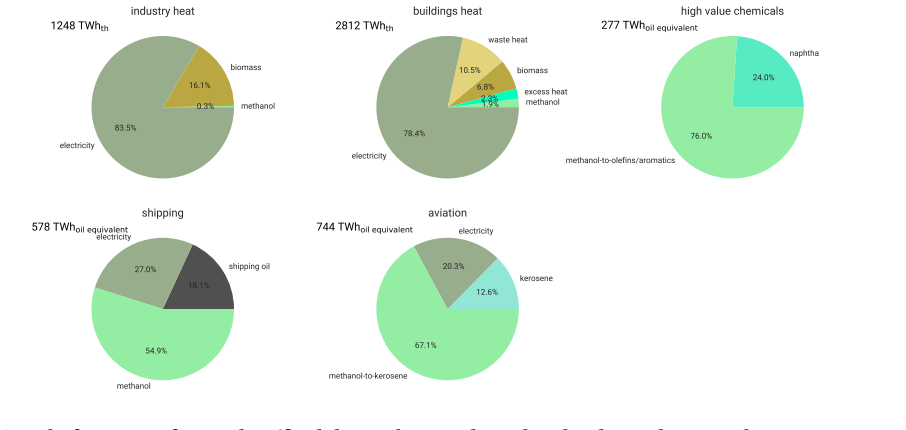


read the original abstract
Electrification of sectors such as land transport and building heating is a cost-effective pathway to deep decarbonization. However, some sectors still require energy-dense fuels -- including aviation, shipping and backup power -- or chemical feedstocks. While a 'hydrogen economy' is often proposed to fill these hard-to-electrify gaps, it faces challenges in transport, storage, and infrastructure coordination. We introduce a 'minimal methanol backstop' to supply residual demand in highly-electrified systems. As a liquid fuel, methanol is easy to store and transport, and avoids infrastructure lock-in. Produced from hydrogen and carbon monoxide, it can help integrate biogenic carbon from decentralized biomass wastes and residues. Using a European energy system model constrained to be carbon-neutral, we show that methanol-based systems increase total system costs by 2.4% relative to hydrogen-based systems, an increase that remains below 6% across sensitivities. We argue that this modest cost premium is justified by reduced infrastructure complexity.
Editorial analysis
A structured set of objections, weighed in public.
Referee Report
Summary. The manuscript proposes a 'minimal methanol backstop' to meet residual demand for energy-dense fuels and feedstocks in highly electrified, carbon-neutral European energy systems. Using a constrained optimization model, it reports that methanol-based configurations raise total system costs by 2.4% relative to hydrogen-based ones, with the premium remaining below 6% across sensitivities. The authors argue this modest increase is justified by methanol's advantages in storage, transport, and avoidance of infrastructure lock-in while facilitating integration of biogenic carbon from wastes and residues.
Significance. If the model parameterization proves robust, the work supplies a concrete, quantitative comparison that could inform infrastructure choices for hard-to-abate sectors such as aviation, shipping, and backup power. The use of a carbon-neutral constrained European energy system model together with sensitivity testing constitutes a clear methodological strength and supports the central claim of a limited cost differential.
major comments (2)
- [Abstract] Abstract: The central quantitative claim of a 2.4% cost increase (and <6% bound in sensitivities) is load-bearing for the paper's argument yet rests on the model's internal encoding of hydrogen transport/storage coordination penalties versus methanol's liquid-fuel advantages and the efficiency losses associated with producing methanol from electrolytic hydrogen plus biogenic CO2. No details on these cost vectors, efficiency assumptions, or external calibration against independent infrastructure studies are supplied in the abstract, leaving the result's sensitivity to parameterization unverified.
- [Model and results sections] Model and results sections: The weakest assumption—that the energy system model accurately captures real-world costs, efficiencies, infrastructure requirements, and integration challenges—is not shown to have been validated outside the modeling framework. If key infrastructure or carbon-accounting parameters deviate from deployment data, the reported modest premium could move outside the <6% sensitivity band, directly affecting the policy-relevant conclusion.
minor comments (1)
- [Introduction] The phrase 'minimal methanol backstop' is introduced without an explicit operational definition; adding a short clarifying sentence in the introduction would improve accessibility.
Simulated Author's Rebuttal
We thank the referee for their constructive review and recommendation for major revision. We address each major comment below and have revised the manuscript to improve clarity on assumptions and parameterization.
read point-by-point responses
-
Referee: [Abstract] Abstract: The central quantitative claim of a 2.4% cost increase (and <6% bound in sensitivities) is load-bearing for the paper's argument yet rests on the model's internal encoding of hydrogen transport/storage coordination penalties versus methanol's liquid-fuel advantages and the efficiency losses associated with producing methanol from electrolytic hydrogen plus biogenic CO2. No details on these cost vectors, efficiency assumptions, or external calibration against independent infrastructure studies are supplied in the abstract, leaving the result's sensitivity to parameterization unverified.
Authors: We agree that the abstract would benefit from brief additional context on the key assumptions. In the revised version, we have updated the abstract to note the efficiency losses in methanol synthesis from electrolytic hydrogen and biogenic CO2, as well as the model's encoding of methanol's storage and transport advantages relative to hydrogen infrastructure penalties. Full details on cost vectors, efficiencies, and citations to external infrastructure studies (e.g., IRENA and IEA reports) remain in the methods and supplementary material. revision: yes
-
Referee: [Model and results sections] Model and results sections: The weakest assumption—that the energy system model accurately captures real-world costs, efficiencies, infrastructure requirements, and integration challenges—is not shown to have been validated outside the modeling framework. If key infrastructure or carbon-accounting parameters deviate from deployment data, the reported modest premium could move outside the <6% sensitivity band, directly affecting the policy-relevant conclusion.
Authors: We acknowledge that the manuscript does not present a comprehensive external validation of the full integrated model against real-world deployment data, which is a genuine limitation for any large-scale energy system optimization study due to data scarcity. The model parameters are drawn from and cross-checked against multiple peer-reviewed sources and reports on hydrogen and methanol infrastructure costs and efficiencies; we have now added explicit citations and a dedicated paragraph in the methods section discussing these sources and the associated uncertainties. The existing sensitivity analysis already tests deviations in key parameters while keeping the cost premium below 6%. We have also expanded the discussion of model limitations. revision: partial
Circularity Check
No circularity: cost comparison obtained from independent model optimization
full rationale
The paper derives its 2.4% cost premium by executing a carbon-neutral constrained optimization in an energy system model for methanol versus hydrogen scenarios. This constitutes a forward simulation whose output is not equivalent to any input parameter by construction. No self-definitional loops, fitted quantities renamed as predictions, or load-bearing self-citations appear in the provided derivation chain. The model structure and external cost/efficiency data remain independent of the headline result, rendering the finding self-contained against external benchmarks.
Axiom & Free-Parameter Ledger
free parameters (1)
- Model cost and efficiency parameters
axioms (1)
- domain assumption The chosen energy system model structure and data accurately represent European infrastructure costs and integration for methanol and hydrogen under carbon neutrality.
Lean theorems connected to this paper
-
IndisputableMonolith/Cost/FunctionalEquation.leanwashburn_uniqueness_aczel unclear?
unclearRelation between the paper passage and the cited Recognition theorem.
Using a European energy system model constrained to be carbon-neutral, we show that methanol-based systems increase total system costs by 2.4% relative to hydrogen-based systems
What do these tags mean?
- matches
- The paper's claim is directly supported by a theorem in the formal canon.
- supports
- The theorem supports part of the paper's argument, but the paper may add assumptions or extra steps.
- extends
- The paper goes beyond the formal theorem; the theorem is a base layer rather than the whole result.
- uses
- The paper appears to rely on the theorem as machinery.
- contradicts
- The paper's claim conflicts with a theorem or certificate in the canon.
- unclear
- Pith found a possible connection, but the passage is too broad, indirect, or ambiguous to say the theorem truly supports the claim.
Reference graph
Works this paper leans on
-
[1]
M. Pathak, R. Slade, P. Shukla, J. Skea, R. Pichs-Madruga, D. Ürge-Vorsatz, Technical summary, in: P. Shukla, J. Skea, R. Slade, A. A. Khourdajie, R. van Diemen, D. McCollum, M. Pathak, S. Some, P. Vyas, R. Fradera, M. Belkacemi, A. Hasija, G. Lisboa, S. Luz, J. Malley (Eds.), Climate Change 2022: Mitigation of Climate Change. Contribution of Working Grou...
-
[2]
rep., International Energy Agency (2024)
IEA, World Energy Outlook 2024, Tech. rep., International Energy Agency (2024). URLhttps://www.iea.org/reports/world-energy-outlook-2024 27
work page 2024
-
[3]
URLhttps://eur-lex.europa.eu/legal-content/EN/TXT/?uri=COM:2024:63:FIN
European Commission, Securing our future: Europe’s 2040 climate target and path to climate neu- trality by 2050 building a sustainable, just and prosperous society, European Commission - Commu- nication (2024). URLhttps://eur-lex.europa.eu/legal-content/EN/TXT/?uri=COM:2024:63:FIN
work page 2040
-
[4]
S. Link, A. Stephan, D. Speth, P. Plötz, Rapidly declining costs of truck batteries and fuel cells enable large-scale road freight electrification, Nature Energy 9 (8) (2024) 1032–1039.doi:10.1038/ s41560-024-01531-9. URLhttps://doi.org/10.1038/s41560-024-01531-9
-
[6]
E. Zeyen, S. Kalweit, M. Victoria, T. Brown, Shifting burdens: how delayed decarbonisation of road transport affects other sectoral emission reductions, Environmental Research Letters 20 (4) (2025) 044044.doi:10.1088/1748-9326/adc290. URLhttps://dx.doi.org/10.1088/1748-9326/adc290
-
[7]
rep., International Energy Agency (2025)
IEA, Global EV Outlook 2025, Tech. rep., International Energy Agency (2025). URLhttps://www.iea.org/reports/global-ev-outlook-2025
work page 2025
-
[8]
A. W. Schäfer, S. R. H. Barrett, K. Doyme, L. M. Dray, A. R. Gnadt, R. Self, A. O’Sullivan, A. P. Synodinos, A. J. Torija, Technological, economic and environmental prospects of all-electric aircraft, Nature Energy 4 (2) (2019) 160–166.doi:10.1038/s41560-018-0294-x. URLhttps://doi.org/10.1038/s41560-018-0294-x
-
[9]
T. Brown, D. Schlachtberger, A. Kies, S. Schramm, M. Greiner, Synergies of sector coupling and transmission reinforcement in a cost-optimised, highly renewable European energy system, Energy 160 (2018) 720–739.doi:10.1016/j.energy.2018.06.222
-
[10]
S. Madeddu, F. Ueckerdt, M. Pehl, J. Peterseim, M. Lord, K. A. Kumar, C. Krüger, G. Luderer, The CO2 reduction potential for the European industry via direct electrification of heat supply (power- to-heat), Environmental Research Letters 15 (12) (2020) 124004.doi:10.1088/1748-9326/abbd02. URLhttps://dx.doi.org/10.1088/1748-9326/abbd02
-
[11]
J. O. Bockris, A hydrogen economy, Science 176 (4041) (1972) 1323–1323.arXiv:https://www.science. org/doi/pdf/10.1126/science.176.4041.1323,doi:10.1126/science.176.4041.1323. URLhttps://www.science.org/doi/abs/10.1126/science.176.4041.1323
-
[12]
V. Vogl, M. Åhman, L. J. Nilsson, Assessment of hydrogen direct reduction for fossil-free steelmak- ing, Journal of Cleaner Production 203 (2018) 736–745.doi:https://doi.org/10.1016/j.jclepro.2018.08. 279. URLhttps://www.sciencedirect.com/science/article/pii/S0959652618326301 28
-
[13]
B. van der Zwaan, A. Fattahi, F. Dalla Longa, M. Dekker, D. van Vuuren, R. Pietzcker, R. Ro- drigues, F. Schreyer, D. Huppmann, J. Emmerling, S. Pfenninger, F. Lombardi, P. Fragkos, M. Kan- navou, T. Fotiou, G. Tolios, W. Usher, Electricity- and hydrogen-driven energy system sector- coupling in net-zero CO2 emission pathways, Nature Communications 16 (1) ...
-
[14]
Haldane, Daedelus or science and the future, Heretics Society, Cambridge, 1923
J. Haldane, Daedelus or science and the future, Heretics Society, Cambridge, 1923. URLhttp://bactra.org/Daedalus.html
work page 1923
-
[15]
N. Johnson, M. Liebreich, D. M. Kammen, P. Ekins, R. McKenna, I. Staffell, Realistic roles for hydrogen in the future energy transition, Nature Reviews Clean Technology (2025).doi:10.1038/ s44359-025-00050-4. URLhttps://doi.org/10.1038/s44359-025-00050-4
-
[16]
P. Martin, I. B. Ocko, S. Esquivel-Elizondo, R. Kupers, D. Cebon, T. Baxter, S. P. Hamburg, A review of challenges with using the natural gas system for hydrogen, Energy Science & Engineering 12 (10) (2024) 3995–4009.doi:10.1002/ese3.1861
-
[17]
F. Frischmuth, M. Berghoff, M. Braun, P. Härtel, Quantifying seasonal hydrogen storage demands under cost and market uptake uncertainties in energy system transformation pathways, Applied Energy 375 (2024) 123991.doi:10.1016/j.apenergy.2024.123991. URLhttps://doi.org/10.1016/j.apenergy.2024.123991
-
[18]
M. Sand, R. B. Skeie, M. Sandstad, S. Krishnan, G. Myhre, H. Bryant, R. Derwent, D. Hauglustaine, F. Paulot, M. Prather, D. Stevenson, A multi-model assessment of the global warming potential of hydrogen, Communications Earth & Environment 4 (1) (2023) 203.doi:10.1038/s43247-023-00857-8. URLhttps://doi.org/10.1038/s43247-023-00857-8
-
[19]
S. Bube, N. Bullerdiek, S. Voß, M. Kaltschmitt, Kerosene production from power-based syngas – A technical comparison of the Fischer-Tropsch and methanol pathway, Fuel 366 (2024) 131269.doi: 10.1016/j.fuel.2024.131269
-
[20]
URLhttps://www.iea.org/data-and-statistics/data-tools/etp-clean-energy-technology-guide
ETP Clean Energy Technology Guide – Data Tools (2025). URLhttps://www.iea.org/data-and-statistics/data-tools/etp-clean-energy-technology-guide
work page 2025
-
[21]
T. Brown, J. Hampp, Ultra-long-duration energy storage anywhere: Methanol with carbon cycling, Joule 7 (11) (2023) 2414–2420.doi:10.1016/j.joule.2023.10.001
-
[22]
M. Bertau, H. Offermanns, L. Plass, F. Schmidt, H.-J. Wernicke (Eds.), Methanol: The Basic Chemical and Energy Feedstock of the Future: Asinger’s Vision Today, 1st Edition, Springer Berlin, Heidelberg, 2014.doi:10.1007/978-3-642-39709-7. URLhttps://doi.org/10.1007/978-3-642-39709-7
-
[23]
URLhttps://github.com/hfg-gmuend/openmoji
Hfg-gmuend/openmoji (2025). URLhttps://github.com/hfg-gmuend/openmoji
work page 2025
-
[24]
J. Cui, R. Yu, H. Wang, Y. Wang, J. Tong, A Comparative Study of Methanol and Methane Combus- tion in a Gas Turbine Combustor, Energies 18 (7) (2025) 1765.doi:10.3390/en18071765. 29
-
[25]
F. Asinger, Methanol — Chemie- und Energierohstoff: Die Mobilisation der Kohle, 1st Edition, Springer Berlin, Heidelberg, 1986.doi:https://doi.org/10.1007/978-3-642-70763-6
-
[26]
G. A. Olah, The methanol economy, Chemical & Engineering News 81 (38) (2003) 5, doi: 10.1021/cen-v081n038.p005.doi:10.1021/cen-v081n038.p005. URLhttps://doi.org/10.1021/cen-v081n038.p005
work page doi:10.1021/cen-v081n038.p005.doi:10.1021/cen-v081n038.p005 2003
-
[27]
G. A. Olah, Beyond oil and gas: The methanol economy, Angewandte Chemie International Edition 44 (18) (2005) 2636–2639.doi:10.1002/anie.200462121. URLhttps://doi.org/10.1002/anie.200462121
-
[28]
H. Blanco, W. Nijs, J. Ruf, A. Faaij, Potential for hydrogen and Power-to-Liquid in a low-carbon EU energy system using cost optimization, Applied Energy 232 (2018) 617 – 639.doi:10.1016/j.apenergy. 2018.09.216. URLhttps://doi.org/10.1016/j.apenergy.2018.09.216
-
[29]
V. G. Johnsen, F. B. Bornemann, A. Nemati, S. Linderoth, H. Lund Frandsen, Efficient onboard car- bon capture system using methanol-fueled solid oxide fuel cells, International Journal of Hydrogen Energy 92 (2024) 1000–1020.doi:https://doi.org/10.1016/j.ijhydene.2024.10.100. URLhttps://www.sciencedirect.com/science/article/pii/S0360319924042927
-
[30]
N. Brazzola, T. Zurbriggen, A. Odenweller, F. Ueckerdt, J. Rogelj, Assessing the feasibility of economy-scale direct air capture deployment by 2050 (Jul. 2025).doi:10.21203/rs.3.rs-6165238/v1. URLhttps://doi.org/10.21203/rs.3.rs-6165238/v1
-
[31]
M. Gustafsson, Centralized or decentralized? How to exploit Sweden’s agricultural biomethane potential, Biofuels (2024) 1–12doi:10.1080/17597269.2024.2318515
-
[32]
P. Matschoss, M. Steubing, J. Pertagnol, Y. Zheng, B. Wern, M. Dotzauer, D. Thrän, A consolidated potential analysis of bio-methane and e-methane using two different methods for a medium-term renewable gas supply in Germany, Energy, Sustainability and Society 10 (1) (2020) 41.doi:10.1186/ s13705-020-00276-z
work page 2020
-
[33]
A. Korberg, S. Brynolf, M. Grahn, I. Skov, Techno-economic assessment of advanced fuels and propulsion systems in future fossil-free ships, Renewable and Sustainable Energy Reviews 142 (2021) 110861.doi:10.1016/j.rser.2021.110861. URLhttps://doi.org/10.1016/j.rser.2021.110861
-
[34]
URLhttps://www.methanol.org/methanol-price-supply-demand/
Methanol Institute and Argus, Renewable methanol plant database (2024). URLhttps://www.methanol.org/methanol-price-supply-demand/
work page 2024
-
[35]
Methanex, The global methanol leader: Corporate presentation, Tech. rep. (2024). URLhttps://www.methanex.com/wp-content/uploads/MEOH-Investor-Presentation-March-2024. pdf
work page 2024
-
[36]
J. Liang, D. Liu, S. Xu, M. Ye, Comparison of light olefins production routes in China: Combining techno-economics and security analysis, Chemical Engineering Research and Design 194 (2023) 225– 241.doi:10.1016/j.cherd.2023.04.037. URLhttps://doi.org/10.1016/j.cherd.2023.04.037 30
-
[37]
Global Maritime Forum, Zero-emission shipping fuels: A guide to methanol and ammonia, Tech. rep. (2025). URLhttps://globalmaritimeforum.org/news/zero-emission-shipping-fuels-methanol-and-ammonia/
work page 2025
-
[38]
URLhttps://www.methanol.org/renewable/
Methanol Institute and GENA Solutions Oy, Renewable methanol plant database (2025). URLhttps://www.methanol.org/renewable/
work page 2025
-
[39]
URLhttps://eur-lex.europa.eu/legal-content/EN/TXT/?uri=COM:2024:62:FIN
European Commission, Towards an ambitious Industrial Carbon Management for the EU, European Commission - Communication (2024). URLhttps://eur-lex.europa.eu/legal-content/EN/TXT/?uri=COM:2024:62:FIN
work page 2024
-
[40]
F. Schreyer, F. Ueckerdt, R. Pietzcker, A. Odenweller, A. Merfort, R. Rodrigues, J. Strefler, F. Lécuyer, G. Luderer, From net-zero to zero-fossil in transforming the EU energy system, Nature Communica- tions 16 (1) (2025) 10700.doi:10.1038/s41467-025-66682-z. URLhttps://doi.org/10.1038/s41467-025-66682-z
-
[41]
M. J. Gidden, S. Joshi, J. J. Armitage, A.-B. Christ, M. Boettcher, E. Brutschin, A. C. Köberle, K. Riahi, H. J. Schellnhuber, C.-F. Schleussner, J. Rogelj, A prudent planetary limit for geologic carbon storage, Nature 645 (8079) (2025) 124–132.doi:10.1038/s41586-025-09423-y. URLhttps://doi.org/10.1038/s41586-025-09423-y
-
[42]
P. Ruiz, W. Nijs, D. Tarvydas, A. Sgobbi, A. Zucker, R. Pilli, R. Jonsson, A. Camia, C. Thiel, C. Hoyer- Klick, F. Dalla Longa, T. Kober, J. Badger, P. Volker, B. S. Elbersen, A. Brosowski, D. Thrän, ENSPRESO - an open, EU-28 wide, transparent and coherent database of wind, solar and biomass energy poten- tials, Energy Strategy Reviews 26 (2019) 100379.do...
-
[43]
URLhttps://www.entsoe.eu/outlooks/tyndp/2024/
ENTSO-E, Ten Year Network Development Plan 2024 (2024). URLhttps://www.entsoe.eu/outlooks/tyndp/2024/
work page 2024
-
[44]
M. Rehfeldt, S. Bußmann, T. Fleiter, Direct electrification of industrial process heat. An assessment of technologies, potentials and future prospects for the EU. Study on behalf of Agora Industry. (2024). URLhttps://www.agora-industry.org/fileadmin/Projects/2023/2023-20_IND_Electrification_ Industrial_Heat/A-IND_329_04_Electrification_Industrial_Heat_WEB.pdf
work page 2024
-
[45]
M. Zier, P. Stenzel, L. Kotzur, D. Stolten, A review of decarbonization options for the glass industry, Energy Conversion and Management: X 10 (2021) 100083.doi:10.1016/j.ecmx.2021.100083. URLhttps://doi.org/10.1016/j.ecmx.2021.100083
-
[46]
F. Hofmann, C. Tries, F. Neumann, E. Zeyen, T. Brown, H 2 and CO 2 network strategies for the European energy system, Nature Energy 10 (6) (2025) 715–724.doi:10.1038/s41560-025-01752-6. URLhttps://doi.org/10.1038/s41560-025-01752-6
-
[47]
P. C. Verpoort, L. Gast, A. Hofmann, F. Ueckerdt, Impact of global heterogeneity of renewable energy supply on heavy industrial production and green value chains, Nature Energy 9 (4) (2024) 491–503. doi:10.1038/s41560-024-01492-z. URLhttps://doi.org/10.1038/s41560-024-01492-z 31
-
[48]
F. Neumann, J. Hampp, T. Brown, Green energy and steel imports reduce Europe’s net-zero infras- tructure needs, Nature Communications 16 (1) (2025) 5302.doi:10.1038/s41467-025-60652-1. URLhttps://www.nature.com/articles/s41467-025-60652-1
-
[49]
für Wirtschaft, Fortschreibung der Nationalen Wasserstoffstrategie (2023)
B.-B. für Wirtschaft, Fortschreibung der Nationalen Wasserstoffstrategie (2023). URLhttps://www.bmwk.de/Redaktion/DE/Publikationen/Energie/ fortschreibung-nationale-wasserstoffstrategie.html
work page 2023
-
[50]
URLhttps://www.bmwk.de/Navigation/DE/Wasserstoff/wasserstoffstrategie.html
One-Stop-Shop - Wasserstoff - Wasserstoff. URLhttps://www.bmwk.de/Navigation/DE/Wasserstoff/wasserstoffstrategie.html
- [51]
- [52]
-
[53]
State of the biogas industry in 12 member countries of IEA Bioenergy Task 37 – Bioenergy. URLhttps://www.ieabioenergy.com/blog/publications/state-of-the-biogas-industry-in-12-member-countries-of-iea-bioenergy-task-37/
-
[54]
URLhttps://www.maersk.com/news/articles/2024/10/30/maersk-signs-long-term-methanol-sourcing-deal
Maersk Signs Long-Term Methanol Sourcing Deal. URLhttps://www.maersk.com/news/articles/2024/10/30/maersk-signs-long-term-methanol-sourcing-deal
work page 2024
-
[55]
G. Luderer, F. Bartels, T. Brown, C. Aulich, F. Benke, T. Fleiter, F. Frank, H. Ganal, J. Geis, N. Ger- hardt, T. Gnann, A. Gunnemann, R. Hasse, A. Herbst, S. Herkel, J. Hoppe, C. Kost, M. Krail, M. Lind- ner, M. Neuwirth, H. Nolte, R. Pietzcker, P. Plötz, M. Rehfeldt, F. Schreyer, T. Seibold, C. Senkpiel, D. Sörgel, D. Speth, B. Steffen, P. C. Verpoort, ...
-
[56]
M. M. Frysztacki, J. Hörsch, V. Hagenmeyer, T. Brown, The strong effect of network resolution on electricity system models with high shares of wind and solar, Applied Energy 291 (2021) 116726. doi:10.1016/j.apenergy.2021.116726
-
[57]
T. Brown, T. Bischof-Niemz, K. Blok, C. Breyer, H. Lund, B. Mathiesen, Response to ‘burden of proof: A comprehensive review of the feasibility of 100% renewable-electricity systems’, Renewable and Sustainable Energy Reviews 92 (2018) 834 – 847.doi:10.1016/j.rser.2018.04.113. URLhttps://doi.org/10.1016/j.rser.2018.04.113
-
[58]
Brown, The Minimal Methanol Backstop: Frequently Asked Questions (2025)
T. Brown, The Minimal Methanol Backstop: Frequently Asked Questions (2025). URLhttps://nworbmot.org/blog/methanol-faq.html
work page 2025
-
[59]
PyPSA-Eur: An Open Optimisation Model of the European Transmission System
J. Hörsch, F. Hofmann, D. Schlachtberger, T. Brown, PyPSA-Eur: An Open Optimisation Model of the European Transmission System, Energy Strategy Reviews 22 (2018) 207–215.arXiv:1806.01613, doi:10.1016/j.esr.2018.08.012
work page internal anchor Pith review Pith/arXiv arXiv doi:10.1016/j.esr.2018.08.012 2018
-
[60]
T. Brown, M. Victoria, E. Zeyen, F. Hofmann, F. Neumann, M. Frysztacki, J. Hampp, D. Schlacht- berger, J. Hörsch, PyPSA-Eur: An open sector-coupled optimisation model of the European energy 32 system (Feb. 2024). URLhttps://pypsa-eur.readthedocs.io/en/latest/index.html#workflow
work page 2024
-
[61]
F. Mölder, K. P. Jablonski, B. Letcher, M. B. Hall, C. H. Tomkins-Tinch, V. Sochat, J. Forster, S. Lee, S. O. Twardziok, A. Kanitz, A. Wilm, M. Holtgrewe, S. Rahmann, S. Nahnsen, J. Köster, Sustainable data analysis with Snakemake, F1000Research 10 (2021) 33.doi:10.12688/f1000research.29032.1
-
[62]
PyPSA: Python for Power System Analysis
T. Brown, J. Hörsch, D. Schlachtberger, PyPSA: Python for Power System Analysis, Journal of Open Research Software 6 (2018) 4.arXiv:1707.09913,doi:10.5334/jors.188
work page internal anchor Pith review Pith/arXiv arXiv doi:10.5334/jors.188 2018
-
[63]
F. Hofmann, Linopy: Linear optimization with n-dimensional labeled variables, Journal of Open Source Software 8 (84) (2023) 4823.doi:10.21105/joss.04823
-
[64]
Joint Research Centre (European Commission), S. Tchung-Ming, L. Mantzos, T. Wiesenthal, N. A. Matei, M. Rozsai, JRC-IDEES: Integrated Database of the European Energy Sector : Methodological Note, Publications Office of the European Union, 2017. URLhttps://data.europa.eu/doi/10.2760/182725
-
[65]
F. Hofmann, J. Hampp, F. Neumann, T. Brown, J. Hörsch, Atlite: A Lightweight Python Package for Calculating Renewable Power Potentials and Time Series, Journal of Open Source Software 6 (62) (2021) 3294.doi:10.21105/joss.03294
-
[66]
OpenStreetMap contributors, Planet dump retrieved from https://planet.osm.org (2017). URLhttps://planet.osm.org
work page 2017
-
[67]
B. Xiong, D. Fioriti, F. Neumann, I. Riepin, T. Brown, Modelling the high-voltage grid using open data for Europe and beyond, Scientific Data 12 (1) (2025) 277.doi:10.1038/s41597-025-04550-7
-
[68]
URLhttps://technology-data.readthedocs.io/en/latest/
Aarhus University, Technische Universität Berlin, PyPSA Technology data (2023). URLhttps://technology-data.readthedocs.io/en/latest/
work page 2023
-
[69]
Danish Energy Agency, Technology Data, Tech. rep. (2022). URLhttps://ens.dk/en/our-services/projections-and-models/technology-data
work page 2022
-
[70]
URLhttps://github.com/p-glaum/technology-data
Techno-economic assumptions for 2030 (2025). URLhttps://github.com/p-glaum/technology-data
work page 2030
-
[71]
M. Hoffmann, L. Kotzur, D. Stolten, The Pareto-optimal temporal aggregation of energy system models, Applied Energy 315 (2022) 119029.doi:10.1016/j.apenergy.2022.119029
-
[72]
M. M. Frysztacki, G. Recht, T. Brown, A comparison of clustering methods for the spatial reduction of renewable electricity optimisation models of Europe, Energy Informatics 5 (1) (2022) 4.doi:10. 1186/s42162-022-00187-7. URLhttps://doi.org/10.1186/s42162-022-00187-7
-
[73]
F. Neumann, E. Zeyen, M. Victoria, T. Brown, The potential role of a hydrogen network in Europe, Joule 7 (8) (2023) 1793–1817.doi:10.1016/j.joule.2023.06.016. URLhttps://doi.org/10.1016/j.joule.2023.06.016 33
-
[74]
S. Bube, L. Sens, C. Drawer, M. Kaltschmitt, Power and biogas to methanol – A techno-economic analysis of carbon-maximized green methanol production via two reforming approaches, Energy Conversion and Management 304 (2024) 118220.doi:10.1016/j.enconman.2024.118220
-
[75]
Grupa Lotos, Yield structures of selected Central European refineries (Mar. 2018). URLhttps://www.statista.com/statistics/685062/yield-structure-central-european-refineries/
work page 2018
-
[76]
D. H. König, N. Baucks, R.-U. Dietrich, A. Wörner, Simulation and evaluation of a process concept for the generation of synthetic fuel from CO2 and H2, Energy 91 (2015) 833–841.doi:10.1016/j.energy. 2015.08.099
-
[77]
S. Lechtenböhmer, L. J. Nilsson, M. Åhman, C. Schneider, Decarbonising the energy intensive basic materials industry through electrification – Implications for future EU electricity demand, Energy 115 (2016-11-15) 1623–1631.doi:10.1016/j.energy.2016.07.110. URLhttps://www.sciencedirect.com/science/article/pii/S0360544216310295
-
[78]
V. Dias, M. Pochet, F. Contino, H. Jeanmart, Energy and Economic Costs of Chemical Storage, Fron- tiers in Mechanical Engineering 6 (May 2020).doi:10.3389/fmech.2020.00021
-
[79]
Bioenergy potentials for EU and neighbouring countries., Tech
Pablo Ruiz, Alessandra Sgobbi, Wouter Nijs, Christian Thiel, Francesco Dalla Longa, Tom Kober, Berien Elbersen, Geerten Hengeveld, The JRC-EU-TIMES model. Bioenergy potentials for EU and neighbouring countries., Tech. rep., IET-JRC, ECN, Alterra (2015). URLhttps://publications.jrc.ec.europa.eu/repository/bitstream/JRC98626/biomass%20potentials% 20in%20eur...
work page 2015
-
[80]
E. Zeyen, V. Hagenmeyer, T. Brown, Mitigating heat demand peaks in buildings in a highly renew- able European energy system, Energy 231 (2021) 120784.doi:10.1016/j.energy.2021.120784. URLhttps://doi.org/10.1016/j.energy.2021.120784
-
[81]
U. Persson, S. Werner, Heat distribution and the future competitiveness of district heating, Applied Energy 88 (3) (2011) 568 – 576.doi:10.1016/j.apenergy.2010.09.020. URLhttps://doi.org/10.1016/j.apenergy.2010.09.020
discussion (0)
Sign in with ORCID, Apple, or X to comment. Anyone can read and Pith papers without signing in.