REVIEW 4 major objections 5 minor 28 references
Layered Unlearning for Adversarial Relearning
T0 review · 4 major / 5 minor · reviewed 2026-08-15 · deepseek-v4-flash
Pith's one-line read The paper claims that Layered Unlearning, which unlearns data folds sequentially while retaining the rest, blocks adversarial relearning from restoring the full forgotten dataset by forcing fold-specific internal inhibitors.
desk verdict Layered unlearning is a genuinely new idea with promising synthetic evidence, but the missing repeated-unlearning control and heavy per-stage tuning keep the central claim from being proven. read the letter →
The pith
A machine-rendered reading of the paper's core claim, the machinery that carries it, and where it could break.
The reading
What carries the argument
The central object is the context-dependent inhibitor: an internal mechanism, formed during unlearning, that suppresses a specific set of responses when the right context is present while leaving other behavior intact. LU's machinery is the staged schedule in Algorithm 1: at stage $i$, it unlearns $F_1 \cup \dots \cup F_i$ while retaining $R \cup F_{i+1} \cup \dots \cup F_k$, so each stage must solve a different forget/retain trade-off and therefore cannot rely on the same single suppression direction. The same unlearning primitive is reused at every stage; only the growing forget set and the shrinking retain set change. This forces the model to encode inhibition in a way that is localized to the fold being forgotten, and the paper shows in a toy transformer that the QK and OV attention circuits are the components that carry this resistance.
What would settle it
Run plain RMU and LU-augmented RMU on the same WMDP folds, giving each the same number of hyperparameter trials and the same total compute; if the best plain RMU regains as much accuracy on fold A after fine-tuning on fold B as the layered model, then the layering schedule is not the cause of the robustness.
Extended reading notes
Core claim
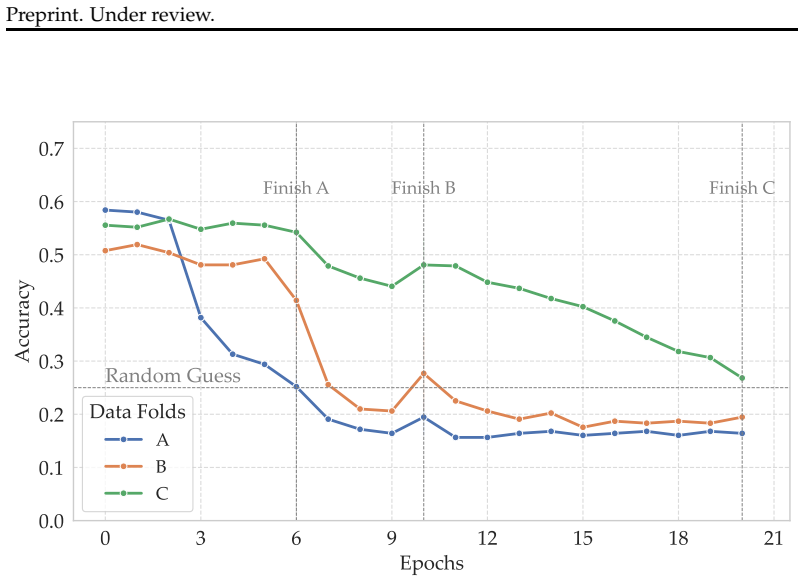
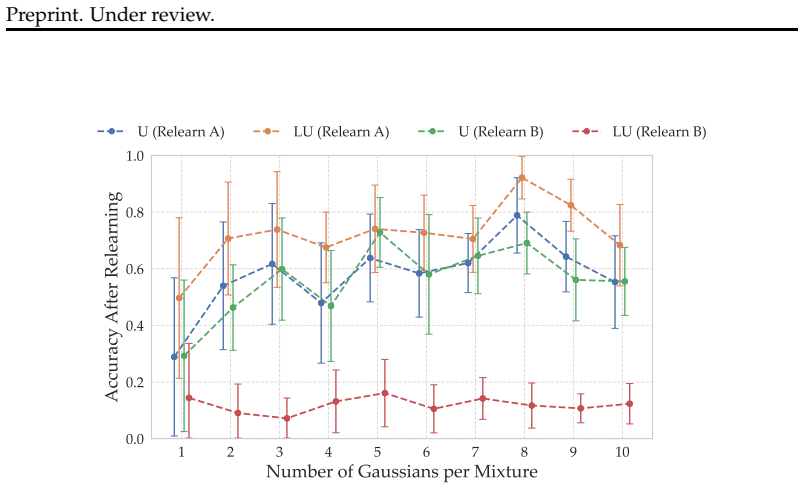
The paper's central claim is that unlearning the first $i$ folds while retaining the remaining $k-i$ at the $i$th of $k$ stages limits the ability of relearning on a subset of data to recover the full dataset. In the paper's own terms, standard unlearning creates a single shared inhibitor $I_{A \cup B}$ that covers all forgotten folds, so relearning on $B$ removes that shared inhibitor and restores $A$. LU instead builds a sequence of inhibitors $I_A$, $I_{AB}$, $I_{ABC}$ by applying an unlearning primitive $U$ with a growing forget set: at stage $i$, it computes $U(\theta_{i-1}, F_1 \cup \dots \cup F_i, R \cup F_{i+1} \cup \dots \cup F_k, \gamma_i)$. Relearning on $B$ deactivates $I_{AB}$ and $I_{ABC}$ but leaves $I_A$ unchanged, so $A$ stays suppressed; the direction of the barrier depends on whether the primitive builds shared or fold-specific inhibitors. The paper reports that LU improves robustness across a 2D logistic-regression synthetic task, a three-token bigram transformer, and the WMDP, MMLU, and Years benchmarks with RMU and SimNPO primitives, and that corpus-based fine-tuning reveals a stronger attack than MCQ-based fine-tuning, especially for representation-engineering variants.
Load-bearing premise
The paper assumes the robustness gain comes from the layering structure itself, not from the per-stage tuning choices documented in the appendix; if the baseline methods were given the same tuning budget, they might match LU.
Editorial extensions
If this is right
- Standard single-shot unlearning has a single point of failure, so unlearning benchmarks should measure fold-specific relearning recovery rather than only aggregate forget accuracy.
- LU makes robustness directional and path-dependent: an adversary with a later fold recovers less from earlier folds, so the fold order can be chosen to protect the most sensitive data first.
- LU is compatible with both major unlearning primitive families, representation misdirection and gradient ascent, so layering can be added on top of existing methods rather than replacing them.
- Corpus-based fine-tuning should become a standard attack in unlearning evaluation, because MCQ-based fine-tuning underestimates how much forgotten information can be recovered.
- In the toy transformer, resistance to relearning is carried by attention circuits (QK/OV), pointing to attention rather than output layers as the locus for future defense mechanisms.
Reading between the lines
- The paper does not formalize it, but its fold-order results imply a policy: if a defender must protect some subset more than others, placing it in the earliest fold should make it the hardest to recover, since later relearning removes only the later inhibitors.
- The corpus-based attack finding suggests a testable correction: re-running existing unlearning benchmarks with corpus fine-tuning, not just MCQ fine-tuning, would likely reveal higher residual vulnerability in methods that look robust today.
- Because the toy-transformer ablation shows QK/OV circuits carry the inhibition, a direct causal test is to patch attention heads from a layered model into a standard unlearned model and check whether fold-specific suppression transfers; the paper leaves this intervention open.
- The paper's alignment discussion suggests a layered 'harmless-but-helpless then helpful' training order; a concrete experiment would fine-tune helpfulness after a harmlessness pass and measure whether harmlessness degrades, which is currently untested.
Signed reviews
Editorial analysis
A structured set of objections, weighed in public.
Referee Report
Summary. The paper introduces Layered Unlearning (LU), a k-fold sequential unlearning method that at each stage unlearns a growing union of folds while retaining the remaining folds, with the goal of creating fold-specific inhibitors that block adversarial relearning from recovering the full forgotten set from a subset. The authors evaluate LU on synthetic tasks (2D logistic regression and a bigram transformer) and on LLM unlearning benchmarks (WMDP, MMLU, Years) using RMU and SimNPO as base unlearning primitives. They report that LU improves robustness to relearning, produces a directional barrier in which relearning a later fold does not recover earlier folds, and reveals that corpus-based fine-tuning is a stronger attack than MCQ-based fine-tuning. The paper includes code, synthetic experiments with multiple seeds, and detailed hyperparameter listings in the appendix.
Significance. If the central claim is correct, LU would be a simple and broadly applicable defense against adversarial relearning, and the observed fold-asymmetric robustness would provide a useful empirical signature for understanding post-training modifications. The paper's strengths include the clear algorithmic proposal, the synthetic experiments that consistently show the directional barrier, the attempt to control for the random-projection confound via RMU-Split, and the release of code. However, the claimed mechanistic interpretation in terms of context-dependent inhibitors is not directly tested, and the LLM experiments currently do not separate the effect of the layered structure from the effects of additional hyperparameter tuning and cumulative unlearning passes. The corpus-based attack finding is interesting and could stand even if the mechanistic story is revised.
major comments (4)
- [Section 5 and Appendix G] The claim in Section 5 that LU “discovers optima that standard unlearning techniques are unable to discover no matter how long they train” is unsupported. Appendix G shows that L-RMU and L-RMU-Split use per-stage tuned coefficients (e.g., forget coefficients 0.39, 13.52; retain set coefficients 14.51609 and 45.51609) while the baseline RMU/RMU-Split runs use a single setting, and no matched hyperparameter selection budget is reported. Without a control that gives the baselines a comparable tuning budget, the robustness gain could be attributed to additional tuning rather than to the layered retain structure; the manuscript itself acknowledges in Section 5 that LU is sensitive to hyperparameters and requires careful tuning at each stage.
- [Algorithm 1 and Section 3.1] Algorithm 1 includes fold F_j in the forget set at every stage j through k, so earlier folds receive strictly more unlearning passes than later folds. The reported directional barrier (relearning B recovers C but not A) is exactly the pattern that cumulative unlearning exposure would predict, without any fold-specific inhibitor. The paper provides no matched repeated-unlearning control, such as running the base unlearning for k rounds on the full forget set or sequential unlearning with a fixed retain set and no future-fold retention. Without such a control, the experiments do not isolate the proposed layered mechanism.
- [Table 3 and Appendix E/F] The LLM experiments report single runs without error bars, and several entries contradict the blanket claim of improved robustness. For example, in Table 3, relearning on B and evaluating on C gives L-RMU 0.50 versus RMU 0.46, and Appendix F reports recovery rates greater than 1 for many L-RMU entries (e.g., Table 14, relearn A evaluate C: 1.33), meaning L-RMU is worse than standard RMU in those conditions. The paper needs multiple seeds or a statistical summary to support the headline claim that LU improves robustness across settings.
- [Abstract and Section 2.3] The paper frames itself as testing the hypothesis that post-training induces context-dependent inhibitors, but the only evidence offered is the behavior of LU, an algorithm designed from that hypothesis. No direct activation-level measurement of the hypothesized inhibitors is provided; the synthetic ablations in Appendix B show that attention components matter for robustness but do not demonstrate fold-specific inhibition. The reasoning is therefore partly circular: the mechanism is inferred from the same behavior it is used to explain. A direct probe of the hypothesized inhibitor directions, or a clearly falsifiable prediction tested independently of the algorithm's construction, would be needed to support the mechanistic conclusion.
minor comments (5)
- [Section 1] The introduction contains a duplicated and awkward sentence: “However, changes introduced in post-training are often brittle. However, these changes are often shallow or brittle.” Please consolidate.
- [Section 2.1] The notation U : Θ × X × X × Γ → Θ is confusing because F and R are subsets of the data space, not elements of X; please use a clearer domain such as Θ × 2^X × 2^X × Γ.
- [Section 1] The acronym RTT is used without definition in the sentence comparing corpus-based fine-tuning with “standard RTT (Deeb & Roger, 2025).” Please define it at first use.
- [Appendix F] The recovery-rate definition is clear as a ratio of differences, but the accompanying text should state explicitly that a value less than 1 means the layered method recovers less information than the baseline, and that values greater than 1 appear in the tables and correspond to worse robustness for the layered method.
- [References] Li et al. 2024a and Li et al. 2024b cite the same WMDP paper; please merge the duplicates.
Circularity Check
No significant circularity: the robustness result is empirical and falsifiable, not an artifact of definition or fitting.
full rationale
I found no circular step. The central claim is an empirical comparison: Layered Unlearning is defined by Algorithm 1 as a sequence of unlearning calls with growing forget sets, and robustness is measured by fine-tuning on relearn subsets and evaluating held-out folds. The loss coefficients listed in Appendix G are tuned per stage, but they are not fitted to the evaluation metric, and the paper does not rename a fitted value as a prediction. The inhibitor discussion is a post-hoc mechanistic interpretation, not a derivation used to generate the results. Self-citations such as Che et al. (2024) and Lynch et al. (2024) provide background and related defenses; the central premise does not rest on any uniqueness theorem or on an unverified self-citation. The absence of a matched repeated-unlearning control is a genuine experimental confound, but it is an alternative explanation rather than a self-referential reduction, so it does not raise the circularity score under the specified criteria.
Assumptions & free parameters
free parameters (5)
- Per-stage forget coefficients for L-RMU and L-RMU-Split =
e.g., 0.39, 0.10, 1.00, 0.01, 0.03, 0.15, 0.75 for WMDP 4 folds
- Per-stage retain coefficients =
e.g., 13.52, 6.76, 8.00, 10.67, 14.51609, 45.51609
- Retain set coefficient =
1, 2, 8, 16, 24, 32, 36, 40 depending on stage
- Forget threshold =
0.35
- Number of folds k =
2, 3, or 4
assumptions (4)
- domain assumption Post-training modifications act through context-dependent inhibitors that can be made fold-specific by retaining future folds during staged unlearning.
- domain assumption Fine-tuning on a subset of forgotten data generalizes to the full forgotten set when a shared inhibitor is removed.
- domain assumption The unlearning primitive U can be composed sequentially without catastrophic interference beyond what LU controls.
- standard math A normal approximation with three standard deviations above random guessing defines the forgetting threshold.
invented entities (1)
-
Context-dependent inhibitors IA, IAB, IABC (fold-specific suppression mechanisms)
Cite this review
Pith. "Pith review of Layered Unlearning for Adversarial Relearning." pith.science (2026). https://pith.science/paper/CN3E7U3W
@misc{pith2026250509500,
  author       = {Pith},
  title        = {Pith review of: Layered Unlearning for Adversarial Relearning},
  year         = {2026},
  howpublished = {\url{https://pith.science/paper/CN3E7U3W}},
  note         = {Machine review of arXiv:2505.09500}
}
abstract
Our goal is to understand how post-training methods, such as fine-tuning, alignment, and unlearning, modify language model behavior and representations. We are particularly interested in the brittle nature of these modifications that makes them easy to bypass through prompt engineering or relearning. Recent results suggest that post-training induces shallow context-dependent ``circuits'' that suppress specific response patterns. This could be one explanation for the brittleness of post-training. To test this hypothesis, we design an unlearning algorithm, Layered Unlearning (LU), that creates distinct inhibitory mechanisms for a growing subset of the data. By unlearning the first $i$ folds while retaining the remaining $k - i$ at the $i$th of $k$ stages, LU limits the ability of relearning on a subset of data to recover the full dataset. We evaluate LU through a combination of synthetic and large language model (LLM) experiments. We find that LU improves robustness to adversarial relearning for several different unlearning methods. Our results contribute to the state-of-the-art of machine unlearning and provide insight into the effect of post-training updates.
Figures


Figures from the paper (5 more)



Reference graph
Works this paper leans on
-
[1]
Refusal in language models is mediated by a single direction
Andy Arditi, Oscar Obeso, Aaquib Syed, Daniel Paleka, Nina Panickssery, Wes Gurnee, and Neel Nanda. Refusal in language models is mediated by a single direction. arXiv preprint arXiv:2406.11717,
-
[3]
Guangyao Dou, Zheyuan Liu, Qing Lyu, Kaize Ding, and Eric Wong
URL https://arxiv.org/abs/2410.08827. Guangyao Dou, Zheyuan Liu, Qing Lyu, Kaize Ding, and Eric Wong. Avoiding copyright infringement via large language model unlearning,
-
[4]
Ronen Eldan and Mark Russinovich
URL https://arxiv.org/abs/ 2406.10952. Ronen Eldan and Mark Russinovich. Who’s harry potter? approximate unlearning in llms,
-
[6]
URL https://arxiv.org/abs/2410.07163. Leo Gao, Jonathan Tow, Baber Abbasi, Stella Biderman, Sid Black, Anthony DiPofi, Charles Foster, Laurence Golding, Jeffrey Hsu, Alain Le Noac’h, Haonan Li, Kyle McDonell, Niklas Muennighoff, Chris Ociepa, Jason Phang, Laria Reynolds, Hailey Schoelkopf, Aviya Skowron, Lintang Sutawika, Eric Tang, Anish Thite, Ben Wang,...
-
[8]
Shengyuan Hu, Yiwei Fu, Zhiwei Steven Wu, and Virginia Smith
URL https://arxiv.org/abs/2009.03300. Shengyuan Hu, Yiwei Fu, Zhiwei Steven Wu, and Virginia Smith. Jogging the memory of unlearned model through targeted relearning attack. arXiv preprint arXiv:2406.13356,
arXiv 2009
-
[11]
URL https://arxiv.org/abs/2407.10264. Joel Jang, Dongkeun Yoon, Sohee Yang, Sungmin Cha, Moontae Lee, Lajanugen Logeswaran, and Minjoon Seo. Knowledge unlearning for mitigating privacy risks in language models. arXiv preprint arXiv:2210.01504,
-
[12]
Soul: Unlocking the power of second-order optimization for llm unlearning
Jinghan Jia, Yihua Zhang, Yimeng Zhang, Jiancheng Liu, Bharat Runwal, James Diffenderfer, Bhavya Kailkhura, and Sijia Liu. Soul: Unlocking the power of second-order optimization for llm unlearning. arXiv preprint arXiv:2404.18239,
-
[13]
Split, unlearn, merge: Leveraging data attributes for more effective unlearning in llms
Swanand Ravindra Kadhe, Farhan Ahmed, Dennis Wei, Nathalie Baracaldo, and Inkit Padhi. Split, unlearn, merge: Leveraging data attributes for more effective unlearning in llms. arXiv preprint arXiv:2406.11780,
Show all 28 references
-
[15]
Li, Ann-Kathrin Dombrowski, Shashwat Goel, Long Phan, Gabriel Mukobi, Nathan Helm-Burger, Rassin Lababidi, Lennart Justen, Andrew B
Nathaniel Li, Alexander Pan, Anjali Gopal, Summer Yue, Daniel Berrios, Alice Gatti, Justin D. Li, Ann-Kathrin Dombrowski, Shashwat Goel, Long Phan, Gabriel Mukobi, Nathan Helm-Burger, Rassin Lababidi, Lennart Justen, Andrew B. Liu, Michael Chen, Isabelle Barrass, Oliver Zhang,...
-
[16]
Large language model unlearning via embedding-corrupted prompts
Chris Yuhao Liu, Yaxuan Wang, Jeffrey Flanigan, and Yang Liu. Large language model unlearning via embedding-corrupted prompts. arXiv preprint arXiv:2406.07933, 2024a. Sijia Liu, Yuanshun Yao, Jinghan Jia, Stephen Casper, Nathalie Baracaldo, Peter Hase, Xiao- jun Xu, Yuguang Ya...
-
[17]
Eight methods to evaluate robust unlearning in llms
Aengus Lynch, Phillip Guo, Aidan Ewart, Stephen Casper, and Dylan Hadfield-Menell. Eight methods to evaluate robust unlearning in llms. arXiv preprint arXiv:2402.16835,
-
[18]
In-context unlearning: Language models as few shot unlearners
Martin Pawelczyk, Seth Neel, and Himabindu Lakkaraju. In-context unlearning: Language models as few shot unlearners. arXiv preprint arXiv:2310.07579,
-
[19]
Avi Schwarzschild, Zhili Feng, Pratyush Maini, Zachary C Lipton, and J Zico Kolter
URL https://arxiv.org/abs/2405.14577. Avi Schwarzschild, Zhili Feng, Pratyush Maini, Zachary C Lipton, and J Zico Kolter. Re- thinking llm memorization through the lens of adversarial compression. arXiv preprint arXiv:2404.15146,
-
[20]
Pratiksha Thaker, Yash Maurya, and Virginia Smith
URL https://openreview.net/forum?id=4FIjRodbW6. Pratiksha Thaker, Yash Maurya, and Virginia Smith. Guardrail baselines for unlearning in llms. arXiv preprint arXiv:2403.03329,
-
[21]
Yu Wang, Ruihan Wu, Zexue He, Xiusi Chen, and Julian McAuley
URL https://arxiv.org/abs/2310.16944. Yu Wang, Ruihan Wu, Zexue He, Xiusi Chen, and Julian McAuley. Large scale knowledge washing. arXiv preprint arXiv:2405.16720,
-
[22]
Large language model unlearning
Yuanshun Yao, Xiaojun Xu, and Yang Liu. Large language model unlearning. arXiv preprint arXiv:2310.10683,
-
[23]
Forget-me-not: Learning to forget in text-to-image diffusion models
Eric Zhang, Kai Wang, Xingqian Xu, Zhangyang Wang, and Humphrey Shi. Forget-me-not: Learning to forget in text-to-image diffusion models. arXiv preprint arXiv:2303.17591,
-
[24]
Unforgettable generalization in language models, 2024a
Eric Zhang, Leshem Chosen, and Jacob Andreas. Unforgettable generalization in language models, 2024a. URL https://arxiv.org/abs/2409.02228. Ruiqi Zhang, Licong Lin, Yu Bai, and Song Mei. Negative preference optimization: From catastrophic collapse to effective unlearning. arXi...
-
[25]
Andy Zou, Zifan Wang, J Zico Kolter, and Matt Fredrikson
URL https://arxiv.org/abs/2406.01257. Andy Zou, Zifan Wang, J Zico Kolter, and Matt Fredrikson. Universal and transferable adversarial attacks on aligned language models. arXiv preprint arXiv:2307.15043,
-
[26]
13 Preprint
URL https://arxiv.org/abs/2406.04313. 13 Preprint. Under review. A Layered Unlearning graphics We provide graphics to better communicate the main idea. Figure 4: The performance trajectory of LU on two foldsA, B. Normally, unlearning methods lose performance on A, B jointly an...
2021 arXiv
-
[27]
Investigating how attention confers this robustness is left for future work
Notably, retain and task accuracies remain stable across all substitution settings (Appendix Table 5), indicating no degradation in core performance. Investigating how attention confers this robustness is left for future work. 16 Preprint. Under review. Figure 8: Relearning ac...
2025
-
[28]
We fine-tune on MCQ for 8 epochs and fine-tune on corpus for 5 epochs. This difference is because we wish to fine-tune until the accuracy on the relearn set stops increasing for a while, and by definition fine-tuning on MCQ can reach 1.0 accuracy, so we fine-tune for longer. W...
2023
-
[2017]
Vinayshekhar Bannihatti Kumar, Rashmi Gangadharaiah, and Dan Roth
URL https://arxiv.org/abs/1412.6980. Vinayshekhar Bannihatti Kumar, Rashmi Gangadharaiah, and Dan Roth. Privacy adhering machine un-learning in nlp. arXiv preprint arXiv:2212.09573,
-
[2021]
Chongyu Fan, Jiancheng Liu, Licong Lin, Jinghan Jia, Ruiqi Zhang, Song Mei, and Sijia Liu
https://transformer- circuits.pub/2021/framework/index.html. Chongyu Fan, Jiancheng Liu, Licong Lin, Jinghan Jia, Ruiqi Zhang, Song Mei, and Sijia Liu. Simplicity prevails: Rethinking negative preference optimization for llm unlearning,
2021
-
[2022]
Knowledge sanitization of large language models
Yoichi Ishibashi and Hidetoshi Shimodaira. Knowledge sanitization of large language models. arXiv preprint arXiv:2309.11852,
-
[2023]
Ryan Greenblatt, Fabien Roger, Dmitrii Krasheninnikov, and David Krueger
URL https://zenodo.org/records/10256836. Ryan Greenblatt, Fabien Roger, Dmitrii Krasheninnikov, and David Krueger. Stress-testing capability elicitation with password-locked models. In The Thirty-eighth Annual Conference on Neural Information Processing Systems,
-
[2024]
Editing models with task arithmetic
Gabriel Ilharco, Marco Tulio Ribeiro, Mitchell Wortsman, Suchin Gururangan, Ludwig Schmidt, Hannaneh Hajishirzi, and Ali Farhadi. Editing models with task arithmetic. arXiv preprint arXiv:2212.04089,
-
[2025]
URL https://arxiv.org/abs/2502.17424. Zora Che, Stephen Casper, Anirudh Satheesh, Rohit Gandikota, Domenic Rosati, Stewart Slocum, Lev E McKinney, Zichu Wu, Zikui Cai, Bilal Chughtai, Furong Huang, and Dylan Hadfield-Menell. Model manipulation attacks enable more rigorous eval...
2024
Reviewed August 15, 2026 · model on record in the stance chip above.
Discussion (0). Continue with ORCID to comment.