REVIEW 3 major objections 6 minor 40 references
Resonant DM scattering in the galactic center under the influence of EMRI
T0 review · 3 major / 6 minor · reviewed 2026-08-15 · deepseek-v4-flash
Pith's one-line read Tidal resonances from an inspiraling compact object barely move dark-matter particles near a supermassive black hole.
desk verdict Solid derivation and numerical pipeline showing cumulative tidal resonances barely affect DM orbits before the EMRI and DM radial ranges overlap, but the 'regardless of initial orbits' claim overreaches into the overlap regime where the effect may be enhanced. read the letter →
The pith
A machine-rendered reading of the paper's core claim, the machinery that carries it, and where it could break.
The reading
What carries the argument
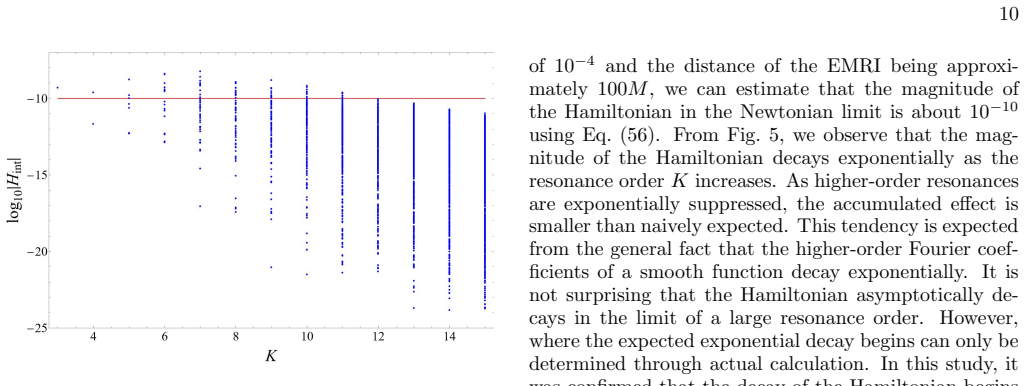
The central object is the averaged interaction Hamiltonian between the EMRI secondary and a DM test particle, expressed in action-angle variables of Kerr geodesics: ⟨H_int⟩(χ) = Σ_{(n,N)∈Res} H_{n,N} $e^{{iχ}}$, with χ = n_a q^a + N_a Q^a and resonance condition n_a ω̂^a + N_a Ω̂^a = 0. Around a single resonance the resonant angle obeys a pendulum equation d²χ/dτ² = -α sin χ, so the orbital jump is Δj_a = (8√H/(π|n|)) n_a, proportional to √H. The amplitudes H_{n,N} are obtained from metric reconstruction of the Teukolsky equation, and the load-bearing numerical observation is that they decay exponentially with K = Σ(|n_a|+|N_a|), which makes higher-order resonances harmless and concentrates the effect in a few low-order events.
What would settle it
Run the same cumulative-resonance evolution with a metric-reconstruction scheme that is valid when the EMRI secondary and the DM particle orbits overlap, and check whether the total semi-major-axis change exceeds the ~1% level for the same fiducial parameters; if it does, the paper's conclusion that the DM spike survives this channel fails.
Extended reading notes
Core claim
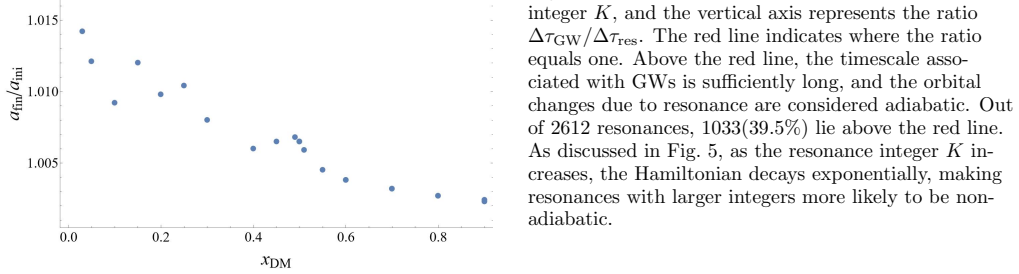
On its own terms, the paper's claim is that the repeated tidal resonances between an EMRI secondary and a DM particle—each event shifting the particle's actions by an amount proportional to the square root of the interaction Hamiltonian—do not accumulate into a significant orbital change. Numerically, for a central black hole of mass $10^{6}$ solar masses, mass ratio $10^{-4}$, spin 0.9, and a range of DM eccentricities and inclinations, the semi-major axis changes by at most roughly 0.8% and the eccentricity decreases by a few percent over the inspiral, with 2612 resonances crossed in the reference case. The reason is that the Fourier amplitude of the interaction Hamiltonian decays exponentially as the resonance order K increases; only a handful of low-order resonances produce noticeable jumps, and the rest are exponentially suppressed. The paper therefore concludes that, in the regime where the DM orbit and the EMRI orbit do not radially overlap, the DM spike survives this resonant-scattering channel.
Load-bearing premise
The whole calculation assumes the DM particle's orbit never crosses the EMRI secondary's radial range, and the numerics are stopped at the first overlap; in the overlapping regime, where the two bodies get closest, the resonance effects could be larger and are not computed.
Editorial extensions
If this is right
- For an EMRI with mass ratio 10^-4 around a 10^6-solar-mass black hole, a DM particle in the LISA band crosses on the order of 10^3 resonances, yet its semi-major axis changes by less than a percent.
- The DM spike is not dissolved by tidal resonances as long as the DM particle's orbit stays outside the EMRI's radial range, so a spike can persist to be probed by EMRI gravitational-wave phase shifts.
- Naive estimates that sum equal-sized resonance kicks overestimate the effect; exponential suppression of high-order Fourier harmonics makes the total kick small.
- The small number of effective resonances means numerical studies can truncate the resonance sum at modest order K with verified convergence (K_max = 15 here).
Reading between the lines
- The paper stops where the DM and EMRI orbits begin to overlap; the authors expect the resonance effect to be enhanced there. If a matter-aware metric reconstruction confirms that expectation, the 'spike survives' conclusion would need to be narrowed to non-crossing orbits only.
- The exponential decay of H with K mirrors the general fact that Fourier coefficients of a smooth function decay exponentially, so a similar smallness may hold for other environmental backreaction channels that scan through resonances.
- A testable extension is to compute the same cumulative kicks with the EMRI's mass ratio pushed toward η ~ 10^-3 or with higher spin, where the decay onset in K shifts and the total effect could grow above the percent level.
- The scatter of six orders of magnitude in H at fixed K is left open; if that scatter correlates with orbital phase or inclination, resonance networks could be modeled statistically rather than event-by-event.
Signed reviews
Editorial analysis
A structured set of objections, weighed in public.
Referee Report
Summary. The manuscript investigates whether an extreme-mass-ratio inspiral (EMRI) in the galactic center can deplete a dark-matter (DM) spike through tidal resonances between the secondary and individual DM particles on bound Kerr geodesics. The setup is a restricted three-body problem: the EMRI evolves by gravitational-wave backreaction (quadrupole formula), while each DM particle is treated as a test particle whose orbital elements change discretely at each resonance satisfying n_a ω_a = N_a Ω_a. The interaction Hamiltonian is derived from first principles using Teukolsky metric reconstruction (Eqs. (59)-(88)), Fourier-decomposed in the action-angle variables of both orbits, and the cumulative effect of O(10^3) resonances per EMRI event is computed numerically with Black Hole Perturbation Toolkit modes. For a benchmark run (central mass 10^6 M_sun, η=10^-4, spin 0.9, EMRI from p=126 to p=72, DM at p=25), the DM semi-major axis changes by about 0.3%, and a scan over DM eccentricity and inclination (Tables I-II, Fig. 6) gives changes below about 1% in semi-major axis and up to about 4.5% in eccentricity. The authors attribute the smallness to an exponential decay of the resonance Hamiltonian with resonance order K (Fig. 5). All numerical runs are stopped before the DM and EMRI radial ranges overlap, and the authors state in Sec. V that the overlap regime may enhance the effect.
Significance. This is a potentially useful negative result for the DM-spike/EMRI literature: within the non-overlapping-orbit regime, the tidal-resonance feedback channel does not significantly modify DM orbits, so the spike survives this specific channel and EMRI-phase signatures of a spike are not erased by it. The paper's strengths are concrete: the interaction Hamiltonian is derived rather than fitted; the exponential suppression of high-order resonances is extracted from numerical evaluation of the Fourier coefficients rather than assumed as an ansatz; the authors are transparent about the six-orders-of-magnitude scatter at fixed K and about the excluded overlap regime; and the numerical pipeline (public Teukolsky toolkit, datasets promised at an archived repository) is reproducible in principle. The significance is conditional on the domain of validity: the claimed universality 'regardless of initial orbits' currently covers only orbits that never cross the EMRI's radial range, a subset for which the interaction is weakest; quantifying the excluded regime is the main open task.
major comments (3)
- [Sec. V; Eq. (81); Fig. 4 note] The paper's headline claim, that the cumulative resonant effect on DM orbits 'remains very small regardless of the initial orbits of the DM particles' (Sec. V), is established only for the non-overlap regime, which is precisely the regime of weakest interaction. The reconstructed metric (81) is built from the retarded Green's function branch (72) that holds for source radius r' larger than the field-point radius r, and every numerical run is terminated as soon as the DM and EMRI radial ranges overlap (note to Fig. 4; Sec. IV). Tables I and II and Fig. 6 fix pDM = 25M, so for the Fig. 4 EMRI (pEMRI from 126M down to 72M) the DM apocenter remains below the EMRI pericenter throughout and the excluded regime is never probed. For example, a DM particle with pDM = 50M and eDM = 0.4 has apocenter ≈ 83M and would begin overlapping the EMRI's radial range once pEMRI drops below ≈ 100M, i.e., during the studied inspiral window; these are the configurations for which the authors themselves state that the resonance effect 'will be enhanced' (Sec. V). As it stands, the conclusion is conditional on the overlap-free assumption, and the spike-survival statement in the abstract should be qualified accordingly, or supplemented by a quantitative estimate of the overlap-regime contribution (for instance, using the complementary branch of the Green's function or a local treatment of near-coincidence encounters).
- [Sec. IV; Tables I-II; Fig. 6] The claim that the smallness holds 'regardless of the initial orbits' is an extrapolation from a narrow parameter slice. The numerical scans hold pDM fixed at 25M, vary eDM only over {0.2, 0.3, 0.4} and xDM over the values shown in Tables I-II and Fig. 6, and do not vary the EMRI mass ratio or spin; the sentence in Sec. IV that 'systematic parameter variation studies reveal negligible quantitative differences' refers to EMRI parameters and is not substantiated by any figure or table in the manuscript. The authors should state explicitly the region of parameter space over which the conclusion is claimed (e.g., the set of (pDM, eDM, xDM) such that the DM radial range never intersects the EMRI's during the relevant inspiral), and ideally add at least one run with a larger pDM or a different mass ratio to demonstrate that the exponential-decay mechanism persists.
- [Appendix A; Sec. IV] The truncation at Kmax = 15 is asserted to be convergent without supporting evidence. Appendix A states that 'convergence of the results has been verified,' but no figure, table, or quantitative criterion is given (e.g., the change in the cumulative Δa/a or Δe when Kmax is increased from 12 to 15, or the largest fractional contribution from the highest-K retained resonances). This matters because Figs. 8-9 show that the decay of the interaction Hamiltonian with K becomes slower as the inclination increases, and the high-inclination points in Fig. 6 (xDM down to 0.1) are part of the headline result; an undiagnosed truncation bias in exactly those cases could affect the stated smallness of the cumulative effect. A short convergence table or a statement of the error criterion is needed.
minor comments (6)
- [Sec. IV (fast-crossing phase)] The prescription that selects 'the phase to maximize the contribution from the resonance' for fast crossings should be labeled as an upper-envelope estimate for that channel, not a phase-averaged value; since the resulting cumulative change is still small, the conclusion is conservative under this choice, but the manuscript should say so explicitly so that Fig. 4 and Tables I-II are not read as typical trajectories.
- [Eq. (54)] In the derivation following Eqs. (47)-(53), the jump is Δj_a = n_a Θ with Θ = 8√H/(π√k) and k = G_ab n_a n_b, so the denominator in Eq. (54) should be √k (or a defined norm |n|_G), not the Euclidean |n|; as printed, the equation is inconsistent with its own derivation.
- [Fig. 5] The 'exponential decay' of the Hamiltonian with K is inferred from the envelope of a scatter of points spanning six orders of magnitude at fixed K; quoting an e-folding scale per unit K and the K range over which the envelope is exponential would make the claim quantitative and testable, and would directly support the Kmax = 15 truncation.
- [Sec. II A] The motivation for neglecting direct scattering is derived for η ≲ 10^-6, while the numerical study uses η = 10^-4; for η = 10^-4 the crossover radius in Eq. (8) is about 478M, so the sentence following Eq. (8) should state explicitly that the conclusion applies to the LISA-band radii (≲ O(100)M) for the adopted mass ratio.
- [Sec. V] First sentence of the concluding paragraph: 'the effect on the overall effect on the DM orbital evolution' is redundant and should be reworded.
- [Sec. II C (Fig. 2 discussion)] The statement that 'the results for other cases are similar' is presented without supporting evidence; a supplementary panel or a quantitative statement on the robustness of the resonance count would help the reader assess the O(10^3) estimate.
Circularity Check
No circularity found: the interaction Hamiltonian and the exponential decay of resonance amplitudes are computed, not fitted or defined into existence.
full rationale
No circular step found. The central quantity, the interaction Hamiltonian (Eq. 88), is obtained by applying the Teukolsky metric-reconstruction formalism of Ref. [32] and the action-angle formalism of Refs. [24, 28] to the explicit point-particle stress tensor; these are background results and computational tools, not functions of the paper's conclusion. The exponential suppression of high-order resonances (Sec. IV, Fig. 5) is read off from numerically computed Fourier coefficients, not imposed as an ansatz; the text explicitly says the onset of the decay 'can only be determined through actual calculation.' The orbital jumps follow from pendulum dynamics (Eq. 54) once H is computed, with no fitted parameter renamed as a prediction. The only caveats are the orbital-overlap restriction and the phrasing 'regardless of the initial orbits'; the authors themselves state that the Hamiltonian 'cannot be used' in the overlap regime and that the effect may be enhanced there. That is a scope limitation and a correctness risk, not a circular reduction. Self-citations (Refs. [24], [28], [31], [32]) supply formalism and background estimates, not the target result, so they do not make the argument circular.
Assumptions & free parameters
assumptions (4)
- standard math Kerr geodesic motion is integrable and can be described by action-angle variables with three independent frequencies.
- domain assumption The metric perturbation generated by the EMRI secondary can be reconstructed from the Teukolsky solution using the Sago-Tanaka-Wikida-Ganz-Nakano reconstruction procedure, which assumes a vacuum background.
- domain assumption DM particles can be treated as test particles in a restricted three-body problem; DM self-interaction and self-gravity are neglected, and the EMRI orbit evolves via the quadrupole GW formula independent of the DM.
- ad hoc to paper For fast crossings, the resonance phase is chosen to maximize the change in angular momentum; actual phase distributions are not modeled.
Cite this review
Pith. "Pith review of Resonant DM scattering in the galactic center under the influence of EMRI." pith.science (2026). https://pith.science/paper/HWDLI7PP
@misc{pith2026250510036,
  author       = {Pith},
  title        = {Pith review of: Resonant DM scattering in the galactic center under the influence of EMRI},
  year         = {2026},
  howpublished = {\url{https://pith.science/paper/HWDLI7PP}},
  note         = {Machine review of arXiv:2505.10036}
}
read the original abstract
Dark matter (DM) search is one of the greatest challenges in physics. If DM consists of particles, it may form a spike around supermassive black holes (BH) prevalent in galaxy centers. This spike could be potentially observed by altering the orbits of Extreme Mass Ratio Inspirals (EMRIs), one of LISA's main targets. Meanwhile, the effects of EMRI on the DM spike have also been explored. In this study, we focus on the tidal resonances between DM particles and EMRI secondary. As the EMRI orbit evolves via gravitational wave backreaction, each DM particle experiences a significant number of resonances. Although the effect of each individual resonance is small, their cumulative impact might significantly alter the DM particle's orbit. To examine this possibility, we explicitly derive the interaction Hamiltonian for tidal resonances and conducted numerical calculations.
Figures


Figures from the paper (5 more)



Reference graph
Works this paper leans on
-
[1]
Reduction to a one-dimensional system As noted in the previous section, orbital averaging eliminates contributions to ⟨Hint⟩ from non-resonant Fourier modes. As the angle variables other than χ de- fined in (29) evolve rapidly, they are irrelevant for long- term evolution. To understand the evolution of χ, we only need to know the combination of frequenci...
-
[2]
Motion near the resonance The changes in the orbital elements due to resonance can be obtained by solving Eqs. (36) and (38). When the interaction Hamiltonian is Fourier decomposed, we expect the fundamental mode to dominate, which leads to the approximation by ⟨Hint⟩(χ) =−H cosχ, (40) withH being the constant amplitude of the interaction Hamiltonian. The...
-
[3]
slow-evolution First, let us investigate how the change in the fre- quencyR is related to the change in the action vari- ables in the case of the slow crossing (∆ τGW > ∆τres). 6 From Eq. (33), since the time derivative of each action variable is proportional to the corresponding resonance integerna, a small jump in the action variable ∆ja across a resona...
-
[4]
This assump- tion might not be always satisfied
fast-evolution In the above discussion, we assumed that the timescale of oscillation around the resonance point ∆ τres is suffi- ciently short compared to the timescale of the resonance crossing due to GW backreaction ∆ τGW. This assump- tion might not be always satisfied. In such a case, the change in action variables can be approximated by the following...
- [5]
- [6]
-
[7]
P. Gondolo and J. Silk, Phys. Rev. Lett. 83, 1719 (1999), arXiv:astro-ph/9906391
arXiv 1999
-
[8]
O. Y. Gnedin and J. R. Primack, Phys. Rev. Lett. 93, 061302 (2004), arXiv:astro-ph/0308385
arXiv 2004
Show all 40 references
-
[9]
H. Kim, A. Lenoci, I. Stomberg, and X. Xue, Phys. Rev. D 107, 083005 (2023), arXiv:2212.07528 [astro-ph.GA]
2023 arXiv
-
[10]
C. P. L. Berry, S. A. Hughes, C. F. Sopuerta, A. J. K. Chua, A. Heffernan, K. Holley-Bockelmann, D. P. Mihaylov, M. C. Miller, and A. Sesana, (2019), arXiv:1903.03686 [astro-ph.HE]
2019 arXiv
-
[11]
Babak, J
S. Babak, J. Gair, A. Sesana, E. Barausse, C. F. Sop- uerta, C. P. L. Berry, E. Berti, P. Amaro-Seoane, A. Pe- titeau, and A. Klein, Phys. Rev. D 95, 103012 (2017), arXiv:1703.09722 [gr-qc]
2017 arXiv
-
[12]
Amaro-Seoane, Phys
P. Amaro-Seoane, Phys. Rev. D 98, 063018 (2018), arXiv:1807.03824 [astro-ph.HE]
2018 arXiv
-
[13]
D. A. Brown, H. Fang, J. R. Gair, C. Li, G. Lovelace, I. Mandel, and K. S. Thorne, Phys. Rev. Lett.99, 201102 (2007), arXiv:gr-qc/0612060
2007 arXiv
-
[14]
Colpi et al., (2024), arXiv:2402.07571 [astro-ph.CO]
M. Colpi et al., (2024), arXiv:2402.07571 [astro-ph.CO]
2024 arXiv
-
[15]
Laser interferometer space antenna,
P. Amaro-Seoane, H. Audley, S. Babak, J. Baker, E. Ba- rausse, P. Bender, and et al., “Laser interferometer space antenna,” (2017), arXiv:1702.00786 [astro-ph.IM]
2017 arXiv
-
[16]
Hu and Y.-L
W.-R. Hu and Y.-L. Wu, Natl. Sci. Rev. 4, 685 (2017)
2017
-
[17]
Luo et al
J. Luo et al. (TianQin), Class. Quant. Grav. 33, 035010 (2016), arXiv:1512.02076 [astro-ph.IM]
2016 arXiv
-
[18]
Kawamura et al
S. Kawamura et al. , Class. Quant. Grav. 28, 094011 (2011)
2011
-
[19]
K. Eda, Y. Itoh, S. Kuroyanagi, and J. Silk, Phys. Rev. D 91, 044045 (2015), arXiv:1408.3534 [gr-qc]
2015 arXiv
-
[20]
B. J. Kavanagh, D. A. Nichols, G. Bertone, and D. Gag- gero, Phys. Rev. D102, 083006 (2020), arXiv:2002.12811 [gr-qc]
2020 arXiv
-
[21]
Amaro-Seoane, Living Rev
P. Amaro-Seoane, Living Rev. Rel. 21, 4 (2018), arXiv:1205.5240 [astro-ph.CO]
2018 arXiv
-
[22]
Mukherjee, A
D. Mukherjee, A. M. Holgado, G. Ogiya, and H. Trac, (2023), arXiv:2312.02275 [astro-ph.CO]
2023 arXiv
-
[23]
Becker, Dancing above the abyss: Environmental ef- fects and dark matter signatures in inspirals into massive black holes, Other thesis (2024), arXiv:2404.02808 [gr-qc]
N. Becker, Dancing above the abyss: Environmental ef- fects and dark matter signatures in inspirals into massive black holes, Other thesis (2024), arXiv:2404.02808 [gr-qc]
2024 arXiv
-
[24]
Bonga, H
B. Bonga, H. Yang, and S. A. Hughes, Phys. Rev. Lett. 123, 101103 (2019), arXiv:1905.00030 [gr-qc]
2019 arXiv
-
[25]
Silva and C
M. Silva and C. Hirata, Phys. Rev. D106, 084058 (2022), arXiv:2207.07733 [gr-qc]
2022 arXiv
-
[26]
Binney and S
J. Binney and S. Tremaine, Galactic Dynamics: Second Edition, Princeton Series in Astrophysics (Princeton Uni- versity Press, 2011)
2011
-
[27]
P. C. Peters and J. Mathews, Phys. Rev.131, 435 (1963)
1963
-
[28]
Gupta, T
P. Gupta, T. Kakehi, and T. Tanaka, Class. Quant. Grav. 39, 245005 (2022), arXiv:2207.13369 [gr-qc]
2022 arXiv
-
[29]
Carter, Phys
B. Carter, Phys. Rev. 174, 1559 (1968)
1968
-
[30]
Hinderer and E
T. Hinderer and E. E. Flanagan, Phys. Rev. D78, 064028 (2008), arXiv:0805.3337 [gr-qc]
2008 arXiv
- [31]
- [32]
-
[33]
Isoyama, R
S. Isoyama, R. Fujita, H. Nakano, N. Sago, and T. Tanaka, PTEP 2019, 013E01 (2019), arXiv:1809.11118 [gr-qc]
2019 arXiv
-
[34]
Murray and S
C. Murray and S. Dermott, Solar System Dynamics (Cambridge University Press, 1999)
1999
-
[35]
Gupta, B
P. Gupta, B. Bonga, A. J. K. Chua, and T. Tanaka, Phys. Rev. D 104, 044056 (2021), arXiv:2104.03422 [gr- qc]
2021 arXiv
-
[36]
N. Sago, T. Tanaka, W. Hikida, K. Ganz, and H. Nakano, Prog. Theor. Phys.115, 873 (2006), arXiv:gr- qc/0511151
2006
-
[37]
Poisson, A
E. Poisson, A. Pound, and I. Vega, Living Rev. Rel. 14, 7 (2011), arXiv:1102.0529 [gr-qc]. 13 (a) xDM = 0.1 (b) xDM = 0.2 (c) xDM = 0.3 FIG. 8: Decay of the interaction Hamiltonian Hint as a function of|K| for xDM = 0.1, 0.2, and 0.3. The three curves—computed with all other p...
2011 arXiv
-
[38]
S. A. Teukolsky and W. H. Press, Astrophys. J. 193, 443 (1974)
1974
-
[39]
Black Hole Perturbation Toolkit,
“Black Hole Perturbation Toolkit,” (bhptoolkit.org)
-
[40]
Fujita and W
R. Fujita and W. Hikida, Class. Quant. Grav. 26, 135002 (2009), arXiv:0906.1420 [gr-qc]
2009 arXiv
Reviewed August 15, 2026 · model on record in the stance chip above.
Discussion (0). Continue with ORCID to comment.