REVIEW 4 major objections 6 minor 57 references
SpecOffload: Unlocking Latent GPU Capacity for LLM Inference on Resource-Constrained Devices
T0 review · 4 major / 6 minor · reviewed 2026-08-15 · deepseek-v4-flash
Pith's one-line read SpecOffload claims that storing and running a small draft model in the low-yield GPU memory of a weight-offloading pipeline lifts LLM inference throughput by 2.54x over the best baseline.
desk verdict Novel interleaving idea, but the planner's math is wrong and the headline speedup looks like per-dataset tuning rather than an automatic planner win. read the letter →
The pith
A machine-rendered reading of the paper's core claim, the machinery that carries it, and where it could break.
The reading
What carries the argument
The load-bearing object is the Interleaved Batch Pipeline, a dual-batch decoding schedule in which one batch is being verified by the target model while the other batch is being drafted by the small model, then the roles swap. At the computation level, each target layer is split so that CPU attention for the current batch, GPU-CPU transfer of the next layer's FFN weights, and GPU execution of the draft model all overlap. Around this sits a tensor-placement optimizer and the ParaSpec Planner, a constrained optimization that selects prefill batch, decoding batch, draft batch, and number of draft tokens to maximize expected tokens per unit time subject to GPU memory.
What would settle it
Run SpecOffload with a draft model that produces random tokens, so the acceptance rate is near zero, on the same hardware and datasets; if throughput stays at or above the best offloading baseline, the speedup is not coming from speculative decoding. Alternatively, instrument the two sides of $T_{\text{decoding}} = \max(T_{\text{target}}, T_{\text{draft}})$ and check whether draft time ever exceeds target I/O time in the reported configurations.
Extended reading notes
Core claim
The paper's central claim is that offloading pipelines have a hidden compute-and-memory budget: during decoding, the GPU is mostly waiting on I/O, and its memory, though scarce, is "low-yield" because shaving it barely changes throughput. SpecOffload fills that budget with a draft model: Mistral-7B is stored in GPU memory, generates candidate tokens while the target model (Mixtral-8x7B or Mixtral-8x22B) is being fed parameters, and the two models alternate batches so drafting and verification overlap. On two GPU environments and several datasets, the paper reports 2.54x throughput over the best baseline, 4.49x higher GPU core utilization, and ablation results that attribute most of the gain to embedding rather than naively stacking speculative decoding on top of offloading.
Load-bearing premise
The entire gain depends on the small draft model being able to do its work during the time the big model is waiting for weights, and on enough of its guesses being accepted that each round produces more than one token; if drafting becomes the slowest step, or acceptance collapses, the speedup disappears.
Editorial extensions
If this is right
- Drafting and verification no longer serialize, so speculative decoding can be embedded in an I/O-bound pipeline without adding a second sequential compute phase.
- GPU memory that previously contributed almost nothing to throughput is repurposed for the draft model; the paper reports that removing this embedding drops throughput from 24.743 to 12.369 token/s on Mixtral 8x7B.
- The four scheduling parameters are tightly coupled and input-dependent; the paper shows that a random policy can cut throughput from 24.743 to 15.624 token/s, so the planner is a necessary part of the gain.
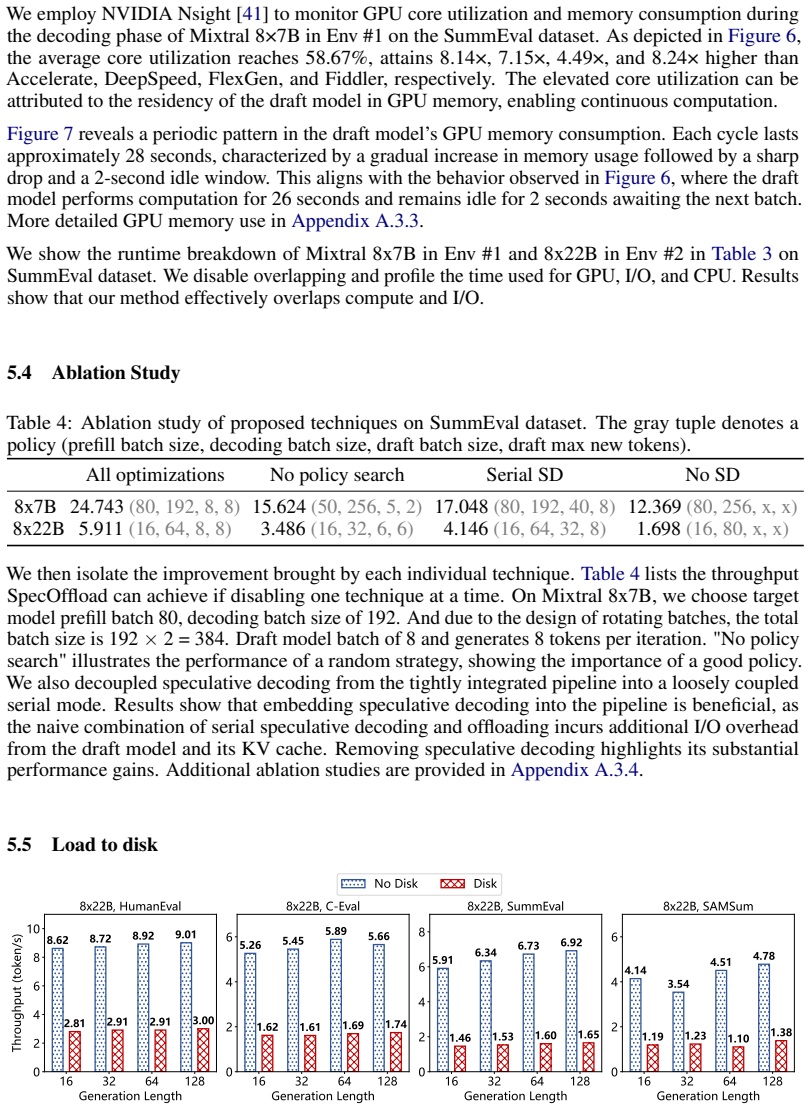
- The approach extends to disk offloading under severe memory limits, reaching 29.3% of the full-throughput figure when part of the model spills to disk.
Reading between the lines
- The core tradeoff should transfer to any draft model small enough to fit in the reclaimed memory; choosing a draft with higher acceptance per token would convert more of the idle GPU time into verified tokens, while a weaker draft would erode the 2.54x figure.
- On hardware with much faster CPU-GPU links, or models small enough to stay GPU-resident, the idle windows shrink and the mechanism's advantage should shrink accordingly; the claimed gain is specific to the I/O-bound regime.
- A natural testable extension is to make the number of draft candidates adaptive to the measured acceptance rate per input, since low acceptance is the failure mode the paper itself flags.
Signed reviews
Editorial analysis
A structured set of objections, weighed in public.
Referee Report
Summary. The paper introduces SpecOffload, a single-GPU LLM inference engine that combines weight offloading with speculative decoding. The system runs a small draft model from GPU memory during the I/O-idle windows of a FlexGen-style offloading pipeline, uses a dual-batch interleaved schedule to overlap draft generation and target verification, and proposes an offline tensor placement scheme plus an online 'ParaSpec Planner' that is supposed to choose batch sizes and draft lengths. The headline results are a 4.49x increase in GPU core utilization and a 2.54x throughput improvement over FlexGen for Mixtral 8x7B and 8x22B with Mistral-7B as the draft model. The paper includes a NeurIPS-style checklist, an appendix with policy-grid tables and ablations, and a code link.
Significance. If the empirical gains are reproducible, the core idea is a valuable contribution to throughput-oriented offloading: instead of treating GPU idle time and low-yield memory as waste, SpecOffload uses those resources to run a draft model at near-zero marginal cost. The detailed profiling in Figures 6-7 and Table 3 supports the mechanism, and the release of code and the exhaustive policy tables are useful for reproducing the system-level behavior. However, the significance as stated is reduced by a gap between the claimed automatic planner and the evaluation: the fastest configurations in the ablation tables coincide with the maxima of the appendix grid searches, and the only formal component of the planner, Appendix A.1, contains an incorrect expected-value formula. The headline speedup is therefore best interpreted as a curated-configuration result until the planner is actually exercised and validated.
major comments (4)
- [§4.3 / Appendix A.1, Eq. (12)] The derivation of E[n_generated] is mathematically incorrect. Under the stated distribution in Eqs. (10)-(11), P(k)=p^{k-1}(1-p) for k=1..n_cand and P(n_cand+1)=p^{n_cand}, the expected number of generated tokens is (1-p^{n_cand+1})/(1-p). Equation (12) gives [n_cand p^{n_cand+2} - (n_cand+1) p^{n_cand+1} + 1]/(1-p), which is wrong; for n_cand=1, p=0.9 it yields 1.09 instead of 1.9. Since this expectation enters the planner objective Eq. (1) and the memory constraint Eq. (22), the planner as described would make systematically wrong decisions. The authors should correct the formula and re-derive any resulting policy predictions.
- [§5.4 and Appendix A.3.2, Tables 4, 7, 10] The evaluation does not show the ParaSpec Planner actually selecting the reported configurations. In Table 4, the 'All optimizations' policy for Mixtral 8x22B/SummEval is (16,64,8,8) at 5.911 token/s, which is exactly the maximum entry in Table 10 (No. 13), and the 8x7B/SummEval policy (80,192,8,8) at 24.743 token/s matches the maximum of Table 7 (No. 25, 24.732). No experiment reports the planner's chosen tuple or its predicted throughput for any dataset. Because the appendix explicitly states that these four parameters are tightly coupled and hard to tune, the 2.54x speedup is currently a per-dataset grid-search result, not a validation of the automatic system claimed in the abstract and §4.3. The authors should report planner-selected configurations and compare their measured throughput with the grid maxima, or reframe the claim as an oracle or selected-configuration result.
- [NeurIPS Checklist item 7 / §5.2] The paper reports no error bars, repeated runs, or significance tests, and the checklist explicitly answers [No] to statistical significance. This matters because the headline comparisons rely on small margins between configurations: in Table 7, adjacent entries differ by about 1 token/s (e.g., entry 25 at 24.732 vs entry 24 at 23.653), and in Table 10, entries 13 and 9 differ by 0.77 token/s. Without variance estimates, the claim that the reported configuration is the best, and the 2.54x speedup over FlexGen, could be within run-to-run noise. Please provide multiple runs (at least for the headline configurations and the best baseline), report standard deviations or confidence intervals, and state how many runs were used.
- [Table 3, §5.3] The runtime breakdown in Table 3 is internally inconsistent as printed. For the 8x7B decoding row, the sum of Compute(G,T) + Compute(G,D) + Compute(C) + Weight(R) is 35.34 + 489.02 + 531.23 + 236.2 = 1291.79 s, which is more than double the reported Total of 569.21 s; analogous inconsistencies appear in the other rows. In a non-overlapped execution, the wall-clock total cannot be smaller than the sum of the component durations, so either Total denotes a different quantity or the component columns are not serial durations. Please define what each column measures, state which values come from overlapped versus non-overlapped runs, and reconcile the numbers; otherwise the claim that the pipeline effectively overlaps compute and I/O is not supported by the table as presented.
minor comments (6)
- [Appendix A.1, Eq. (10)] Equation (10) uses 'pcand' in the right-hand side while the surrounding text and Eq. (11) use p; define pcand or fix the typo. Also, the notation 'n_cand' is introduced only in Appendix A.1 while the main text uses 'draft max new tokens'.
- [Abstract and NeurIPS Checklist item 5] The code URL is inconsistent: the abstract gives github.com/MobiSense/SpecOffload-public, while the checklist gives www.baidu.com. Please unify the URLs and provide the actual repository link.
- [Table 4 vs Table 7] Table 4's 'All optimizations' for 8x7B/SummEval is 24.743 token/s, while Table 7, row 25, reports 24.732 token/s for the same tuple (80,192,8,8); reconcile the numbers or state explicitly that they come from different runs.
- [Tables 8 and 10] Tables 8 and 10 contain duplicated configurations with different throughput values: Table 8 rows 13 and 14 are both (32,192,6,4), and Table 10 rows 1 and 8 are both (16,64,6,4). If these are intentional repeated runs, report them as such; otherwise correct the data-entry error.
- [§5.4, Tables 4 and 11-13] The 'No policy search' rows are described in §5.4 as showing 'a random strategy,' but the tables list fixed tuples such as (50,256,5,2). Please clarify how these tuples were chosen and what randomness, if any, is involved.
- [Throughout] There are numerous typos and inconsistent spellings ('genration', 'inlcudes', 'evluation', 'ParaSpec Planer' in Figure 3), and the paper should undergo a careful proofreading pass.
Circularity Check
Headline speedups are empirical grid-search maxima rather than outputs of the ParaSpec Planner; the planner's expected-token formula is also incorrect, but the core offloading-pipeline comparison is not definitionally circular.
-
fitted input called prediction
[Section 4.3 (ParaSpec Planner); Section 5.4 Table 4; Appendix A.3.2 Table 7 No.25 and Table 10 No.13]
"All optimizations ... 8x7B 24.743 (80, 192, 8, 8) ... 8x22B 5.911 (16, 64, 8, 8) ... These four parameters are tightly coupled and collectively determine the overall system throughput. Given that our design introduces at least four tunable parameters, finding optimal settings through enumeration or heuristics alone is highly unlikely. This highlights the critical role of the Paraspec Planner in the overall system."
The 'All optimizations' tuples used for the headline comparisons are exactly the maximum-throughput entries of the paper's own exhaustive policy sweep (Table 7 No.25: 80/192/8/8 at 24.732 token/s; Table 10 No.13: 16/64/8/8 at 5.911 token/s). No experiment reports the ParaSpec Planner (Eqs. 7-18) choosing or predicting these tuples. The claimed planner-based optimal parameter selection is therefore, by construction, identical to a test-set grid-search maximum; reporting that maximum as the full SpecOffload system turns an ex-post selected configuration into the planner's prediction.
full rationale
The main methodological contribution—embedding a draft model in the idle GPU windows of a weight-offloading pipeline and the dual-batch interleaving—is evaluated as a benchmark against external baselines (Accelerate, DeepSpeed, FlexGen, Fiddler), so the 2.54x throughput and 4.49x utilization claims are not derived from the planner's equations and do not reduce to fitted inputs. The only partial circularity is the planner claim: the configurations labeled 'All optimizations' coincide with the best rows of the authors' own grid tables, so the planner's predictive/selective role is not independently demonstrated. Separately, Appendix A.1 Eq. 12 is numerically wrong: under Eqs. 10-11 the expectation is (1-p^(ncand+1))/(1-p), not [ncand*p^(ncand+2) - (ncand+1)*p^(ncand+1) + 1]/(1-p); e.g., ncand=1, p=0.9 gives 1.9, not 1.09. That is a correctness defect in the planner derivation, not a circularity. No load-bearing self-citation chain or uniqueness-imported-from-authors pattern is present. Appendix A.4 honestly flags the acceptance-rate limitation. Overall score reflects one partial reduction of the planner's 'optimal selection' to a grid-search maximum, with the central pipeline comparison still independent.
Assumptions & free parameters
free parameters (2)
- Draft acceptance probability p =
Not explicitly reported; must be measured empirically for the draft/target pair.
- Policy tuple (prefill batch, decoding batch, draft batch, draft max new tokens) =
For Mixtral 8x7B on SummEval: (80, 192, 8, 8); for Mixtral 8x22B on SummEval: (16, 64, 8, 8).
assumptions (3)
- domain assumption Token acceptance events in speculative decoding are independent across positions.
- domain assumption GPU memory capacity is the binding constraint, and attention can be offloaded to CPU without becoming an end-to-end bottleneck.
- domain assumption The draft model's full inference fits into the GPU idle windows created by target-model I/O and CPU attention.
Cite this review
Pith. "Pith review of SpecOffload: Unlocking Latent GPU Capacity for LLM Inference on Resource-Constrained Devices." pith.science (2026). https://pith.science/paper/ADJEIP6T
@misc{pith2026250510259,
  author       = {Pith},
  title        = {Pith review of: SpecOffload: Unlocking Latent GPU Capacity for LLM Inference on Resource-Constrained Devices},
  year         = {2026},
  howpublished = {\url{https://pith.science/paper/ADJEIP6T}},
  note         = {Machine review of arXiv:2505.10259}
}
read the original abstract
Efficient LLM inference on resource-constrained devices presents significant challenges in compute and memory utilization. Due to limited GPU memory, existing systems offload model weights to CPU memory, incurring substantial I/O overhead between the CPU and GPU. This leads to two major inefficiencies: (1) GPU cores are underutilized, often remaining idle while waiting for data to be loaded; and (2) GPU memory has low impact on performance, as reducing its capacity has minimal effect on overall throughput.In this paper, we propose SpecOffload, a high-throughput inference engine that embeds speculative decoding into offloading. Our key idea is to unlock latent GPU resources for storing and executing a draft model used for speculative decoding, thus accelerating inference at near-zero additional cost. To support this, we carefully orchestrate the interleaved execution of target and draft models in speculative decoding within the offloading pipeline, and propose a planner to manage tensor placement and select optimal parameters. Compared to the best baseline, SpecOffload improves GPU core utilization by 4.49x and boosts inference throughput by 2.54x. Our code is available at https://github.com/MobiSense/SpecOffload-public .
Figures


Figures from the paper (8 more)




Reference graph
Works this paper leans on
-
[1]
Aaron Grattafiori, Abhimanyu Dubey, Abhinav Jauhri, Abhinav Pandey, Abhishek Kadian, Ahmad Al-Dahle, Aiesha Letman, Akhil Mathur, Alan Schelten, Alex Vaughan, et al. The llama 3 herd of models. arXiv preprint arXiv:2407.21783, 2024
arXiv 2024
-
[2]
Spreadsheetcoder: Formula prediction from semi-structured context
Xinyun Chen, Petros Maniatis, Rishabh Singh, Charles Sutton, Hanjun Dai, Max Lin, and Denny Zhou. Spreadsheetcoder: Formula prediction from semi-structured context. In Proceedings of International Conference on Machine Learning , ICML, 2021
work page 2021
-
[3]
Can foundation models wrangle your data? arXiv preprint arXiv:2205.09911, 2022
Avanika Narayan, Ines Chami, Laurel Orr, Simran Arora, and Christopher Ré. Can foundation models wrangle your data? arXiv preprint arXiv:2205.09911, 2022
arXiv 2022
-
[4]
https://mistral.ai/news/mixtral-8x22b, 2024
Mixtral 8x22B | Mistral AI. https://mistral.ai/news/mixtral-8x22b, 2024
work page 2024
-
[5]
Quantizing deep convolutional networks for efficient inference: A whitepaper
Raghuraman Krishnamoorthi. Quantizing deep convolutional networks for efficient inference: A whitepaper. arXiv preprint arXiv:1806.08342, 2018
arXiv 2018
-
[6]
The Lottery Ticket Hypothesis: Finding Sparse, Trainable Neural Networks
Jonathan Frankle and Michael Carbin. The Lottery Ticket Hypothesis: Finding Sparse, Trainable Neural Networks. In Proceedings of International Conference on Learning Representations , ICLR, 2018
work page 2018
-
[7]
Learning both weights and connections for efficient neural network
Song Han, Jeff Pool, John Tran, and William Dally. Learning both weights and connections for efficient neural network. In C. Cortes, N. Lawrence, D. Lee, M. Sugiyama, and R. Garnett, editors, Proceedings of International Conference on Neural Information Processing Systems , NIPS, 2015
work page 2015
-
[8]
Deepspeed-inference: enabling efficient inference of transformer models at unprecedented scale
Reza Yazdani Aminabadi, Samyam Rajbhandari, Ammar Ahmad Awan, Cheng Li, Du Li, Elton Zheng, Olatunji Ruwase, Shaden Smith, Minjia Zhang, Jeff Rasley, and Yuxiong He. Deepspeed-inference: enabling efficient inference of transformer models at unprecedented scale. In Proceedings of the International Conference on High Performance Computing, Networking, Stora...
work page 2022
Show all 57 references
-
[9]
Fast inference of mixture-of-experts language models with offloading
Artyom Eliseev and Denis Mazur. Fast inference of mixture-of-experts language models with offloading. arXiv preprint arXiv:2312.17238, 2023
2023 arXiv
-
[10]
Klotski: Efficient mixture-of-expert inference via expert-aware multi-batch pipeline
Zhiyuan Fang, Yuegui Huang, Zicong Hong, Yufeng Lyu, Wuhui Chen, Yue Yu, Fan Yu, and Zibin Zheng. Klotski: Efficient mixture-of-expert inference via expert-aware multi-batch pipeline. In Proceedings of ACM International Conference on Architectural Support for Programming Langu...
2025
-
[11]
Flexgen: High-throughput generative inference of large language models with a single gpu
Ying Sheng, Lianmin Zheng, Binhang Yuan, Zhuohan Li, Max Ryabinin, Beidi Chen, Percy Liang, Christopher Ré, Ion Stoica, and Ce Zhang. Flexgen: High-throughput generative inference of large language models with a single gpu. In Proceedings of the International Conference on Mac...
2023
-
[12]
Blockwise parallel decoding for deep autoregressive models
Mitchell Stern, Noam Shazeer, and Jakob Uszkoreit. Blockwise parallel decoding for deep autoregressive models. In Proceedings of International Conference on Neural Information Processing Systems, NIPS, 2018
2018
-
[13]
Fast inference from transformers via speculative decoding
Yaniv Leviathan, Matan Kalman, and Yossi Matias. Fast inference from transformers via speculative decoding. In Proceedings of International Conference on Machine Learning , ICML, 2023
2023
-
[14]
A close look into the calibration of pre-trained language models
Yangyi Chen, Lifan Yuan, Ganqu Cui, Zhiyuan Liu, and Heng Ji. A close look into the calibration of pre-trained language models. In Proceedings of the Annual Meeting of the Association for Computational Linguistics , ACL, 2023
2023
-
[15]
Albert Q. Jiang, Alexandre Sablayrolles, Arthur Mensch, Chris Bamford, Devendra Singh Chaplot, Diego de las Casas, Florian Bressand, Gianna Lengyel, Guillaume Lample, Lucile Saulnier, Lélio Renard Lavaud, Marie-Anne Lachaux, Pierre Stock, Teven Le Scao, Thibaut Lavril, Thomas ...
-
[16]
Accelerate: Training and inference at scale made simple, efficient and adaptable
Sylvain Gugger, Lysandre Debut, Thomas Wolf, Philipp Schmid, Zachary Mueller, Sourab Mangrulkar, Marc Sun, and Benjamin Bossan. Accelerate: Training and inference at scale made simple, efficient and adaptable. https://github.com/huggingface/accelerate, 2022
2022
-
[17]
Fiddler: Cpu-gpu orchestration for fast inference of mixture-of-experts models
Keisuke Kamahori, Yile Gu, Kan Zhu, and Baris Kasikci. Fiddler: Cpu-gpu orchestration for fast inference of mixture-of-experts models. In Proceedings of the International Conference on Learning Representations, ICLR, 2025
2025
-
[18]
Gomez, Łukasz Kaiser, and Illia Polosukhin
Ashish Vaswani, Noam Shazeer, Niki Parmar, Jakob Uszkoreit, Llion Jones, Aidan N. Gomez, Łukasz Kaiser, and Illia Polosukhin. Attention is all you need. In Proceedings of International Conference on Neural Information Processing Systems , NIPS, 2017
2017
-
[19]
Efficient memory management for large language model serving with pagedattention
Woosuk Kwon, Zhuohan Li, Siyuan Zhuang, Ying Sheng, Lianmin Zheng, Cody Hao Yu, Joseph Gonzalez, Hao Zhang, and Ion Stoica. Efficient memory management for large language model serving with pagedattention. In Proceedings of Symposium on Operating Systems Principles , SOSP, 2023
2023
-
[20]
Efficiently Scaling Transformer Inference
Reiner Pope, Sholto Douglas, Aakanksha Chowdhery, Jacob Devlin, James Bradbury, Jonathan Heek, Kefan Xiao, Shivani Agrawal, and Jeff Dean. Efficiently Scaling Transformer Inference. In D. Song, M. Carbin, and T. Chen, editors, Proceedings of Machine Learning and Systems , MLSys, 2023
2023
-
[21]
Tom B. Brown, Benjamin Mann, Nick Ryder, Melanie Subbiah, Jared Kaplan, Prafulla Dhariwal, Arvind Neelakantan, Pranav Shyam, Girish Sastry, Amanda Askell, Sandhini Agarwal, Ariel Herbert-V oss, Gretchen Krueger, Tom Henighan, Rewon Child, Aditya Ramesh, Daniel M. Ziegler, Jeff...
2020
-
[22]
Distillspec: Improving speculative decoding via knowledge distillation
Yongchao Zhou, Kaifeng Lyu, Ankit Singh Rawat, Aditya Menon, Afshin Rostamizadeh, Sanjiv Kumar, Jean-François Kagy, and Rishabh Agarwal. Distillspec: Improving speculative decoding via knowledge distillation. In International Conference on Learning Representations, ICLR, 2024
2024
-
[23]
Draft & verify: Lossless large language model acceleration via self-speculative decoding
Jun Zhang, Jue Wang, Huan Li, Lidan Shou, Ke Chen, Gang Chen, and Sharad Mehrotra. Draft & verify: Lossless large language model acceleration via self-speculative decoding. In Lun-Wei Ku, Andre Martins, and Vivek Srikumar, editors,Proceedings of Annual Meeting of the Associati...
2024
-
[24]
Online speculative decoding
Xiaoxuan Liu, Lanxiang Hu, Peter Bailis, Alvin Cheung, Zhijie Deng, Ion Stoica, and Hao Zhang. Online speculative decoding. In Proceedings of International Conference on Machine Learning, ICML, 2024
2024
-
[25]
Lee, Deming Chen, and Tri Dao
Tianle Cai, Yuhong Li, Zhengyang Geng, Hongwu Peng, Jason D. Lee, Deming Chen, and Tri Dao. Medusa: Simple llm inference acceleration framework with multiple decoding heads. In Proceedings of International Conference on Machine Learning , ICML, 2024
2024
-
[26]
Specinfer: Accelerating large language model serving with tree-based speculative inference and verification
Xupeng Miao, Gabriele Oliaro, Zhihao Zhang, Xinhao Cheng, Zeyu Wang, Zhengxin Zhang, Rae Ying Yee Wong, Alan Zhu, Lijie Yang, Xiaoxiang Shi, Chunan Shi, Zhuoming Chen, Daiyaan Arfeen, Reyna Abhyankar, and Zhihao Jia. Specinfer: Accelerating large language model serving with tr...
2024
-
[27]
SpecExec: Massively Parallel Speculative Decoding For Interactive LLM Inference on Con- sumer Devices
Ruslan Svirschevski, Avner May, Zhuoming Chen, Beidi Chen, Zhihao Jia, and Max Ryabinin. SpecExec: Massively Parallel Speculative Decoding For Interactive LLM Inference on Con- sumer Devices. In Proceedings of International Conference on Neural Information Processing Systems, ...
2024
-
[28]
Powerinfer: Fast large language model serving with a consumer-grade gpu
Yixin Song, Zeyu Mi, Haotong Xie, and Haibo Chen. Powerinfer: Fast large language model serving with a consumer-grade gpu. In Proceedings of Symposium on Operating Systems Principles, SOSP, 2024. 12
2024
-
[29]
Moe-infinity: Activation-aware expert offloading for efficient moe serving
Leyang Xue, Yao Fu, Zhan Lu, Luo Mai, and Mahesh Marina. Moe-infinity: Activation-aware expert offloading for efficient moe serving. arXiv e-prints arXiv:2401.14361, 2025
2025 arXiv
-
[30]
Fastdecode: High-throughput gpu-efficient llm serving using heterogeneous pipelines
Jiaao He and Jidong Zhai. Fastdecode: High-throughput gpu-efficient llm serving using heterogeneous pipelines. arXiv e-prints arXiv:2403.11421, 2024
2024 arXiv
-
[31]
Gonzalez, Matei Zaharia, and Ion Stoica
Shiyi Cao, Shu Liu, Tyler Griggs, Peter Schafhalter, Xiaoxuan Liu, Ying Sheng, Joseph E. Gonzalez, Matei Zaharia, and Ion Stoica. Moe-lightning: High-throughput moe inference on memory-constrained gpus. In Proceedings of ACM International Conference on Architectural Support fo...
2025
-
[32]
Neo: Saving gpu memory crisis with cpu offloading for online llm inference
Xuanlin Jiang, Yang Zhou, Shiyi Cao, Ion Stoica, and Minlan Yu. Neo: Saving gpu memory crisis with cpu offloading for online llm inference. arXiv preprint arXiv:2411.01142, 2024
2024 arXiv
-
[33]
HeteGen: Efficient Heterogeneous Parallel Inference for Large Language Models on Resource-Constrained Devices
Zhao Xuanlei, Bin Jia, Haotian Zhou, Ziming Liu, Shenggan Cheng, and Yang You. HeteGen: Efficient Heterogeneous Parallel Inference for Large Language Models on Resource-Constrained Devices. In Proceedings of Machine Learning and Systems , MLSys, 2024
2024
-
[34]
Improving throughput-oriented llm inference with cpu compu- tations
Daon Park and Bernhard Egger. Improving throughput-oriented llm inference with cpu compu- tations. In Proceedings of International Conference on Parallel Architectures and Compilation Techniques, PACT, 2024
2024
-
[35]
Mark Chen, Jerry Tworek, Heewoo Jun, Qiming Yuan, Henrique Ponde de Oliveira Pinto, Jared Kaplan, Harri Edwards, Yuri Burda, Nicholas Joseph, Greg Brockman, Alex Ray, Raul Puri, Gretchen Krueger, Michael Petrov, Heidy Khlaaf, Girish Sastry, Pamela Mishkin, Brooke Chan, Scott G...
2021 arXiv
-
[36]
C-eval: A multi-level multi-discipline chinese evaluation suite for foundation models
Yuzhen Huang, Yuzhuo Bai, Zhihao Zhu, Junlei Zhang, Jinghan Zhang, Tangjun Su, Junteng Liu, Chuancheng Lv, Yikai Zhang, Jiayi Lei, Yao Fu, Maosong Sun, and Junxian He. C-eval: A multi-level multi-discipline chinese evaluation suite for foundation models. arXiv preprint arXiv:2...
2023 arXiv
-
[37]
Summeval: Re-evaluating summarization evaluation
Alexander R Fabbri, Wojciech Kry´sci´nski, Bryan McCann, Caiming Xiong, Richard Socher, and Dragomir Radev. Summeval: Re-evaluating summarization evaluation. arXiv preprint arXiv:2007.12626, 2020
2007 arXiv
-
[38]
SAMSum corpus: A human-annotated dialogue dataset for abstractive summarization
Bogdan Gliwa, Iwona Mochol, Maciej Biesek, and Aleksander Wawer. SAMSum corpus: A human-annotated dialogue dataset for abstractive summarization. In Proceedings of Conference on Empirical Methods in Natural Language Processing: System Demonstrations, New Frontiers in Summariza...
2019
-
[39]
Thomas Wolf, Lysandre Debut, Victor Sanh, Julien Chaumond, Clement Delangue, Anthony Moi, Pierric Cistac, Tim Rault, Rémi Louf, Morgan Funtowicz, Joe Davison, Sam Shleifer, Patrick von Platen, Clara Ma, Yacine Jernite, Julien Plu, Canwen Xu, Teven Le Scao, Sylvain Gugger, Mari...
2020
-
[40]
Mixtral of experts
Albert Q Jiang, Alexandre Sablayrolles, Antoine Roux, Arthur Mensch, Blanche Savary, Chris Bamford, Devendra Singh Chaplot, Diego de las Casas, Emma Bou Hanna, Florian Bressand, et al. Mixtral of experts. arXiv preprint arXiv:2401.04088, 2024
2024 arXiv
-
[41]
Input" and
NVIDIA Nsight Systems. https://developer.nvidia.com/nsight-systems, 2025. 13 A Technical Appendices and Supplementary Material A.1 ParaSpec Planner Planning Goal. ParaSpec Planner aims to maximize model inference throughput on a given hardware configuration. Throughput is dete...
2025
-
[42]
Guidelines: • The answer NA means that the abstract and introduction do not include the claims made in the paper
Claims Question: Do the main claims made in the abstract and introduction accurately reflect the paper’s contributions and scope? Answer: [Yes] Justification: All claims are supported by the experimental results. Guidelines: • The answer NA means that the abstract and introduc...
-
[43]
Limitations
Limitations Question: Does the paper discuss the limitations of the work performed by the authors? Answer: [Yes] Justification: We discuss limitations in Appendix A.4. Guidelines: • The answer NA means that the paper has no limitation while the answer No means that the paper h...
-
[44]
Guidelines: • The answer NA means that the paper does not include theoretical results
Theory assumptions and proofs Question: For each theoretical result, does the paper provide the full set of assumptions and a complete (and correct) proof? Answer: [Yes] 25 Justification: All assumptions and complete proofs related to the Planner component are provided in the ...
-
[45]
The necessary setup details are given in Appendix A.2
Experimental result reproducibility Question: Does the paper fully disclose all the information needed to reproduce the main ex- perimental results of the paper to the extent that it affects the main claims and/or conclusions of the paper (regardless of whether the code and da...
-
[46]
All datasets and models used are publicly available
Open access to data and code 26 Question: Does the paper provide open access to the data and code, with sufficient instruc- tions to faithfully reproduce the main experimental results, as described in supplemental material? Answer: [Yes] Justification: Our code is available at...
-
[47]
Guidelines: • The answer NA means that the paper does not include experiments
Experimental setting/details Question: Does the paper specify all the training and test details (e.g., data splits, hyper- parameters, how they were chosen, type of optimizer, etc.) necessary to understand the results? Answer: [Yes] Justification: The paper, together with the ...
-
[48]
Guidelines: • The answer NA means that the paper does not include experiments
Experiment statistical significance Question: Does the paper report error bars suitably and correctly defined or other appropriate information about the statistical significance of the experiments? Answer: [No] Justification: The runs for the experiments in the paper have low ...
-
[49]
Guidelines: • The answer NA means that the paper does not include experiments
Experiments compute resources Question: For each experiment, does the paper provide sufficient information on the com- puter resources (type of compute workers, memory, time of execution) needed to reproduce the experiments? Answer: [Yes] Justification: Yes, we provide suffici...
-
[50]
Guidelines: • The answer NA means that the authors have not reviewed the NeurIPS Code of Ethics
Code of ethics Question: Does the research conducted in the paper conform, in every respect, with the NeurIPS Code of Ethics https://neurips.cc/public/EthicsGuidelines? Answer: [Yes] Justification: Yes, we confirm adherence to the NeurIPS Code of Ethics. Guidelines: • The answ...
-
[51]
We do not foresee any particular societal impacts from this work
Broader impacts Question: Does the paper discuss both potential positive societal impacts and negative societal impacts of the work performed? Answer: [NA] Justification: Our work is focused on efficient LLM Offloading. We do not foresee any particular societal impacts from th...
-
[52]
Thus, we believe that our paper has a neutral risk impact in this area Guidelines: • The answer NA means that the paper poses no such risks
Safeguards Question: Does the paper describe safeguards that have been put in place for responsible release of data or models that have a high risk for misuse (e.g., pretrained language models, image generators, or scraped datasets)? Answer: [NA] Justification: This paper does...
-
[53]
Guidelines: • The answer NA means that the paper does not use existing assets
Licenses for existing assets Question: Are the creators or original owners of assets (e.g., code, data, models), used in the paper, properly credited and are the license and terms of use explicitly mentioned and properly respected? Answer: [Yes] Justification: All datasets and...
-
[54]
Guidelines: • The answer NA means that the paper does not release new assets
New assets Question: Are new assets introduced in the paper well documented and is the documentation provided alongside the assets? Answer: [Yes] Justification: We provide a link to the anonymized code, which has documentation provided that explains how to run the experiments....
-
[55]
Guidelines: • The answer NA means that the paper does not involve crowdsourcing nor research with human subjects
Crowdsourcing and research with human subjects Question: For crowdsourcing experiments and research with human subjects, does the paper include the full text of instructions given to participants and screenshots, if applicable, as well as details about compensation (if any)? A...
-
[56]
Guidelines: • The answer NA means that the paper does not involve crowdsourcing nor research with human subjects
Institutional review board (IRB) approvals or equivalent for research with human subjects Question: Does the paper describe potential risks incurred by study participants, whether such risks were disclosed to the subjects, and whether Institutional Review Board (IRB) approvals...
-
[57]
Answer: [NA] Justification: LLM is used only for writing, editing, or formatting purposes
Declaration of LLM usage Question: Does the paper describe the usage of LLMs if it is an important, original, or non-standard component of the core methods in this research? Note that if the LLM is used only for writing, editing, or formatting purposes and does not impact the ...
2025
Reviewed August 15, 2026 · model on record in the stance chip above.
Discussion (0). Continue with ORCID to comment.