REVIEW 3 major objections 6 minor 142 references
An Eccentric Sub-Neptune Moving Into the Evaporation Desert
T0 review · 3 major / 6 minor · reviewed 2026-08-15 · deepseek-v4-flash
Pith's one-line read This paper confirms TOI-5800 b as a 2.6-day sub-Neptune with an eccentricity of 0.39±0.07—high enough to rule out a circular orbit at >5σ—and argues it is caught in the act of tidally migrating into the Neptune desert.
desk verdict Solid confirmation, but the headline eccentricity isn't fully secure until a two-Keplerian fit is done. read the letter →
The pith
A machine-rendered reading of the paper's core claim, the machinery that carries it, and where it could break.
The reading
What carries the argument
The load-bearing mechanism is tidal circularization at the hands of the host star, quantified by the Goldreich & Soter (1966) timescale $t_c = \frac{4Q'_p}{63}\frac{M_P a^{13/2}}{(G M_\star^3)^{1/2} R_P^5}$, where $Q'_p$ is the reduced tidal quality factor. This formula converts the measured eccentricity into an expected circularization time of $\sim$1 Gyr (assuming $Q'_p=10^5$, a value taken from Neptune and Uranus), and that timescale is what lets the paper claim the planet is 'moving into the desert' rather than sitting there quietly. The second piece of machinery is a Laplace-Lagrange secular perturbation model augmented with a tidal damping term following Zhang et al. (2013); this model is used to show that a hypothetical outer companion cannot pump the eccentricity up to the observed value on long timescales, strengthening the recent-arrival interpretation.
What would settle it
Measure the transit times of TOI-5800 b over the next decade: under the paper's assumption of $Q'_p=10^5$, tidal decay should shrink the orbit at a rate that produces a cumulative transit-timing drift of about a third of a second after ten years (growing as $t^2$); if no such drift appears, a much larger $Q'_p$ would be required, and the planet would not need to have migrated inward within the last gigayear.
Extended reading notes
Core claim
The central discovery is that TOI-5800 b is a confirmed sub-Neptune on a $2.62788$ day orbit with a mass of $10.8^{+1.3}_{-1.4}\,M_\oplus$, a radius of $2.68^{+0.23}_{-0.20}\,R_\oplus$, a bulk density of $3.16^{+0.86}_{-0.73}\,\mathrm{g\,cm^{-3}}$, and—most notably—an eccentricity of $0.39\pm0.07$ that rules out a circular orbit at more than $5\sigma$ confidence. For a planet this close to its star, tides should have circularized the orbit on a timescale of roughly a gigayear, so the observed eccentricity is either a sign that the planet migrated inward within the last $\sim$1 Gyr or that something is continually stirring it. The authors show through secular dynamical models that a plausible outer companion cannot maintain such a high eccentricity over long timescales, leaving active high-eccentricity migration into the Neptune desert as the favored interpretation. They estimate the tidal luminosity at about 10% of the incident stellar power, which would inflate the planet's atmosphere and cap its H/He envelope mass fraction at $\lesssim0.033\%$; photoevaporation models then predict such an envelope would be lost within about 10 Myr, suggesting that if the planet has any atmosphere left to observe, it is probably rich in heavy volatiles rather than primordial hydrogen and helium.
Load-bearing premise
The story that TOI-5800 b just arrived at its close orbit assumes its interior dissipates tidal energy about as readily as Neptune's or Uranus's does; a much stiffer planet could hold its eccentric orbit for far longer without having migrated recently.
Editorial extensions
If this is right
- TOI-5800 b is a rare example of a sub-Neptune with eccentricity more than $5\sigma$ above zero inside the Neptune desert, making it direct evidence that high-eccentricity migration can deliver planets to short-period orbits.
- The planet's tidal circularization time of about 1 Gyr means it must have arrived at its current orbit relatively recently unless an undetected companion is continuously exciting its eccentricity.
- Tidal heating deposits about 10% as much power as the starlight the planet receives, which inflates any H/He atmosphere and limits the envelope mass fraction to $\lesssim0.033\%$, with photoevaporation then stripping such an envelope within about 10 Myr.
- TOI-5800 b is ranked the top TESS candidate for both transmission and emission spectroscopy within its temperature and radius regime, so it is a priority target for JWST; its eccentricity also creates a 5.2-fold variation in incident flux between apastron and periastron, enabling tests of transient heating on a sub-Neptune.
- The tentative quadratic radial-velocity trend hints at an outer companion, but no significant transit-timing variations are seen, so confirming or ruling out such a companion requires further observations.
Reading between the lines
- If TOI-5800 b is indeed caught mid-migration, the population of such eccentric desert occupants should be rare in a way that depends on the tidal quality factor; measuring $Q'_p$ for this planet, for example via the rate of orbital decay, would calibrate the desert's evacuation timescale.
- The paper's preference for a heavy-volatile atmosphere is testable: a JWST transmission spectrum that sees water, methane, or ammonia but little hydrogen or helium would support the idea that evaporated envelopes leave 'water worlds' behind, extending the desert's role from sculpting orbits to shaping compositions.
- Because the paper's timescale arguments rest on $Q'_p=10^5$ taken from Neptune and Uranus, a larger $Q'_p$ would lengthen the circularization time and weaken the 'recent arrival' narrative; this could be settled observationally by detecting a small but measurable decrease in orbital period over years of monitoring.
- The 5.2-fold flux variation between apastron and periastron means that any atmospheric characterization must account for changing irradiation; phase-resolved spectroscopy of TOI-5800 b could provide the first sub-Neptune analogue of the transient heating seen on eccentric hot Jupiters.
Signed reviews
Editorial analysis
A structured set of objections, weighed in public.
Referee Report
Summary. The paper reports the confirmation and characterization of TOI-5800 b, a sub-Neptune with radius 2.68 R⊕ and mass 10.8 M⊕ on a 2.63-day orbit around a K3V star, based on TESS, CHEOPS, and PFS radial-velocity data. The authors measure a high eccentricity of e=0.39±0.07, rule out circular orbits at >5σ, and find tentative evidence for an outer companion in the form of a significant quadratic RV trend. They argue that the high eccentricity implies ongoing tidal circularization on a ~1 Gyr timescale, so the planet is actively migrating into the Neptune desert, and they discuss implications for tidal heating, atmospheric escape, and JWST follow-up.
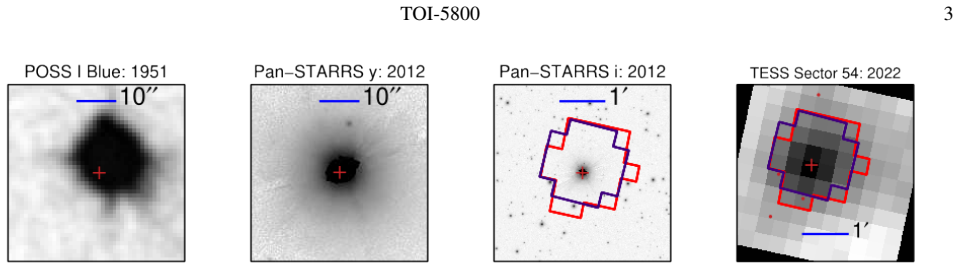
Significance. The paper is a thorough and careful planet-confirmation study: it combines independent photometry and RVs, uses two independent MCMC codes with consistent results, checks TTVs, obtains high-resolution imaging, and cross-checks stellar parameters. If the eccentricity and tidal-migration interpretation hold, TOI-5800 b is a rare example of an eccentric sub-Neptune inside the Neptune desert, directly relevant to high-eccentricity migration as a desert-forming mechanism. The target is also genuinely interesting for JWST. The central claim, however, rests on two assumptions—the robustness of e to the tentative outer companion and the assumed tidal quality factor—that deserve explicit scrutiny.
major comments (3)
- [§5.2, Table A2] The model labeled '2-planet model' is not a two-Keplerian fit: it is the single-planet model plus linear and quadratic RV trend terms (Table A2). Because the observed acceleration reversal suggests an outer companion with period of order twice the 149-day PFS baseline, the companion's signal could deviate significantly from a quadratic. The eccentricity e=0.39±0.07 is the load-bearing quantity for the tidal-migration claim, and both the 1p and 2p models omit the outer Keplerian. I ask the authors to either (i) perform a full two-Keplerian joint fit (including plausible period priors of order 150–600 days) and show the inner-planet eccentricity posterior, or (ii) run injection-recovery tests demonstrating that plausible outer-companion parameters do not shift e by more than the reported uncertainty.
- [§6.1, Eq. (1)] The circularization timescale t_c≈1 Gyr and the tidal luminosity in §6.3 both assume Q'_p=10^5, taken from Neptune and Uranus, with no uncertainty propagated. Since the claim that TOI-5800 b is 'moving into the desert' requires t_c to be shorter than the ~2.5 Gyr stellar age, an order-of-magnitude variation in Q'_p (10^4–10^6) changes t_c by the same factor and materially weakens or strengthens the recent-migration narrative. Please report t_c (and L_tide, f_env) versus Q'_p, and discuss how the interpretation changes for Q'_p=10^6.
- [§6.2.2] The conclusion that an outer companion 'cannot maintain' the observed eccentricity is based on a single representative companion (30 M⊕, 60 days) within the low-e, low-inclination Laplace-Lagrange framework, with tidal damping added as an imaginary diagonal term. The RV trend constraints in Figure A2 permit a much wider range of companion masses and periods, and the linear secular theory is not valid at e~0.4. I suggest either broadening the dynamical exploration (e.g., a grid of companion masses/periods/eccentricities, or N-body integrations with a full tidal model) or softening the claim to 'a companion with the specific parameters tested cannot maintain e=0.39.'
minor comments (6)
- [Table A2] The column label '2p Model' should be renamed to '1-planet + quadratic trend model' to avoid misleading readers into thinking a full two-Keplerian fit was performed.
- [§3.3] The activity-based age of 2.5 Gyr and the astroARIADNE isochrone age of 11.6 Gyr are formally inconsistent; a sentence reconciling these values or stating explicitly which age is adopted in §6 would improve the clarity.
- [§6.3] The sentence 'a direct fit to the simulation results does not converge' is unexplained; please describe the attempted fit and why convergence fails, since this motivates the use of the empirical relations.
- [§7.3] There is a typo: 'atmopsheric' should be 'atmospheric.'
- [§5.2] The phrase 'Gaia systematic RV' should read 'Gaia systemic RV.'
- [References] Egger et al. 2024a and Egger et al. 2024b appear to cite the same paper (A&A 688, A223); please verify that these references are distinct.
Circularity Check
No significant circularity: the measured parameters come from independent photometric and RV data, and the tidal and evaporation calculations use external published models with stated assumptions.
full rationale
The claimed derivation chain is not circular at any load-bearing step. TOI-5800 b's mass, radius, and eccentricity are measured from independent PFS radial velocities and TESS/CHEOPS photometry through a joint MCMC fit; the tidal, secular, and photoevaporation analyses do not feed back into that fit as fitted parameters. Equation (1) is a forward Goldreich & Soter timescale calculation using the measured M_P, R_P, and a together with an assumed Q'_p = 10^5 taken from Neptune and Uranus; Q'_p is not fitted to TOI-5800 b, and the resulting ~1 Gyr timescale is used to interpret, not to construct, the eccentricity measurement. The secular two-planet models and the PASTA mass-loss estimates are similarly forward applications of external published frameworks (Murray & Dermott 1999; Zhang et al. 2013; Bonfanti et al. 2021; Kubyshkina et al. 2018). The f_env <= 0.033% bound in Section 6.3 is an inversion of the Millholland (2019) empirical radius-inflation relation, and the paper explicitly cautions that 'These results should therefore be considered with caution'; this is an acknowledged model-dependence, not a circular reduction. Self-citations exist (Vanderburg software, Millholland relations, Limbach et al. methodology), but none is used as an unverified uniqueness theorem or as the sole support of the central claim. The outer-companion quadratic trend is also explicitly left open ('we reserve judgment on the origin of the quadratic trend'), so the eccentricity robustness concern raised by the skeptic is a data-modeling risk, not a circularity.
Assumptions & free parameters
free parameters (3)
- Planet tidal quality factor Q'_p (circularization and tidal luminosity) =
10^5 (assumed, from Neptune and Uranus values)
- Stellar tidal quality factor Q'_star (orbital evolution) =
10^8 (assumed; Figure 6 caption uses Q* = 8.0)
- Planet tidal quality factor Q'_p (orbital evolution) =
10^5.5 (assumed; Figure 6 caption uses Qp = 5.5)
assumptions (6)
- domain assumption Equilibrium tide theory with constant Q and constant phase lag
- domain assumption Stellar parameters from SPC, astroARIADNE, and MIST isochrones
- domain assumption Activity-age and X-ray luminosity calibrations
- domain assumption Empirical radius-inflation relations from Millholland (2019)
- domain assumption PASTA hydrodynamic escape grid
- domain assumption Laplace-Lagrange secular theory with tidal damping
invented entities (1)
-
Tentative outer planetary companion
independent evidence
Cite this review
Pith. "Pith review of An Eccentric Sub-Neptune Moving Into the Evaporation Desert." pith.science (2026). https://pith.science/paper/W5FU7ASS
@misc{pith2026250510324,
  author       = {Pith},
  title        = {Pith review of: An Eccentric Sub-Neptune Moving Into the Evaporation Desert},
  year         = {2026},
  howpublished = {\url{https://pith.science/paper/W5FU7ASS}},
  note         = {Machine review of arXiv:2505.10324}
}
abstract
Though missions such as Kepler, K2, and TESS have discovered $>$2,000 sub-Neptune and Neptunian planets, there is a dearth of such planets at close-in (P$\lesssim$3 days) orbits. This feature, called the Neptune desert or the evaporation desert, is believed to be primarily shaped by planetary migration and photoevaporation. However, this region is not completely devoid of planets--a small number of very hot Neptunes reside within the desert. These planets provide an opportunity to directly probe the effects of migration and photoevaporation. We present confirmation of TOI-5800 b, an eccentric sub-Neptune on a $\approx$2.6 day period that is likely actively undergoing tidal migration. We use radial velocity measurements from the Carnegie Planet Finder Spectrograph (PFS) to constrain TOI-5800 b's mass and eccentricity. We find that it has an unusually high eccentricity (0.39$\pm$0.07) for its short orbit. TOI-5800 is therefore currently experiencing high levels of tidal heating as it moves into the desert. Ranked as a top candidate for transmission and emission spectroscopy within its temperature and radius regime, TOI-5800 b is a prime target for atmospheric characterization with JWST. TOI-5800 b presents a unique opportunity to study the atmosphere of a planet undergoing tidal heating and to probe the composition of sub-Neptune planets.
Figures


Figures from the paper (5 more)


Reference graph
Works this paper leans on
-
[1]
, " * write output.state after.block = add.period write newline
ENTRY address archivePrefix author booktitle chapter doi edition editor eprint howpublished institution journal key month note number organization pages publisher school series title type volume year label extra.label sort.label short.list INTEGERS output.state before.all mid.sentence after.sentence after.block FUNCTION init.state.consts #0 'before.all :=...
-
[2]
write newline
" write newline "" before.all 'output.state := FUNCTION format.doi doi empty "" "doi:" doi * if FUNCTION format.eprint eprint empty "" archivePrefix empty "" archivePrefix ":" * if eprint field.or.null * if FUNCTION format.pid eprint empty format.doi format.eprint if FUNCTION n.dashify 't := "" t empty not t #1 #1 substring "-" = t #1 #2 substring "--" = ...
-
[3]
Abell , G. O. 1955, , 67, 258, 10.1086/126815
doi:10.1086/126815 1955
-
[4]
Agol , E., Dorn , C., Grimm , S. L., et al. 2021, , 2, 1, 10.3847/PSJ/abd022
-
[5]
L., Chen , X., Ciardi , D., et al
Akeson , R. L., Chen , X., Ciardi , D., et al. 2013, , 125, 989, 10.1086/672273
doi:10.1086/672273 2013
-
[6]
Allard , F., Homeier , D., & Freytag , B. 2012, Philosophical Transactions of the Royal Society of London Series A, 370, 2765, 10.1098/rsta.2011.0269
arXiv 2012
-
[7]
Armstrong, D. J., Lopez, T. A., Adibekyan, V., et al. 2020, Nature, 583, 39–42, 10.1038/s41586-020-2421-7
-
[8]
2021, , 647, A40, 10.1051/0004-6361/202039452
Attia , M., Bourrier , V., Eggenberger , P., et al. 2021, , 647, A40, 10.1051/0004-6361/202039452
Show all 142 references
-
[9]
N., Daylan , T., et al
Badenas-Agusti , M., G \"u nther , M. N., Daylan , T., et al. 2020, , 160, 113, 10.3847/1538-3881/aba0b5
2020 doi
-
[10]
1992, , 99, 390, 10.1016/0019-1035(92)90155-Z
Banfield , D., & Murray , N. 1992, , 99, 390, 10.1016/0019-1035(92)90155-Z
1992 doi
-
[11]
2020, , 496, 1922, 10.1093/mnras/staa1522
Belokurov , V., Penoyre , Z., Oh , S., et al. 2020, , 496, 1922, 10.1093/mnras/staa1522
2020 doi
-
[12]
E., Garc \' a Mu \ n oz , A., et al
Ben-Jaffel , L., Ballester , G. E., Garc \' a Mu \ n oz , A., et al. 2022, Nature Astronomy, 6, 141, 10.1038/s41550-021-01505-x
2022 doi
-
[13]
2003, , 410, 527, 10.1051/0004-6361:20031213
Bensby , T., Feltzing , S., & Lundstr \"o m , I. 2003, , 410, 527, 10.1051/0004-6361:20031213
2003 doi
-
[14]
Bensby , T., Feltzing , S., & Oey , M. S. 2014, , 562, A71, 10.1051/0004-6361/201322631
2014 doi
-
[15]
2021, Experimental Astronomy, 51, 109, 10.1007/s10686-020-09679-4
Benz , W., Broeg , C., Fortier , A., et al. 2021, Experimental Astronomy, 51, 109, 10.1007/s10686-020-09679-4
2021 doi
-
[16]
2011, , 335, 161, 10.1007/s10509-010-0581-x
Bianchi , L., Herald , J., Efremova , B., et al. 2011, , 335, 161, 10.1007/s10509-010-0581-x
2011 doi
-
[17]
Bonfanti , A., Fossati , L., Kubyshkina , D., & Cubillos , P. E. 2021, , 656, A157, 10.1051/0004-6361/202142010
2021 doi
-
[18]
2018 a , , 553, 477, 10.1038/nature24677
Bourrier , V., Lovis , C., Beust , H., et al. 2018 a , , 553, 477, 10.1038/nature24677
2018 doi
-
[19]
2018 b , , 620, A147, 10.1051/0004-6361/201833675
Bourrier , V., Lecavelier des Etangs , A., Ehrenreich , D., et al. 2018 b , , 620, A147, 10.1051/0004-6361/201833675
2018 doi
-
[20]
2023, , 669, A63, 10.1051/0004-6361/202245004
Bourrier , V., Attia , M., Mallonn , M., et al. 2023, , 669, A63, 10.1051/0004-6361/202245004
2023 doi
-
[21]
A., & Morris , B
Brandeker , A., Patel , J. A., & Morris , B. M. 2024, PIPE: Extracting PSF photometry from CHEOPS data , Astrophysics Source Code Library, record ascl:2404.002
2024
-
[22]
A., Latham , D
Buchhave , L. A., Latham , D. W., Johansen , A., et al. 2012, , 486, 375, 10.1038/nature11121
2012 doi
-
[23]
P., Marcy , G
Butler , R. P., Marcy , G. W., Williams , E., et al. 1996, , 108, 500, 10.1086/133755
1996 doi
- [24]
-
[25]
2024, , 689, A250, 10.1051/0004-6361/202450957
Castro-Gonz \'a lez , A., Bourrier , V., Lillo-Box , J., et al. 2024, , 689, A250, 10.1051/0004-6361/202450957
2024 doi
- [26]
-
[27]
I., Jordan , A
Chiang , E. I., Jordan , A. B., Millis , R. L., et al. 2003, , 126, 430, 10.1086/375207
2003 doi
-
[28]
2016, , 823, 102, 10.3847/0004-637X/823/2/102
Choi , J., Dotter , A., Conroy , C., et al. 2016, , 823, 102, 10.3847/0004-637X/823/2/102
2016 doi
-
[29]
2011, , 412, 1237, 10.1111/j.1365-2966.2010.17983.x
Co s kuno g lu , B., Ak , S., Bilir , S., et al. 2011, , 412, 1237, 10.1111/j.1365-2966.2010.17983.x
2011
-
[30]
Correia , A. C. M., Bourrier , V., & Delisle , J. B. 2020, , 635, A37, 10.1051/0004-6361/201936967
2020 doi
-
[31]
D., Shectman , S
Crane , J. D., Shectman , S. A., & Butler , R. P. 2006, in Society of Photo-Optical Instrumentation Engineers (SPIE) Conference Series, Vol. 6269, Ground-based and Airborne Instrumentation for Astronomy, ed. I. S. McLean & M. Iye , 626931, 10.1117/12.672339
2006 doi
-
[32]
D., Shectman , S
Crane , J. D., Shectman , S. A., Butler , R. P., et al. 2010, in Society of Photo-Optical Instrumentation Engineers (SPIE) Conference Series, Vol. 7735, Ground-based and Airborne Instrumentation for Astronomy III, ed. I. S. McLean , S. K. Ramsay , & H. Takami , 773553, 10.1117...
2010 doi
-
[33]
D., Shectman , S
Crane , J. D., Shectman , S. A., Butler , R. P., Thompson , I. B., & Burley , G. S. 2008, in Society of Photo-Optical Instrumentation Engineers (SPIE) Conference Series, Vol. 7014, Ground-based and Airborne Instrumentation for Astronomy II, ed. I. S. McLean & M. M. Casali , 70...
2008 doi
-
[34]
K., Knutson , H
de Wit , J., Lewis , N. K., Knutson , H. A., et al. 2017, , 836, L17, 10.3847/2041-8213/836/2/L17
2017 doi
-
[35]
2016, , 222, 8, 10.3847/0067-0049/222/1/8
Dotter , A. 2016, , 222, 8, 10.3847/0067-0049/222/1/8
2016 doi
- [36]
-
[38]
2024 b , , 688, A223, 10.1051/0004-6361/202450472
---. 2024 b , , 688, A223, 10.1051/0004-6361/202450472
2024 doi
-
[39]
A., Kubyshkina , D., Alibert , Y., et al
Egger , J. A., Kubyshkina , D., Alibert , Y., et al. 2025, , 696, A28, 10.1051/0004-6361/202453325
2025 doi
-
[40]
J., et al
Ehrenreich , D., Bourrier , V., Wheatley , P. J., et al. 2015, , 522, 459, 10.1038/nature14501
2015 doi
-
[41]
2022, , 666, A10, 10.1051/0004-6361/202243731
Esparza-Borges , E., Parviainen , H., Murgas , F., et al. 2022, , 666, A10, 10.1051/0004-6361/202243731
2022 doi
-
[42]
2008, PhD thesis, University of Szeged, Hungary
F u r\'esz, G. 2008, PhD thesis, University of Szeged, Hungary
2008
-
[43]
J., Petigura , E
Fulton , B. J., Petigura , E. A., Blunt , S., & Sinukoff , E. 2018, , 130, 044504, 10.1088/1538-3873/aaaaa8
2018 doi
-
[44]
Gaia Collaboration , Prusti , T., de Bruijne , J. H. J., et al. 2016, , 595, A1, 10.1051/0004-6361/201629272
2016 doi
-
[45]
Gaia Collaboration , Brown , A. G. A., Vallenari , A., et al. 2018, , 616, A1, 10.1051/0004-6361/201833051
2018 doi
-
[46]
Gaia Collaboration , Vallenari , A., Brown , A. G. A., et al. 2023, , 674, A1, 10.1051/0004-6361/202243940
2023 doi
-
[47]
2023, , 672, A77, 10.1051/0004-6361/202245766
Garc \' a Mu \ n oz , A. 2023, , 672, A77, 10.1051/0004-6361/202245766
2023 doi
-
[48]
J., Petigura , E
Gilbert , G. J., Petigura , E. A., & Entrican , P. M. 2025, Proceedings of the National Academy of Science, 122, e2405295122, 10.1073/pnas.2405295122
2025 doi
-
[49]
2023, , 948, 12, 10.3847/1538-4357/acc9ae
Goldberg , M., & Batygin , K. 2023, , 948, 12, 10.3847/1538-4357/acc9ae
2023 doi
-
[50]
1963, , 126, 257, 10.1093/mnras/126.3.257
Goldreich , P. 1963, , 126, 257, 10.1093/mnras/126.3.257
1963 doi
-
[51]
1966, , 5, 375, 10.1016/0019-1035(66)90051-0
Goldreich , P., & Soter , S. 1966, , 5, 375, 10.1016/0019-1035(66)90051-0
1966 doi
-
[52]
M., Schlafly, E., Zucker, C., Speagle, J
Green, G. M., Schlafly, E., Zucker, C., Speagle, J. S., & Finkbeiner, D. 2019, The Astrophysical Journal, 887, 93, 10.3847/1538-4357/ab5362
2019 doi
-
[53]
R., Millman, K
Harris, C. R., Millman, K. J., van der Walt, S. J., et al. 2020, Nature, 585, 357, 10.1038/s41586-020-2649-2
2020 doi
-
[54]
D., Katz , D., & G \'o mez , A
Haywood , M., Di Matteo , P., Lehnert , M. D., Katz , D., & G \'o mez , A. 2013, , 560, A109, 10.1051/0004-6361/201321397
2013 doi
-
[55]
2014, Contributions of the Astronomical Observatory Skalnate Pleso, 43, 518
Henden , A., & Munari , U. 2014, Contributions of the Astronomical Observatory Skalnate Pleso, 43, 518
2014
-
[56]
V., et al
H g , E., Fabricius , C., Makarov , V. V., et al. 2000, , 355, L27
2000
-
[57]
J., Kempton, E
Hord, B. J., Kempton, E. M. R., Mikal-Evans, T., et al. 2023, Identification of the Top TESS Objects of Interest for Atmospheric Characterization of Transiting Exoplanets with JWST. 2308.09617
2023 arXiv
-
[58]
R., Mullan , D
Houdebine , E. R., Mullan , D. J., Bercu , B., Paletou , F., & Gebran , M. 2017, , 837, 96, 10.3847/1538-4357/aa5cad
2017 doi
-
[59]
Hunter, J. D. 2007, Computing in Science & Engineering, 9, 90, 10.1109/MCSE.2007.55
2007 doi
-
[60]
O., Wende-von Berg , S., Dreizler , S., et al
Husser , T. O., Wende-von Berg , S., Dreizler , S., et al. 2013, , 553, A6, 10.1051/0004-6361/201219058
2013 doi
-
[61]
1981, , 99, 126
Hut , P. 1981, , 99, 126
1981
-
[62]
M., Twicken , J
Jenkins , J. M., Twicken , J. D., McCauliff , S., et al. 2016, in Society of Photo-Optical Instrumentation Engineers (SPIE) Conference Series, Vol. 9913, Software and Cyberinfrastructure for Astronomy IV, ed. G. Chiozzi & J. C. Guzman , 99133E, 10.1117/12.2233418
2016 doi
-
[63]
S., D \' az , M
Jenkins , J. S., D \' az , M. R., Kurtovic , N. T., et al. 2020, Nature Astronomy, 4, 1148, 10.1038/s41550-020-1142-z
2020 doi
-
[64]
Johnstone , C. P. 2020, , 890, 79, 10.3847/1538-4357/ab6224
2020 doi
-
[65]
M.-R., Bean, J
Kempton, E. M.-R., Bean, J. L., Louie, D. R., et al. 2018, Publications of the Astronomical Society of the Pacific, 130, 114401, 10.1088/1538-3873/aadf6f
2018 doi
-
[66]
A., Harris, H
Kilic, M., Munn, J. A., Harris, H. C., et al. 2017, The Astrophysical Journal, 837, 162, 10.3847/1538-4357/aa62a5
2017 doi
-
[67]
2022, , 515, 1228, 10.1093/mnras/stac1686
Korol , V., Belokurov , V., & Toonen , S. 2022, , 515, 1228, 10.1093/mnras/stac1686
2022 doi
- [68]
-
[69]
V., et al
Kubyshkina , D., Fossati , L., Erkaev , N. V., et al. 2018, , 619, A151, 10.1051/0004-6361/201833737
2018 doi
-
[70]
I., & Fossati , L
Kubyshkina , D. I., & Fossati , L. 2021, Research Notes of the American Astronomical Society, 5, 74, 10.3847/2515-5172/abf498
2021 doi
-
[71]
Kurucz , R. L. 1992, in The Stellar Populations of Galaxies, ed. B. Barbuy & A. Renzini , 149, 225
1992
-
[72]
Kurucz , R. L. 1993, VizieR Online Data Catalog: Model Atmospheres (Kurucz, 1979) , VizieR On-line Data Catalog: VI/39. Originally published in: 1979ApJS...40....1K
1993
-
[73]
2009, , 457, 562, 10.1038/nature07649
Laughlin , G., Deming , D., Langton , J., et al. 2009, , 457, 562, 10.1038/nature07649
2009 doi
-
[74]
2010, , 516, A64, 10.1051/0004-6361/201014337
Leconte , J., Chabrier , G., Baraffe , I., & Levrard , B. 2010, , 516, A64, 10.1051/0004-6361/201014337
2010 doi
-
[75]
K., Knutson , H
Lewis , N. K., Knutson , H. A., Showman , A. P., et al. 2013, , 766, 95, 10.1088/0004-637X/766/2/95
2013 doi
-
[76]
D., et al
Li , J., Tenenbaum , P., Twicken , J. D., et al. 2019, , 131, 024506, 10.1088/1538-3873/aaf44d
2019 doi
-
[77]
J., et al
Lillo-Box, J., Gandolfi, D., Armstrong, D. J., et al. 2023, Astronomy & Astrophysics, 669, A109, 10.1051/0004-6361/202243879
2023 doi
-
[78]
A., Vanderburg , A., Venner , A., et al
Limbach , M. A., Vanderburg , A., Venner , A., et al. 2024, , 973, L11, 10.3847/2041-8213/ad74ed
2024 doi
-
[79]
2018, Re-normalising the astrometric chi-square in Gaia DR2, GAIA-C3-TN-LU-LL-124-01
Lindegren, L. 2018, Re-normalising the astrometric chi-square in Gaia DR2, GAIA-C3-TN-LU-LL-124-01. http://www.rssd.esa.int/doc_fetch.php?id=3757412
2018
-
[80]
2012, , 761, 122, 10.1088/0004-637X/761/2/122
Lithwick , Y., Xie , J., & Wu , Y. 2012, , 761, 122, 10.1088/0004-637X/761/2/122
2012 doi
-
[81]
2024, Planet-Planet Scattering and ZLK Migration -- The Dynamical History of HAT-P-11
Lu, T., An, Q., Li, G., et al. 2024, Planet-Planet Scattering and ZLK Migration -- The Dynamical History of HAT-P-11. 2405.19511
2024 arXiv
-
[82]
2022, , 163, 101, 10.3847/1538-3881/ac3d38
Lubin , J., Van Zandt , J., Holcomb , R., et al. 2022, , 163, 101, 10.3847/1538-3881/ac3d38
2022 doi
-
[83]
2017, Nature Astronomy, 1, 0129, 10.1038/s41550-017-0129
Luger , R., Sestovic , M., Kruse , E., et al. 2017, Nature Astronomy, 1, 0129, 10.1038/s41550-017-0129
2017 doi
-
[84]
S., Kjeldsen , H., Albrecht , S., et al
Lundkvist , M. S., Kjeldsen , H., Albrecht , S., et al. 2016, Nature Communications, 7, 11201, 10.1038/ncomms11201
2016 doi
-
[85]
G., Polania Vivas , M
MacDonald , M. G., Polania Vivas , M. S., D'Angiolillo , S., Fernandez , A. N., & Quinn , T. 2023, , 166, 94, 10.3847/1538-3881/ace69d
2023 doi
-
[86]
2016, , 824, L22, 10.3847/2041-8205/824/2/L22
Malhotra , R., Volk , K., & Wang , X. 2016, , 824, L22, 10.3847/2041-8205/824/2/L22
2016 doi
-
[87]
E., & Hillenbrand , L
Mamajek , E. E., & Hillenbrand , L. A. 2008, , 687, 1264, 10.1086/591785
2008 doi
-
[88]
W., Vanderburg , A., Latham , D
Mayo , A. W., Vanderburg , A., Latham , D. W., et al. 2018, , 155, 136, 10.3847/1538-3881/aaadff
2018 doi
-
[89]
2016, , 589, A75, 10.1051/0004-6361/201528065
Mazeh , T., Holczer , T., & Faigler , S. 2016, , 589, A75, 10.1051/0004-6361/201528065
2016 doi
-
[90]
2019, , 886, 72, 10.3847/1538-4357/ab4c3f
Millholland , S. 2019, , 886, 72, 10.3847/1538-4357/ab4c3f
2019 doi
-
[91]
2020, , 897, 7, 10.3847/1538-4357/ab959c
Millholland , S., Petigura , E., & Batygin , K. 2020, , 897, 7, 10.3847/1538-4357/ab959c
2020 doi
-
[92]
M., Fabrycky , D
Mills , S. M., Fabrycky , D. C., Migaszewski , C., et al. 2016, , 533, 509, 10.1038/nature17445
2016 doi
-
[93]
H., Leon , J
Mori , M., Livingston , J. H., Leon , J. d., et al. 2022, , 163, 298, 10.3847/1538-3881/ac6bf8
2022 doi
-
[94]
M., Heng , K., Brandeker , A., Swan , A., & Lendl , M
Morris , B. M., Heng , K., Brandeker , A., Swan , A., & Lendl , M. 2021, , 651, L12, 10.1051/0004-6361/202140913
2021 doi
-
[95]
L., Twicken , J
Morris , R. L., Twicken , J. D., Smith , J. C., et al. 2020, Kepler Data Processing Handbook: Photometric Analysis , Kepler Science Document KSCI-19081-003
2020
-
[96]
2024, , 686, A296, 10.1051/0004-6361/202348690
M \"u ller , S., Baron , J., Helled , R., Bouchy , F., & Parc , L. 2024, , 686, A296, 10.1051/0004-6361/202348690
2024 doi
-
[97]
2021, , 653, A60, 10.1051/0004-6361/202140718
Murgas , F., Astudillo-Defru , N., Bonfils , X., et al. 2021, , 653, A60, 10.1051/0004-6361/202140718
2021 doi
-
[98]
D., & Dermott , S
Murray , C. D., & Dermott , S. F. 1999, Solar System Dynamics (Cambridge University Press), 10.1017/CBO9781139174817
1999 doi
-
[99]
X., Burt , J
Nabbie , E., Huang , C. X., Burt , J. A., et al. 2024, , 168, 132, 10.3847/1538-3881/ad60be
2024 doi
-
[100]
2023, , 669, A40, 10.1051/0004-6361/202244120
Orell-Miquel , J., Nowak , G., Murgas , F., et al. 2023, , 669, A40, 10.1051/0004-6361/202244120
2023 doi
- [101]
-
[102]
2015, Monthly Notices of the Royal Astronomical Society, 453, 3822–3827, 10.1093/mnras/stv1857
Parviainen, H., & Aigrain, S. 2015, Monthly Notices of the Royal Astronomical Society, 453, 3822–3827, 10.1093/mnras/stv1857
2015 doi
-
[103]
2011, , 192, 3, 10.1088/0067-0049/192/1/3
Paxton , B., Bildsten , L., Dotter , A., et al. 2011, , 192, 3, 10.1088/0067-0049/192/1/3
2011 doi
-
[104]
2013, , 208, 4, 10.1088/0067-0049/208/1/4
Paxton , B., Cantiello , M., Arras , P., et al. 2013, , 208, 4, 10.1088/0067-0049/208/1/4
2013 doi
-
[105]
2015, , 220, 15, 10.1088/0067-0049/220/1/15
Paxton , B., Marchant , P., Schwab , J., et al. 2015, , 220, 15, 10.1088/0067-0049/220/1/15
2015 doi
-
[106]
J., & Mamajek , E
Pecaut , M. J., & Mamajek , E. E. 2013, , 208, 9, 10.1088/0067-0049/208/1/9
2013 doi
-
[107]
M., Georgieva , I
Persson , C. M., Georgieva , I. Y., Gandolfi , D., et al. 2022, , 666, A184, 10.1051/0004-6361/202244118
2022 doi
-
[108]
S., Lubin , J., Beard , C., et al
Polanski , A. S., Lubin , J., Beard , C., et al. 2024, , 272, 32, 10.3847/1538-4365/ad4484
2024 doi
-
[109]
A., Tout , C
Rasio , F. A., Tout , C. A., Lubow , S. H., & Livio , M. 1996, , 470, 1187, 10.1086/177941
1996 doi
-
[110]
2025, , 694, A88, 10.1051/0004-6361/202452379
Reza , A., Kubyshkina , D., Fossati , L., & Helling , C. 2025, , 694, A88, 10.1051/0004-6361/202452379
2025 doi
-
[111]
A., & Militzer , B
Seager , S., Kuchner , M., Hier-Majumder , C. A., & Militzer , B. 2007, , 669, 1279, 10.1086/521346
2007 doi
-
[112]
2019, Monthly Notices of the Royal Astronomical Society, 490, 5335–5352, 10.1093/mnras/stz2861
Sharma, S., Stello, D., Bland-Hawthorn, J., et al. 2019, Monthly Notices of the Royal Astronomical Society, 490, 5335–5352, 10.1093/mnras/stz2861
2019 doi
-
[113]
F., Cutri , R
Skrutskie , M. F., Cutri , R. M., Stiening , R., et al. 2006, , 131, 1163, 10.1086/498708
2006 doi
-
[114]
C., Stumpe, M
Smith, J. C., Stumpe, M. C., Van Cleve, J. E., et al. 2012, Publications of the Astronomical Society of the Pacific, 124, 1000–1014, 10.1086/667697
2012 doi
-
[115]
2022, , 931, L15, 10.3847/2041-8213/ac6e3c
Stef \`a nsson , G., Mahadevan , S., Petrovich , C., et al. 2022, , 931, L15, 10.3847/2041-8213/ac6e3c
2022 doi
-
[116]
C., Smith , J
Stumpe , M. C., Smith , J. C., Catanzarite , J. H., et al. 2014, , 126, 100, 10.1086/674989
2014 doi
-
[117]
C., Smith , J
Stumpe , M. C., Smith , J. C., Van Cleve , J. E., et al. 2012, , 124, 985, 10.1086/667698
2012 doi
- [118]
-
[119]
C., & Wisdom , J
Tittemore , W. C., & Wisdom , J. 1990, , 85, 394, 10.1016/0019-1035(90)90125-S
1990 doi
-
[120]
2018, , 130, 035002, 10.1088/1538-3873/aaa7d9
Tokovinin , A. 2018, , 130, 035002, 10.1088/1538-3873/aaa7d9
2018 doi
-
[121]
2008, , 120, 170, 10.1086/528809
Tokovinin , A., & Cantarutti , R. 2008, , 120, 170, 10.1086/528809
2008 doi
-
[122]
2009, The Astronomy and Astrophysics Review, 18, 67–126, 10.1007/s00159-009-0025-1
Torres, G., Andersen, J., & Giménez, A. 2009, The Astronomy and Astrophysics Review, 18, 67–126, 10.1007/s00159-009-0025-1
2009 doi
-
[123]
D., Clarke , B
Twicken , J. D., Clarke , B. D., Bryson , S. T., et al. 2010, in , Vol. 7740, Software and Cyberinfrastructure for Astronomy, 774023, 10.1117/12.856790
2010 doi
-
[124]
D., Catanzarite, J
Twicken, J. D., Catanzarite, J. H., Clarke, B. D., et al. 2018, Publications of the Astronomical Society of the Pacific, 130, 064502, 10.1088/1538-3873/aab694
2018 doi
-
[125]
2019, , 157, 61, 10.3847/1538-3881/aaf22f
Van Eylen , V., Albrecht , S., Huang , X., et al. 2019, , 157, 61, 10.3847/1538-3881/aaf22f
2019 doi
-
[126]
2021, avanderburg/edmcmc: v1.0.0, v1.0.0, Zenodo, 10.5281/zenodo.5599854
Vanderburg, A. 2021, avanderburg/edmcmc: v1.0.0, v1.0.0, Zenodo, 10.5281/zenodo.5599854
2021 doi
-
[127]
W., Buchhave , L
Vanderburg , A., Latham , D. W., Buchhave , L. A., et al. 2016 a , , 222, 14, 10.3847/0067-0049/222/1/14
2016 doi
-
[128]
A., et al
Vanderburg , A., Bieryla , A., Duev , D. A., et al. 2016 b , , 829, L9, 10.3847/2041-8205/829/1/L9
2016 doi
-
[129]
X., Rodriguez , J
Vanderburg , A., Huang , C. X., Rodriguez , J. E., et al. 2019, , 881, L19, 10.3847/2041-8213/ab322d
2019 doi
-
[130]
I., & Jenkins, J
Vines, J. I., & Jenkins, J. S. 2022, Monthly Notices of the Royal Astronomical Society, 513, 2719–2731, 10.1093/mnras/stac956
2022 doi
-
[131]
A., Greklek-McKeon , M., et al
Vissapragada , S., Knutson , H. A., Greklek-McKeon , M., et al. 2022, , 164, 234, 10.3847/1538-3881/ac92f2
2022 doi
-
[132]
2017, , 154, 20, 10.3847/1538-3881/aa762b
Wang , X., & Malhotra , R. 2017, , 154, 20, 10.3847/1538-3881/aa762b
2017 doi
-
[133]
C., & Vanderburg , A
Weisserman , D., Becker , J. C., & Vanderburg , A. 2023, , 165, 89, 10.3847/1538-3881/acac80
2023 doi
-
[134]
d., Lewis, N
Wit, J. d., Lewis, N. K., Langton, J., et al. 2016, The Astrophysical Journal Letters, 820, L33, 10.3847/2041-8205/820/2/l33
2016 doi
-
[135]
L., Eisenhardt , P
Wright , E. L., Eisenhardt , P. R. M., Mainzer , A. K., et al. 2010, , 140, 1868, 10.1088/0004-6256/140/6/1868
2010 doi
-
[136]
2017, , 232, 2, 10.3847/1538-4365/aa80e4
Xiang , M., Liu , X., Shi , J., et al. 2017, , 232, 2, 10.3847/1538-4365/aa80e4
2017 doi
-
[137]
2001, , 136, 417, 10.1086/321795
Yi , S., Demarque , P., Kim , Y.-C., et al. 2001, , 136, 417, 10.1086/321795
2001 doi
-
[138]
2022, The Astrophysical Journal, 934, 137, 10.3847/1538-4357/ac7be7
Yoshida, T., Terada, N., Ikoma, M., & Kuramoto, K. 2022, The Astrophysical Journal, 934, 137, 10.3847/1538-4357/ac7be7
2022 doi
-
[139]
2024, , 972, 159, 10.3847/1538-4357/ad5ffb
Yu , H., & Dai , F. 2024, , 972, 159, 10.3847/1538-4357/ad5ffb
2024 doi
-
[140]
D., & Jacobsen , S
Zeng , L., Sasselov , D. D., & Jacobsen , S. B. 2016, , 819, 127, 10.3847/0004-637X/819/2/127
2016 doi
-
[141]
B., Sasselov , D
Zeng , L., Jacobsen , S. B., Sasselov , D. D., et al. 2019, Proceedings of the National Academy of Science, 116, 9723, 10.1073/pnas.1812905116
2019 doi
-
[142]
P., & Matsumura , S
Zhang , K., Hamilton , D. P., & Matsumura , S. 2013, , 778, 6, 10.1088/0004-637X/778/1/6
2013 doi
-
[143]
2020, , 159, 19, 10.3847/1538-3881/ab55e9
Ziegler , C., Tokovinin , A., Brice \ n o , C., et al. 2020, , 159, 19, 10.3847/1538-3881/ab55e9
2020 doi
Reviewed August 15, 2026 · model on record in the stance chip above.
Discussion (0). Continue with ORCID to comment.