REVIEW 3 major objections 5 minor 2 cited by
Measuring Long Stellar Rotation Periods (>10 days) from TESS FFI Light Curves is Possible: An Investigation Using TESS and ZTF
T0 review · 3 major / 5 minor · reviewed 2026-08-15 · deepseek-v4-flash
Pith's one-line read TESS can recover stellar rotation periods longer than the 27-day sector length from full-frame image light curves, matching ground-truth ZTF periods for 66% of a 272-star sample.
desk verdict The threshold-free 66% recovery rate is the real result; the 81% with a power cut is tuned in-sample and should be read as optimistic. read the letter →
The pith
A machine-rendered reading of the paper's core claim, the machinery that carries it, and where it could break.
The reading
What carries the argument
The carrying mechanism is an offset-corrected Lomb-Scargle periodogram: the standard sinusoidal design matrix is augmented with one boxcar column per TESS sector, so the flux offset in each sector is fitted at the same time as the sinusoid rather than subtracted in advance. This removes the artificial boundary jumps that would otherwise suppress signals longer than a sector. The other half of the machinery is the unpopular de-trending step, an L2-regularized linear regression that models each target pixel's systematics using flux from distant pixels in the same FFI cutout, chosen to retain astrophysical variability while removing scattered-light trends.
What would settle it
A reader could settle this by injecting synthetic sinusoids with known periods between 15 and 60 days into real TESS FFI cutouts from the northern continuous viewing zone, adding realistic scattered-light systematics, and running the same de-trending and offset-corrected period search; if most injected periods beyond 27 days are not recovered within 10%, the central claim would be undercut.
Extended reading notes
Core claim
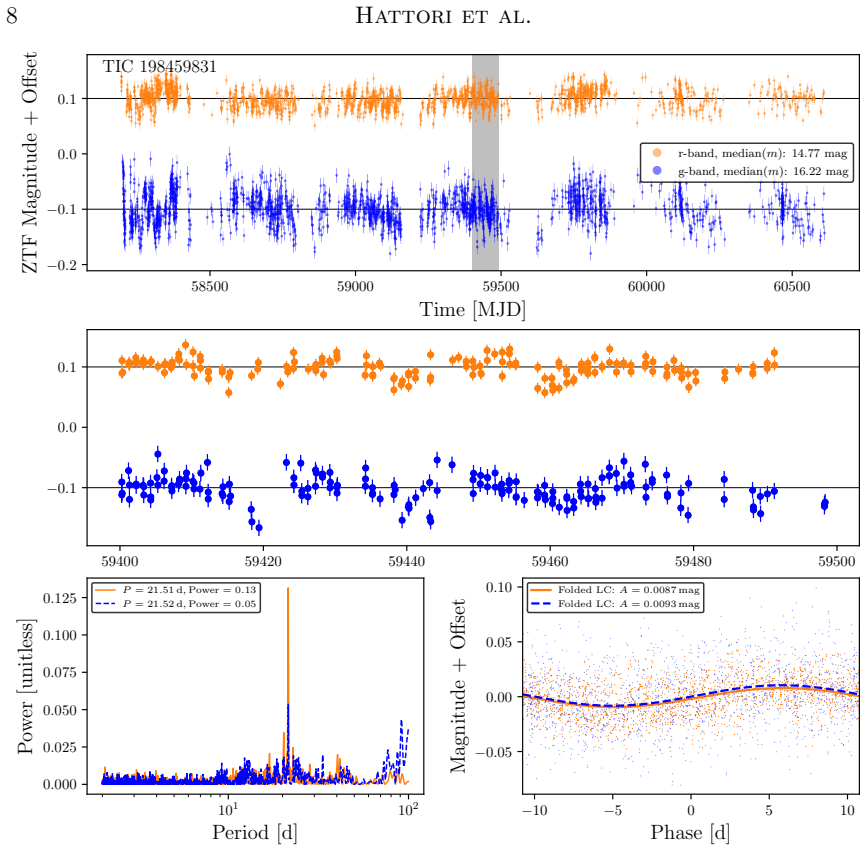
On the paper's own terms, the discovery is that slow stellar rotation is recoverable from TESS prime-mission FFI light curves once each sector is de-trended with the unpopular pipeline and the period search fits per-sector flux offsets jointly with a sinusoid. On a reference sample of 272 K and M dwarfs with ZTF periods longer than 10 days, the TESS period matches the ZTF period within 10% for 66% of the sample. About 43 of the 93 non-matches are TESS periods at half the ZTF value, a known Lomb-Scargle harmonic failure; if those are counted as matches the upper-limit agreement is 82%. Applying a TESS Lomb-Scargle maximum-power threshold of 0.02 leaves 170 sources, of which 137 (81%) match, and examples such as TIC 165552443 show recovery of a ~50-day period, almost twice the sector length.
Load-bearing premise
The comparison treats the ZTF r-band periods as the true rotation periods, so if many of those reference periods are harmonics, aliases, or non-rotation signals, the reported match rates would not measure how well TESS recovers real rotation periods.
Editorial extensions
If this is right
- TESS continuous-viewing-zone data can support systematic searches for slow rotators instead of being limited to periods under the 13.7-day orbital timescale.
- Catalog users can apply a Lomb-Scargle power threshold around 0.02 to trade sample size for period fidelity, roughly 81% ZTF agreement versus 66%.
- Periods up to at least 50 days, nearly double a 27-day sector, are measurable, as illustrated by the ~49-day recovery for TIC 165552443.
- Many apparent failures are harmonic aliases rather than wrong detections, so counting 1:2 matches raises the upper-limit agreement to 82% (94% after the power cut).
Reading between the lines
- Because the paper itself presents a source where TESS's shorter period is likely correct and ZTF's longer period is wrong, the true TESS recovery rate for slow rotators may be higher than 66%.
- The sector-offset design-matrix trick is a general device: any multi-epoch photometric survey with per-epoch flux offsets could adopt the same simultaneous-fit periodogram for long-period searches.
- A shape-aware or harmonic-aware prior could rescue many of the 1:2 mismatches without a power cut, since those cases retain genuine periodicity at the fundamental frequency.
- If the power threshold selects against incompletely removed systematics, de-trending hyperparameter choices will directly control catalog completeness at long periods, a testable prediction for the upcoming catalog.
Signed reviews
Editorial analysis
A structured set of objections, weighed in public.
Referee Report
Summary. This paper asks whether TESS prime-mission FFI light curves in the northern continuous viewing zone can yield reliable stellar rotation periods longer than 10 days, including periods beyond the 27-day sector length. The authors select 272 K and M dwarfs with ZTF r-band periods longer than 10 days from six years of ZTF data, de-trend TESS Cycle 2 FFI cutouts with the unpopular pipeline, and search with a modified Lomb-Scargle periodogram that includes per-sector offset terms. They report that 179/272 (66%) of TESS periods match ZTF periods within 10%, rising to 137/170 (81%) after applying a TESS Lomb-Scargle power threshold of 0.02, and they present individual worked examples including a ~50-day match. The conclusion is that long rotation periods can be measured from TESS FFI light curves.
Significance. If the result holds, it is practically important: TESS all-sky data would substantially expand the sample of slow rotators useful for gyrochronology and stellar activity studies. The paper's strengths are its transparent methodology, a machine-readable table of the 272 stars and their periods, the offset-corrected periodogram formulation with a toy demonstration, and explicit discussion of failure modes such as 1:2 harmonics and the window-function alias. The core feasibility claim is supported by the threshold-free 66% recovery rate and by the worked examples, even though the 81% headline is inflated by in-sample threshold selection and the ZTF "ground truth" is not independently verified.
major comments (3)
- [Section 4, Figures 9 and 10] The power threshold of 0.02 is selected by scanning thresholds from 0.0 to 0.3 in steps of 0.01 on the same 272-star sample with the explicit objective of increasing the match rate; consequently, the 81% (137/170) figure is an in-sample optimization result, not an unbiased estimate of the reliability of a power>=0.02 cut for new targets. This is load-bearing because the abstract presents the 81% as the paper's headline reliability claim. Please validate the threshold with cross-validation or an independent sample, and either report the threshold-free rates (66%, or 82% when 1:2 harmonics are counted) as the primary claims or clearly label the 81% as exploratory.
- [Sections 2.4 and 4] The validation treats ZTF r-band periods as the ground truth, but no independent verification of those periods is provided, and Section 4 itself states that "it is difficult to identify the conditions under which ZTF periods are erroneously wrong" and shows a case (TIC 353875094) where the TESS period is likely correct and the ZTF period is not. If a substantial fraction of the 272 ZTF periods are harmonics or aliases, the reported match rates measure mutual consistency rather than TESS period accuracy. Please quantify this risk, for example by examining the 32 g-band mismatches, cross-matching against literature periods or activity benchmarks, and showing that the main conclusions are robust to removing or reclassifying such sources.
- [Section 5 and Abstract] The paper's own limitation statement in Section 5 says the match rates should not be interpreted as the fraction of sources with reliable TESS periods, but rather as the fraction recovered for sources with relatively strong periodic signals. Since the abstract presents 66% and 81% without this caveat, the paper risks overgeneralizing the rates to the general TESS sample; please move this qualification into the abstract and the discussion of Figures 6 and 10.
minor comments (5)
- [Table 1] The column labeled "dec dr3" is described as "Gaia DR2 Declination" in the table notes; this appears to be a typo and should read "Gaia DR3 Declination."
- [Section 3.3, Figure 5 text] The paragraph preceding Figure 5 contains a garbled sentence that introduces TIC 320504531 and then continues "for TIC 198459831, the same source presented above"; please clarify which source is actually shown in Figure 5.
- [Section 4, Figures 6 and 10] Match rates are reported without binomial uncertainties; for example, 179/272 = 65.8% with a 1-sigma binomial uncertainty of about 2.9%. Adding confidence intervals would help readers compare the rates quantitatively.
- [Section 2.4] The sentence about g-band consistency reports 240 matching sources and 32 mismatches, of which 5 had no downloadable g-band light curves; please clarify whether those 5 are included among the 32 mismatches or counted separately.
- [Section 1] The phrase "sources with a with maximum TESS Lomb-Scargle power" contains a duplicated word and should be corrected.
Circularity Check
Mild circularity: the 81% match rate is reported at a TESS power threshold selected by scanning the same sample to maximize the match rate; the core 66% feasibility claim against ZTF is independent.
-
fitted input called prediction
[Section 4 (power-threshold scan), Figures 9-10; abstract 81% claim]
"At each power threshold, where we started from 0 and increased in increments of 0.01 until we reached 0.3, we removed the sources where the TESS LS max power was smaller than the threshold value from the sample... The objective we are pursuing with this power threshold is to increase the match rate... Therefore, we would like to use the smallest power threshold while increasing the match-rate. This TESS power threshold turns out to be power=0.02, where out of the 170 sources left in our sample 137 of them having matching periods (81%)."
The threshold is chosen by scanning the same 272-star benchmark sample and selecting the cut that increases the match rate; the reported 81% (137/170) is the in-sample match rate at the optimized threshold, not an out-of-sample prediction of what power>=0.02 would yield on new TESS light curves. The abstract presents the 81% as a general match-rate increase without noting that the threshold was selected to produce it, so this particular headline number is partly forced by the selection rule rather than independently measured. The threshold-free 66% (179/272) match rate is unaffected, so the main feasibility claim remains externally anchored to ZTF.
full rationale
No self-definitional or self-citation chain forces the TESS periods to equal the ZTF periods: the TESS periods come from an independent offset-corrected Lomb-Scargle search on unpopular-de-trended FFI data, and the ZTF 'ground truth' is an explicit assumption, not a fitting target. The unpopular self-citation is a methodological citation for de-trending software, not a load-bearing uniqueness or ansatz argument. The paper also candidly warns that the match rates apply to relatively strong ZTF-selected signals and should not be over-interpreted. The only mild circularity is the in-sample optimization of the TESS LS power threshold that produces the headline 81% figure: the threshold was scanned on the same 272-star sample to maximize the match rate, making the 81% an in-sample, optimistic statistic. Since the 66% full-sample recovery rate and the demonstration of >10-day periods do not depend on that threshold, the overall circularity is minor.
Assumptions & free parameters
free parameters (5)
- TESS LS power threshold =
0.02
- unpopular regularization lambda =
0.01
- number of regressors =
128
- aperture size =
3x3 pixels
- ZTF sample selection cuts =
max power > 0.1, SNR > 50, Prot > 10 d, >=500 public r-band points
assumptions (6)
- standard math Lomb-Scargle periodogram is equivalent to least-squares fitting of a sinusoid at each frequency
- domain assumption Common systematics in TESS FFIs can be modeled as a linear combination of fluxes from other pixels (unpopular assumption)
- domain assumption Stellar rotation produces a coherent, approximately sinusoidal flux modulation over the ~1-year TESS CVZ baseline
- domain assumption ZTF r-band periods are the true rotation periods
- domain assumption Sector flux offsets can be represented as step functions; fitting them simultaneously does not absorb the periodic signal
- domain assumption The 5x5 pixel exclusion region prevents source astrophysical signal from entering the systematics regressors
Cite this review
Pith. "Pith review of Measuring Long Stellar Rotation Periods (>10 days) from TESS FFI Light Curves is Possible: An Investigation Using TESS and ZTF." pith.science (2026). https://pith.science/paper/7A6OCQC7
@misc{pith2026250510376,
  author       = {Pith},
  title        = {Pith review of: Measuring Long Stellar Rotation Periods (>10 days) from TESS FFI Light Curves is Possible: An Investigation Using TESS and ZTF},
  year         = {2026},
  howpublished = {\url{https://pith.science/paper/7A6OCQC7}},
  note         = {Machine review of arXiv:2505.10376}
}
read the original abstract
The rotation period of a star is an important quantity that provides insight into its structure and state. For stars with surface features like starspots, their periods can be inferred from brightness variations as these features move across the stellar surface. TESS, with its all-sky coverage, is providing the largest sample of stars for obtaining rotation periods. However, most of the periods have been limited to shorter than the 13.7-day TESS orbital period due to strong background signals (e.g., scattered light) on those timescales. In this study, we investigated the viability of measuring longer periods (> 10 days) from TESS light curves for stars in the Northern Continuous Viewing Zone (NCVZ). We first created a reference set of 272 period measurements longer than 10 days for K & M dwarfs in the NCVZ using data from the Zwicky Transient Facility (ZTF) that we consider as the "ground truth" given ZTF's long temporal baseline of 6+ years. We then used the unpopular pipeline to de-trend TESS light curves and implemented a modified Lomb-Scargle (LS) periodogram that accounts for flux offsets between observing sectors. For 179 out of the 272 sources (66%), the TESS-derived periods match the ZTF-derived periods to within 10%. The match rate increases to 81% (137 out of 170) when restricting to sources with a TESS LS power that exceeds a threshold. Our results confirm the capability of measuring periods longer than 10 days from TESS data, highlighting the dataset's potential for studying slow rotators.
Figures


Figures from the paper (8 more)


Forward citations
Cited by 2 Pith papers
-
Three new exoplanet systems from the Dispersed Matter Planet Project
DMPP-7 hosts a confirmed 0.72 Saturn-mass planet at P=4.93 days; HD 67200 and HD 2134 show moderate evidence for 2.7-2.8 day low-mass candidates that remain unconfirmed.
-
Evaluating the Limits of Rotation Period Recovery through Gyrochronology Criteria
Using open-cluster gyrochronology as a constraint, the authors recover short stellar rotation periods from simulated and real blended TESS light curves, but periods beyond about 10 days generally remain unresolved.
Reference graph
Works this paper leans on
-
[1]
Johnson, J. A. 2016, ApJ, 818, 109, doi: 10.3847/0004-637X/818/2/109
-
[2]
2015, in IAU General Assembly, Vol
Foreman-Mackey, D. 2015, in IAU General Assembly, Vol. 29, 2258432 Astropy Collaboration, Robitaille, T. P.,
work page 2015
-
[3]
Tollerud, E. J., et al. 2013, A&A, 558, A33, doi: 10.1051/0004-6361/201322068 Astropy Collaboration, Price-Whelan, A. M., Sip˝ ocz, B. M., et al. 2018, AJ, 156, 123, doi: 10.3847/1538-3881/aabc4f Astropy Collaboration, Price-Whelan, A. M., Lim, P. L., et al. 2022, ApJ, 935, 167, doi: 10.3847/1538-4357/ac7c74
-
[4]
Attridge, J. M., & Herbst, W. 1992, ApJL, 398, L61, doi: 10.1086/186577
doi:10.1086/186577 1992
-
[5]
2006, in 36th COSPAR Scientific
Baglin, A., Auvergne, M., Boisnard, L., et al. 2006, in 36th COSPAR Scientific
work page 2006
-
[6]
2021, lightkurve/lightkurve: Lightkurve v2.0.9, v2.0.9, Zenodo, doi: 10.5281/zenodo.1181928
Barentsen, G., Hedges, C., Vin´ ıcius, Z., et al. 2021, lightkurve/lightkurve: Lightkurve v2.0.9, v2.0.9, Zenodo, doi: 10.5281/zenodo.1181928
-
[7]
Barnes, S. A. 2003, ApJ, 586, 464, doi: 10.1086/367639
doi:10.1086/367639 2003
-
[8]
Bellm, E. C., Kulkarni, S. R., Graham, M. J., et al. 2019, PASP, 131, 018002, doi: 10.1088/1538-3873/aaecbe
Show all 69 references
-
[9]
S., & G¨ unther, H
Binks, A. S., & G¨ unther, H. M. 2024, MNRAS, 533, 2162, doi: 10.1093/mnras/stae1850
2024 doi
-
[10]
J., Koch, D., Basri, G., et al
Borucki, W. J., Koch, D., Basri, G., et al. 2010, Science, 327, 977, doi: 10.1126/science.1185402
2010 doi
-
[11]
Brandt, J. C. 1966, ApJ, 144, 1221, doi: 10.1086/148720
1966 doi
-
[12]
E., Phillip, C., Fleming, S
Brasseur, C. E., Phillip, C., Fleming, S. W., Mullally, S. E., & White, R. L. 2019, Astrocut: Tools for creating cutouts of TESS images. http://ascl.net/1905.007 Canto Martins, B. L., Gomes, R. L.,
2019
- [13]
-
[14]
2011, A&A, 530, A138, doi: 10.1051/0004-6361/201016276
Casagrande, L., Sch¨ onrich, R., Asplund, M., et al. 2011, A&A, 530, A138, doi: 10.1051/0004-6361/201016276
2011 doi
-
[15]
2020, ApJS, 249, 18, doi: 10.3847/1538-4365/ab9cae
Chen, X., Wang, S., Deng, L., et al. 2020, ApJS, 249, 18, doi: 10.3847/1538-4365/ab9cae
2020 doi
- [16]
-
[17]
R., van Saders, J
Claytor, Z. R., van Saders, J. L., Cao, L., et al. 2024, ApJ, 962, 47, doi: 10.3847/1538-4357/ad159a
2024 doi
-
[18]
R., van Saders, J
Claytor, Z. R., van Saders, J. L., Llama, J., et al. 2022, ApJ, 927, 219, doi: 10.3847/1538-4357/ac498f
2022 doi
- [19]
-
[20]
M., Riddle, R., et al
Dekany, R., Smith, R. M., Riddle, R., et al. 2020, PASP, 132, 038001, doi: 10.1088/1538-3873/ab4ca2
2020 doi
-
[21]
2023, A&A, 674, A20, doi: 10.1051/0004-6361/202244178
Brugaletta, E., et al. 2023, A&A, 674, A20, doi: 10.1051/0004-6361/202244178
2023 doi
-
[22]
1993, A&A, 275, 101
Edvardsson, B., Andersen, J., Gustafsson, B., et al. 1993, A&A, 275, 101
1993
- [23]
-
[24]
2023, ApJS, 268, 4, doi: 10.3847/1538-4365/acdee5
Fetherolf, T., Pepper, J., Simpson, E., et al. 2023, ApJS, 268, 4, doi: 10.3847/1538-4365/acdee5
2023 doi
- [25]
-
[26]
2002, ARA&A, 40, 487, doi: 10.1146/ annurev.astro.40.060401.093840 Gaia Collaboration, Prusti, T., de
Freeman, K., & Bland-Hawthorn, J. 2002, ARA&A, 40, 487, doi: 10.1146/ annurev.astro.40.060401.093840 Gaia Collaboration, Prusti, T., de
2002
-
[27]
Bruijne, J. H. J., et al. 2016, A&A, 595, A1, doi: 10.1051/0004-6361/201629272 Gaia Collaboration, Brown, A. G. A.,
2016 doi
-
[28]
2018, A&A, 616, A1, doi: 10.1051/0004-6361/201833051 Gaia Collaboration, Vallenari, A., Brown, A
Vallenari, A., et al. 2018, A&A, 616, A1, doi: 10.1051/0004-6361/201833051 Gaia Collaboration, Vallenari, A., Brown, A. G. A., et al. 2023, A&A, 674, A1, doi: 10.1051/0004-6361/202243940
2018 doi
-
[29]
Gaidos, E., Claytor, Z., Dungee, R., Ali, A., & Feiden, G. A. 2023, MNRAS, 520, 5283, doi: 10.1093/mnras/stad343
2023 doi
-
[30]
Haywood, R. D. 2017, MNRAS, 472, 1618, doi: 10.1093/mnras/stx1931 26 Hattori et al
2017 doi
-
[31]
M., Brasseur, C
Ginsburg, A., Sip˝ ocz, B. M., Brasseur, C. E., et al. 2019, AJ, 157, 98, doi: 10.3847/1538-3881/aafc33
2019 doi
- [32]
-
[33]
W., et al
Hattori, S., Foreman-Mackey, D., Hogg, D. W., et al. 2022, AJ, 163, 284, doi: 10.3847/1538-3881/ac625a
2022 doi
-
[34]
F., & McCullough, P
Healy, B. F., & McCullough, P. R. 2020, ApJ, 903, 99, doi: 10.3847/1538-4357/abbc03
2020 doi
-
[35]
2020, Research Notes of the American Astronomical Society, 4, 220, doi: 10.3847/2515-5172/abd106
Hedges, C., Angus, R., Barentsen, G., et al. 2020, Research Notes of the American Astronomical Society, 4, 220, doi: 10.3847/2515-5172/abd106
2020 doi
-
[36]
E., & Kennard, R
Hoerl, A. E., & Kennard, R. W. 1970, Technometrics, 12, 55, doi: 10.1080/00401706.1970.10488634
1970
-
[37]
J., Robertson, P., Hartigan, P., Oelkers, R
Holcomb, R. J., Robertson, P., Hartigan, P., Oelkers, R. J., & Robinson, C. 2022, ApJ, 936, 138, doi: 10.3847/1538-4357/ac8990
2022 doi
-
[38]
B., Sobeck, C., Haas, M., et al
Howell, S. B., Sobeck, C., Haas, M., et al. 2014, PASP, 126, 398, doi: 10.1086/676406
2014 doi
-
[39]
Hunter, J. D. 2007, Computing in Science & Engineering, 9, 90, doi: 10.1109/MCSE.2007.55 IRSA. 2022, Zwicky Transient Facility Image Service, IPAC, doi: 10.26131/IRSA539 Jofr´ e, P. 2021, ApJ, 920, 23, doi: 10.3847/1538-4357/ac10c1
2007 doi
-
[40]
1995, A&A, 294, 469
Charbonneau, P. 1995, A&A, 294, 469
1995
-
[41]
G., Bouma, L
Kounkel, M., Stassun, K. G., Bouma, L. G., et al. 2022, AJ, 164, 137, doi: 10.3847/1538-3881/ac866d
2022 doi
-
[42]
Kron, G. E. 1947, PASP, 59, 261, doi: 10.1086/125964
1947 doi
-
[43]
S., et al
LeCun, Y., Boser, B., Denker, J. S., et al. 1989, Neural Computation, 1, 541, doi: 10.1162/neco.1989.1.4.541
1989 doi
-
[44]
Lomb, N. R. 1976, Ap&SS, 39, 447, doi: 10.1007/BF00648343
1976 doi
-
[45]
L., Curtis, J
Lu, Y. L., Curtis, J. L., Angus, R., David, T. J., & Hattori, S. 2022, AJ, 164, 251, doi: 10.3847/1538-3881/ac9bee
2022 doi
-
[46]
L., Minchev, I., Buck, T., et al
Lu, Y. L., Minchev, I., Buck, T., et al. 2024, MNRAS, 535, 392, doi: 10.1093/mnras/stae2364
2024 doi
-
[47]
2014, ApJS, 211, 24, doi: 10.1088/0067-0049/211/2/24
McQuillan, A., Mazeh, T., & Aigrain, S. 2014, ApJS, 211, 24, doi: 10.1088/0067-0049/211/2/24
2014 doi
-
[48]
1985, ApJ, 292, 172, doi: 10.1086/163143
Micela, G., Sciortino, S., Serio, S., et al. 1985, ApJ, 292, 172, doi: 10.1086/163143
1985 doi
-
[49]
S., Dressing, C
Muirhead, P. S., Dressing, C. D., Mann, A. W., et al. 2018, AJ, 155, 180, doi: 10.3847/1538-3881/aab710
2018 doi
-
[50]
Vaughan, A. H. 1984, ApJ, 279, 763, doi: 10.1086/161945
1984 doi
-
[51]
1981, ApJ, 248, 279, doi: 10.1086/159152
Pallavicini, R., Golub, L., Rosner, R., et al. 1981, ApJ, 248, 279, doi: 10.1086/159152
1981 doi
- [52]
-
[53]
2020, in American Astronomical Society Meeting
Prince, T., & Zwicky Transient Facility Project. 2020, in American Astronomical Society Meeting
2020
-
[54]
R., Winn, J
Ricker, G. R., Winn, J. N., Vanderspek, R., et al. 2015, Journal of Astronomical
2015
-
[55]
Telescopes, Instruments, and Systems, 1, 014003, doi: 10.1117/1.JATIS.1.1.014003
-
[56]
J., Claire, M
Rushby, A. J., Claire, M. W., Osborn, H., & Watson, A. J. 2013, Astrobiology, 13, 833, doi: 10.1089/ast.2012.0938
2013
-
[57]
Santos, A. R. G., Breton, S. N., Mathur, S., & Garc´ ıa, R. A. 2021, ApJS, 255, 17, doi: 10.3847/1538-4365/ac033f
2021 doi
-
[58]
Santos, A. R. G., Garc´ ıa, R. A., Mathur, S., et al. 2019, ApJS, 244, 21, doi: 10.3847/1538-4365/ab3b56
2019 doi
-
[59]
Scargle, J. D. 1982, ApJ, 263, 835, doi: 10.1086/160554
1982 doi
-
[60]
1962, Annales d’Astrophysique, 25, 18
Schatzman, E. 1962, Annales d’Astrophysique, 25, 18
1962
-
[61]
1972, ApJ, 171, 565, doi: 10.1086/151310
Skumanich, A. 1972, ApJ, 171, 565, doi: 10.1086/151310
1972 doi
-
[62]
Soderblom, D. R. 2010, ARA&A, 48, 581, doi: 10.1146/ annurev-astro-081309-130806 Long Stellar Rotation Periods from TESS 27
2010
-
[63]
G., Oelkers, R
Stassun, K. G., Oelkers, R. J., Pepper, J., et al. 2018, AJ, 156, 102, doi: 10.3847/1538-3881/aad050
2018 doi
-
[64]
G., Oelkers, R
Stassun, K. G., Oelkers, R. J., Paegert, M., et al. 2019, AJ, 158, 138, doi: 10.3847/1538-3881/ab3467
2019 doi
-
[65]
R., & Hartmann, L
Stauffer, J. R., & Hartmann, L. W. 1987, ApJ, 318, 337, doi: 10.1086/165371 STScI. 2018, TESS Input Catalog and Candidate Target List, STScI/MAST, doi: 10.17909/FWDT-2X66 van Roestel, J., Bellm, E. C., Duev, D. A., et al. 2019, Research Notes of the American Astronomical Socie...
1987 doi
-
[66]
VanderPlas, J. T. 2018, ApJS, 236, 16, doi: 10.3847/1538-4365/aab766
2018 doi
-
[67]
2016, PASP, 128, 094503, doi: 10.1088/1538-3873/128/967/094503
Foreman-Mackey, D., & Sch¨ olkopf, B. 2016, PASP, 128, 094503, doi: 10.1088/1538-3873/128/967/094503
2016 doi
-
[68]
J., & Davis, Leverett, J
Weber, E. J., & Davis, Leverett, J. 1967, ApJ, 148, 217, doi: 10.1086/149138
1967 doi
-
[69]
J., Drake, J
Wright, N. J., Drake, J. J., Mamajek, E. E., & Henry, G. W. 2011, ApJ, 743, 48, doi: 10.1088/0004-637X/743/1/48
2011 doi
Reviewed August 15, 2026 · model on record in the stance chip above.
Discussion (0). Continue with ORCID to comment.