REVIEW 5 major objections 6 minor 50 references
Exploring Implicit Visual Misunderstandings in Multimodal Large Language Models through Attention Analysis
T0 review · 5 major / 6 minor · reviewed 2026-08-15 · deepseek-v4-flash
Pith's one-line read A model can give a correct answer while its attention is locked on the wrong image, and this paper introduces attention accuracy to expose that gap.
desk verdict A useful new benchmark and a genuinely interesting attention phenomenon, but the central claim that attention accuracy measures visual understanding is contradicted by the paper's own OCR experiment and weakened by post hoc metric selection. read the letter →
The pith
A machine-rendered reading of the paper's core claim, the machinery that carries it, and where it could break.
The reading
What carries the argument
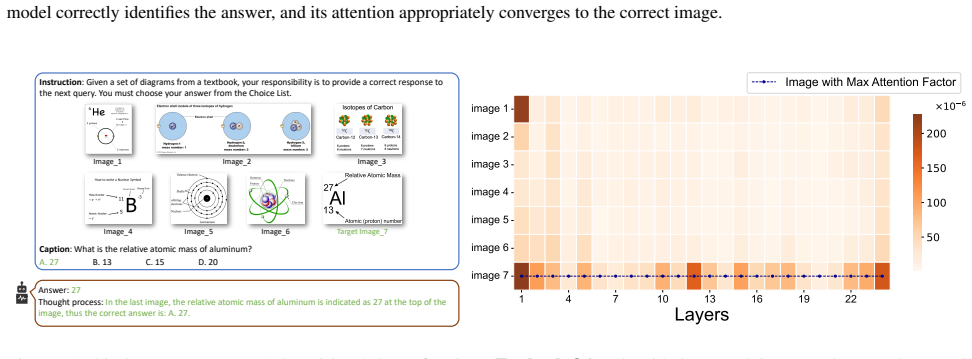
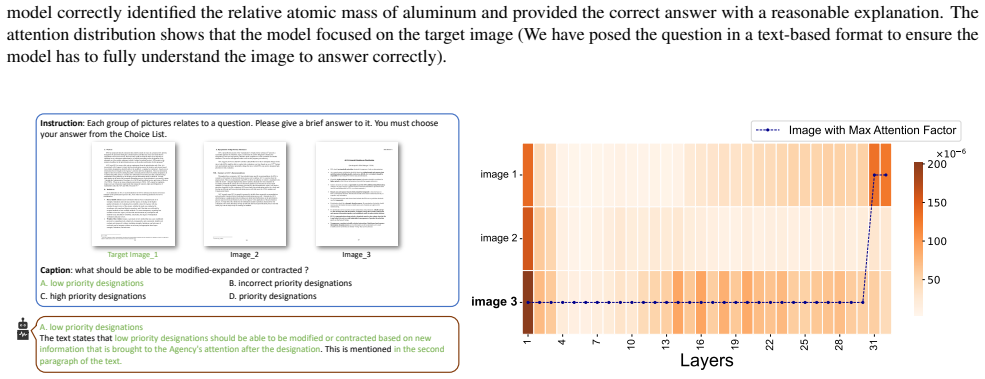
The image-attention factor $\sigma_i$: after softmax is applied to the causal attention matrix, the query rows belonging to the caption or question and to the model output are multiplied by the key columns of each image and averaged across attention heads and token positions, giving a per-image, per-layer concentration score. Three voting rules over the last layers — layer-focused image, mean layer-focused image, and majority-count layer-focused image — turn these scores into a single model-focused image, and attention accuracy is the fraction of correctly answered samples in which that image equals the target. The STME benchmark supplies the target-image association that makes this scoring possible, including a filtering pipeline that keeps only questions whose correct answer depends on exactly one image.
What would settle it
Take samples where attention accuracy is high, hide every image except the attended one, and ask whether the original answer can still be reproduced; if the answer cannot, attention was not carrying the understanding the metric credits it with.
Extended reading notes
Core claim
The paper defines attention accuracy as a metric that compares the image a model's attention locks onto with the single image actually tied to the correct answer. To compute it, the authors separate the visual and textual blocks of the causal attention matrix and average soft attention scores over heads and tokens to form an image-attention factor per image per layer; three layer-based voting rules then name a model-focused image. On the new STME benchmark, which pairs easy caption-matching and retrieval tasks with harder document, textbook, slide, and spatial tasks, the paper reports that attention accuracy reaches 100 percent on easy tasks for Qwen2VL-7B, that it pulls apart model families whose answer accuracy looks similar, that it rises consistently with model scale, and that it stays stable under image-order shuffling. The same factor is extended to image patches and to image-to-image similarity, supporting the claim that the measure is scale- and architecture-agnostic.
Load-bearing premise
The method assumes that the image a model's attention locks onto is the image the model has genuinely understood, so if attention can be correct while understanding fails, attention accuracy overstates visual comprehension.
Editorial extensions
If this is right
- Answer accuracy and attention accuracy become two separate axes: a right answer with wrong attention reveals an implicit misunderstanding, while a wrong answer with right attention localizes the failure to recognition or reasoning rather than image selection.
- Because attention accuracy varies by less than one percent when image order is shuffled, while answer accuracy varies several times more, model comparisons become fairer across different input arrangements.
- Across scales within a model family, attention accuracy rises even where answer accuracy does not, isolating gains in visual capability from gains in the downstream language model.
- On hard tasks the spread in attention accuracy across models is wider, so the metric can serve as a more sensitive diagnostic than answer accuracy when tasks demand close visual reading.
- The patch-level extension identifies which regions of an image drive the answer, allowing hallucinations or misreadings to be traced to particular visual content.
Reading between the lines
- The paper leaves training applications implicit, but attention accuracy could plausibly be used as a training signal or data filter that penalizes models for answering correctly while attending to the wrong image.
- The paper's own OCR experiments in Section C.3 mark a boundary: attention can land on the correct image while the model still misreads fine-grained content, so attention accuracy is best read as measuring target localization, not full semantic comprehension.
- Because the same factor applies to image-to-image attention, the approach could transfer to text-only or audio-visual transformers with little modification, though the paper only sketches this possibility.
- The proposed if-and-only-if relation could be probed adversarially by giving the model samples whose answers are recoverable from the caption alone; stable target attention there would suggest convergence is tracking textual priors rather than visual understanding.
Signed reviews
Editorial analysis
A structured set of objections, weighed in public.
Referee Report
Summary. The paper defines implicit visual misunderstanding (IVM) as cases where a multimodal large language model (MLLM) gives a correct answer without genuinely understanding the relevant visual content. The authors propose to diagnose IVMs by inspecting the causal attention matrices inside the model: they define image-attention factors, introduce three layer-aggregation rules (LND, M-LND, MC-LND), and define attention accuracy as the proportion of correctly answered samples in which the resulting model-focused image matches the target image. They introduce the STME benchmark of multi-image single-target tasks, report attention-accuracy results across Qwen2VL, InternVL2, and LLaVA-OneVision at multiple scales, test robustness to image-order shuffling, and extend the approach to patch-level analysis and unimodal image-to-image matching.
Significance. If the central claim were fully supported, an attention-based metric that identifies which image a model's response is actually grounded in would be a useful complement to answer-accuracy benchmarks, especially for detecting correct answers reached through the wrong visual evidence. The paper provides a new benchmark, reproducible code/data links, and a clear attention-extraction methodology across several model families. However, the quantitative claims are weakened by the choice to report the maximum over metrics and layer counts, by evaluating attention accuracy only on each model's own correctly answered subset, and by the absence of the stated theorems that underpin the metric. The abstract's stronger claim that attention accuracy 'directly evaluates the model's visual understanding' is not supported by the evidence, including the paper's own OCR-needle experiment, so the contribution currently lands as a promising diagnostic framework rather than a validated direct measure of visual understanding.
major comments (5)
- [§2.1, §2.3] The paper repeatedly refers to Theorem 2.1, Theorem 2.2, and Theorem 2.3, but no theorem statements or proofs appear anywhere in the manuscript. The load-bearing biconditional at the end of §2.1 ('MLLM's attention converges onto the target image if and only if there are no IVMs during inference') is asserted without proof and is the basis for defining attention correctness. Either provide precise theorem statements with proofs, or explicitly label these as empirical hypotheses and treat the experiments as tests of that hypothesis rather than consequences of a theorem.
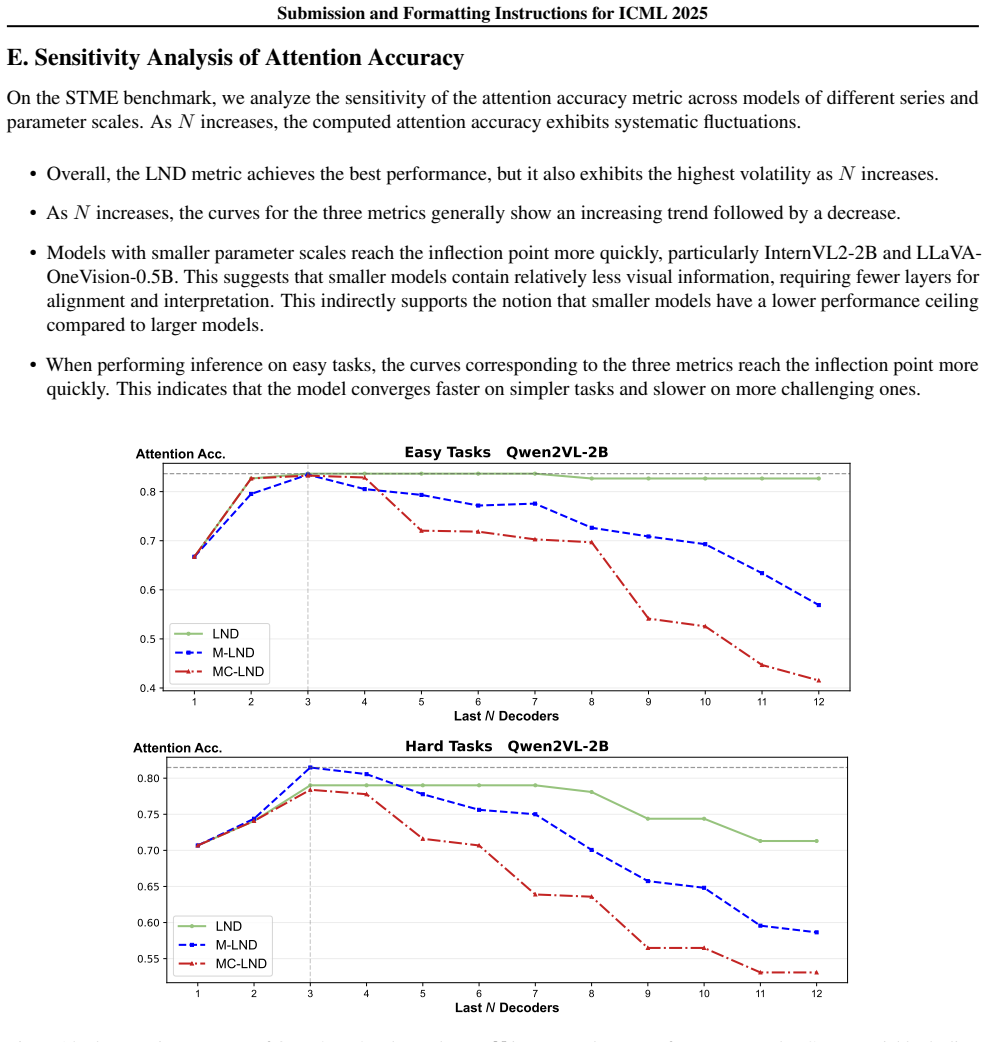
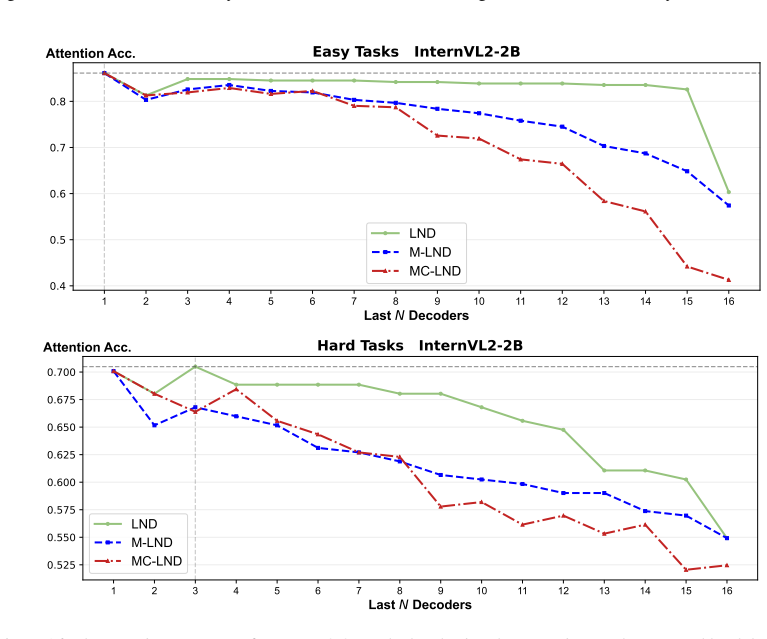
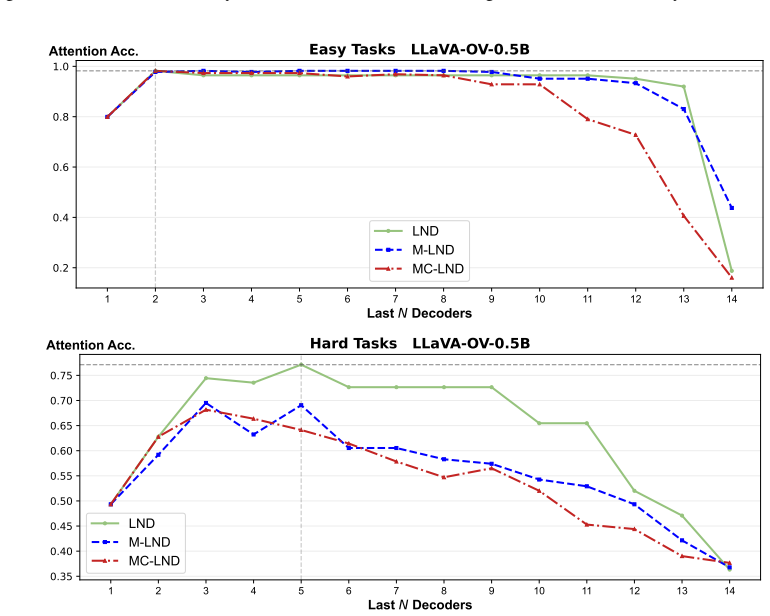
- [§2.3, Definition 2.2, §3.1] The reported attention accuracy is the maximum over the three metrics (LND, M-LND, MC-LND) and over the number of last layers N, as stated in Definition 2.2 and Section 3.1 ('The highest attention accuracy obtained is used as the final value'). This best-of selection over free parameters on the test set inflates the headline numbers. Section E shows that attention-accuracy curves vary substantially with N for the same model, so reporting only the maximum is not a faithful estimate of a fixed evaluation rule. The authors should pre-specify a single metric and N, or report the full distribution over choices, including the average and worst-case values.
- [§2.3, §3.1, Table 1] Attention accuracy is computed only on correctly answered samples, and the set of correctly answered samples differs across models. For example, Qwen2VL-7B and InternVL2-8B have substantially different answer accuracies, so their attention-accuracy scores in Table 1 are evaluated on different, non-comparable subsets. A model with lower answer accuracy may be scored on an easier subsample, making the cross-model comparison unreliable. The authors should compute attention accuracy on a common fixed subset (e.g., the intersection of correctly answered samples) or report the per-sample results and quantify how the choice of subset affects the ranking.
- [Abstract, §2.1, §C.3] The abstract claims that 'Attention accuracy directly evaluates the model's visual understanding via internal mechanisms,' but this is contradicted by the paper's own Section C.3. There, models achieve near-100% attention accuracy on Image Needle in a Haystack samples while failing to recognize the embedded digit string due to limited OCR ability, meaning attention can be correct while fine-grained visual comprehension fails. At best, the metric measures which image the model's response is based on, not whether the visual content was fully understood. The abstract, Section 1, and the conclusion should be revised to state this weaker claim, and the relationship between attention accuracy and full visual understanding should be discussed explicitly.
- [§2.2] The hard-task filtering pipeline relies on GPT-4o to answer questions and identify images related to the final answer, followed by manual review. Using a model to define the target-image labels introduces a potential model-dependent selection bias, especially if GPT-4o's attention or answer patterns correlate with the tested models' behaviors. The authors should report the number of samples removed at each filtering stage, provide inter-annotator agreement or a human-only validation subset, and discuss how GPT-4o-based filtering could affect the measured attention accuracy.
minor comments (6)
- [Eq. (3)] The LND definition is ambiguous: it defines a per-layer argmax over i for each l in N, but the text then treats the result as a single model-level prediction. Please clarify how the per-layer predictions are aggregated for a single sample.
- [Section E figures] Several figure axis labels in Section E appear as garbled token-like strings rather than readable text; the attention-accuracy curves are otherwise informative and should be relabeled.
- [§1, §6] The term 'equivariant measure' is used for attention accuracy but is never defined; either define it formally or replace it with a clearer description.
- [Table 5 caption] Table 5 has the same caption as Table 4 even though it reports a different experiment (Image Needle in a Haystack with incorrect or partial OCR outputs); the caption should describe the actual content and the sample-selection criterion.
- [§2.2] Please provide a per-task breakdown of the 537 easy and 528 hard samples, the number of images per question in each task, and the dataset license and hosting details for the STME benchmark.
- [Throughout] There are several typos and formatting issues, including 'valuates' (§2.2), 'the the methodology' (§3.1), 'Extrcting submatrix' (§4.2), and 'Noted that' (Definition 2.1); a careful proofread is needed.
Circularity Check
Partial circularity: IVM is operationalized through attention matching, and reported attention-accuracy values are post hoc maxima over metrics and N; external checks limit but do not remove the loop.
-
self definitional
[Section 2.1 (Attention Distribution Phenomena) and Section 2.3 (Definitions 2.2-2.3)]
"The comparison between the upper and lower groups in Figure 3 further supports the conclusion that MLLM's attention converges onto the target image if and only if there are no IVMs during inference."
This biconditional is the load-bearing link between attention and 'fully comprehending the visual input.' Downstream, Definition 2.3 defines attention correctness as 'the model-focused image is identical to the target image,' and the text says that 'by comparing the target image with the model-focused image, we can determine whether IVMs occur.' No-IVM is therefore operationalized as attention convergence, so the abstract's claim that attention accuracy 'directly evaluates the model's visual understanding' restates the assumed biconditional rather than deriving it from an independent measure of comprehension. The paper's GPT-4o reasoning check and hallucination-benchmark correlations provide external grounding, so the loop is partial rather than total.
-
fitted input called prediction
[Section 3.1 (Evaluation)]
"Similar to Section 2.3, attention accuracy is calculated on correctly answered samples using the LND, M-LND and MC-LND metrics across different N. The highest attention accuracy obtained is used as the final value."
The reported final attention accuracy is the maximum over three aggregation rules and up to 28 choices of N. The headline values are therefore selected maxima rather than the result of a fixed a priori metric. Claims that attention accuracy is high, or that it beats direct instruction, are partly forced by this post hoc search over hyperparameters. The Appendix E sensitivity curves soften the concern, but the official numbers are still best-case selections made on the same benchmark used to advertise the metric.
full rationale
No load-bearing self-citation or uniqueness theorem appears in the paper; the cited models and benchmark sources (Qwen2VL, InternVL2, LLaVA-OneVision, MileBench, Flickr30k, etc.) are external. The STME labels are produced by GPT-4o filtering plus manual review, not by the attention metric itself, so benchmark construction is not circular. The main circularity-adjacent step is the Section 2.1 biconditional equating 'no IVM' with attention convergence on the target image; once Definition 2.3 turns attention correctness into the criterion for IVM, 'attention accuracy measures IVM' is true by construction, and the stronger claim that it 'directly evaluates visual understanding' inherits that self-definitional status. Section 3.1 further inflates the result by reporting the maximum over metrics and N. The paper's own Section C.3 concedes that models can attend to the correct image while failing OCR (Table 5), which undercuts the sufficiency direction of the biconditional; this is a validity gap rather than a circularity step, so it is noted but not scored separately. Because the paper does provide some external grounding (GPT-4o reasoning evaluation and HallusionBench/POPE correlations for the EVM quadrant), the circularity is partial; score 4.
Assumptions & free parameters
free parameters (3)
- N (number of last layers) =
Swept; best value selected per model and task
- Metric selection rule (LND, M-LND, or MC-LND) =
Best of three selected
- Top-10% patch threshold =
10%
assumptions (3)
- domain assumption Attention weights are a faithful indicator of what the model truly understands.
- domain assumption GPT-4o provides reliable labels for target images and reliable evaluation of reasoning processes.
- domain assumption Causal attention matrices can be cleanly partitioned into image, text, and output token blocks.
invented entities (2)
-
Implicit Visual Misunderstanding (IVM)
-
Attention Accuracy
Cite this review
Pith. "Pith review of Exploring Implicit Visual Misunderstandings in Multimodal Large Language Models through Attention Analysis." pith.science (2026). https://pith.science/paper/VQR6P5ED
@misc{pith2026250510541,
  author       = {Pith},
  title        = {Pith review of: Exploring Implicit Visual Misunderstandings in Multimodal Large Language Models through Attention Analysis},
  year         = {2026},
  howpublished = {\url{https://pith.science/paper/VQR6P5ED}},
  note         = {Machine review of arXiv:2505.10541}
}
read the original abstract
Recent advancements have enhanced the capability of Multimodal Large Language Models (MLLMs) to comprehend multi-image information. However, existing benchmarks primarily evaluate answer correctness, overlooking whether models genuinely comprehend the visual input. To address this, we define implicit visual misunderstanding (IVM), where MLLMs provide correct answers without fully comprehending the visual input. Through our analysis, we decouple the visual and textual modalities within the causal attention module, revealing that attention distribution increasingly converges on the image associated with the correct answer as the network layers deepen. This insight leads to the introduction of a scale-agnostic metric, \textit{attention accuracy}, and a novel benchmark for quantifying IVMs. Attention accuracy directly evaluates the model's visual understanding via internal mechanisms, remaining robust to positional biases for more reliable assessments. Furthermore, we extend our approach to finer granularities and demonstrate its effectiveness in unimodal scenarios, underscoring its versatility and generalizability.
Figures


Figures from the paper (18 more)







Reference graph
Works this paper leans on
-
[1]
write newline
" write newline "" before.all 'output.state := FUNCTION n.dashify 't := "" t empty not t #1 #1 substring "-" = t #1 #2 substring "--" = not "--" * t #2 global.max substring 't := t #1 #1 substring "-" = "-" * t #2 global.max substring 't := while if t #1 #1 substring * t #2 global.max substring 't := if while FUNCTION format.date year duplicate empty "emp...
-
[2]
Claude 3 haiku: our fastest model yet
Anthropic. Claude 3 haiku: our fastest model yet. 2024. Available at: https://www.anthropic.com/news/claude-3-haiku
work page 2024
-
[3]
Y., Bhiwandiwalla, A., Tseng, S.-Y., Olson, M
Ben Melech Stan, G., Aflalo, E., Rohekar, R. Y., Bhiwandiwalla, A., Tseng, S.-Y., Olson, M. L., Gurwicz, Y., Wu, C., Duan, N., and Lal, V. Lvlm-intrepret: An interpretability tool for large vision-language models. In Proceedings of the IEEE/CVF Conference on Computer Vision and Pattern Recognition, pp.\ 8182--8187, 2024
2024
-
[4]
F., G \'o mez, L., and Karatzas, D
Biten, A. F., G \'o mez, L., and Karatzas, D. Let there be a clock on the beach: Reducing object hallucination in image captioning. In Proceedings of the IEEE/CVF Winter Conference on Applications of Computer Vision, pp.\ 1381--1390, 2022
2022
-
[5]
H., Vora, S., Liong, V
Caesar, H., Bankiti, V., Lang, A. H., Vora, S., Liong, V. E., Xu, Q., Krishnan, A., Pan, Y., Baldan, G., and Beijbom, O. nuscenes: A multimodal dataset for autonomous driving. In Proceedings of the IEEE/CVF conference on computer vision and pattern recognition, pp.\ 11621--11631, 2020
2020
-
[6]
Chen, L., Li, J., Dong, X., Zhang, P., Zang, Y., Chen, Z., Duan, H., Wang, J., Qiao, Y., Lin, D., et al. Are we on the right way for evaluating large vision-language models? arXiv preprint arXiv:2403.20330, 2024 a
arXiv 2024
-
[7]
Chen, Y., Sikka, K., Cogswell, M., Ji, H., and Divakaran, A. Dress: Instructing large vision-language models to align and interact with humans via natural language feedback. In Proceedings of the IEEE/CVF Conference on Computer Vision and Pattern Recognition, pp.\ 14239--14250, 2024 b
work page 2024
-
[8]
How far are we to gpt-4v? closing the gap to commercial multimodal models with open-source suites
Chen, Z., Wang, W., Tian, H., Ye, S., Gao, Z., Cui, E., Tong, W., Hu, K., Luo, J., Ma, Z., Ma, J., Wang, J., wen Dong, X., Yan, H., Guo, H., He, C., Jin, Z., Xu, C., Wang, B., Wei, X., Li, W., Zhang, W., Lu, L., Zhu, X., Lu, T., Lin, D., and Qiao, Y. How far are we to gpt-4v? closing the gap to commercial multimodal models with open-source suites. ArXiv, ...
arXiv 2024
Show all 50 references
-
[9]
H., Yu, F., Wan, X., and Wang, B
Dingjie, S., Chen, S., Chen, G. H., Yu, F., Wan, X., and Wang, B. Milebench: Benchmarking MLLM s in long context. In First Conference on Language Modeling, 2024. URL https://openreview.net/forum?id=Uhwze2LEwq
2024
-
[10]
A challenger to gpt-4v? early explorations of gemini in visual expertise, 2023
Fu, C., Zhang, R., Wang, Z., Huang, Y., Zhang, Z., Qiu, L., Ye, G., Shen, Y., Zhang, M., Chen, P., Zhao, S., Lin, S., Jiang, D., Yin, D., Gao, P., Li, K., Li, H., and Sun, X. A challenger to gpt-4v? early explorations of gemini in visual expertise, 2023. URL https://arxiv.org/...
2023 arXiv
-
[11]
A., Ma , W.-C., and Krishna , R
Fu , X., Hu , Y., Li , B., Feng , Y., Wang , H., Lin , X., Roth , D., Smith , N. A., Ma , W.-C., and Krishna , R. BLINK: Multimodal Large Language Models Can See but Not Perceive . arXiv e-prints, art. arXiv:2404.12390, April 2024. doi:10.48550/arXiv.2404.12390
-
[12]
GLM, T., :, Zeng, A., Xu, B., Wang, B., Zhang, C., Yin, D., Zhang, D., Rojas, D., Feng, G., Zhao, H., Lai, H., Yu, H., Wang, H., Sun, J., Zhang, J., Cheng, J., Gui, J., Tang, J., Zhang, J., Sun, J., Li, J., Zhao, L., Wu, L., Zhong, L., Liu, M., Huang, M., Zhang, P., Zheng, Q.,...
2024 arXiv
-
[13]
Hallusionbench: an advanced diagnostic suite for entangled language hallucination and visual illusion in large vision-language models
Guan, T., Liu, F., Wu, X., Xian, R., Li, Z., Liu, X., Wang, X., Chen, L., Huang, F., Yacoob, Y., et al. Hallusionbench: an advanced diagnostic suite for entangled language hallucination and visual illusion in large vision-language models. In Proceedings of the IEEE/CVF Confere...
2024
-
[14]
Cmmu: A benchmark for chinese multi-modal multi-type question understanding and reasoning, 2024
He, Z., Wu, X., Zhou, P., Xuan, R., Liu, G., Yang, X., Zhu, Q., and Huang, H. Cmmu: A benchmark for chinese multi-modal multi-type question understanding and reasoning, 2024. URL https://arxiv.org/abs/2401.14011
2024 arXiv
-
[15]
Cogvlm2: Visual language models for image and video understanding
Hong, W., Wang, W., Ding, M., Yu, W., Lv, Q., Wang, Y., Cheng, Y., Huang, S., Ji, J., Xue, Z., et al. Cogvlm2: Visual language models for image and video understanding. arXiv preprint arXiv:2408.16500, 2024
2024 arXiv
-
[16]
Self-introspective decoding: Alleviating hallucinations for large vision-language models, 2024
Huo, F., Xu, W., Zhang, Z., Wang, H., Chen, Z., and Zhao, P. Self-introspective decoding: Alleviating hallucinations for large vision-language models, 2024. URL https://arxiv.org/abs/2408.02032
2024 arXiv
-
[17]
Mantis: Interleaved multi-image instruction tuning
Jiang, D., He, X., Zeng, H., Wei, C., Ku, M., Liu, Q., and Chen, W. Mantis: Interleaved multi-image instruction tuning. arXiv preprint arXiv:2405.01483, 2024
2024 arXiv
-
[18]
Are you smarter than a sixth grader? textbook question answering for multimodal machine comprehension
Kembhavi, A., Seo, M., Schwenk, D., Choi, J., Farhadi, A., and Hajishirzi, H. Are you smarter than a sixth grader? textbook question answering for multimodal machine comprehension. In Proceedings of the IEEE Conference on Computer Vision and Pattern recognition, pp.\ 4999--5007, 2017
2017
-
[19]
Obelics: An open web-scale filtered dataset of interleaved image-text documents
Lauren c on, H., Saulnier, L., Tronchon, L., Bekman, S., Singh, A., Lozhkov, A., Wang, T., Karamcheti, S., Rush, A., Kiela, D., et al. Obelics: An open web-scale filtered dataset of interleaved image-text documents. Advances in Neural Information Processing Systems, 36, 2024
2024
-
[20]
The curse of multi-modalities: Evaluating hallucinations of large multimodal models across language, visual, and audio, 2024
Leng, S., Xing, Y., Cheng, Z., Zhou, Y., Zhang, H., Li, X., Zhao, D., Lu, S., Miao, C., and Bing, L. The curse of multi-modalities: Evaluating hallucinations of large multimodal models across language, visual, and audio, 2024. URL https://arxiv.org/abs/2410.12787
2024 arXiv
-
[21]
Seed-bench: Benchmarking multimodal llms with generative comprehension
Li, B., Wang, R., Wang, G., Ge, Y., Ge, Y., and Shan, Y. Seed-bench: Benchmarking multimodal llms with generative comprehension. arXiv preprint arXiv:2307.16125, 2023 a
2023 arXiv
-
[22]
Llava-next-interleave: Tackling multi-image, video, and 3d in large multimodal models, 2024
Li, F., Zhang, R., Zhang, H., Zhang, Y., Li, B., Li, W., Ma, Z., and Li, C. Llava-next-interleave: Tackling multi-image, video, and 3d in large multimodal models, 2024. URL https://arxiv.org/abs/2407.07895
2024 arXiv
-
[23]
H., Yatskar, M., Yin, D., Hsieh, C.-J., and Chang, K.-W
Li, L. H., Yatskar, M., Yin, D., Hsieh, C.-J., and Chang, K.-W. Visualbert: A simple and performant baseline for vision and language. arXiv preprint arXiv:1908.03557, 2019
1908 arXiv
-
[24]
Evaluating object hallucination in large vision-language models
Li, Y., Du, Y., Zhou, K., Wang, J., Zhao, X., and Wen, J.-R. Evaluating object hallucination in large vision-language models. In Bouamor, H., Pino, J., and Bali, K. (eds.), Proceedings of the 2023 Conference on Empirical Methods in Natural Language Processing, pp.\ 292--305, S...
2023 doi
-
[25]
X., Tian, P., Yin, C
Liang, C. X., Tian, P., Yin, C. H., Yua, Y., An-Hou, W., Ming, L., Wang, T., Bi, Z., and Liu, M. A comprehensive survey and guide to multimodal large language models in vision-language tasks, 2024. URL https://arxiv.org/abs/2411.06284
2024
-
[26]
Lin, T.-Y., Maire, M., Belongie, S., Hays, J., Perona, P., Ramanan, D., Doll \'a r, P., and Zitnick, C. L. Microsoft coco: Common objects in context. In Computer Vision--ECCV 2014: 13th European Conference, Zurich, Switzerland, September 6-12, 2014, Proceedings, Part V 13, pp....
2014
-
[27]
Mmdu: A multi-turn multi-image dialog understanding benchmark and instruction-tuning dataset for lvlms
Liu, Z., Chu, T., Zang, Y., Wei, X., Dong, X., Zhang, P., Liang, Z., Xiong, Y., Qiao, Y., Lin, D., et al. Mmdu: A multi-turn multi-image dialog understanding benchmark and instruction-tuning dataset for lvlms. arXiv preprint arXiv:2406.11833, 2024
2024 arXiv
-
[28]
Learn to explain: Multimodal reasoning via thought chains for science question answering
Lu, P., Mishra, S., Xia, T., Qiu, L., Chang, K.-W., Zhu, S.-C., Tafjord, O., Clark, P., and Kalyan, A. Learn to explain: Multimodal reasoning via thought chains for science question answering. In Oh, A. H., Agarwal, A., Belgrave, D., and Cho, K. (eds.), Advances in Neural Info...
2022
-
[29]
Docvqa: A dataset for vqa on document images
Mathew, M., Karatzas, D., and Jawahar, C. Docvqa: A dataset for vqa on document images. In Proceedings of the IEEE/CVF winter conference on applications of computer vision, pp.\ 2200--2209, 2021
2021
-
[30]
Mmiu: Multimodal multi-image understanding for evaluating large vision-language models, 2024
Meng, F., Wang, J., Li, C., Lu, Q., Tian, H., Liao, J., Zhu, X., Dai, J., Qiao, Y., Luo, P., Zhang, K., and Shao, W. Mmiu: Multimodal multi-image understanding for evaluating large vision-language models, 2024. URL https://arxiv.org/abs/2408.02718
2024 arXiv
-
[31]
Gpt-4o system card, 2024
OpenAI. Gpt-4o system card, 2024. URL https://openai.com/index/gpt-4o-system-card
2024
-
[32]
Perception test: A diagnostic benchmark for multimodal video models
Patraucean, V., Smaira, L., Gupta, A., Recasens, A., Markeeva, L., Banarse, D., Koppula, S., Malinowski, M., Yang, Y., Doersch, C., et al. Perception test: A diagnostic benchmark for multimodal video models. Advances in Neural Information Processing Systems, 36, 2024
2024
-
[33]
U., Hezel, N., and Jung, K
Schall, K., Barthel, K. U., Hezel, N., and Jung, K. Gpr1200: a benchmark for general-purpose content-based image retrieval. In International Conference on Multimedia Modeling, pp.\ 205--216. Springer, 2022
2022
-
[34]
Eva-clip: Improved training techniques for clip at scale
Sun, Q., Fang, Y., Wu, L., Wang, X., and Cao, Y. Eva-clip: Improved training techniques for clip at scale. arXiv preprint arXiv:2303.15389, 2023
2023 arXiv
-
[35]
Aligning large multimodal models with factually augmented RLHF
Sun, Z., Shen, S., Cao, S., Liu, H., Li, C., Shen, Y., Gan, C., Gui, L., Wang, Y.-X., Yang, Y., Keutzer, K., and Darrell, T. Aligning large multimodal models with factually augmented RLHF . In Ku, L.-W., Martins, A., and Srikumar, V. (eds.), Findings of the Association for Com...
2024 doi
-
[36]
Slidevqa: A dataset for document visual question answering on multiple images
Tanaka, R., Nishida, K., Nishida, K., Hasegawa, T., Saito, I., and Saito, K. Slidevqa: A dataset for document visual question answering on multiple images. In Proceedings of the AAAI Conference on Artificial Intelligence, volume 37, pp.\ 13636--13645, 2023
2023
-
[37]
Eyes wide shut? exploring the visual shortcomings of multimodal llms
Tong, S., Liu, Z., Zhai, Y., Ma, Y., LeCun, Y., and Xie, S. Eyes wide shut? exploring the visual shortcomings of multimodal llms. In Proceedings of the IEEE/CVF Conference on Computer Vision and Pattern Recognition, pp.\ 9568--9578, 2024
2024
-
[38]
Attention is all you need
Vaswani, A. Attention is all you need. Advances in Neural Information Processing Systems, 2017
2017
-
[39]
and Belinkov, Y
Vig, J. and Belinkov, Y. Analyzing the structure of attention in a transformer language model. arXiv preprint arXiv:1906.04284, 2019
1906 arXiv
-
[40]
Y., Li, Z., Liu, Q., Liu, X., Ma, M
Wang, F., Fu, X., Huang, J. Y., Li, Z., Liu, Q., Liu, X., Ma, M. D., Xu, N., Zhou, W., Zhang, K., Yan, T. L., Mo, W. J., Liu, H.-H., Lu, P., Li, C., Xiao, C., Chang, K.-W., Roth, D., Zhang, S., Poon, H., and Chen, M. Muirbench: A comprehensive benchmark for robust multi-image ...
2024 arXiv
-
[41]
Qwen2-vl: Enhancing vision-language model's perception of the world at any resolution, 2024 b
Wang, P., Bai, S., Tan, S., Wang, S., Fan, Z., Bai, J., Chen, K., Liu, X., Wang, J., Ge, W., Fan, Y., Dang, K., Du, M., Ren, X., Men, R., Liu, D., Zhou, C., Zhou, J., and Lin, J. Qwen2-vl: Enhancing vision-language model's perception of the world at any resolution, 2024 b . UR...
2024 arXiv
-
[42]
Needle in a multimodal haystack
Wang, W., Zhang, S., Ren, Y., Duan, Y., Li, T., Liu, S., Hu, M., Chen, Z., Zhang, K., Lu, L., Zhu, X., Luo, P., Qiao, Y., Dai, J., Shao, W., and Wang, W. Needle in a multimodal haystack. In The Thirty-eight Conference on Neural Information Processing Systems Datasets and Bench...
2024
-
[43]
H., Le, Q
Wei, J., Wang, X., Schuurmans, D., Bosma, M., Ichter, B., Xia, F., Chi, E. H., Le, Q. V., and Zhou, D. Chain-of-thought prompting elicits reasoning in large language models. In Proceedings of the 36th International Conference on Neural Information Processing Systems, NIPS '22,...
2024
-
[44]
Mmie: Massive multimodal interleaved comprehension benchmark for large vision-language models, 2024
Xia, P., Han, S., Qiu, S., Zhou, Y., Wang, Z., Zheng, W., Chen, Z., Cui, C., Ding, M., Li, L., Wang, L., and Yao, H. Mmie: Massive multimodal interleaved comprehension benchmark for large vision-language models, 2024. URL https://arxiv.org/abs/2410.10139
2024 arXiv
-
[45]
Qwen2 technical report, 2024
Yang, A., Yang, B., Hui, B., Zheng, B., Yu, B., Zhou, C., Li, C., Li, C., Liu, D., Huang, F., Dong, G., Wei, H., Lin, H., Tang, J., Wang, J., Yang, J., Tu, J., Zhang, J., Ma, J., Yang, J., Xu, J., Zhou, J., Bai, J., He, J., Lin, J., Dang, K., Lu, K., Chen, K., Yang, K., Li, M....
2024 arXiv
-
[46]
Set-of-mark prompting unleashes extraordinary visual grounding in gpt-4v
Yang, J., Zhang, H., Li, F., Zou, X., Li, C., and Gao, J. Set-of-mark prompting unleashes extraordinary visual grounding in gpt-4v. arXiv preprint arXiv:2310.11441, 2023
2023 arXiv
-
[47]
From image descriptions to visual denotations: New similarity metrics for semantic inference over event descriptions
Young, P., Lai, A., Hodosh, M., and Hockenmaier, J. From image descriptions to visual denotations: New similarity metrics for semantic inference over event descriptions. Transactions of the Association for Computational Linguistics, 2: 0 67--78, 2014. doi:10.1162/tacl_a_00166....
2014 doi
-
[48]
Mmmu: A massive multi-discipline multimodal understanding and reasoning benchmark for expert agi
Yue, X., Ni, Y., Zhang, K., Zheng, T., Liu, R., Zhang, G., Stevens, S., Jiang, D., Ren, W., Sun, Y., et al. Mmmu: A massive multi-discipline multimodal understanding and reasoning benchmark for expert agi. In Proceedings of the IEEE/CVF Conference on Computer Vision and Patter...
2024
-
[49]
Sigmoid loss for language image pre-training
Zhai, X., Mustafa, B., Kolesnikov, A., and Beyer, L. Sigmoid loss for language image pre-training. In Proceedings of the IEEE/CVF International Conference on Computer Vision, pp.\ 11975--11986, 2023
2023
-
[50]
Internlm-xcomposer-2.5: A versatile large vision language model supporting long-contextual input and output
Zhang, P., Dong, X., Zang, Y., Cao, Y., Qian, R., Chen, L., Guo, Q., Duan, H., Wang, B., Ouyang, L., et al. Internlm-xcomposer-2.5: A versatile large vision language model supporting long-contextual input and output. arXiv preprint arXiv:2407.03320, 2024
2024 arXiv
Reviewed August 15, 2026 · model on record in the stance chip above.
Discussion (0). Continue with ORCID to comment.