REVIEW 3 major objections 6 minor 39 references
From Artificial Intelligence to Active Inference: The Key to True AI and 6G World Brain [Invited]
T0 review · 3 major / 6 minor · reviewed 2026-08-16 · deepseek-v4-flash
Pith's one-line read The paper argues that active inference—acting to minimize surprise under the free-energy principle—should replace today's training-heavy AI and become the foundation of a 6G 'world brain' built on mycorrhizal-network-inspired generative…
desk verdict This is a readable vision piece that introduces active inference to optical network researchers, but its central claim that active inference resolves AI's open challenges is asserted rather than demonstrated, and the toy simulation is too weak to carry the weight. read the letter →
The pith
A machine-rendered reading of the paper's core claim, the machinery that carries it, and where it could break.
The reading
What carries the argument
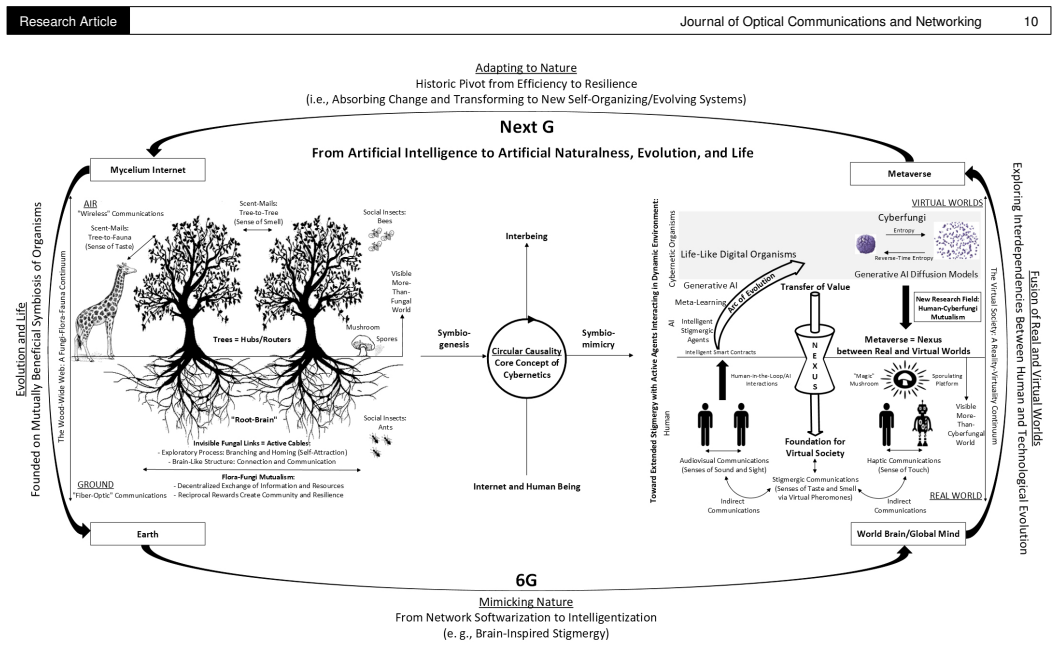
The load-bearing mechanism is the pairing of active inference's free-energy minimization with a denoising diffusion generative model. Active inference supplies the normative loop: a Markov blanket $b = (u, y)$ separates an agent from its environment, Bayes's theorem updates beliefs about hidden states, variational free energy $F$ bounds surprise and makes inference tractable, and expected free energy $G$ scores future policies against preferred observations. The paper then maps the diffusion model's forward process to the branching and exploration of hyphae and the backward denoising process to their fusion and homing, so the model hallucinates scale-free small-world networks that serve as the substrate for social contagion. Purpose-driven tokens act as the action channel that closes the loop: they reward pairs of humans who spread a new social norm, actuating the cyberfungi's 'spores' and rewiring the human-AI network. The argument is carried by this analogy—network structure from denoising, network function from token-rewarded contagion—held together by the claim that both are expressions of entropy minimization.
What would settle it
Run the paper's social-contagion simulation on a generic small-world network of the same 64 nodes and degree, with no DDPM hallucination and no tokens; if it also spreads the norm in about two time units, the cyberfungi generative model is not what produces the fast contagion. Separately, if the DDPM's reverse process cannot be written as variational free-energy minimization over the agent's inferred state space, the claimed equivalence between denoising and active inference fails.
Extended reading notes
Core claim
The paper claims that active inference is not merely an AI technique but the key to true AI, because it replaces supervised training with continuous Bayesian belief updating and explains behavior as self-evidencing under the free-energy principle. To make this concrete for networking, it proposes a metamorphic generative model called cyberfungi, built by adapting a denoising diffusion probabilistic model whose forward diffusion process mimics the branching, exploratory growth of fungal hyphae and whose backward denoising process mimics their fusion and homing. The model hallucinates scale-free networks with small-world properties; humans connect to these networks, and when one person adopts a desirable new social norm, it spreads to directly linked humans with probability $r$, with each successful pair receiving teleological tokens (cybernetic spores) as reciprocal rewards. Simulation results show that the hallucinated small-world networks spread a social norm through all 64 nodes in about two time units across all tested $r$, and that the backward process yields up to almost 2,500 actuated tokens for $r=1.0$, which the paper presents as evidence that cyberfungi act as brokers of cyborganic entanglement for the 6G world brain.
Load-bearing premise
The whole proposal stands or falls on treating a diffusion model's denoising as equivalent to an active-inference agent's free-energy-minimizing belief update, an equivalence the paper asserts by analogy rather than proves.
Editorial extensions
If this is right
- If active inference is the right foundation, AI-native 6G networks would learn continuously from interaction rather than from large offline datasets, dissolving the training bottleneck the paper identifies.
- Optical network management could be reorganized around Markov-blanket interfaces that keep humans in the loop, giving the network a principled channel for explanation and human-AI co-creation.
- A cyberfungi-type generative model would make the network itself an embodied, enactive agent that spreads social norms and tokens, effectively treating collective behavior as a network resource to be cultivated.
- Because hallucinated small-world, scale-free networks spread norms in roughly two time units regardless of spreading probability, the 6G world brain would propagate desirable behaviors quickly and at low reward cost.
- Under active inference, network control becomes homeostasis: the 6G brain would act to keep its sensory states within preferred ranges, rather than optimizing a fixed task objective.
Reading between the lines
- The diffusion-to-active-inference mapping is asserted by analogy; a testable extension would be to prove that the DDPM denoising objective is a free-energy bound, for instance by identifying the reverse process with variational inference over the same latent states the agent infers.
- The fast-contagion result may owe nothing to the fungal metaphor: replacing the hallucinated networks with any small-world network of the same size and degree distribution should reproduce the two-step spreading time, isolating topology as the cause.
- The token-reward mechanism could be tested on its own terms by comparing cyberfungi incentives with standard influence-maximization strategies on identical networks; if outcomes match, active inference is not the operative ingredient.
- The world-brain vision assumes human values can be encoded as preferred observations in a generative model; a stress test would be whether conflicting preferences across humans produce free-energy gradients that pull the collective apart rather than toward homeostasis.
Signed reviews
Editorial analysis
A structured set of objections, weighed in public.
Referee Report
Summary. The paper argues that active inference, premised on the free-energy principle, can overcome the training, learning, and explainability limitations of today's AI and should become the foundation of future optical and 6G network intelligence. It provides an introductory review of the active inference framework in Section 4, including the Markov blanket, POMDP generative models, variational free energy F (Eq. 7), and expected free energy G (Eq. 13). The paper then proposes a 'cyberfungi' generative model based on OpenAI's improved DDPM, using forward diffusion to mimic hyphal branching and backward denoising to mimic fusion/homing, and applies it to a 64-node ring lattice. The simulation in Fig. 8 reports social contagion times and actuated teleological tokens under different spreading probabilities. The conclusions assert that active inference 'not only resolves the open key AI challenges' but also advocates an active AI that views networks as living organisms, leading to a '6G world brain'.
Significance. If the central mapping between diffusion models and active inference were formally established, the paper would open a genuinely novel research direction connecting generative AI, active inference, and network science. The paper's accessible exposition of active inference mathematics in Section 4 is a strength, as it fills a gap for optical networking researchers, and the literature survey correctly identifies the absence of active inference in optical network research. However, the paper offers no machine-checked proofs, no reproducible code, and no parameter-free derivation; the math presented is standard textbook material. The specific contribution—the cyberfungi demonstration—is not a valid test of active inference, and the claimed resolution of AI challenges is asserted rather than demonstrated. As a vision or tutorial paper the work has some value, but the current manuscript overstates the evidence for its central thesis.
major comments (3)
- [Section 6.C, Fig. 8] The paper does not provide a formal link between the DDPM forward/backward processes and the variational free energy F (Eq. 7) or expected free energy G (Eq. 13) defined in Section 4. The assertion that diffusion denoising corresponds to Bayesian belief updating under free-energy minimization is not derived. Since the cyberfungi model contains no variational distribution q(s,π), no belief update, and no policy selection, the simulation in Fig. 8 does not implement active inference. Consequently, the abstract and Section 7's claim that active inference 'resolves the open key AI challenges' is unsupported by the demonstration.
- [Section 6.C, Fig. 8] The reported benefit of the backward hallucination process is confounded. The text states that the forward diffusion process reaches the minimum contagion time of 2 after roughly 500 steps for all values of r; the backward process then maintains this minimum. Thus the low contagion time is not uniquely attributable to the denoising or hallucination process. In addition, Fig. 8 shows no error bars or multiple runs, and the only baseline is the regular ring lattice. The training set of 1,304,483 synthetic small-world, scale-free networks (mentioned in Section 6.C) makes the hallucination outcome circular: the DDPM is trained to produce exactly the topologies whose contagion properties are then measured. This does not validate the proposed cyberfungi model.
- [Section 3.C and Section 7] The paper claims that active inference overcomes the training, learning, and explainability limitations of today's AI, but no mechanism is specified. The 'no big data' claim in Section 3.C is asserted rather than derived, and the paper does not explain how the proposed generative model performs continual learning or yields explainable decisions. Section 4's mathematics is standard active inference, but the mapping to optical networks and 6G is left at the level of analogy (e.g., Markov blanket as an 'interface'). Without a concrete architecture or a formal equivalence, the central thesis remains an unverified research program rather than a demonstrated result.
minor comments (6)
- [Section 6.C] There is a duplicated word 'to to' in the phrases 'used to to biomimic' (two occurrences); this should be corrected.
- [Section 2] The word 'schezophrenia' is a misspelling of 'schizophrenia'.
- [Section 3.B] The word 'environmnet' appears to be a typo for 'environment'.
- [Fig. 8 caption] The caption describes entropy but does not define the right-hand y-axis, which conveys the number of actuated teleological tokens; the caption should be expanded to explain both axes.
- [Section 5.A] The paper correctly notes that popular media accounts of mycorrhizal networks are not scientifically supported, but it then continues to use the 'wood-wide web' framing as a basis for the cyberfungi model. The authors should either temper the use of this metaphor or cite the primary literature more carefully.
- [Title and Abstract] The categorical phrasing 'the key to true AI' and 'not only resolves the open key AI challenges' goes beyond what the evidence supports; a more measured framing as a research vision would align better with the paper's actual contribution.
Circularity Check
The cyberfungi 'demonstration' is circular: the DDPM is trained on synthetic small-world scale-free networks and then hallucinates exactly that class, while the active-inference label is a renaming of diffusion/denoising with no free-energy machinery.
-
fitted input called prediction
[Section 6.C, Figure 8 description and preceding paragraph]
"More specifically, we let our cyberfungi generative model hallucinate so-called scale-free networks with small-world properties to couple the biomimicked life cycles of plants and mushrooms. ... we used NetworkX to generate a dataset consisting of 1,304,483 unique tensors, each defining a different small-world, scale-free synthetic network, for training OpenAI's improved DDPM."
The DDPM's output class is fixed by its training distribution: it is trained only on synthetic small-world scale-free networks, so the claim that the hallucinated networks are small-world scale-free is true by construction, not by empirical test. The Figure 8 result that these networks make social contagion fast is a known property of small-world topology, as the paper itself states ('small-world networks are particularly suited to foster social contagion'). The figure even shows that the forward diffusion process reaches the same minimum contagion time after about 500 steps, so the backward denoising process is not uniquely responsible. This 'demonstration' therefore reduces to the training input and does not test active inference.
-
renaming known result
[Section 6.C, paragraphs on DDPM as cyberfungi active inference agent]
"Note that the use of generative AI diffusion models such as DDPM allows us to create not only an increase in entropy (diffusion) but also decrease or reverse-time entropy (denoising), which may be viewed as negative entropy. Recall from Section 4 that entropy denotes the average surprise, which needs to be minimized in active inference. ... As a result, DDPM becomes an embodied AI as well as enactive AI, which are two main characteristics of active inference agents (see Section 4.A)."
Section 4 defines active inference as belief updating and policy selection driven by variational free energy F (Eq. 7) and expected free energy G (Eq. 13) over a POMDP generative model with preferred observations p(o|C). The cyberfungi model contains no F, no G, no POMDP belief update, and no policy selection; it is an OpenAI DDPM. The paper imports the conclusion by labeling diffusion entropy as 'average surprise' and denoising as 'negative entropy', then declares DDPM an active inference agent. This is a renaming of a known generative model rather than a derivation that the DDPM minimizes the free energies defined in Section 4.
full rationale
The tutorial portion of the paper (Sections 3 and 4) is a standard, self-contained exposition of the free-energy principle and active inference: it defines Bayes' rule, variational free energy F, and expected free energy G, and none of that exposition is circular. The circularity enters at the claimed demonstration in Section 6.C. The DDPM is trained on 1,304,483 synthetic small-world scale-free networks generated with NetworkX, and its hallucinated outputs are then reported as small-world scale-free networks that enable fast social contagion; both the topology and the consequent contagion speed are inherited from the training set and from known small-world properties, not from any active-inference computation. The paper also labels the DDPM as a cyberfungi active inference agent by equating diffusion/denoising with entropy/negative entropy, even though variational free energy and expected free energy never appear in the model or the simulation. The author's self-citations (e.g., the INTERBEING paper) frame the vision but are not the mechanism of the circular step, so they do not independently raise the score. Overall, the central quantitative demonstration reduces by construction to its training input, and the active-inference claim is attached by renaming, giving partial circularity rather than a fully self-contained derivation.
Assumptions & free parameters
free parameters (4)
- spreading probability r =
0.5, 0.75, 1.0
- ring lattice size N =
64
- diffusion/hallucination step range =
up to 500 steps
- teleological token reward =
up to ~2500 tokens
assumptions (5)
- domain assumption The free-energy principle is a universal first principle describing how all living systems learn, adapt, and self-evolve.
- domain assumption Any system with a Markov blanket can be shown to engage in active inference.
- domain assumption The generative model should closely biomimic the generative process that produces observations.
- ad hoc to paper Diffusion and denoising in DDPM correspond to hyphal branching and fusing, respectively.
- ad hoc to paper Social norms act as entropy-reducing devices, and token rewards incentivize their spread.
invented entities (4)
-
cyberfungi
-
cybernetic spores / teleological tokens
-
homo technicus
-
Interbeing
Cite this review
Pith. "Pith review of From Artificial Intelligence to Active Inference: The Key to True AI and 6G World Brain [Invited]." pith.science (2026). https://pith.science/paper/A3RZ43CS
@misc{pith2026250510569,
  author       = {Pith},
  title        = {Pith review of: From Artificial Intelligence to Active Inference: The Key to True AI and 6G World Brain [Invited]},
  year         = {2026},
  howpublished = {\url{https://pith.science/paper/A3RZ43CS}},
  note         = {Machine review of arXiv:2505.10569}
}
read the original abstract
In his opening OFC plenary talk back in 2021, Alibaba Group's Yiqun Cai notably added in the follow-up Q&A that today's complex networks are more than computer science - they grow, they are life. This entails that future networks may be better viewed as techno-social systems that resemble biological superorganisms with brain-like cognitive capabilities. Fast-forwarding, there is now growing awareness that we have to completely change our networks from being static into being a living entity that would act as an AI-powered network `brain', as recently stated by Bruno Zerbib, Chief Technology and Innovation Officer of France's Orange, at the Mobile World Congress (MWC) 2025. Even though AI was front and center at both MWC and OFC 2025 and has been widely studied in the context of optical networks, there are currently no publications on active inference in optical (and less so mobile) networks available. Active inference is an ideal methodology for developing more advanced AI systems by biomimicking the way living intelligent systems work, while overcoming the limitations of today's AI related to training, learning, and explainability. Active inference is considered the key to true AI: Less artificial, more intelligent. The goal of this paper is twofold. First, we aim at enabling optical network researchers to conceptualize new research lines for future optical networks with human-AI interaction capabilities by introducing them to the main mathematical concepts of the active inference framework. Second, we demonstrate how to move AI research beyond the human brain toward the 6G world brain by exploring the role of mycorrhizal networks, the largest living organism on planet Earth, in the AI vision and R&D roadmap for the next decade and beyond laid out by Karl Friston, the father of active inference.
Figures


Figures from the paper (5 more)




Reference graph
Works this paper leans on
-
[1]
From Artificial Intelligence to Active Inference: “Natural Intelligence
M. Maier, “From Artificial Intelligence to Active Inference: “Natural Intelligence” – the Future of AI-Native 6G [Invited],” in Optical Fiber Communications Conference, (OPTICA, 2025), pp. 1–3
work page 2025
-
[2]
The Genius Neuroscientist Who Might Hold the Key to True AI,
S. Raviv, “The Genius Neuroscientist Who Might Hold the Key to True AI,” WIRED 26, 1–20 (2018)
work page 2018
-
[3]
T. Parr, G. Pezzulo, and K. J. Friston,Active Inference: The Free Energy Principle in Mind, Brain, and Behavior (The MIT Press, 2022)
2022
-
[4]
J. Haidt, The Anxious Generation: How the Great Rewiring of Child- hood Is Causing an Epidemic of Mental Illness (Penguin Press, 2024)
work page 2024
-
[5]
H. A. Kissinger, C. Mundie, and E. Schmidt, Genesis: Artificial Intelli- gence, Hope, and the Human Spirit (John Murray, 2024)
work page 2024
-
[6]
An Overview on Application of Machine Learning Techniques in Optical Networks,
F . Musumeci, C. Rottondi, A. Nag, I. Macaluso, D. Zibar, M. Ruffini, and M. Tornatore, “An Overview on Application of Machine Learning Techniques in Optical Networks,” IEEE Commun. Surv. & Tutorials21, 1383–1408 (2019)
work page 2019
-
[7]
AI/ML-as- a-Service for optical network automation: use cases and challenges [Invited],
C. Natalino, A. Panahi, N. Mohammadiha, and P . Monti, “AI/ML-as- a-Service for optical network automation: use cases and challenges [Invited],” J. Opt. Commun. Netw. 16, A169–A179 (2024)
work page 2024
-
[8]
Scientific discovery in the age of artificial intelligence,
H. Wang et al., “Scientific discovery in the age of artificial intelligence,” Nature. 620, 47–60 (2023)
work page 2023
Show all 39 references
-
[9]
Co-creating a cyber-physical world,
Ericsson, “Co-creating a cyber-physical world,” White Paper GFTL- 24:000856 Uen (2024)
2024
-
[10]
The Art of 6G (TAO 6G): how to wire Society 5.0 [Invited],
M. Maier, A. Ebrahimzadeh, A. Beniiche, and S. Rostami, “The Art of 6G (TAO 6G): how to wire Society 5.0 [Invited],” J. Opt. Commun. Networking, OFC 2021 Special Issue 14, A101–A112 (2022)
2022
-
[11]
Orange is working on an AI network ‘brain’ to run 5G,
Iain Morris, “Orange is working on an AI network ‘brain’ to run 5G,” Light Reading (2025)
2025
-
[12]
Nine Challenges in Artificial Intelligence and Wireless Communications for 6G,
W. Tong and G. Y . Li, “Nine Challenges in Artificial Intelligence and Wireless Communications for 6G,” IEEE Wirel. Commun. 29, 140–145 (2022)
2022
-
[13]
6G: The Next Frontier: From Holographic Messaging to Artificial Intelligence Using Subterahertz and Visible Light Communication,
E. C. Strinati, S. Barbarossa, J. L. Gonzalez-Jimenez, D. Ktenas, N. Cassiau, and L. Maret, “6G: The Next Frontier: From Holographic Messaging to Artificial Intelligence Using Subterahertz and Visible Light Communication,” IEEE Veh. Technol. Mag.14, 42–50 (2019)
2019
-
[14]
Buzsáki, The Brain From Inside Out (Oxford University Press, 2019)
G. Buzsáki, The Brain From Inside Out (Oxford University Press, 2019)
2019
-
[15]
White Matter Matters,
R. D. Fields, “White Matter Matters,” Sci. Am. 298, 42–49 (2008)
2008
-
[16]
Beyond the Hype Cycle: What AI is Today, and What It Can Become,
Y . LeCun, K. Friston, and O. Oullier, “Beyond the Hype Cycle: What AI is Today, and What It Can Become,” World Economic Forum (WEF) (2024)
2024
-
[17]
The free-energy principle: a unified brain theory?
K. Friston, “The free-energy principle: a unified brain theory?” Nat. Rev. Neurosci. 11, 127–138 (2010)
2010
-
[18]
Schrödinger, What is Life? (Cambridge University Press, 1968)
E. Schrödinger, What is Life? (Cambridge University Press, 1968)
1968
-
[19]
Answering Schrödinger’s question: A free-energy formulation,
M. J. D. Ramstead, P . B. Badcock, and K. J. Friston, “Answering Schrödinger’s question: A free-energy formulation,” Phys. Life Rev. 24, 1–16 (2018)
2018
-
[20]
Designing ecosystems of intelligence from first principles,
K. J. Friston et al., “Designing ecosystems of intelligence from first principles,” Collect. Intell. 3, 1–19 (2024)
2024
-
[21]
Active Inference and Human-Computer Interaction,
R. Murray-Smith, J. H. Williamson, and S. Stein, “Active Inference and Human-Computer Interaction,” arXiv:2412.14741 (2024)
2024 arXiv
-
[22]
Active inference as a theory of sentient behavior,
G. Pezzulo, T. Parr, and K. Friston, “Active inference as a theory of sentient behavior,” Biol. Psychol. 186, 1–9 (2024)
2024
-
[23]
A step-by-step tutorial on active inference and its applications to empirical data,
R. Smith, K. J. Friston, and C. J. Whyte, “A step-by-step tutorial on active inference and its applications to empirical data,” J. Math. Psychol. 107, 1–60 (2022)
2022
-
[24]
Pearl, Probabilistic Reasoning in Intelligent Systems: Networks of Plausible Inference (Morgan Kaufmann Publishers Inc., 1988)
J. Pearl, Probabilistic Reasoning in Intelligent Systems: Networks of Plausible Inference (Morgan Kaufmann Publishers Inc., 1988)
1988
-
[25]
The Markov blankets of life: autonomy, active inference and the free energy principle,
M. Kirchhoff, T. Parr, E. Palacios, K. Friston, and J. Kiverstein, “The Markov blankets of life: autonomy, active inference and the free energy principle,” J. Royal Soc. Interface186, 1–9 (2018)
2018
-
[26]
Clark, Philosophy and Predictive Processing, 3 (MIND Group, Frank- furt am Main, Germany, 2017), chap
A. Clark, Philosophy and Predictive Processing, 3 (MIND Group, Frank- furt am Main, Germany, 2017), chap. How to Knit Y our Own Markov Blanket: Resisting the Second Law with Metamorphic Minds, pp. 1–19
2017
-
[27]
Tutorial on Active Inference,
Oleg Solopchuk, “Tutorial on Active Inference,” Medium (2018)
2018
-
[28]
On efficient computation in active inference,
A. Paul, N. Sajid, L. D. Costa, and A. Razi, “On efficient computation in active inference,” Expert. Syst. With Appl. 253, 1–14 (2024)
2024
-
[29]
Active inference and learning,
K. Friston, T. FitzGerald, F . Rigoli, P . Schwartenbeck, J. O. Doherty, and G. Pezzulo, “Active inference and learning,” Neurosci. Biobehav. Rev. 68, 862–879 (2016)
2016
-
[30]
The ties that bind,
D. Read, “The ties that bind,” Nature. 388, 517–518 (1997)
1997
-
[31]
Underground networking,
J. Whitfield, “Underground networking,” Nature. 449, 136–138 (2007)
2007
-
[32]
Net transfer of carbon between ectomycorrhizal tree species in the field,
S. W. Simard, D. A. Perry, M. D. Jones, D. D. Myrold, D. M. Durali, and R. Molina, “Net transfer of carbon between ectomycorrhizal tree species in the field,” Nature. 388, 579–582 (1997)
1997
-
[33]
Positive citation bias and overinterpreted results lead to misinformation on common mycorrhizal networks in forests,
J. Karst, M. D. Jones, and J. D. Hoeksema, “Positive citation bias and overinterpreted results lead to misinformation on common mycorrhizal networks in forests,” Nat. Ecol. & Evol.7, 501–511 (2023)
2023
-
[34]
The ‘root- brain’ hypothesis of Charles and Francis Darwin: Revival after more than 125 years,
F . Balu˘ska, S. Mancuso, D. Volkmann, and P . W. Barlow, “The ‘root- brain’ hypothesis of Charles and Francis Darwin: Revival after more than 125 years,” Plant Signal. & Behav.4, 1121–1127 (2009)
2009
-
[35]
Pentland, Social Physics: How Good Ideas Spread—The Lessons from a New Science (Penguin Press, 2014)
A. Pentland, Social Physics: How Good Ideas Spread—The Lessons from a New Science (Penguin Press, 2014)
2014
-
[36]
Borders, The Social Singularity: A Decentralist Manifesto (Social Evolution, 2018)
M. Borders, The Social Singularity: A Decentralist Manifesto (Social Evolution, 2018)
2018
-
[37]
INTERBEING: On the Symbiosis Between INTERnet and Human BEING,
M. Maier, N. Hosseini, and M. Soltanshahi, “INTERBEING: On the Symbiosis Between INTERnet and Human BEING,” IEEE Consumer Electron. Mag. 13, 98–106 (2024)
2024
-
[38]
S. H. Strogatz, Sync: The Emerging Science of Spontaneous Order (Theia, 2003). AUTHOR BIOGRAPHY Martin Maier is a full pro- fessor with INRS, Montréal, Canada. He was educated at the Technical University of Berlin, Germany, and received MSc and PhD degrees both with distinctio...
2003
-
[2007]
Contribution to a better society
He was a co-recipient of the 2009 IEEE Communi- cations Society Best Tutorial Paper Award. Further, he was a Marie Curie IIF Fellow of the European Commission from 2014 through 2015. In 2017, he received the Friedrich Wilhelm Bessel Research Award from the Alexander von Humbol...
2009
Reviewed August 16, 2026 · model on record in the stance chip above.
Discussion (0). Continue with ORCID to comment.