REVIEW 3 major objections 4 minor 53 references
Multi-Stage Speaker Diarization for Noisy Classrooms
T0 review · 3 major / 4 minor · reviewed 2026-08-15 · deepseek-v4-flash
Pith's one-line read A multi-stage pipeline with a hybrid VAD cuts classroom diarization error to 17% for teacher-student separation.
desk verdict The hybrid VAD is a genuinely useful trick and the teacher-student numbers are believable, but the all-speaker headline leans on oracle speaker counts that won't hold up in deployment. read the letter →
The pith
A machine-rendered reading of the paper's core claim, the machinery that carries it, and where it could break.
The reading
What carries the argument
The load-bearing object is the hybrid VAD, a weighted combination of two speech detectors with complementary failure modes. Frame-wise VAD misses little speech but produces false alarms; ASR word timestamps are precise about word boundaries but miss unworded or misrecognized speech. The scalar $\alpha$ balances the two, and the paper shows that tuning the VAD stage matters most because DER correlates almost perfectly with VAD error (Spearman $\rho = 0.96$ within teacher-student experiments). Around the hybrid sit the other pipeline stages the paper varies less: multi-scale speaker embedding extraction for short utterances, spectral clustering, and oracle-conditioned speaker counts.
What would settle it
Re-run the all-speaker experiments with the number of speakers predicted automatically instead of taken from ground truth, and compare the resulting DER to the reported 44-45%; a large gap would show the headline all-speaker result depends on oracle speaker counts. A secondary check is to measure false-alarm and confusion rates on short student turns in a held-out classroom set to confirm the paper's error profile.
Extended reading notes
Core claim
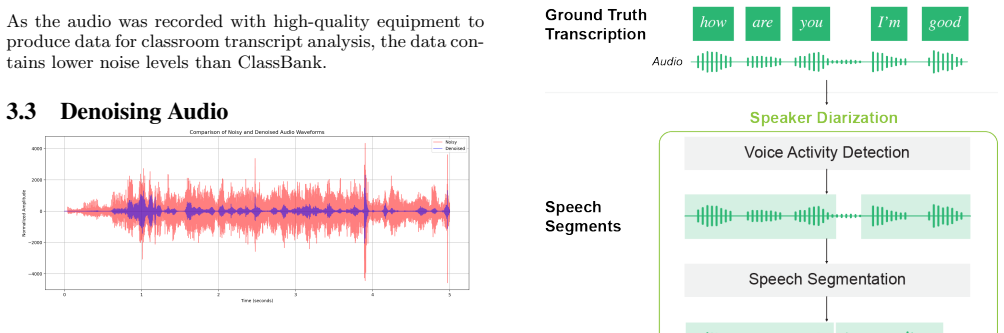
Off-the-shelf diarization models, the paper reports, reach only 52-62% DER on classroom audio, while the adapted pipeline reaches single-digit-to-moderate error rates. The best configuration uses a hybrid voice activity detector: frame-wise speech probabilities from a wav2vec-based model are merged with speech frames derived from ASR word timestamps through the weighted sum $Y_i = \alpha \cdot \text{frame-vad}_i + (1-\alpha)\cdot \text{whisper}_i$, with the weight $\alpha$ tuned on development data. This hybrid lowers both missed speech and false alarms and improves DER by up to 5.6 percentage points over the tuned frame-wise VAD. Denoising at inference reduces missed speech but raises false alarms and speaker confusion, so the paper instead augments the training set with denoised copies of recordings. The all-speaker numbers depend on the oracle number of speakers: Section 4.3 states that clustering was given the ground-truth speaker count, so the reported all-speaker DER is a best-case clustering result. Error analysis shows that short student speech segments, common in classrooms, account for the largest share of confusion and false-alarm errors.
Load-bearing premise
The reported all-speaker error rates assume the clustering step is told the true number of speakers; if a deployment has to guess that number, it will likely do worse and the paper does not measure how much worse.
Editorial extensions
If this is right
- Teacher-student diarization at 17.4% DER is low enough to support automatic talk-ratio analytics in noisy English classrooms, the paper's stated practical target.
- Denoising should be treated as a data-augmentation strategy rather than an inference-time preprocessing step, since inference denoising trades missed speech for false alarms and speaker confusion.
- Short student speech segments are the dominant error source, so progress on diarization for children will come mainly from better handling of sub-2-second turns.
- Beyond two speakers, speaker confusion replaces voice activity detection as the limiting factor: mean CER rises from 9.2% in two-speaker to 29.8% in all-speaker experiments.
- Because the hybrid VAD inherits its speech information from an ASR model, future improvements to classroom ASR should transfer directly into lower DER for this pipeline.
Reading between the lines
- Beyond the paper's claims: the oracle-conditioned clustering means the practical all-speaker DER depends on automatic speaker counting, which the paper does not evaluate; a deployment would likely see the 44-45% figure degrade by however much counting is wrong.
- Beyond the paper's claims: the same weighted-combination idea could be applied at utterance level rather than frame level, using ASR word confidence to set $\alpha$ per turn, which would reduce the computational cost of the hybrid.
- Beyond the paper's claims: the concentration of errors in short student turns suggests that a two-pass system, first detecting candidate student turns and then re-embedding them at higher resolution, is a testable next step.
- Beyond the paper's claims: because the evaluation is English-only, the most direct external check is to run the same hybrid pipeline on non-English classroom recordings to see whether the ASR-timestamp benefit persists.
Signed reviews
Editorial analysis
A structured set of objections, weighed in public.
Referee Report
Summary. The paper adapts NVIDIA's NeMo multi-stage speaker diarization pipeline to noisy classroom audio, evaluating several voice activity detection (VAD) strategies: NeMo's segment-wise MarbleNet, frame-wise MarbleNet, wav2vec2-based VADs (including a classroom-pretrained variant), Whisper word-level timestamps used as VAD, and a hybrid VAD that combines frame-level VAD with Whisper timestamps via a weighted sum. The authors also study the effect of denoising, first at inference time and then as a data-augmentation strategy, and compare teacher-student (two-speaker) versus all-speaker diarization on the public ClassBank dataset and the private MPT dataset. The headline results are a DER of 17% for teacher-student separation and 45% for all-speaker diarization. The paper includes a qualitative error analysis showing that short student speech segments account for a large share of errors.
Significance. If the reported results hold, the paper makes a useful applied contribution: it provides a reproducible recipe (with released code) for adapting an open-source diarization pipeline to noisy classroom recordings, and it demonstrates a simple and effective way to leverage ASR word-level timestamps to improve VAD. The systematic comparison of VAD options and the explicit error analysis by segment length and speaker role are useful for practitioners building classroom analytics tools. However, the headline all-speaker result depends on an oracle speaker count, and the evaluation is based on small test sets without uncertainty quantification, so the strength of the empirical claims is currently overstated.
major comments (3)
- [§4.3] The all-speaker DER numbers in Table 4 (e.g., ClassBank 45.4, MPT 44.4) and the abstract's '45% in all-speaker experiments' are computed with the oracle number of speakers supplied to clustering. The paper notes that automatic speaker prediction 'often led to imbalanced clusters' but provides no quantitative comparison, so the degradation from replacing the oracle with an automatic estimate is unknown. Because a deployed classroom system must infer the number of speakers, this condition materially narrows the headline claim; the limitation section should state it, and the authors should either report all-speaker DER with automatically estimated speaker counts or explicitly label the reported results as oracle-conditioned.
- [§5.1, Table 1] The central claim that denoising and data augmentation 'significantly improve' DER is supported only by mean DER values over very small test sets: the MPT test set has four files and the ClassBank test set has 33 ten-minute files. No confidence intervals, per-file error-rate distributions, or significance tests are reported. Given the large per-file variability typical of classroom audio, the differences in Table 1 (e.g., MPT all-speaker DER worsening from 71.3 to 82.2 after denoising) show that conclusions based on means alone are fragile; the authors should report per-file results or interval estimates, or temper the significance language.
- [§4.1.5] The hyperparameter search over onset and offset thresholds and the hybrid weight α is described as 'identified the best performing combinations,' but the text does not state whether the search was conducted on the development set or the test set. If test-set performance was used for model selection, the reported DERs in Table 4 would be optimistically biased. Please clarify that all threshold and α tuning was done on the development splits, or report the selection procedure explicitly.
minor comments (4)
- [§4.1.4, Eq. (1)] Please define the ranges of frame-vad_i and whisper_i before introducing the weighted combination; the text says 'predictions' but it is not clear whether these are raw probabilities, logits, or binarized frame labels.
- [§5.4.3] The phrase 'DER improvements of up to 5.6%' is ambiguous: it should be stated as absolute percentage points (e.g., from 22.5% to 17.4% would be 5.1 points) or as relative improvement.
- [Table 4 and §4.2] The model name is written inconsistently as 'TitaNet-Large' in Section 4.2 and 'Titanet-Large' in several other places; please standardize the spelling throughout.
- [Title page] The second author's name appears garbled as 'T olúlo. pé. Ògúnrè. mí'; please fix the typesetting of the author name.
Circularity Check
No significant circularity: the paper is an empirical evaluation whose reported DERs are measured, not derived from fitted parameters or self-citations.
full rationale
The paper contains no derivation chain that reduces to its inputs. Its only equations are the definition of DER (Eq. 2: DER = (FA+MISS+CER)/Total Speech Duration) and the hybrid VAD combination (Eq. 1: Y_i = alpha*frame-vad_i + (1-alpha)*whisper_i), neither of which defines a target result in terms of itself. The oracle number of speakers disclosed in Section 4.3 is a conditional evaluation protocol: the all-speaker DER assumes perfect speaker counting, which narrows the scope of the headline claim but is not a fitted parameter renamed as a prediction and does not make DER equivalent to an input by construction. The VAD thresholds and alpha are tuned hyperparameters; the paper does not state that selection occurred on the test set, so this is an overfitting and reproducibility concern, not demonstrated circularity. Self-citations to CPT-Boosted wav2vec2.0 [2] are used as a pretrained model variant whose VAD performance is measured on held-out data, not as an unverified load-bearing premise. There is no uniqueness theorem imported from the authors, no ansatz smuggled in via citation, and no renaming of a known result. The limitation section omits the oracle-count dependency, but that omission is a correctness and scope issue, not circularity. Accordingly, no circular steps are identified.
Assumptions & free parameters
free parameters (4)
- hybrid VAD weight alpha =
not reported
- VAD onset threshold =
not reported
- VAD offset threshold =
not reported
- oracle number of speakers =
ground-truth count per recording
assumptions (5)
- domain assumption NeMo multi-stage diarization components (VAD, speaker embedding, clustering) function as documented after adaptation.
- domain assumption Sainburg's noisereduce algorithm removes background noise without removing speech when used as augmentation.
- domain assumption Ground-truth RTTM annotations are accurate.
- domain assumption Whisper word-level timestamps are reliable enough to serve as pseudo-VAD.
- ad hoc to paper The number of speakers is known a priori for all-speaker clustering.
Cite this review
Pith. "Pith review of Multi-Stage Speaker Diarization for Noisy Classrooms." pith.science (2026). https://pith.science/paper/MDSFM5JY
@misc{pith2026250510879,
  author       = {Pith},
  title        = {Pith review of: Multi-Stage Speaker Diarization for Noisy Classrooms},
  year         = {2026},
  howpublished = {\url{https://pith.science/paper/MDSFM5JY}},
  note         = {Machine review of arXiv:2505.10879}
}
read the original abstract
Speaker diarization, the process of identifying "who spoke when" in audio recordings, is essential for understanding classroom dynamics. However, classroom settings present distinct challenges, including poor recording quality, high levels of background noise, overlapping speech, and the difficulty of accurately capturing children's voices. This study investigates the effectiveness of multi-stage diarization models using Nvidia's NeMo diarization pipeline. We assess the impact of denoising on diarization accuracy and compare various voice activity detection (VAD) models, including self-supervised transformer-based frame-wise VAD models. We also explore a hybrid VAD approach that integrates Automatic Speech Recognition (ASR) word-level timestamps with frame-level VAD predictions. We conduct experiments using two datasets from English speaking classrooms to separate teacher vs. student speech and to separate all speakers. Our results show that denoising significantly improves the Diarization Error Rate (DER) by reducing the rate of missed speech. Additionally, training on both denoised and noisy datasets leads to substantial performance gains in noisy conditions. The hybrid VAD model leads to further improvements in speech detection, achieving a DER as low as 17% in teacher-student experiments and 45% in all-speaker experiments. However, we also identified trade-offs between voice activity detection and speaker confusion. Overall, our study highlights the effectiveness of multi-stage diarization models and integrating ASR-based information for enhancing speaker diarization in noisy classroom environments.
Figures


Reference graph
Works this paper leans on
-
[1]
INTRODUCTION ∗(Does NOT produce the permission block, copyright infor- mation nor page numbering). For use with edm article.cls. Understanding classroom interactions is essential for enhanc- ing student engagement, promoting collaborative learning, and implementing effective teaching strategies. By examin- ing who speaks, when, and for how long, we can ga...
arXiv 2025
-
[2]
RELA TED WORK 2.1 Speech Recognition in Classroom Settings Prior studies have highlighted challenges in achieving accu- rate transcriptions in noisy classrooms. Both Southwell et al. [37] and Cao el al. [6] evaluated multiple ASR engines for transcribing recordings of student classroom discourse and found high Word Error Rates (WER) across all sys- tems. ...
-
[3]
DA TA This study utilized two datasets: ClassBank [21] and the M- Powering Teachers (MPT) Data [2]. These datasets provide ∼60 hours of speech recordings that reflect various classroom environments, speaker demographics, and noise conditions. 3.1 ClassBank Dataset The ClassBank dataset [21] is a publicly available dataset that provides access to transcrib...
-
[4]
DIARIZA TION ARCHITECTURE Our model architecture customizesNeMo’s multi-stage di- arization pipeline[23]. Given an input audio file, this pipeline generates timestamps for detected speech segments and as- signs a speaker label to each segment. Segments are defined as continuous audio clips containing speech that are defined by start and end timestamps. Th...
-
[5]
EXPERIMENTS AND RESULTS We conducted experiments to separate teacher-student speech and separate speech from all speakers. To evaluate diariza- tion performance, we use diarization error rate (DER), which is calculated as the sum of false alarm (FA), missed detection (MISS), and confusion error rate (CER): DER= (FA+MISS+CER)/Total Speech Duration (2) 5.1 ...
-
[6]
CONCLUSION AND FUTURE WORK Speaker diarization systems play a crucial role in analyzing classroom interactions by distinguishing individual speakers and teacher-student dynamics. This technology offers valu- able insights into communication patterns, student engage- ment, and instructional effectiveness, enabling educators to refine teaching strategies fo...
-
[7]
PRACTICAL IMPLICA TIONS The hybrid pipeline results in speaker-attributed transcripts which may be accurate enough to support downstream ana- lytics such as the calculation of teacher-student talk ratios. These analytics enable tools like TeachFX 2, TalkMoves [39] or M-Powering Teachers [8] to surface insights to teachers or coaches without costly manual ...
-
[8]
The generalizability of our findings to other classroom data contexts remains to be tested
LIMITA TIONS Our data is drawn from English-speaking classrooms, is a relatively small sample drawn from particular teacher and student populations, and was recorded often with high-quality equipment. The generalizability of our findings to other classroom data contexts remains to be tested. Our data also lacks voice enrollment information, which makes th...
Show all 53 references
-
[9]
Amazon transcribe, 2021
Amazon Web Services. Amazon transcribe, 2021. https://docs.aws.amazon.com/transcribe/
2021
-
[10]
A. A. Attia, D. Demszky, T. Ogunremi, J. Liu, and C. Espy-Wilson. CPT-boosted wav2vec2.0: Towards noise robust speech recognition for classroom environments, 2024
2024
-
[11]
Baevski, Y
A. Baevski, Y. Zhou, A. Mohamed, and M. Auli. wav2vec 2.0: A framework for self-supervised learning of speech representations.Advances in neural information processing systems, 33:12449–12460, 2020
2020
-
[12]
H. Bredin. pyannote.audio 2.1 speaker diarization pipeline: principle, benchmark, and recipe. InProc. INTERSPEECH 2023, 2023
2023
-
[13]
Canovas and F
O. Canovas and F. J. Garc´ ıa Clemente. Analysis of classroom interaction using speaker diarization and discourse features from audio recordings. 09 2022
2022
-
[14]
J. Cao, A. Ganesh, J. Cai, R. Southwell, E. M. Perkoff, M. Regan, K. Kann, J. H. Martin, M. Palmer, and S. D’Mello. A comparative analysis of automatic speech recognition errors in small group classroom discourse. InProceedings of the 31st ACM Conference on User Modeling, Adap...
2023
-
[15]
Chang, W
X. Chang, W. Zhang, Y. Qian, J. L. Roux, and S. Watanabe. End-to-end multi-speaker speech recognition with transformer, 2020
2020
-
[16]
Demszky and J
D. Demszky and J. Liu. M-powering teachers: Natural language processing powered feedback improves 1: 1 instruction and student outcomes. InProceedings of the Tenth ACM Conference on Learning@ Scale, pages 59–69, 2023
2023
-
[17]
Demszky, R
D. Demszky, R. Wang, S. Geraghty, and C. Yu. Does feedback on talk time increase student engagement? evidence from a randomized controlled trial on a math tutoring platform. InProceedings of the 14th Learning Analytics and Knowledge Conference, pages 632–644, 2024
2024
-
[18]
Desplanques, J
B. Desplanques, J. Thienpondt, and K. Demuynck. Ecapa-tdnn: Emphasized channel attention, propagation and aggregation in tdnn based speaker verification.arXiv preprint arXiv:2005.07143, 2020
2005 arXiv
-
[19]
Dubey, L
H. Dubey, L. Kaushik, A. Sangwan, and J. H. Hansen. A speaker diarization system for studying peer-led team learning groups.arXiv preprint arXiv:1606.07136, 2016
2016 arXiv
-
[20]
Dutta, D
S. Dutta, D. Irvin, J. Buzhardt, and J. H. Hansen. Activity focused speech recognition of preschool children in early childhood classrooms. In E. Kochmar, J. Burstein, A. Horbach, R. Laarmann-Quante, N. Madnani, A. Tack, V. Yaneva, Z. Yuan, and T. Zesch, editors, Proceedings o...
2022
-
[21]
Fujita, S
Y. Fujita, S. Watanabe, S. Horiguchi, Y. Xue, J. Shi, and K. Nagamatsu. Neural speaker diarization with speaker-wise chain rule.arXiv preprint arXiv:2006.01796, 2020
2006 arXiv
-
[22]
D. Fung, H. To, and K. Leung. collaborative-learning: The influence of collaborative group work on students’ development of critical thinking: The teacher’s role in facilitating group discussions.Pedagogies: An International Journal, 11:146–166, 04 2016
2016
-
[23]
A. Gomez. Speaker diarization and identification from single-channel classroom audio recording using virtual microphones, 2022
2022
-
[24]
Detect different speakers in an audio recording, 2021.https://cloud.google.com/ speech-to-text/docs/multiple-voices
Google Cloud. Detect different speakers in an audio recording, 2021.https://cloud.google.com/ speech-to-text/docs/multiple-voices
2021
-
[25]
Harper, S
E. Harper, S. Majumdar, O. Kuchaiev, L. Jason, Y. Zhang, E. Bakhturina, V. Noroozi, S. Subramanian, K. Nithin, H. Jocelyn, et al. Nemo: A toolkit for conversational ai and large language models.Computer software], URL: https://github. com/NVIDIA/NeMo, 2019
2019
-
[26]
W.-N. Hsu, A. Sriram, A. Baevski, T. Likhomanenko, Q. Xu, V. Pratap, J. Kahn, A. Lee, R. Collobert, G. Synnaeve, et al. Robust wav2vec 2.0: Analyzing domain shift in self-supervised pre-training.arXiv preprint arXiv:2104.01027, 2021
2021 arXiv
-
[27]
Kanda, X
N. Kanda, X. Xiao, Y. Gaur, X. Wang, Z. Meng, Z. Chen, and T. Yoshioka. Transcribe-to-diarize: Neural speaker diarization for unlimited number of speakers using end-to-end speaker-attributed asr. In ICASSP 2022-2022 IEEE International Conference on Acoustics, Speech and Signal...
2022
-
[28]
Kelly, A
S. Kelly, A. Olney, P. Donnelly, M. Nystrand, and S. D’Mello. Automatically measuring question authenticity in real-world classrooms.Educational Researcher, 47:0013189X1878561, 06 2018
2018
-
[29]
MacWhinney
B. MacWhinney. A transcript-video database for collaborative commentary in the learning sciences. In R. Goldman, R. Pea, B. Barron, and S. Derry, editors, Video research in the learning sciences, pages 537–546. Lawrence Erlbaum Associates, Mahwah, NJ, 2007
2007
-
[30]
Ecapa-tdnn model for speaker recognition and verification, 2024
NVIDIA. Ecapa-tdnn model for speaker recognition and verification, 2024. Accessed: February 15, 2025
2024
-
[31]
Accessed: February 15, 2025
NVIDIA.NVIDIA NeMo Speaker Diarization User Guide, 2024. Accessed: February 15, 2025
2024
-
[32]
Speakernet model for speaker recognition and verification, 2024
NVIDIA. Speakernet model for speaker recognition and verification, 2024. Accessed: February 15, 2025
2024
-
[33]
Titanet-large model for speaker recognition and verification, 2024
NVIDIA. Titanet-large model for speaker recognition and verification, 2024. Accessed: February 15, 2025
2024
-
[34]
Vad marblenet model, 2024
NVIDIA. Vad marblenet model, 2024. Accessed: February 15, 2025
2024
-
[35]
Vad multilingual frame marblenet model,
NVIDIA. Vad multilingual frame marblenet model,
-
[36]
Sainburg, M
T. Sainburg, M. Thielk, and T. Q. Gentner. Finding, visualizing, and quantifying latent structure across diverse animal vocal repertoires.PLoS computational biology, 16(10):e1008228, 2020
2020
-
[37]
Vad multilingual marblenet model, 2024
NVIDIA. Vad multilingual marblenet model, 2024. Accessed: February 15, 2025
2024
-
[38]
Vad telephony marblenet model, 2024
NVIDIA. Vad telephony marblenet model, 2024. Accessed: February 15, 2025
2024
-
[39]
D. S. Park, Y. Zhang, Y. Jia, W. Han, C.-C. Chiu, B. Li, Y. Wu, and Q. V. Le. Improved noisy student training for automatic speech recognition.arXiv preprint arXiv:2005.09629, 2020
2005 arXiv
-
[40]
T. J. Park, N. Kanda, D. Dimitriadis, K. J. Han, S. Watanabe, and S. Narayanan. A review of speaker diarization: Recent advances with deep learning, 2021
2021
-
[41]
Radford, J
A. Radford, J. W. Kim, T. Xu, G. Brockman, C. McLeavey, and I. Sutskever. Robust speech recognition via large-scale weak supervision, 2022
2022
-
[42]
Radford, J
A. Radford, J. W. Kim, T. Xu, G. Brockman, C. McLeavey, and I. Sutskever. Robust speech recognition via large-scale weak supervision. In International conference on machine learning, pages 28492–28518. PMLR, 2023
2023
-
[43]
R ¨as¨anen, S
O. R ¨as¨anen, S. Seshadri, M. Lavechin, A. Cristia, and M. Casillas. Alice: An open-source tool for automatic measurement of phoneme, syllable, and word counts from child-centered daylong recordings.Behavior Research Methods, 53:818–835, 2021
2021
-
[44]
Sainburg
T. Sainburg. timsainb/noisereduce: v1.0, June 2019
2019
-
[46]
Southwell, S
R. Southwell, S. Pugh, E. M. Perkoff, C. Clevenger, J. Bush, R. Lieber, W. Ward, P. Foltz, and S. D’Mello. Challenges and feasibility of automatic speech recognition for modeling student collaborative discourse in classrooms. In A. Mitrovic and N. Bosch, editors,Proceedings of...
2022
-
[47]
A. Sun, J. J. Londono, B. Elbaum, L. Estrada, R. J. Lazo, L. Vitale, H. G. Villasanti, R. Fusaroli, L. K. Perry, and D. S. Messinger. Who said what? an automated approach to analyzing speech in preschool classrooms.arXiv preprint arXiv:2401.07342, 2024
2024 arXiv
-
[48]
Suresh, J
A. Suresh, J. Jacobs, V. Lai, C. Tan, W. Ward, J. H. Martin, and T. Sumner. Using transformers to provide teachers with personalized feedback on their classroom discourse: The talkmoves application.arXiv preprint arXiv:2105.07949, 2021
2021 arXiv
-
[49]
J. Wang, S. Dudy, X. He, Z. Wang, R. Southwell, and J. Whitehill. Speaker diarization in the classroom: How much does each student speak in group discussions? In B. Paa ˜A¨Yen and C. D. Epp, editors, Proceedings of the 17th International Conference on Educational Data Mining, ...
2024
-
[50]
Z. Wang, X. Pan, K. F. Miller, and K. S. Cortina. Automatic classification of activities in classroom discourse.Computers & Education, 78:115–123, 2014
2014
-
[51]
Wung, B.-H
J. Wung, B.-H. F. Juang, and B. Lee. Speech enhancement based on a log-spectral amplitude estimator and a postfilter derived from clean speech codebook. In2010 18th European Signal Processing Conference, pages 999–1003, 2010
2010
-
[52]
G. Yu, E. Bacry, and S. Mallat. Audio signal denoising with complex wavelets and adaptive block attenuation. In2007 IEEE International Conference on Acoustics, Speech and Signal Processing - ICASSP ’07, volume 3, pages III–869–III–872, 2007
2007
-
[53]
Zhou and L
J. Zhou and L. Tao. Speech enhancement in joint time-frequency domain based on real-valued discrete gabor transform. In2010 5th International Conference on Computer Science & Education, pages 1028–1031, 2010
2010
-
[2024]
Accessed: February 15, 2025
2025
Reviewed August 15, 2026 · model on record in the stance chip above.
Discussion (0). Continue with ORCID to comment.