REVIEW 4 major objections 5 minor 13 references
Vaiage: A Multi-Agent Solution to Personalized Travel Planning
T0 review · 4 major / 5 minor · reviewed 2026-08-15 · deepseek-v4-flash
Pith's one-line read Vaiage claims that a team of specialized LLM agents coordinated by a shared graph memory and grounded in live APIs produces personalized travel itineraries that LLM judges score 8.5/10, outperforming ablated variants by 1.3-1.7 points.
desk verdict Vaiage is a genuinely well-specified multi-agent travel planner, but its headline 8.5-vs-7.2/6.8 result rests on a self-referential LLM-judge evaluation with no error bars, no human validation, and an internal inconsistency about which dimension improved. read the letter →
The pith
A machine-rendered reading of the paper's core claim, the machinery that carries it, and where it could break.
The reading
What carries the argument
The central object is TravelGraph, a graph-structured context manager that keeps user sessions and agent state in one place and routes event-driven messages among the six agents. Each agent is an LLM with a specialized prompt and tool set: the Information Agent makes all external API calls and caches results; the Recommend Agent re-ranks attractions against user preferences; the Route Agent drafts multi-day, budget-allocated itineraries; and the Strategy Agent loops over leftover time and constraints to insert complementary attractions and adjust sequencing. The claim is that this graph-plus-specialists arrangement turns raw LLM suggestion into a feasible, explainable schedule.
What would settle it
A blinded human study would settle it: give the same five user requests to the full, no-strategy, and no-API variants and have independent human raters score the outputs on the same 1-10 dimensions; if humans do not rank the full system above both ablations by a clear margin, the reported advantage is an artifact of LLM judging. A complementary check is plan execution—run one itinerary and measure whether opening hours, travel times, and budget estimates hold.
Extended reading notes
Core claim
Vaiage consists of six LLM-powered agents—Chat, Information, Recommendation, Route, Strategy, and Communication—connected by a centralized graph-structured context manager called TravelGraph. The paper's central claim is that this composition matters: the full system's plans scored 8.5/10 on a GPT-4 rubric averaged over five diverse travel scenarios, while the no-Strategy variant scored 7.2 and the no-external-API variant scored 6.8. The authors attribute the largest part of the API-related drop to Feasibility, and the Strategy Agent's contribution to better time use and schedule refinement. They conclude that LLM reasoning, modular agent coordination, and real-time external grounding together produce adaptive, explainable itineraries that satisfy user constraints such as budget, group composition, health, and weather.
Load-bearing premise
The load-bearing premise is that GPT-4 and GPT-3.5 rubric scores are a valid measure of travel-plan quality and that the 1.3-to-1.7 point gaps are practically meaningful; the evaluation never validates these proxy judges against human travelers, domain experts, or plan execution.
Editorial extensions
If this is right
- If the central claim is right, trip-planning products can be built as modular agent teams whose internal reasoning is inspectable and whose outputs adapt conversationally as users add constraints.
- Removing the Strategy Agent costs 1.3 points on the LLM rubric, so schedule-refinement after initial recommendation is a principal source of plan quality, not a cosmetic step.
- Removing external APIs costs 1.7 points and hits Feasibility hardest, so grounding itineraries in real map, weather, and transport data is necessary for plans that appear practically executable.
- The five test scenarios span culture, architecture, family needs, mobility limits, and budgets, suggesting the architecture generalizes across trip types rather than overfitting one style.
Reading between the lines
- Editorial inference, not in the paper: if LLM rubric scores track what travelers value, the same graph-coordinated agent pattern could transfer to other constraint-heavy open-ended tasks such as conference scheduling, multi-stop logistics, and day-of-event replanning.
- A direct testable extension the paper does not run: replace the LLM judges with human travelers or professional trip planners rating blind; if humans see no gap between full and ablated plans, the reported 8.5/7.2/6.8 spread is an artifact of the proxy judge.
- The paper leaves long-term personalization as future work, but TravelGraph's persistent session memory is a natural substrate for it: one could feed past trips back into the Strategy Agent as additional constraints and test whether plan quality improves over repeated sessions.
Signed reviews
Editorial analysis
A structured set of objections, weighed in public.
Referee Report
Summary. Vaiage is a multi-agent travel planning system in which LLM-powered agents handle user interaction, external API retrieval (Maps, Weather, Places, rental), attraction recommendation, route construction, and plan refinement, coordinated through a graph-based context store called TravelGraph. The paper describes the architecture, a user guide, and an evaluation in which five hand-crafted scenarios are scored by GPT-4/GPT-3.5 rubrics. The full system reportedly achieves an average score of 8.5/10, versus 7.2 without the Strategy Agent and 6.8 without external APIs, and the authors interpret this as evidence that combining LLM reasoning with symbolic agent coordination improves personalized travel planning.
Significance. If the reported improvements were established by a sound evaluation, Vaiage would be a useful demonstration that graph-structured multi-agent LLM architectures with real-time API integration can yield more personalized and feasible itineraries than simpler LLM pipelines. The system design is modular, the code is publicly available, and the prompt templates are included in the appendix, which are strengths for reproducibility. However, the central empirical claim is currently supported only by LLM-generated rubric scores on five scenarios, with no human validation, no statistical inference, and an inconsistency between the abstract and Section 5.4 about which dimension drives the improvement. As it stands, the paper does not substantiate the claimed superiority of the full system.
major comments (4)
- [Sections 5.3–5.4] The central claim that the full system 'significantly outperforms' the ablated variants (8.5 vs 7.2 vs 6.8) is based entirely on rubric scores produced by GPT-4/GPT-3.5, the same model family that generates the plans. With only five hand-authored scenarios, no confidence intervals, no paired significance tests, and no human rating protocol, the reported gaps may reflect surface-level cues in the generated text (e.g., presence of weather information, concrete POI names, car-rental suggestions) rather than actual itinerary quality. The authors should add human evaluation of the same outputs, report per-scenario scores and variance, and either provide a statistical test or temper the 'significantly outperforms' language.
- [Abstract vs. Section 5.4] The abstract states that the full system outperforms the variants 'particularly in Feasibility,' while Section 5.4 reports that the full system improves 'especially in terms of Relevance and Personalization' and that the no-external-API variant shows its largest drop in Feasibility. These are not the same claim, and the ambiguity is load-bearing because the paper's main evidence is the 1.3–1.7 point score gaps. The authors should reconcile the text and present per-dimension scores for all variants in a table so readers can see which rubric dimension actually drives the headline difference.
- [Section 5.2 and 5.4] With n=5 scenarios and no repeated runs or error bars, the statement that the full system 'significantly outperforms' the baselines is not statistically supported. A single run on each scenario cannot distinguish a systematic advantage from noise, especially when the judge is an LLM with its own stochasticity. Provide multiple runs, score variance for each scenario/variant, and an appropriate paired test (e.g., Wilcoxon signed-rank) if significance is claimed.
- [Abstract and Section 5.4] The abstract claims 'human-in-the-loop experiments,' but Section 5 describes only LLM rubric scoring and 'qualitative feedback,' with no protocol for human participants, number of raters, or analysis method. Section 5.4 states that 'the evaluation data, including detailed LLM assessments and human evaluations, is available in the project repository,' but no human evaluation is described or summarized in the manuscript. Clarify what human-in-the-loop means here and report the human ratings or explain why they are omitted from the main text.
minor comments (5)
- [Section 5.1] The scoring prompt mentions GPT-4 and GPT-3.5, but the paper does not specify which model is used for which role or how the two judge outputs are combined; please clarify the protocol.
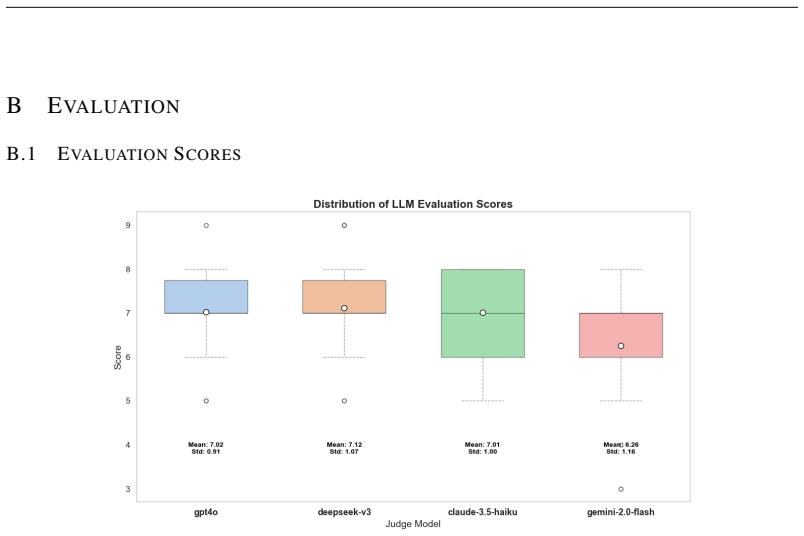
- [Appendix B.1] Figure 10 is labeled 'Distribution of LLM Evaluation Scores' but no textual description is provided; add axis labels and a brief caption explaining what is plotted.
- [Introduction] The Google Drive link for the video and slides ends with 'usp=sharin' and appears truncated; please correct the URL.
- [References] The reference to Houlsby et al. lists venue as 'ICML' but omits the standard citation details (e.g., proceedings page numbers); please complete the entry.
- [Title and header] The paper title is rendered without spaces in the running header ('MULTI-AGENTSOLUTION TOPERSONAL-IZEDTRAVELPLANNING'); this appears to be a formatting artifact, but it should be corrected in the camera-ready version.
Circularity Check
No circularity: the paper's empirical claims rest on LLM rubric judgments, which is a construct-validity concern, not a definitional reduction.
full rationale
The paper contains no formal derivation chain, no fitted parameters renamed as predictions, and no load-bearing self-citation. Its central claim is empirical: the full Vaiage system scores 8.5/10 versus 7.2 without the Strategy Agent and 6.8 without external APIs, using GPT-4 and GPT-3.5 as rubric-based judges. While using the same LLM family for both plan generation and evaluation raises a legitimate concern about judge bias and construct validity, this is not circularity under the required patterns: the paper does not define plan quality as the LLM's score, does not fit any parameter to the judge's outputs, and does not rely on a self-citation chain to forbid alternatives. The rubric dimensions (Relevance, Feasibility, Personalization, Satisfaction) are stated as independent criteria, and the reported improvement is not forced by construction. The internal inconsistency between the abstract's claim that gains were 'particularly in Feasibility' and Section 5.4's statement that the full system improves 'especially in terms of Relevance and Personalization' is a reporting-consistency or correctness risk, not a circular step. Likewise, the lack of human validation, confidence intervals, and inter-annotator agreement weakens the empirical conclusion but does not make any result equivalent to its inputs by definition. Accordingly, the appropriate finding is no significant circularity.
Assumptions & free parameters
assumptions (4)
- domain assumption GPT-4/GPT-3.5 rubric scores are a valid proxy for itinerary quality.
- domain assumption External APIs (Google Maps, OpenWeatherMap, Places, RapidAPI) return accurate, timely data.
- ad hoc to paper The handwritten prompt templates in Appendix A reliably produce the intended agent behavior.
- domain assumption The five scenarios in Section 5.2 are representative of typical travel planning tasks.
Cite this review
Pith. "Pith review of Vaiage: A Multi-Agent Solution to Personalized Travel Planning." pith.science (2026). https://pith.science/paper/IWKN5E3C
@misc{pith2026250510922,
  author       = {Pith},
  title        = {Pith review of: Vaiage: A Multi-Agent Solution to Personalized Travel Planning},
  year         = {2026},
  howpublished = {\url{https://pith.science/paper/IWKN5E3C}},
  note         = {Machine review of arXiv:2505.10922}
}
read the original abstract
Planning trips is a cognitively intensive task involving conflicting user preferences, dynamic external information, and multi-step temporal-spatial optimization. Traditional platforms often fall short - they provide static results, lack contextual adaptation, and fail to support real-time interaction or intent refinement. Our approach, Vaiage, addresses these challenges through a graph-structured multi-agent framework built around large language models (LLMs) that serve as both goal-conditioned recommenders and sequential planners. LLMs infer user intent, suggest personalized destinations and activities, and synthesize itineraries that align with contextual constraints such as budget, timing, group size, and weather. Through natural language interaction, structured tool use, and map-based feedback loops, Vaiage enables adaptive, explainable, and end-to-end travel planning grounded in both symbolic reasoning and conversational understanding. To evaluate Vaiage, we conducted human-in-the-loop experiments using rubric-based GPT-4 assessments and qualitative feedback. The full system achieved an average score of 8.5 out of 10, outperforming the no-strategy (7.2) and no-external-API (6.8) variants, particularly in feasibility. Qualitative analysis indicated that agent coordination - especially the Strategy and Information Agents - significantly improved itinerary quality by optimizing time use and integrating real-time context. These results demonstrate the effectiveness of combining LLM reasoning with symbolic agent coordination in open-ended, real-world planning tasks.
Figures


Figures from the paper (7 more)


Reference graph
Works this paper leans on
-
[1]
Improving language models by retrieving from trillions of tokens
Sebastian Borgeaud et al. Improving language models by retrieving from trillions of tokens. arXiv preprint arXiv:2112.04426, 2021
arXiv 2021
-
[2]
Parameter-efficient transfer learning for nlp
Neil Houlsby et al. Parameter-efficient transfer learning for nlp. In ICML, 2022
work page 2022
-
[3]
Generalization through memorization: Nearest neighbor language models
Urvashi Khandelwal et al. Generalization through memorization: Nearest neighbor language models. arXiv preprint arXiv:1911.00172, 2019
arXiv 1911
-
[4]
Retrieval-augmented generation for knowledge-intensive nlp tasks
Patrick Lewis et al. Retrieval-augmented generation for knowledge-intensive nlp tasks. In Advances in Neural Information Processing Systems, 2020
work page 2020
-
[5]
Tensor product of holomorphic discrete series representations of U(p,q) and quivers
Zihan Li et al. Conversational recommendation with large language models. arXiv preprint arXiv:2304.02000, 2023
work page Pith review arXiv 2023
-
[6]
How can recommender systems benefit from llms: A survey
Jianghao Lin et al. How can recommender systems benefit from llms: A survey. ACM Transactions on Information Systems, 2025
work page 2025
-
[7]
An empirical study on retrieval-augmented language models
Yuning Mao et al. An empirical study on retrieval-augmented language models. arXiv preprint arXiv:2104.07567, 2021
arXiv 2021
-
[8]
Alex Sarch et al. Memory-augmented agents for embodied instruction following. arXiv preprint arXiv:2303.12037, 2023
work page Pith review arXiv 2023
Show all 13 references
-
[9]
Planner agents with long-term memory for task-oriented planning
Yan Song et al. Planner agents with long-term memory for task-oriented planning. arXiv preprint arXiv:2301.00700, 2023
2023 arXiv
-
[11]
Memorizing transformers
Shiyue Wu et al. Memorizing transformers. arXiv preprint arXiv:2203.08913, 2022
2022 arXiv
-
[12]
@esa (Ref
\@ifxundefined[1] #1\@undefined \@firstoftwo \@secondoftwo \@ifnum[1] #1 \@firstoftwo \@secondoftwo \@ifx[1] #1 \@firstoftwo \@secondoftwo [2] @ #1 \@temptokena #2 #1 @ \@temptokena \@ifclassloaded agu2001 natbib The agu2001 class already includes natbib coding, so you should ...
-
[13]
\@lbibitem[] @bibitem@first@sw\@secondoftwo \@lbibitem[#1]#2 \@extra@b@citeb \@ifundefined br@#2\@extra@b@citeb \@namedef br@#2 \@nameuse br@#2\@extra@b@citeb \@ifundefined b@#2\@extra@b@citeb @num @parse #2 @tmp #1 NAT@b@open@#2 NAT@b@shut@#2 \@ifnum @merge>\@ne @bibitem@firs...
-
[14]
@open @close @open @close and [1] URL: #1 \@ifundefined chapter * \@mkboth \@ifxundefined @sectionbib * \@mkboth * \@mkboth\@gobbletwo \@ifclassloaded amsart * \@ifclassloaded amsbook * \@ifxundefined @heading @heading NAT@ctr thebibliography [1] @ \@biblabel @NAT@ctr \@bibset...
2024 arXiv
Reviewed August 15, 2026 · model on record in the stance chip above.
Discussion (0). Continue with ORCID to comment.