Depolarization of synchrotron radiation of a relativistic electron beam
Pith reviewed 2026-05-22 14:46 UTC · model grok-4.3
The pith
Synchrotron radiation from a relativistic electron beam depolarizes as the beam self-polarizes to about -0.8 through emission in a perpendicular magnetic field.
A machine-rendered reading of the paper's core claim, the machinery that carries it, and where it could break.
Core claim
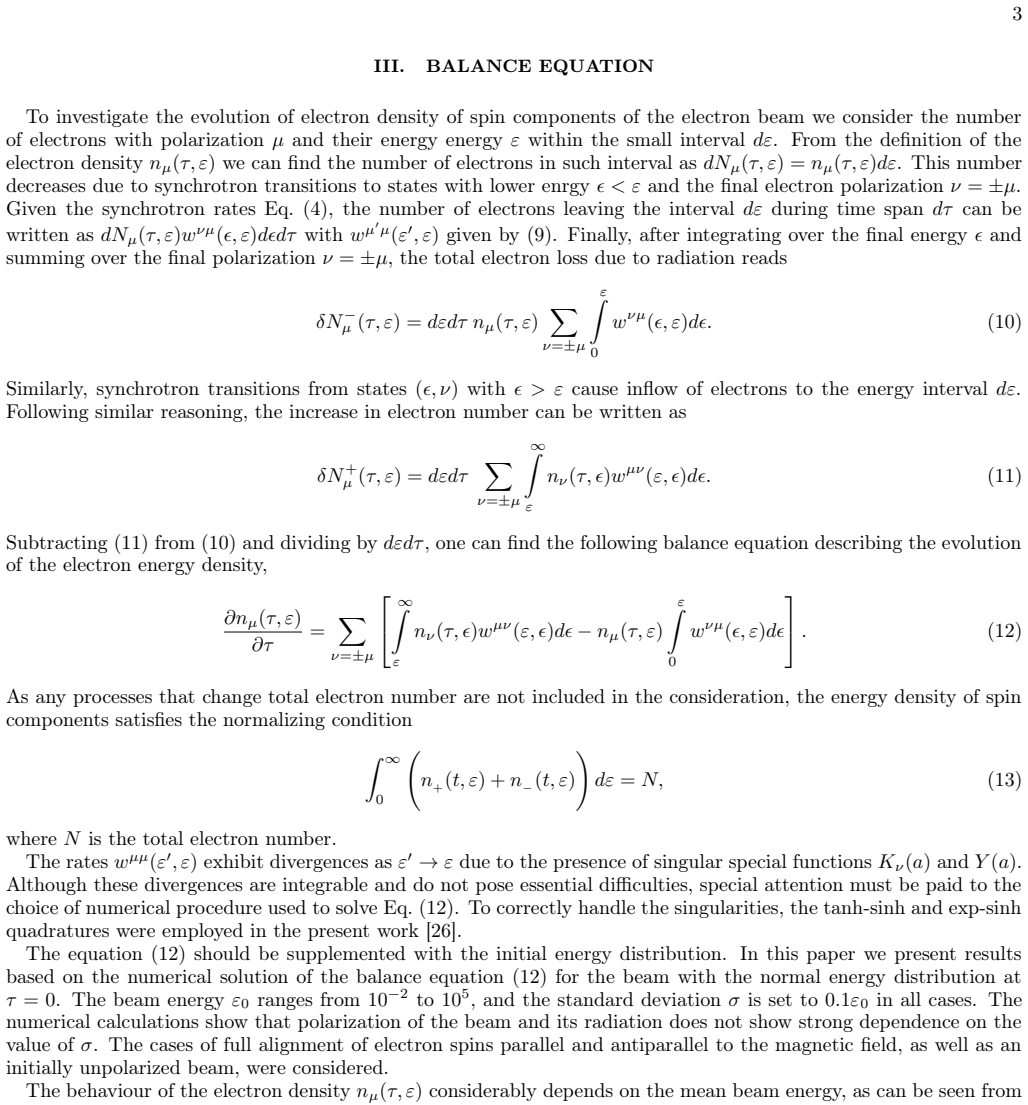
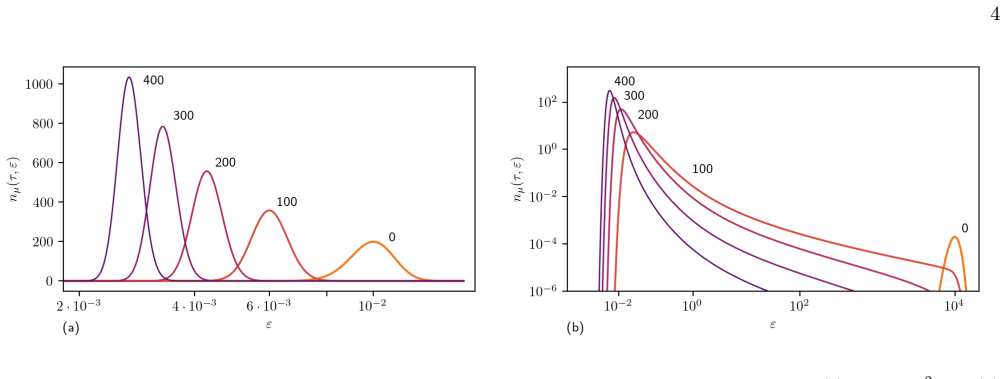
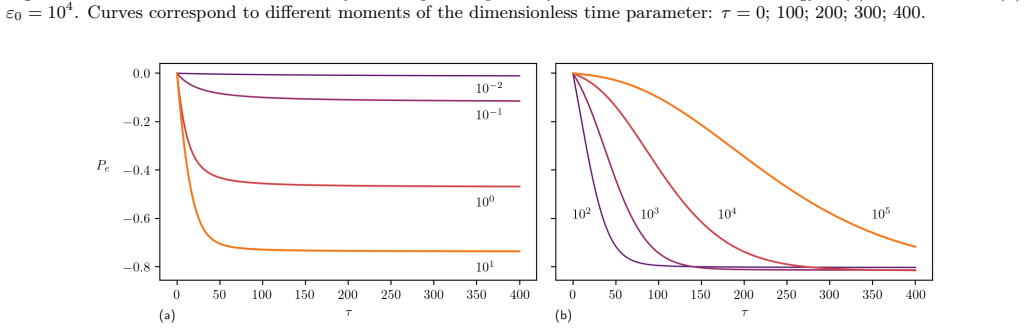
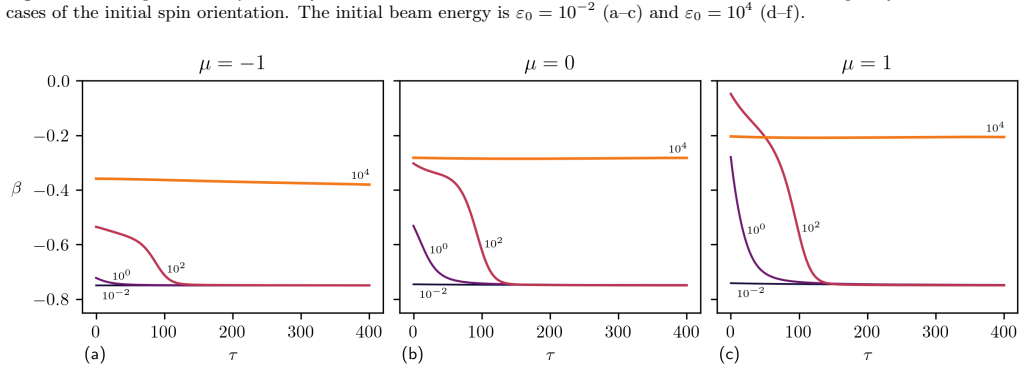
The numerical solution of the balance equation shows that the resulting electron beam polarization increases rapidly as a function of ε for ε ≪ 1 and saturates at a value of approximately -0.8. If ε ≫ 1, the rate of self-polarization decreases significantly. At the same time, a substantial or nearly complete depolarization of synchrotron radiation is observed, particularly for an electron beam with spins initially aligned parallel to the field.
What carries the argument
The balance equation that evolves the electron spin polarization through emission of polarized synchrotron photons, solved numerically versus the dimensionless parameter ε.
If this is right
- Electron polarization grows rapidly for ε much less than one.
- Polarization saturates near -0.8 for moderate ε.
- Self-polarization slows markedly when ε greatly exceeds one.
- Synchrotron radiation undergoes substantial or nearly complete depolarization for large ε, especially with initial spins parallel to the field.
Where Pith is reading between the lines
- The radiation depolarization could serve as an observable signature of the beam's self-polarization state in laboratory setups.
- Polarized photon beam applications would require operating at moderate rather than very high ε to preserve radiation polarization.
- The saturation value near -0.8 may shift if non-perpendicular components or higher-order quantum effects become important.
Load-bearing premise
The radiative self-polarization process is fully captured by the balance equation whose numerical solution is reported, without dominant contributions from unmodeled effects such as quantum recoil corrections, beam instabilities, or non-perpendicular propagation components.
What would settle it
A direct measurement of the polarization of synchrotron radiation emitted by an electron beam with known initial parallel spin alignment at ε values much larger than one, which should register near-zero polarization under the reported model.
Figures
read the original abstract
We present a theoretical study on the radiative self-polarization of a high-energy electron beam propagating perpendicular to a strong magnetic field. Recently, a similar setup has been proposed as a source of polarized electron and photon beams. We focus on the dependence of electron and radiation polarization on the dimensionless parameter $\varepsilon$, which is proportional to the product of electron energy and magnetic field strength. The numerical solution of the balance equation shows that the resulting electron beam polarization increases rapidly as a function of $\varepsilon$ for $\varepsilon \ll 1$ and saturates at a value of approximately $-0.8$. If $\varepsilon \gg 1$, the rate of self-polarization decreases significantly. At the same time, a substantial or nearly complete depolarization of synchrotron radiation is observed, particularly for an electron beam with spins initially aligned parallel to the field.
Editorial analysis
A structured set of objections, weighed in public.
Referee Report
Summary. The paper presents a theoretical study on the radiative self-polarization of a high-energy electron beam propagating perpendicular to a strong magnetic field. It focuses on the dependence of electron and radiation polarization on the dimensionless parameter ε, which is proportional to the product of electron energy and magnetic field strength. The numerical solution of the balance equation shows that the resulting electron beam polarization increases rapidly as a function of ε for ε ≪ 1 and saturates at a value of approximately -0.8. If ε ≫ 1, the rate of self-polarization decreases significantly. At the same time, a substantial or nearly complete depolarization of synchrotron radiation is observed, particularly for an electron beam with spins initially aligned parallel to the field.
Significance. If the numerical results hold and the balance equation accurately incorporates the full QED transition rates including recoil corrections, the findings would extend the Sokolov-Ternov effect into the quantum regime and could inform proposals for polarized electron and photon beam sources in high-energy physics.
major comments (2)
- [Numerical solution] The explicit form of the balance equation, the numerical integration method employed, and any convergence checks or error estimates are not provided. This omission is load-bearing because the central quantitative claims (saturation near -0.8 for ε ≪ 1 and suppression for ε ≫ 1) rest entirely on these unreported numerics.
- [Large-ε regime] For the ε ≫ 1 regime the reported decrease in self-polarization rate and near-complete depolarization of the radiation require that the spin-flip and photon-emission rates include quantum recoil corrections (χ ∼ ε). No derivation from the Dirac equation in a magnetic field or explicit χ-dependent expressions are given, so it is unclear whether the results follow from the correct QED rates or from a classical/leading-order truncation.
minor comments (1)
- [Abstract] An explicit formula for the parameter ε (including any proportionality constant) would improve clarity and reproducibility.
Simulated Author's Rebuttal
We thank the referee for their careful reading and constructive comments, which help improve the clarity of our work. We address each major comment below and indicate the revisions planned for the next version of the manuscript.
read point-by-point responses
-
Referee: [Numerical solution] The explicit form of the balance equation, the numerical integration method employed, and any convergence checks or error estimates are not provided. This omission is load-bearing because the central quantitative claims (saturation near -0.8 for ε ≪ 1 and suppression for ε ≫ 1) rest entirely on these unreported numerics.
Authors: We agree that the numerical details were insufficiently documented. In the revised manuscript we will explicitly state the balance equation, specify the integration algorithm and discretization parameters, and report convergence tests together with estimated numerical uncertainties on the quoted polarization values (including the saturation level near -0.8). revision: yes
-
Referee: [Large-ε regime] For the ε ≫ 1 regime the reported decrease in self-polarization rate and near-complete depolarization of the radiation require that the spin-flip and photon-emission rates include quantum recoil corrections (χ ∼ ε). No derivation from the Dirac equation in a magnetic field or explicit χ-dependent expressions are given, so it is unclear whether the results follow from the correct QED rates or from a classical/leading-order truncation.
Authors: The rates inserted into the balance equation are the standard QED expressions that retain the full recoil dependence through the quantum parameter χ ∝ ε. Although the present manuscript does not re-derive these rates from the Dirac equation, we will add a short clarifying paragraph that cites the relevant literature expressions and confirms that the χ dependence is retained for the ε ≫ 1 regime. This addition will make the origin of the reported suppression and depolarization explicit. revision: partial
Circularity Check
Numerical integration of balance equation shows no load-bearing circularity
full rationale
The central results are obtained by direct numerical solution of the balance equation for polarization evolution as a function of the parameter ε. No evidence appears of fitting parameters to the reported saturation value near -0.8, nor of the equation itself reducing by construction to a prior self-citation or ansatz. The derivation chain is self-contained as integration of the governing rates; external benchmarks for the rates would be needed to raise the score but are not required for a low-circularity finding here.
Axiom & Free-Parameter Ledger
axioms (1)
- domain assumption The balance equation for radiative self-polarization accurately describes the spin evolution of the electron beam in the perpendicular geometry.
Lean theorems connected to this paper
-
IndisputableMonolith/Cost/FunctionalEquation.leanwashburn_uniqueness_aczel (J-cost uniqueness) unclear?
unclearRelation between the paper passage and the cited Recognition theorem.
numerical solution of the balance equation (12) … synchrotron rates … G_μ′μ involving K_{2/3}(a), Y(a) … ε = E H / (m c² H_c)
-
IndisputableMonolith/Foundation/DimensionForcing.leanalexander_duality_circle_linking (D=3 forcing) unclear?
unclearRelation between the paper passage and the cited Recognition theorem.
polarization degree Pe(τ) … Stokes parameter Q … saturation at approximately −0.8 for ε≪1
What do these tags mean?
- matches
- The paper's claim is directly supported by a theorem in the formal canon.
- supports
- The theorem supports part of the paper's argument, but the paper may add assumptions or extra steps.
- extends
- The paper goes beyond the formal theorem; the theorem is a base layer rather than the whole result.
- uses
- The paper appears to rely on the theorem as machinery.
- contradicts
- The paper's claim conflicts with a theorem or certificate in the canon.
- unclear
- Pith found a possible connection, but the passage is too broad, indirect, or ambiguous to say the theorem truly supports the claim.
Reference graph
Works this paper leans on
- [1]
-
[2]
A.A. Sokolov, I.M. Ternov. Radiation from Relativistic Electrons (American Inst. of Physics, 1986)
work page 1986
- [3]
-
[4]
François Méot, Haixin Huang, Vadim Ptitsyn, Fanglei Lin, ed., Particle Acceleration and Detection (Springer, Cham, 2021)
work page 2021
-
[5]
High Power Laser Science and Engineering 8, e36 (2020)
Markus Büscher, Anna Hützen, Liangliang Ji, and Andreas Lehrach. High Power Laser Science and Engineering 8, e36 (2020)
work page 2020
-
[6]
D. Del Sorbo, D. Seipt, T. G. Blackburn, A. G. R. Thomas, C. D. Murphy, J. G. Kirk, and C. P. Ridgers, Phys. Rev. A 96, 043407 (2017)
work page 2017
-
[7]
D. Del Sorbo, D. Seipt, A. G. R. Thomas, and C. P. Ridgers, Plasma Phys. Control. Fusion 60, 064003 (2018)
work page 2018
- [8]
-
[9]
Daniel Seipt, Dario Del Sorbo, Christopher P. Ridgers, and Alec G. R. Thomas. Phys. Rev. A 100, 061402(R) (2019)
work page 2019
-
[10]
Hatsagortsyan, Feng Wan, Christoph H
Yan-Fei Li, Rashid Shaisultanov, Karen Z. Hatsagortsyan, Feng Wan, Christoph H. Keitel, and Jian-Xing Li. Phys. Rev. Lett. 122, 154801 (2019)
work page 2019
-
[11]
Hatsagortsyan, and Christoph H
Xiaofei Shen, Zheng Gong, Karen Z. Hatsagortsyan, and Christoph H. Keitel. Phys. Rev. Research 6, L032075 (2024)
work page 2024
-
[12]
Xing-Long Zhu, Wei-Yuan Liu, Min Chen, Su-Ming Weng, Dong Wu, Zheng-Ming Sheng, and Jie Zhang. Optica 10(1), pp. 118–124 (2023)
work page 2023
-
[13]
Xing-Long Zhu, Wei-Yuan Liu, Tong-Pu Yu, Min Chen, Su-Ming Weng, Wei-Min Wang, Zheng-Ming Sheng. Phys. Rev. Lett. 132, 235001 (2024)
work page 2024
-
[14]
Xing-Long Zhu, Min Chen, Wei-Min Wang, and Zheng-Ming Sheng. Phys. Rev. Research 6, L042069 (2024)
work page 2024
-
[15]
arXiv:2408.08563 [physics.plasm-ph]
Kun Xue, Yue Cao, Feng Wan, Zhong-Peng Li, Qian Zhao, Si-Man Liu, Xin-Yu Liu, Li-Xiang Hu, Yong-Tao Zhao, Zhong-Feng Xu, Tong-Pu Yu, Jian-Xing Li. arXiv:2408.08563 [physics.plasm-ph]
-
[16]
A. Sampath, X. Davoine, S. Corde, L. Gremillet, M. Gilljohann, M. Sangal, C. H. Keitel, R. Ariniello, J. Cary, H. Ekerfelt et al., Phys. Rev. Lett. 126, 064801 (2021)
work page 2021
-
[17]
Klepikov N.P., Sov. Phys. JETP 26, p.19 (1954)
work page 1954
-
[18]
Hong-Yee Chiu and Laura Fassio-Canuto, Phys. Rev. 185, 1614 (1969)
work page 1969
-
[19]
W. Y. Tsai and A. Yildiz, Phys. Rev. D. 8, p.3446 (1973)
work page 1973
-
[20]
H.G. Latal, (1979). Quantum Theory of Synchroton Radiation. In: Dittrich, W. (eds) Recent Developments in Particle and Field Theory. Vieweg+Teubner Verlag, 1979
work page 1979
- [21]
-
[22]
Hofmann, Synchrotron Radiation
A. Hofmann, Synchrotron Radiation. Reviews of Accelerator Science and Technology Vol. 1, 121 (2008)
work page 2008
- [23]
- [24]
-
[25]
A. Fedotov, A. Ilderton, F. Karbstein, B. King, D. Seipt, H. Taya, G. Torgrimsson, Phys. Rep. 1010, 1 (2023)
work page 2023
-
[26]
Hidetoshi Takahashi, Masatake Mori, Publications of the Research Institute for Mathematical Sciences 9, p.721 (1974)
work page 1974
discussion (0)
Sign in with ORCID, Apple, or X to comment. Anyone can read and Pith papers without signing in.