The fate of the Fermi surface coupled to a single-wave-vector cavity mode
Pith reviewed 2026-05-22 14:07 UTC · model grok-4.3
The pith
Cavity-induced single-wave-vector interactions always deform the Fermi surface of an ultracold gas and select density-wave order only for attractive coupling while favoring superfluid pairing for repulsive coupling.
A machine-rendered reading of the paper's core claim, the machinery that carries it, and where it could break.
Core claim
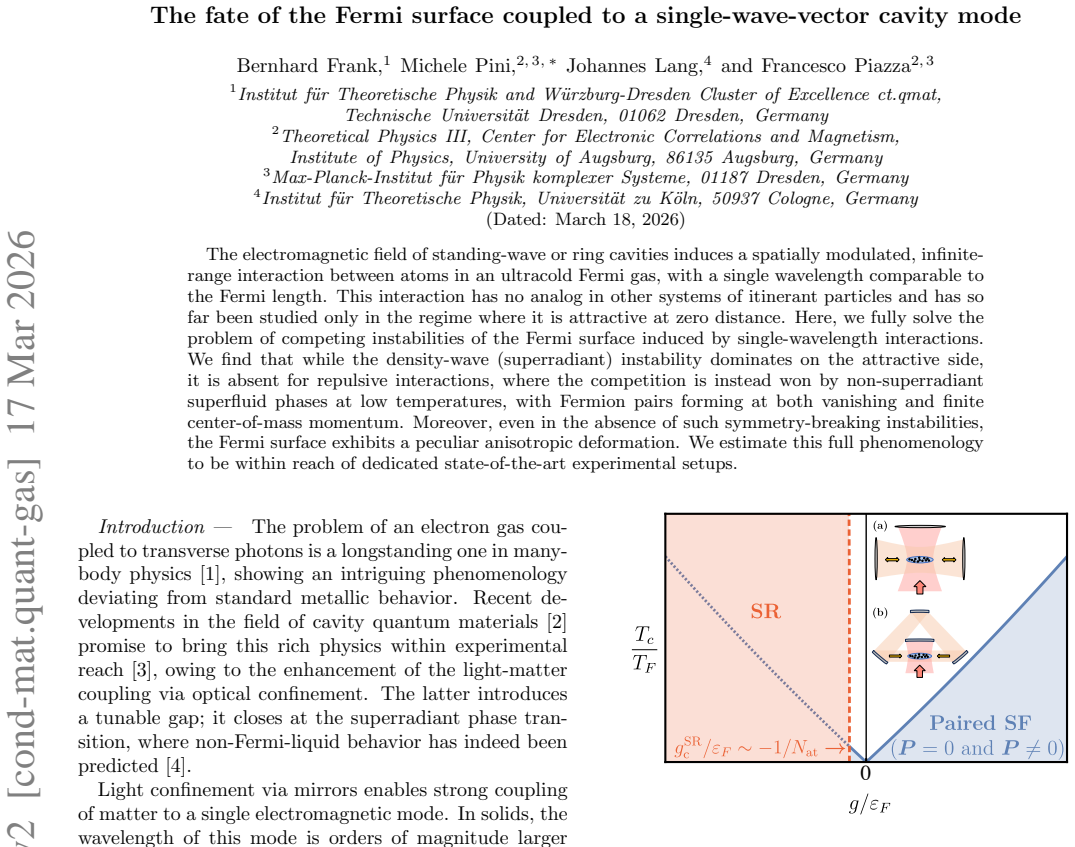
The density-wave (superradiant) instability dominates on the attractive side, yet is absent for repulsive interactions, where the competition is instead won by non-superradiant superfluid phases at low temperatures with Fermion pairs forming at both vanishing and finite center-of-mass momentum. Even in the absence of such symmetry-breaking instabilities, the Fermi surface is always nontrivially deformed from an isotropic shape.
What carries the argument
The single-wave-vector cavity mode that imposes a spatially modulated, infinite-range interaction whose sign and strength are independently tunable.
If this is right
- The Fermi surface remains deformed even in the absence of any symmetry-breaking order.
- Repulsive interactions stabilize superfluid pairing at both zero and finite center-of-mass momentum instead of density waves.
- The full phase diagram, including the location of the various instabilities, is accessible to state-of-the-art cavity-QED setups with ultracold fermions.
Where Pith is reading between the lines
- The persistent deformation could modify collective modes or transport coefficients even above any critical temperature.
- Engineering analogous single-wavelength infinite-range forces in other itinerant systems might reveal similar competition between pairing and density-wave channels.
- Finite-temperature crossovers between the superfluid phases could be probed through momentum-resolved spectroscopy.
Load-bearing premise
The cavity produces a purely single-wave-vector, infinite-range interaction whose strength and sign can be adjusted independently of all other parameters.
What would settle it
Time-of-flight imaging that either detects or rules out a density-wave modulation when the cavity-mediated interaction is tuned repulsive, or that measures a non-circular Fermi surface in the normal phase.
Figures


read the original abstract
The electromagnetic field of standing-wave or ring cavities induces a spatially modulated, infinite-range interaction between atoms in an ultracold Fermi gas, with a single wavelength comparable to the Fermi length. This interaction has no analog in other systems of itinerant particles and has so far been studied only in the regime where it is attractive at zero distance. Here, we fully solve the problem of competing instabilities of the Fermi surface induced by single-wavelength interactions. We find that while the density-wave (superradiant) instability dominates on the attractive side, it is absent for repulsive interactions, where the competition is instead won by non-superradiant superfluid phases at low temperatures, with Fermion pairs forming at both vanishing and finite center-of-mass momentum. Moreover, even in the absence of such symmetry-breaking instabilities, we find the Fermi surface to be always nontrivially deformed from an isotropic shape. We estimate this full phenomenology to be within reach of dedicated state-of-the-art experimental setups.
Editorial analysis
A structured set of objections, weighed in public.
Referee Report
Summary. The manuscript analyzes competing instabilities in an ultracold Fermi gas coupled to a single-wave-vector cavity mode that induces a spatially modulated infinite-range interaction. It claims a full solution showing that the density-wave (superradiant) instability dominates for attractive interactions at zero distance, while for repulsive interactions this instability is absent and non-superradiant superfluid phases win at low temperatures, with fermion pairing at both zero and finite center-of-mass momentum. The Fermi surface is reported to be nontrivially deformed from isotropy even without symmetry breaking, with the full phenomenology estimated to be experimentally accessible.
Significance. If the central results hold, the work delivers a complete phase diagram for this cavity-mediated interaction with no direct analog in other itinerant systems, cleanly separating attractive and repulsive regimes and identifying a deformed Fermi surface as a generic feature. Credit is due for the direct solution of the model equations against external physical regimes and for generating falsifiable predictions for state-of-the-art cavity QED experiments with fermions.
major comments (2)
- [§2] §2 (model definition): the central claim that the repulsive regime is free of density-wave instability and instead hosts non-superradiant superfluid phases at zero and finite COM momentum requires explicit confirmation that the effective interaction remains purely single-wave-vector and infinite-range when its sign at zero distance is reversed; if the microscopic cavity-QED derivation introduces additional momentum components or range corrections for repulsive detuning, the reported separation of regimes would not follow.
- [§4] §4 (repulsive-side results): the statement that the competition is won by superfluid phases rests on the absence of superradiant instability; the specific criterion (e.g., the eigenvalue spectrum of the density-wave susceptibility or the self-consistent gap equations) used to establish this absence must be shown explicitly, together with the numerical or analytic method that locates the superfluid transition lines.
minor comments (2)
- [Abstract] Abstract: the phrase 'we fully solve the problem' is strong; a one-sentence summary of the method (mean-field ansatz, functional integral, etc.) would help readers assess the scope of the solution.
- [Figure 3] Figure 3 (or equivalent phase diagram): the boundaries between the reported superfluid phases and the normal state should be labeled with the precise order parameters (pairing momentum, etc.) for immediate readability.
Simulated Author's Rebuttal
We thank the referee for the positive assessment and for identifying points where additional clarification would strengthen the manuscript. We address the two major comments below and will incorporate the requested details in a revised version.
read point-by-point responses
-
Referee: [§2] §2 (model definition): the central claim that the repulsive regime is free of density-wave instability and instead hosts non-superradiant superfluid phases at zero and finite COM momentum requires explicit confirmation that the effective interaction remains purely single-wave-vector and infinite-range when its sign at zero distance is reversed; if the microscopic cavity-QED derivation introduces additional momentum components or range corrections for repulsive detuning, the reported separation of regimes would not follow.
Authors: The effective interaction is obtained from the single-mode cavity QED Hamiltonian in the dispersive regime. The atom-cavity coupling generates an infinite-range interaction whose spatial dependence is fixed by the cavity mode function (a single wave vector set by the cavity geometry). The overall sign of the interaction is controlled by the atom-cavity detuning; reversing this sign does not alter the momentum content or introduce additional Fourier components. The same single-wave-vector form therefore applies on both sides of the resonance. We will add a short paragraph in §2 that explicitly states this point and references the microscopic derivation. revision: yes
-
Referee: [§4] §4 (repulsive-side results): the statement that the competition is won by superfluid phases rests on the absence of superradiant instability; the specific criterion (e.g., the eigenvalue spectrum of the density-wave susceptibility or the self-consistent gap equations) used to establish this absence must be shown explicitly, together with the numerical or analytic method that locates the superfluid transition lines.
Authors: The density-wave susceptibility is obtained from the static Lindhard response of the deformed Fermi surface; its largest eigenvalue remains finite throughout the repulsive regime, confirming the absence of a superradiant instability. The superfluid transition lines are determined by solving the self-consistent gap equations for both zero-momentum and finite-center-of-mass-momentum pairing channels, with the critical temperature identified as the point where the largest eigenvalue of the linearized gap equation reaches unity. We will include the explicit expressions for the susceptibility and the numerical procedure (including convergence checks) in the revised §4 and the associated supplementary material. revision: yes
Circularity Check
No circularity: direct solution of model equations against tunable interaction sign
full rationale
The paper states it fully solves the competing instabilities of the Fermi surface for a single-wave-vector infinite-range interaction whose sign is independently tunable. The attractive-side dominance of density-wave instability versus repulsive-side non-superradiant superfluid phases (zero and finite COM momentum) plus always-deformed Fermi surface follow from solving the model equations under those stated assumptions. No self-definitional steps, no fitted parameters renamed as predictions, and no load-bearing self-citations appear in the derivation chain. The sign tunability is an input of the cavity-QED setup rather than a result derived from the target phenomenology.
Axiom & Free-Parameter Ledger
axioms (1)
- domain assumption Cavity electromagnetic field induces spatially modulated infinite-range interaction with single wavelength comparable to Fermi length
Lean theorems connected to this paper
-
IndisputableMonolith/Cost/FunctionalEquation.leanwashburn_uniqueness_aczel unclear?
unclearRelation between the paper passage and the cited Recognition theorem.
We fully solve the problem of competing instabilities of the Fermi surface induced by single-wavelength interactions... mean-field treatment, which becomes exact in the thermodynamic limit
-
IndisputableMonolith/Foundation/AlphaCoordinateFixation.leanJ_uniquely_calibrated_via_higher_derivative unclear?
unclearRelation between the paper passage and the cited Recognition theorem.
the pairing gap... strongly depends on momentum... |Δ(0,±)k(T→0)| = |g|/2 everywhere on the reshaped FS
What do these tags mean?
- matches
- The paper's claim is directly supported by a theorem in the formal canon.
- supports
- The theorem supports part of the paper's argument, but the paper may add assumptions or extra steps.
- extends
- The paper goes beyond the formal theorem; the theorem is a base layer rather than the whole result.
- uses
- The paper appears to rely on the theorem as machinery.
- contradicts
- The paper's claim conflicts with a theorem or certificate in the canon.
- unclear
- Pith found a possible connection, but the passage is too broad, indirect, or ambiguous to say the theorem truly supports the claim.
Reference graph
Works this paper leans on
-
[1]
The PDW instability After the detailed study of the Cooper instability we turn now to the PDW instability. In the absence of the Cooper instabibility, the exciton condensation and with- out the effects of the FS reshaping the eigenvalues ofˆHMF read ϵ(r) l,(ν) = 1 2 s ξ2 k(ν) l + ∆(r) k(ν) l+1 + ∆(r) k(ν) l−1 2 ,(S47) for the combinations (r, ν) = (+, i) ...
-
[2]
Like in the pairing scenarios we can relate the eigenvalues to the momenta
Exciton condensation Next, we repeat the analysis for the XCON in the ab- sence of any pairing and without the reshaped FS. Like in the pairing scenarios we can relate the eigenvalues to the momenta. In the following, we will focus on the de- termination ofT (X) c for the XCON of typeX (+) k(ν) l and summarize the very similar results forY (+) k(ν) l belo...
-
[3]
Both are characterized by K(δk +) = 2k hs −Q c + 2δk y ˆey =P(δk +)
Very similar particle-hole expectation values g⟨ˆc† k(iii) l+1 ˆck(i) l ⟩org⟨ˆc † k(iv) l+1 ˆck(ii) l ⟩can be formed from (i)/(iii) and (ii)/(iv). Both are characterized by K(δk +) = 2k hs −Q c + 2δk y ˆey =P(δk +). However, only the choice from the main text, allows for the familiar particle-hole excitations with a hole inside the FS and particle outside...
-
[4]
J. Blaizot and G. Ripka,Quantum Theory of Finite Sys- tems(MIT Press, 1986)
work page 1986
-
[5]
In the cavity scenario the exchange channel corresponds rather to the Fock diagram
We also note that diagrammatically the shift in the stan- dard case arises from the Hartree diagram. In the cavity scenario the exchange channel corresponds rather to the Fock diagram
-
[6]
L. Rademaker, Y. Wang, T. Berlijn, and S. Johnston, New Journal of Physics18, 022001 (2016)
work page 2016
-
[7]
H. Gao, F. Schlawin, M. Buzzi, A. Cavalleri, and D. Jaksch, Phys. Rev. Lett.125, 053602 (2020)
work page 2020
- [8]
-
[9]
Indeed, the calculation with the next four shifted copies givesT (0) c = |g| 4 + g2 8ξkhs +Qc + g4 32ξkhs +2Qc ξ2 khs +Qc
- [10]
- [11]
-
[12]
T. Zwettler, F. Marijanovi´ c, T. B¨ uhler, S. Chattopad- hyay, G. Del Pace, L. Skolc, V. Helson, S. Uchino, E. Demler, and J.-P. Brantut, Nature Communications 17, 496 (2026)
work page 2026
- [13]
-
[14]
F. Mivehvar, F. Piazza, T. Donner, and H. Ritsch, Ad- vances in Physics70, 1 (2021)
work page 2021
-
[15]
A. L. Fetter and J. D. Walecka,Quantum Theory of Many-Particle Systems(McGraw-Hill, Boston, 1971)
work page 1971
-
[16]
Note that in the ∆ (±) case, pairs in the form ∆ k,p and ∆p,k are to be considered independent, since we suppose to still have an infinitesimal deviation from the hot spots δk± which allows to distinguish between them
discussion (0)
Sign in with ORCID, Apple, or X to comment. Anyone can read and Pith papers without signing in.