REVIEW 3 major objections 4 minor 42 references
Decentralized Traffic Flow Optimization Through Intrinsic Motivation
T0 review · 3 major / 4 minor · reviewed 2026-08-15 · deepseek-v4-flash
Pith's one-line read Replacing a fraction of cars with empowerment-driven agents raises traffic flow by up to 58 percent in a standard cellular-automaton traffic model.
desk verdict A readable proof-of-concept that empowerment-style agents can improve NaSch traffic flow, but the missing no-random-braking control leaves the central causal claim unsupported. read the letter →
The pith
A machine-rendered reading of the paper's core claim, the machinery that carries it, and where it could break.
The reading
What carries the argument
The load-bearing object is empowerment, defined for a planning horizon n as the channel capacity between a distribution over n-step action sequences and the future state the agent can reach, conditioned on the current state. The agent computes this using a precomputed one-step velocity transition for ordinary cars and a standard channel-capacity algorithm, then chooses the velocity that maximizes expected empowerment across possible one-step outcomes. Empowerment functions here as a local proxy for freedom of operation: a car avoids putting itself behind a slow leader where it would have few distinguishable future options, and this buffering of options smooths the fluctuations that ordinary randomly braking cars inject into traffic.
What would settle it
Re-run the same simulations with empowered agents modeling a leading car that also follows the empowerment policy instead of the assumed Nagel-Schreckenberg transition table; if the reported flow improvements shrink or reverse at high agent fractions, the gains depend on a false model assumption rather than on empowerment itself. A second check is to replace empowered agents with the simple rule 'never randomly brake when stationary, and brake only to avoid collisions' and compare the flow curve; matching gains would show that the specific empowerment objective is not the operative cause.
Extended reading notes
Core claim
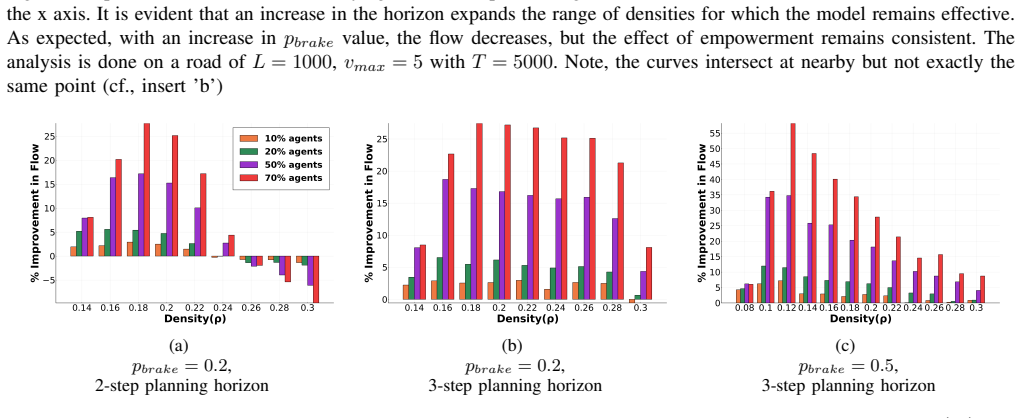
The paper's central claim is that empowerment maximization, applied locally to a subset of cars in the Nagel-Schreckenberg cellular automaton, substantially improves the collective traffic flow. An agent's state is the local pair of the gap to its leading car and the leading car's velocity, and its action is a velocity chosen so as to step into a future state with the highest expected empowerment. The paper reports that across densities beyond the critical density, flow increases by up to roughly 27 percent for braking probability 0.2 and roughly 58 percent for braking probability 0.5 compared with the unmodified model, while the critical density shifts rightward and the average time cars remain stationary decreases by up to roughly 85 percent. It attributes the gains to adaptive braking: empowered agents refrain from the background cars' speed-independent random braking, especially when slow or stationary, so jam waves dissolve faster.
Load-bearing premise
Each empowered agent assumes its leading car follows the ordinary Nagel-Schreckenberg rules with future velocities drawn from a fixed single-car transition table, but when the leading car is itself an empowered agent—likely at high agent fractions—that assumption is false, and the paper does not test how much this mismatch distorts the computed empowerment.
Editorial extensions
If this is right
- A small fraction of locally autonomous cars can yield system-level congestion relief without communication, explicit coordination, or a shared reward function.
- Longer empowerment planning horizons expand the range of densities over which flow improves, so the method's effective regime is tied to how far ahead each agent looks.
- Empowered agents delay the free-flow-to-congestion transition, shifting the peak of the fundamental diagram upward and toward higher density.
- The average time vehicles spend stationary can fall by roughly 85 percent at densities where peak improvement occurs.
- The method slightly reduces flow at low densities because empowerment encourages leaving maneuvering room rather than driving maximally aggressively.
Reading between the lines
- A simple control rule that merely suppresses random braking while stationary may reproduce much of the reported gain, which would suggest empowerment is a principled source of that rule rather than the only possible one; this can be tested directly.
- Because agents assume a normal NaSch leader even when leaders are also empowered, the computed empowerment is an approximation at high agent fractions; measuring how the gain changes when agents model the true leader policy would separate model mismatch from genuine benefit.
- The dependence on the planning horizon hints that gains may track the characteristic lifetime of NaSch jam waves; a horizon matched to that timescale could be exploited in future designs.
- The same empowerment formalism could be tested in continuum or speed-dependent-noise traffic models to see whether the congestion-mitigation effect survives beyond cellular automata.
Signed reviews
Editorial analysis
A structured set of objections, weighed in public.
Referee Report
Summary. The paper proposes a decentralized traffic control scheme for the Nagel-Schreckenberg (NaSch) cellular automaton in which a fraction of cars are governed by an empowerment-maximizing policy instead of the default NaSch update. Each empowered agent observes only the gap to its leading car and the leader's velocity, assumes the leader follows NaSch dynamics, and selects the velocity that maximizes expected n-step empowerment (horizons n=2 and n=3). Simulations on a periodic single-lane road with pbrake=0.2 and pbrake=0.5 and agent fractions up to 70% report flow improvements of up to about 27% and 58% over the all-NaSch baseline, a rightward shift of the critical density, and up to about 85% reduction in average jam time. The authors argue that this is the first demonstration of intrinsic motivation, implemented via empowerment, as a purely local and reward-free mechanism for improving collective traffic flow.
Significance. If the reported effect is real and attributable to empowerment, the paper would be a valuable proof of concept: it would show that a generic, reward-free, communication-free local objective can produce a collective traffic benefit in a standard model. The authors provide a public code repository, which supports reproducibility. However, the central attribution claim is currently under-supported because the treatment condition changes two things at once: the decision rule and the removal of stochastic braking for the agent fraction. The absence of a control that only removes random braking makes it impossible to decide whether empowerment is the operative ingredient. Because the missing control is a standard, feasible experiment, the paper can be repaired within its own scope; this is a major-revision situation rather than a rejection.
major comments (3)
- [§V, Algorithm 2]
- [§IV]
- [§V, Figs. 3–6]
minor comments (4)
- [§III-A]
- [§V, Fig. 6]
- [§IV]
- [Algorithm 2 and §V]
Circularity Check
No significant circularity: the empowerment policy is defined independently of the traffic-flow metric, and the reported gains are emergent simulation results.
full rationale
The paper's central claim (27%/58% flow improvements from empowered agents) is an emergent outcome of a simulation, not a quantity derived from the objective by construction. The empowerment objective in Eq. (5) is channel capacity, defined independently of the flow estimator in Eq. (4), and the agent action rule in Algorithm 2 selects actions maximizing expected empowerment without any reference to the measured flow. No parameter is fitted to the baseline flow or to the reported improvement, and no equation in the paper reduces the flow result to the empowerment definition. The use of p(vt+1|vt) sampled from the NaSch model is an internal modeling assumption for the agents' predictions and does not force high flow; indeed it is inaccurate when the leading car is itself an empowered agent, which the paper does not correct. Self-citations to the empowerment literature are background support for the formalism, not a load-bearing justification of the traffic-flow result. The absence of a control simulation with deterministic (no-R3) agents is a legitimate experimental-validity concern about attribution of the effect, but it is not circularity under the stated criteria.
Assumptions & free parameters
free parameters (1)
- Empowerment planning horizon n =
2 or 3
assumptions (4)
- domain assumption The NaSch cellular automaton is a valid model for traffic flow and congestion.
- domain assumption Agents know the exact braking probability p_brake, vmax, and the velocity transition probability p(v_{t+1}|v_t) of normal cars.
- ad hoc to paper The state s=(delta_lead, v_lead) is sufficient for computing meaningful empowerment for traffic control.
- ad hoc to paper Leading cars follow NaSch rules even when they are empowered agents.
Cite this review
Pith. "Pith review of Decentralized Traffic Flow Optimization Through Intrinsic Motivation." pith.science (2026). https://pith.science/paper/4ZMMYC52
@misc{pith2026250511520,
  author       = {Pith},
  title        = {Pith review of: Decentralized Traffic Flow Optimization Through Intrinsic Motivation},
  year         = {2026},
  howpublished = {\url{https://pith.science/paper/4ZMMYC52}},
  note         = {Machine review of arXiv:2505.11520}
}
read the original abstract
Traffic congestion has long been an ubiquitous problem that is exacerbating with the rapid growth of megacities. In this proof-of-concept work we study intrinsic motivation, implemented via the empowerment principle, to control autonomous car behavior to improve traffic flow. In standard models of traffic dynamics, self-organized traffic jams emerge spontaneously from the individual behavior of cars, affecting traffic over long distances. Our novel car behavior strategy improves traffic flow while still being decentralized and using only locally available information without explicit coordination. Decentralization is essential for various reasons, not least to be able to absorb robustly substantial levels of uncertainty. Our scenario is based on the well-established traffic dynamics model, the Nagel-Schreckenberg cellular automaton. In a fraction of the cars in this model, we substitute the default behavior by empowerment, our intrinsic motivation-based method. This proposed model significantly improves overall traffic flow, mitigates congestion, and reduces the average traffic jam time.
Figures


Figures from the paper (3 more)


Reference graph
Works this paper leans on
-
[1]
Car navigation with route information sharing for improvement of traffic efficiency,
T. Yamashita, K. Izumi, and K. Kurumatani, “Car navigation with route information sharing for improvement of traffic efficiency,” in Proceedings. The 7th International IEEE Conference on Intelligent Transportation Systems (IEEE Cat. No. 04TH8749) . IEEE, 2004, pp. 465–470
work page 2004
-
[2]
Reliable pretrip multipath planning and dynamic adaptation for a centralized road navigation system,
Y . Chen, M. G. Bell, and K. Bogenberger, “Reliable pretrip multipath planning and dynamic adaptation for a centralized road navigation system,” IEEE Transactions on Intelligent Transportation Systems , vol. 8, no. 1, pp. 14–20, 2007
work page 2007
-
[3]
A centralized route-management solution for autonomous vehicles in urban areas,
J. L. Zambrano-Martinez, C. T. Calafate, D. Soler, L.-G. Lemus- Z´u˜niga, J.-C. Cano, P. Manzoni, and T. Gayraud, “A centralized route-management solution for autonomous vehicles in urban areas,” Electronics, vol. 8, no. 7, p. 722, 2019
work page 2019
-
[4]
Intrinsically motivated collective motion,
H. J. Charlesworth and M. S. Turner, “Intrinsically motivated collective motion,” Proceedings of the National Academy of Sciences , vol. 116, no. 31, pp. 15 362–15 367, 2019
work page 2019
-
[5]
Intrinsically motivated general companion npcs via coupled empowerment maximisation,
C. Guckelsberger, C. Salge, and S. Colton, “Intrinsically motivated general companion npcs via coupled empowerment maximisation,” in 2016 IEEE Conference on Computational Intelligence and Games (CIG). IEEE, 2016, pp. 1–8
work page 2016
-
[6]
T. D. Kulkarni, K. Narasimhan, A. Saeedi, and J. Tenenbaum, “Hier- archical deep reinforcement learning: Integrating temporal abstraction and intrinsic motivation,” in Advances in Neural Information Process- ing Systems, NeurIPS , 2016
work page 2016
-
[7]
Variational empowerment as representation learning for goal-conditioned rein- forcement learning,
J. Choi, A. Sharma, H. Lee, S. Levine, and S. S. Gu, “Variational empowerment as representation learning for goal-conditioned rein- forcement learning,” International Conference on Machine Learning , pp. 1953–1963, 2021
work page 1953
-
[8]
Variational intrinsic con- trol,
K. Gregor, D. J. Rezende, and D. Wierstra, “Variational intrinsic con- trol,” International Conference on Learning Representations (ICLR), Workshop Track Proceedings, 2017
work page 2017
Show all 42 references
-
[9]
Ave: Assistance via empowerment,
Y . Du, S. Tiomkin, E. Kiciman, D. Polani, P. Abbeel, and A. Dragan, “Ave: Assistance via empowerment,” Advances in Neural Information Processing Systems, vol. 33, pp. 4560–4571, 2020
2020
-
[10]
Efficient empowerment estima- tion for unsupervised stabilization,
R. Zhao, P. Abbeel, and S. Tiomkin, “Efficient empowerment estima- tion for unsupervised stabilization,”International Conference Learning Representations, 2020
2020
-
[11]
Empowerment: A universal agent-centric measure of control,
A. S. Klyubin, D. Polani, and C. L. Nehaniv, “Empowerment: A universal agent-centric measure of control,” in 2005 IEEE Congress on Evolutionary Computation , vol. 1. IEEE, 2005, pp. 128–135
2005
-
[12]
General self-motivation and strategy identification: Case studies based on sokoban and pac- man,
T. Anthony, D. Polani, and C. L. Nehaniv, “General self-motivation and strategy identification: Case studies based on sokoban and pac- man,” IEEE Transactions on Computational Intelligence and AI in Games, vol. 6, no. 1, pp. 1–17, 2014
2014
-
[13]
Goal-directed empowerment: combining intrinsic motivation and task-oriented behaviour,
N. C. V olpi and D. Polani, “Goal-directed empowerment: combining intrinsic motivation and task-oriented behaviour,” IEEE Transactions on Cognitive and Developmental Systems , 2020
2020
-
[14]
Changing the environment based on empowerment as intrinsic motivation,
C. Salge, C. Glackin, and D. Polani, “Changing the environment based on empowerment as intrinsic motivation,” Entropy, vol. 16, no. 5, pp. 2789–2819, 2014
2014
-
[15]
Empowerment an introduction,
——, “Empowerment an introduction,” Guided Self-Organization: Inception, pp. 67–114, 2014
2014
-
[16]
Information: currency of life?
D. Polani, “Information: currency of life?” HFSP journal, vol. 3, no. 5, pp. 307–316, 2009
2009
-
[17]
Empowerment: A universal agent-centric measure of control,
A. S. Klyubin, D. Polani, and C. L. Nehaniv, “Empowerment: A universal agent-centric measure of control,” in 2005 ieee congress on evolutionary computation, vol. 1. IEEE, 2005, pp. 128–135
2005
-
[18]
Intrinsic motivation in dynamical control systems,
S. Tiomkin, I. Nemenman, D. Polani, and N. Tishby, “Intrinsic motivation in dynamical control systems,” in PRX Life - Physical Review Journals. American Physical Society, Aug 2024
2024
-
[19]
A cellular automaton model for freeway traffic,
K. Nagel and M. Schreckenberg, “A cellular automaton model for freeway traffic,” Journal de physique I , vol. 2, no. 12, pp. 2221–2229, 1992
1992
-
[20]
Modeling traffic flow on buah batu exit toll gate using cellular automata,
R. F. Ketaren, F. H. Danufane, and I. Kurniawan, “Modeling traffic flow on buah batu exit toll gate using cellular automata,” in 2020 Inter- national Conference on Data Science and Its Applications (ICoDSA) . IEEE, 2020, pp. 1–5
2020
-
[21]
Aircraft ground-taxiing model for congested airport using cellular automata,
R. Mori, “Aircraft ground-taxiing model for congested airport using cellular automata,” IEEE Transactions on Intelligent Transportation Systems, vol. 14, no. 1, pp. 180–188, 2012
2012
-
[22]
Optimizing traffic flow on highway with three consecutive on-ramps,
L. Lin, R. Jiang, M.-B. Hu, and Q.-S. Wu, “Optimizing traffic flow on highway with three consecutive on-ramps,” in 2012 Fifth International Joint Conference on Computational Sciences and Optimization. IEEE, 2012, pp. 514–518
2012
-
[23]
Effects of traffic lights for manhattan-like urban traffic network inintelligent transportation systems,
B. Chen, D. Z. Wang, Y . Gao, K. Zhang, L. Miao, and B. Wang, “Effects of traffic lights for manhattan-like urban traffic network inintelligent transportation systems,” Transportmetrica B: Transport Dynamics, vol. 6, no. 1, pp. 4–16, 2018
2018
-
[24]
Optimizing mixed autonomy traffic flow with decentralized autonomous vehicles and multi-agent reinforcement learning,
E. Vinitsky, N. Lichtl ´e, K. Parvate, and A. Bayen, “Optimizing mixed autonomy traffic flow with decentralized autonomous vehicles and multi-agent reinforcement learning,” ACM Transactions on Cyber- Physical Systems, vol. 7, no. 2, pp. 1–22, 2023
2023
-
[25]
Decentralized approaches to adaptive traffic control,
A. Kesting, M. Sch ¨onhof, S. L ¨ammer, M. Treiber, and D. Helbing, “Decentralized approaches to adaptive traffic control,” in Managing complexity: insights, concepts, applications. Springer, 2008, pp. 189– 199
2008
-
[26]
Large-scale traffic control using autonomous vehicles and decentralized deep reinforcement learning,
H. Maske, T. Chu, and U. Kalabi ´c, “Large-scale traffic control using autonomous vehicles and decentralized deep reinforcement learning,” in 2019 IEEE Intelligent Transportation Systems Conference (ITSC) . IEEE, 2019, pp. 3816–3821
2019
-
[27]
Congestion-aware cooperative adaptive cruise control for mitigation of self-organized traffic jams,
T. Kim and K. Jerath, “Congestion-aware cooperative adaptive cruise control for mitigation of self-organized traffic jams,” IEEE Transac- tions on Intelligent Transportation Systems , vol. 23, no. 7, pp. 6621– 6632, 2021
2021
-
[28]
Learning a robust multiagent driving policy for traffic congestion reduction,
Y . Zhang, W. Macke, J. Cui, S. Hornstein, D. Urieli, and P. Stone, “Learning a robust multiagent driving policy for traffic congestion reduction,” Neural Computing and Applications , pp. 1–14, 2023
2023
-
[29]
Scalable multiagent driving policies for reducing traffic congestion,
J. Cui, W. Macke, H. Yedidsion, D. Urieli, and P. Stone, “Scalable multiagent driving policies for reducing traffic congestion,” arXiv preprint arXiv:2103.00058, 2021
2021 arXiv
-
[30]
Life times of simulated traffic jams,
K. Nagel, “Life times of simulated traffic jams,” International Journal of Modern Physics C , vol. 5, no. 03, pp. 567–580, 1994
1994
-
[31]
Emergent traffic jams,
K. Nagel and M. Paczuski, “Emergent traffic jams,” Physical Review E, vol. 51, no. 4, p. 2909, 1995
1995
-
[32]
Density fluctuations and phase transition in the nagel-schreckenberg traffic flow model,
S. L ¨ubeck, M. Schreckenberg, and K. Usadel, “Density fluctuations and phase transition in the nagel-schreckenberg traffic flow model,” Physical Review E , vol. 57, no. 1, p. 1171, 1998
1998
-
[33]
Critical behavior of a traffic flow model,
L. Roters, S. L ¨ubeck, and K. Usadel, “Critical behavior of a traffic flow model,” Physical Review E , vol. 59, no. 3, p. 2672, 1999
1999
-
[34]
Dynamics-aware unsupervised discovery of skills,
A. Sharma, S. Gu, S. Levine, V . Kumar, and K. Hausman, “Dynamics-aware unsupervised discovery of skills,” in International Conference on Learning Representations , 2020. [Online]. Available: https://openreview.net/forum?id=HJgLZR4KvH
2020
-
[35]
Empowerment as replacement for the three laws of robotics,
C. Salge and D. Polani, “Empowerment as replacement for the three laws of robotics,” Frontiers in Robotics and AI , p. 25, 2017
2017
-
[36]
All else being equal be empowered,
A. S. Klyubin, D. Polani, and C. L. Nehaniv, “All else being equal be empowered,” in European Conference on Artificial Life. Springer, 2005, pp. 744–753
2005
-
[37]
Computation of channel capacity and rate-distortion func- tions,
R. Blahut, “Computation of channel capacity and rate-distortion func- tions,” IEEE transactions on Information Theory , vol. 18, no. 4, pp. 460–473, 1972
1972
-
[38]
Code repository for reproduction of the results and further experiments,
“Code repository for reproduction of the results and further experiments,” 2024. [Online]. Available: https://github.com/Decentralized-Traffic-Flow-Optimization/ Decentralized-Traffic-Flow-Optimization-Through-Intrinsic-Motivation. git
2024
-
[39]
Continuous limit of the nagel- schreckenberg model,
S. Krauß, P. Wagner, and C. Gawron, “Continuous limit of the nagel- schreckenberg model,” Physical Review E , vol. 54, no. 4, p. 3707, 1996
1996
-
[40]
Simulation study of traffic circle intersection with traffic lights,
N. Lakouari, O. Oubram, R. Marzoug, H. Ez-Zahraouy, J. Vel ´asquez- Aguilar, and L. Cisneros-Villalobos, “Simulation study of traffic circle intersection with traffic lights,” International Journal of Modern Physics C, vol. 29, no. 07, p. 1850062, 2018
2018
-
[41]
The effects of reaction delay in the nagel-schreckenberg traffic flow model,
R. Jiang, M. Hu, B. Jia, R. Wang, and Q. Wu, “The effects of reaction delay in the nagel-schreckenberg traffic flow model,” The European Physical Journal B , vol. 54, pp. 267–273, 2006
2006
-
[42]
Entry ramps in the nagel- schreckenberg model,
M. M. Pedersen and P. T. Ruhoff, “Entry ramps in the nagel- schreckenberg model,” Physical Review E , vol. 65, no. 5, p. 056705, 2002
2002
Reviewed August 15, 2026 · model on record in the stance chip above.
Discussion (0). Continue with ORCID to comment.