REVIEW 3 major objections 5 minor 63 references
Dust stars in the minimal exponential measure model
T0 review · 3 major / 5 minor · reviewed 2026-08-15 · deepseek-v4-flash
Pith's one-line read The paper claims that in the MEMe model of gravity, dust can form horizonless compact objects with masses below about $10^{-11}$ solar masses, making them viable MACHO dark-matter candidates, and that this requires the model's single free…
desk verdict Genuinely new dust-supported horizonless compact objects in the MEMe model, with a clean analytic core and an explicitly heuristic stability analysis that is the main thing to fix before the dark matter claim hardens. read the letter →
The pith
A machine-rendered reading of the paper's core claim, the machinery that carries it, and where it could break.
The reading
What carries the argument
The load-bearing object is the exact algebraic map between the Jordan-frame fluid variables $(\hat\rho,\hat p)$ and the Einstein-frame variables $(\rho,p)$, given by Eqs. (9)-(10) through the determinant $|A|$ of the auxiliary tensor. For a perfect fluid this produces the implicit Einstein-frame equation of state $F(\rho,p)=0$ (Eq. (20)). The argument then runs through the inequality $\rho\le 7/(9q)$, obtained by applying the arithmetic-geometric mean inequality to Eq. (21), and the Buchdahl-limit argument that converts the density cap into $M_{\min}$. The stellar-structure system (28) is integrated in the Einstein frame, and stability is classified with the standard radial-perturbation equations (30)-(31).
What would settle it
A rigorous radial-perturbation calculation (treating the $r=0$ singular term in Eq. (30) with a proper boundary condition, or a nonlinear simulation) that finds a growing mode for any first-branch solution with $\hat\rho_0<2/q$ would falsify the stability claim; alternatively, constructing a static horizonless dust solution with $q<0$ would falsify the claimed necessary condition $q>0$.
Extended reading notes
Core claim
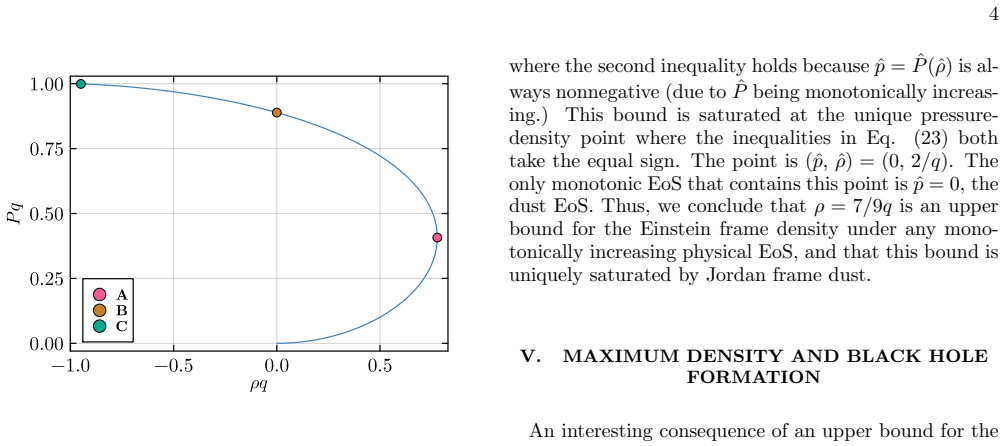
On the paper's own terms, the central discovery is that the MEMe field equations for a perfect fluid can be rewritten exactly as Einstein equations sourced by a transformed fluid, and that for dust the transformed equation of state is the implicit relation $F(\rho,p)=0$ of Eq. (20). The transformed density is bounded above by $7/(9q)$, an inequality saturated only by dust, and this cap turns a would-be collapse into a horizonless compact object rather than a black hole. Numerically solving the stellar-structure equations in the Einstein frame gives three classes of solutions, of which only the first class (initial physical density $\hat\rho_0<2/q$) is stable; these stable dust stars have masses below about $10^{-11}\,M_\odot$ and radii controlled by the same energy scale $1/q$. The paper also derives the minimum black hole mass $M_{\min}=(c^4/G^{3/2})(4/9)\sqrt{3q/(7\pi)}$ from the Buchdahl limit, and identifies $q>0$ as a necessary condition for all of this.
Load-bearing premise
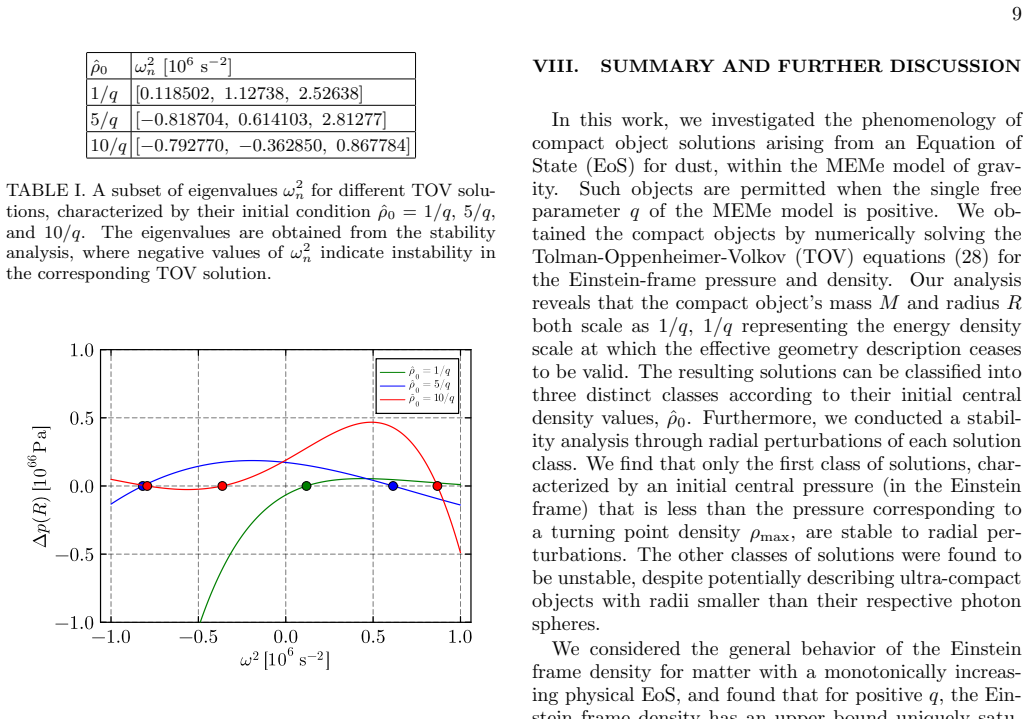
The radial-stability analysis assumes that the singular point at $r=0$ in the oscillation equation (30) does not break the discreteness of the Sturm-Liouville spectrum, so the standard perturbation framework applies; the paper labels this heuristic, and if the assumption fails the conclusion that only the $\hat\rho_0<2/q$ dust stars are stable collapses.
Editorial extensions
If this is right
- The MEMe model predicts a new population of horizonless, dust-supported compact objects with masses up to about $10^{-11}\,M_\odot$ that can act as MACHO dark matter and evade current microlensing limits when $1/|q|\gtrsim 10^{18}$ GeV/fm$^3$.
- Black holes formed from the gravitational collapse of matter with a monotonic equation of state must be heavier than $M_{\min}$, so primordial black hole formation below that mass is suppressed; this offers an alternative to other explanations for the lack of evaporation signals from low-mass PBHs.
- The stable dust-star branch is the one with central physical density $\hat\rho_0<2/q$; the other branches, though ultra-compact and possibly smaller than their photon spheres, are unstable and should not be observable as enduring objects.
- The upper density bound $\rho_{\max}=7/(9q)$ applies to every monotonically increasing physical equation of state, so the minimum-mass floor is a generic feature of the $q>0$ model rather than an artifact of the dust choice.
Reading between the lines
- The paper leaves implicit that stable dust stars, being horizonless, could be distinguished from black holes by direct observation: gravitational-wave ringdowns, accretion shadows, or tidal signatures would differ even at the same mass, making the MACHO window a live target for next-generation surveys.
- The $q>0$ requirement for dust stars is in tension with the bounce-cosmology scenario in earlier MEMe work, which needs $q<0$; the multi-MEMe extension proposed in the appendix could reconcile them, but within a single sector both mechanisms cannot operate. This is a consistency question a future calculation could settle.
- A sharp prediction of the suppression mechanism is a mass cutoff in the black hole mass function; if future surveys find collapse-formed black holes below $M_{\min}$ for an independently measured $q$, the mechanism is falsified rather than merely constrained.
Signed reviews
Editorial analysis
A structured set of objections, weighed in public.
Referee Report
Summary. The paper studies static, spherically symmetric compact objects in the Minimal Exponential Measure (MEMe) model, a Type I minimally modified gravity theory with a single free parameter q. For a Jordan-frame perfect fluid with a linear equation of state, the authors rewrite the field equations in an Einstein frame and derive the effective Einstein-frame equation of state. For positive q and Jordan-frame dust, they obtain an implicit Einstein-frame EoS with three branches, prove an upper bound rho_max = 7/(9q) on the Einstein-frame density, and numerically integrate the TOV equations to find horizonless compact objects. They classify solutions by central density, show that only the first branch (rho_hat_0 < 2/q) avoids a negative fundamental radial mode, and derive a minimum black hole mass from a Buchdahl-type argument. They then use constraints on primordial black holes and microlensing to identify a window of q for which these dust stars could be a significant part of dark matter. The paper explicitly labels the radial stability analysis as heuristic because of a singular point at r=0 in the perturbation equations.
Significance. If the results hold, the paper reports a genuinely new mechanism: a minimally modified gravity theory in which pressureless dust can support horizonless compact objects, with masses below roughly 10^-11 solar masses and a parameter range that evades existing MACHO constraints. The analytic derivation of the Einstein-frame EoS (Eq. 20), the density bound (Eqs. 21-23), and the M_min formula (Eq. 26) are clean and transparent. The single parameter q is left free and later constrained by external physical inputs, so the argument is not circular. The paper is also honest about the main weakness, flagging the singular Sturm-Liouville issue in Section VII. However, the dark-matter claim depends on the stability of the first-branch solutions, and that stability is not yet established with the rigor the central claim requires.
major comments (3)
- [Sec. VII, Eqs. (30)-(31), Table I] The claim that all first-region dust stars (rho_hat_0 < 2/q) are stable is load-bearing for the dark-matter interpretation, but the supporting analysis is explicitly heuristic. The singular point at r=0 in Eq. (30) is assumed not to spoil the discreteness of the Sturm-Liouville spectrum, with no argument or reference supplying that proof. The numerical search starts at omega^2 = -10^6 s^-2, so any unstable mode with a more negative omega^2 would not be seen. Only three representative solutions are shown in Table I, and the statement that the check was performed for all first-region solutions is not accompanied by a scan, a stability criterion, or a plot. Because removing first-region stability eliminates the only viable MACHO candidate, this gap must be closed or the abstract and Section VIII claims must be substantially weakened.
- [Sec. V, Eqs. (24)-(26)] The paper claims that a positive q suppresses the formation of primordial black holes below M_min, but this inference applies a static, equilibrium Buchdahl bound to a dynamical collapse process. The density maximum rho_max = 7/(9q) was derived for static TOV solutions with a monotonically increasing Einstein-frame EoS; it is not shown that the same bound controls the densities reached during gravitational collapse, nor that the Buchdahl divergence of central pressure implies collapse in the presence of the modified matter coupling. A dynamical collapse calculation, or at least a clearly stated additional assumption, is needed to support the abstract statement that the model provides a mechanism for suppressing PBH formation.
- [Sec. VII, Eq. (32)] The adiabatic index used in the perturbation equations is computed from the effective Einstein-frame EoS, but the paper does not derive the perturbation mapping between the Jordan-frame dust, which has zero pressure, and the Einstein-frame perfect fluid. The statement that the unmodified radial oscillation equations apply in the Einstein frame requires that the effective fluid's perturbations faithfully represent perturbations of the underlying physical matter in the MEMe model. Without such a derivation, the stability conclusions for the first branch remain an assumption about the effective description rather than a demonstrated property of the Jordan-frame dust stars.
minor comments (5)
- [Sec. V, Eq. (24)] The displayed definition rho_c := M/(4 pi R_Buch^3) is inconsistent with the numerical value 16/(243 pi M^2); the uniform-density relation is rho_c = 3M/(4 pi R_Buch^3), which yields the stated value.
- [Sec. IV, Eqs. (21)-(23)] The AM-GM step would be easier to verify if the identity 4 - q(3 p - rho) = 3(1 - q p) + (1 + q rho) were stated before applying the inequality.
- [Sec. VIII] There is a typo, 'an relatively simple', which should read 'a relatively simple'.
- [Fig. 7 and Sec. VIII] The phrase 'smaller from the minimum black hole mass' should read 'smaller than the minimum black hole mass'.
- [Sec. V, Eq. (27)] The bound 1/|q| lesssim 10^33 GeV/fm^3 is explicitly conditional on attributing the absence of PBH evaporation signals to the lower mass bound; the paper should state more prominently that this is an assumption, not a direct observational upper limit on q.
Circularity Check
No significant circularity: dust-star solutions, density bound, and M_min are derived from the MEMe action rather than fitted, and the stability caveat is a rigor gap, not a circular reduction.
full rationale
The paper's central claims—existence of dust-supported horizonless solutions, the Einstein-frame density bound rho_max = 7/(9q), and the minimum black-hole mass M_min—follow algebraically and numerically from the MEMe action (1) and the field equations (3)-(10). No parameter is fitted to the quantity being predicted: q is left free and later constrained by external inputs (heavy-ion densities, PBH evaporation bounds, microlensing limits), so the dark-matter window is conditional rather than derived from itself. Citations to the authors' prior work ([14], [15], [17], [20]) introduce the model and earlier applications, but the paper does not invoke a uniqueness theorem or a prior result to forbid alternatives; the q>0 condition is obtained from the TOV analysis in Secs. IV-VI. The only flagged limitation is the radial-stability analysis in Sec. VII, where the authors explicitly caution that Eq. (30) is singular at r=0 and state that 'one must assume that the singular point does not spoil the discreteness of the spectrum,' calling the analysis 'heuristic.' That is an admitted rigor gap, not a circular reduction: the stability conclusion could be overturned by a more rigorous treatment, but it is not equivalent to an input of the derivation. No load-bearing step reduces to its own input by construction, so no significant circularity is present.
Assumptions & free parameters
free parameters (1)
- q (MEMe coupling parameter) =
not fitted; numerical runs use q ~ 5e-50 m^3/J
assumptions (4)
- domain assumption The MEMe action (Eq. 1) correctly describes gravity-matter couplings without new dynamical degrees of freedom.
- domain assumption Matter can be treated as a single perfect fluid in both Jordan and Einstein frames, and the Jordan-frame dust EoS p_hat = 0 is physically valid at the relevant densities.
- domain assumption The Buchdahl limit and the uniform-density collapse threshold (Eq. 24) apply to the Einstein-frame fluid, so that the maximum density bound yields a minimum black hole mass.
- ad hoc to paper The singular point at r=0 in the radial perturbation equation (Eq. 30) does not spoil the discrete Sturm-Liouville spectrum of oscillation modes.
Cite this review
Pith. "Pith review of Dust stars in the minimal exponential measure model." pith.science (2026). https://pith.science/paper/M7LZ7U6H
@misc{pith2026250511591,
  author       = {Pith},
  title        = {Pith review of: Dust stars in the minimal exponential measure model},
  year         = {2026},
  howpublished = {\url{https://pith.science/paper/M7LZ7U6H}},
  note         = {Machine review of arXiv:2505.11591}
}
abstract
We report the existence of horizonless compact object solutions supported by dust in the Minimal Exponential Measure (MEMe) model, a theory which modifies the couplings between gravity and matter without introducing dynamical degrees of freedom. For a perfect fluid source, the field equations for the MEMe model can be rewritten as the Einstein field equations sourced by a perfect fluid with a transformed equation of state, which can endow a sufficiently dense cloud of dust with an effective pressure. The resulting dust-supported horizonless compact objects can have masses below $\sim 10^{-11}~M_\odot$, making them suitable as MACHOs comprising a significant mass fraction for dark matter. A necessary condition for the existence of these compact object solutions is that the single free parameter in the MEMe model is positive-valued. Additionally, we find that this positive sign for the parameter can provide a mechanism for suppressing the formation of (primordial) black holes from the gravitational collapse of matter below a certain mass scale.
Figures


Figures from the paper (4 more)



Reference graph
Works this paper leans on
-
[1]
We consider now the generic behavior of the Einstein frame EoS in the case of positiveq
Intuitively, this follows from the fact that at densities approaching|1/q|, the pressure becomes negative; ifp< 0 atr∼0, then we require thatp ′(r)>0, as one expects a compact object in equilibrium to satisfyp= 0 at the outer boundary. We consider now the generic behavior of the Einstein frame EoS in the case of positiveq. We observe that since 4 FIG. 1. ...
work page 2025
-
[2]
We will consider three different scenarios in terms of initial conditions, based on these three regions. Although we must choose a value for the parameterq to proceed with numerical solutions, we found that the qualitative properties of the solutions are insensitive to variations inq. Currently we have setq∼5×10 −50 m3/J; we will further explore the impli...
- [3]
-
[4]
C. J. Goebel, ApJL172, L95 (1972)
work page 1972
-
[5]
V. Cardoso, A. S. Miranda, E. Berti, H. Witek, and V. T. Zanchin, Phys. Rev. D79, 064016 (2009), arXiv:0812.1806 [hep-th]
arXiv 2009
- [6]
-
[7]
K. Glampedakis, G. Pappas, H. O. Silva, and E. Berti, Phys. Rev. D96, 064054 (2017), arXiv:1706.07658 [gr- qc]
arXiv 2017
-
[8]
S. Shankaranarayanan and J. P. Johnson, Gen. Rel. Grav. 54, 44 (2022), arXiv:2204.06533 [gr-qc]
arXiv 2022
Show all 63 references
- [9]
-
[10]
De Felice and S
A. De Felice and S. Mukohyama, JCAP04, 018 (2021), arXiv:2011.04188 [astro-ph.CO]
2021 arXiv
-
[11]
De Felice, A
A. De Felice, A. Doll, and S. Mukohyama, JCAP09, 034 (2020), arXiv:2004.12549 [gr-qc]
2020 arXiv
-
[12]
K. Aoki, A. De Felice, C. Lin, S. Mukohyama, and M. Oliosi, JCAP01, 017 (2019), arXiv:1810.01047 [gr- qc]
2019 arXiv
-
[13]
K. Aoki, C. Lin, and S. Mukohyama, Phys. Rev. D98, 044022 (2018), arXiv:1804.03902 [gr-qc]. 11
2018 arXiv
- [14]
-
[15]
K. Aoki, A. De Felice, S. Mukohyama, K. Noui, M. Oliosi, and M. C. Pookkillath, Eur. Phys. J. C80, 708 (2020), arXiv:2005.13972 [astro-ph.CO]
2020 arXiv
-
[16]
J. C. Feng and S. Carloni, Phys. Rev. D101, 064002 (2020), arXiv:1910.06978 [gr-qc]
2020 arXiv
-
[17]
J. C. Feng, S. Mukohyama, and S. Carloni, Phys. Rev. D103, 084055 (2021), arXiv:2011.12305 [gr-qc]
2021 arXiv
-
[18]
M. D. Danarianto and A. Sulaksono, AIP Conf. Proc. 2906, 030005 (2023)
2023
-
[19]
Troisi and S
A. Troisi and S. Carloni, Phys. Lett. B864, 139426 (2025)
2025
-
[20]
C. J. A. P. Martins, C. M. J. Marques, C. B. D. Fernan- des, J. S. J. S. Oliveira, D. A. R. Pinheiro, and B. A. R. Rocha, in16th Marcel Grossmann Meeting on Recent Developments in Theoretical and Experimental General Relativity, Astrophysics and Relativistic Field Theories (20...
2021 arXiv
-
[21]
C. B. D. Fernandes, C. J. A. P. Martins, and B. A. R. Rocha, Phys. Dark Univ.31, 100761 (2021), arXiv:2012.10513 [astro-ph.CO]
2021 arXiv
-
[22]
J. C. Feng, S. Mukohyama, and S. Carloni, Phys. Rev. D105, 104036 (2022), arXiv:2203.00011 [gr-qc]
2022 arXiv
-
[23]
M. D. Danarianto and A. Sulaksono, Eur. Phys. J. C83, 463 (2023)
2023
-
[24]
Chandrasekhar, inGeneral relativity: papers in honour of J
S. Chandrasekhar, inGeneral relativity: papers in honour of J. L. Synge, edited by L. O’Raifeartaigh (Clarendon Press, Oxford, 1972) pp. 185–199
1972
-
[25]
Chavanis, Astronomy & Astrophysics381, 709 (2002)
P.-H. Chavanis, Astronomy & Astrophysics381, 709 (2002)
2002
-
[26]
Weinberg, Rev
S. Weinberg, Rev. Mod. Phys.61, 1 (1989)
1989
-
[27]
Chandrasekhar,An introduction to the study of stellar structure(Chicago Univ
S. Chandrasekhar,An introduction to the study of stellar structure(Chicago Univ. Pr., Chicago, USA, 1939)
1939
-
[28]
Pasechnik and M
R. Pasechnik and M. ˇSumbera, Universe3, 7 (2017), arXiv:1611.01533 [hep-ph]
2017 arXiv
-
[29]
B. Carr, K. Kohri, Y. Sendouda, and J. Yokoyama, Rept. Prog. Phys.84, 116902 (2021), arXiv:2002.12778 [astro- ph.CO]
2021 arXiv
-
[30]
S. W. Hawking, Phys. Lett. B231, 237 (1989)
1989
-
[31]
A. M. Abrahams and C. R. Evans, Phys. Rev. D46, R4117 (1992)
1992
-
[32]
Alcubierre, G
M. Alcubierre, G. Allen, B. Bruegmann, G. Lanfermann, E. Seidel, W.-M. Suen, and M. Tobias, Phys. Rev. D61, 041501 (2000), arXiv:gr-qc/9904013
2000 arXiv
-
[33]
R. J. Adler, P. Chen, and D. I. Santiago, General Rela- tivity and Gravitation33, 2101 (2001)
2001
-
[34]
Chen and R
P. Chen and R. J. Adler, Nuclear Physics B-Proceedings Supplements124, 103 (2003)
2003
-
[35]
bradkav/pbhbounds: Release version,
B. J. Kavanagh, “bradkav/pbhbounds: Release version,” (2019)
2019
-
[36]
Rackauckas and Q
C. Rackauckas and Q. Nie, Journal of Open Research Software5(2017), 10.5334/jors.151, Accessed 2024-07- 03
2017 doi
-
[37]
J. M. Z. Pretel, Eur. Phys. J. C80, 726 (2020), arXiv:2008.05331 [gr-qc]
2020 arXiv
-
[38]
S. L. Shapiro and S. A. Teukolsky,Black holes, white dwarfs, and neutron stars: The physics of compact ob- jects(1983)
1983
-
[39]
Chandrasekhar, Astrophys
S. Chandrasekhar, Astrophys. J.140, 417 (1964), [Erra- tum: Astrophys.J. 140, 1342 (1964)]
1964
-
[40]
Chandrasekhar, Phys
S. Chandrasekhar, Phys. Rev. Lett.12, 114 (1964)
1964
-
[41]
Chanmugam, Astrophys
G. Chanmugam, Astrophys. J.217, 799 (1977)
1977
-
[42]
Luz and S
P. Luz and S. Carloni, Phys. Rev. D110, 084055 (2024), arXiv:2405.10359 [gr-qc]
2024 arXiv
-
[43]
Luz and S
P. Luz and S. Carloni, Phys. Rev. D110, 084054 (2024), arXiv:2405.06740 [gr-qc]
2024 arXiv
-
[44]
Luz and S
P. Luz and S. Carloni, Class. Quant. Grav.41, 235012 (2024), arXiv:2405.05321 [gr-qc]
2024 arXiv
-
[45]
Santiago, J
J. Santiago, J. Feng, S. Schuster, and M. Visser, (2025), arXiv:2503.20696 [gr-qc]; M. J. Baker, J. Iguaz Juan, A. Symons, and A. Thamm, (2025), arXiv:2503.10755 [hep-ph]
2025
-
[46]
P. C. W. Davies, D. A. Easson, and P. B. Levin, (2024), arXiv:2410.21577 [hep-th]
2024 arXiv
-
[47]
Carr and F
B. Carr and F. Kuhnel, SciPost Phys. Lect. Notes48, 1 (2022), arXiv:2110.02821 [astro-ph.CO]
2022 arXiv
-
[48]
Bai and N
Y. Bai and N. Orlofsky, Phys. Rev. D101, 055006 (2020), arXiv:1906.04858 [hep-ph]
2020 arXiv
-
[49]
Chen and R
P. Chen and R. J. Adler, Nucl. Phys. B Proc. Suppl.124, 103 (2003), arXiv:gr-qc/0205106
2003 arXiv
-
[50]
R. J. Adler, P. Chen, and D. I. Santiago, Gen. Rel. Grav. 33, 2101 (2001), arXiv:gr-qc/0106080
2001 arXiv
-
[51]
J. D. Barrow, E. J. Copeland, and A. R. Liddle, Phys. Rev. D46, 645 (1992)
1992
-
[52]
J. D. Barrow, Phys. Rev. D46, R3227 (1992), [Erratum: Phys.Rev.D 47, 1730 (1993)]
1992
-
[53]
Aharonov, A
Y. Aharonov, A. Casher, and S. Nussinov, Phys. Lett. B191, 51 (1987)
1987
-
[54]
Dvali, M
G. Dvali, M. Zantedeschi, and S. Zell, (2025), arXiv:2503.21740 [hep-ph]; V. Thoss, A. Burkert, and K. Kohri, Mon. Not. Roy. Astron. Soc.532, 451 (2024), arXiv:2402.17823 [astro-ph.CO]; G. Dvali, J. S. Valbuena-Berm´ udez, and M. Zantedeschi, Phys. Rev. D110, 056029 (2024), ar...
2025 arXiv
-
[55]
Alcocket al.(MACHO), Astrophys
C. Alcocket al.(MACHO), Astrophys. J.542, 281 (2000), arXiv:astro-ph/0001272
2000 arXiv
-
[56]
Basak, A
S. Basak, A. Ganguly, K. Haris, S. Kapadia, A. K. Mehta, and P. Ajith, Astrophys. J.926, L28 (2022), arXiv:2109.06456 [gr-qc]
2022 arXiv
-
[57]
M. W. Sammons, J.-P. Macquart, R. D. Ekers, R. M. Shannon, H. Cho, J. X. Prochaska, A. T. Deller, and C. K. Day, Astrophys. J.900, 122 (2020), arXiv:2002.12533 [astro-ph.CO]
2020 arXiv
-
[58]
Shahet al.(DES), Mon
P. Shahet al.(DES), Mon. Not. Roy. Astron. Soc.536, 946 (2024), arXiv:2410.07956 [astro-ph.CO]
2024 arXiv
-
[59]
T. D. Brandt, Astrophys. J. Lett.824, L31 (2016), arXiv:1605.03665 [astro-ph.GA]
2016 arXiv
-
[60]
S. L. Liebling and C. Palenzuela, Living Rev. Rel.26, 1 (2023), arXiv:1202.5809 [gr-qc]
2023 arXiv
-
[61]
Visinelli, Int
L. Visinelli, Int. J. Mod. Phys. D30, 2130006 (2021), arXiv:2109.05481 [gr-qc]
2021 arXiv
-
[62]
D. J. Kaup, Phys. Rev.172, 1331 (1968)
1968
-
[63]
Baguiet al.(LISA Cosmology Working Group), Living Rev
E. Baguiet al.(LISA Cosmology Working Group), Living Rev. Rel.28, 1 (2025), arXiv:2310.19857 [astro-ph.CO]
2025 arXiv
Reviewed August 15, 2026 · model on record in the stance chip above.
Discussion (0). Continue with ORCID to comment.