REVIEW 3 major objections 4 minor 3 cited by
Singlet-doublet dark matter revisited
T0 review · 3 major / 4 minor · reviewed 2026-08-15 · deepseek-v4-flash
Pith's one-line read After the 2024 LZ limits, the singlet-doublet dark matter model survives only with tiny Yukawa couplings or near a blind spot, and in both cases requires coannihilation and a compressed spectrum.
desk verdict Solid LZ-2024 update of singlet-doublet DM with useful compressed-spectrum predictions; main caveats are an imported MSSM loop-correction argument and an RG claim that is less generic than advertised. read the letter →
The pith
A machine-rendered reading of the paper's core claim, the machinery that carries it, and where it could break.
The reading
What carries the argument
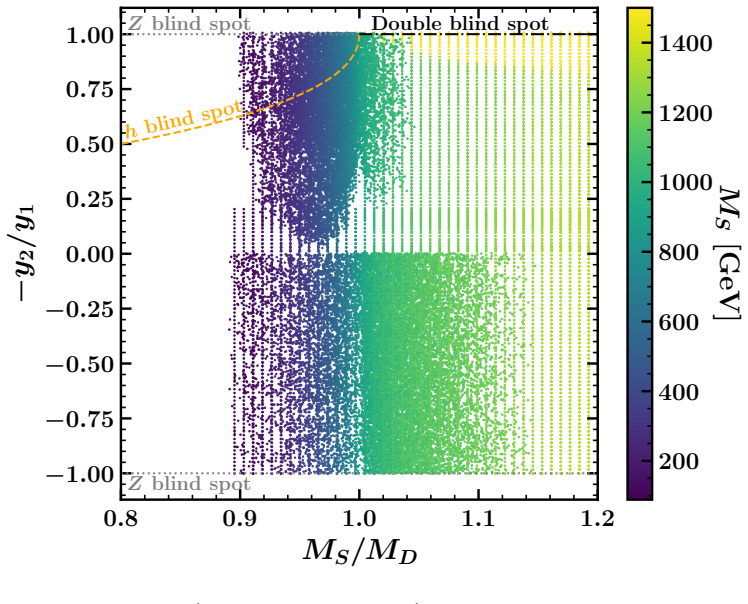
The engine is the $3\times3$ neutral mass matrix $M_N$ built from $M_S$, $M_D$, $y_1$, and $y_2$, whose diagonalization gives three Majorana fermions and one charged Dirac fermion. Direct detection at tree level is controlled by two couplings: the DM--Higgs coupling $g_{h\chi^0_1\chi^0_1}$, which generates the spin-independent signal, and the DM--$Z$ coupling $g_{Z\chi^0_1\chi^0_1}$, which generates the spin-dependent signal. The blind spots are the conditions under which these couplings vanish: $y_2/y_1=\pm1$ for the $Z$ blind spot, the Higgs blind spot relation of Eq. (12) for $M_S<M_D$, and the double blind spot $y_2/y_1=-1$ for $M_D<M_S$. The second pillar is coannihilation, whose Boltzmann suppression $\sim e^{-x\Delta_i}$ with $\Delta_i=(m_i-m_1)/m_1$ makes the relic density sensitive to the fractional mass splittings, so a compressed spectrum is a consequence of the constraints rather than an assumption. The third is a one-loop renormalization group analysis of the ratios $r_m\equiv M_S/M_D$ and $r_y\equiv y_2/y_1$, which shows that $r_y=-1$ is a fixed point of enhanced symmetry and that $r_m$ can flow toward a pseudostationary point $r_m^*$, focusing parameters into the double blind spot in the infrared.
What would settle it
Compute the one-loop correction to the spin-independent cross section at the Higgs and double blind spots for representative viable points (for example $M_S=300$ GeV with $y_1=0.25$, or $M_S=M_D=850$ GeV). If the loop result exceeds the projected direct detection sensitivity at those masses, the region claimed to lie below the neutrino fog disappears. A second check is experimental: search 13.6 TeV collider data for the predicted soft-lepton or pion final states from $χ^\pm\toχ^0_1$ and $χ^0_2\toχ^0_1$ decays; an exclusion stronger than the model's cross-section curves would rule out the surviving compressed-spectrum points.
Extended reading notes
Core claim
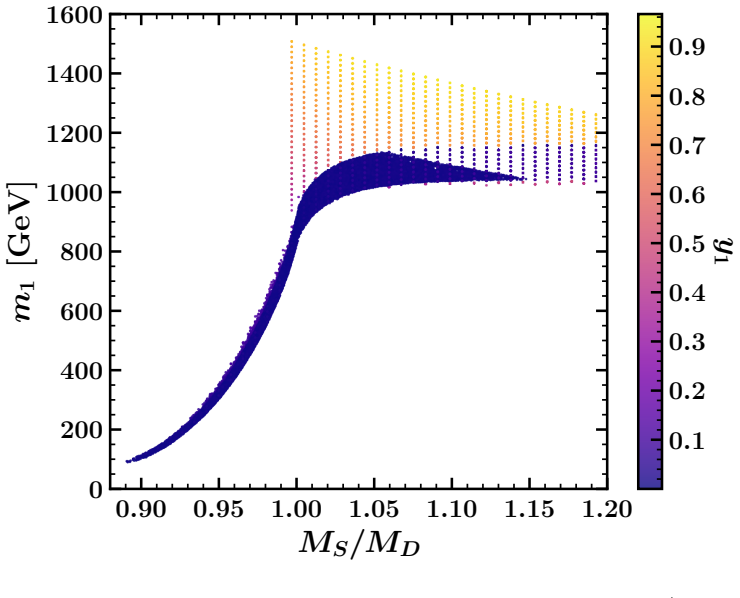
The paper establishes that consistency with the observed relic density and the 2024 direct detection bounds forces the singlet-doublet model into one of two corners. In the first, the Yukawa couplings are so small that the dark matter's direct detection cross section is automatically tiny. In the second, the parameters sit near a tree-level blind spot where the DM--Higgs coupling $g_{h\chi^0_1\chi^0_1}$ vanishes, the DM--$Z$ coupling $g_{Z\chi^0_1\chi^0_1}$ vanishes, or both vanish at the 'double blind spot' $y_2/y_1=-1$ with $M_D<M_S$. In both corners the dark matter's own annihilations are too weak to set the abundance, so the observed relic density is achieved by coannihilation with neighboring dark-sector states; this forces the spectrum to be compressed, with one state near $M_S$ and three near $M_D$. For $M_S\lesssim 850$ GeV the dark matter is singletlike with mass splittings of order 1--20 GeV, while for larger masses it is doubletlike and nearly degenerate with the charged state. The paper finds points whose direct detection cross sections fall below the projected sensitivity of LZ and even below the neutrino fog, and it shows that those hard-to-detect regions have specific LHC signatures. It also argues that renormalization group evolution can focus a range of ultraviolet mass ratios onto the double blind spot when the Yukawa couplings are large, making that corner less accidental.
Load-bearing premise
The tree-level blind-spot cancellation survives loop corrections, so loop-induced direct detection rates stay below the neutrino fog; the paper imports this result from the related MSSM context rather than computing the loop correction in the singlet-doublet model itself.
Editorial extensions
If this is right
- Every remaining viable point of the singlet-doublet model has a compressed dark sector, with the charged state and second neutral state within roughly 0--20 GeV of the dark matter, so future WIMP searches should target compressed spectra rather than isolated heavy states.
- Direct detection cannot close the remaining parameter space: points below the neutrino fog evade even the projected sensitivity of upcoming experiments, so ruling out the model requires complementary probes.
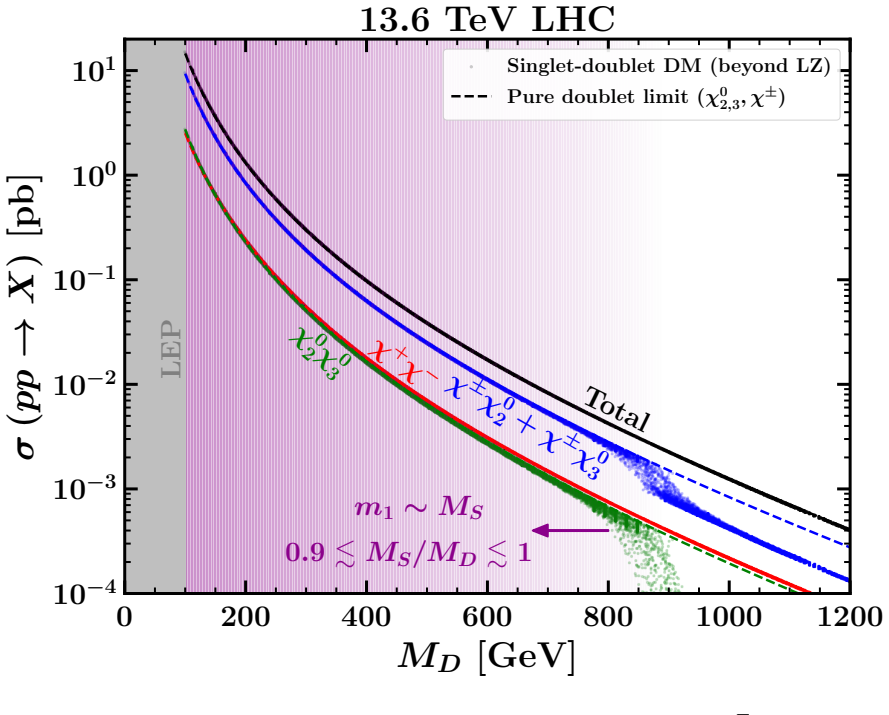
- At the LHC, dark-sector pair production cross sections match the pure doublet limit, and the produced states decay through off-shell $W$ and $Z$ bosons to soft leptons; some small-Yukawa corners give displaced vertices.
- Large Yukawa couplings near the double blind spot allow dark matter masses up to about 1500 GeV, beyond the roughly 1100 GeV limit set by gauge interactions alone, which extends the mass range that collider searches must cover.
- Renormalization group focusing can make the double blind spot natural: with $r_y=-1$ in the infrared and $y_1\gtrsim 0.6$, ultraviolet values with $M_S<M_D$ evolve to $M_S\gtrsim M_D$ at low energies, placing the model directly in the blind-spot regime.
Reading between the lines
- Editorial inference: the claim that blind-spot points remain below the neutrino fog leans on a loop-correction result imported from the MSSM; a dedicated one-loop calculation of the singlet-doublet spin-independent cross section at the blind spot is the direct test of this corner, and if loops restore a larger cross section, the 'stubbornly out of reach' region shrinks.
- Editorial inference: because both surviving regimes produce near-degenerate doubletlike states with electroweak pair-production cross sections, collider searches for soft leptons and short track gaps can in principle cover the blind-spot region that direct detection cannot, making colliders the decisive experiment for this model.
- Editorial inference: the same blind-spot-plus-coannihilation logic transfers to neighboring models such as singlet-triplet and Wino-Bino-like dark matter, and the RG-focusing analysis indicates which of those corners can emerge from generic ultraviolet conditions and which require coincidence.
Signed reviews
Editorial analysis
A structured set of objections, weighed in public.
Referee Report
Summary. The manuscript revisits the singlet-doublet fermion dark matter model in light of the 2024 LZ direct detection results. It scans the four-dimensional parameter space (MS, MD, y1, y2) with SARAH, SPheno and micrOMEGAs, imposing the Planck relic density, thermalization of the dark sector, and LZ bounds. The authors find that the surviving parameter space is organized into two regimes: small Yukawa couplings, or proximity to the h, Z, or double blind spots, with coannihilation and a compressed mass spectrum required to obtain the observed relic abundance. The paper then characterizes the mass spectrum, the dominant early-universe processes, LHC production and decay signatures, and the possibility of RG evolution focusing generic high-scale parameters into the blind-spot regions. Appendix A provides analytic diagonalization formulas and explicit couplings in the small-Yukawa and blind-spot limits, and the scan data are made publicly available.
Significance. If the main claims hold, this is a valuable and timely phenomenological update: it sharply characterizes the remaining viable parameter space of a well-motivated WIMP model, identifies a region below the neutrino fog that will be difficult to probe, and gives concrete LHC signatures that follow from the compressed spectrum. The paper is transparent in its use of standard public codes, provides analytic expressions for the relevant couplings, and releases the scan data, all of which strengthen its usefulness. The RG-focusing discussion is an interesting addition, although the authors appropriately note that the most attractive focusing scenario is in tension with gauge coupling unification. The most consequential claim, that some surviving points remain 'stubbornly out of reach' of direct detection, is also the one that rests most heavily on an imported loop-level argument.
major comments (3)
- [Sec. II A, after Eq. (13), with Figs. 1 and 3 and the Conclusion] The assertion that loop corrections do not spoil the blind-spot suppression, and that loop-induced direct detection rates remain below the neutrino fog, is imported from Ref. [34] in the MSSM context rather than demonstrated for the singlet-doublet model. This is load-bearing for the paper's headline conclusion that points beneath the neutrino fog are 'stubbornly out of reach.' The Z blind spot at y2/y1 = -1 is protected by a custodial symmetry, but the h blind spot of Eq. (12) (MS < MD) and the generic near-blind-spot points are accidental cancellations, and the singlet-doublet model differs from the MSSM in field content and loop structure. I request a model-specific estimate, ideally an explicit one-loop computation of the spin-independent cross section for representative surviving points, or a clearly softened claim that the below-fog region is a tree-level statement whose loop-level viability remains to be checked.
- [Sec. III A, scan range and text near Fig. 2 and the Conclusion] The statement that all viable parameter space requires coannihilation, and hence a compressed spectrum, is central to the paper's two-regime summary, but the main scan restricts the mass ratio to 0.7 < MS/MD < 1.2. This range by construction preferentially selects compressed spectra. The text mentions additional exploratory scans that found no points without coannihilation, but gives no details on their coverage or robustness. Since the paper claims that the remaining parameter space is 'fully characterized,' please either provide details of the exploratory scans or rephrase the claim to be explicitly about the surveyed region.
- [Sec. III A, footnote 1 and relic density discussion] The relic density calculation uses micrOMEGAs with the fast option and with off-shell gauge-boson final states neglected (VW/VZdecay=0). For the low-mass part of the scan and for compressed spectra near thresholds, this approximation can shift the computed relic density by an amount comparable to the 10% tolerance used to select surviving points. Please quantify the impact of this approximation on the displayed relic-density curves and on the boundaries of the surviving regions, or justify that all retained points are sufficiently far from the affected thresholds.
minor comments (4)
- [Throughout] There are several typographical errors, including 'coannhilation' in Secs. II A and III C and 'direction detection' in Sec. II A; these should be corrected.
- [Eqs. (9)-(10)] The unsymmetrized nature of the Higgs coupling gh is easy to miss; consider adding a sentence in the text immediately after Eq. (10) clarifying how the couplings are symmetrized when inserted into the interaction Lagrangian for i ≠ j.
- [Sec. III B, captions of Figs. 6 and 7] The phrase 'beyond the LZ projected sensitivity' is ambiguous: in the context of cross sections it means 'below the projected sensitivity curve,' and I suggest rewording the captions to avoid confusion.
- [Sec. IV 2, footnote 3] The tension between the large-Yukawa focusing scenario and gauge coupling unification is an important caveat; I suggest moving it from the footnote into the main text of Sec. IV 2.
Circularity Check
No significant circularity: the scan, relic-density computation, and RG analysis are self-contained forward calculations; the imported loop-correction argument in Sec. II A is a correctness risk, not a circular reduction.
full rationale
The paper's central derivations are forward computations from the Lagrangian in Eq. (3). The dark-sector masses, mixing matrix elements, direct-detection cross sections, and relic density are computed from the input parameters (MS, MD, y1, y2) using SPheno and micrOMEGAs, and then compared against external constraints (Planck omega h^2 and LZ 2024 bounds). No parameter is fitted to the target prediction of 'surviving points below the neutrino fog'; the surviving points are selected by those external constraints. The blind-spot conditions in Eqs. (11)-(13) are derived from the vanishing of the numerators of Eqs. (A7)-(A8), with the h blind spot additionally justified by the Higgs low-energy theorem; they are not defined in terms of the final cross-section claims. The RG-focusing section computes beta functions for the ratios rm and ry from SARAH and evolves them forward from UV to IR; the conclusion that ry = -1 is a repulsive fixed point away from which coupling ratios run is a direct consequence of Eq. (20), not an assumed input. The self-citations, Refs. [4] and [63], provide the blind-spot and RG-focusing concepts, but the algebra is rederived here and the numerical scan is independent; these citations are not load-bearing. The only substantive caveat is in Sec. II A, where the survival of the blind-spot suppression under loop corrections is imported from the MSSM analysis of Ref. [34] and the size of the loop-induced cross section is 'expected' to lie below the neutrino fog rather than computed for this model. That is a legitimate external-transfer and omitted-calculation concern affecting the robustness of the 'stubbornly out of reach' conclusion, but it is not circular: the loop result is not an input that is later renamed as a prediction, nor is the claim equivalent to an assumption already built into the scan. Accordingly, no circular step is identified.
Assumptions & free parameters
free parameters (4)
- MS
- MD
- y1
- y2
assumptions (6)
- ad hoc to paper A Z2 symmetry, under which the new fermions are odd and Standard Model fields are even, ensures dark matter stability.
- domain assumption The standard thermal freeze-out picture in a standard cosmology with the measured Planck abundance applies; no non-standard early universe cosmology.
- domain assumption The dark sector maintains chemical equilibrium during freeze-out; the analysis rejects points with Gamma/(H x_FO) <= 50.
- domain assumption Loop corrections shift but do not eliminate the blind spots, leaving the direct detection cross section below the neutrino fog.
- ad hoc to paper CP-violating phases are set to zero (y2 real), so all couplings are real and the mass matrix is real symmetric.
- domain assumption Perturbative one-loop RGEs with two-loop numerics from SARAH describe the running over many decades; large-IR-coupling cases encounter Landau poles above the cutoff.
Cite this review
Pith. "Pith review of Singlet-doublet dark matter revisited." pith.science (2026). https://pith.science/paper/JOADMRDG
@misc{pith2026250511607,
  author       = {Pith},
  title        = {Pith review of: Singlet-doublet dark matter revisited},
  year         = {2026},
  howpublished = {\url{https://pith.science/paper/JOADMRDG}},
  note         = {Machine review of arXiv:2505.11607}
}
read the original abstract
The singlet-doublet model is an economical model of weakly interacting dark matter. We revisit it in light of improved dark matter direct detection limits. We characterize the now well-defined regions of remaining parameter space with suppressed direct detection cross sections and discuss features of the spectrum accessible at the Large Hadron Collider. We discuss when and how parameters in these special regions might be realized as the result of renormalization group evolution when starting with generic ultraviolet initial conditions.
Figures


Figures from the paper (10 more)





Forward citations
Cited by 3 Pith papers
-
Singlet-Doublet fermion origin of dark matter, neutrino mass and inverse first-order electroweak phase transition
New singlet and doublet fermions, a scalar singlet, and right-handed neutrinos can simultaneously explain Dirac neutrino masses, dark matter, and a two-step inverse electroweak phase transition with observable gravita...
-
Singlet-doublet dark matter beyond freeze-out
In the small-coupling limit of the singlet-doublet dark matter model, the relic density is set by co-scattering, freeze-in, or SuperWIMP decays rather than ordinary freeze-out, and the observable signals move from dir...
-
WIMPs Below the Radar: Blind Spots and Benchmarks Beyond the Neutrino Floor
In three WIMP models, blind spots and loop corrections keep spin-independent scattering below current bounds and, in parts of parameter space, below the neutrino floor, while satisfying thermal relic density.
Reference graph
Works this paper leans on
-
[34]
S. Banerjee, S. Matsumoto, K. Mukaida, and Y.-L. S. Tsai, JHEP 11, 070 (2016), arXiv:1603.07387 [hep-ph]
arXiv 2016
-
[1]
Couplings and production 23
-
[2]
Renormalization Group Focusing 26
Decays 25 IV. Renormalization Group Focusing 26
-
[3]
Small Yukawa couplings 29
-
[4]
Double blind spot 29
-
[5]
Spin-independent blind spot with rm < 1 31
-
[6]
Conclusion 33 Acknowledgments 34 Data Availability 34 A
RG focusing summary 32 V. Conclusion 33 Acknowledgments 34 Data Availability 34 A. Mass Matrix Diagonalization and Couplings 34
-
[7]
Double blind spot 36
Show all 91 references
-
[8]
Small Yukawa couplings 37 References 39 2 I. INTRODUCTION With the improvement in limits on the dark matter (DM) direct detection cross section from the LUX-ZEPLIN (LZ) experiment in 2024 [1], it is timely to consider the status of the weakly interacting massive particle (WIMP...
2024
-
[9]
The states are odd under a Z2 symmetry while the SM states are all even under the same Z2
representations of the SM gauge groupSU (3)c×SU (2)L×U(1)Y respectively. The states are odd under a Z2 symmetry while the SM states are all even under the same Z2. This discrete symmetry ensures the stability of the lightest new particle (i.e. our dark matter candidate). We de...
-
[10]
blind spot
is the SM Higgs doublet, whose neutral component contains the physical Higgs boson h, and MS,MD,y 1,y 2 are the four new parameters introduced in this singlet- doublet model. Via field redefinitions, without loss of generality, we may consider the case where MS,MD,y 1 are posi...
2024
-
[11]
Couplings and production As can be seen above, the remaining viable parameter space potentially within reach of the LHC will have 0.9 ≲MS/MD ≲ 1, with singletlike dark matter χ0 1 with massm1≃MS, and Yukawa couplingsy1 and y2 with relatively small magnitude. It can therefore b...
-
[12]
Therefore, the dominant production mechanisms for this model at the LHC are via intermediate electroweak bosons which produce some combination of χ±, χ0 2,3
All other couplings are small. Therefore, the dominant production mechanisms for this model at the LHC are via intermediate electroweak bosons which produce some combination of χ±, χ0 2,3. Furthermore, pair production cross sections for the dominant final states are expected t...
-
[13]
We seek to understand whether these particles are long-lived and whether there can be cascade decays or whether dark sector states immediately decay to χ0 1
Decays To understand the potential collider signatures of the model, we now discuss the decays of those particles produced with significant cross section (χ±,χ0 2 orχ0 3). We seek to understand whether these particles are long-lived and whether there can be cascade decays or w...
-
[14]
We note that when |y1| and|y2| are similar (or equivalently|ry|∼ 1) then ry evolves slowly
= 3A 2 ryy2 1(1−r2 y) (18) where A ≡ 1/16π2 is the loop factor. We note that when |y1| and|y2| are similar (or equivalently|ry|∼ 1) then ry evolves slowly. The stationary points of this beta function are r∗ y = 0,±1. (19) While it may be possible to have focusing to r∗ y = 0, ...
-
[15]
In this case, it is possible to stray further from the blind spots while maintaining consistency with current experimental bounds
Small Yukawa couplings As we have seen, smally1 andy2 suppress the direct detection cross sections. In this case, it is possible to stray further from the blind spots while maintaining consistency with current experimental bounds. In this regime RG focusing plays no role. When...
-
[16]
The factor of 0.01 comes from plugging in the values of the SM gauge couplings
and β1(rm)∼ 0.01rm +O(y2 1). The factor of 0.01 comes from plugging in the values of the SM gauge couplings. Moreover, when the Yukawa couplings are small, the running for y1 and y2 themselves are suppressed. Since RG evolution is slow, this means that if one starts out in the...
-
[17]
As mentioned above, ry =−1 is a point of enhanced symmetry of the model and is a fixed point under RG evolution
Double blind spot The area of parameter space where ry =−1 and rm > 1 is of particular interest because both the spin-independent and spin-dependent direct detection cross sections are suppressed. As mentioned above, ry =−1 is a point of enhanced symmetry of the model and is a...
-
[18]
Instead, the value ofry corresponding to the spin-independent blind spot becomes a function of rm (see Eq
Spin-independent blind spot with rm< 1 As discussed in Section II A, whenrm < 1, the spin-independent and spin-dependent blind spots no longer coincide. Instead, the value ofry corresponding to the spin-independent blind spot becomes a function of rm (see Eq. (12)). Since the ...
-
[19]
So, over the last few decades of evolution, the blind spot steeply descends from −ry = 1 while ry(µ) continues to evolve slowly
As seen in Figure 12 and for most of parameter space |β(rm)|≫| β(ry)|. So, over the last few decades of evolution, the blind spot steeply descends from −ry = 1 while ry(µ) continues to evolve slowly. It is possible (but would be coincidental) for these to nearly coincide near ...
-
[20]
In the case of ry, there is a fixed point and we studied its stability
RG focusing summary In this section, we have studied the one-loop RG evolution of the mass ratio rm and the coupling ratio ry. In the case of ry, there is a fixed point and we studied its stability. In the case of rm, we argued that, although it does not have a true fixed poin...
-
[21]
Double blind spot First, consider the double blind spot, y2 =−y1 when MD < MS (see Eq. (13)). In this case, the physical masses are 5 m1 =MD, m2 = 1 2 MD−MS + q (MS +MD)2 + 4y2 1v2 , m3 = 1 2 MS−MD + q (MS +MD)2 + 4y2 1v2 , (A9) with signs ϵ1 =−ϵ2 =ϵ3 = 1, such that the three ...
-
[22]
In this regime, it is particularly conve- nient to express the mass mixing of the neutral states, as given in Eqs
Small Y ukawa couplings Now we turn to the small Yukawa coupling limit. In this regime, it is particularly conve- nient to express the mass mixing of the neutral states, as given in Eqs. (5) and (6), in terms of the rotated gauge eigenstate basis eψ0≡ (S, N+N√ 2 , N−N√ 2 ): Lm...
- [23]
-
[24]
Arkani-Hamed, S
N. Arkani-Hamed, S. Dimopoulos, and S. Kachru, (2005), arXiv:hep-th/0501082
2005 arXiv
-
[25]
Kearney, N
J. Kearney, N. Orlofsky, and A. Pierce, Phys. Rev. D 95, 035020 (2017), arXiv:1611.05048 [hep-ph]
2017 arXiv
-
[26]
Cohen, J
T. Cohen, J. Kearney, A. Pierce, and D. Tucker-Smith, Phys. Rev. D 85, 075003 (2012), arXiv:1109.2604 [hep-ph]
2012 arXiv
- [27]
- [28]
-
[29]
Mahbubani and L
R. Mahbubani and L. Senatore, Phys. Rev. D 73, 043510 (2006), arXiv:hep-ph/0510064
2006 arXiv
-
[30]
Enberg, P
R. Enberg, P. J. Fox, L. J. Hall, A. Y. Papaioannou, and M. Papucci, JHEP 11, 014 (2007), arXiv:0706.0918 [hep-ph]. 39
2007 arXiv
-
[31]
T. Abe, R. Kitano, and R. Sato, Phys. Rev. D 91, 095004 (2015), [Erratum: Phys.Rev.D 96, 019902 (2017)], arXiv:1411.1335 [hep-ph]
2015 arXiv
-
[32]
Calibbi, A
L. Calibbi, A. Mariotti, and P. Tziveloglou, JHEP 10, 116 (2015), arXiv:1505.03867 [hep-ph]
2015 arXiv
-
[33]
Freitas, S
A. Freitas, S. Westhoff, and J. Zupan, JHEP 09, 015 (2015), arXiv:1506.04149 [hep-ph]
2015 arXiv
-
[35]
Egana-Ugrinovic, JHEP 12, 064 (2017), arXiv:1707.02306 [hep-ph]
D. Egana-Ugrinovic, JHEP 12, 064 (2017), arXiv:1707.02306 [hep-ph]
2017 arXiv
-
[36]
Lopez Honorez, M
L. Lopez Honorez, M. H. G. Tytgat, P. Tziveloglou, and B. Zaldivar, JHEP 04, 011 (2018), arXiv:1711.08619 [hep-ph]
2018 arXiv
-
[37]
S. Esch, M. Klasen, and C. E. Yaguna, JHEP 10, 055 (2018), arXiv:1804.03384 [hep-ph]
2018 arXiv
- [38]
-
[39]
Arcadi, D
G. Arcadi, D. Cabo-Almeida, M. Dutra, P. Ghosh, M. Lindner, Y. Mambrini, J. P. Neto, M. Pierre, S. Profumo, and F. S. Queiroz, (2024), arXiv:2403.15860 [hep-ph]
2024 arXiv
-
[40]
Arcadi, A
G. Arcadi, A. Djouadi, and M. Raidal, Phys. Rept. 842, 1 (2020), arXiv:1903.03616 [hep-ph]
2020 arXiv
-
[41]
Arcadi, M
G. Arcadi, M. Dutra, P. Ghosh, M. Lindner, Y. Mambrini, M. Pierre, S. Profumo, and F. S. Queiroz, Eur. Phys. J. C 78, 203 (2018), arXiv:1703.07364 [hep-ph]
2018 arXiv
- [42]
-
[43]
P. K. Paul, S. K. Sahoo, and N. Sahu, (2024), arXiv:2412.02607 [hep-ph]
2024
-
[44]
Arkani-Hamed and S
N. Arkani-Hamed and S. Dimopoulos, JHEP 06, 073 (2005), arXiv:hep-th/0405159
2005 arXiv
-
[45]
G. F. Giudice and A. Romanino, Nucl. Phys. B 699, 65 (2004), [Erratum: Nucl.Phys.B 706, 487–487 (2005)], arXiv:hep-ph/0406088
2004 arXiv
- [46]
-
[47]
Cheung, L
C. Cheung, L. J. Hall, D. Pinner, and J. T. Ruderman, JHEP 05, 100 (2013), arXiv:1211.4873 [hep-ph]
2013 arXiv
-
[48]
M. Ibe, Y. Nakayama, and S. Shirai, JHEP 03, 012 (2024), arXiv:2312.08087 [hep-ph]
2024 arXiv
- [49]
-
[50]
S. P. Martin, Phys. Rev. D 109, 095045 (2024), arXiv:2403.19598 [hep-ph]
2024 arXiv
-
[51]
S. P. Martin, Phys. Rev. D 111, 075004 (2025), arXiv:2412.08958 [hep-ph]
2025 arXiv
-
[52]
Griest and D
K. Griest and D. Seckel, Phys. Rev. D 43, 3191 (1991)
1991
- [53]
-
[54]
Badziak, M
M. Badziak, M. Olechowski, and P. Szczerbiak, JHEP 03, 179 (2016), arXiv:1512.02472 40 [hep-ph]
2016 arXiv
-
[55]
Badziak, M
M. Badziak, M. Olechowski, and P. Szczerbiak, JHEP 07, 050 (2017), arXiv:1705.00227 [hep-ph]
2017 arXiv
-
[56]
T. Han, H. Liu, S. Mukhopadhyay, and X. Wang, JHEP 03, 080 (2019), arXiv:1810.04679 [hep-ph]
2019 arXiv
-
[57]
C.-Y. Chen, R. J. Hill, M. P. Solon, and A. M. Wijangco, Phys. Lett. B 781, 473 (2018), arXiv:1801.08551 [hep-ph]
2018 arXiv
-
[58]
Chen and R
Q. Chen and R. J. Hill, Phys. Lett. B 804, 135364 (2020), arXiv:1912.07795 [hep-ph]
2020 arXiv
- [59]
- [60]
-
[61]
Staub, Adv
F. Staub, Adv. High Energy Phys. 2015, 840780 (2015), arXiv:1503.04200 [hep-ph]
2015 arXiv
- [62]
-
[63]
Porod and F
W. Porod and F. Staub, Comput. Phys. Commun. 183, 2458 (2012), arXiv:1104.1573 [hep-ph]
2012 arXiv
- [64]
-
[65]
Alguero, G
G. Alguero, G. Belanger, F. Boudjema, S. Chakraborti, A. Goudelis, S. Kraml, A. Mjallal, and A. Pukhov, Comput. Phys. Commun. 299, 109133 (2024), arXiv:2312.14894 [hep-ph]
2024 arXiv
-
[66]
Dataset for singlet-doublet dark matter revisited,
P. N. Bhattiprolu, E. Petrosky, and A. Pierce, “Dataset for singlet-doublet dark matter revisited,” https://doi.org/10.7302/27j9-nw17
-
[67]
Calibbi, L
L. Calibbi, L. Lopez-Honorez, S. Lowette, and A. Mariotti, JHEP 09, 037 (2018), arXiv:1805.04423 [hep-ph]
2018 arXiv
-
[68]
D. S. Akerib et al. (LZ), Phys. Rev. D 101, 052002 (2020), arXiv:1802.06039 [astro-ph.IM]
2020 arXiv
-
[69]
C. A. J. O’Hare, Phys. Rev. Lett. 127, 251802 (2021), arXiv:2109.03116 [hep-ph]
2021 arXiv
-
[70]
Aghanim et al
N. Aghanim et al. (Planck), Astron. Astrophys. 641, A6 (2020), [Erratum: Astron.Astrophys. 652, C4 (2021)], arXiv:1807.06209 [astro-ph.CO]
2020 arXiv
-
[71]
Aalbers et al
J. Aalbers et al. (LZ), Phys. Rev. Lett. 131, 041002 (2023), arXiv:2207.03764 [hep-ex]
2023 arXiv
-
[72]
Tucker-Smith and N
D. Tucker-Smith and N. Weiner, Phys. Rev. D 64, 043502 (2001), arXiv:hep-ph/0101138
2001 arXiv
-
[73]
P. W. Graham, H. Ramani, and S. S. Y. Wong, Phys. Rev. D 111, 055030 (2025), arXiv:2409.07768 [hep-ph]
2025 arXiv
-
[74]
S. D. Thomas and J. D. Wells, Phys. Rev. Lett. 81, 34 (1998), arXiv:hep-ph/9804359
1998 arXiv
-
[75]
Nihei, L
T. Nihei, L. Roszkowski, and R. Ruiz de Austri, JHEP 03, 031 (2002), arXiv:hep-ph/0202009
2002 arXiv
-
[76]
Alguero, G
G. Alguero, G. Belanger, S. Kraml, and A. Pukhov, SciPost Phys. 13, 124 (2022), 41 arXiv:2207.10536 [hep-ph]
2022 arXiv
-
[77]
Arganda, M
E. Arganda, M. Carena, M. de los Rios, A. D. Perez, D. Rocha, R. M. Sand´ a Seoane, and C. E. M. Wagner, (2024), arXiv:2410.13799 [hep-ph]
2024 arXiv
- [78]
-
[79]
Hayrapetyan et al
A. Hayrapetyan et al. (CMS), Phys. Rev. D 109, 112001 (2024), arXiv:2402.01888 [hep-ex]
2024 arXiv
-
[80]
Aad et al
G. Aad et al. (ATLAS), Phys. Rev. Lett. 133, 031802 (2024), arXiv:2402.08347 [hep-ex]
2024 arXiv
- [81]
-
[82]
Djouadi, Y
A. Djouadi, Y. Mambrini, and M. Muhlleitner, Eur. Phys. J. C 20, 563 (2001), arXiv:hep- ph/0104115
2001
-
[83]
H. E. Haber and D. Wyler, Nucl. Phys. B 323, 267 (1989)
1989
-
[84]
S. Baum, M. Carena, T. Ou, D. Rocha, N. R. Shah, and C. E. M. Wagner, JHEP 11, 037 (2023), arXiv:2303.01523 [hep-ph]
2023 arXiv
-
[85]
Kearney and A
J. Kearney and A. Pierce, Phys. Rev. D 88, 095009 (2013), [Erratum: Phys.Rev.D 88, 119902 (2013)], arXiv:1309.4447 [hep-ph]
2013 arXiv
-
[86]
Binosi and L
D. Binosi and L. Theußl, Comput. Phys. Commun. 161, 76 (2004), arXiv:hep-ph/0309015
2004 arXiv
-
[87]
C. R. Harris et al. , Nature 585, 357 (2020), arXiv:2006.10256 [cs.MS]
2020 arXiv
-
[88]
Virtanen et al
P. Virtanen et al. , Nature Meth. 17, 261 (2020), arXiv:1907.10121 [cs.MS]
2020 arXiv
-
[89]
J. D. Hunter, Comput. Sci. Eng. 9, 90 (2007)
2007
-
[90]
H. K. Dreiner, H. E. Haber, and S. P. Martin, From Spinors to Supersymmetry (Cambridge University Press, Cambridge, UK, 2023)
2023
-
[91]
H. K. Dreiner, H. E. Haber, and S. P. Martin, Phys. Rept. 494, 1 (2010), arXiv:0812.1594 [hep-ph]. 42
2010 arXiv
Reviewed August 15, 2026 · model on record in the stance chip above.
Discussion (0). Continue with ORCID to comment.