REVIEW 4 major objections 6 minor 66 references
X-Edit: Detecting and Localizing Edits in Images Altered by Text-Guided Diffusion Models
T0 review · 4 major / 6 minor · reviewed 2026-08-15 · deepseek-v4-flash
Pith's one-line read The paper claims that diffusion-based image edits can be localized pixel-by-pixel by inverting the image with Stable Diffusion and training a U-Net with attention on the inversion features, backed by a 167,026-pair dataset.
desk verdict A genuinely new task and a large paired dataset, but the evaluation is circular—PSNR/SSIM against the same pixel-difference mask used as the training target—so the localization claim is not yet established. read the letter →
The pith
A machine-rendered reading of the paper's core claim, the machinery that carries it, and where it could break.
The reading
What carries the argument
The load-bearing object is the composite inversion-feature tensor $\varphi$ defined in Eq. (5): $\varphi = x \oplus D(\hat{z}_T) \oplus D(\hat{z}_0) \oplus |x - D(\hat{z}_0)|$, built from the original image, the decoded DDIM inversion noise, the reconstructed image, and the reconstruction residual. The argument is that discrepancies between the original and its diffusion reconstruction are amplified in edited regions, so a segmentation network can learn to map these discrepancies to the edited mask. The mask target is $y = |x_o - x_e|$, the absolute pixel difference between original and edited images. The model is a U-Net augmented with convolutional block attention modules (CBAM), which apply channel and spatial attention inside each block, and it is trained with a segmentation loss combining mean squared error and SSIM plus a relevance loss that uses integrated gradients and Sobel-filter high/low-frequency maps to suppress attention to edges.
What would settle it
Run X-Edit on edits that change global illumination or artistic style (e.g., “make it night” or “turn it into an oil painting”) and compare the predicted masks with human-annotated masks of the semantically changed region; if the predictions track the pixel-difference signal rather than the semantic edit, X-Edit localizes pixel changes, not edits in the forensic sense claimed.
Extended reading notes
Core claim
X-Edit is the paper's proposed answer to the question of where a text-guided diffusion edit actually changed an image. The method starts from the observation, inherited from fake-image detection, that DDIM inversion of an image through a pretrained Stable Diffusion model reconstructs unedited content well and leaves detectable discrepancies where content was altered. The paper constructs an input tensor $\varphi$ by concatenating the original RGB image, the decoded inversion noise, the reconstructed image, and the residual between them, then trains a U-Net with CBAM attention to predict a mask $\hat{y}$ that reproduces the absolute pixel difference $y = |x_o - x_e|$ between the original and edited image. A combined MSE-plus-SSIM segmentation loss and a relevance loss that pushes the model's integrated-gradient maps away from high-frequency edges are used to keep predictions focused on edited regions. The authors report that this pipeline outperforms the tested baselines on PSNR and SSIM, and they present it as the first method specifically modeling the localization of diffusion-based edits.
Load-bearing premise
The paper assumes that the raw absolute pixel difference between the original and edited image is an adequate ground-truth mask of the edited region, and it uses that same mask both to train the network and to score it.
Editorial extensions
If this is right
- If X-Edit works as claimed, forensic pipelines gain a localization step: instead of only deciding that an image is fake, they can point to the pixels most likely changed by a text-guided edit.
- The released dataset of 167,026 paired original–edited images provides a training and evaluation resource for a task that currently has no standard benchmark.
- The qualitative out-of-distribution experiments suggest the method transfers, at least partially, to other editing methods such as FPE, MasaCtrl, and Plug-and-Play, which would make it useful beyond the InstructPix2Pix training distribution.
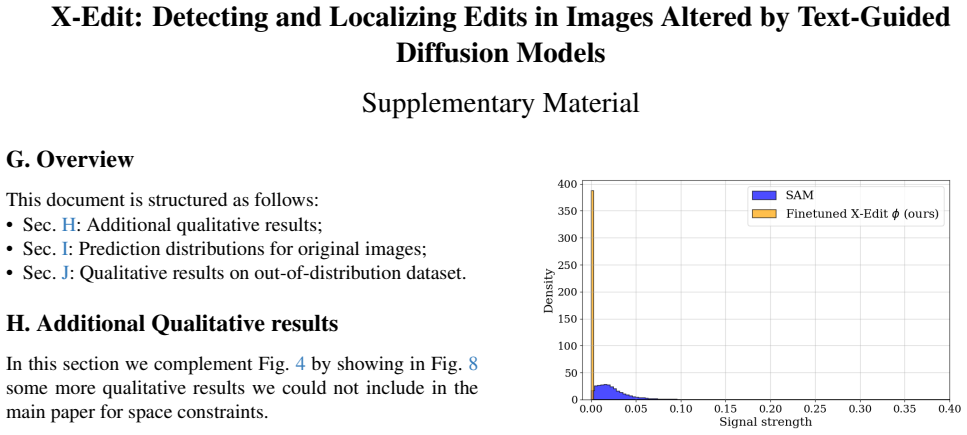
- Because the model predicts near-blank masks for original images, it could serve as a false-positive-aware detector as well as a localizer.
Reading between the lines
- One implication the authors leave implicit is that the pixel-difference mask defines “edit” operationally; edits that recolor or relight whole scenes will yield diffuse masks, so a stricter evaluation would compare against human-annotated semantic regions.
- A testable extension is to retrain the same U-Net with object-level or human-annotated masks instead of pixel differences and check whether the inversion features still separate edited from unedited regions; this would isolate whether the method learns edit semantics or low-level change.
- Because inversion is conditioned on an auto-generated caption, the method’s sensitivity to caption quality could be measured by perturbing the BLIP-3 caption; if localization degrades sharply on wrong captions, the captioner becomes a silent dependency of the whole pipeline.
Signed reviews
Editorial analysis
A structured set of objections, weighed in public.
Referee Report
Summary. The paper introduces X-Edit, a method for localizing text-guided diffusion-based edits in images. The pipeline performs DDIM inversion of a query image through a pretrained Stable Diffusion model, constructs a composite feature volume from the original image, decoded noise map, reconstructed image, and residual, and feeds this into a U-Net with CBAM attention trained to predict a soft mask. The ground-truth mask is defined as the absolute pixel difference between the original and edited images (Eq. 6). Training combines an MSE+SSIM segmentation loss (Eq. 8) with a relevance loss (Eq. 7) aimed at suppressing high-frequency artifacts. The authors contribute a dataset of 167,026 original/edited pairs generated with InstructPix2Pix, and report PSNR/SSIM comparisons against U-Net, ViT, SegFormer, and SAM baselines, plus ablations over input composition and qualitative out-of-distribution results on FPE, MasaCtrl, and PnP edits. The central claim is that X-Edit accurately localizes diffusion-based edits and outperforms baselines on this task.
Significance. If the localization claim were established, the paper would provide a useful forensic tool and a large paired dataset for a relatively new task. The method's core idea of exploiting inversion discrepancies is well motivated and builds sensibly on FakeInversion. The paper ships a concrete architecture, a loss design, and a dataset of nontrivial scale, and the qualitative results do show that the model often highlights plausible edited regions. However, the quantitative evidence as presented does not demonstrate localization accuracy in the forensic sense: the evaluation metric is computed against the same raw difference mask used as the training target, and no segmentation-style metrics (IoU, Dice, thresholded precision/recall) are reported. The claim of 'balanced precision and recall' in the abstract is not backed by any precision/recall numbers in the paper. The significance of the contribution therefore hinges on whether the authors can re-frame the target and evaluation to match the localization claim.
major comments (4)
- [§3, Eq. (6)] The ground-truth mask y=|x_o - x_e| is a dense, nonlocal pixel-level difference and does not represent a semantic edit mask. Any global change in illumination, tone, or compression produces nonzero values everywhere, while a subtle or style-based edit can yield a sparse or misleading target. Using this same mask as both the training target and the evaluation reference means that Table 1 largely measures how well the model reconstructs its own training target on an in-distribution test set, rather than whether predicted masks coincide with the actually edited regions. The paper's own failure cases (Fig. 6, color/style shifts) concede this limitation, but the central 'accurate localization' claim is not supported by this target definition.
- [§4, 'Inference and Evaluation Metrics'; Eq. (8)] PSNR and SSIM are computed against the same y defined in Eq. (6), and SSIM appears directly in the training loss (Eq. 8). PSNR is a monotone transform of MSE, the first term of L_S. Reporting these quantities as evidence of localization quality is therefore circular: a model optimized to minimize MSE and SSIM against y will naturally score well on those same metrics, and a blurred copy of the difference map can score arbitrarily high in PSNR while being useless for localization. The absence of any IoU, Dice, or thresholded precision/recall computed against a binarized semantic edit mask is a load-bearing gap for the paper's central claim.
- [Abstract; §5, Table 1] The abstract claims 'balanced precision and recall,' but no precision or recall numbers are reported anywhere in the main text or supplementary material. Table 1 reports only PSNR and SSIM. Moreover, the best PSNR (X-Edit on φ_FI, 24.946) and the best SSIM (X-Edit+finetuning on φ, 0.954) come from different configurations, and no error bars, confidence intervals, or significance tests are provided, so the statement that X-Edit 'outperforms baselines' is not statistically supported.
- [§5, 'Qualitative results'; Supplementary Sec. J] The out-of-distribution evaluation is purely qualitative. The paper claims robustness to FPE, MasaCtrl, and PnP edits, but only a handful of example images are shown, with no quantitative results on the 100-image Flickr30k set described in the supplementary. Given that the main quantitative evaluation is in-distribution with InstructPix2Pix only, the generalization claim is not substantiated without numbers.
minor comments (6)
- [§6] In the Conclusions, 'paired original end edited image' should be 'paired original and edited images.'
- [§3, Dataset] 'LAION-Aestetics V2 6.5+' contains a typo: 'Aestetics' should be 'Aesthetics.'
- [§4, 'Input Data Format'] The notation for the FakeInversion feature is introduced as φ_FI but the subscript is dropped in several places in Table 1 and the text, which can confuse which input configuration is being discussed.
- [§2, Figure 2] The claim that EfficientNet has 'high detection accuracy (99.93%) and precision (99.92%)' is stated without any training details or reference; please provide the source or experimental setup for these numbers.
- [§5, Table 1] SAM is listed with PSNR 23.478 and SSIM 0.506; the paper explains the low SSIM via false positives on original images, but a quantitative comparison of false positive rates on the original-image subset would be more informative than the single aggregate SSIM value.
- [§3, 'Finetuning Procedure'] The relevance loss in Eq. (7) uses λ_flat and λ_edge, but the paper does not report sensitivity of the performance to these hyperparameters or to α; a short sensitivity analysis would strengthen the claim that the chosen values are robust.
Circularity Check
PSNR/SSIM evaluation reproduces the training objective on the raw pixel-difference target, so the headline localization numbers are partly forced.
-
fitted input called prediction
[Section 3, Eq. (6) and Eq. (8); Section 4, Inference and Evaluation Metrics; Table 1]
"After defining a ground-truth mask y as: y=|x_o−x_e|, where x_o and x_e represents the original and edited images respectively, we train a segmentation model to predict a mask ŷ, indicating the likelihood of each pixel belonging to an edited area. ... We evaluate the models using key standard metrics for reconstruction tasks: Peak Signal-to-Noise Ratio (PSNR) and Structural Similarity Index Measure (SSIM) between the predicted mask ŷ and the ground-truth mask y."
The evaluation reference y is identical to the supervised target in Eq. (8): L_S = MSE(ŷ,y) + α·[1−SSIM(ŷ,y)]. PSNR is a monotone transform of MSE and SSIM appears directly in the loss, so Table 1 reports the training objective itself, not an independent measure of edit localization. A U-Net optimized to minimize MSE and SSIM against y is expected to score high PSNR/SSIM against y on the in-distribution test set by construction, and it is also expected to beat baselines (e.g., SAM, SegFormer) that were never trained with this objective. The claim 'X-Edit accurately localizes edits' therefore rests on a metric that the method was explicitly fitted to, rather than on an external evaluation such as thresholded IoU/Dice on semantic edit masks.
full rationale
X-Edit is a supervised segmentation method, not a derivation from fitted parameters: it regresses a pixel-difference mask y=|x_o−x_e| from inversion features and evaluates PSNR/SSIM against y on held-out InstructPix2Pix pairs. This is legitimate supervised learning, and the method's core mechanism (inversion features plus U-Net attention) has independent content. There is no load-bearing self-citation chain: references to FakeInversion, RobustViT, InstructPix2Pix, and others are external prior work, not the authors' own unverified results. The circularity concern is limited to the evaluation design. Eq. (6) defines the ground truth as raw absolute pixel difference, and Eq. (8) trains with MSE and SSIM against that same map; Table 1 then reports PSNR and SSIM against the same map. Thus the headline quantitative support for 'accurate localization' is partly self-referential: the metric is the objective, and the target is not an independently labeled semantic edit mask. Qualitative examples and the blank-output behavior on original images provide some independent evidence, and the out-of-distribution results are only qualitative, so the paper is not fully circular. Score 4 reflects one substantial evaluation-target/metric coupling while acknowledging the supervised, externally reproducible dataset and method.
Assumptions & free parameters
free parameters (5)
- lambda_flat =
0.1
- lambda_edge =
3.0
- alpha =
0.2
- lambda_R =
0.5
- lambda_S =
0.5
assumptions (3)
- domain assumption Ground-truth mask y = |x_o - x_e| represents the edited region.
- domain assumption Discrepancies from DDIM inversion of the query image are concentrated in edited regions.
- domain assumption Integrated-gradient relevance maps can be reshaped with a Sobel-based loss without harming mask prediction.
Cite this review
Pith. "Pith review of X-Edit: Detecting and Localizing Edits in Images Altered by Text-Guided Diffusion Models." pith.science (2026). https://pith.science/paper/VPIJYYSL
@misc{pith2026250511753,
  author       = {Pith},
  title        = {Pith review of: X-Edit: Detecting and Localizing Edits in Images Altered by Text-Guided Diffusion Models},
  year         = {2026},
  howpublished = {\url{https://pith.science/paper/VPIJYYSL}},
  note         = {Machine review of arXiv:2505.11753}
}
read the original abstract
Text-guided diffusion models have significantly advanced image editing, enabling highly realistic and local modifications based on textual prompts. While these developments expand creative possibilities, their malicious use poses substantial challenges for detection of such subtle deepfake edits. To this end, we introduce Explain Edit (X-Edit), a novel method for localizing diffusion-based edits in images. To localize the edits for an image, we invert the image using a pretrained diffusion model, then use these inverted features as input to a segmentation network that explicitly predicts the edited masked regions via channel and spatial attention. Further, we finetune the model using a combined segmentation and relevance loss. The segmentation loss ensures accurate mask prediction by balancing pixel-wise errors and perceptual similarity, while the relevance loss guides the model to focus on low-frequency regions and mitigate high-frequency artifacts, enhancing the localization of subtle edits. To the best of our knowledge, we are the first to address and model the problem of localizing diffusion-based modified regions in images. We additionally contribute a new dataset of paired original and edited images addressing the current lack of resources for this task. Experimental results demonstrate that X-Edit accurately localizes edits in images altered by text-guided diffusion models, outperforming baselines in PSNR and SSIM metrics. This highlights X-Edit's potential as a robust forensic tool for detecting and pinpointing manipulations introduced by advanced image editing techniques.
Figures


Figures from the paper (9 more)




Reference graph
Works this paper leans on
-
[1]
Amina Adadi and Mohammed Berrada. Peeking inside the black-box: a survey on explainable artificial intelligence (xai).IEEE access, 6:52138–52160, 2018. 2
work page 2018
-
[2]
Alejandro Barredo Arrieta, Natalia D ´ıaz-Rodr´ıguez, Javier Del Ser, Adrien Bennetot, Siham Tabik, Alberto Barbado, Salvador Garc´ıa, Sergio Gil-L ´opez, Daniel Molina, Richard Benjamins, et al. Explainable artificial intelligence (xai): Concepts, taxonomies, opportunities and challenges toward responsible ai.Information fusion, 58:82–115, 2020. 3
work page 2020
-
[3]
Jawadul H Bappy, Cody Simons, Lakshmanan Nataraj, BS Manjunath, and Amit K Roy-Chowdhury. Hybrid lstm and encoder–decoder architecture for detection of image forg- eries.IEEE transactions on image processing, 28(7):3286– 3300, 2019. 3
work page 2019
-
[4]
A deep learning approach to universal image manipulation detection using a new convolutional layer
Belhassen Bayar and Matthew C Stamm. A deep learning approach to universal image manipulation detection using a new convolutional layer. InProceedings of the 4th ACM workshop on information hiding and multimedia security, pages 5–10, 2016. 3
2016
-
[5]
Tim Brooks, Aleksander Holynski, and Alexei A. Efros. In- structpix2pix: Learning to follow image editing instructions. In2023 IEEE/CVF Conference on Computer Vision and Pat- tern Recognition (CVPR), pages 18392–18402, 2023. 2, 3, 1
work page 2023
-
[6]
Language models are few-shot learners
Tom Brown, Benjamin Mann, Nick Ryder, Melanie Sub- biah, Jared D Kaplan, Prafulla Dhariwal, Arvind Neelakan- tan, Pranav Shyam, Girish Sastry, Amanda Askell, Sand- hini Agarwal, Ariel Herbert-V oss, Gretchen Krueger, Tom Henighan, Rewon Child, Aditya Ramesh, Daniel Ziegler, Jeffrey Wu, Clemens Winter, Chris Hesse, Mark Chen, Eric Sigler, Mateusz Litwin, S...
work page 1901
-
[7]
Masactrl: Tuning-free mu- tual self-attention control for consistent image synthesis and editing
Mingdeng Cao, Xintao Wang, Zhongang Qi, Ying Shan, Xi- aohu Qie, and Yinqiang Zheng. Masactrl: Tuning-free mu- tual self-attention control for consistent image synthesis and editing. InProceedings of the IEEE/CVF International Con- ference on Computer Vision, pages 22560–22570, 2023. 3, 7, 1
work page 2023
-
[8]
George Cazenavette, Avneesh Sud, Thomas Leung, and Ben Usman. Fakeinversion: Learning to detect images from un- seen text-to-image models by inverting stable diffusion. In Proceedings of the IEEE/CVF Conference on Computer Vi- sion and Pattern Recognition, pages 10759–10769, 2024. 2, 3, 4, 5, 6
work page 2024
Show all 66 references
-
[9]
Optimizing relevance maps of vision transformers improves robustness
Hila Chefer, Idan Schwartz, and Lior Wolf. Optimizing relevance maps of vision transformers improves robustness. Advances in Neural Information Processing Systems, 35: 33618–33632, 2022. 2, 5
2022
-
[10]
X-iqe: explain- able image quality evaluation for text-to-image genera- tion with visual large language models.arXiv preprint arXiv:2305.10843, 2023
Yixiong Chen, Li Liu, and Chris Ding. X-iqe: explain- able image quality evaluation for text-to-image genera- tion with visual large language models.arXiv preprint arXiv:2305.10843, 2023. 3
2023 arXiv
-
[11]
On the detection of synthetic images generated by diffusion mod- els
Riccardo Corvi, Davide Cozzolino, Giada Zingarini, Gio- vanni Poggi, Koki Nagano, and Luisa Verdoliva. On the detection of synthetic images generated by diffusion mod- els. InICASSP 2023-2023 IEEE International Conference on Acoustics, Speech and Signal Processing (ICASSP), pa...
2023
-
[12]
Diffusion models beat gans on image synthesis.Advances in neural informa- tion processing systems, 34:8780–8794, 2021
Prafulla Dhariwal and Alexander Nichol. Diffusion models beat gans on image synthesis.Advances in neural informa- tion processing systems, 34:8780–8794, 2021. 1
2021
-
[13]
An image is worth 16x16 words: Transformers for image recognition at scale.arXiv preprint arXiv:2010.11929, 2020
Alexey Dosovitskiy. An image is worth 16x16 words: Transformers for image recognition at scale.arXiv preprint arXiv:2010.11929, 2020. 6
2010 arXiv
-
[14]
Exposing digital forgeries in scientific images
Hany Farid. Exposing digital forgeries in scientific images. InProceedings of the 8th workshop on Multimedia and se- curity, pages 29–36, 2006. 3
2006
-
[15]
Leveraging fre- quency analysis for deep fake image recognition
Joel Frank, Thorsten Eisenhofer, Lea Sch ¨onherr, Asja Fis- cher, Dorothea Kolossa, and Thorsten Holz. Leveraging fre- quency analysis for deep fake image recognition. InInter- national conference on machine learning, pages 3247–3258. PMLR, 2020. 1
2020
-
[16]
Guiding instruction-based im- age editing via multimodal large language models.arXiv preprint arXiv:2309.17102, 2023
Tsu-Jui Fu, Wenze Hu, Xianzhi Du, William Yang Wang, Yinfei Yang, and Zhe Gan. Guiding instruction-based im- age editing via multimodal large language models.arXiv preprint arXiv:2309.17102, 2023. 3
2023 arXiv
-
[17]
Generative adversarial nets.Advances in neural information processing systems, 27, 2014
Ian Goodfellow, Jean Pouget-Abadie, Mehdi Mirza, Bing Xu, David Warde-Farley, Sherjil Ozair, Aaron Courville, and Yoshua Bengio. Generative adversarial nets.Advances in neural information processing systems, 27, 2014. 1
2014
-
[18]
Proxedit: Improving tuning-free real image editing with proximal guidance
Ligong Han, Song Wen, Qi Chen, Zhixing Zhang, Kunpeng Song, Mengwei Ren, Ruijiang Gao, Anastasis Stathopou- los, Xiaoxiao He, Yuxiao Chen, et al. Proxedit: Improving tuning-free real image editing with proximal guidance. In Proceedings of the IEEE/CVF Winter Conference on Appl...
2024
-
[19]
Dice: Discrete inversion enabling controllable editing for multinomial diffusion and masked generative models.arXiv preprint arXiv:2410.08207, 2024
Xiaoxiao He, Ligong Han, Quan Dao, Song Wen, Minhao Bai, Di Liu, Han Zhang, Martin Renqiang Min, Felix Juefei- Xu, Chaowei Tan, et al. Dice: Discrete inversion enabling controllable editing for multinomial diffusion and masked generative models.arXiv preprint arXiv:2410.08207, 2024. 3
-
[20]
Prompt-to-prompt im- age editing with cross attention control.arXiv preprint arXiv:2208.01626, 2022
Amir Hertz, Ron Mokady, Jay Tenenbaum, Kfir Aberman, Yael Pritch, and Daniel Cohen-Or. Prompt-to-prompt im- age editing with cross attention control.arXiv preprint arXiv:2208.01626, 2022. 2
2022 arXiv
-
[21]
Denoising dif- fusion probabilistic models.Advances in neural information processing systems, 33:6840–6851, 2020
Jonathan Ho, Ajay Jain, and Pieter Abbeel. Denoising dif- fusion probabilistic models.Advances in neural information processing systems, 33:6840–6851, 2020. 1
2020
-
[22]
Diffusion model-based image editing: A survey.arXiv preprint arXiv:2402.17525, 2024
Yi Huang, Jiancheng Huang, Yifan Liu, Mingfu Yan, Jiaxi Lv, Jianzhuang Liu, Wei Xiong, He Zhang, Shifeng Chen, and Liangliang Cao. Diffusion model-based image editing: A survey.arXiv preprint arXiv:2402.17525, 2024. 1, 2
2024 arXiv
-
[23]
An edit friendly ddpm noise space: Inversion and manipulations
Inbar Huberman-Spiegelglas, Vladimir Kulikov, and Tomer Michaeli. An edit friendly ddpm noise space: Inversion and manipulations. InProceedings of the IEEE/CVF Conference on Computer Vision and Pattern Recognition, pages 12469– 12478, 2024. 3 9
2024
-
[24]
Image-to-image translation with conditional adver- sarial networks
Phillip Isola, Jun-Yan Zhu, Tinghui Zhou, and Alexei A Efros. Image-to-image translation with conditional adver- sarial networks. InProceedings of the IEEE conference on computer vision and pattern recognition, pages 1125–1134,
-
[25]
Segment any- thing
Alexander Kirillov, Eric Mintun, Nikhila Ravi, Hanzi Mao, Chloe Rolland, Laura Gustafson, Tete Xiao, Spencer White- head, Alexander C Berg, Wan-Yen Lo, et al. Segment any- thing. InProceedings of the IEEE/CVF International Con- ference on Computer Vision, pages 4015–4026, 2023. 6, 1
2023
-
[26]
Viescore: Towards explainable metrics for conditional image synthesis evaluation.arXiv preprint arXiv:2312.14867, 2023
Max Ku, Dongfu Jiang, Cong Wei, Xiang Yue, and Wenhu Chen. Viescore: Towards explainable metrics for conditional image synthesis evaluation.arXiv preprint arXiv:2312.14867, 2023. 3
2023 arXiv
-
[27]
The tug-of-war be- tween deepfake generation and detection.arXiv preprint arXiv:2407.06174, 2024
Hannah Lee, Changyeon Lee, Kevin Farhat, Lin Qiu, Steve Geluso, Aerin Kim, and Oren Etzioni. The tug-of-war be- tween deepfake generation and detection.arXiv preprint arXiv:2407.06174, 2024. 3
2024 arXiv
-
[28]
Distildire: A small, fast, cheap and lightweight diffusion synthesized deepfake detection.arXiv preprint arXiv:2406.00856, 2024
Yewon Lim, Changyeon Lee, Aerin Kim, and Oren Et- zioni. Distildire: A small, fast, cheap and lightweight diffusion synthesized deepfake detection.arXiv preprint arXiv:2406.00856, 2024. 3
2024 arXiv
-
[29]
Towards understanding cross and self-attention in stable diffusion for text-guided image editing
Bingyan Liu, Chengyu Wang, Tingfeng Cao, Kui Jia, and Jun Huang. Towards understanding cross and self-attention in stable diffusion for text-guided image editing. InProceed- ings of the IEEE/CVF Conference on Computer Vision and Pattern Recognition, pages 7817–7826, 2024. 3, 7, 1
2024
-
[30]
Detecting images generated by deep diffusion models using their local intrinsic dimensionality
Peter Lorenz, Ricard L Durall, and Janis Keuper. Detecting images generated by deep diffusion models using their local intrinsic dimensionality. InProceedings of the IEEE/CVF International Conference on Computer Vision, pages 448– 459, 2023. 3
2023
-
[31]
Sgdr: Stochas- tic gradient descent with warm restarts.arXiv preprint arXiv:1608.03983, 2016
Ilya Loshchilov and Frank Hutter. Sgdr: Stochas- tic gradient descent with warm restarts.arXiv preprint arXiv:1608.03983, 2016. 6
2016 arXiv
-
[32]
Fixing weight decay regularization in adam.arXiv preprint arXiv:1711.05101, 5,
Ilya Loshchilov, Frank Hutter, et al. Fixing weight decay regularization in adam.arXiv preprint arXiv:1711.05101, 5,
-
[33]
Detection of gan-generated fake im- ages over social networks
Francesco Marra, Diego Gragnaniello, Davide Cozzolino, and Luisa Verdoliva. Detection of gan-generated fake im- ages over social networks. In2018 IEEE conference on mul- timedia information processing and retrieval (MIPR), pages 384–389. IEEE, 2018. 3
2018
-
[34]
Do gans leave artificial fingerprints? In 2019 IEEE conference on multimedia information process- ing and retrieval (MIPR), pages 506–511
Francesco Marra, Diego Gragnaniello, Luisa Verdoliva, and Giovanni Poggi. Do gans leave artificial fingerprints? In 2019 IEEE conference on multimedia information process- ing and retrieval (MIPR), pages 506–511. IEEE, 2019. 3
2019
-
[35]
Negative-prompt inversion: Fast image inversion for editing with text-guided diffusion models.arXiv preprint arXiv:2305.16807, 2023
Daiki Miyake, Akihiro Iohara, Yu Saito, and Toshiyuki Tanaka. Negative-prompt inversion: Fast image inversion for editing with text-guided diffusion models.arXiv preprint arXiv:2305.16807, 2023. 3
2023 arXiv
-
[36]
Null-text inversion for editing real im- ages using guided diffusion models
Ron Mokady, Amir Hertz, Kfir Aberman, Yael Pritch, and Daniel Cohen-Or. Null-text inversion for editing real im- ages using guided diffusion models. InProceedings of the IEEE/CVF Conference on Computer Vision and Pattern Recognition, pages 6038–6047, 2023. 3
2023
-
[37]
Towards uni- versal fake image detectors that generalize across genera- tive models
Utkarsh Ojha, Yuheng Li, and Yong Jae Lee. Towards uni- versal fake image detectors that generalize across genera- tive models. InProceedings of the IEEE/CVF Conference on Computer Vision and Pattern Recognition, pages 24480– 24489, 2023. 3
2023
-
[38]
Image-to-image translation: Methods and applications
Yingxue Pang, Jianxin Lin, Tao Qin, and Zhibo Chen. Image-to-image translation: Methods and applications. IEEE Transactions on Multimedia, 24:3859–3881, 2021. 1, 2
2021
-
[39]
Ex- plaining generative diffusion models via visual analysis for interpretable decision-making process.Expert Systems with Applications, 248:123231, 2024
Ji-Hoon Park, Yeong-Joon Ju, and Seong-Whan Lee. Ex- plaining generative diffusion models via visual analysis for interpretable decision-making process.Expert Systems with Applications, 248:123231, 2024. 3
2024
-
[40]
Learning transferable visual models from natural language supervi- sion
Alec Radford, Jong Wook Kim, Chris Hallacy, Aditya Ramesh, Gabriel Goh, Sandhini Agarwal, Girish Sastry, Amanda Askell, Pamela Mishkin, Jack Clark, et al. Learning transferable visual models from natural language supervi- sion. InInternational conference on machine learning, p...
2021
-
[41]
Towards the detection of diffusion model deepfakes
Jonas Ricker, Simon Damm, Thorsten Holz, and Asja Fis- cher. Towards the detection of diffusion model deepfakes. arXiv preprint arXiv:2210.14571, 2022. 3
2022 arXiv
-
[42]
High-resolution image synthesis with latent diffusion models
Robin Rombach, Andreas Blattmann, Dominik Lorenz, Patrick Esser, and Bj ¨orn Ommer. High-resolution image synthesis with latent diffusion models. InProceedings of the IEEE/CVF conference on computer vision and pattern recognition, pages 10684–10695, 2022. 2
2022
-
[43]
U- net: Convolutional networks for biomedical image segmen- tation
Olaf Ronneberger, Philipp Fischer, and Thomas Brox. U- net: Convolutional networks for biomedical image segmen- tation. InMedical image computing and computer-assisted intervention–MICCAI 2015: 18th international conference, Munich, Germany, October 5-9, 2015, proceedings, par...
2015
-
[44]
Palette: Image-to-image diffusion models
Chitwan Saharia, William Chan, Huiwen Chang, Chris Lee, Jonathan Ho, Tim Salimans, David Fleet, and Mohammad Norouzi. Palette: Image-to-image diffusion models. In ACM SIGGRAPH 2022 conference proceedings, pages 1–10,
2022
-
[45]
Comparison and analysis of image-to-image generative adversarial net- works: a survey.arXiv preprint arXiv:2112.12625, 2021
Sagar Saxena and Mohammad Nayeem Teli. Comparison and analysis of image-to-image generative adversarial net- works: a survey.arXiv preprint arXiv:2112.12625, 2021. 2
2021 arXiv
-
[46]
Laion-5b: An open large-scale dataset for training next generation image-text models.Advances in Neural In- formation Processing Systems, 35:25278–25294, 2022
Christoph Schuhmann, Romain Beaumont, Richard Vencu, Cade Gordon, Ross Wightman, Mehdi Cherti, Theo Coombes, Aarush Katta, Clayton Mullis, Mitchell Worts- man, et al. Laion-5b: An open large-scale dataset for training next generation image-text models.Advances in Neural In- fo...
2022
-
[47]
Grad-cam: Visual explanations from deep networks via gradient-based localization
Ramprasaath R Selvaraju, Michael Cogswell, Abhishek Das, Ramakrishna Vedantam, Devi Parikh, and Dhruv Batra. Grad-cam: Visual explanations from deep networks via gradient-based localization. InProceedings of the IEEE in- ternational conference on computer vision, pages 618–626,
-
[48]
De-fake: Detection and attribution of fake images generated by text- to-image generation models
Zeyang Sha, Zheng Li, Ning Yu, and Yang Zhang. De-fake: Detection and attribution of fake images generated by text- to-image generation models. InProceedings of the 2023 ACM SIGSAC Conference on Computer and Communica- tions Security, pages 3418–3432, 2023. 3 10
2023
-
[49]
Deep unsupervised learning using nonequilibrium thermodynamics
Jascha Sohl-Dickstein, Eric Weiss, Niru Maheswaranathan, and Surya Ganguli. Deep unsupervised learning using nonequilibrium thermodynamics. InInternational confer- ence on machine learning, pages 2256–2265. PMLR, 2015. 1
2015
-
[50]
Denoising diffusion implicit models.arXiv preprint arXiv:2010.02502, 2020
Jiaming Song, Chenlin Meng, and Stefano Ermon. Denoising diffusion implicit models.arXiv preprint arXiv:2010.02502, 2020. 1, 3, 4
2010 arXiv
-
[51]
Axiomatic attribution for deep networks
Mukund Sundararajan, Ankur Taly, and Qiqi Yan. Axiomatic attribution for deep networks. InInternational conference on machine learning, pages 3319–3328. PMLR, 2017. 5
2017
-
[52]
Plug-and-play diffusion features for text-driven image-to-image translation
Narek Tumanyan, Michal Geyer, Shai Bagon, and Tali Dekel. Plug-and-play diffusion features for text-driven image-to-image translation. InProceedings of the IEEE/CVF Conference on Computer Vision and Pattern Recognition, pages 1921–1930, 2023. 2, 3, 7, 1
1921
-
[53]
Fakespotter: A simple yet robust baseline for spotting ai-synthesized fake faces.arXiv preprint arXiv:1909.06122, 2019
Run Wang, Felix Juefei-Xu, Lei Ma, Xiaofei Xie, Yihao Huang, Jian Wang, and Yang Liu. Fakespotter: A simple yet robust baseline for spotting ai-synthesized fake faces.arXiv preprint arXiv:1909.06122, 2019. 3
1909 arXiv
-
[54]
Cnn-generated images are surprisingly easy to spot
Sheng-Yu Wang, Oliver Wang, Richard Zhang, Andrew Owens, and Alexei A Efros. Cnn-generated images are surprisingly easy to spot... for now. InProceedings of the IEEE/CVF conference on computer vision and pattern recognition, pages 8695–8704, 2020. 1, 3
2020
-
[55]
Image quality assessment: from error visibility to structural similarity.IEEE transactions on image processing, 13(4):600–612, 2004
Zhou Wang, Alan C Bovik, Hamid R Sheikh, and Eero P Si- moncelli. Image quality assessment: from error visibility to structural similarity.IEEE transactions on image processing, 13(4):600–612, 2004. 5
2004
-
[56]
Dire for diffusion-generated image detection
Zhendong Wang, Jianmin Bao, Wengang Zhou, Weilun Wang, Hezhen Hu, Hong Chen, and Houqiang Li. Dire for diffusion-generated image detection. InProceedings of the IEEE/CVF International Conference on Computer Vision, pages 22445–22455, 2023. 3
2023
-
[57]
Cbam: Convolutional block attention module
Sanghyun Woo, Jongchan Park, Joon-Young Lee, and In So Kweon. Cbam: Convolutional block attention module. In Proceedings of the European conference on computer vision (ECCV), pages 3–19, 2018. 2, 5
2018
-
[58]
Segformer: Simple and efficient design for semantic segmentation with transform- ers.Advances in neural information processing systems, 34: 12077–12090, 2021
Enze Xie, Wenhai Wang, Zhiding Yu, Anima Anandkumar, Jose M Alvarez, and Ping Luo. Segformer: Simple and efficient design for semantic segmentation with transform- ers.Advances in neural information processing systems, 34: 12077–12090, 2021. 6, 1
2021
-
[59]
Exposing fake images generated by text-to-image diffusion models.Pattern Recognition Letters, 176:76–82, 2023
Qiang Xu, Hao Wang, Laijin Meng, Zhongjie Mi, Jianye Yuan, and Hong Yan. Exposing fake images generated by text-to-image diffusion models.Pattern Recognition Letters, 176:76–82, 2023. 3
2023
-
[60]
xgen-mm (blip-3): A family of open large multimodal models.arXiv preprint arXiv:2408.08872, 2024
Le Xue, Manli Shu, Anas Awadalla, Jun Wang, An Yan, Senthil Purushwalkam, Honglu Zhou, Viraj Prabhu, Yu- tong Dai, Michael S Ryoo, et al. xgen-mm (blip-3): A family of open large multimodal models.arXiv preprint arXiv:2408.08872, 2024. 5, 6
2024
-
[61]
Attributing fake images to gans: Learning and analyzing gan fingerprints
Ning Yu, Larry S Davis, and Mario Fritz. Attributing fake images to gans: Learning and analyzing gan fingerprints. In Proceedings of the IEEE/CVF international conference on computer vision, pages 7556–7566, 2019. 1
2019
-
[62]
Detecting and simulating artifacts in gan fake images
Xu Zhang, Svebor Karaman, and Shih-Fu Chang. Detecting and simulating artifacts in gan fake images. In2019 IEEE in- ternational workshop on information forensics and security (WIFS), pages 1–6. IEEE, 2019. 3
2019
-
[63]
Trustworthy text-to-image diffu- sion models: A timely and focused survey.arXiv preprint arXiv:2409.18214, 2024
Yi Zhang, Zhen Chen, Chih-Hong Cheng, Wenjie Ruan, Xi- aowei Huang, Dezong Zhao, David Flynn, Siddartha Khast- gir, and Xingyu Zhao. Trustworthy text-to-image diffu- sion models: A timely and focused survey.arXiv preprint arXiv:2409.18214, 2024. 3 11 X-Edit: Detecting and Loca...
2024 arXiv
-
[64]
FPE [29] uses self-attention control to guide the diffu- sion process towards the target prompt
-
[65]
Figure 7.Comparison of model distributions for original im- ages.The histograms display the density distributions of predicted mask values for SAM and Finetuned X-Editϕmodels
MasaCtrl [7] editing allows to set up the mutual self- attention controller with specified steps and layers, thus registering the attention editor within the diffusion pipeline. Figure 7.Comparison of model distributions for original im- ages.The histograms display the density...
-
[66]
add fire
PnP [52] manipulates internal spatial features and self- attention components during the diffusion process. By applying these editing methods, we generate two edited versions for each image in the test set. These edited im- ages are used to assess the performance of our models...
Reviewed August 15, 2026 · model on record in the stance chip above.
Discussion (0). Continue with ORCID to comment.