REVIEW 5 major objections 6 minor 22 references
ELITE: Embedding-Less retrieval with Iterative Text Exploration
T0 review · 5 major / 6 minor · reviewed 2026-08-15 · deepseek-v4-flash
Pith's one-line read The paper claims that retrieval for long-context question answering can be done without embeddings or offline indexing, replacing them with iterative LLM-driven lexical search guided by an importance-based sufficiency judge.
desk verdict The accuracy numbers in Table 2 are likely a 10-way majority-vote ensemble, not a fair single-pass comparison, so the headline retrieval wins are not yet established. read the letter →
The pith
A machine-rendered reading of the paper's core claim, the machinery that carries it, and where it could break.
The reading
What carries the argument
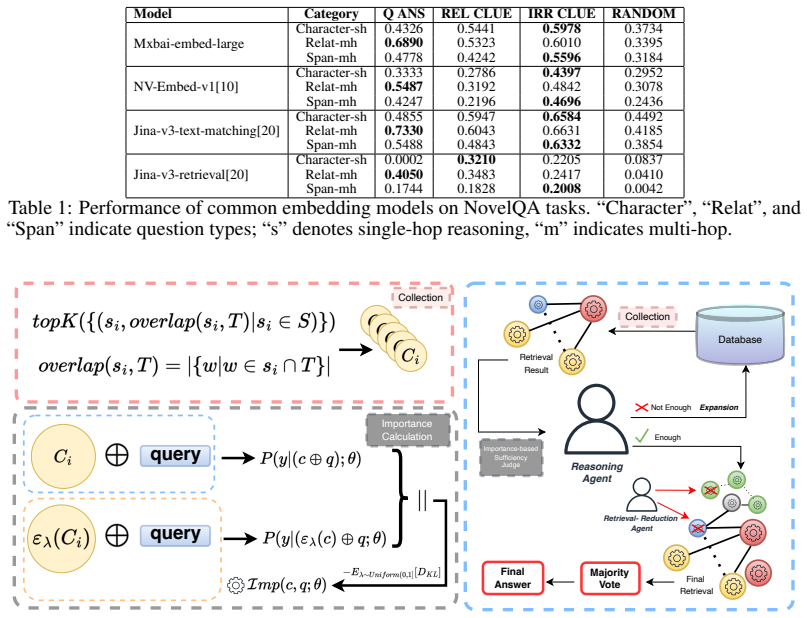
The load-bearing mechanism is the iterative exploration loop built on two components: a word-overlap collector, $R = \operatorname{topK}(\{(s_i, \operatorname{overlap}(s_i, T)) \mid s_i \in S\})$, which retrieves sentences by exact term matching; and an importance-based sufficiency judge, whose score $Imp(c,q;\theta)=1-\operatorname{AvgSim}(\theta(c\oplus q), \theta(\varepsilon_\lambda(c)\oplus q))$ estimates how much a chunk drives the model's answer by measuring output sensitivity to character-level noise. The judge's verdict gates breadth-wise and depth-wise term expansion, which emulates graph propagation without constructing a graph. The importance score does the argument's heavy lifting: it turns the subjective question of whether enough evidence has been collected into a measurable quantity, but the whole chain still depends on the collector's lexical matches.
What would settle it
Construct a long-context QA set where every answer sentence paraphrases or renames the key entities from the question so no question-derived term appears in the gold sentence. Run ELITE and a strong embedding retriever on it: if ELITE's accuracy falls toward the no-retrieval baseline while the embedding retriever holds, the lexical-coverage assumption is the limiting factor. A smaller probe is to take NovelQA questions, replace answer-bearing names with synonyms, and measure the drop.
Extended reading notes
Core claim
ELITE's central discovery is that a retrieval system can replace embedding similarity with an explicit generate-collect-judge-expand loop. For a question, the LLM first produces phrases likely to carry the answer; sentences containing those phrases are scored by raw lexical overlap and the top K, expanded with neighboring sentences, are passed to a sufficiency judge. The judge combines the model's own assessment with an objective importance score: the expected change in model output when a chunk is corrupted by character-level noise, estimated as $1 - \operatorname{AvgSim}(\theta(c\oplus q), \theta(\varepsilon_\lambda(c)\oplus q))$. If the evidence is judged insufficient, the LLM generates a broader term list (breadth-wise) and a deeper list derived from retrieved chunks (depth-wise), traversing an implicit knowledge graph without materializing it. This loop repeats until sufficiency or a limit, then the model trims and answers. The paper demonstrates that this pipeline outperforms MiniRAG and RAPTOR at every model scale tested and approaches proprietary systems.
Load-bearing premise
The method assumes that the answer-bearing sentences will contain at least some of the words the LLM generates as search terms, so if the answer is expressed in completely different vocabulary from the question, the word-overlap collector retrieves nothing and the expansion loop must stumble onto the right terms.
Editorial extensions
If this is right
- RAG can operate with zero offline indexing: preparation time for documents over 2M tokens drops from thousands of seconds (19,337.6s for MiniRAG, 6,423.2s for RAPTOR) to 0.085s.
- Storage overhead can be eliminated: ELITE reports a fixed 1.0x expansion ratio versus 10.6x-19.6x for graph-based baselines.
- Retrieval policy becomes inspectable and modifiable at test time: because search terms are generated text, a user can see why a document was retrieved and can steer the term list, unlike with dense vectors.
- Performance scales with base model capability: ELITE improves monotonically from 1B to 70B parameters and beats both MiniRAG and RAPTOR at every scale on both benchmarks.
- The method's accuracy approaches proprietary systems: 71.27% on NovelQA versus 71.80% for the leading GPT-4-0125-preview, and 68.46% on Marathon versus 78.59% for GPT-4.
Reading between the lines
- A testable extension: mutate the benchmark by paraphrasing answer-bearing sentences so no generated term matches lexically; if ELITE's accuracy drops sharply while embedding baselines hold, the lexical-overlap bridge is the binding constraint.
- The importance score could be reused outside sufficiency judging, for example as a training signal for query-expansion models or as a diagnostic for which retrieved chunks actually change an LLM's answer.
- The method's reliance on exact term overlap suggests it may transfer better to technical or entity-dense domains, where answers reuse question vocabulary, than to heavily paraphrased or non-English text; measuring that boundary would clarify where embedding-free retrieval is appropriate.
- Because the search loop is prompt-driven, the same machinery could be used for tasks beyond QA, such as evidence-based fact-checking or multi-document summarization, by swapping the sufficiency criterion.
Signed reviews
Editorial analysis
A structured set of objections, weighed in public.
Referee Report
Summary. The manuscript proposes ELITE, a retrieval-augmented generation framework for long-context multiple-choice QA that avoids offline dense indexing and explicit graph construction. The method iteratively (i) has an LLM generate lexical search terms from the question and from prior retrieval results, (ii) collects sentences by word overlap and expands them with symmetric context windows, (iii) computes an 'importance' score for each chunk from the sensitivity of the LLM's output distribution to character-level noise, and (iv) uses an LLM judge with these importance scores to decide whether to stop or explore further; final answers are produced after majority voting. Experiments on NovelQA and Marathon with LLaMA-3.1/3.2 models report accuracy gains over internal, vanilla, MiniRAG, and RAPTOR baselines and large reductions in preprocessing time and storage overhead, claiming near-zero preparation cost, a 1.0x storage ratio, and roughly two orders of magnitude runtime savings on long documents.
Significance. If the claims were fully supported, ELITE would be a useful contribution: it shows that a lexical, LLM-driven retrieval loop can be competitive with learned dense retrieval on long-context QA, and it provides concrete efficiency numbers for avoiding offline indexing. The paper does not fit parameters to the test sets, so the headline accuracies are external benchmark results rather than circular in-sample numbers. However, two load-bearing issues currently prevent accepting the central claims: the method is not actually embedding-free as stated because the importance computation uses cosine similarity over embedded texts, and the Table 2 comparison is confounded by an undefined ten-way majority vote that likely gives ELITE a self-consistency advantage not shared by the baselines. The derivation of the importance measure from KL divergence to cosine similarity is also not rigorous.
major comments (5)
- [Section 4.2, Eqs. (3)-(4); Abstract] The paper's central claim of being embedding-free is contradicted by the implementation sentence 'we used cosine similarity between embedded result texts to calculate the similarity.' Even if the retrieval stage itself uses lexical overlap, the framework as a whole relies on embeddings in its importance-based sufficiency judge, so the abstract's 'embedding-free retrieval framework' and contribution 1 ('eliminates reliance on embedding models and dense indexing') are overstatements. Please either rework the terminology to 'without embedding-based retrieval' and clearly separate the embedding-based importance heuristic, or remove embeddings from the pipeline; as written, the central claim is internally inconsistent.
- [Section 5, Experimental Setting; Fig. 1; Table 2] The configuration line 'voter_num=10' is never defined in Section 4, and Fig. 1 inserts a 'Majority Vote' step before the final answer. If this means ten answer samples are aggregated, then every 'Ours' row in Table 2 is a ten-way self-consistency ensemble, while MiniRAG, RAPTOR, vanilla, and the cited leaderboard entries are single-pass systems. Majority voting is known to improve LLM accuracy on long-context multiple-choice QA, so the 12.31-point NovelQA gap over RAPTOR at 70B and the 3.29-point Marathon gap cannot be attributed to the retrieval component without a single-vote ablation. Please report Ours with voter_num=1, or clarify exactly what voter_num controls and show that it does not materially affect the reported accuracy.
- [Section 4.2, Eqs. (3)-(4)] The transition from the expected-KL definition to the cosine-similarity Monte Carlo estimate is asserted rather than derived. The justification that output distributions 'maintain the same functional form with variance determined by the fixed temperature parameter' does not by itself imply that expected KL divergence is monotonically related to mean cosine similarity of output texts. Please either provide a rigorous derivation with the exact functional form assumed, or present the importance score as a heuristic and validate it empirically (for example, by showing that high-importance chunks are the ones whose removal changes the correct answer), and remove the word 'objective' from the claims about this metric.
- [Section 4.2 and Section 5.1] Because the same LLM generates the search terms (4.1), produces the output distributions used for importance (4.2), and decides sufficiency (4.2), the stopping criterion is fully self-referential. No experiment shows that when the judge says 'enough,' the retrieved chunks actually contain the answer, or that the iterative loop would continue if the answer were absent. Please add an analysis of the sufficiency judge's reliability, for example by checking answer containment or lexical overlap between the final retrieved set and gold evidence, and include an ablation that disables the judge (e.g., fixed iteration count) to demonstrate that the judge contributes positively to accuracy.
- [Section 5.1 and Contributions] The claim of 'ranking 2nd overall on both benchmarks' compares LLaMA-3.1-70B against proprietary systems such as GPT-4 and Claude under different inference conditions; this cross-model leaderboard comparison is not a controlled evaluation of the retrieval method. The accuracy differences in Table 2 are the only place where the retrieval component is compared with same-backbone baselines, and the contribution 3 claim of 'outperforming all baseline methods at every scale' should be limited to those same-backbone settings or explicitly labeled as an uncontrolled leaderboard comparison.
minor comments (6)
- [Section 4.1] The special handling of counting questions is described only in prose; no prompt, no separate accuracy number, and no ablation are provided. Add the counting prompt and report the counting-question subset accuracy separately.
- [Section 4.1] The context expansion window (five sentences before and after each retrieved sentence) is not listed in the Experimental Setting; add it to the configuration list so that the method is reproducible.
- [Section 4.2, Eq. (4)] The notation \theta(c⊕q) is ambiguous because \theta is earlier defined as the model parameters; write the model function explicitly and specify how the output text is embedded and averaged when computing cosine similarity.
- [Table 3] For 'Our Method,' the preparation time is nonzero (0.004-0.085s) even though no offline index is built; clarify what this preparation includes and whether the reported retrieval time includes all LLM calls for term generation, importance scoring, and sufficiency judging.
- [Figure 1] The flowchart is hard to read; the 'Not Enough/Expansion' and 'Enough' transitions are not clearly connected to the iterative loop, and the boxes for components such as 'Importance Calculation' and 'Retrieval-Reduction Agent' are underspecified.
- [Abstract footnote] The footnote says code is available at a GitHub repository, but no URL is given; provide the repository link and runnable configuration files so that voter_num, prompts, and the noise-perturbation procedure are reproducible.
Circularity Check
No circular derivation; benchmark accuracies are external measurements.
full rationale
The paper's central claim is an empirical accuracy comparison on NovelQA and Marathon, not a derivation of those numbers from its own construction. The retrieval pipeline (Eqs. 1-4) uses an LLM-generated term set, lexical overlap, and an importance score defined as model-output similarity under noise; these are internal heuristics whose parameters (recall_index, voter_num, etc.) are fixed hyperparameters, not fitted to test labels or renamed predictions. No equation reduces to another by construction, and no load-bearing claim is justified by a self-citation: references [21] and [22] are external benchmark sources, and [5], [18], etc. are external baselines. The same LLM generating terms, scoring importance, and judging sufficiency creates a methodological introspection loop, but it does not make the reported accuracies equivalent to the method's inputs; the result is an external benchmark measurement. No circularity step can be exhibited under the required reduction standard.
Assumptions & free parameters
free parameters (7)
- recall_index (K) =
25
- neighbor_num =
2
- deep_search_index =
5
- deep_search_num =
10
- voter_num =
10
- iter_max =
5
- context expansion window =
5 per side stated, config says 2
assumptions (5)
- domain assumption Sentences containing LLM-generated surface terms are sufficient evidence locations for answering the query.
- domain assumption The LLM-generated search terms will lexically overlap the wording of true answer passages.
- ad hoc to paper Output distributions under original and noise-perturbed chunks have the same functional form with variance fixed by temperature, making expected KL divergence monotonically related to mean cosine similarity.
- domain assumption The base model can reliably judge whether collected chunks are sufficient to answer the query, given importance scores.
- domain assumption Baseline implementations and reported leaderboard numbers are faithful and comparable.
Cite this review
Pith. "Pith review of ELITE: Embedding-Less retrieval with Iterative Text Exploration." pith.science (2026). https://pith.science/paper/WNERSZJQ
@misc{pith2026250511908,
  author       = {Pith},
  title        = {Pith review of: ELITE: Embedding-Less retrieval with Iterative Text Exploration},
  year         = {2026},
  howpublished = {\url{https://pith.science/paper/WNERSZJQ}},
  note         = {Machine review of arXiv:2505.11908}
}
read the original abstract
Large Language Models (LLMs) have achieved impressive progress in natural language processing, but their limited ability to retain long-term context constrains performance on document-level or multi-turn tasks. Retrieval-Augmented Generation (RAG) mitigates this by retrieving relevant information from an external corpus. However, existing RAG systems often rely on embedding-based retrieval trained on corpus-level semantic similarity, which can lead to retrieving content that is semantically similar in form but misaligned with the question's true intent. Furthermore, recent RAG variants construct graph- or hierarchy-based structures to improve retrieval accuracy, resulting in significant computation and storage overhead. In this paper, we propose an embedding-free retrieval framework. Our method leverages the logical inferencing ability of LLMs in retrieval using iterative search space refinement guided by our novel importance measure and extend our retrieval results with logically related information without explicit graph construction. Experiments on long-context QA benchmarks, including NovelQA and Marathon, show that our approach outperforms strong baselines while reducing storage and runtime by over an order of magnitude.
Figures

Reference graph
Works this paper leans on
-
[1]
A neural probabilistic language model
Yoshua Bengio, Réjean Ducharme, Pascal Vincent, and Christian Janvin. A neural probabilistic language model. J. Mach. Learn. Res., 3(null):1137–1155, March 2003. ISSN 1532-4435
work page 2003
-
[2]
Pathrag: Pruning graph-based retrieval augmented generation with relational paths, 2025
Boyu Chen, Zirui Guo, Zidan Yang, Yuluo Chen, Junze Chen, Zhenghao Liu, Chuan Shi, and Cheng Yang. Pathrag: Pruning graph-based retrieval augmented generation with relational paths, 2025. URL https://arxiv.org/abs/2502.14902
arXiv 2025
-
[3]
BERT: Pre-training of deep bidirectional transformers for language understanding
Jacob Devlin, Ming-Wei Chang, Kenton Lee, and Kristina Toutanova. BERT: Pre-training of deep bidirectional transformers for language understanding. In Jill Burstein, Christy Doran, and Thamar Solorio, editors, Proceedings of the 2019 Conference of the North American Chapter of the Association for Computational Linguistics: Human Language Technologies, V o...
doi:10.18653/v1 2019
-
[4]
From local to global: A graph rag approach to query-focused summarization, 2025
Darren Edge, Ha Trinh, Newman Cheng, Joshua Bradley, Alex Chao, Apurva Mody, Steven Truitt, Dasha Metropolitansky, Robert Osazuwa Ness, and Jonathan Larson. From local to global: A graph rag approach to query-focused summarization, 2025. URL https://arxiv. org/abs/2404.16130
arXiv 2025
-
[5]
Minirag: Towards extremely simple retrieval-augmented generation, 2025
Tianyu Fan, Jingyuan Wang, Xubin Ren, and Chao Huang. Minirag: Towards extremely simple retrieval-augmented generation, 2025. URL https://arxiv.org/abs/2501.06713
arXiv 2025
-
[6]
Realm: Retrieval-augmented language model pre-training, 2020
Kelvin Guu, Kenton Lee, Zora Tung, Panupong Pasupat, and Ming-Wei Chang. Realm: Retrieval-augmented language model pre-training, 2020. URL https://arxiv.org/abs/ 2002.08909
arXiv 2020
-
[7]
Leveraging passage retrieval with generative models for open domain question answering, 2021
Gautier Izacard and Edouard Grave. Leveraging passage retrieval with generative models for open domain question answering, 2021. URL https://arxiv.org/abs/2007.01282
arXiv 2021
-
[8]
Atlas: Few-shot learning with retrieval augmented language models, 2022
Gautier Izacard, Patrick Lewis, Maria Lomeli, Lucas Hosseini, Fabio Petroni, Timo Schick, Jane Dwivedi-Yu, Armand Joulin, Sebastian Riedel, and Edouard Grave. Atlas: Few-shot learning with retrieval augmented language models, 2022. URL https://arxiv.org/abs/ 2208.03299
arXiv 2022
Show all 22 references
-
[9]
Colbert: Efficient and effective passage search via contextu- alized late interaction over bert, 2020
Omar Khattab and Matei Zaharia. Colbert: Efficient and effective passage search via contextu- alized late interaction over bert, 2020. URL https://arxiv.org/abs/2004.12832
2020 arXiv
-
[10]
Nv-embed: Improved techniques for training llms as generalist embedding models, 2025
Chankyu Lee, Rajarshi Roy, Mengyao Xu, Jonathan Raiman, Mohammad Shoeybi, Bryan Catanzaro, and Wei Ping. Nv-embed: Improved techniques for training llms as generalist embedding models, 2025. URL https://arxiv.org/abs/2405.17428
2025 arXiv
-
[11]
Retrieval-augmented generation for knowledge-intensive nlp tasks, 2021
Patrick Lewis, Ethan Perez, Aleksandra Piktus, Fabio Petroni, Vladimir Karpukhin, Naman Goyal, Heinrich Küttler, Mike Lewis, Wen tau Yih, Tim Rocktäschel, Sebastian Riedel, and Douwe Kiela. Retrieval-augmented generation for knowledge-intensive nlp tasks, 2021. URL https://arx...
2021 arXiv
-
[12]
Efficient estimation of word representations in vector space, 2013
Tomas Mikolov, Kai Chen, Greg Corrado, and Jeffrey Dean. Efficient estimation of word representations in vector space, 2013. URL https://arxiv.org/abs/1301.3781
2013 arXiv
-
[13]
Morris, Brandon Duderstadt, and Andriy Mulyar
Zach Nussbaum, John X. Morris, Brandon Duderstadt, and Andriy Mulyar. Nomic embed: Training a reproducible long context text embedder, 2025. URL https://arxiv.org/abs/ 2402.01613
2025 arXiv
-
[14]
GloVe: Global vectors for word representation
Jeffrey Pennington, Richard Socher, and Christopher Manning. GloVe: Global vectors for word representation. In Alessandro Moschitti, Bo Pang, and Walter Daelemans, editors, Proceedings of the 2014 Conference on Empirical Methods in Natural Language Processing (EMNLP) , pages 1...
2014 doi
-
[15]
Peters, Mark Neumann, Mohit Iyyer, Matt Gardner, Christopher Clark, Kenton Lee, and Luke Zettlemoyer
Matthew E. Peters, Mark Neumann, Mohit Iyyer, Matt Gardner, Christopher Clark, Kenton Lee, and Luke Zettlemoyer. Deep contextualized word representations, 2018. URL https: //arxiv.org/abs/1802.05365
2018 arXiv
-
[16]
Memorag: Boosting long context processing with global memory-enhanced retrieval augmentation, 2025
Hongjin Qian, Zheng Liu, Peitian Zhang, Kelong Mao, Defu Lian, Zhicheng Dou, and Tiejun Huang. Memorag: Boosting long context processing with global memory-enhanced retrieval augmentation, 2025. URL https://arxiv.org/abs/2409.05591
2025 arXiv
-
[17]
Sentence-BERT: Sentence embeddings using Siamese BERT- networks
Nils Reimers and Iryna Gurevych. Sentence-BERT: Sentence embeddings using Siamese BERT- networks. In Kentaro Inui, Jing Jiang, Vincent Ng, and Xiaojun Wan, editors, Proceedings of the 2019 Conference on Empirical Methods in Natural Language Processing and the 9th International...
2019 doi
-
[18]
Parth Sarthi, Salman Abdullah, Aditi Tuli, Shubh Khanna, Anna Goldie, and Christopher D. Manning. Raptor: Recursive abstractive processing for tree-organized retrieval, 2024. URL https://arxiv.org/abs/2401.18059
2024 arXiv
-
[19]
Replug: Retrieval-augmented black-box language models, 2023
Weijia Shi, Sewon Min, Michihiro Yasunaga, Minjoon Seo, Rich James, Mike Lewis, Luke Zettlemoyer, and Wen tau Yih. Replug: Retrieval-augmented black-box language models, 2023. URL https://arxiv.org/abs/2301.12652
2023 arXiv
-
[20]
jina-embeddings-v3: Multilingual embeddings with task lora, 2024
Saba Sturua, Isabelle Mohr, Mohammad Kalim Akram, Michael Günther, Bo Wang, Markus Krimmel, Feng Wang, Georgios Mastrapas, Andreas Koukounas, Nan Wang, and Han Xiao. jina-embeddings-v3: Multilingual embeddings with task lora, 2024. URL https://arxiv. org/abs/2409.10173
2024 arXiv
-
[21]
Novelqa: Benchmarking question answering on documents exceeding 200k tokens, 2024
Cunxiang Wang, Ruoxi Ning, Boqi Pan, Tonghui Wu, Qipeng Guo, Cheng Deng, Guangsheng Bao, Xiangkun Hu, Zheng Zhang, Qian Wang, and Yue Zhang. Novelqa: Benchmarking question answering on documents exceeding 200k tokens, 2024. URL https://arxiv.org/ abs/2403.12766
2024 arXiv
-
[22]
Marathon: A race through the realm of long context with large language models, 2024
Lei Zhang, Yunshui Li, Ziqiang Liu, Jiaxi yang, Junhao Liu, Longze Chen, Run Luo, and Min Yang. Marathon: A race through the realm of long context with large language models, 2024. URL https://arxiv.org/abs/2312.09542. 11
2024 arXiv
Reviewed August 15, 2026 · model on record in the stance chip above.
Discussion (0). Continue with ORCID to comment.