REVIEW 6 major objections 5 minor 45 references
Denoising Mutual Knowledge Distillation in Bi-Directional Multiple Instance Learning
T0 review · 6 major / 5 minor · reviewed 2026-08-15 · deepseek-v4-flash
Pith's one-line read A mutual-distillation training loop corrects noisy pseudo-labels in whole-slide image classification and outperforms prior boosting frameworks at both slide and patch levels.
desk verdict Plausible incremental MIL boosting recipe with consistent but under-evidenced gains; the weak-to-strong denoising story is asserted rather than demonstrated. read the letter →
The pith
A machine-rendered reading of the paper's core claim, the machinery that carries it, and where it could break.
The reading
What carries the argument
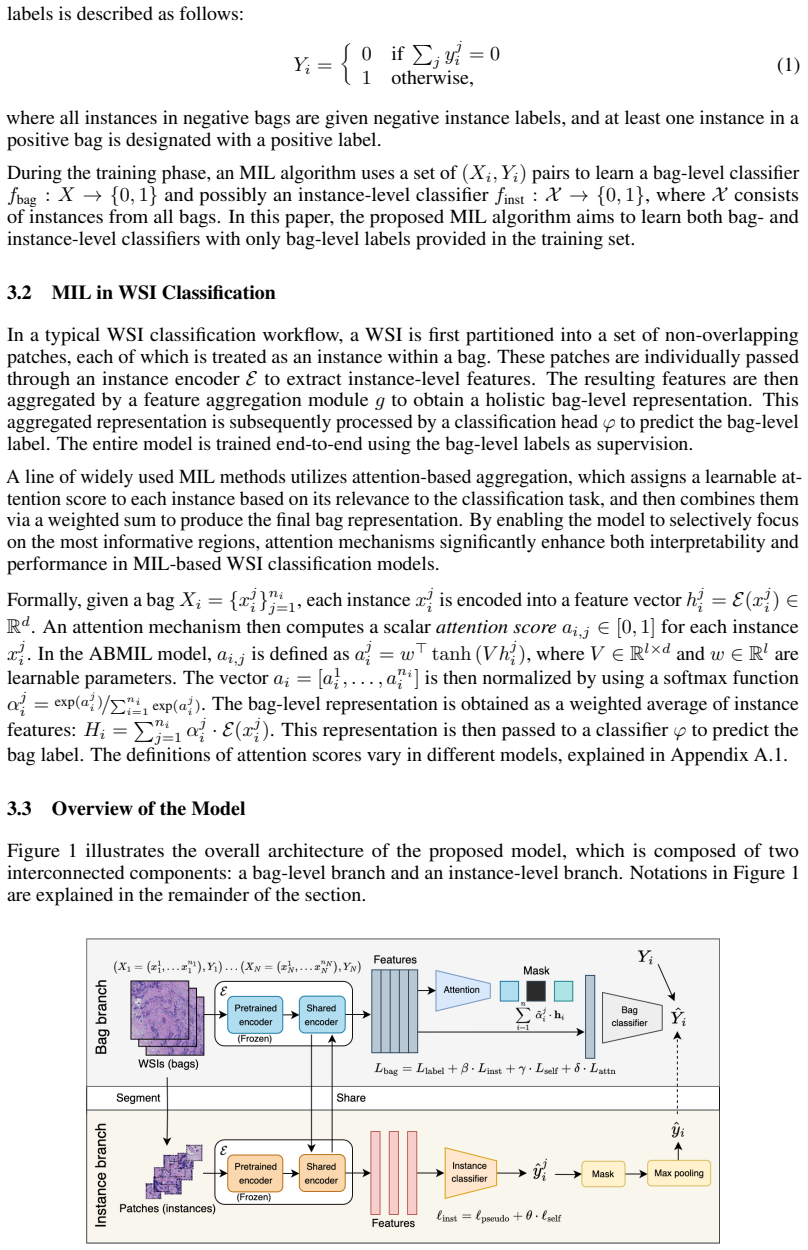
The central object is a bi-directional distillation loop between two branches sharing one encoder. In the bag branch, attention scores $\alpha$ are passed through a hard positive mining module $\mathcal{M}$ that zeroes the normalized attention of any patch whose instance prediction $\sigma(\hat{y})$ exceeds a threshold $\tau$, forcing the bag aggregator to learn from hard patches; the remaining predictions are max-pooled and fed back as bag supervision. A self-confidence loss $L_{\text{self}} = c_1\,\mathrm{CE}(\hat{Y}, I_t(\hat{Y})) + c_2\,\mathrm{CE}(\hat{y}^j, I_t(\hat{y}^j))$ and its instance-branch counterpart $\ell_{\text{self}} = \mathrm{CE}(\hat{y}^j, I_t(\hat{y}^j))$ push each branch toward its own confident hard labels, where $I_t$ is an indicator at threshold $t$. The bag loss also includes an attention-calibration term $L_{\text{attn}}$ that aligns the maximum attention score with the bag label, and the two branches are trained on a periodic schedule ($\kappa$ bag iterations per instance iteration) to keep them at the same pace. These components together form the tripartite balance the paper argues corrects pseudo-label errors.
What would settle it
Run the full method again but replace every self-confidence target $I_t(\cdot)$ with the branch's own prediction recorded from a fixed early-training checkpoint, so the pseudo-labels are frozen rather than self-correcting. If instance-level AUC does not drop, the self-correction mechanism is not responsible for the reported gain; if confident predictions become less accurate over training, the loss amplifies confirmation bias.
Extended reading notes
Core claim
The paper's central claim is that the full model, with bag loss $L_{\text{bag}} = L_{\text{label}} + \beta L_{\text{inst}} + \gamma L_{\text{self}} + \delta L_{\text{attn}}$ and instance loss $\ell_{\text{inst}} = \ell_{\text{pseudo}} + \theta \ell_{\text{self}}$, outperforms WENO and MHIM-MIL boosts at both bag and instance levels. On CAMELYON16, ABMIL+Ours reaches 0.9318 bag AUC and 0.9216 instance AUC; on TCGA-NSCLC it reaches 0.9626 bag AUC. The authors attribute these gains to the self-confidence losses $L_{\text{self}}$ and $\ell_{\text{self}}$, which leverage weak-to-strong generalization to correct pseudo-label noise when the soft labels are not confident or when the bag label and instance supervision disagree. They further state that the method consistently outperforms previous distillation-based boosting methods, especially for instance predictions.
Load-bearing premise
The load-bearing premise is that pushing each branch toward its own most confident guesses corrects mistakes in the patch-level labels through the model's ability to generalize beyond its teacher; if that instead locks in the model's early mistakes, the reported gains would be an artifact of training dynamics, and the paper provides no theoretical safeguard.
Editorial extensions
If this is right
- ABMIL+Ours raises bag AUC on CAMELYON16 to 0.9318 and instance AUC to 0.9216, closing most of the gap to fully supervised instance prediction (0.9759) without using patch labels.
- On TCGA-NSCLC, the best bag AUC reaches 0.9626, surpassing both WENO and MHIM-MIL boosts on the same backbone.
- The improvements are consistent across four attention-based MIL backbones (ABMIL, DSMIL, CLAM-SB, CLAM-MB), indicating the recipe is model-agnostic.
- With pathology-specific encoders (CONCH, PLIP), the method still leads on instance-level metrics even when bag-level AUC is saturated above 0.96, showing the main remaining benefit is at the patch level.
- Removing the self-confidence losses $L_{\text{self}}$ and $\ell_{\text{self}}$ drops bag AUC from 0.9318 to 0.9151 and instance AUC from 0.9216 to 0.9117 on CAMELYON16, so the paper's reported gains depend on those terms.
Reading between the lines
- The mutual-distillation recipe is likely transferable to other weakly supervised MIL problems beyond pathology, such as video anomaly detection or remote sensing, where pretrained encoders supply the weak-to-strong gap, but the paper does not test this.
- Part of the reported gain may come from the larger number of total loss terms rather than from the self-distillation mechanism itself; a controlled comparison that matches loss count would separate these factors.
- The threshold $t$ in $I_t$ and the schedule ratio $\kappa$ are free hyperparameters with unknown sensitivity; tuning them per dataset is a natural extension the paper leaves open.
- Because weak-to-strong generalization depends on pretrained representations, the method's advantage may shrink or vanish if the encoder is trained from scratch, which is a testable implication of the stated mechanism.
Signed reviews
Editorial analysis
A structured set of objections, weighed in public.
Referee Report
Summary. The paper proposes a dual-branch multiple instance learning (MIL) framework for whole slide image classification. The bag branch uses attention-based aggregation and a hard positive mining mask, while the instance branch is supervised by soft labels derived from the bag branch's attention scores. The two branches are trained in a scheduled mutual-distillation loop, and both branches include self-confidence losses (Eq. 6 and Section 3.6) that the authors justify through weak-to-strong generalization. The method is evaluated on CAMELYON16 and TCGA-NSCLC with several encoders, and the authors report that their framework improves bag- and instance-level AUC/ACC over the WENO and MHIM-MIL boosting baselines. The central claim is that self-confidence distillation denoises pseudo-labels and yields consistent gains under weak supervision.
Significance. If the central claim is correct, this is a practically relevant contribution to weakly supervised pathology analysis, because it improves instance-level predictions without requiring additional annotation. The evaluation uses external public test labels on CAMELYON16, so there is no derivational circularity in the main results, and the inclusion of both bag- and instance-level metrics is a strength. The reported gains, however, are modest in several cells, the experiments are single-run, and the ablation evidence is internally inconsistent, which weakens the support for the claimed mechanism. The paper does not provide code, which further limits the verifiability of the empirical results.
major comments (6)
- [Section 4.4 and Appendix C, Table 5] The ablation results for removing the self-confidence losses are inconsistent between the main text and the appendix: Section 4.4 reports a bag AUC drop to 0.9151 and a bag ACC of 0.8915, while Table 5 reports 0.9134 and 0.8974 for the same setting. Moreover, the full-model instance ACC in Table 5 is 0.9191, whereas Table 1 and the main text report 0.9291. These mismatches mean the quantitative support for the central denoising claim is not reliable as presented; the authors should reconcile the tables and re-verify the numbers.
- [Section 4.2 (Evaluation Metrics)] Accuracy is evaluated by optimizing the decision threshold on the test set using Youden's J statistic. This procedure makes the reported ACC values optimistically biased and can change the ranking of methods, especially when ACC differences are small. The authors should report ACC with a threshold selected on the validation set or at a pre-specified operating point, and disclose the selected threshold values.
- [Table 1 (Fully supervised row)] The fully supervised baseline is not specified: the table gives no architecture, no training details, and no statement of which instance-level labels are used for training or validation. Since the text uses this row to claim that the proposed method outperforms fully supervised bag-level classification, this baseline must be fully described and its training protocol must match the weakly supervised setting as closely as possible.
- [Section 4.4 and Tables 1, 4] All results are single-run, and no variance, confidence intervals, or significance tests are reported. The claim of consistent outperformance is not supported by the numbers: in Table 1, TransMIL achieves a bag AUC of 0.9332 on C16, above ABMIL+Ours at 0.9318; in Table 4 with ResNet-18, CLAM-SB+Ours (0.8802 bag AUC) beats ABMIL+Ours (0.8215), and with CONCH, ABMIL+Ours (0.9784) is below plain ABMIL (0.9809). The authors should provide repeated-seed results with confidence intervals and soften the consistency claim accordingly.
- [Section 3.6, Eq. (6) and ℓself] The central mechanism of the paper is self-confidence distillation, but the paper does not demonstrate that hardening the model's own predictions corrects pseudo-label noise rather than reinforcing confirmation bias. The weak-to-strong analogy does not directly apply because both branches share the same encoder and receive the same patch features, and the 'teacher' is the model itself at an earlier state. The Conclusion explicitly admits the lack of theoretical guarantees. A controlled experiment, such as tracing pseudo-label accuracy over training or comparing against an entropy-minimization baseline on the same architecture, is needed to support the denoising interpretation.
- [Section 3.6 and Appendix A.3] The hyperparameters β, γ, δ, θ, τ, t, and κ are never reported anywhere in the paper or appendix. Without these values the method cannot be reproduced; the authors must provide them along with the search ranges and, ideally, a sensitivity analysis.
minor comments (5)
- [Section 3.4, Eq. (2)] The hard positive mining threshold τ appears in the text but its value and the range of the attention scores it is applied to are not defined; please clarify the relationship between σ(ŷ) and the attention scores.
- [Section 3.6, Eq. (5)] The notation CE(Ŷ_i, ŷ_i) in L_inst is ambiguous because ŷ_i is a scalar between 0 and 1; the authors should state explicitly that this is binary cross-entropy with ŷ_i as a soft target.
- [Appendix A.1] The DSMIL definition contains an error: 'hm_i = max{h1_i, h2_i, ..., hn_i}' should refer to the max of the instance scores, not the feature vectors; the equation and the surrounding text are inconsistent.
- [Section 4.4 (Ablation Study)] The ablation paragraph says Lself and ℓself are removed, but Table 5 also reports ablations with L_inst and L_attn removed; the text should specify which loss terms are kept in each ablation row.
- [Related Work] The word 'pseudolable' should be 'pseudo-label', and the reference list appears to be truncated at [46] without a conclusion section; please check the formatting of the bibliography.
Circularity Check
No derivational circularity: all headline claims are empirical comparisons on external public labels; the self-confident losses are self-referential training objectives, not predictions equivalent to their inputs.
full rationale
The paper's central claims are empirical: Tables 1, 2, and 3 report bag- and instance-level AUC/ACC on CAMELYON16 and TCGA-NSCLC against reproduced baselines, with evaluation on held-out ground-truth labels. Equation (6) and the instance-branch l_self define losses whose targets are the model's own thresholded predictions I_t(Yhat) and I_t(yhat); this is self-referential as a training objective and creates a confirmation-bias risk, but it is not a circular derivation of a reported result, because the paper does not use those self-targets as evidence of denoising—it measures performance against external labels. The weak-to-strong mechanism is invoked from prior literature as a heuristic, and the Conclusion explicitly states 'Limitations of our work include the absence of theoretical guarantees'; that is an unverified assumption and a correctness concern, not circularity. Self-citations [16,17] appear only as background on causal MIL and are not load-bearing. No fitted parameter is renamed as a prediction, and no uniqueness claim or ansatz is imported from the authors' own prior work. The minor inconsistency between main-text ablation numbers and Appendix Table 5 is a reporting/correctness issue, not a circular step.
Assumptions & free parameters
free parameters (7)
- beta, gamma, delta (bag loss weights) =
not reported
- theta (instance loss weight) =
not reported
- c1, c2 (component weights) =
not reported
- tau (hard positive mining threshold) =
not reported
- t (self-confidence threshold) =
not reported
- Youden's J threshold for accuracy =
optimized on test labels
- kappa (branch scheduling ratio) =
10 bag epochs per 1 instance epoch
assumptions (5)
- domain assumption Standard MIL assumption (Eq. 1): a bag is positive if at least one instance is positive, and all instances in negative bags are negative.
- ad hoc to paper Calibrated attention scores, enforced by L_attn, are class-discriminative enough to serve as instance pseudo-labels.
- ad hoc to paper Self-confidence losses correct pseudo-label noise rather than reinforce confirmation bias.
- domain assumption Frozen pretrained encoders (ResNet-50, CONCH, PLIP) supply features rich enough for both bag and instance classification.
- ad hoc to paper The shared encoder benefits from both branches under the periodic scheduling scheme.
Cite this review
Pith. "Pith review of Denoising Mutual Knowledge Distillation in Bi-Directional Multiple Instance Learning." pith.science (2026). https://pith.science/paper/7L2XQPQ7
@misc{pith2026250512074,
  author       = {Pith},
  title        = {Pith review of: Denoising Mutual Knowledge Distillation in Bi-Directional Multiple Instance Learning},
  year         = {2026},
  howpublished = {\url{https://pith.science/paper/7L2XQPQ7}},
  note         = {Machine review of arXiv:2505.12074}
}
read the original abstract
Multiple Instance Learning is the predominant method for Whole Slide Image classification in digital pathology, enabling the use of slide-level labels to supervise model training. Although MIL eliminates the tedious fine-grained annotation process for supervised learning, whether it can learn accurate bag- and instance-level classifiers remains a question. To address the issue, instance-level classifiers and instance masks were incorporated to ground the prediction on supporting patches. These methods, while practically improving the performance of MIL methods, may potentially introduce noisy labels. We propose to bridge the gap between commonly used MIL and fully supervised learning by augmenting both the bag- and instance-level learning processes with pseudo-label correction capabilities elicited from weak to strong generalization techniques. The proposed algorithm improves the performance of dual-level MIL algorithms on both bag- and instance-level predictions. Experiments on public pathology datasets showcase the advantage of the proposed methods.
Figures


Reference graph
Works this paper leans on
-
[24]
Pseudo-labeling and confirmation bias in deep semi-supervised learning,
E. Arazo, D. Ortego, P. Albert, N. E. O’Connor, and K. McGuinness, “Pseudo-labeling and confirmation bias in deep semi-supervised learning,”CoRR, vol. abs/1908.02983, 2019
arXiv 1908
-
[1]
A. Myronenko, Z. Xu, D. Yang, H. R. Roth, and D. Xu, “Accounting for dependencies in deep learning based multiple instance learning for whole slide imaging,” inMedical Image Computing and Computer Assisted Intervention (MICCAI 2021)(M. de Bruijne, P. C. Cattin, S. Cotin, N. Padoy, S. Speidel, Y . Zheng, and C. Essert, eds.), (Cham), pp. 329–338, Springer ...
work page 2021
-
[2]
Clinical-grade computational pathology using weakly supervised deep learning on whole slide images,
G. Campanella, M. G. Hanna, L. Geneslaw, A. Miraflor, V . Werneck Krauss Silva, K. J. Busam, E. Brogi, V . E. Reuter, D. S. Klimstra, and T. J. Fuchs, “Clinical-grade computational pathology using weakly supervised deep learning on whole slide images,”Nature medicine, vol. 25, no. 8, pp. 1301–1309, 2019
2019
-
[3]
Deep neural network models for computational histopathology: A survey,
C. L. Srinidhi, O. Ciga, and A. L. Martel, “Deep neural network models for computational histopathology: A survey,”Medical Image Analysis, vol. 67, p. 101813, 2021. 12 Table 5: Ablation study results on the CAMELYON16 dataset Model Bag Instance AUC ACC AUC ACC withoutL inst ABMIL+Ours 0.9211 0.8984 0.9199 0.9147 DSMIL+Ours 0.9189 0.8944 0.9107 0.9154 with...
work page 2021
-
[4]
Murcl: Multi-instance reinforcement contrastive learning for whole slide image classification,
Z. Zhu, L. Yu, W. Wu, R. Yu, D. Zhang, and L. Wang, “Murcl: Multi-instance reinforcement contrastive learning for whole slide image classification,”IEEE Transactions on Medical Imaging, vol. 42, no. 5, pp. 1337–1348, 2023
work page 2023
-
[5]
L. Qu, S. Liu, X. Liu, M. Wang, and Z. Song, “Towards label-efficient automatic diagnosis and analysis: a comprehensive survey of advanced deep learning-based weakly-supervised, semi-supervised and self-supervised techniques in histopathological image analysis,”Physics in Medicine & Biology, vol. 67, no. 20, p. 20TR01, 2022
work page 2022
-
[6]
Attention-based deep multiple instance learning,
M. Ilse, J. M. Tomczak, and M. Welling, “Attention-based deep multiple instance learning,” in Proceedings of the 35th International Conference on Machine Learning (ICML 2018), vol. 80 ofProceedings of Machine Learning Research, pp. 2132–2141, 2018
work page 2018
-
[8]
B. Li, Y . Li, and K. W. Eliceiri, “Dual-stream multiple instance learning network for whole slide image classification with self-supervised contrastive learning,” in2021 IEEE/CVF Conference on Computer Vision and Pattern Recognition (CVPR), pp. 14313–14323, 2021
work page 2021
Show all 45 references
-
[9]
Transmil: Transformer based correlated multiple instance learning for whole slide image classification,
Z. Shao, H. Bian, Y . Chen, Y . Wang, J. Zhang, X. Ji, and Y . Zhang, “Transmil: Transformer based correlated multiple instance learning for whole slide image classification,” inAdvances in Neural Information Processing Systems (NeurIPS 2021)(M. Ranzato, A. Beygelzimer, Y . N....
2021
-
[10]
Dtfd-mil: Double-tier feature distillation multiple instance learning for histopathology whole slide image classification,
H. Zhang, Y . Meng, Y . Zhao, Y . Qiao, X. Yang, S. E. Coupland, and Y . Zheng, “Dtfd-mil: Double-tier feature distillation multiple instance learning for histopathology whole slide image classification,” in2022 IEEE/CVF Conference on Computer Vision and Pattern Recognition (C...
2022
-
[11]
Rethinking multiple instance learn- ing: Developing an instance-level classifier via weakly-supervised self-training,
Y . Ma, X. Luo, M. Yuan, X. Chen, and M. Wang, “Rethinking multiple instance learn- ing: Developing an instance-level classifier via weakly-supervised self-training,”CoRR, vol. abs/2408.04813, 2024
2024 arXiv
-
[12]
Bi-directional weakly supervised knowledge distillation for whole slide image classification,
L. Qu, X. Luo, M. Wang, and Z. Song, “Bi-directional weakly supervised knowledge distillation for whole slide image classification,” inAdvances in Neural Information Processing Systems (NeurIPS 2022)(S. Koyejo, S. Mohamed, A. Agarwal, D. Belgrave, K. Cho, and A. Oh, eds.), vol...
2022
-
[13]
Interventional bag multi-instance learning on whole-slide pathological images,
T. Lin, Z. Yu, H. Hu, Y . Xu, and C.-W. Chen, “Interventional bag multi-instance learning on whole-slide pathological images,” in2023 IEEE/CVF Conference on Computer Vision and Pattern Recognition (CVPR), pp. 19830–19839, 2023
2023
-
[14]
Multiple instance learning framework with masked hard instance mining for whole slide image classification,
W. Tang, S. Huang, X. Zhang, F. Zhou, Y . Zhang, and B. Liu, “Multiple instance learning framework with masked hard instance mining for whole slide image classification,” inIEEE/CVF International Conference on Computer Vision (ICCV 2023), pp. 4055–4064, IEEE, 2023
2023
-
[15]
CaMIL: Causal multiple instance learning for whole slide image classification,
K. Chen, S. Sun, and J. Zhao, “CaMIL: Causal multiple instance learning for whole slide image classification,” inProceedings of the AAAI Conference on Artificial Intelligence (AAAI 2024) (M. J. Wooldridge, J. G. Dy, and S. Natarajan, eds.), vol. 38, pp. 1120–1128, 2024. 13
2024
-
[16]
Robust multi-instance learning with stable instances,
W. Zhang, L. Liu, and J. Li, “Robust multi-instance learning with stable instances,” in24th European Conference on Artificial Intelligence (ECAI 2020) - Including 10th Conference on Prestigious Applications of Artificial Intelligence (PAIS 2020)(G. D. Giacomo, A. Catalá, B. Di...
2020
-
[17]
Multi-instance causal representation learning for instance label prediction and out-of-distribution generalization,
W. Zhang, X. Zhang, h. deng, and M.-L. Zhang, “Multi-instance causal representation learning for instance label prediction and out-of-distribution generalization,” inAdvances in Neural Infor- mation Processing Systems (NeurIPS 2022)(S. Koyejo, S. Mohamed, A. Agarwal, D. Belgra...
2022
-
[18]
Boosting multiple instance learning models for whole slide image classification: A model-agnostic framework based on counterfactual inference,
W. Lin, Z. Zhuang, L. Yu, and L. Wang, “Boosting multiple instance learning models for whole slide image classification: A model-agnostic framework based on counterfactual inference,” in Proceedings of the AAAI Conference on Artificial Intelligence (AAAI 2024), vol. 38, pp. 34...
2024
-
[19]
Rethinking multiple instance learning for whole slide image classification: A good instance classifier is all you need,
L. Qu, Y . Ma, X. Luo, Q. Guo, M. Wang, and Z. Song, “Rethinking multiple instance learning for whole slide image classification: A good instance classifier is all you need,”IEEE Transactions on Circuits and Systems for Video Technology, vol. 34, no. 10, pp. 9732–9744, 2024
2024
-
[20]
Deep multiple instance learning for image classification and auto-annotation,
J. Wu, Y . Yu, C. Huang, and K. Yu, “Deep multiple instance learning for image classification and auto-annotation,” in2015 IEEE Conference on Computer Vision and Pattern Recognition (CVPR), pp. 3460–3469, 2015
2015
-
[21]
Toward causal representation learning,
B. Schölkopf, F. Locatello, S. Bauer, N. R. Ke, N. Kalchbrenner, A. Goyal, and Y . Bengio, “Toward causal representation learning,”Proceedings of the IEEE, vol. 109, no. 5, pp. 612–634, 2021
2021
-
[22]
Learning multi-instance deep discriminative patterns for image classification,
P. Tang, X. Wang, B. Feng, and W. Liu, “Learning multi-instance deep discriminative patterns for image classification,”IEEE Transactions on Image Processing, vol. 26, no. 7, pp. 3385–3396, 2017
2017
-
[23]
Weldon: Weakly supervised learning of deep convolutional neural networks,
T. Durand, N. Thome, and M. Cord, “Weldon: Weakly supervised learning of deep convolutional neural networks,” in2016 IEEE Conference on Computer Vision and Pattern Recognition (CVPR), pp. 4743–4752, 2016
2016
-
[25]
Self-training with noisy student improves imagenet classification,
Q. Xie, M.-T. Luong, E. Hovy, and Q. V . Le, “Self-training with noisy student improves imagenet classification,” in2020 IEEE/CVF Conference on Computer Vision and Pattern Recognition (CVPR), pp. 10684–10695, 2020
2020
-
[26]
Revisiting multiple instance neural networks,
X. Wang, Y . Yan, P. Tang, X. Bai, and W. Liu, “Revisiting multiple instance neural networks,” Pattern Recognition, vol. 74, pp. 15–24, 2018
2018
-
[27]
Whole slide images are 2d point clouds: Context-aware survival prediction using patch-based graph convolutional networks,
R. J. Chen, M. Y . Lu, M. Shaban, C. Chen, T. Y . Chen, D. F. K. Williamson, and F. Mahmood, “Whole slide images are 2d point clouds: Context-aware survival prediction using patch-based graph convolutional networks,” inMedical Image Computing and Computer Assisted Interven- ti...
2021
-
[28]
A graph-transformer for whole slide image classification,
Y . Zheng, R. H. Gindra, E. J. Green, E. J. Burks, M. Betke, J. E. Beane, and V . B. Kolachalama, “A graph-transformer for whole slide image classification,”IEEE Transactions on Medical Imaging, vol. 41, no. 11, pp. 3003–3015, 2022
2022
-
[29]
Dynamic graph representation with knowledge-aware attention for histopathology whole slide image analysis,
J. Li, Y . Chen, H. Chu, Q. Sun, T. Guan, A. Han, and Y . He, “Dynamic graph representation with knowledge-aware attention for histopathology whole slide image analysis,” in2024 IEEE/CVF Conference on Computer Vision and Pattern Recognition (CVPR), pp. 11323–11332, June 2024
2024
-
[30]
Data- efficient and weakly supervised computational pathology on whole-slide images,
M. Y . Lu, D. F. Williamson, T. Y . Chen, R. J. Chen, M. Barbieri, and F. Mahmood, “Data- efficient and weakly supervised computational pathology on whole-slide images,”Nature biomedical engineering, vol. 5, no. 6, pp. 555–570, 2021
2021
-
[31]
Dgmil: Distribution guided multiple instance learning for whole slide image classification,
L. Qu, X. Luo, S. Liu, M. Wang, and Z. Song, “Dgmil: Distribution guided multiple instance learning for whole slide image classification,” inMedical Image Computing and Computer Assisted Intervention (MICCAI 2022), (Berlin, Heidelberg), p. 24–34, Springer-Verlag, 2022. 14
2022
-
[32]
Training region-based object detectors with online hard example mining,
A. Shrivastava, A. Gupta, and R. Girshick, “Training region-based object detectors with online hard example mining,” in2016 IEEE Conference on Computer Vision and Pattern Recognition (CVPR), pp. 761–769, 2016
2016
-
[33]
Hard example mining in multi-instance learning for whole-slide image classification,
X. Du, J. Guo, Z. Xing, M. Liu, Z. Xu, C. Ruan, Y . Wen, Y . Wang, L. Cui, and H. Li, “Hard example mining in multi-instance learning for whole-slide image classification,” in2024 46th Annual International Conference of the IEEE Engineering in Medicine and Biology Society (EMB...
2024
-
[34]
Attention-challenging multiple instance learning for whole slide image classification,
Y . Zhang, H. Li, Y . Sun, S. Zheng, C. Zhu, and L. Yang, “Attention-challenging multiple instance learning for whole slide image classification,” inEuropean Conference on Computer Vision (ECCV), pp. 125–143, Springer, 2024
2024
-
[35]
Weak-to-strong generalization: eliciting strong capabilities with weak supervision,
C. Burns, P. Izmailov, J. H. Kirchner, B. Baker, L. Gao, L. Aschenbrenner, Y . Chen, A. Ecoffet, M. Joglekar, J. Leike, I. Sutskever, and J. Wu, “Weak-to-strong generalization: eliciting strong capabilities with weak supervision,” inProceedings of the 41st International Confer...
2024
-
[36]
Quantifying the gain in weak-to-strong generaliza- tion,
M. Charikar, C. Pabbaraju, and K. Shiragur, “Quantifying the gain in weak-to-strong generaliza- tion,” inAdvances in Neural Information Processing Systems (NeurIPS 2024)(A. Globerson, L. Mackey, D. Belgrave, A. Fan, U. Paquet, J. Tomczak, and C. Zhang, eds.), vol. 37, pp. 1264...
2024
-
[37]
Theoretical analysis of weak-to-strong generaliza- tion,
H. Lang, D. Sontag, and A. Vijayaraghavan, “Theoretical analysis of weak-to-strong generaliza- tion,” inAdvances in Neural Information Processing Systems (NeurIPS 2024)(A. Globerson, L. Mackey, D. Belgrave, A. Fan, U. Paquet, J. Tomczak, and C. Zhang, eds.), vol. 37, pp. 46837...
2024
-
[38]
Vision superalignment: Weak-to- strong generalization for vision foundation models,
J. Guo, H. Chen, C. Wang, K. Han, C. Xu, and Y . Wang, “Vision superalignment: Weak-to- strong generalization for vision foundation models,”CoRR, vol. abs/2402.03749, 2024
2024 arXiv
-
[39]
Self-instruct: Aligning language models with self-generated instructions,
Y . Wang, Y . Kordi, S. Mishra, A. Liu, N. A. Smith, D. Khashabi, and H. Hajishirzi, “Self-instruct: Aligning language models with self-generated instructions,” inProceedings of the 61st Annual Meeting of the Association for Computational Linguistics (Volume 1: Long Papers)(A....
2023
-
[40]
Bayesian weaks-to-strong from text classifi- cation to generation,
Z. Cui, Z. Zhang, G. Sun, W. Wu, and C. Zhang, “Bayesian weaks-to-strong from text classifi- cation to generation,” inThe Thirteenth International Conference on Learning Representation (ICLR 2025), OpenReview.net, 2025
2025
-
[41]
A transfer learning framework for weak to strong generalization,
S. Somerstep, F. M. Polo, M. Banerjee, Y . Ritov, M. Yurochkin, and Y . Sun, “A transfer learning framework for weak to strong generalization,” inThe Thirteenth International Conference on Learning Representations (ICLR), 2025
2025
-
[42]
Diagnostic assessment of deep learning algorithms for detection of lymph node metastases in women with breast cancer,
B. Ehteshami Bejnordi, M. Veta, P. Johannes van Diest, B. van Ginneken, N. Karssemeijer, G. Litjens, J. A. W. M. van der Laak, , and the CAMELYON16 Consortium, “Diagnostic assessment of deep learning algorithms for detection of lymph node metastases in women with breast cancer...
2017
-
[43]
Deep residual learning for image recognition,
K. He, X. Zhang, S. Ren, and J. Sun, “Deep residual learning for image recognition,” in2016 IEEE Conference on Computer Vision and Pattern Recognition (CVPR), pp. 770–778, IEEE Computer Society, 2016
2016
-
[44]
Imagenet: A large-scale hierarchical image database,
J. Deng, W. Dong, R. Socher, L. Li, K. Li, and L. Fei-Fei, “Imagenet: A large-scale hierarchical image database,” in2009 IEEE Computer Society Conference on Computer Vision and Pattern Recognition (CVPR), pp. 248–255, IEEE Computer Society, 2009
2009
-
[45]
A visual-language foundation model for computational pathology,
M. Y . Lu, B. Chen, D. F. Williamson, R. J. Chen, I. Liang, T. Ding, G. Jaume, I. Odintsov, L. P. Le, G. Gerber,et al., “A visual-language foundation model for computational pathology,” Nature Medicine, vol. 30, p. 863–874, 2024
2024
-
[46]
A visual–language foundation model for pathology image analysis using medical twitter,
Z. Huang, F. Bianchi, M. Yuksekgonul, T. J. Montine, and J. Zou, “A visual–language foundation model for pathology image analysis using medical twitter,”Nature Medicine, pp. 1–10, 2023. 15
2023
Reviewed August 15, 2026 · model on record in the stance chip above.
Discussion (0). Continue with ORCID to comment.