REVIEW 4 major objections 5 minor 34 references
Dynamical regimes of two eccentric and mutually inclined giant planets
T0 review · 4 major / 5 minor · reviewed 2026-08-15 · deepseek-v4-flash
Pith's one-line read For two comparable-mass giant planets, the secular dynamics has two regimes separated by a critical mutual inclination between about 30° and 40°, marked by the secular resonance g1 = g2.
desk verdict A workmanlike non-hierarchical survey of two-planet secular dynamics; the two-regime picture is not new, but the explicit g1=g2 criterion and the broad parameter map make it a useful reference—worth peer review, with requests for uncertainty quantification and a sharper novelty statement. read the letter →
The pith
A machine-rendered reading of the paper's core claim, the machinery that carries it, and where it could break.
The reading
What carries the argument
The load-bearing tool is frequency analysis of long numerical integrations: the authors integrate the exact equations for 10 Myr, extract periodicities with a spectral correlation coefficient (SCC) cutoff, and track the fundamental frequencies $g_1$, $g_2$, $f$ as functions of initial mutual inclination, eccentricity, semi-major axis, and mass ratio. The crossing $g_1=g_2$ is the event that defines the regime boundary, and the crossing $g_2=f$ marks the onset of the vZLK regime. Supporting this is a semi-analytical secular Hamiltonian $\mathcal{R}_s(\omega_1,\omega_2)$ obtained by numerical double averaging over the mean anomalies; its extrema locate the pseudo-equilibrium configurations and show the geometric switch from $\Delta\varpi$-type to $\omega_i=K\,90^\circ$-type equilibria. The assumption of an invariable Laplace reference plane (nodes opposed, $\Delta\Omega=180^\circ$) reduces the system to two degrees of freedom while still allowing three fundamental frequencies in an inertial frame.
What would settle it
Integrate the working system (Sun-like star, $m_J=0.001$, $m_N=m_J/10$, $a_J=8$ au, $a_N$ from 4 to 16 au, $e\simeq0.05$–$0.2$) for 10 Myr at mutual inclinations of 25°, 30°, 35°, 40°, and 45° and measure the fundamental frequencies. If the $g_1=g_2$ crossing is not found between 30° and 40° for a configuration with no MMR overlap, or if the mutual inclination varies strongly for some stable case with $i<30°$, the claimed regime boundary fails. A direct look at the frequency map would settle it.
Extended reading notes
Core claim
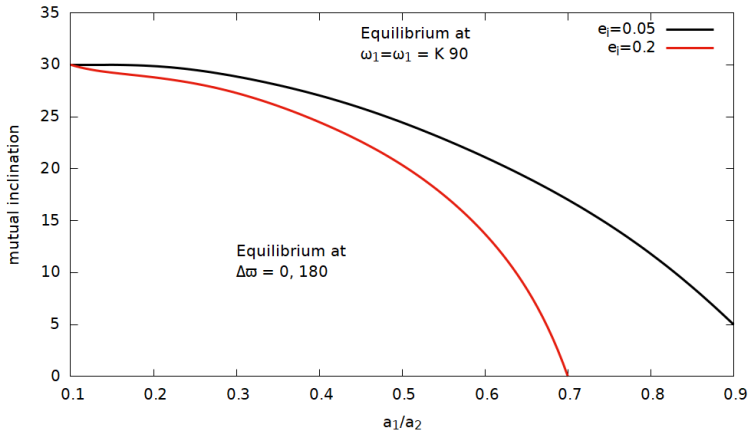
The central claim is that the regime boundary is the condition $g_1=g_2$, i.e., the equality of the two secular precession rates of the planetary pericenters, which the authors observe to occur in their explored configurations only when the initial mutual inclination lies between roughly $i_c=30^\circ$ and $40^\circ$. Below $i_c$, three well-defined fundamental frequencies exist — $g_1$, $g_2$ associated with the pericenters and eccentricities, and $f$ associated with the common line of nodes and inclinations — and the mutual inclination is essentially conserved. Above $i_c$, spectral analysis shows combinations such as $f+(f-g_2)$, the identities of the $g_i$ become entangled, and the mutual inclination changes; the vZLK mechanism begins when $g_2=f$, with $\omega_N$ librating. The authors further find that the equilibrium configurations of the secular Hamiltonian change at the same transition: at low inclination, minima occur for $\Delta\varpi=0^\circ$ or $180^\circ$ regardless of the individual $\omega_i$, while at high inclination they occur only for $\omega_1=\omega_2=K\,90^\circ$. This is established through numerical integrations of the full equations of motion over 10 Myr, spectral decomposition with a spectral correlation coefficient threshold, and a semi-analytical secular Hamiltonian computed by double averaging.
Load-bearing premise
The classification into two regimes rests on the assumption that the frequencies measured in 10-Myr integrations with spectral correlation coefficient above 0.05 are the system's true fundamental frequencies, and that below the critical inclination the mutual inclination is constant enough for the regime split to be sharp.
Editorial extensions
If this is right
- Below the critical mutual inclination $i_c$, a two-giant-planet system keeps three well-separated fundamental frequencies, the mutual inclination stays nearly constant, and the eccentricity dynamics reduces to forced plus free modes; above $i_c$, frequency combinations appear and the mutual inclination can change substantially over time.
- The locus of secular equilibria shifts from $\Delta\varpi=0^\circ$ or $180^\circ$ at low mutual inclination to $\omega_1=\omega_2=K\,90^\circ$ (apses aligned or perpendicular to the line of nodes) at high mutual inclination, so the orientation of the apsidal lines relative to the nodes becomes dynamically meaningful only in the high-inclination regime.
- The von Zeipel–Lidov–Kozai mechanism sets in only above the critical inclination, and the onset inclination is higher for an exterior Neptune-like planet and higher still when the mass ratio $m_N/m_J$ is smaller.
- Systems with mutual inclination above roughly 30° are predisposed to large changes in eccentricity and inclination, and for an exterior planet this can lead to instability, consistent with earlier stability studies that place the onset of inclination-driven instability around 30°–40°.
- The atlas of roughly 1300 mean-motion resonances shows that for a Neptune-like planet between about 4 and 16 au with mutual inclination below about 30°, resonance overlap dominates, so the secular regime split applies primarily in the white, MMR-free regions of the atlas.
Reading between the lines
- A testable extension of the paper's picture: for a given pair of giant planets, the critical inclination should be measurable from observed orbital precession rates as the mutual inclination at which the apsidal precession rates cross; if real systems near $i\simeq 35^\circ$ show no such frequency crossing, the boundary would need revision.
- The two regimes suggest a practical classification for exoplanet stability: systems with mutual inclination below $i_c$ can be modeled with quasi-constant-inclination secular theory, while those above it require vZLK-capable integration; this could guide choices of which systems to flag for strong mutual perturbations.
- The equilibrium switch to $\omega_i=K\,90^\circ$ implies that high-inclination giant-planet pairs may preferentially settle with apses aligned or perpendicular to the mutual line of nodes, a statistical preference that could be searched for in observed multi-planet systems with measured mutual inclinations.
- The paper excludes secular evolution inside mean-motion resonances; extending the frequency analysis to resonant populations might reveal that the $g_1=g_2$ boundary shifts inside resonance, connecting the MMR atlas to the secular regime split.
Signed reviews
Editorial analysis
A structured set of objections, weighed in public.
Referee Report
Summary. The paper studies a star plus two giant planets (Jupiter-like at 8 au, Neptune-like at 1–20 au) over a wide range of eccentricities and mutual inclinations, using MMR atlases, MEGNO chaos maps, a semi-analytical secular Hamiltonian, and 10 Myr numerical integrations with spectral analysis. The central claim is that the secular dynamics splits into two regimes separated by a critical mutual inclination 30 < i_c < 40 degrees, defined by the condition g1 = g2 (a secular resonance). For i < i_c the system exhibits three well-defined fundamental frequencies and a nearly constant mutual inclination ('classic secular' regime); for i > i_c combinations of frequencies appear, the mutual inclination changes, and the dynamics is dominated by the secular resonance or by the vZLK mechanism. The paper also documents two families of pseudo-equilibrium configurations: low-inclination equilibria at Δϖ = 0° or 180°, and high-inclination equilibria at ω1 = ω2 = K·90°.
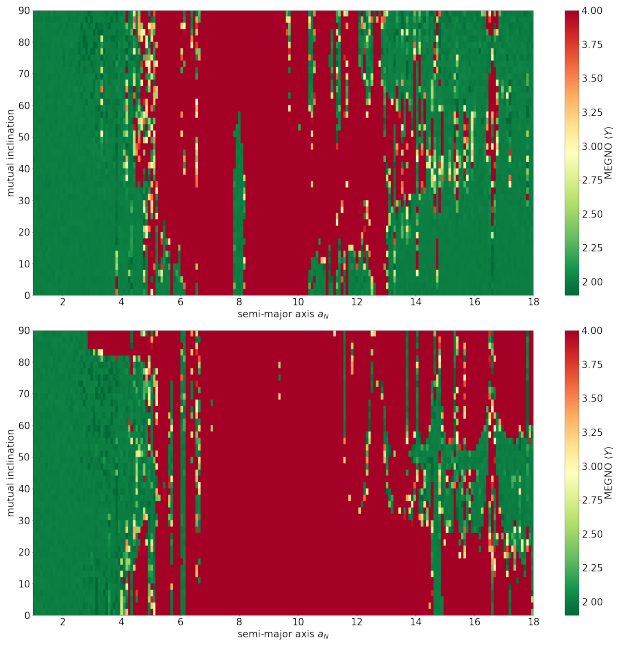
Significance. If correct, the proposed 30–40 degree boundary would provide a simple, physically interpretable organizing principle for two-planet secular dynamics, connecting the g1 = g2 resonance with the onset of vZLK-like evolution, and it would strengthen earlier stability studies that place the unstable/inclined boundary near 30–40 degrees. The paper is valuable for its numerical atlases (Figs. 1–2, 4), its explicit use of direct integrations, and its careful labeling of pseudo-equilibria and finite-time limitations. The semi-analytical Rs topology calculation (Figs. 5–7) is independent of planetary masses and provides a useful geometric characterization. However, the central regime boundary rests on spectral detections with a fixed SCC > 0.05 threshold over 10 Myr, and the paper itself notes (Sec. 3.3) that in high-(e,i) cases identifying fundamental frequencies is difficult; without convergence tests or uncertainty quantification, the sharpness and exact location of the boundary remain not fully established.
major comments (4)
- [Sec. 3.3, Figs. 8–10] The central claim that a sharp two-regime boundary occurs at the g1 = g2 crossing rests entirely on frequencies extracted from 10 Myr integrations with a fixed spectral correlation coefficient threshold (SCC > 0.05). The paper states in Sec. 3.3 that in high-(e,i) cases 'several frequencies appear in the spectra... so we simply record all those with SCC>0.05.' There is no convergence test in integration time, no test of the spectral pipeline on a synthetic signal with known frequencies, and no uncertainty estimate for the detected frequencies. A fixed SCC cutoff can systematically drop weak fundamental peaks and retain combination peaks as the dynamics complexify, producing an apparent emergence of combination frequencies above i_c even if no qualitative change occurs exactly at g1 = g2. Since the g1 = g2 crossing is the definition of the boundary, this is load-bearing and needs to be addressed.
- [Sec. 3.3, Figs. 8 and 11] The claimed critical inclination range 30 < i_c < 40 is inferred from a finite set of initial conditions and displayed as frequency-versus-inclination curves without uncertainty quantification. The paper states that 'in all experiments we performed for the range of aN we studied is located between 30 and 40 degrees' (Sec. 3.3), but no statistical or systematic error bars are given, and the number of experiments is not specified. Moreover, Fig. 11 shows that i_c varies with a_N and eccentricity, so the statement that 'in general' i_c is between 30 and 40 needs a quantitative characterization of the range of variation, especially for a_N/a_J near the chaotic boundary, before it can support a universal regime split.
- [Figs. 5–6 and Sec. 3.3] The equilibrium-topology switch in Figs. 5–6 occurs at mutual inclinations below 30 degrees (e.g., 15 < i < 30 in the text describing Fig. 5), which is distinct from the g1 = g2 boundary at 30–40 degrees used for the regime split. The paper says the g1 = g2 crossing is 'not equal but linked to' the change in the distribution of equilibrium points (Sec. 3.3), but no dynamical mechanism or quantitative relation is provided. This leaves the central claim with two separate, potentially inconsistent critical inclinations; a demonstration of how the equilibrium switch and the frequency crossing are related is needed.
- [Sec. 3.3, Fig. 8] The identification of the vZLK onset with the condition g2 = f is based on the same finite-time spectral analysis, and the paper reports that after g2 = f the frequency g2 'disappears or is merged with f' and f shows a discontinuity. These observations are qualitative and depend on the SCC threshold. Since a secular resonance and a vZLK regime have distinct phase-space signatures, the paper should verify at least one representative high-inclination case with longer integrations and/or with a direct phase-space diagnostic (e.g., libration of ωN in the appropriate variables) to confirm that the spectral transition corresponds to a true dynamical transition rather than to a loss of spectral resolution.
minor comments (5)
- [Abstract and throughout] There are several typographical and grammatical issues, e.g., 'an a Neptune-like planet', 'with1< aN <20 au' (missing space), 'the dynamics is analogue a the classic secular model', and 'intial' in Fig. 9. These should be corrected.
- [Sec. 3.1] The notation i for mutual inclination is introduced informally in Sec. 2 and used extensively, but a formal definition relating i to i1 and i2 in the invariable Laplace plane appears only in Sec. 3.2. It would help to define the mutual inclination explicitly when the variables are first introduced.
- [Fig. 6] Fig. 6 is described as showing the 'relative minimal mutual inclination' for the onset of the new equilibria, but the caption and text do not explain how this curve is computed from the Rs topography (e.g., what threshold in Rs is used to identify the onset). A brief description in the caption would improve reproducibility.
- [Sec. 2.1, Fig. 4] The MEGNO maps use a time span of 5000 orbital revolutions of the test Neptune; the paper notes this may be insufficient to detect chaos in some regions. It would be useful to state the MEGNO threshold used to classify regular versus chaotic, since the color scale is not quantified in the caption.
- [Sec. 3.3] The term 'SCC' is defined in the text, but the numerical threshold 'SCC>0.05' is used without discussion of its sensitivity. A brief statement of how the threshold was chosen and how results change for, say, SCC>0.1 or SCC>0.01 would be valuable.
Circularity Check
No significant circularity: the regime boundary is measured from direct integrations and cross-checked with independent dynamical maps, not derived from a fitted parameter or self-citation.
full rationale
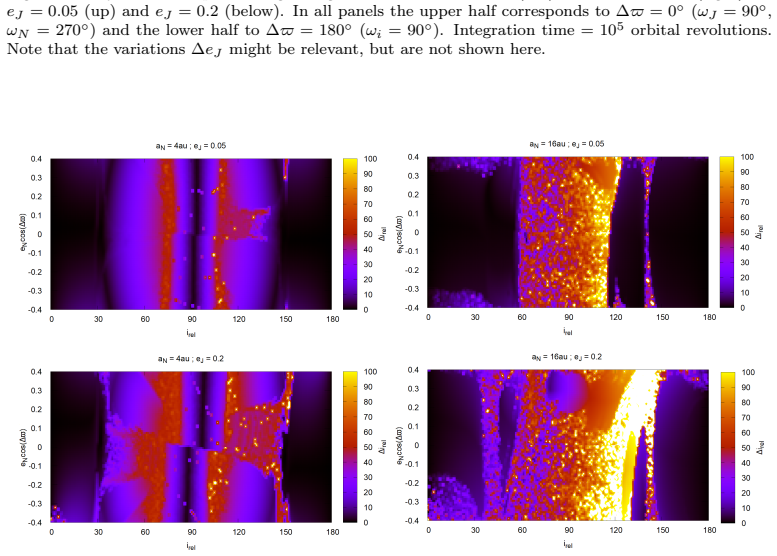
The paper's central claim is that the secular dynamics of two giant planets split at a critical mutual inclination ic defined by the secular resonance g1=g2. This is not circular: the frequencies g1 and g2 are extracted from 10 Myr numerical integrations of the exact equations of motion using a spectral analysis code, and the crossing g1=g2 is an observed event, not an imposed condition. The classification into two regimes is corroborated by independent diagnostics: MEGNO chaos maps (Fig. 4), dynamical maps of ΔeN and Δi (Figs. 13-14) that show a discontinuity around i~30°, and the change in the Rs equilibrium topology (Figs. 5-6), which the authors explicitly state is 'linked' to, but 'not equal' to, ic. The paper also verifies the atlas-based MMR exclusion with direct numerical dynamical maps (Fig. 3). Self-citations (Gallardo et al. 2021 for the MMR atlas; Gallardo 2017 for the spectral code) are tools in the pipeline, not load-bearing inputs for the central regime claim. The SCC>0.05 threshold is a detection criterion, not a fitted parameter; any concern that finite-time spectral peaks could masquerade as fundamental frequencies is a robustness question, not a circularity. No equation is defined in terms of the target result, and no quantity is fitted and then renamed as a prediction.
Assumptions & free parameters
free parameters (2)
- Spectral correlation coefficient threshold =
0.05
- Integration time for frequency analysis =
10 Myr
assumptions (4)
- domain assumption The double-averaged secular Hamiltonian is valid when there are no MMRs and no close encounters between the planets.
- domain assumption Using the invariable Laplace plane as reference gives Delta-Omega = 180 degrees and reduces the secular dynamics to two degrees of freedom.
- domain assumption Spectral peaks with SCC greater than 0.05 represent genuine fundamental frequencies of the system.
- domain assumption Mutual inclination remains approximately constant for i < ic, justifying fixed-i level curves in Fig. 7.
Cite this review
Pith. "Pith review of Dynamical regimes of two eccentric and mutually inclined giant planets." pith.science (2026). https://pith.science/paper/QUZCBYY6
@misc{pith2026250512124,
  author       = {Pith},
  title        = {Pith review of: Dynamical regimes of two eccentric and mutually inclined giant planets},
  year         = {2026},
  howpublished = {\url{https://pith.science/paper/QUZCBYY6}},
  note         = {Machine review of arXiv:2505.12124}
}
read the original abstract
We consider a basic planetary system composed by a Sun like star, a Jupiter-like planet an a Neptune-like planet in a wide range of orbital configurations not limited to the hierarchical case. We present atlases of resonances showing the domains of approx. 1300 mutual mean-motion resonances (MMRs) and their link to chaotic and regular dynamics. Following a semi-analytical method for the study of the secular dynamics we found two regimes for equilibrium configurations: one for low mutual inclinations were equilibrium is related to oscillations of the difference between the pericenter longitudes around 0 or 180 degrees, and another for high mutual inclinations where the equilibrium is given by defined values of the argument of the pericenters equal to integer multiples of 90 degrees. By numerical integration of the full equations of motion we calculate the fundamental frequencies of the systems in their diverse configurations and study their dependence with the orbital elements. According to the analysis of the fundamental frequencies we found two dynamical regimes depending on the initial mutual inclination and the limit between the two regimes occurs at some critical inclination 30<ic<40 defined by the occurrence of the secular resonance g1=g2. For i<ic the dynamics is analogue a the classic secular model for low (e,i) with well defined three fundamental frequencies and free and forced modes, conserving quasi constant the mutual inclination. For i>ic the dynamics is completely different with increasing changes in mutual inclination and emerging combinations of the fundamental frequencies and, depending on the case, dominated by the secular resonance or the vZLK mechanism.
Figures


Figures from the paper (11 more)



Reference graph
Works this paper leans on
-
[3]
doi:10.1007/s10569-022-10112-5,arXiv:2305.14198. Hansen, B.M., Naoz, S.,
-
[18]
Monthly Notices of the Royal Astronomical Society 532, 1580–1597
Dynamical structures of misaligned cir- cumbinary planets under hierarchical three-body systems. Monthly Notices of the Royal Astronomical Society 532, 1580–1597. URL: https://academic.oup.com/mnras/article/532/2/1580/7700715, doi:10.1093/mnras/stae1600. Libert, A.S.,
-
[22]
doi:10.1007/s10569-023-10136-5,arXiv:2212.10569. Michtchenko, T.A., Ferraz-Mello, S., Beaugé, C.,
-
[25]
Monthly Notices of the Royal Astronomical Society 395, 1777–1794
Equilibria in the secular, non-co-planar two- planet problem. Monthly Notices of the Royal Astronomical Society 395, 1777–1794. doi:10.1111/j.1365-2966.2009.14552.x,arXiv:0812.2949. Murray, C.D., Dermott, S.F.,
arXiv 2009
-
[29]
Astronomy and Astrophysics 685, A105
Secular evolution of resonant planets in the coplanar case - application to the systems hd 73526 and hd 31527. Astronomy and Astrophysics 685, A105. URL:https://doi.org/10.1051/0004-6361/202348378, doi:10.1051/0004- 6361/202348378. Rein, H., Spiegel, D.S.,
-
[31]
Predicting the long-term stability of compact multiplanet systems
Predicting the long-term stability of compact multiplanet systems. Proceedings of the National Academy of Sciences of the United States of America 117, 18194–18205. doi:10.1073/pnas.2001258117,arXiv:2007.06521. Turrini, D., Zinzi, A., Belinchon, J.A.,
work page Pith review arXiv 2007
-
[32]
Astronomy and Astrophysics 636, 1–6
Normalized angular momentum deficit: A tool for comparing the violence of the dynamical histories of planetary sys- tems. Astronomy and Astrophysics 636, 1–6. doi:10.1051/0004-6361/201936301, arXiv:2003.05366. 22 Volk, K., Malhotra, R.,
arXiv 2003
-
[108]
doi:10.3847/1538- 4357/ad62f9,arXiv:2404.07264. Brouwer, D., Clemence, G.M.,
Show all 34 references
-
[135]
doi:10.1007/s10569-023-10143-6. Errico, A., Wittenmyer, R.A., Horner, J., Li, Z., Brandt, G.M., Kane, S.R., Fetherolf, T., Holt, T.R., Carter, B., Clark, J.T., Butler, R.P., Tinney, C.G., Ballard, S., Bowler, B.P., Kielkopf, J., Liu, H., Plavchan, P.P., Shporer, A., Zhang, H.,...
-
[271]
Volpi, M., Roisin, A., Libert, A.S.,
doi:10.3847/1538- 3881/ad3de5,arXiv:2404.06567. Volpi, M., Roisin, A., Libert, A.S.,
-
[273]
Fernández, J.A., Gallardo, T., Brunini, A.,
doi:10.3847/1538- 3881/ac6589,arXiv:2204.05711. Fernández, J.A., Gallardo, T., Brunini, A.,
-
[276]
Laskar, J.,
URL:http://arxiv.org/abs/2007.14473 http://dx.doi.org/10.3847/1538-3881/abba18 https://iopscience.iop.org/article/10.3847/1538-3881/abba18, doi:10.3847/1538-3881/abba18,arXiv:2007.14473. Laskar, J.,
2007 arXiv
-
[619]
Funk, B., Libert, A.S., Süli, Á., Pilat-Lohinger, E.,
doi:10.1086/112924. Funk, B., Libert, A.S., Süli, Á., Pilat-Lohinger, E.,
-
[863]
Giuppone, C., Rodríguez, A., Alencastro, V., Roig, F., Gallardo, T.,
doi:10.1086/118306. Giuppone, C., Rodríguez, A., Alencastro, V., Roig, F., Gallardo, T.,
-
[1999]
doi:10.1017/CBO9781139174817
Solar System Dynamics. doi:10.1017/CBO9781139174817. Naoz, S., Farr, W.M., Lithwick, Y., Rasio, F.A., Teyssandier, J.,
-
[2000]
Astronomy and Astrophysics, Supplement 147, 205–228
Simple tools to study global dynamics in non- axisymmetric galactic potentials - I. Astronomy and Astrophysics, Supplement 147, 205–228. doi:10.1051/aas:2000108. Daquin, J., Charalambous, C.,
-
[2002]
doi:10.1006/icar.2002.6903
Are There Many Inactive Jupiter- Family Comets among the Near-Earth Asteroid Population? Icarus 159, 358–368. doi:10.1006/icar.2002.6903. Ferraz-Mello, S.,
2002
-
[2003]
The Astrophysical Journal 592, 1201–1216
Secular Evolution of Hierarchical Planetary Systems. The Astrophysical Journal 592, 1201–1216. doi:10.1086/375857, arXiv:astro-ph/0304454. Lei, H., Gong, Y.X.,
-
[2004]
Icarus 168, 237–248
Secular dynamics of the three-body prob- lem: application to theυAndromedae planetary system. Icarus 168, 237–248. doi:10.1016/j.icarus.2003.12.010,arXiv:astro-ph/0307094. Migaszewski, C., Goździewski, K.,
2003 arXiv
-
[2006]
Discussion on the outerυAndromedae planetary system
Modeling the 3-D secular plan- etary three-body problem. Discussion on the outerυAndromedae planetary system. Icarus 181, 555–571. doi:10.1016/j.icarus.2005.11.015,arXiv:astro-ph/0505169. Michtchenko, T.A., Malhotra, R.,
2005 arXiv
-
[2008]
Celestial Mechanics and Dynamical Astronomy 100, 209–229
Secularfrequenciesof3-Dexoplanetarysystems. Celestial Mechanics and Dynamical Astronomy 100, 209–229. doi:10.1007/s10569-007-9113-6. 21 Libert, A.S., Tsiganis, K.,
-
[2009]
Astronomy and Astrophysics 493, 677–686
Kozai resonance in extrasolar systems. Astronomy and Astrophysics 493, 677–686. doi:10.1051/0004-6361:200810843. Mastroianni, R., Efthymiopoulos, C.,
-
[2011]
Astronomy and Astro- physics 526, A98
On the influence of the Kozai mechanism in habitable zones of extrasolar planetary systems. Astronomy and Astro- physics 526, A98. doi:10.1051/0004-6361/201015218. Gajdoš, P., Vaňko, M.,
-
[2012]
Monthly Notices of the Royal Astronomical Society 422, 2725–2736
Interesting dynamics at high mutual inclination in the framework of the Kozai problem with an eccentric perturber. Monthly Notices of the Royal Astronomical Society 422, 2725–2736. doi:10.1111/j.1365-2966.2012.20855.x. Libert, A.S., Henrard, J.,
2012
-
[2013]
Monthly Notices of the Royal Astronomical Society 431, 2155–2171
Secular dynamics in hierarchical three-body systems. Monthly Notices of the Royal Astronomical Society 431, 2155–2171. doi:10.1093/mnras/stt302. Petit, A.C., Laskar, J., Boué, G.,
-
[2015]
Monthly No- tices of the Royal Astronomical Society 446, 1424–1437
IAS15: a fast, adaptive, high-order integrator for gravi- tational dynamics, accurate to machine precision over a billion orbits. Monthly No- tices of the Royal Astronomical Society 446, 1424–1437. doi:10.1093/mnras/stu2164, arXiv:1409.4779. Tamayo, D., Cranmer, M., Hadden, S....
-
[2017]
Astronomy and Astrophysics 605, 1–16
AMD-stability and the classification of planetary sys- tems. Astronomy and Astrophysics 605, 1–16. doi:10.1051/0004-6361/201630022, arXiv:1703.07125. Lee, M.H., Peale, S.J.,
-
[2018]
Astronomy and Astrophysics 617, A93
Hill stability in the AMD framework. Astronomy and Astrophysics 617, A93. URL: https://www.aanda.org/10.1051/0004-6361/201833088, doi:10.1051/0004- 6361/201833088. Pons, J., Gallardo, T.,
-
[2019]
Astronomy and Astrophysics 626, A74
The 3D secular dynamics of radial-velocity- detected planetary systems. Astronomy and Astrophysics 626, A74. doi:10.1051/0004- 6361/201834896,arXiv:1905.03722. 23 Figure 10: Frequencies in units of yr−1 detected with SCC>0.05in grayscale as a function of initial mutual inclina...
1905 arXiv
-
[2020]
Monthly Notices of the Royal Astronomical Society 499, 1682–1700
The stationary points of the hierarchical three-body problem. Monthly Notices of the Royal Astronomical Society 499, 1682–1700. doi:10.1093/mnras/staa2602. He, M.Y., Ford, E.B., Ragozzine, D., Carrera, D.,
-
[2021]
Astronomy and Astrophysics 646, A148
Semianalytical model for planetary resonances. Astronomy and Astrophysics 646, A148. URL: https://www.aanda.org/10.1051/0004-6361/202039764, doi:10.1051/0004- 6361/202039764,arXiv:2012.12296. Gallardo, T., Ferraz-Mello, S.,
2012 arXiv
-
[2022]
Monthly Notices of the Royal Astronomical Society 518, 2068–
Chaos in multiplanetary extrasolar sys- tems. Monthly Notices of the Royal Astronomical Society 518, 2068–
-
[2024]
Bhaskar, H.G., Perets, H.,
Main-sequence systems: orbital stability around single star hosts URL: http://arxiv.org/abs/2407.13899,arXiv:2407.13899. Bhaskar, H.G., Perets, H.,
-
[2075]
Gallardo, T.,
URL:https://academic.oup.com/mnras/article/518/2/2068/6807467, doi:10.1093/mnras/stac3200,arXiv:2211.01721. Gallardo, T.,
Reviewed August 15, 2026 · model on record in the stance chip above.
Discussion (0). Continue with ORCID to comment.