REVIEW 4 major objections 6 minor 20 references
Towards Sustainability in 6G Network Slicing with Energy-Saving and Optimization Methods
T0 review · 4 major / 6 minor · reviewed 2026-08-15 · deepseek-v4-flash
Pith's one-line read This paper proposes embedding contrastive-learning agents in the SFI2 slicing architecture to save energy in 6G by aligning resource allocation with user demand.
desk verdict A clearly written SFI2 architecture extension with a pilot CL anomaly-detection experiment, but the abstract's energy-saving claim is not supported by any slice-level measurement. read the letter →
The pith
A machine-rendered reading of the paper's core claim, the machinery that carries it, and where it could break.
The reading
What carries the argument
The load-bearing mechanism is contrastive representation learning applied to unlabeled energy time series. An LSTM encoder with 16 hidden units maps pairs of time-series windows to embeddings, a contrastive loss with Euclidean distance and margin $m$ pulls similar pairs together and pushes dissimilar pairs apart, and a new point is scored by its minimum embedding distance to the training set; distances above 0.5 count as anomalies. These anomaly signals are meant to feed the SFI2 resource-optimization phases, letting slice building, instantiation, and supervision adapt to user demand.
What would settle it
Run the SFI2 slice orchestration with and without the contrastive-learning agent while measuring actual per-slice energy draw; the central claim fails if energy consumption does not decrease, or if the 0.5-threshold detections disagree with a hand-labeled set of known energy anomalies.
Extended reading notes
Core claim
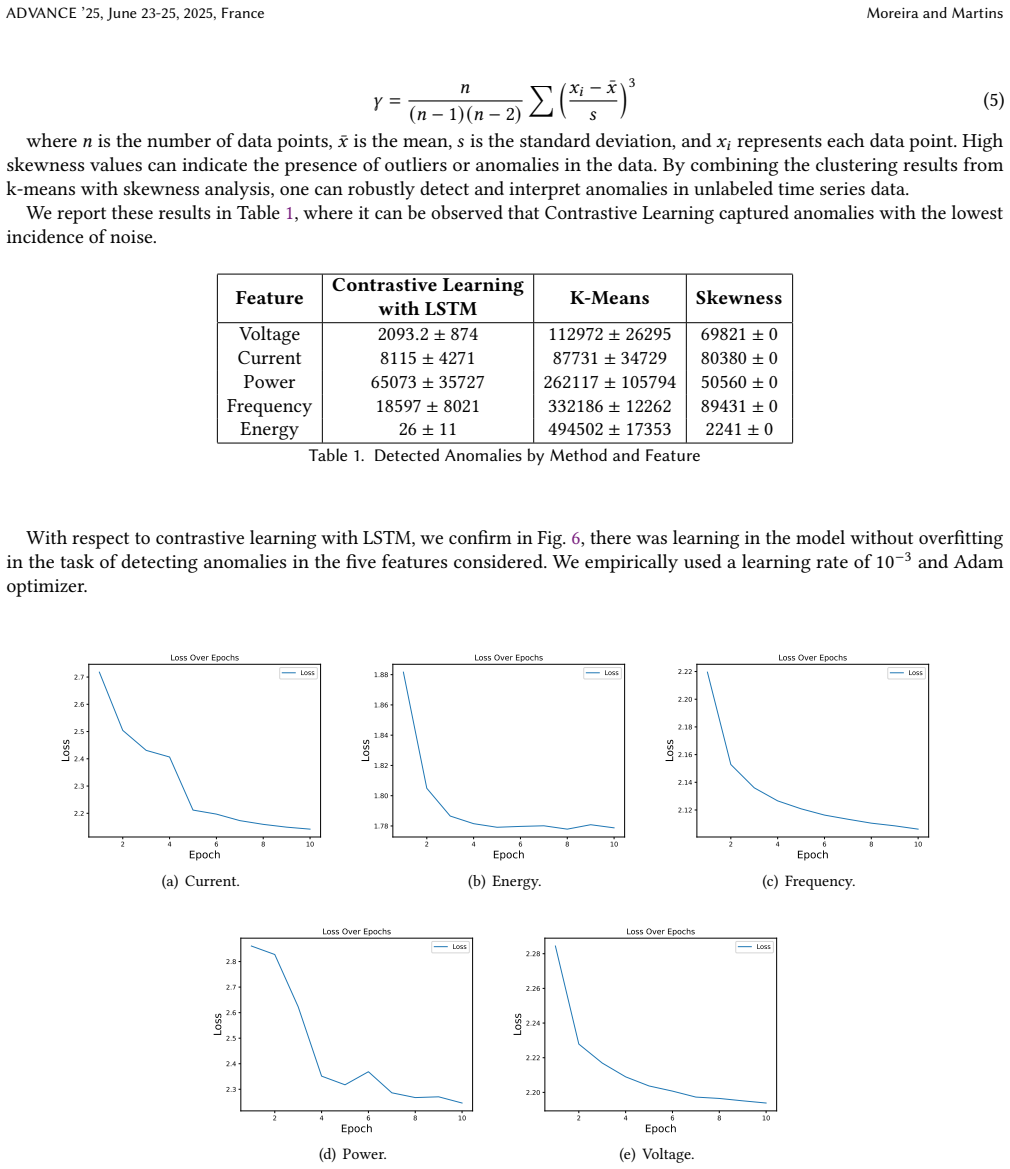
The paper's central claim is that embedding contrastive-learning agents in the SFI2 slicing reference architecture makes resource allocation energy-aware and saves energy over the slicing life cycle. On an unlabeled datacenter energy dataset (Voltage, Current, Power, Frequency, Energy), an LSTM-based contrastive encoder learns representations that cluster normal patterns and separate anomalies; with an empirically set threshold of 0.5, it detects anomalies with the lowest noise incidence among the methods compared. The paper interprets this as evidence that contrastive learning can accurately capture energy demands throughout slicing preparation, commissioning, operation, and decommissioning, and thus improve energy saving in slice resource and network resource optimization.
Load-bearing premise
The load-bearing premise is that finding fewer anomalies in an unlabeled datacenter energy time series, with no ground-truth anomaly labels, is a valid proxy for saving energy in 6G network slicing; if that proxy fails, the central claim loses its evidence.
Editorial extensions
If this is right
- If contrastive learning reliably identifies abnormal energy states, SFI2's Service Dynamic Optimization and Network Resource Optimization can reallocate computing and bandwidth to match user demand, avoiding wasted energy.
- A noise-resistant anomaly detector would reduce false reconfiguration triggers, so the slice supervisor intervenes only on genuine demand shifts rather than on data artifacts.
- Embedding ML agents across slice preparation, commissioning, operation, and decommissioning makes energy efficiency a continuous property of the slicing life cycle rather than a one-time configuration choice.
Reading between the lines
- Beyond the paper: the anomaly-count comparison is a proxy, not a measurement of slice-level energy use, so the actual energy saved by contrastive learning in 6G slicing remains unquantified.
- Beyond the paper: a direct test would compare end-to-end energy consumption of slice instantiation and supervision with and without the contrastive agent on a real SFI2 testbed.
- Beyond the paper: because the detector is label-free, the same approach could be applied to per-slice RAN energy traces or to multi-tenant data-center telemetry, where labeled anomalies are scarce.
Signed reviews
Editorial analysis
A structured set of objections, weighed in public.
Referee Report
Summary. The paper argues that 6G network slicing architectures should embed machine-learning-native agents to save energy, and it proposes contrastive learning (CL) as the core mechanism. It positions this within the SFI2 reference architecture, distinguishing Slice Resource Optimization (SRO), Network Resource Optimization (NRO), and Service Dynamic Optimization (SDO). The only quantitative support is an anomaly-detection experiment (Section 4.1) on an unlabeled datacenter energy-consumption dataset with five correlation-selected features, where a CL model with an LSTM encoder is compared against k-means and skewness. Table 1 reports that CL flags far fewer points as anomalous, and the paper interprets this as evidence that CL can 'accurately capture energy demands throughout the slicing lifecycle.' Section 5 states that integration with real-time energy probes is future work.
Significance. If the central claim were substantiated, the paper would address a genuine and timely gap: there is little published work on embedding energy-saving methods inside network-slicing life-cycle management. The SFI2 architectural discussion is coherent, and the three optimization levels (SRO, NRO, SDO) are a useful framing. Equations (1) through (5) are standard formulations, and the proposed use of contrastive learning for unlabeled time-series anomaly detection is plausible. However, the paper's significance is currently prospective: no slice-level energy measurement, no user-demand alignment metric, no comparison of orchestration with and without CL, and no ground truth for anomalies are reported. The contribution as written is a proposal plus a preliminary anomaly-counting exercise, not a validated energy-saving method.
major comments (4)
- [Abstract and Section 4.1, Table 1] The central claim that contrastive learning 'improves energy saving for resource allocation' is supported only by anomaly counts on an unlabeled datacenter energy time series in Table 1. Fewer flagged anomalies is not an energy-saving measure: it quantifies neither energy consumed, energy saved, nor slice-resource allocation decisions. No slice workload, no energy probe, and no comparison of orchestration with and without CL is reported. This missing link is load-bearing for the abstract's claim.
- [Section 4.1, threshold and feature selection] The paper states that a threshold of 0.5 was 'defined empirically' and that the five features were selected by correlation, both on the same dataset used for evaluation. No train/validation/test split, no ground truth for anomalies, and no threshold-selection procedure are reported. Consequently, the lower CL anomaly count in Table 1 may reflect data-dependent calibration rather than a general property of the method. Please specify the split, the selection procedure, and evaluate against labeled anomalies or a clearly justified proxy.
- [Section 5, final considerations] Section 5 concedes that integration with 'real-time energy probes' is future work, which is inconsistent with the conclusion that the results show CL can 'accurately capture energy demands throughout the slicing lifecycle.' The experiment only counts anomalies in one time series; it does not measure energy demands of slices or demonstrate any lifecycle-wide capture of energy behavior. The conclusion should be scaled back to what the experiment actually supports.
- [Equation (3) versus Algorithm 1] Equation (3) defines an anomaly score as the minimum distance between a new instance and the training set, while Algorithm 1 creates pairs from the input column and thresholds pairwise embedding distances. These are different detection schemes, and the paper does not explain how the pairwise procedure implements Eq. (3) or how pairs are constructed. Since Table 1 is produced by Algorithm 1, this ambiguity makes the reported anomaly counts non-reproducible and should be clarified.
minor comments (6)
- [Sections 3 and 4] The acronym for Service Dynamic Optimization is defined as SDO in Section 3 but written as 'SRO' in Section 4 ('Service Dynamic Optimization (SRO)'), which conflicts with the earlier Slice Resource Optimization abbreviation.
- [Figure 5] Figure 5 shows a PyTorch autograd graph rather than a model-architecture diagram; it does not convey the contrastive learning architecture, pair construction, or projection head. A schematic diagram would be far more informative.
- [Table 1] The reported values mix inconsistent precision and apparent units, e.g., '2093.2±874' and '69821±0'; please standardize the number of significant digits and state units explicitly.
- [Section 4.1 and Figure 7] The phrase 'Amount of noised anomalies' is nonstandard; consider 'number of detected anomalies' or 'number of noisy detections.'
- [Reference [20]] The datacenter energy-consumption dataset is cited but not named, and no access details are given; please identify the dataset precisely to support reproducibility.
- [Received/accepted dates] The date line 'accepted 15 05 25' is formatted inconsistently with the rest of the manuscript; use a consistent date format.
Circularity Check
The anomaly-detection experiment is externally benchmarked, but the 0.5 threshold and five-feature selection are fit on the same unlabeled dataset, and the resulting anomaly counts are then interpreted as evidence of energy-demand capture; this is a mild fitting and interpretation issue, not a derivation-level circularity.
-
fitted input called prediction
[Section 4.1 (Eq. 3, feature selection, Table 1) and Section 5]
"If 𝑠(𝑥′) exceeds a threshold, 𝑥′ is an anomaly. We defined empirically a threshold of 0.5. ... Among these features, we selected the five best ones by the correlation method to be used as an object of anomaly analysis ... The findings indicate that contrastive learning is less susceptible to noise, enabling AI algorithms to accurately capture energy demands throughout the slicing lifecycle."
The evaluation statistic (the number of anomalies reported in Table 1) is computed with a threshold and a feature subset fitted on the same unlabeled dataset. Section 5 then promotes this descriptive count into the paper's energy-saving claim, saying contrastive learning can 'accurately capture energy demands throughout the slicing lifecycle.' The lower anomaly count is therefore partly a function of the chosen 0.5 cutoff and the correlation-selected features, not an independently measured energy outcome; no slice-level energy or demand-alignment metric is presented. The comparison against k-means and skewness is genuine and not forced by construction, so this is a mild calibration/interpretation concern rather than a fully circular derivation.
full rationale
The paper's central proposal is architectural: embedding ML-native, contrastive-learning agents into the SFI2 network-slicing framework to orchestrate resources and save energy. That proposal is not derived by fitting a quantity and then predicting the same quantity. The only quantitative evidence, the anomaly-detection study in Section 4.1, is evaluated against external baselines (k-means and skewness) on an external datacenter dataset, so the comparison has independent content. The mild circularity is limited to the threshold (0.5) and the five features being selected empirically on the same data used for evaluation, and to the final section reinterpreting the resulting anomaly counts as evidence of accurate 'energy demand capture' and energy saving in network slicing. Since no slice-level energy measurement, resource-allocation policy change, or demand-alignment metric is tested, the energy-saving conclusion is not forced by the experiment. The self-citations to the SFI2 architecture papers are used as background context for the architecture itself, not as the proof of the energy-saving claim, so they are not load-bearing. Overall, the derivation chain is mostly self-contained, with the identified fitting and interpretation step preventing a score of zero.
Assumptions & free parameters
free parameters (5)
- anomaly_threshold =
0.5
- contrastive_margin_m =
not specified
- lstm_hidden_units =
16
- learning_rate =
1e-3
- selected_features =
Voltage, Current, Power, Frequency, Energy
assumptions (3)
- standard math The Euclidean contrastive loss, LSTM encoder, and standard ML training assumptions in Equations 1 to 5 are correct.
- domain assumption Anomaly detection on datacenter energy data is a valid proxy for energy-saving decisions in network slicing.
- ad hoc to paper A lower number of flagged anomalies means less noise and therefore better detection.
Cite this review
Pith. "Pith review of Towards Sustainability in 6G Network Slicing with Energy-Saving and Optimization Methods." pith.science (2026). https://pith.science/paper/35AEBHKV
@misc{pith2026250512132,
  author       = {Pith},
  title        = {Pith review of: Towards Sustainability in 6G Network Slicing with Energy-Saving and Optimization Methods},
  year         = {2026},
  howpublished = {\url{https://pith.science/paper/35AEBHKV}},
  note         = {Machine review of arXiv:2505.12132}
}
read the original abstract
The 6G mobile network is the next evolutionary step after 5G, with a prediction of an explosive surge in mobile traffic. It provides ultra-low latency, higher data rates, high device density, and ubiquitous coverage, positively impacting services in various areas. Energy saving is a major concern for new systems in the telecommunications sector because all players are expected to reduce their carbon footprints to contribute to mitigating climate change. Network slicing is a fundamental enabler for 6G/5G mobile networks and various other new systems, such as the Internet of Things (IoT), Internet of Vehicles (IoV), and Industrial IoT (IIoT). However, energy-saving methods embedded in network slicing architectures are still a research gap. This paper discusses how to embed energy-saving methods in network-slicing architectures that are a fundamental enabler for nearly all new innovative systems being deployed worldwide. This paper's main contribution is a proposal to save energy in network slicing. That is achieved by deploying ML-native agents in NS architectures to dynamically orchestrate and optimize resources based on user demands. The SFI2 network slicing reference architecture is the concrete use case scenario in which contrastive learning improves energy saving for resource allocation.
Figures


Figures from the paper (4 more)



Reference graph
Works this paper leans on
-
[1]
6G—Enabling the New Smart City: A Survey.Sensors, 23(17):7528, January 2023
Maurizio Murroni, Matteo Anedda, Mauro Fadda, Pietro Ruiu, Vlad Popescu, Corneliu Zaharia, and Daniele Giusto. 6G—Enabling the New Smart City: A Survey.Sensors, 23(17):7528, January 2023
work page 2023
-
[2]
Emmanuel Ekene Okere and Vipin Balyan. Sixth Generation Enabling Technologies and Machine Learning Intersection: A Performance Optimization Perspective.Future Internet, 17(2):50, February 2025
work page 2025
-
[3]
World Bank and International Telecommunication Union, 2024
ITU and World Bank.Measuring the Emissions and Energy Footprint of the ICT Sector. World Bank and International Telecommunication Union, 2024
work page 2024
-
[4]
Ashu Taneja, Nitin Saluja, Neeti Taneja, Ali Alqahtani, M. A. Elmagzoub, Asadullah Shaikh, and Deepika Koundal. Power Optimization Model for Energy Sustainability in 6G Wireless Networks.Sustainability, 14(12):7310, January 2022
work page 2022
-
[5]
Towards Zero: A Review on Strategies in Achieving Net-Zero-Energy and Net-Zero-Carbon Buildings
Hoi-Lam Lou and Shang-Hsien Hsieh. Towards Zero: A Review on Strategies in Achieving Net-Zero-Energy and Net-Zero-Carbon Buildings. Sustainability, 16(11):4735, January 2024
work page 2024
-
[6]
6G Sustainability KPI Assessment Introduction and Gap Analysis
ATIS Alliance for Telecommunications Industry Solutions. 6G Sustainability KPI Assessment Introduction and Gap Analysis. Technical Report, Alliance for Telecommunications Industry Solutions, 2023
work page 2023
-
[7]
3GPP. 3rd Generation Partnership Project; Technical Specification Group Services and System Aspects; Management and Orchestration; Concepts, Use Cases and Requirements. Technical Specification 3GPP TS 28.530 V15.0, 3GPP, 2019
work page 2019
-
[8]
Rodrigo Moreira, Flavio de Oliveira Silva, Tereza Cristina Melo de Brito Carvalho Carvalho, and Joberto S. B. Martins. Intelligent Data-Driven Architectural Features Orchestration for Network Slicing. InProceedings of the International Workshop on ADV ANCEs in ICT Infrastructures and Services (ADV ANCE), pages 1–12, Hanoi, Vietnam, 2024
work page 2024
Show all 20 references
-
[9]
Prashant Subedi, Abeer Alsadoon, P. W. C. Prasad, Sabih Rehman, Nabil Giweli, Muhammad Imran, and Samrah Arif. Network Slicing: A Next Generation 5G Perspective.EURASIP Journal on Wireless Communications and Networking, 2021(1):102, April 2021
2021
-
[10]
5G Network Slicing Using SDN and NFV: A Survey of Taxonomy, Architectures and Future Challenges.Computer Networks, 167:106984, February 2020
Alcardo Alex Barakabitze, Arslan Ahmad, Rashid Mijumbi, and Andrew Hines. 5G Network Slicing Using SDN and NFV: A Survey of Taxonomy, Architectures and Future Challenges.Computer Networks, 167:106984, February 2020
2020
-
[11]
6G R&D Vision: Requirements and Candidate Technologies.Journal of Communications and Networks, 24(2):232–245, April 2022
Een-Kee Hong, Inkyu Lee, Byonghyo Shim, Young-Chai Ko, Sang-Hyo Kim, Sangheon Pack, Kyunghan Lee, Sunwoo Kim, Jae-Hyun Kim, Yoan Shin, Younghan Kim, and Haejoon Jung. 6G R&D Vision: Requirements and Candidate Technologies.Journal of Communications and Networks, 24(2):232–245, ...
2022
-
[12]
A Comprehensive Review of Computing Paradigms, Enabling Computation Offloading and Task Execution in Vehicular Networks.IEEE Access, 10:3580–3600, 2022
Abdul Waheed, Munam Ali Shah, Syed Muhammad Mohsin, Abid Khan, Carsten Maple, Sheraz Aslam, and Shahab Shamshirband. A Comprehensive Review of Computing Paradigms, Enabling Computation Offloading and Task Execution in Vehicular Networks.IEEE Access, 10:3580–3600, 2022. Confere...
2022
-
[13]
Joberto S. B. Martins, Tereza C. Carvalho, Rodrigo Moreira, Cristiano Bonato Both, Adnei Donatti, João H. Corrêa, José A. Suruagy, Sand L. Corrêa, Antonio J. G. Abelem, Moisés R. N. Ribeiro, José-marcos S. Nogueira, Luiz C. S. Magalhães, Juliano Wickboldt, Tiago C. Ferreto, Ri...
2023
-
[14]
Yulei Wu, Hong-Ning Dai, Haozhe Wang, Zehui Xiong, and Song Guo. A Survey of Intelligent Network Slicing Management for Industrial IoT: Integrated Approaches for Smart Transportation, Smart Energy, and Smart Factory.IEEE Communications Surveys & Tutorials, 24(2):1175–1211, 202...
2022
-
[15]
Correa, Joberto S
Adnei Donatti, Sand L. Correa, Joberto S. B. Martins, Antonio Abelem, Cristiano B. Both, Flavio Silva, José A. Suruagy, Rafael Pasquini, Rodrigo Moreira, Kleber V. Cardoso, and Tereza C. Carvalho. Survey on Machine Learning-Enabled Network Slicing: Covering the Entire Life Cyc...
2023
-
[16]
Multi-Perspective Approach for Developing Sustainable 6G Mobile Communications
Marja Matinmikko-Blue, Seppo Yrjölä, and Petri Ahokangas. Multi-Perspective Approach for Developing Sustainable 6G Mobile Communications. Telecommunications Policy, 48(2):102640, March 2024
2024
-
[17]
Rodrigo Moreira, Joberto S. B. Martins, Tereza C. M. B. Carvalho, and Flávio de Oliveira Silva. On Enhancing Network Slicing Life-Cycle Through an AI-Native Orchestration Architecture. In Leonard Barolli, editor,Advanced Information Networking and Applications, Lecture Notes i...
2023
-
[18]
Villaça, Moisés R
Rodrigo Moreira, Rodolfo S. Villaça, Moisés R. N. Ribeiro, Joberto S. B. Martins, João Henrique Corrêa, Tereza C. Carvalho, and Flávio de Oliveira Silva. An Intelligent Native Network Slicing Security Architecture Empowered by Federated Learning.Future Generation Computer Syst...
2025
-
[19]
A Survey on Contrastive Self-supervised Learning, February 2021
Ashish Jaiswal, Ashwin Ramesh Babu, Mohammad Zaki Zadeh, Debapriya Banerjee, and Fillia Makedon. A Survey on Contrastive Self-supervised Learning, February 2021. arXiv:2011.00362 [cs]
2021 arXiv
-
[20]
Learning-based energy consumption prediction.Procedia Computer Science, 203:272–279, 2022
Rebeca Estrada, víctor Asanza, Danny Torres, Adrian Bazurto, and Irving Valeriano. Learning-based energy consumption prediction.Procedia Computer Science, 203:272–279, 2022. Received 12 March 2025; revised 30 April 2025; accepted 15 05 25 10
2022
Reviewed August 15, 2026 · model on record in the stance chip above.
Discussion (0). Continue with ORCID to comment.