REVIEW 4 major objections 5 minor 13 references
One-for-All Pruning: A Universal Model for Customized Compression of Large Language Models
T0 review · 4 major / 5 minor · reviewed 2026-08-15 · deepseek-v4-flash
Pith's one-line read The paper claims that a single trained network, StratNet, can map any compression request for a large language model to a near-optimal pruning strategy, cutting the time to serve 64 simultaneous requests by at least 28x without…
desk verdict A practical engineering paper: a request-conditional pruning net trained via a GP surrogate, with real latency gains but a load-bearing GP whose calibration is never checked. read the letter →
The pith
A machine-rendered reading of the paper's core claim, the machinery that carries it, and where it could break.
The reading
What carries the argument
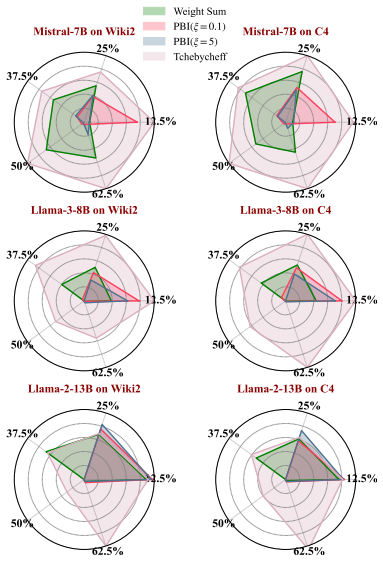
The load-bearing component is StratNet, a multi-layer perceptron that maps request weights $\lambda$ to a block-sparsity vector $x$, trained end-to-end through a Gaussian process surrogate. The GP stands in for the expensive evaluation of $f_2(x)$, the KL divergence between the pruned and original model's outputs on a calibration set, and its gradient $\nabla_x G$ supplies the missing factor in the chain rule $\nabla_\theta \hat{f}_2(x)\approx \nabla_\theta\phi_\theta(\lambda)\cdot\nabla_x G$. The other components are the weighted Tchebycheff scalarization, which decides which point on the Pareto front matches the request even when the front is concave, and an alternating update in which hypervolume improvement chooses the strategies that get exactly evaluated and added to the GP's training set.
What would settle it
Take a model with more than one hundred transformer blocks, sample two hundred random compression requests that were never seen during training, and compare each strategy UniCuCo outputs against the exact KL-divergence the surrogate predicted and against the best strategy an evolutionary search finds for the same request. If the predictions are systematically off or the strategies lose badly to the search baseline, the central claim that one trained network replaces per-request search fails.
Extended reading notes
Core claim
The central discovery is that the search over pruning strategies for large language models can be amortized across all compression requests. For a request $\lambda \in \mathbb{R}^2_+$ with $\lambda_1+\lambda_2=1$, the paper trains a StratNet $\phi_\theta$ so that $x=\phi_\theta(\lambda)$ directly outputs the sparsity ratios $x_i\in[0,1]$ for each block, minimizing both model size $f_1(x)$ and output-distribution mismatch $f_2(x)=D_{\mathrm{KL}}(P_{M_x}\|P_M)$. The key technical move is to estimate $f_2$ with a Gaussian process and to use the GP's analytic gradient in $\nabla_\theta \hat{g}_{\mathrm{tch}}$ to repair the chain rule broken by the non-differentiable mapping from strategy to pruned model. Optimizing with the weighted Tchebycheff scalarization $g_{\mathrm{tch}}(x|\lambda)=\max_i \lambda_i(f_i(x)-z^*_i)$ lets one request weight reach optimal points even on concave Pareto fronts. The paper reports that on Mistral-7B and Llama-3-8B the resulting strategies stay close to evolutionary-search baselines in perplexity and zero-shot accuracy, beat score-based methods at higher sparsities, and run in under a second per request.
Load-bearing premise
The method's accuracy rests on the surrogate model's estimate of how much a proposed pruning plan damages the language model. If that estimate is wrong anywhere in the space of possible plans, the gradient that trains the strategy network points the wrong way and the pruned model quality collapses, as the paper's own ablation without surrogate updates shows.
Editorial extensions
If this is right
- After the one-time training, each new compression request is a single forward pass through StratNet, so the per-request time drops from tens of minutes to under a second.
- The same trained request-conditional mapping handles both binary depth-pruning plans and continuous per-block sparsity plans without retraining.
- The 28x speedup over optimization-based search grows with the number of requests, because the baseline pays its search cost once per request while UniCuCo pays it once per model.
- On the reported benchmarks, UniCuCo improves on score-based pruning at high sparsity, with about 3% higher average zero-shot accuracy than Uniform at 70% non-uniform sparsity on Mistral-7B.
- Because the GP also supplies uncertainty, the method can deliberately explore uncertain strategies through lower or upper confidence bounds rather than greedily exploiting a single best guess.
Reading between the lines
- The paper's 'arbitrary request' claim covers the two-dimensional trade-off simplex; extending to requests with extra objectives, such as energy or latency targets, would require a higher-dimensional surrogate and scalarization that the paper does not test.
- The GP is trained on at most a few hundred exact evaluations plus ten per epoch, so the method's reach onto models with hundreds of blocks is the natural stress test; one way to extend it would be to add batch exact evaluations for high-variance candidates during training.
- The same amortize-the-search template should transfer to other expensive, non-differentiable model-editing choices, such as quantization configurations or expert routing, but that transfer is an inference from the method's structure, not a result the paper demonstrates.
- If the GP faithfully tracks $f_2$, UniCuCo is effectively learning the entire Pareto front of compression, and that learned map could answer inverse queries such as 'smallest model that keeps perplexity below a threshold' with no additional search.
Signed reviews
Editorial analysis
A structured set of objections, weighed in public.
Referee Report
Summary. The paper proposes UniCuCo, an amortized LLM pruning framework with a StratNet that maps a compression request λ to a pruning strategy x, along with a Gaussian process (GP) surrogate that estimates the KL-based objective f2(x) and supplies gradients through the otherwise non-differentiable pruning pipeline. A weighted Tchebycheff scalarization is used to handle arbitrary trade-offs between model size and performance. Experiments cover depth pruning and non-uniform pruning on Mistral-7B, Llama-3-8B, and Llama-2-13B, comparing against EvoPress, OWL, Uniform, and several score-based baselines. The paper reports per-request latencies under one second, a 28–56x speedup when processing 64 requests, and accuracy that is competitive with EvoPress at low sparsity and better than Uniform at high sparsity. The Limitations section acknowledges that scaling to models with hundreds of blocks is unvalidated.
Significance. If the central claims hold, UniCuCo addresses a real bottleneck: replacing per-request evolutionary pruning searches with a single amortized model that can serve many compression requests cheaply. The idea of using a GP surrogate both to reduce evaluation cost and to restore gradient flow through a discrete pruning process is interesting and potentially useful. Strengths of the paper include experiments across three models and two pruning regimes, ablations showing the importance of dynamic GP updates and uncertainty weighting, a comparison of scalarization functions, and a clearly stated limitation about scaling. However, the main speed and accuracy claims are currently supported only conditionally, because the depth-pruning pipeline is underspecified and the GP surrogate's fidelity is not directly validated.
major comments (4)
- [Section 3.1 and Table 1] The depth-pruning pipeline is underspecified. StratNet outputs a continuous vector x=φθ(λ), but Table 1 evaluates binary block-removal strategies at exact sparsity levels (12.5% to 62.5%), and the paper never states how the continuous output is converted to a binary mask or how the exact sparsity level is enforced. This matters because Eq. (10) defines the training gradient only through continuous x; the discrete masking operation used at evaluation breaks that chain unless an additional mechanism is specified (e.g., ranking-based selection, a straight-through estimator, or a Gumbel relaxation). Please provide the binarization rule, the procedure for enforcing each target sparsity, and an explanation of how gradients are obtained across that discrete mapping.
- [Section 3.2, Eq. (10), and Fig. 5] The GP surrogate is the sole source of f2-gradient information for StratNet, but the paper never validates the surrogate's fidelity. Fig. 5 demonstrates that removing dynamic GP updates degrades results; it does not show that the GP posterior mean or gradient is an accurate estimate of the true KL objective on held-out strategies. Because Tables 2, 4, and 5 show UniCuCo's accuracy gap to EvoPress widening at 70% sparsity (3.6, 6.9, and 3.2 average-accuracy points on Mistral-7B, Llama-3-8B, and Llama-2-13B, respectively), the high-sparsity regime is exactly where surrogate error is most consequential. Please add a direct evaluation of GP predictive error (e.g., RMSE or negative log-likelihood) on held-out strategies and a comparison of ∇xG with finite-difference or exact gradient estimates on a sample of points, including high-sparsity strategies.
- [Abstract, Section 4.3, and Conclusion] The claim of a '3% accuracy improvement over score-based methods' is too broad. In Table 2, the 3-point gain at 70% sparsity on Mistral-7B is relative to the Uniform baseline (52.87 vs 49.88); the corresponding gains on Llama-3-8B and Llama-2-13B are 1.66 points (Table 4, 45.76 vs 44.10) and 8.57 points (Table 5, 54.11 vs 45.54), so the stated magnitude is not a general property. Moreover, 'maintaining comparable accuracy to baselines' is not well supported at high sparsity: at 70% sparsity, EvoPress exceeds UniCuCo by 3.6, 6.9, and 3.2 average-accuracy points on the three models. The abstract and conclusion should qualify these headline statements with the specific baselines and sparsity regimes from which they are drawn.
- [Appendix A and Algorithm 1] Several parameters needed to assess the GP training regime are missing or inconsistent. The number N of initial strategies sampled in Section 3.3(A) is never reported; Algorithm 1 is written as 'for t = 0 to T' but line 13 updates {X_t,F_t} from {X_{t-1},F_{t-1}}, which is undefined at t=0; and the relationship between the pseudocode and the text's (A)/(B) epoch structure is unclear. Please report N, correct the indexing, and state the total number of exact f2 evaluations performed per model. Without this, the GP training-set size, which is a key determinant of surrogate quality, cannot be assessed.
minor comments (5)
- [General] Please proofread for naming and typographical issues: 'Univeral' in the title and abstract, 'Wandb' for Wanda in Section 2.2, and 'ReCoP' instead of UniCuCo in the first paragraph of Section 4.
- [Appendix A and Eq. (9)] The default value of κ and the choice of LCB versus UCB for the main results in Tables 1–5 are not stated; Figs. 6 and 7 show that both choices affect the results, so they should be reported.
- [Section 3.3 and Eq. (13)] The hypervolume-improvement subset selection is not specified algorithmically: Eq. (13) maximizes over subsets of a 2240-point candidate pool, but the paper does not say whether a greedy procedure or exact search is used. Please provide the selection algorithm.
- [Section 3.1.2 and Eq. (5)] The ideal point z* used in the weighted Tchebycheff scalarization is never specified; please state how z_i^* is obtained for each model and whether it is held fixed during training.
- [Section 4.2 and Abstract] The relationship between the abstract's '28 times faster' figure and the text's '56 times more efficiently' on Mistral-7B for 64 requests should be made explicit; as written, the two numbers appear inconsistent.
Circularity Check
No significant circularity: reported results are measured on actually pruned models, not on the GP surrogate's own predictions.
full rationale
Walked the derivation chain. StratNet maps a request lambda to a strategy x; f1(x) is computed exactly from Eq. (1), and f2(x) is defined as the KL divergence between pruned and unpruned LLM outputs on calibration data in Eq. (2). The Gaussian process G is fitted to exact f2 evaluations (Section 3.2, Eqs. (8)-(9)) and provides a gradient surrogate in Eq. (10) so that StratNet can be trained despite the non-differentiable pruning step. This GP approximation is internal to training: the paper's headline claims are evaluated externally by applying the discovered pruning strategies to real models and measuring perplexity and zero-shot accuracy (Tables 1-5), and by wall-clock time comparisons (Fig. 4). No equation in the paper defines those reported metrics in terms of the GP's posterior mean or variance, and no fitted parameter is renamed as a prediction. The weighted Tchebycheff scalarization is attributed to Miettinen (1999), an external standard reference, and no uniqueness or impossibility claim is imported from the authors' own prior work; the reference list contains no self-citations. The paper's own Fig. 5 and Limitations section show that GP fidelity is load-bearing and that scaling to hundreds of blocks is unvalidated, but that is an empirical robustness concern, not a circularity: the derivation does not reduce, by construction, to its own inputs. Under the hard rules, this warrants a score of 0.
Assumptions & free parameters
free parameters (3)
- GP kernel hyperparameters (Matérn 5/2 lengthscales, noise) =
not reported
- Uncertainty weight kappa =
0.1, 0.5, 1, 2 explored; kappa=2 degrades
- Ideal point z* in Tchebycheff scalarization =
not specified
assumptions (4)
- domain assumption f2(x) = D_KL(P_Mx || P_M) on the calibration dataset is a faithful proxy for the quality of the pruned model.
- standard math The weighted Tchebycheff function gtch(·) yields the optimal strategy for any request lambda regardless of Pareto-front convexity.
- ad hoc to paper The GP posterior mean and its gradient accurately approximate f2 and grad_x f2 over the strategy space.
- ad hoc to paper Binary depth-pruning masks can be obtained from StratNet's continuous outputs without breaking the gradient chain used in Eq. (11).
invented entities (2)
-
StratNet (phi_theta)
independent evidence
-
Gaussian process estimator G
independent evidence
Cite this review
Pith. "Pith review of One-for-All Pruning: A Universal Model for Customized Compression of Large Language Models." pith.science (2026). https://pith.science/paper/DEMRO4AR
@misc{pith2026250512216,
  author       = {Pith},
  title        = {Pith review of: One-for-All Pruning: A Universal Model for Customized Compression of Large Language Models},
  year         = {2026},
  howpublished = {\url{https://pith.science/paper/DEMRO4AR}},
  note         = {Machine review of arXiv:2505.12216}
}
read the original abstract
Existing pruning methods for large language models (LLMs) focus on achieving high compression rates while maintaining model performance. Although these methods have demonstrated satisfactory performance in handling a single user's compression request, their processing time increases linearly with the number of requests, making them inefficient for real-world scenarios with multiple simultaneous requests. To address this limitation, we propose a Univeral Model for Customized Compression (UniCuCo) for LLMs, which introduces a StratNet that learns to map arbitrary requests to their optimal pruning strategy. The challenge in training StratNet lies in the high computational cost of evaluating pruning strategies and the non-differentiable nature of the pruning process, which hinders gradient backpropagation for StratNet updates. To overcome these challenges, we leverage a Gaussian process to approximate the evaluation process. Since the gradient of the Gaussian process is computable, we can use it to approximate the gradient of the non-differentiable pruning process, thereby enabling StratNet updates. Experimental results show that UniCuCo is 28 times faster than baselines in processing 64 requests, while maintaining comparable accuracy to baselines.
Figures


Figures from the paper (6 more)


Reference graph
Works this paper leans on
-
[3]
arXiv preprint arXiv:2402.02834,
Shortened llama: A simple depth pruning for large language models. arXiv preprint arXiv:2402.02834,
-
[4]
arXiv preprint arXiv:2403.03853
Shortgpt: Layers in large language models are more redundant than you expect. arXiv preprint arXiv:2403.03853. Stephen Merity, Caiming Xiong, James Bradbury, and Richard Socher
-
[6]
arXiv preprint arXiv:2406.17557
The fineweb datasets: Decanting the web for the finest text data at scale. arXiv preprint arXiv:2406.17557. Colin Raffel, Noam Shazeer, Adam Roberts, Katherine Lee, Sharan Narang, Michael Matena, Yanqi Zhou, Wei Li, and Peter J Liu
-
[8]
arXiv preprint arXiv:2410.14649
Evopress: Towards optimal dy- namic model compression via evolutionary search. arXiv preprint arXiv:2410.14649. Mingjie Sun, Zhuang Liu, Anna Bair, and J Zico Kolter. A simple and effective pruning approach for large language models. In The Twelfth International Con- ference on Learning Representations. Sandeep Tata and Jignesh M Patel
-
[10]
arXiv preprint arXiv:2402.04396
Quip#: Even better llm quantization with hadamard in- coherence and lattice codebooks. arXiv preprint arXiv:2402.04396. Mengzhou Xia, Tianyu Gao, Zhiyuan Zeng, and Danqi Chen. Sheared llama: Accelerating language model pre-training via structured pruning. In The Twelfth International Conference on Learning Representa- tions. Lu Yin, You Wu, Zhenyu Zhang, ...
-
[11]
arXiv preprint arXiv:2310.05175
Out- lier weighed layerwise sparsity (owl): A missing secret sauce for pruning llms to high sparsity. arXiv preprint arXiv:2310.05175. Xinjie Yu and Mitsuo Gen
-
[12]
Transactions of the Associa- tion for Computational Linguistics, 12:1556–1577
A survey on model compression for large language models. Transactions of the Associa- tion for Computational Linguistics, 12:1556–1577. A Experimental Details Baselines. We provide detailed descriptions of the four baseline methods used for comparison in depth pruning as follows: • ShortGPT (Men et al., 2024): Blocks are scored based on the average cosine...
work page 2024
-
[13]
SparseGPT generates spar- sified blocks with varying sparsity levels across layers
as a fast and efficient one-shot layer pruning framework. SparseGPT generates spar- sified blocks with varying sparsity levels across layers. The following baselines focus on searching for the optimal sparsity level for each layer: • Uniform: Directly set a uniform sparsity level for all layers and extract the corresponding sparse model generated by Spars...
work page 2023
Show all 13 references
-
[2003]
In 15th In- ternational Conference on Scientific and Statistical Database Management, 2003., pages 141–150
Piqa: An algebra for querying protein data sets. In 15th In- ternational Conference on Scientific and Statistical Database Management, 2003., pages 141–150. IEEE. Albert Tseng, Jerry Chee, Qingyao Sun, V olodymyr Kuleshov, and Christopher De Sa
2003
-
[2016]
arXiv preprint arXiv:1609.07843
Pointer sentinel mixture mod- els. arXiv preprint arXiv:1609.07843. Kaisa Miettinen
-
[2018]
arXiv preprint arXiv:1803.05457
Think you have solved question an- swering? try arc, the ai2 reasoning challenge. arXiv preprint arXiv:1803.05457. Elias Frantar and Dan Alistarh
-
[2023]
arXiv preprint arXiv:2312.09299
Weight subcloning: direct initialization of transformers using larger pretrained ones. arXiv preprint arXiv:2312.09299. Oliver Sieberling, Denis Kuznedelev, Eldar Kurtic, and Dan Alistarh
-
[2024]
arXiv preprint arXiv:2403.17887
The un- reasonable ineffectiveness of the deeper layers. arXiv preprint arXiv:2403.17887. Andreia P Guerreiro, Carlos M Fonseca, and Luís Pa- quete
Reviewed August 15, 2026 · model on record in the stance chip above.
Discussion (0). Continue with ORCID to comment.