REVIEW 4 major objections 6 minor 55 references
Machine Learning Applications Related to Suicide in Military and Veterans: A Scoping Literature Review
T0 review · 4 major / 6 minor · reviewed 2026-08-15 · deepseek-v4-flash
Pith's one-line read This scoping review of 32 studies argues that machine learning studies of suicide in military and veteran populations, despite their differences, converge on a common set of risk factors—depression, PTSD, prior suicidal thoughts or…
desk verdict A useful scoping review of 32 ML studies on suicide in military/veteran populations, but the abstract overstates the consistency of risk factors that the body itself shows are mixed. read the letter →
The pith
A machine-rendered reading of the paper's core claim, the machinery that carries it, and where it could break.
The reading
What carries the argument
The argument is carried by a structured literature-review and synthesis process. Four literature databases were searched, records were screened against five eligibility criteria, full texts were reviewed by two reviewers, and the retained studies were compared on study population, data modality, outcome, metrics, and leading risk factors. The load-bearing analytic device is the risk-factor categorization scheme, which groups predictors reported across studies into common domains such as mental-health problems, substance use, physical health, military experience, demographics, and trauma or interpersonal violence. This categorization is what allows the authors to demonstrate convergence despite methodological variation, while the tables of leading factors per outcome and the reported AUC values supply the evidence for that convergence.
What would settle it
Run the same review with dual independent screening, full-text keyword searches in all databases, and no country restriction; if the study set changes the core risk-factor list or moves the typical AUC range outside roughly 0.80 to 0.85, the convergence claim is weakened. A complementary test is to prospectively apply the common factor set to a new military or veteran cohort and check whether predictive accuracy reproduces.
Extended reading notes
Core claim
The central discovery is a convergence result across heterogeneous studies: no single dataset or algorithm dominates, yet the same risk clusters recur. Mental-health problems, PTSD, prior suicidal thoughts and attempts, physical health problems, traumatic brain injury, relationship and financial stressors, military experience variables, and demographic factors appear again and again as leading predictors. The paper reports that most models achieve AUC values around 0.80 to 0.85, where AUC is a standard ranking-accuracy score, and notes one reported AUC of 1.00 that it flags as needing further explanation. It also identifies sex-specific patterns, with alcohol misuse and sexual abuse weighing more heavily for female veterans and traumatic brain injury more prominently for males. From this, the paper concludes that machine learning has verified on a large scale the risk factors previously found by manual analytic methods, and that prevention strategies must be comprehensive and flexible.
Load-bearing premise
The review's conclusions rest on the assumption that the 32 retained studies fairly represent the full body of relevant research; because one reviewer performed title and abstract screening and one large database was searched by title only, a different or broader search could change the common risk-factor list or the reported accuracy range.
Editorial extensions
If this is right
- If the convergence claim holds, suicide-screening systems for military and veteran populations can be built around a stable core of variables—mental-health diagnoses, prior suicidal thoughts or attempts, physical health problems, and demographic indicators—without depending on any single algorithm.
- The typical AUC range of 0.80 to 0.85 implies models are informative but far from deterministic, so real deployments must plan for both false alarms and missed cases.
- Because most studies omit positive and negative predictive values, current evidence cannot tell prevention programs how many flagged individuals would be false positives; better error reporting is needed before cost-based policy decisions.
- The scarcity of survival-specific metrics such as the c-index means the evidence is weak on when risk peaks; studies that treat time-to-event explicitly would strengthen intervention timing.
- The diversity of leading factors across studies implies that prevention strategies must be multi-component and tailored to sex and subpopulation rather than a single risk score.
Reading between the lines
- An extension the paper leaves implicit: if the factor convergence is real, the same core set should perform reasonably in non-U.S. military cohorts, and a prospective external-validation study would test this transferability.
- Not stated in the paper but implied by its metric critique: choosing a decision threshold changes both which factors look important and how many false alarms a program must absorb; reporting threshold-dependent metrics would likely alter the priority ordering of risk factors.
- The single AUC of 1.00 that the review flags as needing clarification is, in editorial inference, most plausibly a sign of data leakage or overfitting; routine sharing of code and data would let readers distinguish that from a genuine result.
- Because most studies were conducted in the U.S. with predominantly White samples, the paper's factor list is a claim about that population; applying the same pipelines to underrepresented racial and ethnic groups would reveal whether the common factors are universal or context-bound.
Signed reviews
Editorial analysis
A structured set of objections, weighed in public.
Referee Report
Summary. This manuscript is a PRISMA-based scoping review of machine learning (ML) studies that assess or predict suicide-related outcomes (suicidal ideation, attempts, mortality) in active-duty service members and veterans. The authors searched PubMed, IEEE Xplore, ACM Digital Library, and Google Scholar, and retained 32 studies published between 2014 and 2024. The review summarizes study characteristics (datasets, sample sizes, ML techniques, outcome definitions, performance metrics) in Table 1, and it organizes reported risk factors into categories in Tables 2–4. The stated central findings are that, despite large variability across studies, a consistent set of risk factors emerges (depression, PTSD, prior suicidal ideation/attempts, physical health problems, demographic characteristics), and that ML models achieve reasonable predictive accuracy, with AUCs typically around 0.80–0.85. The Discussion also identifies research gaps: underuse of PPV/NPV and survival-specific metrics, limited longitudinal modeling, insufficient attention to clinical rationale, and narrow demographic diversity. The conclusion emphasizes that ML has verified known risk factors on a large scale and that prevention strategies must be comprehensive and flexible.
Significance. If the synthesis is accurate, this review provides a useful map of a rapidly growing but fragmented literature. Its strengths include a reproducible search protocol, detailed extraction tables, a 2014–2024 coverage window, and explicit recognition of heterogeneity in the Discussion. The paper also flags practical gaps (e.g., underreporting of PPV/NPV, absence of c-index in survival-frame studies) that are actionable for future work. However, the significance is diminished because the headline claim of 'consistently identified' risk factors is not backed by a systematic comparison of factor importance across studies, and the review's own text reports contrary evidence for PTSD and other mental-health diagnoses. The paper would be strengthened by either softening that claim or adding a formal cross-study synthesis (e.g., frequency counts of factor categories, direction of association, number of studies supporting each row in Table 3). The topic is timely for ML suicide research, and the paper has the potential to serve as a reference for interdisciplinary teams, but the current framing overstates the certainty of the evidence.
major comments (4)
- [Abstract; §3.4.2; §4] The abstract's claim that the 32 studies 'consistently identified' a common set of risk factors (depression, PTSD, suicidal ideation, prior attempts, physical health, demographics) is not reconciled with the review's own findings. Section 3.4.2 states that 'PTSD was not a major factor in predicting suicide attempts and mortality, despite many in the sample having a PTSD diagnosis' and that 'there were mixed findings regarding the importance of mental health disorders in predicting suicide attempts for veterans.' The Discussion likewise concedes that 'the role of PTSD and other mental health conditions varies considerably across different study samples.' Because the synthesis is the paper's main contribution, this internal tension is load-bearing; the authors should either rephrase the conclusion to acknowledge heterogeneity explicitly or provide a systematic, reproducible comparison (e.g., counting how many studies report each factor as leading, with direction of effect) to substantiate 'consistently identified.'
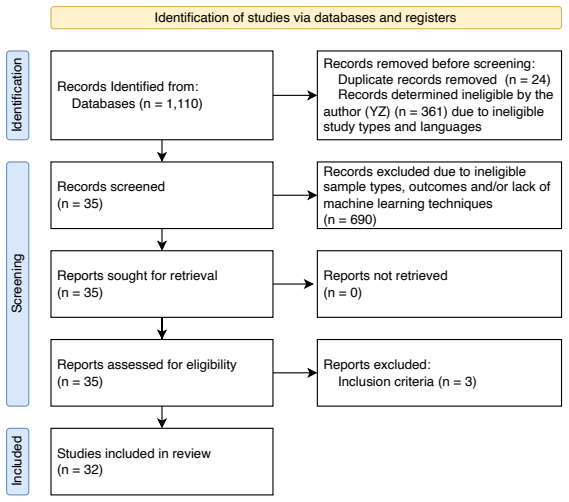
- [§2.3; §2.4; Figure 1] The corpus underlies all subsequent claims, but the screening process has a material risk of selection bias: title/abstract screening appears to have been conducted by a single author (YZ, per Figure 1), and the Google Scholar search was restricted to a title-only query. Single-reviewer screening is known to miss potentially relevant records, and a title-only search will systematically exclude studies where 'machine learning' or 'suicide' appear only in the abstract or full text. The authors should either re-screen a sample independently and report inter-rater agreement, or at least discuss these as limitations in the Discussion; the current manuscript does neither.
- [Table 1; §2.1] The inclusion criteria do not require completed data analysis, and accordingly two of the 32 included items are study protocols without results: ref. 40 (Brown et al., a study protocol) and ref. 41 (Meerwijk et al., a protocol for a mixed-method study). Including protocols in the count and in Table 1 inflates the corpus and does not provide evidence for the review's claims about predictive performance or risk factors. These items should be excluded from the synthesis or analyzed separately and clearly labeled as protocols, with the study total adjusted accordingly.
- [Table 3] Table 3 presents 'Leading factors' for each outcome–population subgroup, but many rows rest on a single citation (e.g., 'Suicide attempt — General active service members population' cites ref. 28; 'Suicide mortality — Current service members after psychiatric outpatient visits' cites ref. 13). Since the table is the principal evidence for cross-study consistency, the authors should indicate how many studies support each row and, where a row reflects only one study, say so explicitly. Without this, the visual layout of the table implies a degree of replication that the underlying studies may not provide.
minor comments (6)
- [§4] The Discussion states that 'Thompson et al. represented a pioneering effort, utilizing social media data for assessing suicide risk' (with ref. 10), but Table 1 lists Thompson et al. as using EHR data. The social-media study appears to be Zuromski et al. (ref. 23). This attribution needs correction.
- [§1] The Introduction cites the '2024 National Suicide Prevention Annual Report,' but reference 7 is titled '2023 national veteran suicide prevention annual report.' The year in the text and the reference year should be aligned.
- [Figure 1] The PRISMA flow diagram shows 'Records identified from databases (n = 1,110),' but subsection 2.3 reports two separate queries, with the second (deep-learning query) run on December 15, 2024. It is unclear whether the 1,110 includes both queries; the figure and text should be made consistent.
- [Contributorship statement] The contributorship statement mentions experimental studies by 'G.H., M.L.' and data interpretation by 'J.B.'; these initials do not correspond to any listed author (the author list includes G.L.H., J.M.B., and others with different initials). This appears to be a typographical error and should be corrected.
- [§2.4] The sentence 'The most statistically significant predictive factors ... were identified from articles and included in the tables as leading factors' does not specify the criterion used to designate a factor as 'leading' (e.g., rank order, effect size, author-reported importance). A brief operational definition would improve transparency.
- [§4] The Discussion notes that one study reported an AUC of 1.00 'which needs further clarification and explanation,' but no resolution is proposed. Since such a result is a red flag for overfitting or leakage, the authors should recommend a concrete reporting standard or explain how to interpret such values in future reviews.
Circularity Check
No significant circularity: the review synthesizes external studies and performs no derivation that reduces to its inputs.
full rationale
This paper is a scoping literature review rather than a derivation, model fit, or prediction study. It applies a PRISMA-style search and selection process to 32 externally published articles and then narratively summarizes their reported risk factors and performance metrics. There is no fitted parameter that is later renamed as a prediction, no equation in which an output is defined in terms of the target quantity, and no uniqueness claim imported from the authors' own prior work to force a modeling choice. The authors do cite a substantial number of Army STARRS and VA studies by Kessler and colleagues, but those citations are used as source material for the reviewed corpus, not as load-bearing justification for a conclusion that the cited papers themselves establish by assumption. The review's central synthesis (that depression, PTSD, prior suicidal thoughts or attempts, physical health problems, and demographics recur as risk factors, and that AUCs commonly fall near 0.80–0.85) is an aggregation of external findings; even if one disputes its accuracy or its handling of heterogeneous evidence, that is a correctness or rigor concern, not a circularity concern. The skeptic's point that the abstract says risk factors were 'consistently identified' while the text reports mixed findings for PTSD and other mental health disorders is a legitimate tension in the synthesis, but it does not make the review circular: summary claims are not equivalent by construction to the individual studies' inputs. Accordingly, the appropriate circularity finding is 0.
Assumptions & free parameters
assumptions (3)
- domain assumption The keyword search and database selection captured a representative sample of the relevant literature.
- domain assumption The included studies' reported performance metrics are comparable enough to summarize as 'reasonable predictive accuracy'.
- domain assumption Studies without completed analyses (protocols) can inform the synthesis.
Cite this review
Pith. "Pith review of Machine Learning Applications Related to Suicide in Military and Veterans: A Scoping Literature Review." pith.science (2026). https://pith.science/paper/VEYNNDDQ
@misc{pith2026250512220,
  author       = {Pith},
  title        = {Pith review of: Machine Learning Applications Related to Suicide in Military and Veterans: A Scoping Literature Review},
  year         = {2026},
  howpublished = {\url{https://pith.science/paper/VEYNNDDQ}},
  note         = {Machine review of arXiv:2505.12220}
}
read the original abstract
Suicide remains one of the main preventable causes of death among active service members and veterans. Early detection and prediction are crucial in suicide prevention. Machine learning techniques have yielded promising results in this area recently. This study aims to assess and summarize current research and provides a comprehensive review regarding the application of machine learning techniques in assessing and predicting suicidal ideation, attempts, and mortality among members of military and veteran populations. A keyword search using PubMed, IEEE, ACM, and Google Scholar was conducted, and the PRISMA protocol was adopted for relevant study selection. Thirty-two articles met the inclusion criteria. These studies consistently identified risk factors relevant to mental health issues such as depression, post-traumatic stress disorder (PTSD), suicidal ideation, prior attempts, physical health problems, and demographic characteristics. Machine learning models applied in this area have demonstrated reasonable predictive accuracy. However, additional research gaps still exist. First, many studies have overlooked metrics that distinguish between false positives and negatives, such as positive predictive value and negative predictive value, which are crucial in the context of suicide prevention policies. Second, more dedicated approaches to handling survival and longitudinal data should be explored. Lastly, most studies focused on machine learning methods, with limited discussion of their connection to clinical rationales. In summary, machine learning analyses have identified a wide range of risk factors associated with suicide in military populations. The diversity and complexity of these factors also demonstrates that effective prevention strategies must be comprehensive and flexible.
Figures

Reference graph
Works this paper leans on
-
[1]
Preventing suicides in US service members and veterans: concerns after a decade of war
Hoge CW, Castro CA. Preventing suicides in US service members and veterans: concerns after a decade of war. JAMA. 2012;308(7):671–672. doi: 10.1001/jama.2012.9955. PMID: 22893160
-
[2]
Soldier suicide rates continue to rise: military, scientists work to stem the tide
Kuehn BM. Soldier suicide rates continue to rise: military, scientists work to stem the tide. JAMA. 2009;301(11):1111, 1113. doi: 10.1001/jama.2009.342. PMID: 19293405
-
[3]
Nock MK, Stein MB, Heeringa SG, Ursano RJ, Colpe LJ, Fullerton CS, Hwang I, Naifeh JA, Sampson NA, Schoenbaum M, Zaslavsky AM, Kessler RC, Army STARRS Collaborators. Preva- lence and correlates of suicidal behavior among soldiers: results from the army study to assess risk and resilience in servicemembers (army STARRS). JAMA Psychiatry. 2014;71(5):514–522...
-
[4]
Suicide attempts in the US army during the wars in afghanistan and iraq, 2004 to 2009
Ursano RJ, Kessler RC, Stein MB, Naifeh JA, Aliaga PA, Fullerton CS, Sampson NA, Kao TC, Colpe LJ, Schoenbaum M, Cox KL, Heeringa SG, Army Study to Assess Risk and Resilience in Service- members Collaborators. Suicide attempts in the US army during the wars in afghanistan and iraq, 2004 to 2009. JAMA Psychiatry. 2015;72(9):917–926. doi: 10.1001/jamapsychi...
-
[5]
Using machine learning to predict suicide attempts in military personnel
Rozek DC, Andres WC, Smith NB, Leifker FR, Arne K, Jennings G, Dartnell N, Bryan CJ, Rudd MD. Using machine learning to predict suicide attempts in military personnel. Psychiatry Res. 2020;294: 113515. doi: 10.1016/j.psychres.2020.113515. PMID: 33113452. PMCID: PMC7719604. 14
-
[6]
Using machine learning algorithms to enhance the man- agement of suicide ideation
Colic S, Richardson J, Reilly JP, Hasey GM. Using machine learning algorithms to enhance the man- agement of suicide ideation. Conf. Proc. IEEE Eng. Med. Biol. Soc. 2018;2018:4936–4939. doi: 10.1109/EMBC.2018.8513200. PMID: 30441450
-
[7]
2023 national veteran suicide prevention annual report
V A Suicide Prevention, Office of Mental Health and Suicide Prevention. 2023 national veteran suicide prevention annual report. 2023
work page 2023
-
[8]
Unintended consequences: stigma and suicide prevention efforts
Blocker GM, Miller JA. Unintended consequences: stigma and suicide prevention efforts. Mil. Med. 2013;178(5):473. doi: 10.7205/MILMED-D-13-00056. PMID: 23756002
Show all 55 references
-
[9]
Post- deployment mental health screening: A systematic review of current evidence and future directions
Panaite V , Brown R, Henry M, Garcia A, Powell-Cope G, Vanderploeg RD, Belanger HG. Post- deployment mental health screening: A systematic review of current evidence and future directions. Adm. Policy Ment. Health. 2018;45(6):850–875. doi: 10.1007/s10488-018-0869-7. PMID: 29603055
2018 doi
-
[10]
Predicting military and veteran suicide risk: Cultural aspects
Thompson P, Bryan C, Poulin C. Predicting military and veteran suicide risk: Cultural aspects. In: Proceedings of the Workshop on Computational Linguistics and Clinical Psychology: From Linguistic Signal to Clinical Reality. 2014. p. 1–6. doi: 10.3115/v1/W14-3201
2014 doi
-
[11]
Improving suicide risk screening to identify the highest risk patients: Results from the PRImary care screening methods (PRISM) study
Bryan CJ, Allen MH, Thomsen CJ, May AM, Baker JC, Bryan AO, Harris JA, Cunningham CA, Taylor KB, Wine MD, Young J, Williams S, White K, Smith L, Lawson WC, Hope T, Russell W, Hinkson KD, Cheney T, Arne K. Improving suicide risk screening to identify the highest risk patients: ...
2021 doi
-
[12]
How well can U.S
V ogt D, Rosellini AJ, Borowski S, Street AE, O’Brien RW, Tomoyasu N. How well can U.S. military veterans’ suicidal ideation be predicted from static and change-based indicators of their psychosocial well-being as they adapt to civilian life? Soc. Psychiatry Psychiatr. Epidemi...
2024 doi
-
[13]
Predicting suicides after outpatient mental health visits in the army study to assess risk and resilience in servicemembers (army STARRS)
Kessler RC, Stein MB, Petukhova MV , Bliese P, Bossarte RM, Bromet EJ, Fullerton CS, Gilman SE, Ivany C, Lewandowski-Romps L, Millikan Bell A, Naifeh JA, Nock MK, Reis BY , Rosellini AJ, Sampson NA, Zaslavsky AM, Ursano RJ, Army STARRS Collaborators. Predicting suicides after ...
2017 doi
-
[14]
Evaluation of the recovery engagement and coordination for Health-Veterans enhanced treatment suicide risk modeling clinical program in the veterans health administration
McCarthy JF, Cooper SA, Dent KR, Eagan AE, Matarazzo BB, Hannemann CM, Reger MA, Landes SJ, Trafton JA, Schoenbaum M, Katz IR. Evaluation of the recovery engagement and coordination for Health-Veterans enhanced treatment suicide risk modeling clinical program in the veterans h...
2021 doi
-
[15]
Developing a practical suicide risk pre- diction model for targeting high-risk patients in the veterans health administration
Kessler RC, Hwang I, Hoffmire CA, McCarthy JF, Petukhova MV , Rosellini AJ, Sampson NA, Schnei- der AL, Bradley PA, Katz IR, Thompson C, Bossarte RM. Developing a practical suicide risk pre- diction model for targeting high-risk patients in the veterans health administration. ...
2017 doi
-
[16]
The veterans health admin- istration REACH VET program: Suicide predictive modeling in practice
Matarazzo BB, Eagan A, Landes SJ, Mina LK, Clark K, Gerard GR, McCarthy JF, Trafton J, Bahraini NH, Brenner LA, Keen A, Gamble SA, Lawson WC, Katz IR, Reger MA. The veterans health admin- istration REACH VET program: Suicide predictive modeling in practice. Psychiatr. Serv. 20...
2023 doi
-
[17]
The army study to assess risk and resilience in servicemembers (army STARRS): progress toward understanding suicide among soldiers
Naifeh JA, Mash HBH, Stein MB, Fullerton CS, Kessler RC, Ursano RJ. The army study to assess risk and resilience in servicemembers (army STARRS): progress toward understanding suicide among soldiers. Mol. Psychiatry. 2019;24(1):34–48. doi: 10.1038/s41380-018-0197-z. PMID: 3010...
2019 doi
-
[18]
Gender differences in machine learning models of trauma and suicidal ideation in veterans of the iraq and afghanistan wars
Gradus JL, King MW, Galatzer-Levy I, Street AE. Gender differences in machine learning models of trauma and suicidal ideation in veterans of the iraq and afghanistan wars. J. Trauma. Stress. 2017;30 (4):362–371. doi: 10.1002/jts.22210. PMID: 28741810. PMCID: PMC5735841
2017 doi
-
[19]
Machine learning based suicide ideation prediction for military personnel
Lin GM, Nagamine M, Yang SN, Tai YM, Lin C, Sato H. Machine learning based suicide ideation prediction for military personnel. IEEE J. Biomed. Health Inform. 2020;24(7):1907–1916. doi: 10.1109/JBHI.2020.2988393. PMID: 32324581
2020
-
[20]
Acoustic and language analysis of speech for suicidal ideation among US veterans
Belouali A, Gupta S, Sourirajan V , Yu J, Allen N, Alaoui A, Dutton MA, Reinhard MJ. Acoustic and language analysis of speech for suicidal ideation among US veterans. BioData Min. 2021;14(1):11. doi: 10.1186/s13040-021-00245-y. PMID: 33531048. PMCID: PMC7856815
2021 doi
-
[21]
The first year after military service: Predictors of U.S
Borowski S, Rosellini AJ, Street AE, Gradus JL, V ogt D. The first year after military service: Predictors of U.S. veterans’ suicidal ideation. Am. J. Prev. Med. 2022;63(2):233–241. doi: 10.1016/j.amepre. 2022.03.017. PMID: 35527173
2022 doi
-
[22]
A machine learning approach to iden- tification of self-harm and suicidal ideation among military and police veterans
Colic S, He JC, Richardson JD, Cyr KS, Reilly JP, Hasey GM. A machine learning approach to iden- tification of self-harm and suicidal ideation among military and police veterans. Journal of Military, Veteran and Family Health. 2022;8(1):56–67. doi: 10.3138/jmvfh-2021-0035
2022 doi
-
[23]
Detecting suicide risk among U.S
Zuromski KL, Low DM, Jones NC, Kuzma R, Kessler D, Zhou L, Kastman EK, Epstein J, Madden C, Ghosh SS, Gowel D, Nock MK. Detecting suicide risk among U.S. servicemembers and veterans: a deep learning approach using social media data. Psychol. Med. 2024;54(12):1–10. doi: 10.1017...
2024
-
[24]
Text mining the EMR for modeling and predicting suicidal behavior among US veterans of the 1991 persian gulf war
Ben-Ari A, Hammond K. Text mining the EMR for modeling and predicting suicidal behavior among US veterans of the 1991 persian gulf war. In: 2015 48th Hawaii International Conference on System Sciences. 2015. p. 3168–3175. ISBN 9781479973675. doi: 10.1109/HICSS.2015.382
1991 doi
-
[25]
Sexual assault victimization and mental health treatment, suicide attempts, and career outcomes among women in the US army
Rosellini AJ, Street AE, Ursano RJ, Chiu WT, Heeringa SG, Monahan J, Naifeh JA, Petukhova MV , Reis BY , Sampson NA, Bliese PD, Stein MB, Zaslavsky AM, Kessler RC. Sexual assault victimization and mental health treatment, suicide attempts, and career outcomes among women in th...
2017
-
[26]
Predicting suicide attempts among soldiers who deny suicidal ideation in the army study to assess risk and resilience in servicemembers (army STARRS)
Bernecker SL, Zuromski KL, Gutierrez PM, Joiner TE, King AJ, Liu H, Nock MK, Sampson NA, Za- slavsky AM, Stein MB, Ursano RJ, Kessler RC. Predicting suicide attempts among soldiers who deny suicidal ideation in the army study to assess risk and resilience in servicemembers (ar...
2019 doi
-
[27]
Zuromski KL, Bernecker SL, Gutierrez PM, Joiner TE, King AJ, Liu H, Naifeh JA, Nock MK, Samp- son NA, Zaslavsky AM, Stein MB, Ursano RJ, Kessler RC. Assessment of a risk index for suicide attempts among US army soldiers with suicide ideation: Analysis of data from the army stu...
2019
-
[28]
Pre-deployment predictors of suicide attempt during and after combat deployment: Results from the army study to assess risk and resilience in servicemembers
Zuromski KL, Bernecker SL, Chu C, Wilks CR, Gutierrez PM, Joiner TE, Liu H, Naifeh JA, Nock MK, Sampson NA, Zaslavsky AM, Stein MB, Ursano RJ, Kessler RC, Site Principal Investigators, Army liaison/consultant, Other team members. Pre-deployment predictors of suicide attempt du...
2020 doi
-
[29]
Predicting suicide at- tempts among U.S
Stanley IH, Chu C, Gildea SM, Hwang IH, King AJ, Kennedy CJ, Luedtke A, Marx BP, O’Brien R, Petukhova MV , Sampson NA, V ogt D, Stein MB, Ursano RJ, Kessler RC. Predicting suicide at- tempts among U.S. army soldiers after leaving active duty using information available before ...
2022 doi
-
[30]
Chu C, Stanley IH, Marx BP, King AJ, V ogt D, Gildea SM, Hwang IH, Sampson NA, O’Brien R, Stein MB, Ursano RJ, Kessler RC. Associations of vulnerability to stressful life events with suicide attempts after active duty among high-risk soldiers: results from the study to assess ...
2023 doi
-
[31]
A practical risk calculator for suicidal behavior among transitioning U.S
Kearns JC, Edwards ER, Finley EP, Geraci JC, Gildea SM, Goodman M, Hwang I, Kennedy CJ, King AJ, Luedtke A, Marx BP, Petukhova MV , Sampson NA, Seim RW, Stanley IH, Stein MB, Ursano RJ, Kessler RC. A practical risk calculator for suicidal behavior among transitioning U.S. army...
2023 doi
-
[32]
Deep sequential neural network models improve stratification of suicide attempt risk among US veterans
Martinez C, Levin D, Jones J, Finley PD, McMahon B, Dhaubhadel S, Cohn J, Million Veteran Pro- gram, MVP Suicide Exemplar Workgroup, Oslin DW, Kimbrel NA, Beckham JC. Deep sequential neural network models improve stratification of suicide attempt risk among US veterans. J. Am....
2023 doi
-
[33]
Predicting the risk of suicide by analyzing the text of clinical notes
Poulin C, Shiner B, Thompson P, Vepstas L, Young-Xu Y , Goertzel B, Watts B, Flashman L, McAllister T. Predicting the risk of suicide by analyzing the text of clinical notes. PLoS One. 2014;9(1):e85733. doi: 10.1371/journal.pone.0085733. PMID: 24489669. PMCID: PMC3904866
2014 doi
-
[34]
Predicting suicides after psychiatric hospitalization in US army soldiers: the army study to assess risk and resilience in servicemembers (army STARRS)
Kessler RC, Warner CH, Ivany C, Petukhova MV , Rose S, Bromet EJ, Brown M 3rd, Cai T, Colpe LJ, Cox KL, Fullerton CS, Gilman SE, Gruber MJ, Heeringa SG, Lewandowski-Romps L, Li J, Millikan- Bell AM, Naifeh JA, Nock MK, Rosellini AJ, Sampson NA, Schoenbaum M, Stein MB, Wessely ...
2015
-
[35]
Using administrative data to predict suicide after psychiatric hospitalization in the veterans health administration system
Kessler RC, Bauer MS, Bishop TM, Demler OV , Dobscha SK, Gildea SM, Goulet JL, Karras E, Kreyenbuhl J, Landes SJ, Liu H, Luedtke AR, Mair P, McAuliffe WHB, Nock M, Petukhova M, Pigeon WR, Sampson NA, Smoller JW, Weinstock LM, Bossarte RM. Using administrative data to predict s...
2020
-
[36]
Evaluation of suicide mortality among sexual minority US veterans from 2000 to 2017
Lynch KE, Gatsby E, Viernes B, Schliep KC, Whitcomb BW, Alba PR, DuVall SL, Blosnich JR. Evaluation of suicide mortality among sexual minority US veterans from 2000 to 2017. JAMA Netw Open. 2020;3(12):e2031357. doi: 10.1001/jamanetworkopen.2020.31357. PMID: 33369662. PMCID: PMC7770555
-
[37]
Leveraging natural language processing to improve electronic health record suicide risk prediction for veterans health administration users
Levis M, Levy J, Dent KR, Dufort V , Gobbel GT, Watts BV , Shiner B. Leveraging natural language processing to improve electronic health record suicide risk prediction for veterans health administration users. J. Clin. Psychiatry. 2023;84(4). doi: 10.4088/JCP.22m14568. PMID: 3...
2023 doi
-
[38]
High dimensional predictions of suicide risk in 4.2 million US veterans using ensemble transfer learning
Dhaubhadel S, Ganguly K, Ribeiro RM, Cohn JD, Hyman JM, Hengartner NW, Kolade B, Singley A, Bhattacharya T, Finley P, Levin D, Thelen H, Cho K, Costa L, Ho YL, Justice AC, Pestian J, Santel D, Zamora-Resendiz R, Crivelli S, Tamang S, Martins S, Trafton J, Oslin DW, Beckham JC,...
2024
-
[39]
Automatic prediction of suicidal risk in military couples using multimodal interaction cues from couples conversations
Chakravarthula SN, Nasir M, Tseng SY , Li H, Park TJ, Baucom B, Bryan CJ, Narayanan S, Georgiou P. Automatic prediction of suicidal risk in military couples using multimodal interaction cues from couples conversations. In: ICASSP 2020 - 2020 IEEE International Conference on Ac...
2020
-
[40]
Digital phenotyping to improve prediction of suicidal urges in treatment: Study protocol
Brown LA, Taylor DJ, Bryan C, Wiley JF, Pruiksma K, Khazem L, Baker JC, Young J, O’Leary K. Digital phenotyping to improve prediction of suicidal urges in treatment: Study protocol. Aggress. Violent Behav. 2022;66(101733):101733. doi: 10.1016/j.avb.2022.101733
2022
-
[41]
Suicide theory-guided nat- ural language processing of clinical progress notes to improve prediction of veteran suicide risk: proto- col for a mixed-method study
Meerwijk EL, Tamang SR, Finlay AK, Ilgen MA, Reeves RM, Harris AHS. Suicide theory-guided nat- ural language processing of clinical progress notes to improve prediction of veteran suicide risk: proto- col for a mixed-method study. BMJ Open. 2022;12(8):e065088. doi: 10.1136/bmj...
2022 doi
-
[42]
6 facts about the U.S
Parker K. 6 facts about the U.S. military and its changing demographics. 2017
2017
-
[43]
National violent death reporting system: Web coding manual: Version 6.0 [2022-01-18]
CDC. National violent death reporting system: Web coding manual: Version 6.0 [2022-01-18]. 2022
2022
-
[44]
Binge drinking among female veterans affairs patients: prevalence and associated risks
Bradley KA, Bush KR, Davis TM, Dobie DJ, Burman ML, Rutter CM, Kivlahan DR. Binge drinking among female veterans affairs patients: prevalence and associated risks. Psychol. Addict. Behav. 2001;15(4):297–305. doi: 10.1037//0893-164x.15.4.297. PMID: 11767260
2001 doi
-
[45]
Sex/Gender differences in the Time- Course for the development of substance use disorder: A focus on the telescoping effect
Towers EB, Williams IL, Qillawala EI, Rissman EF, Lynch WJ. Sex/Gender differences in the Time- Course for the development of substance use disorder: A focus on the telescoping effect. Pharma- col. Rev. 2023;75(2):217–249. doi: 10.1124/pharmrev.121.000361. PMID: 36781217. PMCI...
2023 doi
-
[46]
Suicidal ideation and behaviours after traumatic brain injury: A systematic review
Bahraini NH, Simpson GK, Brenner LA, Hoffberg AS, Schneider AL. Suicidal ideation and behaviours after traumatic brain injury: A systematic review. Brain Impair. 2013;14(1):92–112. doi: 10.1017/ BrImp.2013.11
2013
-
[47]
Posttraumatic stress disorder and suicide risk among veterans: a literature review
Pompili M, Sher L, Serafini G, Forte A, Innamorati M, Dominici G, Lester D, Amore M, Girardi P. Posttraumatic stress disorder and suicide risk among veterans: a literature review. J. Nerv. Ment. Dis. 2013;201(9):802–812. doi: 10.1097/NMD.0b013e3182a21458. PMID: 23995037. 18
2013 doi
-
[48]
Posttraumatic stress disorder as a risk factor for suicidal ideation in iraq and afghanistan war veterans
Jakupcak M, Cook J, Imel Z, Fontana A, Rosenheck R, McFall M. Posttraumatic stress disorder as a risk factor for suicidal ideation in iraq and afghanistan war veterans. J. Trauma. Stress. 2009;22(4): 303–306. doi: 10.1002/jts.20423. PMID: 19626682
2009 doi
-
[49]
Childhood adversities and suicide attempts: A retrospective study
Hardt J, Sidor A, Nickel R, Kappis B, Petrak P, Egle UT. Childhood adversities and suicide attempts: A retrospective study. J. Fam. Violence. 2008;23(8):713–718. doi: 10.1007/s10896-008-9196-1
2008 doi
-
[50]
Predictors of suicidal ideation, suicide attempts, and self-harm without lethal intent in a community corrections sample
Gunter TD, Chibnall JT, Antoniak SK, Philibert RA, Hollenbeck N. Predictors of suicidal ideation, suicide attempts, and self-harm without lethal intent in a community corrections sample. J. Crim. Justice. 2011;39(3):238–245. doi: 10.1016/j.jcrimjus.2011.02.005
2011 doi
-
[51]
Personality traits as prospective predictors of suicide attempts
Yen S, Shea MT, Sanislow CA, Skodol AE, Grilo CM, Edelen MO, Stout RL, Morey LC, Za- narini MC, Markowitz JC, McGlashan TH, Daversa MT, Gunderson JG. Personality traits as prospective predictors of suicide attempts. Acta Psychiatr. Scand. 2009;120(3):222–229. doi: 10.1111/j.16...
2009
-
[52]
Role of machine learning algorithms in suicide risk prediction: a systematic review-meta analysis of clinical studies
Ehtemam H, Sadeghi Esfahlani S, Sanaei A, Ghaemi MM, Hajesmaeel-Gohari S, Rahimisadegh R, Bahaadinbeigy K, Ghasemian F, Shirvani H. Role of machine learning algorithms in suicide risk prediction: a systematic review-meta analysis of clinical studies. BMC Med. Inform. Decis. Ma...
2024 doi
-
[53]
The psychology of suicidal behaviour
O’Connor RC, Nock MK. The psychology of suicidal behaviour. Lancet Psychiatry. 2014;1(1):73–85. doi: 10.1016/S2215-0366(14)70222-6. PMID: 26360404
2014 doi
-
[54]
Linguistic variables and gender differences within a messenger-based psychosocial chat counseling service for children and adolescents: Cross-sectional study
Efe Z, Baldofski S, Kohls E, Eckert M, Saee S, Thomas J, Wundrack R, Rummel-Kluge C. Linguistic variables and gender differences within a messenger-based psychosocial chat counseling service for children and adolescents: Cross-sectional study. JMIR Form. Res. 2024;8:e51795. do...
2024
-
[55]
Translating promise into practice: a review of machine learning in suicide research and prevention
Kirtley OJ, van Mens K, Hoogendoorn M, Kapur N, de Beurs D. Translating promise into practice: a review of machine learning in suicide research and prevention. Lancet Psychiatry. 2022;9(3):243–252. doi: 10.1016/S2215-0366(21)00254-6. PMID: 35183281. 19
2022 doi
Reviewed August 15, 2026 · model on record in the stance chip above.
Discussion (0). Continue with ORCID to comment.