REVIEW 4 major objections 4 minor 2 cited by
Entanglement Request Scheduling in Quantum Networks Using Deep Q-Network
T0 review · 4 major / 4 minor · reviewed 2026-08-15 · deepseek-v4-flash
Pith's one-line read A Deep Q-Network scheduler can balance delay and fairness for entanglement requests in quantum repeater networks, matching Greedy's low delay while improving fairness.
desk verdict Useful network-simulation framework, but the DQN reward as written makes the fairness coefficient inert, so the claimed delay–fairness trade-off is not implemented. read the letter →
The pith
A machine-rendered reading of the paper's core claim, the machinery that carries it, and where it could break.
The reading
What carries the argument
The central object is a Double DQN scheduler that turns request scheduling into sequential action selection: at each step it computes a Q-value for every pending request from a binary matrix encoding source and destination nodes, then serves the request with the highest value. The reward is a weighted sum of a normalized delay-reduction term, $r_1 = (\min_d - \mathrm{cur}_d)/\max_d$, and a fairness term derived from the change in a fairness index; the coefficients $c_d$ and $c_j$ set the bias. This reward design is what lets one architecture express both delay-priority and fairness-priority schedulers.
What would settle it
Re-run the medium-load simulation on the same ten-node topology but with link distances drawn from a spread of, say, tenfold; if the delay-biased DQN's fairness gain over Greedy falls below the reported normalized 14%, the homogeneous-link assumption is load-bearing.
Extended reading notes
Core claim
The scheduler picks pending entanglement requests one at a time, scoring each with a Q-value and serving the highest-scoring request until all are processed. With a delay bias (delay coefficient 0.9, fairness coefficient 0.1), the DQN's completion-delay distribution is close to Greedy's, yet its fairness index is 0.4893 in medium load and 0.5323 in low load, versus Greedy's 0.4704 and 0.5173, a normalized gain of at least 14%. With a fairness bias (delay 0.15, fairness 0.85), the DQN reaches a fairness index of 0.5927 versus Proportional fair's 0.5778, a normalized gain of 12.8%, while its delays remain similar to Proportional fair's. The authors take this as evidence that a DQN trained on simulation-derived lookup tables can traverse the delay-fairness trade-off in quantum request scheduling.
Load-bearing premise
The training reward and the reported gains depend on the network model's assumption that all links are homogeneous (same distance and quality) and that requests are processed sequentially; a real repeater network with heterogeneous links or parallel entanglement attempts may not preserve them.
Editorial extensions
If this is right
- Network operators can pre-train DQN schedulers with different reward coefficients and pick among them as traffic or application priorities change, since the same architecture covers both delay- and fairness-biased policies.
- On homogeneous ten-node topologies, the delay-biased DQN matches Greedy's delay behavior while improving fairness by a normalized margin of at least 14%.
- The fairness-biased DQN improves on Proportional fair's fairness index by a normalized 12.8% at similar delay levels, showing that the approach does not simply trade all delay for fairness.
- The time-slot simulator with queuing and dropping gives a testbed for other reinforcement-learning schedulers, since it captures network behaviors that pure quantum simulators do not.
Reading between the lines
- The reward decomposition into delay and fairness terms is not tied to DQN; applying the same reward with other reinforcement-learning algorithms such as policy-gradient methods would test whether the scheduler's flexibility is a property of the reward or of the specific Q-network.
- Replacing the fixed-size binary state matrix with a graph-based encoder could let a single agent generalize across topologies and arrival counts, which the current approach handles by training separate DQNs.
- The homogeneous-link assumption means the reported gains are likely an upper bound; on real hardware, adding link-distance and quality features to the state could recover some of the advantage.
- Because the reward includes a fairness index computed over the whole request set, the method may be sensitive to the arrival process; testing with bursty or non-uniform arrivals would show how robust the trained policies are.
Signed reviews
Editorial analysis
A structured set of objections, weighed in public.
Referee Report
Summary. The paper proposes a Deep Q-Network (DQN) based scheduler for entanglement requests in quantum repeater networks. The authors build a hybrid simulation framework that uses NetSquid to generate lookup tables for entanglement fidelity and execution time, and a discrete-time network simulator that queues, executes, and drops requests. The DQN is trained to select, at each step, the pending request that maximizes a reward combining a delay term and a fairness term. The scheduler is compared against Greedy, Proportional fair, and FIFO baselines under a Watts-Strogatz topology with 10 nodes and random request arrivals, reporting delay CDFs and Jain's fairness indices. The central claim is that the DQN can trade off delay and fairness, achieving lower or comparable delay with higher fairness than Greedy in a delay-biased configuration, and higher fairness than Proportional fair in a fairness-biased configuration.
Significance. If the claims hold, the paper makes a useful contribution by bridging quantum-level fidelity simulations (NetSquid) with network-layer scheduling simulation, and by demonstrating a learning-based scheduler that can balance QoS objectives in entanglement request scheduling. The inclusion of queuing, pending, and dropping behaviors, and the use of random topologies, are strengths. However, the central quantitative claims currently rest on an ill-defined reward formula and an incomplete evaluation methodology; the significance of the work will depend on whether those issues can be resolved.
major comments (4)
- [§III-A3, Eqs. (8)-(10)] As written, the fairness reward r2 is action-independent: Eq. (9) defines r2 = c_j − 1, which is a constant for a given coefficient c_j. In Q-learning, adding a constant to every reward in a state shifts all Q-values equally and cannot change the argmax over actions. Therefore varying c_j cannot make the DQN prefer fairer request sets, and the claimed delay-fairness trade-off is not implemented by the stated equations. The conclusion in Section V that the 'reward mechanism learns from the execution time' and the Abstract's 'balancing delay and fairness' are not supported by the equations as printed. If the intent was r2 = J − 1 for some online Jain index, the symbol c_j is overloaded and the paper does not define how J is computed during stepwise decisions. This needs to be corrected and the experiments repeated with a properly defined fairness reward.
- [§III-A3, Eq. (8)] The reward r1 uses min_d and max_d, which the text states are 'calculated using the execution time of each request after all the requests are executed.' If the reward for a stepwise decision depends on the full future schedule, the training signal has a look-ahead bias: the agent is effectively told the outcome of the entire episode, which is not available during deployment. The authors should clarify whether rewards are computed causally at each decision step (e.g., from statistics of the current queue only) or whether this is an offline, non-causal training procedure; in the latter case, the learned policy's real-time applicability is not established.
- [§IV-B, Tables III and IV] The normalized gain is defined as (J_DQN − J_baseline)/(J_max − J_min), but J_max and J_min are never defined. Without these values, the reported gains of 'at least 14%' and '12.8%' are not interpretable. If, for example, J_max and J_min are taken as 1 and 0, the actual gains shown in Tables III and IV are roughly 2 to 4 percentage points, which is far smaller than the headline percentages. The authors must specify how J_max and J_min are chosen and report the unnormalized differences as well.
- [§IV-A and Tables III-IV] The simulation results are reported as single numbers with no error bars, confidence intervals, or number of independent runs. Delay CDFs and Jain's indices are stochastic quantities, and the observed differences between DQN and the baselines are small (e.g., 0.4893 vs. 0.4704 in Table III). Without multiple seeds or a statistical significance test, the claim that the DQN 'achieves higher fairness' than Greedy or Proportional fair is not firmly supported. The authors should repeat the simulations with several random seeds and report mean and variance.
minor comments (4)
- [§III-B and §III-C] The Greedy and Proportional fair baselines are described only loosely; in particular, Algorithm 2 does not specify how the 'likelihood of being chosen' is computed from execution time or distance. A precise definition is needed for the comparisons to be reproducible.
- [§IV-A, Table II] The topology parameter is labeled 'Watts-Strogetz' (typo for Watts-Strogatz), and the paper does not state whether the same graph instance is used across all experiments or whether different graphs are sampled; this should be clarified.
- [§III-A] The DQN training details are incomplete: network architecture, learning rate, replay buffer size, target network update frequency, and exploration schedule are not reported. These are needed for reproducibility, especially since the paper claims stable training with Double DQN.
- [§II-C] The assumption that requests are processed sequentially is stated but not justified, and its effect on the generality of the scheduling conclusions is not discussed. The paper would be stronger if it either justified this assumption for the target quantum network scenarios or acknowledged it as a known limitation in the conclusion.
Circularity Check
Fairness evaluation is the fairness reward: the reported Jain-index gain reduces to the training objective.
-
fitted input called prediction
[Section III-A3, Eqs. (8)-(10); Section IV-B, Table IV and text following Fig. 7]
"r2 =cj− 1 (9) r =cd×r1 +cj×r2 (10) ... The parameters cd and cj represent the coefficients of the reward from delay time and Jain’s index, respectively. ... In this case, the normalized gain in fairness of the DQN approach over the Proportional fair method, (JDQN−JP F air)/(Jmax−Jmin), is 12.8%, as shown in Table IV."
The reward that the DQN is trained to maximize includes the Jain fairness term (Eq. 9, intended as J−1 given the surrounding text) and the evaluation in Section IV reports exactly that same Jain index J. Setting cj=0.85 'biased towards fairness' and then measuring a 12.8% gain in J over Proportional fair is an in-sample consequence of the objective: the optimizer is being asked to increase J, and the evaluation confirms that it did. The flexibility claim ('changing the reward changes the fairness') is therefore a restatement of the reward definition rather than an external validation. The delay-time comparison retains some independent content because it is not the sole reward term, but the central fairness conclusion is forced by construction.
full rationale
The paper is self-contained on the simulation side: the NetSquid lookup tables are external benchmarks, and no load-bearing self-citation or uniqueness theorem is used. The only substantial circularity is the identity between the fairness component of the DQN reward and the fairness metric used in evaluation. This is not a full derivation-level tautology, because the DQN must still learn a policy and the delay results are not purely reward-identical, but the 'fairness-biased' experiment reduces to checking that the optimizer follows its objective. A separate, non-circular caveat: if Eq. (9) is read literally as r2=c_j−1 rather than J−1, the fairness term is an action-independent constant and cannot drive the reported trade-off; that would be a correctness inconsistency, not a circularity, and is not the basis for the score.
Assumptions & free parameters
free parameters (7)
- Reward coefficients cd, cj =
cd=0.9/cj=0.1 and cd=0.15/cj=0.85
- Time slot interval =
2x10^5 ns and 5x10^5 ns
- Maximum execution time Em =
100,000 ns
- Arrival request distribution U[a,b] =
U[0,5] per time slot
- Watts-Strogatz graph parameters =
V=10, K=3, p=0.6
- Quantum hardware parameters =
Source fidelity 0.9, memory depolarizing rate 6000 Hz, gate dephasing rate 5000 Hz
- Fidelity success threshold =
0.5
assumptions (5)
- domain assumption Links between nodes are homogeneous in distance and quality
- domain assumption Entanglement success is determined by a fidelity threshold of 0.5
- domain assumption Requests are processed sequentially with a limited number of quantum memories
- domain assumption NetSquid simulations faithfully represent quantum behavior for the lookup tables
- ad hoc to paper Reward normalization uses min and max delay computed after all requests are executed
Cite this review
Pith. "Pith review of Entanglement Request Scheduling in Quantum Networks Using Deep Q-Network." pith.science (2026). https://pith.science/paper/OVOCR75Q
@misc{pith2026250512461,
  author       = {Pith},
  title        = {Pith review of: Entanglement Request Scheduling in Quantum Networks Using Deep Q-Network},
  year         = {2026},
  howpublished = {\url{https://pith.science/paper/OVOCR75Q}},
  note         = {Machine review of arXiv:2505.12461}
}
read the original abstract
In this paper, a novel Deep Q-Network (DQN) based scheduling method to optimize delay time and fairness among entanglement requests in quantum repeater networks is proposed. The scheduling of requests determines which pairs of end nodes should be entangled during the current time slot, while other pairs are placed in a queue for future slots. However, existing research on quantum networking often relies on simple statistical models to capture the behavior of quantum hardware, such as the failure rate of establishing entanglement. Moreover, current quantum simulators do not support network behaviors, including handling, pending, and dropping requests. To bridge the gap between quantum deployments and network behaviors, in this paper a dynamic network model is presented, encompassing quantum simulations, random topologies, and user modeling. The DQN based scheduling scheme allows us to balance the conflicting objectives of minimizing delay time and maximizing fairness among these entanglement requests. The proposed technique was evaluated using simulations, with results showing that the proposed DQN achieves higher performance compared to Greedy, Proportional fair and FIFO scheduling schemes.
Figures


Figures from the paper (4 more)


Forward citations
Cited by 2 Pith papers
-
Programmable Quantum Matter: Heralding Large Cluster States in Driven Inhomogeneous Spin Ensembles
A single SAFE-GRAPE-optimized global strain pulse is shown by simulation to give O(1) control of inhomogeneous SiV ensembles, with more robust dynamical decoupling and O(10^2 to 10^4) more usable heralded entanglement...
-
Scheduling Concurrent Entanglement Requests in Quantum Networks
PPO-based scheduling balances low delay and high success rates better than classical methods in simulations of multi-channel quantum entanglement distribution.
Reference graph
Works this paper leans on
-
[1]
Delay Time for Each Request: Given the assumption of a limited number of quantum memories, entanglement requests are queued for resource allocation to establish entanglement between source and destination nodes. If the request is not dropped due to exceeding the maximum execution time, the delay time for this request is calculated by subtracting the time ...
-
[2]
(4) The range of Jain’s fairness index J is (0, 1)
Jain’s Fairness Index for the Generated Request Set: The Jain’s fairness index, J, for the delay time d in each request (d1,d 2,...,d n) is calculated as J(d1,d 2,...,d n) = (Pn i=1di)2 nPn i=1d2 i . (4) The range of Jain’s fairness index J is (0, 1). A higher index value indicates that delay time for each request is closer to each other, while a lower va...
-
[3]
State: A binary matrix D of size k× 2|v| is used to represent the source and destination nodes of incoming entanglement requests for the input state, where k is the number of requests in the arrival request set: D = vs1 vd1 vs2 vd2 ... ... vsk vdk . (5) v is a binary vector v = [{vi;i = 1,..., |V|}] represent- ing the positions of the source ...
-
[4]
Action: A discrete action space is utilized in which the model is trained to select the pending request with the highest score at each step until all requests are processed. At each step t, the DQN scheduler selects the action a(t) = argmaxi r(t) i , (7) corresponding to the highest reward r(t) among all pending requests. The reward set, which contains th...
-
[5]
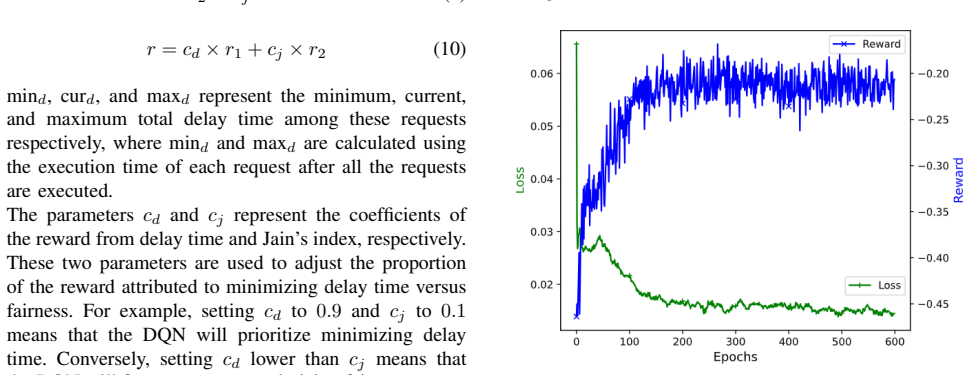
Reward: The reward is assigned to balance the delay time, and fairness among these requests. The specific reward is designed as follows: r1 = (mind− curd)/maxd (8) r2 =cj− 1 (9) r =cd×r1 +cj×r2 (10) mind, cur d, and max d represent the minimum, current, and maximum total delay time among these requests respectively, where min d and max d are calculated us...
-
[6]
Towards large-scale quantum networks,
W. Kozlowski and S. Wehner, “Towards large-scale quantum networks,” in Proceedings of the sixth annual ACM international conference on nanoscale computing and communication , 2019, pp. 1–7
work page 2019
-
[7]
Path selection for quantum repeater networks,
R. Van Meter, T. Satoh, T. D. Ladd, W. J. Munro, and K. Nemoto, “Path selection for quantum repeater networks,” Networking Science , vol. 3, pp. 82–95, 2013
work page 2013
-
[8]
Towards a global quantum network,
C. Simon, “Towards a global quantum network,” Nature Photonics , vol. 11, no. 11, pp. 678–680, 2017
work page 2017
Show all 20 references
-
[9]
Quantum cryptography: Public key distribution and coin tossing,
C. H. Bennett and G. Brassard, “Quantum cryptography: Public key distribution and coin tossing,” Theoretical computer science , vol. 560, pp. 7–11, 2014
2014
-
[10]
Quantum internet: networking challenges in distributed quantum computing,
A. S. Cacciapuoti, M. Caleffi, F. Tafuri, F. S. Cataliotti, S. Gherardini, and G. Bianchi, “Quantum internet: networking challenges in distributed quantum computing,” IEEE Network, vol. 34, no. 1, pp. 137–143, 2019
2019
-
[11]
Dis- tributed quantum sensing in a continuous-variable entangled network,
X. Guo, C. R. Breum, J. Borregaard, S. Izumi, M. V . Larsen, T. Gehring, M. Christandl, J. S. Neergaard-Nielsen, and U. L. Andersen, “Dis- tributed quantum sensing in a continuous-variable entangled network,” Nature Physics, vol. 16, no. 3, pp. 281–284, 2020
2020
-
[12]
Entanglement-based quantum communication over 144 km,
R. Ursin, F. Tiefenbacher, T. Schmitt-Manderbach, H. Weier, T. Scheidl, M. Lindenthal, B. Blauensteiner, T. Jennewein, J. Perdigues, P. Trojek et al. , “Entanglement-based quantum communication over 144 km,” Nature physics, vol. 3, no. 7, pp. 481–486, 2007
2007
-
[13]
M. A. Nielsen and I. L. Chuang, Quantum computation and quantum information: 10th Anniversary Edition . Cambridge University Press, 2010
2010
-
[14]
System design for a long-line quantum repeater,
R. Van Meter, T. D. Ladd, W. J. Munro, and K. Nemoto, “System design for a long-line quantum repeater,” IEEE/ACM Transactions On Networking, vol. 17, no. 3, pp. 1002–1013, 2008
2008
-
[15]
Dqra: Deep quantum routing agent for entanglement routing in quantum networks,
L. Le and T. N. Nguyen, “Dqra: Deep quantum routing agent for entanglement routing in quantum networks,” IEEE Transactions on Quantum Engineering , vol. 3, pp. 1–12, 2022
2022
-
[16]
Request scheduling in quan- tum networks,
C. Cicconetti, M. Conti, and A. Passarella, “Request scheduling in quan- tum networks,” IEEE Transactions on Quantum Engineering , vol. 2, pp. 2–17, 2021
2021
-
[17]
Netsquid, a network simulator for quantum information using discrete events,
T. Coopmans, R. Knegjens, A. Dahlberg, D. Maier, L. Nijsten, J. de Oliveira Filho, M. Papendrecht, J. Rabbie, F. Rozp˛ edek, M. Skrzypczyk et al. , “Netsquid, a network simulator for quantum information using discrete events,” Communications Physics , vol. 4, no. 1, p. 164, 2021
2021
-
[18]
Van Meter, Quantum networking
R. Van Meter, Quantum networking . John Wiley & Sons, 2014
2014
-
[19]
Designing a quantum network protocol,
W. Kozlowski, A. Dahlberg, and S. Wehner, “Designing a quantum network protocol,” in Proceedings of the 16th international conference on emerging networking experiments and technologies , 2020, pp. 1–16
2020
-
[20]
Collective dynamics of ‘small- world’networks,
D. J. Watts and S. H. Strogatz, “Collective dynamics of ‘small- world’networks,” nature, vol. 393, no. 6684, pp. 440–442, 1998
1998
Reviewed August 15, 2026 · model on record in the stance chip above.
Discussion (0). Continue with ORCID to comment.