REVIEW 3 major objections 6 minor 61 references
Framework of Voting Prediction of Parliament Members
T0 review · 3 major / 6 minor · reviewed 2026-08-15 · deepseek-v4-flash
Pith's one-line read A data-driven framework trained on more than five million parliamentary roll-call records predicts individual votes with up to 85 percent accuracy and bill outcomes with up to 84 percent accuracy across five countries.
desk verdict Useful multi-country voting dataset, but the predictive accuracy claims are unproven because no trivial baseline is reported; for US bills the model exactly matches always predicting 'pass'. read the letter →
The pith
A machine-rendered reading of the paper's core claim, the machinery that carries it, and where it could break.
The reading
What carries the argument
The machinery is the VPF pipeline: web crawlers and APIs feed raw parliamentary data into a unified schema; parsers enrich it with features; and a multi-class classifier turns those features into per-member vote predictions, with a gradient-boosted tree model performing best in every country tested. Three engineered features carry much of the predictive load: political affiliation, indicating whether the member's party is part of the governing coalition; importance rank, a numeric seniority score derived from the member's parliamentary position; and Opinion on Subject, the count of references to a bill's subject in that member's meeting protocols. Bill text enters through pre-trained embeddings, and SHAP values are used to attribute each prediction to these features.
What would settle it
Check the Israeli dataset's protocol references used for the Opinion on Subject feature and recompute the 85.2 percent accuracy with only references dated strictly before each vote; if accuracy drops noticeably, the time-series split is leaking post-vote information. A simpler first look is to verify whether any protocol date in the feature table is later than the corresponding vote date.
Extended reading notes
Core claim
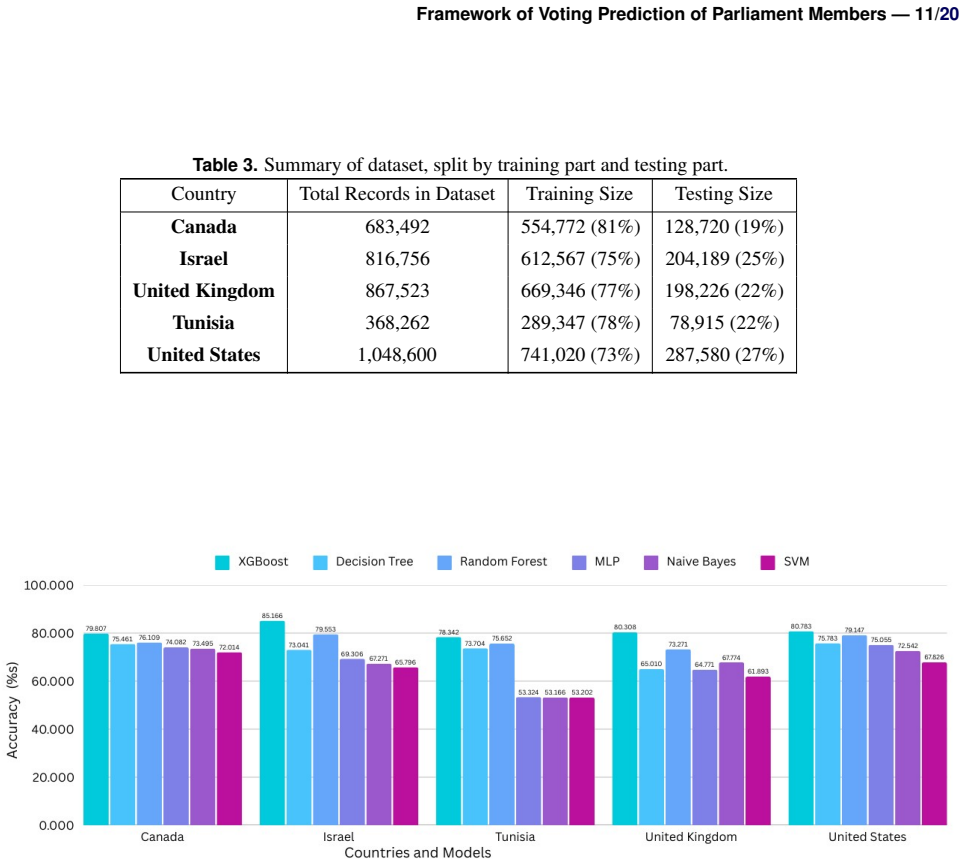
The paper's central claim is that a single, largely generic framework can forecast individual parliamentarians' votes and full-bill outcomes from open parliamentary data alone. Using time-series splits, the best model reaches 79.8 percent accuracy in Canada, 85.2 percent in Israel, 78.3 percent in Tunisia, 80.3 percent in the United Kingdom, and 80.8 percent in the United States; aggregating vote predictions to bills gives 82 to 84 percent accuracy across those countries. VPF rests on a small set of features, including coalition affiliation, parliamentary position rank, counts of how often a legislator has referenced a bill's subject in meeting protocols, and embeddings of bill text, suggesting that most of the signal comes from party alignment and bill content rather than from hand-built country-specific rules.
Load-bearing premise
The evaluation assumes the split between training and test periods is genuinely out-of-sample; if the feature that counts how often a bill's subject appears in meeting protocols includes meetings held after the vote, the model could be peeking at the future and the reported accuracy would not be a true forecast.
Editorial extensions
If this is right
- Legislative staff could use VPF to screen bills before floor votes, prioritizing those predicted to pass and reworking or dropping those predicted to fail.
- Watchdog groups could use VPF's false-negative cases to flag members voting against their party line, such as the Canadian carbon-tax example discussed in the paper.
- The unified schema makes cross-country comparison feasible, so a researcher could compare coalition discipline or issue-driven voting across the five parliaments with the same pipeline.
- If the open-source release works as stated, anyone can adapt the parsers and features to a new parliament instead of building collection tooling from scratch.
- Feature-importance results suggest voting drivers differ by country, with party and coalition shape in Canada and Israel and individual voting history mattering more in the United Kingdom and the United States.
Reading between the lines
- Beyond the paper's own claims, a strict temporal audit would be the cleanest test: recompute accuracy using only protocol references dated before the vote, because the current feature definition does not specify that the references must precede the vote.
- A second extension the authors do not develop is calibration: reporting predicted probabilities for each bill would let users set a threshold for 'likely to pass' and test whether the 82 to 84 percent bill accuracy reflects well-separated probabilities or just a good ranking.
- A third extension is transfer learning across parliaments: training the feature pipeline on one country and testing on another would show whether coalition-affiliation and bill-embedding features capture general legislative behavior or only country-specific party discipline.
Signed reviews
Editorial analysis
A structured set of objections, weighed in public.
Referee Report
Summary. The paper introduces the Voting Prediction Framework (VPF), a generic pipeline that collects parliamentary data from five countries (Canada, Israel, Tunisia, the UK, and the US), enriches it with features such as political affiliation, importance rank, protocol-based opinion signals, and bill embeddings, and trains machine-learning classifiers (with XGBoost performing best) to predict individual legislator votes and overall bill outcomes. The authors report vote-level accuracies between 78% and 85% and bill-level accuracies between 82% and 84%, and they use SHAP values to interpret feature importance and discuss anomalous false predictions. The central claim is that VPF provides accurate, cross-country voting prediction and can help prioritize legislation.
Significance. A working multi-country framework for forecasting parliamentary votes would be genuinely valuable for transparency, political analysis, and legislative decision-making, and the paper's attempt to unify heterogeneous parliamentary data into a common schema is a useful direction. The scale of the collected data and the inclusion of temporal splits are also positive features. However, the significance is conditional: the evaluation does not demonstrate that the reported accuracies exceed trivial baselines, and for the US bill-level result the reported accuracy exactly equals the majority-class rule. Potential temporal leakage in a key feature and unexplained dataset inconsistencies further weaken the empirical contribution. If the authors can add baselines, fix the leakage and data issues, and show robust gains over naive rules, the framework could be a meaningful contribution.
major comments (3)
- [Section 5, Tables 4 and S6] The US bill-level accuracy of 82.781% is exactly equal to always predicting the majority class, since 250 of the 302 test bills actually passed (250/302 = 0.82781). The manuscript provides no comparison against majority-class, party-line, or past-vote baselines anywhere in the evaluation, so the headline claim that VPF 'achieves up to 84% accuracy in predicting overall bill outcomes' is not evidence of predictive skill for the largest, most carefully curated dataset. The authors must add trivial baselines and statistical significance tests for all countries before the claimed predictive value can be assessed.
- [Section 3.2, 'Opinion on Subject' feature] The 'Opinion on Subject' feature counts references to a bill's subject in meeting protocols without specifying whether those protocols predate the vote. Because the evaluation uses chronological splits, any post-vote protocol content in the test set would leak future information into the model, making the reported test accuracy not a genuine forecast. The manuscript must either document that all protocol references are time-constrained to occur before the vote date or the reported numbers must be treated as corrupted by leakage.
- [Tables 1 and 3; Section 4.4] The dataset sizes are inconsistent across the paper: Table 1 reports 273,948 UK voting records and 2,850,296 US records, while Table 3 reports 867,523 UK records and 1,048,600 US records, with no explanation of the reconciliation. Additionally, Section 4.4 sets the UK training cutoff at 'before August 2026,' which is after the manuscript's 18 May 2025 submission date and is impossible; this also contradicts the 77%-23% training-test split reported in Table 3. These issues prevent reproducibility and undermine confidence in the reported evaluation pipeline.
minor comments (6)
- [Abstract and Introduction] The abstract and introduction use 'precision' when reporting accuracy figures (e.g., 'up to 85% precision in predicting individual votes'); precision and accuracy are distinct metrics and should be labeled correctly.
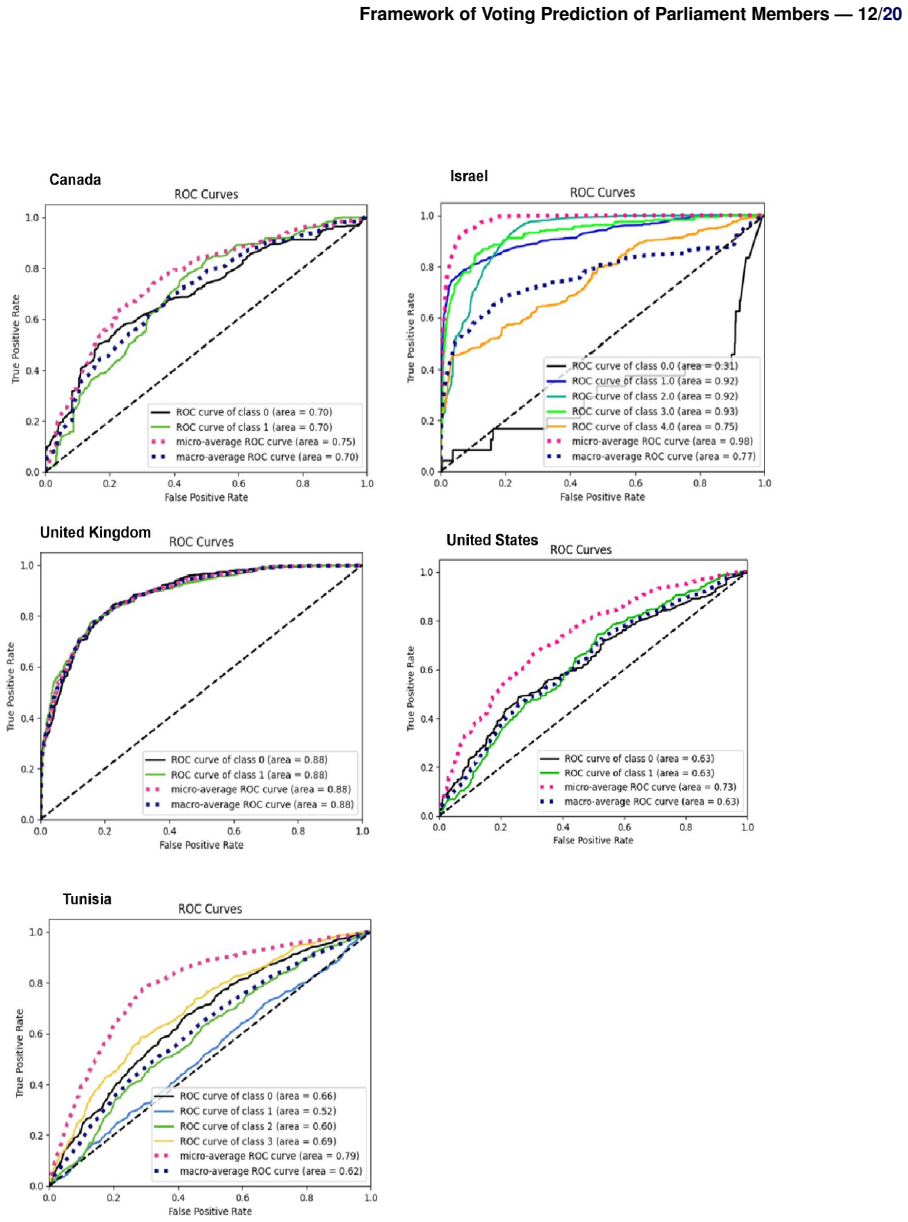
- [Figure 4 caption] The caption reads 'class 0 = Yes; class 0 = No; class 2 = Abstention,' which should likely be 'class 0 = Yes; class 1 = No; class 2 = Abstention.'
- [Section 5 opening] The text says 'more than 2.8 million protocols over 19 years from the US parliament,' but Table 1 (and the surrounding context) refers to voting records, not protocols; this appears to be a typo.
- [Section 4.4] The UK data description states 'over 850,000 voting records' while Table 1 reports 273,948 records; the discrepancy should be resolved or explicitly explained.
- [Section 6] The sentence 'Random Forest perform well but outperform XGBoost' appears to say the opposite of the reported results; it should read 'but do not outperform XGBoost.'
- [Section 7 and Availability] The paper repeatedly states the framework 'will be open source' but provides no code, data, or repository link; this claim is not verifiable from the manuscript and should be substantiated.
Circularity Check
Vote-prediction features include each vote's own aggregate totals, making part of the reported accuracy self-definitional.
-
self definitional
[Section 3.2 Data Analysis; Table 2 Generic Data Votes Schema; Table S4 Enriched Dataset Schema]
"Table 2: "Total For — Number of members who voted for the proposal; Total Against — Number of members who voted against the proposal; ... Vote Result — Kind of vote (1-for, 2-against, 3-abstain, 4-did not vote)". Section 3.2: "The features used in this predictive model include a wide range of contextual information ... (the schema can be found in Table S4).""
The two 'Total' features are per-vote sums of the exact label being predicted (Vote Result) for the same Vote ID. In Table S4 they appear among the columns of the enriched dataset that Section 3.2 describes as the predictive model's feature schema, and the Canada section says it uses 'all the voting records schema'. Thus, for each test row, the model receives the aggregate outcome of that same vote while being asked to predict the row's individual Vote Result. The time-series split only separates rows chronologically; it never removes these outcome aggregates from the test features. Consequently, the reported 79.8-85.2% vote-prediction accuracy partly measures decoding individual labels from their own sum, rather than forecasting unknown votes.
full rationale
Most components of the paper are not circular: data collection, parsing, bill embeddings, party/seniority features, SHAP explanations, and the explicit time-series split are all external to the vote label and could in principle support a genuine out-of-sample evaluation. The one load-bearing circular step is that the enriched feature schema (Table S4, with definitions in Table 2) includes 'Total For' and 'Total Against' for each vote, which are aggregate functions of the Vote Result label. Because Section 3.2 presents Table S4 as the features used by the classifier, and the Canada section confirms use of 'all the voting records schema,' the model has access to the outcome tally for the exact vote it is asked to predict. This reduces part of the reported accuracy to a self-definitional feature: the prediction target is encoded in its own input. The US bill-level accuracy exactly equalling the majority-class rate (250/302 = 82.781%) and the absence of any baseline comparison further show that the headline numbers do not demonstrate skill, though those are empirical/reporting issues rather than separate circular reductions. The self-citation to the authors' earlier protocol-analysis framework is contextual only and not load-bearing. Overall: partial but real circularity in the central vote-prediction pipeline, score 7.
Assumptions & free parameters
free parameters (3)
- XGBoost hyperparameters =
n_estimators=1000, early_stopping_rounds=30
- Temporal split cutoff dates =
e.g., Canada before 2023, Israel before 2018-04-01, UK before August 2026 (likely typo), US before 2023
- Importance rank dictionary =
Not specified
assumptions (4)
- domain assumption Government datasets are accurate and complete
- domain assumption Unified schema captures the relevant information across parliaments
- domain assumption No temporal leakage in features, especially 'Count of references'
- domain assumption Majority voting is used
Cite this review
Pith. "Pith review of Framework of Voting Prediction of Parliament Members." pith.science (2026). https://pith.science/paper/RAUZ6G57
@misc{pith2026250512535,
  author       = {Pith},
  title        = {Pith review of: Framework of Voting Prediction of Parliament Members},
  year         = {2026},
  howpublished = {\url{https://pith.science/paper/RAUZ6G57}},
  note         = {Machine review of arXiv:2505.12535}
}
read the original abstract
Keeping track of how lawmakers vote is essential for government transparency. While many parliamentary voting records are available online, they are often difficult to interpret, making it challenging to understand legislative behavior across parliaments and predict voting outcomes. Accurate prediction of votes has several potential benefits, from simplifying parliamentary work by filtering out bills with a low chance of passing to refining proposed legislation to increase its likelihood of approval. In this study, we leverage advanced machine learning and data analysis techniques to develop a comprehensive framework for predicting parliamentary voting outcomes across multiple legislatures. We introduce the Voting Prediction Framework (VPF) - a data-driven framework designed to forecast parliamentary voting outcomes at the individual legislator level and for entire bills. VPF consists of three key components: (1) Data Collection - gathering parliamentary voting records from multiple countries using APIs, web crawlers, and structured databases; (2) Parsing and Feature Integration - processing and enriching the data with meaningful features, such as legislator seniority, and content-based characteristics of a given bill; and (3) Prediction Models - using machine learning to forecast how each parliament member will vote and whether a bill is likely to pass. The framework will be open source, enabling anyone to use or modify the framework. To evaluate VPF, we analyzed over 5 million voting records from five countries - Canada, Israel, Tunisia, the United Kingdom and the USA. Our results show that VPF achieves up to 85% precision in predicting individual votes and up to 84% accuracy in predicting overall bill outcomes. These findings highlight VPF's potential as a valuable tool for political analysis, policy research, and enhancing public access to legislative decision-making.
Figures


Figures from the paper (2 more)

Reference graph
Works this paper leans on
-
[1]
Predicting legislative roll calls from text
Sean M Gerrish and David M Blei. Predicting legislative roll calls from text. InProceedings of the 28th Inter- national Conference on Machine Learning, ICML 2011, 2011
work page 2011
-
[2]
Joshua D Clinton. Using roll call estimates to test models of politics.Annual Review of Political Science, 15(1):79– 99, 2012
work page 2012
-
[3]
Us government linked open data: seman- tic
James Hendler, Jeanne Holm, Chris Musialek, and George Thomas. Us government linked open data: seman- tic. data. gov.IEEE Intelligent Systems, 27(03):25–31, 2012
work page 2012
-
[4]
Christian Philipp Geiger and J¨orn V on Lucke. Open gov- ernment and (linked)(open)(government)(data).JeDEM- eJournal of eDemocracy and open Government, 4(2):265– 278, 2012
work page 2012
-
[5]
Liberating data for public value: The case of data
Rashmi Krishnamurthy and Yukika Awazu. Liberating data for public value: The case of data. gov.Interna- tional Journal of Information Management, 36(4):668– 672, 2016
work page 2016
-
[6]
An- alytical report 9: the economic benefits of open data
Jorn Berends, Wendy Carrara, and Cosmina Radu. An- alytical report 9: the economic benefits of open data. Publications Office of the European Union: Luxembourg, 2017
work page 2017
-
[7]
Esther Huyer and Laura van Knippenberg.The Economic Impact of Open Data: Opportunities for Value Creation in Europe. European Commission, 2020
work page 2020
-
[8]
Felipe Gonz´alez-Zapata, Arturo Rivera, Lucia Chauvet, Cecilia Emilsson, Andrew J Zahuranec, Andrew Young, and Stefaan Verhulst. Open data in action: initiatives dur- ing the initial stage of the covid-19 pandemic.Available at SSRN 3937613, 2021
work page 2021
Show all 61 references
-
[9]
Govtrack
Every Student Succeeds Act. Govtrack. us. InS. 1177—114th Congress, 2015
2015
-
[10]
Open govern- ment data usage: a brief overview
Alfonso Quarati and Monica De Martino. Open govern- ment data usage: a brief overview. InProceedings of the 23rd international database applications & engineering symposium, pages 1–8, 2019
2019
-
[11]
A tale of two taxes: The fate of en- vironmental tax reform in canada.Review of Policy Re- search, 29(3):383–407, 2012
Kathryn Harrison. A tale of two taxes: The fate of en- vironmental tax reform in canada.Review of Policy Re- search, 29(3):383–407, 2012
2012
-
[12]
The role of information Framework of Voting Prediction of Parliament Members — 16/20 (smart) technologies in improving the efficiency of public administration
Olga V Fetisova, Vladimir V Kurchenkov, Olga A Golodova, and Julia M Azmina. The role of information Framework of Voting Prediction of Parliament Members — 16/20 (smart) technologies in improving the efficiency of public administration. InInstitute of Scientific Communications...
2020
-
[13]
A systematic review of open government data initiatives.Government information quarterly, 32(4):399– 418, 2015
Judie Attard, Fabrizio Orlandi, Simon Scerri, and S¨oren Auer. A systematic review of open government data initiatives.Government information quarterly, 32(4):399– 418, 2015
2015
-
[14]
Corruption and democratic insti- tutions: a review and synthesis.Greed, Corruption, and the Modern State, pages 92–133, 2015
Matthew C Stephenson. Corruption and democratic insti- tutions: a review and synthesis.Greed, Corruption, and the Modern State, pages 92–133, 2015
2015
-
[15]
Routledge, 2019
Andi Hoxhaj.The EU anti-corruption report: a reflexive governance approach. Routledge, 2019
2019
-
[16]
Open data for accountability in the fight against corrup- tion
Joris Hulstijn, Darusalam Darusalam, and Marijn Janssen. Open data for accountability in the fight against corrup- tion. 2017
2017
-
[17]
Open government data: Towards empiri- cal analysis of open government data initiatives
Barbara Ubaldi. Open government data: Towards empiri- cal analysis of open government data initiatives. 2013
2013
-
[18]
Creating value through open data: Study on the impact of re-use of public data resources
Wendy Carrara, Wae-San Chan, Sander Fischer, and E van Steenbergen. Creating value through open data: Study on the impact of re-use of public data resources. European Commission, 2015
2015
-
[19]
Benefits, adoption barriers and myths of open data and open government.Information systems management, 29(4):258–268, 2012
Marijn Janssen, Yannis Charalabidis, and Anneke Zuider- wijk. Benefits, adoption barriers and myths of open data and open government.Information systems management, 29(4):258–268, 2012
2012
-
[20]
Rebooting public service delivery-how can open government data help drive innovation, 2016
B Ubaldi. Rebooting public service delivery-how can open government data help drive innovation, 2016
2016
-
[21]
Benchmarks and self-assessment frameworks for parliaments.Benchmarking and Self- Assessment for Parliaments, page 7, 2016
Lisa von Trapp. Benchmarks and self-assessment frameworks for parliaments.Benchmarking and Self- Assessment for Parliaments, page 7, 2016
2016
-
[22]
Localview, a database of public meetings for the study of local politics and policy-making in the united states.Scientific Data, 10(1):135, 2023
Soubhik Barari and Tyler Simko. Localview, a database of public meetings for the study of local politics and policy-making in the united states.Scientific Data, 10(1):135, 2023
2023
-
[23]
Open framework for analyzing public parliaments data.arXiv preprint arXiv:2210.00433, 2022
Shai Berkovitz, Amit Mazuz, and Michael Fire. Open framework for analyzing public parliaments data.arXiv preprint arXiv:2210.00433, 2022
2022 arXiv
-
[24]
Legislation on political parties: A global comparison.Party Politics, 13(4):437–455, 2007
Lauri Karvonen. Legislation on political parties: A global comparison.Party Politics, 13(4):437–455, 2007
2007
-
[25]
CQ Press, 2016
Barbara Sinclair.Unorthodox lawmaking: New legisla- tive processes in the US Congress. CQ Press, 2016
2016
-
[26]
Multi-factor congressional vote prediction
Hamid Karimi, Tyler Derr, Aaron Brookhouse, and Jil- iang Tang. Multi-factor congressional vote prediction. In Proceedings of the 2019 IEEE/ACM International Con- ference on Advances in Social Networks Analysis and Mining, pages 266–273, 2019
2019
-
[27]
An embedding model for predicting roll-call votes
Peter Kraft, Hirsh Jain, and Alexander M Rush. An embedding model for predicting roll-call votes. InPro- ceedings of the 2016 conference on empirical methods in natural language processing, pages 2066–2070, 2016
2016
-
[28]
Pathways to party unity: Sanctions, loyalty, homogeneity and di- vision of labour in the dutch parliament.Party Politics, 17(5):655–672, 2011
Rudy B Andeweg and Jacques Thomassen. Pathways to party unity: Sanctions, loyalty, homogeneity and di- vision of labour in the dutch parliament.Party Politics, 17(5):655–672, 2011
2011
-
[29]
Strategic behaviour in parliament.The Journal of legislative studies, 21(3):295– 322, 2015
Sarah B¨utikofer and Simon Hug. Strategic behaviour in parliament.The Journal of legislative studies, 21(3):295– 322, 2015
2015
-
[30]
Measuring emotion in parliamen- tary debates with automated textual analysis.PloS one, 11(12):e0168843, 2016
Ludovic Rheault, Kaspar Beelen, Christopher Cochrane, and Graeme Hirst. Measuring emotion in parliamen- tary debates with automated textual analysis.PloS one, 11(12):e0168843, 2016
2016
-
[31]
Sentiment and position-taking analysis of parliamentary debates: a systematic literature review.Journal of Computational Social Science, 3(1):245–270, 2020
Gavin Abercrombie and Riza Batista-Navarro. Sentiment and position-taking analysis of parliamentary debates: a systematic literature review.Journal of Computational Social Science, 3(1):245–270, 2020
2020
-
[32]
Parliamentary voting.Party governance and party democracy, pages 137–157, 2013
Simon Hug. Parliamentary voting.Party governance and party democracy, pages 137–157, 2013
2013
-
[33]
Ideal points and american political development: Beyond dw-nominate
David A Bateman and John Lapinski. Ideal points and american political development: Beyond dw-nominate. Studies in American Political Development, 30(2):147– 171, 2016
2016
-
[34]
Align voting behavior with public statements for legisla- tor representation learning
Xinyi Mou, Zhongyu Wei, Lei Chen, Shangyi Ning, Yancheng He, Changjian Jiang, and Xuan-Jing Huang. Align voting behavior with public statements for legisla- tor representation learning. InProceedings of the 59th Annual Meeting of the Association for Computational Lin- guistics...
2021
-
[35]
Text-based ideal points
Keyon Vafa, Suresh Naidu, and David M Blei. Text-based ideal points. 2020
2020
-
[36]
Legislative voting in the canadian parliament.Canadian Journal of Political Science/Revue canadienne de science politique, 44(2):367–388, 2011
Jean-Franc ¸ois Godbout and Bjørn Høyland. Legislative voting in the canadian parliament.Canadian Journal of Political Science/Revue canadienne de science politique, 44(2):367–388, 2011
2011
-
[37]
How predictable is your state? leveraging lexical and con- textual information for predicting legislative floor action at the state level.arXiv preprint arXiv:1806.05284, 2018
Vlad Eidelman, Anastassia Kornilova, and Daniel Argyle. How predictable is your state? leveraging lexical and con- textual information for predicting legislative floor action at the state level.arXiv preprint arXiv:1806.05284, 2018
2018 arXiv
-
[38]
Deepparliament: A legal domain benchmark & dataset for parliament bills prediction.arXiv preprint arXiv:2211.15424, 2022
Ankit Pal. Deepparliament: A legal domain benchmark & dataset for parliament bills prediction.arXiv preprint arXiv:2211.15424, 2022
2022 arXiv
-
[39]
V ote prediction on com- ments in social polls
Isaac Persing and Vincent Ng. V ote prediction on com- ments in social polls. InProceedings of the 2014 confer- ence on empirical methods in natural language process- ing (EMNLP), pages 1127–1138, 2014
2014
-
[40]
Can we forecast presidential election using twitter data? an integrative modelling approach.Annals of GIS, 27(1):43–56, 2021
Ruowei Liu, Xiaobai Yao, Chenxiao Guo, and Xuebin Wei. Can we forecast presidential election using twitter data? an integrative modelling approach.Annals of GIS, 27(1):43–56, 2021. Framework of Voting Prediction of Parliament Members — 17/20
2021
-
[41]
So- cial media discourse and voting decisions influence: senti- ment analysis in tweets during an electoral period.Social Network Analysis and Mining, 13(1):46, 2023
Paulo Rita, Nuno Ant´onio, and Ana Patr´ıcia Afonso. So- cial media discourse and voting decisions influence: senti- ment analysis in tweets during an electoral period.Social Network Analysis and Mining, 13(1):46, 2023
2023
-
[42]
V ote expectations versus vote intentions: rival forecasting strategies.British Journal of Political Science, 51(1):60–67, 2021
Andreas E Murr, Mary Stegmaier, and Michael S Lewis- Beck. V ote expectations versus vote intentions: rival forecasting strategies.British Journal of Political Science, 51(1):60–67, 2021
2021
-
[43]
Parliament proceeding classi- fication via machine learning algorithms: A case of greek parliament proceedings, 2023
Christos-Sotirios Kavallos. Parliament proceeding classi- fication via machine learning algorithms: A case of greek parliament proceedings, 2023
2023
-
[44]
Loyal activists? party socialization and dissenting voting behavior in par- liament.Legislative Studies Quarterly, 49(1):131–160, 2024
Philipp Mai and Georg Wenzelburger. Loyal activists? party socialization and dissenting voting behavior in par- liament.Legislative Studies Quarterly, 49(1):131–160, 2024
2024
-
[45]
Unsuper- vised deep embedding for clustering analysis
Junyuan Xie, Ross Girshick, and Ali Farhadi. Unsuper- vised deep embedding for clustering analysis. InInterna- tional conference on machine learning, pages 478–487. PMLR, 2016
2016
-
[46]
Sgpt: Gpt sentence embeddings for semantic search.arXiv preprint arXiv:2202.08904, 2022
Niklas Muennighoff. Sgpt: Gpt sentence embeddings for semantic search.arXiv preprint arXiv:2202.08904, 2022
2022 arXiv
-
[47]
Word-class embeddings for multiclass text classification
Alejandro Moreo, Andrea Esuli, and Fabrizio Sebastiani. Word-class embeddings for multiclass text classification. Data Mining and Knowledge Discovery, 35:911–963, 2021
2021
-
[48]
Building decision trees for the multi-class im- balance problem
T Ryan Hoens, Qi Qian, Nitesh V Chawla, and Zhi-Hua Zhou. Building decision trees for the multi-class im- balance problem. InAdvances in Knowledge Discovery and Data Mining: 16th Pacific-Asia Conference, PAKDD 2012, Kuala Lumpur, Malaysia, May 29-June 1, 2012, Proceedings, Par...
2012
-
[49]
Random forests for multiclass classification: Random multinomial logit.Ex- pert systems with Applications, 34(3):1721–1732, 2008
Anita Prinzie and Dirk Van den Poel. Random forests for multiclass classification: Random multinomial logit.Ex- pert systems with Applications, 34(3):1721–1732, 2008
2008
-
[50]
Multilayer per- ceptron and neural networks.WSEAS Transactions on Circuits and Systems, 8(7):579–588, 2009
Marius-Constantin Popescu, Valentina E Balas, Liliana Perescu-Popescu, and Nikos Mastorakis. Multilayer per- ceptron and neural networks.WSEAS Transactions on Circuits and Systems, 8(7):579–588, 2009
2009
-
[51]
Making large-scale svm learning practical
Thorsten Joachims. Making large-scale svm learning practical. Technical report, Technical report, 1998
1998
-
[52]
A non- parametric mixture of gaussian naive bayes classifiers based on local independent features
Ali Haghpanah Jahromi and Mohammad Taheri. A non- parametric mixture of gaussian naive bayes classifiers based on local independent features. In2017 Artificial intelligence and signal processing conference (AISP), pages 209–212. IEEE, 2017
2017
-
[53]
Xgboost: A scalable tree boosting system
Tianqi Chen and Carlos Guestrin. Xgboost: A scalable tree boosting system. InProceedings of the 22nd acm sigkdd international conference on knowledge discovery and data mining, pages 785–794, 2016
2016
-
[54]
Beyond accuracy, f-score and roc: a family of dis- criminant measures for performance evaluation
Marina Sokolova, Nathalie Japkowicz, and Stan Szpakow- icz. Beyond accuracy, f-score and roc: a family of dis- criminant measures for performance evaluation. InAus- tralasian joint conference on artificial intelligence, pages 1015–1021. Springer, 2006
2006
-
[55]
Data splitting
Zuzana Reitermanova et al. Data splitting. InWDS, volume 10, pages 31–36. Matfyzpress Prague, 2010
2010
-
[56]
It’s about time: Rethinking evaluation on rumor detection benchmarks using chronological splits.arXiv preprint arXiv:2302.03147, 2023
Yida Mu, Kalina Bontcheva, and Nikolaos Aletras. It’s about time: Rethinking evaluation on rumor detection benchmarks using chronological splits.arXiv preprint arXiv:2302.03147, 2023
2023 arXiv
-
[57]
Time split based pre-processing with a data-driven approach for malicious url detection
NB Harikrishnan, R Vinayakumar, KP Soman, and Praba- haran Poornachandran. Time split based pre-processing with a data-driven approach for malicious url detection. Cybersecurity and Secure Information Systems: Chal- lenges and Solutions in Smart Environments, pages 43– 65, 2019
2019
-
[58]
Explaining predic- tion models and individual predictions with feature con- tributions.Knowledge and information systems, 41:647– 665, 2014
Erik ˇStrumbelj and Igor Kononenko. Explaining predic- tion models and individual predictions with feature con- tributions.Knowledge and information systems, 41:647– 665, 2014
2014
-
[59]
Aleph- bert: A hebrew large pre-trained language model to start- off your hebrew nlp application with.arXiv preprint arXiv:2104.04052, 2021
Amit Seker, Elron Bandel, Dan Bareket, Idan Brusilovsky, Refael Shaked Greenfeld, and Reut Tsarfaty. Aleph- bert: A hebrew large pre-trained language model to start- off your hebrew nlp application with.arXiv preprint arXiv:2104.04052, 2021
2021 arXiv
-
[60]
Senti- ment analysis algorithms and applications: A survey.Ain Shams engineering journal, 5(4):1093–1113, 2014
Walaa Medhat, Ahmed Hassan, and Hoda Korashy. Senti- ment analysis algorithms and applications: A survey.Ain Shams engineering journal, 5(4):1093–1113, 2014
2014
-
[61]
Bertopic: Neural topic model- ing with a class-based tf-idf procedure.arXiv preprint arXiv:2203.05794, 2022
Maarten Grootendorst. Bertopic: Neural topic model- ing with a class-based tf-idf procedure.arXiv preprint arXiv:2203.05794, 2022. Appendix: Dataset Schema & Results * Represents an optional feature; Framework of Voting Prediction of Parliament Members — 18/20 Table S1.Generic...
2022 arXiv
Reviewed August 15, 2026 · model on record in the stance chip above.
Discussion (0). Continue with ORCID to comment.