REVIEW 5 major objections 6 minor 54 references
An improved guess for the variational calculation of charge-transfer excitations in large systems
T0 review · 5 major / 6 minor · reviewed 2026-08-15 · deepseek-v4-flash
Pith's one-line read A constrained initial guess plus squared-gradient minimization lets variational DFT converge to charge-transfer excited states in large supramolecular systems.
desk verdict Plausible recipe for reliable OO-DFT convergence to CT states, but the large-system validation is thinner than the dimer benchmark and the D102-TiO2 anomaly needs reconciling. read the letter →
The pith
A machine-rendered reading of the paper's core claim, the machinery that carries it, and where it could break.
The reading
What carries the argument
The load-bearing object is the squared-gradient objective $$\$\Delta$=\sum_{ja}\left|\frac{\partial E}{\partial \theta_{ja}}\right|^2,$$ where $\theta_{ja}$ are the occupied-virtual orbital rotations. Feeding this objective to a direct-optimization algorithm turns the search for a saddle point on the electronic energy surface into a minimization problem, but it introduces undesired minima and cusps, so the starting point must lie in the correct quadratic well. The FR guess supplies that starting point: the MO coefficient matrix $C$ is partitioned and reordered so that the hole and electron orbitals form frozen blocks, and only the remaining occupied-virtual rotations enter the gradient; a second-order geometric direct minimization then produces a density close to the target CT state. The ALMO guess is an alternative that treats donor and acceptor as ionized fragments and works when the system has a clean fragment separation. SGM is the algorithm that carries the final optimization once the frozen blocks are released.
What would settle it
Run FR-SGM on the tetrafluoroethylene-ethylene dimer at R_DA = 3.5-5 angstrom with deliberately corrupted guesses, for instance with the hole and electron orbitals swapped or rotated by a few degrees, and check whether any converge to a lower non-CT stationary point instead of the target ICT state; if any chemically relevant geometry does so, the claim that FR provides reliable convergence would need to be qualified.
Extended reading notes
Core claim
On the paper's own terms, the discovery is that variational OO-DFT can be made to converge to target intermolecular charge-transfer excited states in large systems, provided the optimization starts from a guess that already has the correct electron-hole character. The FR guess is made by reordering the MO coefficient matrix so that the hole and electron orbitals are frozen and excluded from the gradient, then optimizing the remaining rotations with geometric direct minimization; the ALMO guess is made by computing the donor and acceptor as isolated ionic fragments. Once the constraint is lifted, squared-gradient minimization (SGM) converges to the targeted saddle point. The paper demonstrates this on the tetrafluoroethylene-ethylene dimer, where FR-SGM gives a mean signed error of -0.64 eV and a mean variance of 0.005 eV against EOM-CCSD(fT), compared with -1.27 eV for TDA, and then applies the method to the PTZ-ANQ donor-acceptor pair in a Pd coordination cage and to dye-TiO2 complexes. The paper also reports that the global density-dependent tuning of the range-separation parameter (omega_GDD) is smooth and reliable for TDA, while the DCT-based tuning gives irregular parameters.
Load-bearing premise
The result rests on the assumption that the initial guess is close enough to the target charge-transfer state that the squared-gradient optimization lands in the right one of its many valleys; the paper demonstrates this on three systems but never measures how close is close enough.
Editorial extensions
If this is right
- FR-SGM and ALMO-SGM give a low-scaling route to intermolecular CT excitation energies in large supramolecular systems, where wavefunction references are prohibitively expensive.
- Because FR-SGM's errors are nearly a constant shift (variance 0.005 eV on the dimer scan), relative CT energies along a conformational coordinate are expected to be more reliable than the absolute numbers.
- For TDA, the omega_GDD reparametrization of LRC-omegaPBE is recommended for CT excitations when conformational changes matter; DCT-based tuning should be used only through its asymptotic limit.
- In the full Pd cage, FR-SGM predicts PTZ-ANQ CT excitations in the visible range for the stacked conformer, plus LMCT excitations in the same energy window, leaving open the possibility of relaxation to LMCT states after a 400 nm pump.
- ALMO-SGM estimates an inter-cage CT excitation at 3.81 eV in a model of the interlocked cage, within the energy range of intra-cage CT states.
Reading between the lines
- Beyond the paper: if the near-constant FR-SGM shift holds for other donor-acceptor systems, then differences of CT energies across conformers, rather than absolute excitation energies, may be the most defensible quantity to compare with experiment.
- Beyond the paper: the paper never characterizes the basin of attraction of SGM; a practical extension would be to perturb the FR hole and electron orbitals systematically, for example by small rotations, and map which perturbations still converge to the target CT state, giving a quantitative convergence radius.
- Beyond the paper: the success of ALMO and FR guesses suggests that any cheap method that encodes the correct ion-pair electrostatics of the CT state, such as a constrained DFT density or a fragment charge assignment, could serve as a guess, not just the two tested here.
- Beyond the paper: because the SGM objective squares the gradient, the method's condition number is intrinsically worse than ordinary minimization; an accelerated SGM with a better preconditioner could make the approach routine on even larger systems than those tested.
Signed reviews
Editorial analysis
A structured set of objections, weighed in public.
Referee Report
Summary. The paper presents an improved initial-guess strategy for variational orbital-optimized DFT (OO-DFT) calculations of charge-transfer excitations, combining a frozen hole-and-electron constrained optimization (FR) with squared-gradient minimization (SGM). The FR guess is compared with an ALMO-based guess on the tetrafluoroethylene-ethylene dimer, where FR-SGM is shown to converge reliably to the targeted lowest ICT state with a mean error of 0.64 eV and very small variance against EOM-CCSD(fT). The method is then applied to two large supramolecular systems: a Pd coordination cage with PTZ-ANQ donor-acceptor ligands and two dye-TiO2 complexes. The paper also compares two range-separation tuning schemes for TD-DFT, the global density-dependent (GDD) tuning and a DCT-based tuning, recommending the former. The central claim is that with FR or ALMO guesses, SGM-based OO-DFT reliably converges to targeted CT states even in large systems.
Significance. If the large-system reliability claim holds, the FR-SGM method would be a practically useful tool for computing charge-transfer excitation energies in supramolecular and dye-semiconductor systems at DFT cost, with a clear prescription for generating good initial guesses. The dimer benchmark is a genuine strength: it provides an external reference (EOM-CCSD(fT)) and demonstrates that FR-SGM gives a small, systematic error with exceptionally low variance, while TDA errors are larger and more scattered. The comparison of tuning schemes is also useful for practitioners. However, the step from the dimer benchmark to the claim of reliable convergence in large systems is not fully backed by independent validation, and the unexplained discrepancy for D102-TiO2 in Table 4 is a concrete unresolved point. The conclusions about the cage system depend on an ad hoc shift parameter in the fit. These issues make the manuscript suitable for major revision rather than acceptance as is.
major comments (5)
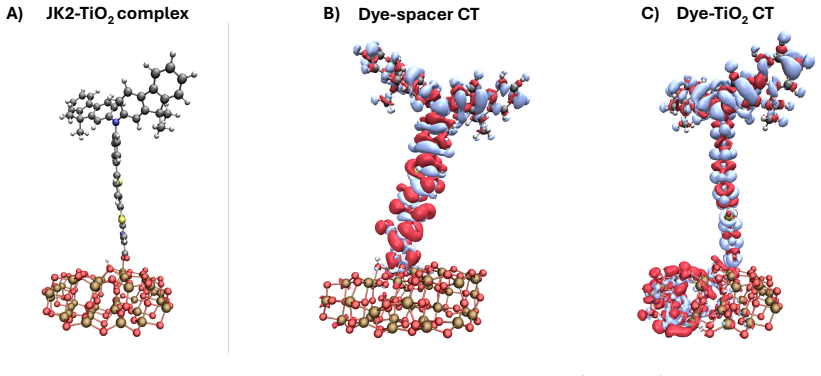
- [Section 4.4, Table 4] The FR-SGM result for the D102-TiO2 dye-TiO2 CT state is 5.45 eV, which is 1.97 eV higher than the sTDA value of 3.48 eV, while all JK2-TiO2 states are red-shifted relative to sTDA by up to about 1 eV. The manuscript does not explain this sign-reversed discrepancy or provide any independent reference for the dye-TiO2 states. Since this system is one of only two new large-system applications and the only one with an external comparison, the conclusion in Section 5 that 'FR-SGM reliably converged on the CT excitations also for these systems' is not supported for D102-TiO2 until the discrepancy is resolved, either by demonstrating a specific sTDA failure or by verifying the character of the FR-SGM state with an independent method.
- [Section 4.3, Eq. 13] The full-cage CT energies are fitted with the shifted expression E = a - b/(RDA - c), where c is set by hand to 3.4 Å without a reported justification or sensitivity analysis. The fitted IPD - EAA asymptote is then compared with the ligand-only fits to conclude that cage confinement lowers the CT energy and makes it accessible with a 400 nm pump. Because the asymptote and hence this physical conclusion depend directly on the arbitrary value of c, the analysis is not robust; the paper should either fit c, justify it, or demonstrate that the conclusions are insensitive to reasonable variations of c.
- [Section 4.2 and Section 4.3] The large-system reliability of FR-SGM is inferred primarily from a dimer benchmark containing a single well-characterized low-lying ICT state, whereas the paper itself notes in Section 2 that the squared-gradient objective has undesired minima and cusps and that the quality of the initial guess determines the basin of attraction. The FR guess requires an a priori assignment of the hole and electron orbitals, and Fig. 3 shows that IMOM starting from related constrained guesses can converge to different, non-ICT states at short donor-acceptor distances. The cage and dye-TiO2 systems contain multiple close-lying CT and LMCT states, so the dimer evidence alone does not establish that FR-SGM reliably lands in the targeted basin for these larger systems. A characterization of the basin of attraction or tests with deliberately misassigned guesses would be needed to support the generalization.
- [Section 4.3, SGM convergence criterion] The large-system calculations use a 'rather loose' SGM convergence criterion of 10^-4, while the dimer benchmark uses 10^-5. Because SGM minimizes the squared gradient, a 10^-4 threshold on the squared gradient leaves a residual orbital gradient that is not negligible, and no estimate of the resulting energy error is provided. Since the large-system energies are used in quantitative fits and in the comparison between methods, the paper should either tighten the convergence or report how much the reported energies change when the threshold is reduced.
- [Section 4.3, Figs. 5 and 6] The comparison of the GDD- and DCT-based tuning schemes excludes data points from the fits (e.g., the 56.3° point in Fig. 6A, the stacked conformer in Fig. 6B, and points marked with orange squares in Fig. 5) without a pre-defined, formal exclusion rule. Because the recommendation of LRC-omegaGDDPBE over DCT-based tuning rests on the smoothness and consistency of these fits, the post hoc exclusions could bias the comparison. The authors should either specify the outlier criterion in advance, report fits with and without the excluded points, or otherwise demonstrate that the conclusions are unchanged.
minor comments (6)
- [Figure 2 caption] The caption says 'the C matrix partitioning introduced in Fig. 2' but should refer to Fig. 1; the stray line 'Sincerely, Nicola Bogo' inside the Fock matrix display is a typographical artifact and should be removed.
- [Table 1 and Section 4.2] The term 'mean signed variance' is a misnomer because variance is non-negative; 'mean variance of the signed error' or simply 'variance' would be clearer.
- [Section 4.3, Fig. 6 panels C and D] The text states that the 31.3° data point 'was found to be problematic also for other methods,' but it is not clear from the figure or caption whether this point is excluded from the fits for ALMO-SGM and FR-SGM; this should be stated explicitly.
- [Section 4.3, Eq. 11] The symbols a and b in Eq. 11 are defined as fitting parameters and later identified with IPD - EAA, but the identification is made only after the fits; please introduce the Mulliken identification before the fits are discussed in Table 2.
- [Section 3] The text in Section 3 refers to 'the guess refinement method introduced in section 4.1,' but Section 4.1 is in the Results section; this cross-reference interrupts the narrative flow and could be rephrased.
- [Section 5] The statement 'we confirm the presence of low-lying D-A CT and LMCT excitations' is stronger than what the calculations support; 'predict' or 'find evidence for' would be more appropriate.
Circularity Check
No significant circularity: the central convergence claim is benchmarked against external EOM-CCSD(fT), and the DCT-based tuning comparison is an evaluation of an external scheme rather than a self-fulfilling fit.
full rationale
The paper's central claim—that ALMO and FR guesses combined with SGM reliably converge to targeted charge-transfer states—is validated on the tetrafluoroethylene-ethylene dimer against an EOM-CCSD(fT) reference, so the target energy is not defined by the method's own outputs. The FR guess does preselect the hole and electron orbitals, but the final stationary-point energy and DCT are not fixed by that choice; the benchmark provides an external check on the result. The paper cites its own previous benchmark (Ref. 10) for the RDA dataset and for the accuracy of OO-DFT, but it re-benchmarks the method in Section 4.2, so this self-citation is not load-bearing. The DCT descriptor is used both as input to the Yan tuning (omega* = 2/Dmax_CT, Eq. 10) and as a diagnostic of the resulting states; this is an internal consistency check of an externally prescribed tuning scheme, not a reduction of the predicted energies to the tuning input. The large-system applications lack independent references, and the D102-TiO2 FR-SGM/sTDA discrepancy (5.45 eV vs 3.48 eV in Table 4) is not reconciled; the paper also acknowledges the squared-gradient objective has undesired minima and cusps (Sec. 2) and that a loose 10^-4 convergence criterion was used (Sec. 4.3). These are validation and robustness limitations, not circularity, and no equation in the paper reduces a claimed prediction to an input by construction.
Assumptions & free parameters
free parameters (5)
- C (GDD tuning constant) =
not reported
- 2 (numerator in omega* = 2/Dmax_CT) =
2
- c in Eq. 13 =
3.4 Å
- a and b in Eq. 11 / Eq. 13 =
varies per method; e.g., a = 4.22 eV, b = 5.87 eV/Å for FR-SGM (Table 2)
- k and q in Eq. 12 =
varies per method
assumptions (5)
- domain assumption The squared-gradient objective (Eq. 6) has stationary points that correspond to the targeted excited-state saddle points, provided the optimization starts in the right basin.
- domain assumption OO-DFT (ΔSCF) energies are legitimate approximations to excited-state energies.
- domain assumption Freezing the hole and electron orbitals during the constrained pre-optimization keeps the calculation in the target CT configuration.
- domain assumption EOM-CCSD(fT)/cc-pVTZ provides accurate reference ICT energies for the tetrafluoroethylene-ethylene dimer.
- domain assumption The interpolated D-A structures used for the dihedral scans are representative of accessible conformations.
Cite this review
Pith. "Pith review of An improved guess for the variational calculation of charge-transfer excitations in large systems." pith.science (2026). https://pith.science/paper/ZTTRKEZK
@misc{pith2026250512645,
  author       = {Pith},
  title        = {Pith review of: An improved guess for the variational calculation of charge-transfer excitations in large systems},
  year         = {2026},
  howpublished = {\url{https://pith.science/paper/ZTTRKEZK}},
  note         = {Machine review of arXiv:2505.12645}
}
read the original abstract
Charge-transfer excited states are highly relevant for applications in molecular electronics. However, the accurate calculation of these states in large systems is challenging since wave function methods are prohibitively expensive, time-dependent density functional theory with typical functionals is not precise, and the complicated topology of the electronic hypersurface makes the variational convergence to the targeted excited states a difficult task. We address the latter aspect by providing suitable initial guesses which we obtain by two separate constrained algorithms. Combined with subsequent squared-gradient minimization schemes, we demonstrate that OO-DFT calculations can reliably converge to the charge-transfer states of interest even for large molecular systems. We test this approach on two chemically very different supramolecular structures and also analyze the performance of two recently proposed methods for the tuning of the range-separation parameter in time-dependent DFT with range-separated hybrid functionals. Our results demonstrate that with the methods presented here, reliable convergence of charge-transfer excited states can be achieved with variational excited-state DFT methods, while time-dependent DFT calculations with an adequate tuning procedure for the range-separation parameter can provide a computationally efficient initial estimate of the corresponding energies.
Figures


Figures from the paper (8 more)



Reference graph
Works this paper leans on
-
[1]
Runge, E.; Gross, E. K. Density-functional theory for time-dependent systems. Phys. Rev. Lett. 1984, 52, 997
work page 1984
-
[2]
Time-dependent density functional theory within the Tamm--Dancoff approximation
Hirata, S.; Head-Gordon, M. Time-dependent density functional theory within the Tamm--Dancoff approximation. Chem. Phys. Lett. 1999, 314, 291--299
work page 1999
-
[3]
Bene, J. E. D.; Ditchfield, R.; Pople, J. A. Self-Consistent Molecular Orbital Methods. X. Molecular Orbital Studies of Excited States with Minimal and Extended Basis Sets. J. Chem. Phys. 1971, 55, 2236--2241
work page 1971
-
[4]
Foresman, J. B.; Head-Gordon, M.; Pople, J. A.; Frisch, M. J. Toward a systematic molecular orbital theory for excited states. J. Phys. Chem. 1992, 96, 135--149
work page 1992
-
[5]
Yanai, T.; Tew, D. P.; Handy, N. C. A new hybrid exchange--correlation functional using the Coulomb-attenuating method (CAM-B3LYP). Chem. Phys. Lett. 2004, 393, 51--57
work page 2004
-
[6]
Semiempirical hybrid density functional with perturbative second-order correlation
Grimme, S. Semiempirical hybrid density functional with perturbative second-order correlation. J. Chem. Phys. 2006, 124, 034108
work page 2006
-
[7]
A simple range-separated double-hybrid density functional theory for excited states
Mester, D.; Kallay, M. A simple range-separated double-hybrid density functional theory for excited states. J. Chem. Theory Comput. 2021, 17, 927--942
work page 2021
-
[8]
Tuned range-separated hybrids in density functional theory
Baer, R.; Livshits, E.; Salzner, U. Tuned range-separated hybrids in density functional theory. Annu. Rev. Phys. Chem. 2010, 61, 85--109
work page 2010
Show all 54 references
-
[9]
Optimal tuning perspective of range-separated double hybrid functionals
Prokopiou, G.; Hartstein, M.; Govind, N.; Kronik, L. Optimal tuning perspective of range-separated double hybrid functionals. J. Chem. Theory Comput. 2022, 18, 2331--2340
2022
-
[10]
Bogo, N.; Stein, C. J. Benchmarking DFT-based excited-state methods for intermolecular charge-transfer excitations. Phys. Chem. Chem. Phys. 2024, 26, 21575--21588
2024
-
[11]
Excited state orbital optimization via minimizing the square of the gradient: General approach and application to singly and doubly excited states via density functional theory
Hait, D.; Head-Gordon, M. Excited state orbital optimization via minimizing the square of the gradient: General approach and application to singly and doubly excited states via density functional theory. J. Chem. Theory Comput. 2020, 16, 1699--1710
2020
-
[12]
Orbital optimized density functional theory for electronic excited states
Hait, D.; Head-Gordon, M. Orbital optimized density functional theory for electronic excited states. J. Phys. Chem. Lett. 2021, 12, 4517--4529
2021
-
[13]
Yang, W.; Ayers, P. W. Foundation for the \ Delta \ SCF Approach in Density Functional Theory. arXiv:2403.04604 2024,
2024 arXiv
-
[14]
Highly accurate prediction of core spectra of molecules at density functional theory cost: Attaining sub-electronvolt error from a restricted open-shell Kohn--Sham approach
Hait, D.; Head-Gordon, M. Highly accurate prediction of core spectra of molecules at density functional theory cost: Attaining sub-electronvolt error from a restricted open-shell Kohn--Sham approach. J. Phys. Chem. Lett. 2020, 11, 775--786
2020
-
[15]
E.; Schmerwitz, Y
Selenius, E.; Sigurdarson, A. E.; Schmerwitz, Y. L.; Levi, G. Orbital-Optimized Versus Time-Dependent Density Functional Calculations of Intramolecular Charge Transfer Excited States. J. Chem. Theory Comput. 2024, 20, 3809--3822
2024
-
[16]
M.; Gilbert, A
Barca, G. M.; Gilbert, A. T.; Gill, P. M. Simple models for difficult electronic excitations. J. Chem. Theory Comput. 2018, 14, 1501--1509
2018
-
[17]
L.; Selenius, E.; Levi, G
Schmerwitz, Y. L.; Selenius, E.; Levi, G. Freeze-and-release direct optimization method for variational calculations of excited electronic states. arXiv:2501.18568 2025,
2025
-
[18]
T.; Feng, X.; Lee, J.; Mao, Y.; Mardirossian, N.; Pokhilko, P.; White, A
Epifanovsky, E.; Gilbert, A. T.; Feng, X.; Lee, J.; Mao, Y.; Mardirossian, N.; Pokhilko, P.; White, A. F.; Coons, M. P.; Dempwolff, A. L.; others Software for the frontiers of quantum chemistry: An overview of developments in the Q-Chem 5 package. J. Chem. Phys. 2021, 155, 084801
2021
-
[19]
A geometric approach to direct minimization
Van Voorhis, T.; Head-Gordon, M. A geometric approach to direct minimization. Mol. Phys. 2002, 100, 1713--1721
2002
-
[20]
On the use of local basis sets for localized molecular orbitals
Stoll, H.; Wagenblast, G.; Preu , H. On the use of local basis sets for localized molecular orbitals. Theor. Chim. Acta 1980, 57, 169--178
1980
-
[21]
Modification of the Roothaan equations to exclude BSSE from molecular interaction calculations
Gianinetti, E.; Raimondi, M.; Tornaghi, E. Modification of the Roothaan equations to exclude BSSE from molecular interaction calculations. Int. J. Quantum Chem. 1996, 60, 157--166
1996
-
[22]
Frank, M.; Ahrens, J.; Bejenke, I.; Krick, M.; Schwarzer, D.; Clever, G. H. Light-induced charge separation in densely packed donor--acceptor coordination cages. J. Am. Chem. Soc. 2016, 138, 8279--8287
2016
-
[23]
C.; Pastore, M.; Bahmann, H
Gemeri, D.; Tremblay, J. C.; Pastore, M.; Bahmann, H. Electronic structure, optical properties, and electron dynamics in organic dye-sensitized TiO2 interfaces by local hybrid density functionals. J. Chem. Phys. 2022, 559, 111521
2022
-
[24]
A.; Herbert, J
Rohrdanz, M. A.; Herbert, J. M. Simultaneous benchmarking of ground-and excited-state properties with long-range-corrected density functional theory. J. Chem. Phys. 2008, 129, 034107
2008
-
[25]
A.; Maitra, N
Marques, M. A.; Maitra, N. T.; Nogueira, F. M.; Gross, E. K.; Rubio, A. Fundamentals of time-dependent density functional theory; Springer, 2012; Vol. 837
2012
-
[26]
Convergence acceleration of iterative sequences
Pulay, P. Convergence acceleration of iterative sequences. The case of SCF iteration. Chem. Phys. Lett. 1980, 73, 393--398
1980
-
[27]
Improved SCF convergence acceleration
Pulay, P. Improved SCF convergence acceleration. J. Comput. Chem. 1982, 3, 556--560
1982
-
[28]
Constrained density functional theory
Kaduk, B.; Kowalczyk, T.; Van Voorhis, T. Constrained density functional theory. Chem. Rev. 2012, 112, 321--370
2012
-
[29]
B.; Brawand, N
Goldey, M. B.; Brawand, N. P.; Voros, M.; Galli, G. Charge transport in nanostructured materials: implementation and verification of constrained density functional theory. J. Chem. Theory Comput. 2017, 13, 2581--2590
2017
-
[30]
A Constraint-Based Orbital-Optimized Excited State Method (COOX)
Kussmann, J.; Lemke, Y.; Weinbrenner, A.; Ochsenfeld, C. A Constraint-Based Orbital-Optimized Excited State Method (COOX). J. Chem. Theory Comput. 2024, 20, 8461--8473
2024
-
[31]
T.; Besley, N
Gilbert, A. T.; Besley, N. A.; Gill, P. M. Self-consistent field calculations of excited states using the maximum overlap method (MOM). J. Phys. Chem. A 2008, 112, 13164--13171
2008
-
[32]
Burton, H. G. Energy landscape of state-specific electronic structure theory. J. Chem. Theory Comput. 2022, 18, 1512--1526
2022
-
[33]
V.; J \'o nsson, H
Levi, G.; Ivanov, A. V.; J \'o nsson, H. Variational density functional calculations of excited states via direct optimization. J. Chem. Theory Comput. 2020, 16, 6968--6982
2020
-
[34]
L.; Levi, G.; J \'o nsson, H
Schmerwitz, Y. L.; Levi, G.; J \'o nsson, H. Calculations of excited electronic states by converging on saddle points using generalized mode following. J. Chem. Theory Comput. 2023, 19, 3634--3651
2023
-
[35]
a fer, C.; J \'o nsson, E. \
Mortensen, J. J.; Larsen, A. H.; Kuisma, M.; Ivanov, A. V.; Taghizadeh, A.; Peterson, A.; Haldar, A.; Dohn, A. O.; Sch \"a fer, C.; J \'o nsson, E. \"O .; others GPAW: An open Python package for electronic structure calculations. J. Chem. Phys. 2024, 160, 092503
2024
-
[36]
Modrzejewski, M.; Rajchel, .; Chalasinski, G.; Szczesniak, M. M. Density-dependent onset of the long-range exchange: A key to donor--acceptor properties. J. Phys. Chem. A 2013, 117, 11580--11586
2013
-
[37]
Mandal, A.; Herbert, J. M. Simplified tuning of long-range corrected time-dependent density functional theory. Chem. Phys. Lett. 2025, 16, 2672--2680
2025
-
[38]
Toward reliable density functional methods without adjustable parameters: The PBE0 model
Adamo, C.; Barone, V. Toward reliable density functional methods without adjustable parameters: The PBE0 model. J. Chem. Phys. 1999, 110, 6158--6170
1999
-
[39]
Adaptable Range-Separated Hybrids for the Description of Excited States: Tuning the Range Separation Parameter on Effective Charge Transfer Distance
Yan, T.; Bonardi, A.; Adamo, C.; Ciofini, I. Adaptable Range-Separated Hybrids for the Description of Excited States: Tuning the Range Separation Parameter on Effective Charge Transfer Distance. J. Chem. Theory Comput. 2025,
2025
-
[40]
Balanced basis sets of split valence, triple zeta valence and quadruple zeta valence quality for H to Rn: Design and assessment of accuracy
Weigend, F.; Ahlrichs, R. Balanced basis sets of split valence, triple zeta valence and quadruple zeta valence quality for H to Rn: Design and assessment of accuracy. Phys. Chem. Chem. Phys. 2005, 7, 3297--3305
2005
-
[41]
Long-range corrected hybrid density functionals with damped atom--atom dispersion corrections
Chai, J.-D.; Head-Gordon, M. Long-range corrected hybrid density functionals with damped atom--atom dispersion corrections. Phys. Chem. Chem. Phys. 2008, 10, 6615--6620
2008
-
[42]
G.; Bannwarth, C.; Hansen, A
Grimme, S.; Brandenburg, J. G.; Bannwarth, C.; Hansen, A. Consistent structures and interactions by density functional theory with small atomic orbital basis sets. J. Chem. Phys. 2015, 143, 054107
2015
-
[43]
Corrected small basis set Hartree-Fock method for large systems
Sure, R.; Grimme, S. Corrected small basis set Hartree-Fock method for large systems. J. Comput. Chem. 2013, 34, 1672--1685
2013
-
[44]
A simplified Tamm-Dancoff density functional approach for the electronic excitation spectra of very large molecules
Grimme, S. A simplified Tamm-Dancoff density functional approach for the electronic excitation spectra of very large molecules. J. Chem. Phys. 2013, 138, 244104
2013
-
[45]
Software update: The ORCA program system—Version 5.0
Neese, F. Software update: The ORCA program system—Version 5.0. Wiley Interdiscip. Rev. Comput. Mol. Sci. 2022, 12, e1606
2022
-
[46]
A qualitative index of spatial extent in charge-transfer excitations
Le Bahers, T.; Adamo, C.; Ciofini, I. A qualitative index of spatial extent in charge-transfer excitations. J. Chem. Theory Comput. 2011, 7, 2498--2506
2011
-
[47]
M.; Clever, G
Han, M.; Engelhard, D. M.; Clever, G. H. Self-assembled coordination cages based on banana-shaped ligands. Chem. Soc. Rev. 2014, 43, 1848--1860
2014
-
[48]
D.; Curtis, D
Hanwell, M. D.; Curtis, D. E.; Lonie, D. C.; Vandermeersch, T.; Zurek, E.; Hutchison, G. R. Avogadro: an advanced semantic chemical editor, visualization, and analysis platform. J. Cheminform. 2012, 4, 1--17
2012
-
[49]
Schaftenaar, G.; Noordik, J. H. Molden: a pre-and post-processing program for molecular and electronic structures. Comput. Aided Des. 2000, 14, 123--134
2000
-
[50]
H.; Mortensen, J
Larsen, A. H.; Mortensen, J. J.; Blomqvist, J.; Castelli, I. E.; Christensen, R.; Du ak, M.; Friis, J.; Groves, M. N.; Hammer, B.; Hargus, C.; others The atomic simulation environment—a Python library for working with atoms. J. Condens. Matter Phys. 2017, 29, 273002
2017
-
[51]
Improved initial guess for minimum energy path calculations
Smidstrup, S.; Pedersen, A.; Stokbro, K.; J \'o nsson, H. Improved initial guess for minimum energy path calculations. J. Chem. Phys. 2014, 140, 214106
2014
-
[52]
Mulliken, R. S. Molecular compounds and their spectra. II. J. Am. Chem. Soc. 1952, 74, 811--824
1952
-
[53]
G.; Henderson, T
Janesko, B. G.; Henderson, T. M.; Scuseria, G. E. Screened hybrid density functionals for solid-state chemistry and physics. Phys. Chem. Chem. Phys. 2009, 11, 443--454
2009
-
[54]
Sohlberg, K.; Foster, M. E. What's the gap? A possible strategy for advancing theory, and an appeal for experimental structure data to drive that advance. RSC advances 2020, 10, 36887--36896 mcitethebibliography figure [H] [width=0.75 ] TOCgraphics TOC graphic fgr:toc figure document
2020
Reviewed August 15, 2026 · model on record in the stance chip above.
Discussion (0). Continue with ORCID to comment.