REVIEW 4 major objections 5 minor 50 references
Towards a Universal Image Degradation Model via Content-Degradation Disentanglement
T0 review · 4 major / 5 minor · reviewed 2026-08-15 · deepseek-v4-flash
Pith's one-line read The paper claims a single learned module can encode, separate, and transfer arbitrary image degradations, including spatially varying ones, without user parameters.
desk verdict A genuinely new degradation-transfer architecture with an overclaimed theoretical guarantee; worth serious review, but the universality claim should be dialed back. read the letter →
The pith
A machine-rendered reading of the paper's core claim, the machinery that carries it, and where it could break.
The reading
What carries the argument
The core mechanism is disentangle-by-compression: entropy regularization applied to the homogeneous and inhomogeneous degradation embeddings e_g and e_l. The rate losses sum the per-entry entropies, and the identity sum_i H(e^(i)) = H(e) + D_KL(p(e)||q(e)) means that minimizing the loss both reduces the total entropy and forces the entries toward independence. The homogeneous encoding network uses a dual-branch design with short- and long-range receptive fields, while the inhomogeneous encoding network keeps spatial structure; the synthesis network inserts a new deconvolution-based layer, IDA, combined with a spatial feature transform in an IDA-SFT block to apply spatially varying and global degradations.
What would settle it
Train the same architecture on a paired dataset where the applied degradation is deliberately content-dependent (for example, blur strength proportional to local saliency or haze depth derived from scene content), then measure whether the homogeneous embedding can be used to decode or predict the clean image content, or whether degradation transfer to a different-content image loses fidelity. If content is recoverable from the embedding or transfer quality drops, the central disentanglement claim is falsified.
Extended reading notes
Core claim
The central claim is that degradation and content are disentanglable by compression: a pair of encoding networks extracts a global, spatially uniform degradation embedding and a local, spatially structured embedding from a distorted image, and a synthesis network rebuilds the degradation onto any clean image. Training with an entropy regularization loss on both embeddings makes the embeddings carry as little information as possible. Under the paper's stated assumptions, minimizing the entropy yields the identity H(e)=I(e;x)+H(d), so the embedding's mutual information with the clean content is driven toward zero while the fixed entropy of the degradation remains, separating the two. The same loss also pushes embedding entries toward statistical independence, giving interpretable latent dimensions that control groups of degradations. With this mechanism, the paper reports high reproduction and transfer scores on synthetic and real distortions, successful film-grain transfer, and blind restoration with two inversion-based methods.
Load-bearing premise
The disentanglement guarantee assumes the distortion process is statistically independent of the clean image content and that spatially uniform and spatially varying degradations are independent of each other; real-world degradations are often content-dependent, so when that assumption fails the proof no longer ensures the embedding is free of content.
Editorial extensions
If this is right
- A single pre-trained degradation module could replace per-distortion simulators in training-data generation for restoration, super-resolution, and denoising tasks.
- Non-blind inversion-based restoration methods that plug in this module become blind: they only need the distorted image, not degradation parameters, as demonstrated on two distinct inversion-based frameworks.
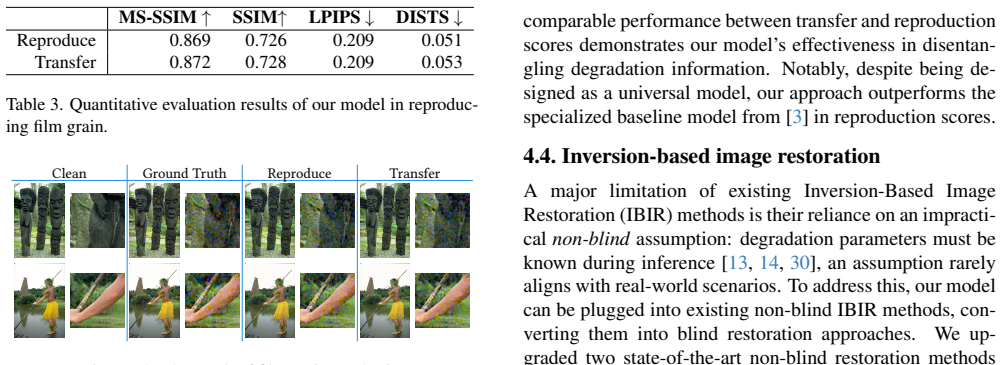
- Film-grain encoding and transfer become a single operation: the model can take a grainy frame, encode its grain, and apply it to a grain-free frame while preserving content, matching or exceeding a specialized grain method's reproduction score.
- The degradation embeddings are interpretable: perturbing one active dimension changes one family of degradations, so degradation can be edited as a controllable attribute rather than a fixed pipeline step.
Reading between the lines
- Because the model is trained only on paired clean/distorted images, its generality is bounded by the diversity of that training data; a natural testable extension is to train on unpaired multi-distortion corpora and measure whether transfer accuracy scales with degradation diversity rather than content diversity.
- If the entropy-loss derivation holds, an analogous disentangle-by-compression objective might separate other spatially varying attributes from content, such as lighting, albedo, or style, wherever the same independence assumptions approximately hold.
- The model's blindness relies on the test-time distortion being represented by its training distribution; one could probe the boundary by feeding it a degradation outside the training pool and checking whether the embedding silently reinterprets it as a familiar distortion rather than failing openly.
- A practical consequence of interpretable embedding dimensions is a potential editing interface: users could dial a single latent dimension to strengthen or weaken a specific distortion without retraining, something the paper demonstrates visually but does not develop as a tool.
Signed reviews
Editorial analysis
A structured set of objections, weighed in public.
Referee Report
Summary. The manuscript proposes a universal image degradation model that encodes a degraded image into a homogeneous degradation embedding e_g and a spatially varying embedding e_l using two encoder networks (HDEN and IDEN), then synthesizes degradations on a target pristine image through a U-Net with IDA-SFT blocks. The central methodological claim is a “disentangle-by-compression” approach: an entropy regularization loss on the embeddings is shown, under assumptions A-1 to A-5, to yield H(e) = I(e;x) + H(d), so that minimizing H(e) minimizes the mutual information between the degradation embedding and image content. The paper reports experiments on synthetic degradation reproduction and transfer, film grain synthesis, and the conversion of non-blind inversion-based restoration methods (RSG, DPS) into blind ones.
Significance. If the disentanglement guarantee holds, the paper would be a valuable step toward learning degradation representations that can be transferred across images without user-provided degradation parameters, and the idea of plugging such a module into inversion-based restoration to make it blind is practically interesting. The paper includes informative ablations showing that the entropy loss and the IDA/IDEN components improve transfer scores, and it promises code and data. However, the “universal” claim is broader than the theoretical and experimental support: the central identity is derived under assumptions that are in tension with content-dependent degradations, and the experiments cover a limited set of distortion types without direct comparisons to existing degradation models.
major comments (4)
- [Sec. 3.3, Eq. (6), Assumptions A-2 and A-5] The derivation of H(e) = I(e;x) + H(d) requires the step H(e|x) = H(d) with H(d) a constant independent of x, which follows from A-2 (degradation distribution independent of the clean image) and, for the homogeneous/inhomogeneous split, A-5 (joint independence of homogeneous and inhomogeneous degradations). The paper's own introduction states that real-world complex degradations are typically nonlinear and content-dependent. Depth-dependent haze, object-motion blur, and rain all violate these assumptions: the degradation parameters include scene depth, object motion, or coupled global/local rain effects, which are correlated with content. If A-2 fails, minimizing H(e) may suppress content-related information rather than isolate a content-free degradation representation, which would directly undermine the transfer experiments of Sec. 4.1 and the blind-restoration claim of Sec. 4.4. Please state the theorem with all assumptions explicitly and provide experiments on content-dependent degradations (e.g., depth-based haze, object-dependent motion blur) to show the disentanglement still holds or to delimit the failure regime.
- [Sec. 3.3, proof of Eq. (6)] The central proof is deferred to Supp. Sec. 6.2, and the main text does not specify the probability space: which variables are random, over which set of images and distortions the entropies are taken, and how the random state n is treated. This makes Eq. (6) impossible to verify from the main text. At minimum, state the theorem and proof sketch in the main text, or move the proof into the main text, because Eq. (6) is the theoretical justification for the entire disentangle-by-compression loss.
- [Sec. 4.4, Eq. (9), Table 4] The blind-restoration evaluation compares only “w/o Ours” (naive blind inversion without re-degradation) with “w/ Ours”. There is no comparison with the original non-blind method that uses the true degradation parameters, nor with other blind restoration baselines. The claim that the model achieves “competitive performance” and converts non-blind restoration into blind restoration needs a calibration point: for example, report the non-blind upper bound from [30] on the same test set, and report the performance of a blind method that estimates degradation parameters directly.
- [Sec. 4.1 and Sec. 4.5, Tables 2–6] The “universal” claim is supported only by a restricted synthetic pool (typical image-processing pipeline degradations on WQIs), film grain, and raindrop transfer. No quantitative comparison is provided with existing degradation models, including the closest prior work [12], despite Table 1 positioning the paper against them. Please add comparisons on at least the degradations used by previous models; if no comparison is possible, explicitly state that limitation. Otherwise “first universal degradation model” is not supported by the current evidence.
minor comments (5)
- [Eq. (7)] In the total loss, λ_g is used for both Lrate_g and L_gan, which is ambiguous. Use a distinct symbol such as λ_gan for the adversarial loss weight.
- [Table 4] Several entries are run together without spacing, e.g., “228.828.1” and “45.116.9”. Please format the table so the values are readable.
- [Sec. 3, first sentence; Fig. 5 caption; Table 1 header] There are several typos: “all distorted process can be described” should be “all distorted processes can be described”; “Encodeing” in Fig. 5 should be “Encoding”; “Mdl Type” in Table 1 should be “Model Type”.
- [Sec. 3.3, entropy estimation] The text says p(e_g) cannot be reliably estimated “due to its high dimensionality,” but the loss uses estimates of p(e_g(i)); please clarify exactly which density is estimated and how the high-dimensionality issue is avoided.
- [Sec. 4.1] The sentence “Since this is the first universal image degradation model, it is difficult to find comparable models” is an explanation, not a substitute for comparison; if comparable methods are not available, the claim should be softened accordingly.
Circularity Check
No significant circularity; the disentanglement guarantee is a self-contained information-theoretic derivation under stated assumptions, with held-out evaluations.
full rationale
The derivation chain is self-contained. The disentanglement guarantee H(e)=I(e;x)+H(d) (Eq. 6) is a mathematical consequence of the stated assumptions A-1..A-5, proved in Supp. Sec. 6.2; it is not obtained by fitting a parameter to the result it is used to explain. The entropy regularization loss (Sec. 3.3) is a regularizer, and the evaluation of reproduction/transfer uses held-out WQI test triplets (Sec. 4.1), the FilmGrainStyle test set (Sec. 4.3), and the FFHQ-X restoration benchmarks (Sec. 4.4) that the model did not train on. Self-citations ([37], [38]) are non-load-bearing: SSIM is used as a diversity regularizer, and [38] only supports a post-hoc interpretation of latent dimensions. The main caveat is that A-2 and A-5 (degradation independent of content; homogeneous/inhomogeneous degradations jointly independent) conflict with the paper's own observation that real degradations are 'typically nonlinear and content-dependent'; if these assumptions fail, Eq. (6) and the disentanglement guarantee may not hold. This is a correctness/robustness limitation, not a circularity: the paper does not assume the target result, and no fitted parameter is renamed as a prediction.
Assumptions & free parameters
free parameters (3)
- Loss trade-off weights (λ_g, λ_l, λ_c, λ_r, λ_d, λ_gan) =
not reported in main text
- Downsampling factor d in HDEN long-range branch =
not reported
- Embedding dimensions of e_g and e_l =
not reported
assumptions (8)
- standard math Sum-entropy identity Σ_i H(e_i) = H(e) + D_KL(p(e)∥∏_i p(e_i))
- domain assumption A-1: Given degradation process and clean image, the degraded image can be exactly reconstructed up to the random state
- domain assumption A-2: Distribution of distortion processes is independent of the clean images
- domain assumption A-3: Distortion can be inferred from the degraded image
- domain assumption A-4: With an appropriate perceptual loss L_sim, the reconstructed degraded image is similar enough to the target
- domain assumption A-5: Homogeneous and inhomogeneous degradations are jointly independent
- domain assumption The model is sufficiently flexible to achieve the optimum of the entropy-regularized loss
- domain assumption DISTS is an appropriate perceptual distance with low sensitivity to noise random state
invented entities (4)
-
Homogeneous Degradation Embedding Network (HDEN)
-
Inhomogeneous Degradation Embedding Network (IDEN)
-
Inhomogeneous Degradation Aware (IDA) layer
-
IDA-SFT block
Cite this review
Pith. "Pith review of Towards a Universal Image Degradation Model via Content-Degradation Disentanglement." pith.science (2026). https://pith.science/paper/4AA5H5IM
@misc{pith2026250512860,
  author       = {Pith},
  title        = {Pith review of: Towards a Universal Image Degradation Model via Content-Degradation Disentanglement},
  year         = {2026},
  howpublished = {\url{https://pith.science/paper/4AA5H5IM}},
  note         = {Machine review of arXiv:2505.12860}
}
read the original abstract
Image degradation synthesis is highly desirable in a wide variety of applications ranging from image restoration to simulating artistic effects. Existing models are designed to generate one specific or a narrow set of degradations, which often require user-provided degradation parameters. As a result, they lack the generalizability to synthesize degradations beyond their initial design or adapt to other applications. Here we propose the first universal degradation model that can synthesize a broad spectrum of complex and realistic degradations containing both homogeneous (global) and inhomogeneous (spatially varying) components. Our model automatically extracts and disentangles homogeneous and inhomogeneous degradation features, which are later used for degradation synthesis without user intervention. A disentangle-by-compression method is proposed to separate degradation information from images. Two novel modules for extracting and incorporating inhomogeneous degradations are created to model inhomogeneous components in complex degradations. We demonstrate the model's accuracy and adaptability in film-grain simulation and blind image restoration tasks. The demo video, code, and dataset of this project will be released at github.com/yangwenbo99/content-degradation-disentanglement.
Figures


Figures from the paper (8 more)




Reference graph
Works this paper leans on
-
[12]
Li-Heng Chen, Christos G. Bampis, Zhi Li, and Alan C. Bovik. Learning to distort images using generative adver- sarial networks.IEEE Signal Processing Letters, 27:2144– 2148, 2020. 2, 3, 6
work page 2020
-
[3]
Style-based film grain analysis and synthesis
Zoubida Ameur, Claire-H ´el`ene Demarty, Olivier Le Meur, Daniel M ´enard, and Edouard Franc ¸ois. Style-based film grain analysis and synthesis. InProceedings of the 14th ACM Multimedia Systems Conference, page 229–238, New York, NY , USA, 2023. Association for Computing Machinery. 7
work page 2023
-
[30]
Robust un- supervised stylegan image restoration
Yohan Poirier-Ginter and Jean-Franc ¸ois Lalonde. Robust un- supervised stylegan image restoration. In2023 IEEE/CVF Conference on Computer Vision and Pattern Recognition (CVPR), pages 22292–22301, 2023. 1, 7, 8
work page 2023
-
[1]
Abdelrahman Abdelhamed, Marcus A. Brubaker, and Michael S. Brown. Noise flow: Noise modeling with con- ditional normalizing flows. InProceedings of the IEEE/CVF International Conference on Computer Vision (ICCV), 2019. 1, 3
work page 2019
-
[2]
Style-based film grain analysis and synthesis
Zoubida Ameur, Claire-H ´el`ene Demarty, Olivier Le Meur, Daniel M ´enard, and Edouard Franc ¸ois. Style-based film grain analysis and synthesis. InProceedings of the 14th Con- ference on ACM Multimedia Systems, page 229–238, New York, NY , USA, 2023. Association for Computing Machin- ery. 3
work page 2023
-
[4]
Zoubida Ameur, Wassim Hamidouche, Edouard Franc ¸ois, Miloˇs Radosavljevi´c, Daniel Menard, and Claire-H´el`ene De- marty. Deep-based film grain removal and synthesis.IEEE Transactions on Image Processing, 32:5046–5059, 2023. 3
work page 2023
-
[5]
Ancuti, Cosmin Ancuti, Chris Hermans, and Philippe Bekaert
Codruta O. Ancuti, Cosmin Ancuti, Chris Hermans, and Philippe Bekaert. A fast semi-inverse approach to detect and remove the haze from a single image. InComputer Vision – ACCV 2010, pages 501–514, Berlin, Heidelberg, 2011. Springer Berlin Heidelberg. 3
work page 2010
-
[6]
End-to-end optimized image compression.arXiv preprint arXiv:1611.01704, 2016
Johannes Ball ´e, Valero Laparra, and Eero P Simoncelli. End-to-end optimized image compression.arXiv preprint arXiv:1611.01704, 2016. 4
arXiv 2016
Show all 50 references
-
[7]
Variational image compres- sion with a scale hyperprior
Johannes Ball ´e, David Minnen, Saurabh Singh, Sung Jin Hwang, and Nick Johnston. Variational image compres- sion with a scale hyperprior. InInternational Conference on Learning Representations, 2018. 4
2018
-
[8]
Dehazenet: An end-to-end system for single image haze removal.IEEE transactions on image process- ing, 25(11):5187–5198, 2016
Bolun Cai, Xiangmin Xu, Kui Jia, Chunmei Qing, and Dacheng Tao. Dehazenet: An end-to-end system for single image haze removal.IEEE transactions on image process- ing, 25(11):5187–5198, 2016. 1, 3
2016
-
[9]
Im- age neural style transfer: A review.Computers and Electri- cal Engineering, 108:108723, 2023
Qiang Cai, Mengxu Ma, Chen Wang, and Haisheng Li. Im- age neural style transfer: A review.Computers and Electri- cal Engineering, 108:108723, 2023. 3
2023
-
[10]
Any-resolution training for high- resolution image synthesis
Lucy Chai, Micha ¨el Gharbi, Eli Shechtman, Phillip Isola, and Richard Zhang. Any-resolution training for high- resolution image synthesis. InComputer Vision – ECCV 2022, pages 170–188, Cham, 2022. Springer Nature Switzer- land. 7
2022
-
[11]
Learn- ing camera-aware noise models
Ke-Chi Chang, Ren Wang, Hung-Jin Lin, Yu-Lun Liu, Chia- Ping Chen, Yu-Lin Chang, and Hwann-Tzong Chen. Learn- ing camera-aware noise models. InComputer Vision – ECCV 2020: 16th European Conference, Glasgow, UK, August 23–28, 2020, Proceedings, Part XXIV, page 343–358, Berlin, ...
2020
-
[13]
Diffusion pos- terior sampling for general noisy inverse problems
Hyungjin Chung, Jeongsol Kim, Michael Thompson Mc- cann, Marc Louis Klasky, and Jong Chul Ye. Diffusion pos- terior sampling for general noisy inverse problems. InThe Eleventh International Conference on Learning Representa- tions, 2023. 7, 8
2023
-
[14]
Stylegan-induced data-driven regularization for inverse problems
Arthur Conmy, Subhadip Mukherjee, and Carola-Bibiane Sch¨onlieb. Stylegan-induced data-driven regularization for inverse problems. InICASSP 2022-2022 IEEE Interna- tional Conference on Acoustics, Speech and Signal Process- ing (ICASSP), pages 3788–3792. IEEE, 2022. 7
2022
-
[15]
Imagenet: A large-scale hierarchical image database
Jia Deng, Wei Dong, Richard Socher, Li-Jia Li, Kai Li, and Li Fei-Fei. Imagenet: A large-scale hierarchical image database. In2009 IEEE Conference on Computer Vision and Pattern Recognition, pages 248–255, 2009. 7
2009
-
[16]
Stytr2: Im- age style transfer with transformers
Yingying Deng, Fan Tang, Weiming Dong, Chongyang Ma, Xingjia Pan, Lei Wang, and Changsheng Xu. Stytr2: Im- age style transfer with transformers. InIEEE Conference on Computer Vision and Pattern Recognition (CVPR), 2022. 3
2022
-
[17]
Simoncelli
Keyan Ding, Kede Ma, Shiqi Wang, and Eero P. Simoncelli. Image quality assessment: Unifying structure and texture similarity.IEEE Transactions on Pattern Analysis and Ma- chine Intelligence, 44(5):2567–2581, 2022. 5
2022
-
[18]
Practical poissonian-gaussian noise mod- eling and fitting for single-image raw-data.IEEE Transac- tions on Image Processing, 17(10):1737–1754, 2008
Alessandro Foi, Mejdi Trimeche, Vladimir Katkovnik, and Karen Egiazarian. Practical poissonian-gaussian noise mod- eling and fitting for single-image raw-data.IEEE Transac- tions on Image Processing, 17(10):1737–1754, 2008. 3
2008
-
[19]
Fre- quency separation for real-world super-resolution
Manuel Fritsche, Shuhang Gu, and Radu Timofte. Fre- quency separation for real-world super-resolution. In2019 IEEE/CVF International Conference on Computer Vision Workshop (ICCVW), pages 3599–3608, 2019. 5
2019
-
[20]
Commons:quality images - Wikimedia Commons.https://commons.wikimedia.org/ wiki/Commons:Quality_images, n.d
Gnangarra, et al. Commons:quality images - Wikimedia Commons.https://commons.wikimedia.org/ wiki/Commons:Quality_images, n.d. 6
-
[21]
Single image haze removal using dark channel prior
Kaiming He, Jian Sun, and Xiaoou Tang. Single image haze removal using dark channel prior. In2009 IEEE Conference on Computer Vision and Pattern Recognition, pages 1956– 1963, 2009. 3
1956
-
[22]
Real-world super-resolution via kernel estimation and noise injection
Xiaozhong Ji, Yun Cao, Ying Tai, Chengjie Wang, Jilin Li, and Feiyue Huang. Real-world super-resolution via kernel estimation and noise injection. InThe IEEE/CVF Confer- ence on Computer Vision and Pattern Recognition (CVPR) Workshops, 2020. 1, 3
2020
-
[23]
Neural style transfer: A review
Yongcheng Jing, Yezhou Yang, Zunlei Feng, Jingwen Ye, Yizhou Yu, and Mingli Song. Neural style transfer: A review. IEEE transactions on visualization and computer graphics, 26(11):3365–3385, 2019. 3
2019
-
[24]
Noisetransfer: Image noise generation with contrastive embeddings
Seunghwan Lee and Tae Hyun Kim. Noisetransfer: Image noise generation with contrastive embeddings. InProceed- ings of the Asian Conference on Computer Vision (ACCV), pages 3569–3585, 2022. 4
2022
-
[25]
AOD-Net: All-in-one dehazing network
Boyi Li, Xiulian Peng, Zhangyang Wang, Jizheng Xu, and Dan Feng. AOD-Net: All-in-one dehazing network. In2017 IEEE International Conference on Computer Vision (ICCV), pages 4780–4788, 2017. 3
2017
-
[26]
Xuan Luo, Xuaner Cecilia Zhang, Paul Yoo, Ricardo Martin- Brualla, Jason Lawrence, and Steven M. Seitz. Time-travel rephotography.ACM Trans. Graph., 40(6), 2021. 3
2021
-
[27]
Poisson-gaussian denoising using the exact unbiased inverse of the gener- alized anscombe transformation
Markku M ¨akitalo and Alessandro Foi. Poisson-gaussian denoising using the exact unbiased inverse of the gener- alized anscombe transformation. In2012 IEEE Interna- tional Conference on Acoustics, Speech and Signal Process- ing (ICASSP), pages 1081–1084, 2012. 3
2012
-
[28]
Deep multi-scale convolutional neural network for dynamic scene deblurring
Seungjun Nah, Tae Hyun Kim, and Kyoung Mu Lee. Deep multi-scale convolutional neural network for dynamic scene deblurring. In2017 IEEE Conference on Computer Vision and Pattern Recognition (CVPR), pages 257–265, 2017. 5, 6
2017
-
[29]
Film grain synthesis for av1 video codec
Andrey Norkin and Neil Birkbeck. Film grain synthesis for av1 video codec. In2018 Data Compression Conference, pages 3–12, 2018. 1, 7
2018
-
[31]
Robby T. Tan. Visibility in bad weather from a single image. In2008 IEEE Conference on Computer Vision and Pattern Recognition, pages 1–8, 2008. 3
2008
-
[32]
From rain generation to rain re- moval
Hong Wang, Zongsheng Yue, Qi Xie, Qian Zhao, Yefeng Zheng, and Deyu Meng. From rain generation to rain re- moval. InProceedings of the IEEE/CVF Conference on Computer Vision and Pattern Recognition (CVPR), pages 14791–14801, 2021. 1, 3
2021
-
[33]
Unsuper- vised degradation representation learning for blind super- resolution
Longguang Wang, Yingqian Wang, Xiaoyu Dong, Qingyu Xu, Jungang Yang, Wei An, and Yulan Guo. Unsuper- vised degradation representation learning for blind super- resolution. In2021 IEEE/CVF Conference on Computer Vi- sion and Pattern Recognition (CVPR), pages 10576–10585,
-
[34]
Tianyu Wang, Xin Yang, Ke Xu, Shaozhe Chen, Qiang Zhang, and Rynson W.H. Lau. Spatial attentive single- image deraining with a high quality real rain dataset. In 2019 IEEE/CVF Conference on Computer Vision and Pat- tern Recognition (CVPR), pages 12262–12271, 2019. 5, 6
2019
-
[35]
Recovering realistic texture in image super-resolution by deep spatial feature transform
Xintao Wang, Ke Yu, Chao Dong, and Chen Change Loy. Recovering realistic texture in image super-resolution by deep spatial feature transform. InThe IEEE Conference on Computer Vision and Pattern Recognition (CVPR), 2018. 4
2018
-
[36]
Real-esrgan: Training real-world blind super-resolution with pure synthetic data
Xintao Wang, Liangbin Xie, Chao Dong, and Ying Shan. Real-esrgan: Training real-world blind super-resolution with pure synthetic data. In2021 IEEE/CVF International Con- ference on Computer Vision Workshops (ICCVW), pages 1905–1914, 2021. 2
1905
-
[37]
Bovik, H.R
Zhou Wang, A.C. Bovik, H.R. Sheikh, and E.P. Simoncelli. Image quality assessment: from error visibility to structural similarity.IEEE Transactions on Image Processing, 13(4): 600–612, 2004. 5
2004
-
[38]
Blind quality assessment of multiply distorted images using deep neural networks
Zhongling Wang, Shahrukh Athar, and Zhou Wang. Blind quality assessment of multiply distorted images using deep neural networks. InImage Analysis and Recognition, pages 89–101, Cham, 2019. Springer International Publishing. 6
2019
-
[39]
Information theoretical analysis of multi- variate correlation.IBM J
Satosi Watanabe. Information theoretical analysis of multi- variate correlation.IBM J. Res. Dev., 4(1):66–82, 1960. 5
1960
-
[40]
Physics-based noise modeling for extreme low-light photog- raphy.IEEE Transactions on Pattern Analysis and Machine Intelligence, 44(11):8520–8537, 2022
Kaixuan Wei, Ying Fu, Yinqiang Zheng, and Jiaolong Yang. Physics-based noise modeling for extreme low-light photog- raphy.IEEE Transactions on Pattern Analysis and Machine Intelligence, 44(11):8520–8537, 2022. 3
2022
-
[41]
J.C.K. Yan, P. Campisi, and D. Hatzinakos. Film grain noise removal and generation for color images. InPro- ceedings of the 1998 IEEE International Conference on Acoustics, Speech and Signal Processing, ICASSP ’98 (Cat. No.98CH36181), pages 2957–2960 vol.5, 1998. 1, 3
1998
-
[42]
Dual adversarial network: Toward real-world noise removal and noise generation
Zongsheng Yue, Qian Zhao, Lei Zhang, and Deyu Meng. Dual adversarial network: Toward real-world noise removal and noise generation. InComputer Vision – ECCV 2020, pages 41–58, Cham, 2020. Springer International Publish- ing. 1, 3
2020
-
[43]
Zeiler, Dilip Krishnan, Graham W
Matthew D. Zeiler, Dilip Krishnan, Graham W. Taylor, and Rob Fergus. Deconvolutional networks. In2010 IEEE Com- puter Society Conference on Computer Vision and Pattern Recognition, pages 2528–2535, 2010. 4
2010
-
[44]
Designing a practical degradation model for deep blind image super-resolution
Kai Zhang, Jingyun Liang, Luc Van Gool, and Radu Timo- fte. Designing a practical degradation model for deep blind image super-resolution. InProceedings of the IEEE/CVF In- ternational Conference on Computer Vision (ICCV), pages 4791–4800, 2021. 2
2021
-
[45]
Efros, Eli Shecht- man, and Oliver Wang
Richard Zhang, Phillip Isola, Alexei A. Efros, Eli Shecht- man, and Oliver Wang. The unreasonable effectiveness of deep features as a perceptual metric. InProceedings of the IEEE Conference on Computer Vision and Pattern Recogni- tion (CVPR), 2018. 7
2018
-
[46]
Rethinking noise synthesis and modeling in raw denois- ing
Yi Zhang, Hongwei Qin, Xiaogang Wang, and Hongsheng Li. Rethinking noise synthesis and modeling in raw denois- ing. InProceedings of the IEEE/CVF International Confer- ence on Computer Vision (ICCV), pages 4593–4601, 2021. 1, 3
2021
-
[47]
Joint learning con- tent and degradation aware feature for blind super-resolution
Yifeng Zhou, Chuming Lin, Donghao Luo, Yong Liu, Ying Tai, Chengjie Wang, and Mingang Chen. Joint learning con- tent and degradation aware feature for blind super-resolution. InProceedings of the 30th ACM International Conference on Multimedia, page 2606–2616, New York, NY , U...
2022
-
[48]
From noise modeling to blind image denoising
Fengyuan Zhu, Guangyong Chen, and Pheng Ann Heng. From noise modeling to blind image denoising. In2016 IEEE Conference on Computer Vision and Pattern Recog- nition (CVPR), pages 420–429, 2016. 1, 3
2016
-
[49]
A fast single image haze removal algorithm using color attenuation prior
Qingsong Zhu, Jiaming Mai, and Ling Shao. A fast single image haze removal algorithm using color attenuation prior. IEEE Transactions on Image Processing, 24(11):3522–3533,
-
[50]
Estimating fine-grained noise model via contrastive learning
Yunhao Zou and Ying Fu. Estimating fine-grained noise model via contrastive learning. InProceedings of the IEEE/CVF Conference on Computer Vision and Pattern Recognition (CVPR), pages 12682–12691, 2022. 1, 3
2022
Reviewed August 15, 2026 · model on record in the stance chip above.
Discussion (0). Continue with ORCID to comment.