REVIEW 3 major objections 7 minor 1 cited by
EPIC: Explanation of Pretrained Image Classification Networks via Prototype
T0 review · 3 major / 7 minor · reviewed 2026-08-15 · deepseek-v4-flash
Pith's one-line read EPIC gives pretrained image classifiers prototype-based explanations while leaving every prediction exactly unchanged.
desk verdict EPIC is a genuinely useful post-hoc prototype method, but the unstated choice of whether U is orthogonal or merely invertible determines whether the central purity claim means anything. read the letter →
The pith
A machine-rendered reading of the paper's core claim, the machinery that carries it, and where it could break.
The reading
What carries the argument
The Disentanglement Module is a learnable $D \times D$ matrix $U$, restricted to invertible or orthogonal matrices, applied per pixel to the feature map by $\widehat{Z}[x,y] = U Z[x,y]$ at each spatial location $(x,y)$, with the final linear layer's weights replaced by $A' = A U^{-1}$ so the output logits are exactly preserved. The purity measure is $purity(I,k) = p_k / \|p\|$, where $p = Z_I[h,w] \in \mathbb{R}^D$ is the feature vector at the spatial location of the maximal activation of channel $k$; a value of 1 means every other channel is zero at that location. Prototypes are the top-$m$ training images by channel activation, and training maximizes the purity of these prototypes while periodically recomputing them as $U$ evolves.
What would settle it
Inspect the learned $U$ in a released EPIC model: if its singular values are not all equal, the purity gain is confounded by scaling. A direct null test is to apply $U = \mathrm{diag}(1,\dots,\lambda,\dots,1)$ to a single channel of an arbitrary feature map: this preserves predictions (Remark 3.1) yet drives the channel's purity toward 1, showing that the disentanglement score alone does not certify semantic separation. If the released implementation restricts $U$ to the orthogonal group, the null test is blocked and the claim survives.
Extended reading notes
Core claim
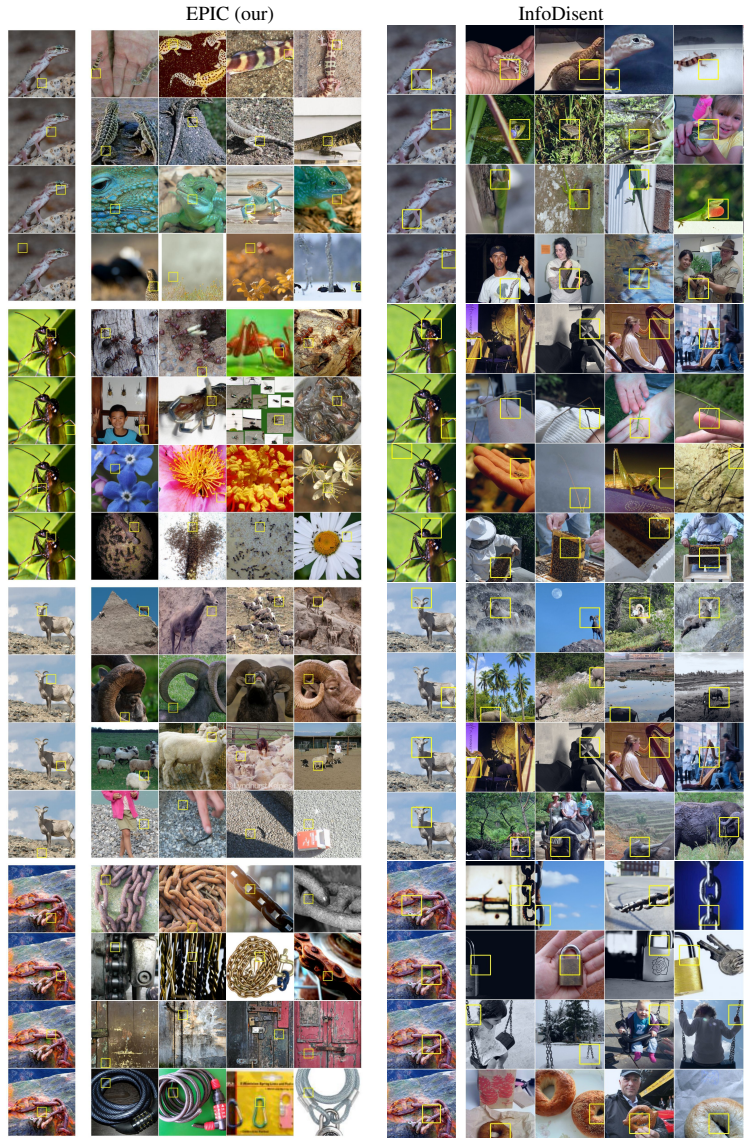
EPIC's central discovery is that prototype explanations do not require an inherently interpretable architecture. By inserting a learnable square matrix $U$ into the feature map just before global average pooling and replacing the classification weight $A$ with $A U^{-1}$, the pretrained network's logits are exactly preserved (Remark 3.1). Training $U$ to maximize the purity $p_k / \|p\|$ of each channel's prototype pixel yields a disentangled feature space in which each channel corresponds to a single dominant concept, and the top contributing channels to the predicted class can be shown as prototype images. The authors state that this makes EPIC the first post-hoc method able to fully replicate the core explanatory power of inherently interpretable prototype models.
Load-bearing premise
Whether EPIC's disentanglement is genuine rests on the unstated restriction that the learned matrix $U$ is an orthogonal (norm-preserving) rotation rather than an arbitrary invertible matrix, because an unrestricted transform can inflate the purity score simply by rescaling channels.
Editorial extensions
If this is right
- For architectures with a pooled feature map followed by a linear classification head, prototype explanations can be added to an already-trained model with zero change in its outputs.
- EPIC's construction preserves the pretrained model's accuracy exactly, so the accuracy-interpretability tradeoff usually associated with prototype models disappears.
- The method scales to large datasets such as ImageNet and to modern backbones, where training dedicated prototype architectures from scratch is impractical.
- User studies in the paper indicate that people who see EPIC explanations identify the model's predicted class above chance, so the explanations convey decision-relevant information.
- Because the original training data is not needed for the explanation step, EPIC can be applied to models already in deployment.
Reading between the lines
- (Editorial inference) If the effectiveness of EPIC depends on the orthogonal restriction, the method is best understood as a learned rotation of the final feature space; the same purity objective could then be applied to intermediate layers to yield hierarchical concept explanations.
- (Editorial inference) A natural stress test not reported in the paper is channel ablation: removing or strongly suppressing one disentangled channel should produce a predictable drop in the probability of the classes that rely on it, which would confirm that the channels carry independent concepts.
- (Editorial inference) The purity score is computed at a single spatial location per channel; a complementary check for global disentanglement would measure whether the winning channel dominates across the whole feature map, not only at its maximum, since local purity alone does not rule out redundant or overlapping channels.
Signed reviews
Editorial analysis
A structured set of objections, weighed in public.
Referee Report
Summary. The paper proposes EPIC, a post-hoc explanation method for pretrained image classifiers with a global-average-pooling and linear classification head. EPIC inserts a learnable invertible matrix U before pooling and multiplies the classification weights by U^{-1}, which preserves the network's predictions exactly (Remark 3.1). U is trained to maximize the 'purity' of channel prototypes, defined as the normalized k-th coordinate of the feature vector at the max-activation pixel of channel k. After training, the authors select top-k contributing channels to explain a prediction and display the corresponding prototype patches. Experiments on CUB-200-2011, Stanford Cars/Dogs, and ImageNet compare EPIC with Grad-CAM, LRP, InfoDisent, and other prototype methods, and include FunnyBirds scores and two user studies.
Significance. The mathematical identity in Remark 3.1 is correct and clean: an invertible linear transform applied to each spatial location and compensated by U^{-1} in the final layer leaves the logits exactly unchanged. If the disentanglement training is meaningful—that is, if U is constrained to be orthogonal and the purity loss is well defined—EPIC would be a valuable post-hoc prototype method applicable to a broad class of pretrained CNNs. The paper includes a code link and reports FunnyBirds and user-study evaluations that provide some independent grounding beyond the internal purity metric. However, as written, the manuscript does not specify the constraint set for U or the training loss, so the validity of the reported disentanglement cannot be assessed; the DenseNet-121 accuracy discrepancy further weakens confidence. The significance of the contribution is therefore conditional on resolving these load-bearing points.
major comments (3)
- [Section 3 (Disentanglement Module)] The paper states that U is trained 'with a restriction to either the class of invertible or orthogonal matrices' but never specifies which restriction is used in the experiments, nor does it give the parameterization of the constrained matrix. This choice is load-bearing for the paper's central claim. If U is allowed to be an arbitrary invertible matrix, the purity objective can be trivially saturated: for any prototype pixel p, a diagonal U = diag(1,...,lambda,...,1) with lambda > 1 makes purity(I,k) = (Up)_k/||Up|| approach 1, while leaving the selected prototypes, their spatial locations, and the top-k contribution scores exactly unchanged (A'_{pred,k} v_k = A_{pred,k} avg_pool(Z)_k). The reported disentanglement and the visual improvements in Fig. 3 would then be vacuous. The authors must state which constraint was used, define the purity loss computed on the transformed representation, and provide the concrete optimization setup. As written, the method is not reproducible and the main claim is unsupported.
- [Appendix A.3, Table 4] In the DenseNet-121 row of Table 4, EPIC is reported to achieve 75.4% accuracy on Stanford Dogs while the original DenseNet-121 achieves 84.1%. This contradicts the paper's assertion that EPIC preserves the original model's predictions exactly (Section 3, Remark 3.1, and the 'Classification Performance' section). The value 75.4% also coincides with the ProtoPNet entry in the same column, suggesting a typographical error. Regardless, as printed, the table undermines the numerical validation of prediction preservation and must be corrected.
- [Section 3 (Training)] The training objective is not specified. The text says only that 'the training stage focuses on the maximization of prototypes purity,' but no loss function is given, and the definition of purity in the 'Purity of prototype' paragraph involves an argmax over spatial locations, which is non-differentiable as written. The paper does not state how the purity of a set of prototypes is aggregated, how gradients are obtained through the argmax, what optimizer or learning rate is used, or how the prototype recalculation interacts with the loss. Without this information, the experimental results cannot be reproduced and it is impossible to verify that the reported disentanglement is due to a meaningful optimization rather than the trivial scaling described in the first comment.
minor comments (7)
- [Section 4 and Fig. 5] The text says Fig. 5 'illustrates ... on the imput images from CUB200-2011 and Stanford Dogs datasets,' but the caption identifies the image as a Hognose Snake from ImageNet; please reconcile the text and the figure caption.
- [References] Reference [15] lists incorrect author names for PIPNet; the correct authors are Meike Nauta, Ron van Bree, and Christin Seifert. Please fix the citation.
- [Section 4 (User study results)] The text says Table 2 'reports ... p-values', but Table 2 contains no p-value column; p-values appear only in Table 3. Please correct the text or the table.
- [Section 3 (Eq. (3))] The function name avg_pool_over_channels is misleading: it performs global average pooling over spatial dimensions, not over channels (see Eq. (3) and Fig. 2). Please rename it (e.g., avg_pool_over_spatial) or clarify the terminology.
- [Throughout] There are several typos: 'LPR' should be 'LRP' (Section 4), 'usy studies' should be 'user studies' (Appendix A.2), 'distributative' should be 'distributive' (Remark 3.1 proof), and 'future space' should be 'feature space' (Section 3, Purity of prototype).
- [Algorithm 1] Algorithm 1 overloads the symbol ⊛: it is used both for the matrix application U⊛Z (Eq. (2)) and for element-wise multiplication in line 9. Please use different symbols for these operations.
- [Abstract and Section 5] The claim that EPIC 'fully replicat[es] the core explanatory power of inherently interpretable models' is stronger than what the user studies support: in Table 3, EPIC's accuracy (0.568 ImageNet, 0.55 CUB) is below that of InfoDisent (0.593, 0.647) and only barely above random. Please temper the claim or add discussion of this limitation.
Circularity Check
Internal purity evidence is the optimization objective, and the unspecified U constraint permits a trivial rescaling that saturates purity; external FunnyBirds/user studies provide partial independent grounding.
-
self definitional
[Section 3, 'Purity of prototype' and 'Training' (pp. 5-7)]
"The quality of a prototype is tied to the value of purity. Consequently, the training stage focuses on the maximization of prototypes purity. ... as noted the larger the purity the better the explanation."
EPIC's quality measure for prototypes is purity(I,k)=p_k/||p||, and this same quantity is the training objective for U. Figures 3-4 and the text use the post-training purity increase as evidence that prototypes are coherent ('After EPIC optimization, such prototypes are consistent'), but that increase is the direct result of optimizing exactly that objective, so it is not an independent confirmation. The external FunnyBirds and user studies break the circle for the overall claim, but the internal before/after quality demonstration is self-referential.
-
other
[Section 3, 'Disentanglement Module' and Remark 3.1]
"We train the matrix U with a restriction to either the class of invertible or orthogonal matrices. ... U−1avg_pool_over_channels(U⊛Z) = avg_pool_over_channels(Z)."
The paper never states which restriction was used in the experiments. If U is merely invertible, the purity objective has a trivial maximizer: U=diag(1,...,λ,...,1) scales one channel, so for any prototype pixel p, (Up)_k/||Up|| → 1. By Remark 3.1 (and A′=AU−1), the logits are exactly preserved, and in Algorithm 1 the explanation scores A′_k ReLU(v_k) equal A_k ReLU(avg Z_k). Thus the reported 'disentanglement' could be achieved by rescaling alone, without any semantic separation. Since the paper leaves both classes open, the central purity-based evidence is underdetermined and can reduce to this by-construction solution.
full rationale
EPIC's derivation of explanations is self-contained: given a frozen backbone, pooling, and linear head A, it inserts an invertible U and compensates with A′=AU−1; Remark 3.1 proves logits are unchanged. That part is not circular. However, the paper uses purity as both the training loss and the internal measure of explanation quality, so the before/after purity improvement is the optimization target by construction. In addition, the paper states U is restricted to 'either the class of invertible or orthogonal matrices' but never reports which; with merely invertible U, a diagonal scaling saturates purity while preserving logits and leaving Algorithm 1's explanation scores unchanged, so the disentanglement evidence can reduce to a rescaling artifact. The external evaluations (FunnyBirds, user studies) and the exact logit preservation are independent evidence, preventing a score above 5; the self-citation to InfoDisent is a comparison, not a load-bearing justification.
Assumptions & free parameters
free parameters (4)
- U (D x D learnable matrix) =
not reported
- m (number of prototypes per channel) =
5 at convergence, starts at 100
- k (top contributing channels in explanation) =
not reported
- training epochs and prototype recalc interval =
20 epochs, recalc every 2
assumptions (4)
- standard math Average pooling is linear over channel-wise linear transforms: U^{-1} avg_pool(U Z) = avg_pool(Z) for invertible U.
- domain assumption The model has a backbone followed by average pooling and a single linear classification head.
- ad hoc to paper Purity at the max-activation pixel is a valid proxy for human-interpretable prototype coherence.
- domain assumption The original training set is available for prototype selection and U training.
Cite this review
Pith. "Pith review of EPIC: Explanation of Pretrained Image Classification Networks via Prototype." pith.science (2026). https://pith.science/paper/BPPE2GAT
@misc{pith2026250512897,
  author       = {Pith},
  title        = {Pith review of: EPIC: Explanation of Pretrained Image Classification Networks via Prototype},
  year         = {2026},
  howpublished = {\url{https://pith.science/paper/BPPE2GAT}},
  note         = {Machine review of arXiv:2505.12897}
}
read the original abstract
Explainable AI (XAI) methods generally fall into two categories. Post-hoc approaches generate explanations for pre-trained models and are compatible with various neural network architectures. These methods often use feature importance visualizations, such as saliency maps, to indicate which input regions influenced the model's prediction. Unfortunately, they typically offer a coarse understanding of the model's decision-making process. In contrast, ante-hoc (inherently explainable) methods rely on specially designed model architectures trained from scratch. A notable subclass of these methods provides explanations through prototypes, representative patches extracted from the training data. However, prototype-based approaches have limitations: they require dedicated architectures, involve specialized training procedures, and perform well only on specific datasets. In this work, we propose EPIC (Explanation of Pretrained Image Classification), a novel approach that bridges the gap between these two paradigms. Like post-hoc methods, EPIC operates on pre-trained models without architectural modifications. Simultaneously, it delivers intuitive, prototype-based explanations inspired by ante-hoc techniques. To the best of our knowledge, EPIC is the first post-hoc method capable of fully replicating the core explanatory power of inherently interpretable models. We evaluate EPIC on benchmark datasets commonly used in prototype-based explanations, such as CUB-200-2011 and Stanford Cars, alongside large-scale datasets like ImageNet, typically employed by post-hoc methods. EPIC uses prototypes to explain model decisions, providing a flexible and easy-to-understand tool for creating clear, high-quality explanations.
Figures


Figures from the paper (11 more)


Forward citations
Cited by 1 Pith paper
-
SIDE: Sparse Information Disentanglement for Explainable Artificial Intelligence
SIDE produces sparse prototype-based explanations for image classifiers, cutting explanation size by over 90 percent while keeping accuracy comparable to InfoDisent.
Reference graph
Works this paper leans on
-
[1]
Sanity checks for saliency maps.Advances in Neural Information Processing Systems, 31, 2018
Julius Adebayo, Justin Gilmer, Michael Muelly, Ian Goodfellow, Moritz Hardt, and Been Kim. Sanity checks for saliency maps.Advances in Neural Information Processing Systems, 31, 2018
work page 2018
-
[2]
Sebastian Bach, Alexander Binder, Gregoire Montavon, Frederick Klauschen, Klaus-Robert Muller, and Wojciech Samek. On pixel-wise explanations for non-linear classifier decisions by layer-wise relevance propagation.PLoS One, 10(7):e0130140, 2015
work page 2015
-
[3]
B-cos networks: Alignment is all we need for interpretability
Moritz Böhle, Mario Fritz, and Bernt Schiele. B-cos networks: Alignment is all we need for interpretability. InProceedings of the IEEE/CVF Conference on Computer Vision and Pattern Recognition, pages 10329–10338, 2022
work page 2022
-
[4]
Concept whitening for interpretable image recognition.Nature Machine Intelligence, 2:772–782, 2020
Chaofan Chen, Alina Barnett, Jonathan Su, Cynthia Rudin, and Suresh Venkatasubramanian. Concept whitening for interpretable image recognition.Nature Machine Intelligence, 2:772–782, 2020
work page 2020
-
[5]
Chaofan Chen, Oscar Li, Daniel Tao, Alina Barnett, Cynthia Rudin, and Jonathan K Su. This looks like that: Deep learning for interpretable image recognition.Advances in Neural Information Processing Systems, 32, 2019
work page 2019
-
[6]
Imagenet: A large- scale hierarchical image database
Jia Deng, Wei Dong, Richard Socher, Li-Jia Li, Kai Li, and Li Fei-Fei. Imagenet: A large- scale hierarchical image database. In2009 IEEE Conference on Computer Vision and Pattern Recognition, pages 248–255, 2009
2009
-
[7]
Towards automatic concept- based explanations
Amirata Ghorbani, James Wexler, James Y Zou, and Been Kim. Towards automatic concept- based explanations. InAdvances in Neural Information Processing Systems, volume 32, 2019
work page 2019
-
[8]
Deep residual learning for im- age recognition
Kaiming He, Xiangyu Zhang, Shaoqing Ren, and Jian Sun. Deep residual learning for im- age recognition. InProceedings of the IEEE Conference on Computer Vision and Pattern Recognition, pages 770–778, 2016
2016
Show all 24 references
-
[9]
Fast axiomatic attribution for neural networks.Advances in Neural Information Processing Systems, 34:19513–19524, 2021
Robin Hesse, Simone Schaub-Meyer, and Stefan Roth. Fast axiomatic attribution for neural networks.Advances in Neural Information Processing Systems, 34:19513–19524, 2021
2021
-
[10]
FunnyBirds: A synthetic vision dataset for a part-based analysis of explainable AI methods
Robin Hesse, Simone Schaub-Meyer, and Stefan Roth. FunnyBirds: A synthetic vision dataset for a part-based analysis of explainable AI methods. In2023 IEEE/CVF International Confer- ence on Computer Vision (ICCV), Paris, France, October 2-6, 2023, pages 3981–3991. IEEE, 2023
2023
-
[11]
Novel dataset for fine-grained image categorization
Aditya Khosla, Nityananda Jayadevaprakash, Bangpeng Yao, and Li Fei-Fei. Novel dataset for fine-grained image categorization. InFirst Workshop on Fine-Grained Visual Categorization, IEEE Conference on Computer Vision and Pattern Recognition, Colorado Springs, CO, June 2011
2011
-
[12]
Collecting a large-scale dataset of fine-grained cars
Jonathan Krause, Jia Deng, Michael Stark, and Li Fei-Fei. Collecting a large-scale dataset of fine-grained cars. 2013
2013
-
[13]
The mythos of model interpretability: In machine learning, the concept of interpretability is both important and slippery.Queue, 16(3):31–57, 2018
Zachary C Lipton. The mythos of model interpretability: In machine learning, the concept of interpretability is both important and slippery.Queue, 16(3):31–57, 2018
2018
-
[14]
A unified approach to interpreting model predictions
Scott M Lundberg and Su-In Lee. A unified approach to interpreting model predictions. Advances in Neural Information Processing Systems, 30, 2017. 10
2017
-
[15]
Pipnet: Prototypical part network for interpretable fine-grained recognition.IEEE Transactions on Pattern Analysis and Machine Intelligence, 2023
Lucas Nauta, Max H Sieb, and Jan C van Gemert. Pipnet: Prototypical part network for interpretable fine-grained recognition.IEEE Transactions on Pattern Analysis and Machine Intelligence, 2023
2023
-
[16]
Rise: Randomized input sampling for explanation of black-box models.arXiv preprint arXiv:1806.07421, 2018
Vitali Petsiuk, Abir Das, and Kate Saenko. Rise: Randomized input sampling for explanation of black-box models.arXiv preprint arXiv:1806.07421, 2018
2018 arXiv
-
[17]
why should i trust you?
Marco Tulio Ribeiro, Sameer Singh, and Carlos Guestrin. "why should i trust you?" explaining the predictions of any classifier. InProceedings of the 22nd ACM SIGKDD International Conference on Knowledge Discovery and Data Mining, pages 1135–1144, 2016
2016
-
[18]
Grad-cam: Visual explanations from deep networks via gradient-based localization
Ramprasaath R Selvaraju, Michael Cogswell, Abhishek Das, Ramakrishna Vedantam, Devi Parikh, and Dhruv Batra. Grad-cam: Visual explanations from deep networks via gradient-based localization. InProceedings of the IEEE International Conference on Computer Vision (ICCV), pages 61...
2017
-
[19]
Grad-cam: Visual explanations from deep networks via gradient-based localization.International Journal of Computer Vision, 128:336–359, 2020
Ramprasaath R Selvaraju, Michael Cogswell, Abhishek Das, Ramakrishna Vedantam, Devi Parikh, and Dhruv Batra. Grad-cam: Visual explanations from deep networks via gradient-based localization.International Journal of Computer Vision, 128:336–359, 2020
2020
-
[20]
Not just a black box: Learning important features through propagating activation differences, 2017
Avanti Shrikumar, Peyton Greenside, Anna Shcherbina, and Anshul Kundaje. Not just a black box: Learning important features through propagating activation differences, 2017
2017
-
[21]
Infodisent: Explainability of image classification models by information disentanglement.arXiv preprint arXiv:2409.10329, 2024
Lukasz Struski, Dawid Rymarczyk, and Jacek Tabor. Infodisent: Explainability of image classification models by information disentanglement.arXiv preprint arXiv:2409.10329, 2024
2024 arXiv
-
[22]
Axiomatic attribution for deep networks
Mukund Sundararajan, Ankur Taly, and Qiqi Yan. Axiomatic attribution for deep networks. In International conference on machine learning, pages 3319–3328. PMLR, 2017
2017
-
[23]
C. Wah, S. Branson, P. Welinder, P. Perona, and S. Belongie. Caltech-ucsd birds 200. Technical Report CNS-TR-2011-001, California Institute of Technology, 2011
2011
-
[24]
Explainable ai: A brief survey on history, research areas, approaches and challenges
Feiyu Xu, Hans Uszkoreit, Yangzhou Du, Wei Fan, Dongyan Zhao, and Jun Zhu. Explainable ai: A brief survey on history, research areas, approaches and challenges. InNatural Language Processing and Chinese Computing, pages 563–574. Springer, 2019. A Appendix / supplemental materi...
2019
Reviewed August 15, 2026 · model on record in the stance chip above.
Discussion (0). Continue with ORCID to comment.