REVIEW 3 major objections 5 minor 81 references
LatentINDIGO: An INN-Guided Latent Diffusion Algorithm for Image Restoration
T0 review · 3 major / 5 minor · reviewed 2026-08-15 · deepseek-v4-flash
Pith's one-line read A wavelet-inspired invertible network lets latent diffusion models restore images with unknown degradations, without retraining, by alternating guided latent updates with on-the-fly refinement of the degradation model.
desk verdict A genuinely useful extension of INDIGO+ to latent diffusion, with consistent gains and a clever latent INN, but the test-time refinement that carries the unknown-degradation claim is never ablated. read the letter →
The pith
A machine-rendered reading of the paper's core claim, the machinery that carries it, and where it could break.
The reading
What carries the argument
The central object is the wavelet-inspired invertible neural network, whose predict and update modules are trainable networks arranged in the lifting scheme, making the whole transform exactly invertible by construction. In the forward direction the network factors an image into a coarse component that should match the degraded measurement and a detail component that holds the lost information; in the inverse direction it fuses the actual measurement with the detail component produced by the current diffusion estimate. Because forward and inverse parameters are shared, refining the INN against the observed measurement also improves reconstruction, which is the mechanism the paper relies on to handle unknown degradations. A secondary mechanism is the regularization step that re-encodes the guided latent through the autoencoder, pulling intermediate latents back toward the natural image manifold.
What would settle it
Train the INN only on synthetic Gaussian blur plus noise, then run both algorithm variants on a JPEG-only or motion-blur-only degradation with refinement enabled and disabled, and record the forward loss $\|x_{c,t}-y\|_2^2$ at each sampling step. If refinement does not reduce this loss relative to the frozen INN, or if disabling refinement already matches enabling it, the claim that refinement adapts the forward model to unknown degradations is falsified; equivalently, a degradation on which PSNR or LPIPS worsens as refinement steps increase would show the per-image fit overfitting to the measurement.
Extended reading notes
Core claim
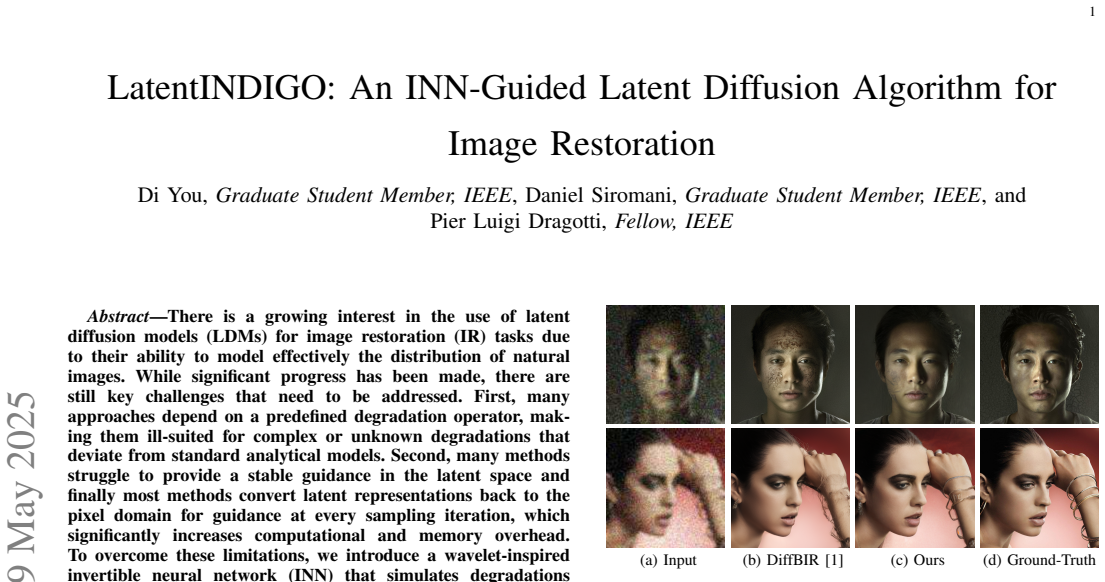
The central claim is that an invertible neural network built on the lifting scheme of the wavelet transform can serve as a learned, trainable degradation simulator inside latent diffusion sampling, and that by alternating latent guidance with parameter refinement the pipeline can restore images under unknown degradations without fine-tuning the diffusion model. The paper proposes two instantiations: LatentINDIGO-PixelINN, where the INN acts in pixel space and guidance uses a forward data-consistency loss plus a perceptual backprojection loss, and LatentINDIGO-LatentINN, where the INN acts on VAE latents and guidance is a simple interpolation between the denoised latent and the INN-reconstructed latent. Both share a per-step regularization that re-encodes the guided latent to keep it near the natural image manifold, and both refine the INN parameters at inference by gradient descent on the squared error between the predicted coarse component and the observed measurement. The paper reports that DiffBIR-PixelINN improves PSNR by up to 1.22 dB over DiffBIR on synthetic face degradation with consistent LPIPS gains, that both variants improve no-reference quality scores on real web-photo benchmarks, and that the latent variant roughly halves the runtime of the pixel variant.
Load-bearing premise
The load-bearing premise is that a few gradient updates to the INN parameters against the squared error on the single observed image make the INN's forward transform faithfully simulate the true degradation, while the shared inverse transform still reconstructs the clean image; if this per-image fitting overfits to noise or collapses the detail channel, the guided sampling degrades even though the pretrained diffusion model is strong.
Editorial extensions
If this is right
- Existing pretrained latent diffusion models can be turned into blind restoration solvers by adding a small INN guidance module, with no retraining or fine-tuning of the denoiser.
- The pixel variant and the latent variant trade cost against texture fidelity: the latent variant roughly halves runtime by staying in latent space, while the pixel variant gives globally consistent reconstructions.
- Because the INN is conditioned on a degradation embedding estimated from the measurement, one training recipe covers super-resolution, JPEG compression, and real-world low-quality photos.
- On-the-fly refinement extends the framework to degradations outside the INN's synthetic training distribution, as shown by the JPEG quality-factor-5 experiment on DIV2K without retraining.
- The patch-based extension supports arbitrary output resolutions by processing latent tiles while applying guidance on the whole latent, reducing memory overhead and tile-boundary artifacts.
Reading between the lines
- The paper leaves open whether the gain comes from invertibility itself or from the per-image refinement; an experiment that freezes the INN would separate the two.
- A testable extension is to apply the refinement-only idea to non-invertible guidance such as DPS or LDPS; if those methods then match LatentINDIGO on unseen degradations, the invertible architecture is not the essential ingredient.
- The observation that a simple latent-space blend works suggests that in latent space, data consistency can be enforced with a cheap coupling; the same design might transfer to other latent inverse problems such as compressed sensing or inpainting.
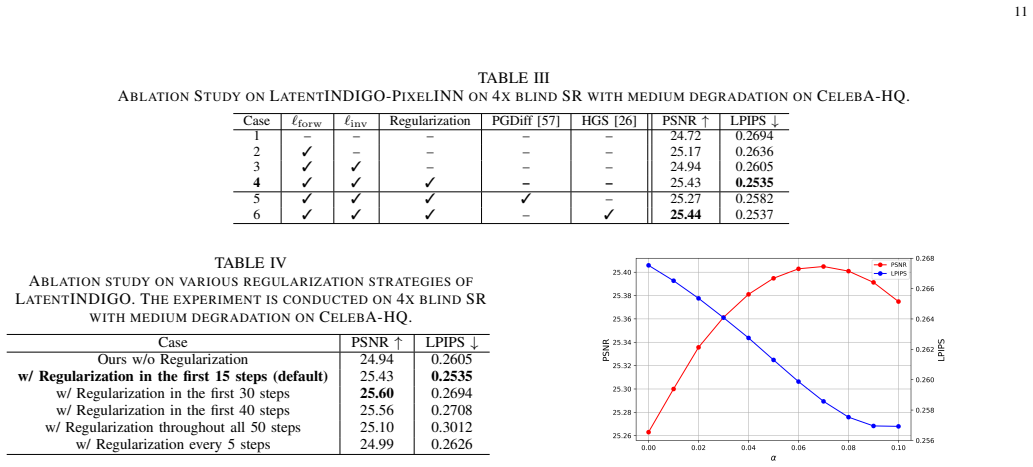
- The regularization schedule implies a tuning knob: applying re-encoding only in early sampling steps worked best for faces, and the same schedule may need re-tuning per task and noise level.
Signed reviews
Editorial analysis
A structured set of objections, weighed in public.
Referee Report
Summary. The paper proposes LatentINDIGO, a latent diffusion framework for blind image restoration that uses a wavelet-inspired invertible neural network (INN) as a learned degradation simulator and inverse reconstructor. Two variants are introduced: LatentINDIGO-PixelINN, which performs guidance in the pixel domain, and LatentINDIGO-LatentINN, which operates entirely in the latent space to avoid per-iteration decoding. At each sampling step the method alternates between updating the latent variable under INN guidance and refining the INN parameters on the observed measurement, followed by a re-encoding regularisation step intended to keep latents on the natural image manifold. Experiments on synthetic face restoration and real-world benchmarks report consistent gains over DiffBIR and several other baselines, and a single qualitative example on unseen JPEG degradation is used to illustrate the refinement mechanism.
Significance. The central idea of using an invertible lifting-scheme network to factor a clean image into a degraded coarse component and a detail component, then fusing LDM-sampled details with the observed measurement through the inverse transform, is elegant and the reported gains over DiffBIR are consistent across degradation levels. The LatentINN variant is a practically useful contribution because it avoids decoding at every iteration, and the paper includes careful ablations of the guidance losses and the regularisation schedule. The quantitative claims are, however, only as strong as the support for the per-image refinement mechanism, which is the component that addresses unknown degradations and is not directly ablated. If the refinement mechanism is validated with additional experiments, the paper would be a solid contribution to blind image restoration with latent diffusion models.
major comments (3)
- [Section III-B3, Algorithm 1 line 11] The on-the-fly refinement update Θ ← Θ − l∇Θ∥x_{c,t} − y∥² (also Algorithm 2 line 9 and Eq. (16)) is the only mechanism claimed to adapt the INN to unknown degradations, yet the paper never isolates it experimentally. Table III ablates ℓ_forw, ℓ_inv, and the regularisation, but the refinement update is present in every case, and the only out-of-distribution demonstration (Fig. 9, JPEG q=5) is a single qualitative example. Please add a quantitative ablation that disables the refinement update, report the learning rate l and the number of gradient steps per sampling iteration, and evaluate the effect of the first-half-only schedule. Without this, the 'handle unknown degradations' contribution is unsupported.
- [Section IV-B2, Fig. 9] The claim that the method generalises to degradations outside the INN training distribution rests entirely on one qualitative example on DIV2K with JPEG q=5. There are no PSNR/LPIPS numbers for this setting and no comparison against the same method with refinement disabled. Please provide quantitative results over a set of images for at least one unseen degradation, including a no-refinement control, to demonstrate that the per-image fitting does not overfit the single measurement.
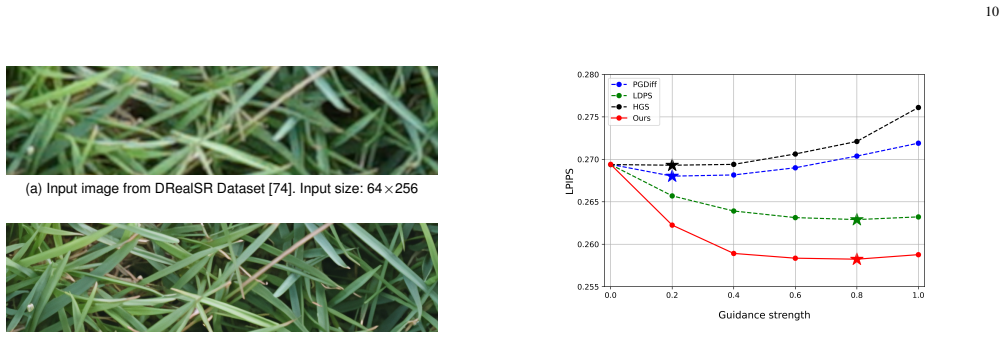
- [Section IV-C1, Figs. 12 and 13, Table IV] Several hyperparameters (α_forw, α_inv, α, and the regularisation schedule) are selected by evaluating on the test set (CelebA-HQ medium degradation), and all reported metrics are point estimates. This raises the risk that the comparisons in Tables I and II overstate the improvement. Please select hyperparameters on a validation set and report mean ± std over multiple independent restorations or seeds.
minor comments (5)
- [Section II-A] There is a typo in the text after Eq. (5): 'ϵ is samped from N(0,I)' should read 'sampled'.
- [Section III-D, Algorithm 3] In Algorithm 3, line 11 the reverse step is computed from \tilde{z}_{0,t}, but line 10 defines \hat{z}_{0,t} = E(D(\tilde{z}_{0,t})) and the surrounding text says the regularisation update is preserved. This is inconsistent with Algorithm 2, where z_{t-1} is computed from \hat{z}_{0,t}. Please correct the algorithm or explicitly state that the regularisation step is skipped in the arbitrary-resolution variant and justify that choice.
- [Section IV-B] The introduction describes two proposed approaches, but the experiments evaluate three variants (StableSR-PixelINN, DiffBIR-PixelINN, DiffBIR-LatentINN). Please clarify the relationship between the conceptual approaches and the evaluated variants.
- [Algorithms 1 and 2] The text in Section III-B3 states that the refinement mechanism is applied only during the first half of the sampling process, but the pseudocode shows the refinement inside the full loop without such a condition. Please make the schedule explicit in the pseudocode.
- [Related Work / References] The relationship to the authors' prior INDIGO+ work (Ref. [62]) is not discussed in the introduction or related work; the incremental novelty of the two approaches over [62] should be stated explicitly.
Circularity Check
No circular dependency: INN training, test-time refinement, and benchmark evaluation are self-contained.
full rationale
The paper's derivation chain is self-contained. PixelINN and LatentINN are trained on paired synthetic (x, y) data with forward loss ||x_c - y||^2 and inverse reconstruction loss ||x_inv - x||^2 (Eqs. 11-13 and 19-21), which is supervised fitting rather than prediction from fitted values. At inference, the INN is used as a learned forward model for data-consistency guidance inside latent diffusion sampling (Algorithms 1 and 2), and the test-time refinement (Eq. 16, Algorithm 1 line 11, Algorithm 2 line 9) adapts the shared INN parameters to the observed measurement y alone. Since y is the observation, not the target, and since the reported gains are measured on external benchmarks (CelebA-Test, WebPhoto-Test, CelebChild, DIV2K) against held-out ground truth or independent no-reference quality metrics, no reported quantity is equal by construction to a fitted parameter. The paper cites the authors' prior INDIGO+ and WINNet work for background and architectural context, but it does not import any load-bearing uniqueness theorem or ansatz from those citations; the lifting-scheme construction, losses, and sampling updates are stated explicitly in the paper. The JPEG q=5 experiment is qualitative and the refinement step is not separately ablated, which are limitations of evidence, not circularity. Accordingly, the score is 0.
Assumptions & free parameters
free parameters (6)
- alpha_forw guidance step =
0.1
- alpha_inv guidance step =
1
- alpha latent interpolation =
0.08
- regularization schedule =
first 15 of 50 steps
- refinement learning rate l =
not specified
- lambda_inv training weight =
not specified
assumptions (5)
- standard math The lifting-scheme construction makes the INN exactly invertible for any choice of predict/update modules.
- domain assumption The pretrained LDM and VAE encode a natural image manifold useful for restoration.
- domain assumption The coarse component of a transformed clean image approximates the degraded observation y.
- domain assumption The pretrained degradation estimator F(y) from [68] transfers to real-world degradations.
- domain assumption Re-encoding D(z_tilde) projects off-manifold latents back to the manifold.
invented entities (1)
-
Two-level wavelet-inspired invertible neural network with PM/UM modules (PixelINN and LatentINN)
independent evidence
Cite this review
Pith. "Pith review of LatentINDIGO: An INN-Guided Latent Diffusion Algorithm for Image Restoration." pith.science (2026). https://pith.science/paper/6GB5OGCX
@misc{pith2026250512935,
  author       = {Pith},
  title        = {Pith review of: LatentINDIGO: An INN-Guided Latent Diffusion Algorithm for Image Restoration},
  year         = {2026},
  howpublished = {\url{https://pith.science/paper/6GB5OGCX}},
  note         = {Machine review of arXiv:2505.12935}
}
read the original abstract
There is a growing interest in the use of latent diffusion models (LDMs) for image restoration (IR) tasks due to their ability to model effectively the distribution of natural images. While significant progress has been made, there are still key challenges that need to be addressed. First, many approaches depend on a predefined degradation operator, making them ill-suited for complex or unknown degradations that deviate from standard analytical models. Second, many methods struggle to provide a stable guidance in the latent space and finally most methods convert latent representations back to the pixel domain for guidance at every sampling iteration, which significantly increases computational and memory overhead. To overcome these limitations, we introduce a wavelet-inspired invertible neural network (INN) that simulates degradations through a forward transform and reconstructs lost details via the inverse transform. We further integrate this design into a latent diffusion pipeline through two proposed approaches: LatentINDIGO-PixelINN, which operates in the pixel domain, and LatentINDIGO-LatentINN, which stays fully in the latent space to reduce complexity. Both approaches alternate between updating intermediate latent variables under the guidance of our INN and refining the INN forward model to handle unknown degradations. In addition, a regularization step preserves the proximity of latent variables to the natural image manifold. Experiments demonstrate that our algorithm achieves state-of-the-art performance on synthetic and real-world low-quality images, and can be readily adapted to arbitrary output sizes.
Figures


Figures from the paper (10 more)




Reference graph
Works this paper leans on
-
[1]
Diffbir: Toward blind image restoration with generative diffusion prior,
X. Linet al., “Diffbir: Toward blind image restoration with generative diffusion prior,” inProc. Eur . Conf. Comput. Vis. (ECCV), 2024, pp. 430–448
2024
-
[2]
Diffusion models in vision: A survey,
F.-A. Croitoru, V . Hondru, R. T. Ionescu, and M. Shah, “Diffusion models in vision: A survey,”IEEE Transactions on Pattern Analysis and Machine Intelligence, vol. 45, no. 9, pp. 10 850–10 869, 2023
2023
-
[3]
High-resolution image synthesis with latent diffusion models,
R. Rombach, A. Blattmann, D. Lorenz, P. Esser, and B. Ommer, “High-resolution image synthesis with latent diffusion models,” inProc. IEEE/CVF Conf. Comput. Vis. Pattern Recognit. (CVPR), 2022, pp. 10 684–10 695
2022
-
[4]
Image super-resolution via iterative refinement,
C. Saharia, J. Ho, W. Chan, T. Salimans, D. J. Fleet, and M. Norouzi, “Image super-resolution via iterative refinement,”IEEE Transactions on Pattern Analysis and Machine Intelligence, 2022
2022
-
[5]
Denoising diffusion probabilistic models for robust image super-resolution in the wild,
H. Sahak, D. Watson, C. Saharia, and D. Fleet, “Denoising diffusion probabilistic models for robust image super-resolution in the wild,”arXiv preprint arXiv:2302.07864, 2023
arXiv 2023
-
[6]
Srdiff: Single image super-resolution with diffusion probabilistic models,
H. Liet al., “Srdiff: Single image super-resolution with diffusion probabilistic models,”Neurocomputing, vol. 479, pp. 47–59, 2022
work page 2022
-
[7]
Cdpmsr: Conditional diffusion probabilistic models for single image super-resolution,
A. Niuet al., “Cdpmsr: Conditional diffusion probabilistic models for single image super-resolution,” inProc. IEEE Int. Conf. Image Process. (ICIP), 2023, pp. 615–619
work page 2023
-
[8]
Resdiff: Combining cnn and diffusion model for image super-resolution,
S. Shanget al., “Resdiff: Combining cnn and diffusion model for image super-resolution,” inProc. AAAI Conf. Artif. Intell. (AAAI), vol. 38, no. 8, 2024, pp. 8975–8983
work page 2024
Show all 81 references
-
[9]
Face super-resolution using stochastic differential equa- tions,
M. Dos Santos, R. Laroca, R. O. Ribeiro, J. Neves, H. Proenc ¸a, and D. Menotti, “Face super-resolution using stochastic differential equa- tions,” inProc. 35th SIBGRAPI Conf. Graphics, Patterns and Images (SIBGRAPI), vol. 1. IEEE, 2022, pp. 216–221
2022
-
[10]
Diffir: Efficient diffusion model for image restoration,
B. Xiaet al., “Diffir: Efficient diffusion model for image restoration,” inProc. IEEE/CVF Int. Conf. Comput. Vis. (ICCV), 2023, pp. 13 095– 13 105
2023
-
[11]
Difface: Blind face restoration with diffused error contraction,
Z. Yue and C. C. Loy, “Difface: Blind face restoration with diffused error contraction,”IEEE Transactions on Pattern Analysis and Machine Intelligence, pp. 1–15, 2024
2024
-
[12]
Dr2: Diffusion-based robust degradation remover for blind face restoration,
Z. Wanget al., “Dr2: Diffusion-based robust degradation remover for blind face restoration,” inProc. IEEE/CVF Conf. Comput. Vis. Pattern Recognit. (CVPR), 2023, pp. 1704–1713
2023
-
[13]
Implicit diffusion models for continuous super- resolution,
S. Gaoet al., “Implicit diffusion models for continuous super- resolution,” inProc. IEEE/CVF Conf. Comput. Vis. Pattern Recognit. (CVPR), 2023, pp. 10 021–10 030
2023
-
[14]
Ilvr: Condi- tioning method for denoising diffusion probabilistic models,
J. Choi, S. Kim, Y . Jeong, Y . Gwon, and S. Yoon, “Ilvr: Condi- tioning method for denoising diffusion probabilistic models,” inProc. IEEE/CVF Int. Conf. Comput. Vis. (ICCV), 2021, pp. 14 347–14 356
2021
-
[15]
SNIPS: Solving noisy inverse problems stochastically,
B. Kawar, G. Vaksman, and M. Elad, “SNIPS: Solving noisy inverse problems stochastically,”Adv. Neural Inf. Process. Syst. (NeurIPS), vol. 34, pp. 21 757–21 769, 2021
2021
-
[16]
Denoising diffusion restoration models,
B. Kawar, M. Elad, S. Ermon, and J. Song, “Denoising diffusion restoration models,” inAdv. Neural Inf. Process. Syst. (NeurIPS), 2022
2022
-
[17]
Diffusion posterior sampling for general noisy inverse problems,
H. Chung, J. Kim, M. T. Mccann, M. L. Klasky, and J. C. Ye, “Diffusion posterior sampling for general noisy inverse problems,” inProc. Int. Conf. Learn. Represent. (ICLR), 2023
2023
-
[18]
Parallel diffusion models of operator and image for blind inverse problems,
H. Chung, J. Kim, S. Kim, and J. C. Ye, “Parallel diffusion models of operator and image for blind inverse problems,” inProc. IEEE/CVF Conf. Comput. Vis. Pattern Recognit. (CVPR), 2023, pp. 6059–6069
2023
-
[19]
Come-closer-diffuse-faster: Accelerat- ing conditional diffusion models for inverse problems through stochastic contraction,
H. Chung, B. Sim, and J. C. Ye, “Come-closer-diffuse-faster: Accelerat- ing conditional diffusion models for inverse problems through stochastic contraction,” inProc. IEEE/CVF Conf. Comput. Vis. Pattern Recognit. (CVPR), 2022, pp. 12 413–12 422
2022
-
[20]
Pseudoinverse-guided diffusion models for inverse problems,
J. Song, A. Vahdat, M. Mardani, and J. Kautz, “Pseudoinverse-guided diffusion models for inverse problems,” inProc. Int. Conf. Learn. Represent. (ICLR), 2023
2023
-
[21]
Generative diffusion prior for unified image restoration and enhancement,
B. Feiet al., “Generative diffusion prior for unified image restoration and enhancement,” inProc. IEEE/CVF Conf. Comput. Vis. Pattern Recognit. (CVPR), 2023, pp. 9935–9946
2023
-
[22]
A variational perspective on solving inverse problems with diffusion models,
M. Mardani, J. Song, J. Kautz, and A. Vahdat, “A variational perspective on solving inverse problems with diffusion models,” inProc. Int. Conf. Learn. Represent. (ICLR), 2024
2024
-
[23]
One-step effective diffu- sion network for real-world image super-resolution,
R. Wu, L. Sun, Z. Ma, and L. Zhang, “One-step effective diffu- sion network for real-world image super-resolution,”arXiv preprint arXiv:2406.08177, 2024
2024 arXiv
-
[24]
Exploiting diffusion prior for real-world image super-resolution,
J. Wang, Z. Yue, S. Zhou, K. C. Chan, and C. C. Loy, “Exploiting diffusion prior for real-world image super-resolution,”International Journal of Computer Vision, pp. 1–21, 2024
2024
-
[25]
Seesr: Towards semantics-aware real-world image super-resolution,
R. Wu, T. Yang, L. Sun, Z. Zhang, S. Li, and L. Zhang, “Seesr: Towards semantics-aware real-world image super-resolution,” inProc. IEEE/CVF Conf. Comput. Vis. Pattern Recognit. (CVPR), 2024, pp. 25 456–25 467
2024
-
[26]
Promptfix: You prompt and we fix the photo,
Y . Yu, Z. Zeng, H. Hua, J. Fu, and J. Luo, “Promptfix: You prompt and we fix the photo,” inAdv. Neural Inf. Process. Syst. (NeurIPS), 2024
2024
-
[27]
Zero-shot image restoration using denoising diffusion null-space model,
Y . Wang, J. Yu, and J. Zhang, “Zero-shot image restoration using denoising diffusion null-space model,” inInternational Conference on Learning Representations (ICLR), 2023
2023
-
[28]
Plug-and-play split gibbs sampler: Embedding deep generative priors in bayesian inference,
F. Coeurdoux, N. Dobigeon, and P. Chainais, “Plug-and-play split gibbs sampler: Embedding deep generative priors in bayesian inference,”IEEE Transactions on Image Processing, vol. 33, pp. 3496–3507, 2024
2024
-
[29]
Deblurring via stochastic refinement,
J. Whang, M. Delbracio, H. Talebi, C. Saharia, A. G. Dimakis, and P. Milanfar, “Deblurring via stochastic refinement,” inProc. IEEE/CVF Conf. Comput. Vis. Pattern Recognit. (CVPR), 2022, pp. 16 293–16 303
2022
-
[30]
Inversion by direct iteration: An alterna- tive to denoising diffusion for image restoration,
M. Delbracio and P. Milanfar, “Inversion by direct iteration: An alterna- tive to denoising diffusion for image restoration,”Trans. Mach. Learn. Res., 2023
2023
-
[31]
Diracdiffusion: denoising and incremental reconstruction with assured data-consistency,
Z. Fabian, B. Tinaz, and M. Soltanolkotabi, “Diracdiffusion: denoising and incremental reconstruction with assured data-consistency,” inProc. Int. Conf. Mach. Learn. (ICML), 2024, pp. 12 754–12 783
2024
-
[32]
Adir: Adaptive diffusion for image reconstruction,
S. Abu-Hussein, T. Tirer, and R. Giryes, “Adir: Adaptive diffusion for image reconstruction,”arXiv preprint arXiv:2212.03221, 2022
2022 arXiv
-
[33]
Score-based diffusion models as principled priors for inverse imaging,
B. T. Feng, J. Smith, M. Rubinstein, H. Chang, K. L. Bouman, and W. T. Freeman, “Score-based diffusion models as principled priors for inverse imaging,” inProc. IEEE/CVF Int. Conf. Comput. Vis. (ICCV), 2023, pp. 10 520–10 531. 13
2023
-
[34]
Blind image restoration via fast diffusion inversion,
H. Chihaoui, A. Lemkhenter, and P. Favaro, “Blind image restoration via fast diffusion inversion,” inProc. Conf. Neural Inf. Process. Syst. (NeurIPS), 2024
2024
-
[35]
DMPlug: A plug-in method for solving inverse problems with diffusion models,
H. Wang, X. Zhang, T. Li, Y . Wan, T. Chen, and J. Sun, “DMPlug: A plug-in method for solving inverse problems with diffusion models,” in Proc. Conf. Neural Inf. Process. Syst. (NeurIPS), 2024
2024
-
[36]
Palette: Image-to-image diffusion models,
C. Sahariaet al., “Palette: Image-to-image diffusion models,” inACM SIGGRAPH 2022 Conference Proceedings, 2022, pp. 1–10
2022
-
[37]
Driftrec: Adapting diffusion models to blind jpeg restoration,
S. Welker, H. N. Chapman, and T. Gerkmann, “Driftrec: Adapting diffusion models to blind jpeg restoration,”IEEE Transactions on Image Processing, 2024
2024
-
[38]
Jpeg artifact correction us- ing denoising diffusion restoration models,
B. Kawar, J. Song, S. Ermon, and M. Elad, “Jpeg artifact correction us- ing denoising diffusion restoration models,” inNeurIPS 2022 Workshop on Score-Based Methods
2022
-
[39]
Anligh- tendiff: Anchoring diffusion probabilistic model on low light image enhancement,
C.-Y . Chan, W.-C. Siu, Y .-H. Chan, and H. Anthony Chan, “Anligh- tendiff: Anchoring diffusion probabilistic model on low light image enhancement,”IEEE Transactions on Image Processing, vol. 33, pp. 6324–6339, 2024
2024
-
[40]
Mutually reinforcing learn- ing of decoupled degradation and diffusion enhancement for unpaired low-light image lightening,
K. Wu, J. Huang, Y . Ma, F. Fan, and J. Ma, “Mutually reinforcing learn- ing of decoupled degradation and diffusion enhancement for unpaired low-light image lightening,”IEEE Transactions on Image Processing, vol. 34, pp. 2020–2035, 2025
2020
-
[41]
Dif-fusion: Toward high color fidelity in infrared and visible image fusion with diffusion models,
J. Yue, L. Fang, S. Xia, Y . Deng, and J. Ma, “Dif-fusion: Toward high color fidelity in infrared and visible image fusion with diffusion models,” IEEE Transactions on Image Processing, vol. 32, pp. 5705–5720, 2023
2023
-
[42]
Crossdiff: Exploring self-supervisedrepresentation of pansharpening via cross-predictive diffusion model,
Y . Xing, L. Qu, S. Zhang, K. Zhang, Y . Zhang, and L. Bruzzone, “Crossdiff: Exploring self-supervisedrepresentation of pansharpening via cross-predictive diffusion model,”IEEE Transactions on Image Processing, vol. 33, pp. 5496–5509, 2024
2024
-
[43]
Vdmufusion: A versatile diffusion model-based unsupervised framework for image fusion,
Y . Shi, Y . Liu, J. Cheng, Z. J. Wang, and X. Chen, “Vdmufusion: A versatile diffusion model-based unsupervised framework for image fusion,”IEEE Transactions on Image Processing, vol. 34, pp. 441–454, 2025
2025
-
[44]
Solving linear inverse problems provably via posterior sampling with latent diffusion models,
L. Rout, N. Raoof, G. Daras, C. Caramanis, A. Dimakis, and S. Shakkot- tai, “Solving linear inverse problems provably via posterior sampling with latent diffusion models,”Adv. Neural Inf. Process. Syst. (NeurIPS), 2023
2023
-
[45]
Prompt-tuning latent diffusion models for inverse problems,
H. Chung, J. C. Ye, P. Milanfar, and M. Delbracio, “Prompt-tuning latent diffusion models for inverse problems,” inProc. Int. Conf. Mach. Learn. (ICML), vol. 235, 21–27 Jul 2024, pp. 8941–8967
2024
-
[46]
Manifold preserving guided diffusion,
Y . Heet al., “Manifold preserving guided diffusion,” inProc. Int. Conf. Learn. Represent. (ICLR), 2024
2024
-
[47]
Solving inverse problems with latent diffusion models via hard data consistency,
B. Song, S. M. Kwon, Z. Zhang, X. Hu, Q. Qu, and L. Shen, “Solving inverse problems with latent diffusion models via hard data consistency,” inProc. Int. Conf. Learn. Represent. (ICLR), 2024
2024
-
[48]
Regularization by texts for latent diffusion inverse solvers,
J. Kim, G. Y . Park, H. Chung, and J. C. Ye, “Regularization by texts for latent diffusion inverse solvers,” inProc. Int. Conf. Learn. Represent. (ICLR), 2025
2025
-
[49]
Iterative reconstruction based on latent diffusion model for sparse data reconstruction,
L. Heet al., “Iterative reconstruction based on latent diffusion model for sparse data reconstruction,”arXiv preprint arXiv:2307.12070, 2023
2023 arXiv
-
[50]
Beyond first-order tweedie: Solving inverse problems using latent diffusion,
L. Rout, Y . Chen, A. Kumar, C. Caramanis, S. Shakkottai, and W. Chu, “Beyond first-order tweedie: Solving inverse problems using latent diffusion,” inProc. IEEE/CVF Conf. Comput. Vis. Pattern Recognit. (CVPR), 2024
2024
-
[51]
Silo: Solving inverse problems with latent operators,
R. Raphaeli, S. Man, and M. Elad, “Silo: Solving inverse problems with latent operators,”arXiv preprint arXiv:2501.11746, 2025
2025 arXiv
-
[52]
Denoising diffusion probabilistic models,
J. Ho, A. Jain, and P. Abbeel, “Denoising diffusion probabilistic models,” Adv. Neural Inf. Process. Syst. (NeurIPS), vol. 33, pp. 6840–6851, 2020
2020
-
[53]
Resshift: Efficient diffusion model for image super-resolution by residual shifting,
Z. Yue, J. Wang, and C. C. Loy, “Resshift: Efficient diffusion model for image super-resolution by residual shifting,”Adv. Neural Inf. Process. Syst. (NeurIPS), vol. 36, 2024
2024
-
[54]
Pixel-aware stable diffu- sion for realistic image super-resolution and personalized stylization,
T. Yang, R. Wu, P. Ren, X. Xie, and L. Zhang, “Pixel-aware stable diffu- sion for realistic image super-resolution and personalized stylization,” in The European Conference on Computer Vision (ECCV) 2024, p. 74–91
2024
-
[55]
Sinsr: diffusion-based image super-resolution in a single step,
Y . Wanget al., “Sinsr: diffusion-based image super-resolution in a single step,” inProc. IEEE/CVF Conf. Comput. Vis. Pattern Recognit. (CVPR), 2024, pp. 25 796–25 805
2024
-
[56]
Scaling up to excellence: Practicing model scaling for photo-realistic image restoration in the wild,
F. Yuet al., “Scaling up to excellence: Practicing model scaling for photo-realistic image restoration in the wild,” inProc. IEEE/CVF Conf. Comput. Vis. Pattern Recognit. (CVPR), 2024, pp. 25 669–25 680
2024
-
[57]
PGDiff: Guiding diffusion models for versatile face restoration via partial guidance,
P. Yang, S. Zhou, Q. Tao, and C. C. Loy, “PGDiff: Guiding diffusion models for versatile face restoration via partial guidance,” inAdv. Neural Inf. Process. Syst. (NeurIPS), 2023
2023
-
[58]
Diffusion posterior proximal sampling for image restora- tion,
H. Wuet al., “Diffusion posterior proximal sampling for image restora- tion,” inProc. ACM Int. Conf. Multimed. (ACM MM), 2024, pp. 214– 223
2024
-
[59]
Fast diffusion em: A diffusion model for blind inverse problems with application to deconvolution,
C. Laroche, A. Almansa, and E. Coupet ´e, “Fast diffusion em: A diffusion model for blind inverse problems with application to deconvolution,” in Proc. IEEE/CVF Winter Conf. Appl. Comput. Vis. (WACV), 2024, pp. 5271–5281
2024
-
[60]
Diffusion posterior sampling for linear inverse problem solving: A filtering perspective,
Z. Dou and Y . Song, “Diffusion posterior sampling for linear inverse problem solving: A filtering perspective,” inProc. Int. Conf. Learn. Represent. (ICLR), 2024
2024
-
[61]
Rethinking diffusion posterior sampling: From conditional score estimator to maximizing a posterior,
T. Xuet al., “Rethinking diffusion posterior sampling: From conditional score estimator to maximizing a posterior,” inProc. Int. Conf. Learn. Represent. (ICLR), 2025
2025
-
[62]
Indigo+: A unified inn-guided probabilistic diffusion algorithm for blind and non-blind image restoration,
D. You and P. L. Dragotti, “Indigo+: A unified inn-guided probabilistic diffusion algorithm for blind and non-blind image restoration,”IEEE Journal of Selected Topics in Signal Processing, vol. 18, no. 6, pp. 1108–1122, 2024
2024
-
[63]
Factoring wavelet transforms into lifting steps,
I. Daubechies and W. Sweldens, “Factoring wavelet transforms into lifting steps,”Journal of F ourier analysis and applications, vol. 4, no. 3, pp. 247–269, 1998
1998
-
[64]
WINNet: Wavelet-inspired invertible network for image denoising,
J.-J. Huang and P. L. Dragotti, “WINNet: Wavelet-inspired invertible network for image denoising,”IEEE Transactions on Image Processing, vol. 31, pp. 4377–4392, 2022
2022
-
[65]
The reversible residual network: Backpropagation without storing activations,
A. N. Gomez, M. Ren, R. Urtasun, and R. B. Grosse, “The reversible residual network: Backpropagation without storing activations,”Adv. Neural Inf. Process. Syst. (NeurIPS), vol. 30, 2017
2017
-
[66]
Swinir: Image restoration using swin transformer,
J. Liang, J. Cao, G. Sun, K. Zhang, L. Van Gool, and R. Timofte, “Swinir: Image restoration using swin transformer,” inProc. IEEE/CVF Int. Conf. Comput. Vis. (ICCV), 2021, pp. 1833–1844
2021
-
[67]
The unreasonable effectiveness of deep features as a perceptual metric,
R. Zhang, P. Isola, A. A. Efros, E. Shechtman, and O. Wang, “The unreasonable effectiveness of deep features as a perceptual metric,” in Proc. IEEE/CVF Conf. Comput. Vis. Pattern Recognit. (CVPR), 2018, pp. 586–595
2018
-
[68]
Knowledge distillation based degradation estimation for blind super-resolution,
B. Xiaet al., “Knowledge distillation based degradation estimation for blind super-resolution,” inProc. Int. Conf. Learn. Represent. (ICLR), 2023
2023
-
[69]
A style-based generator architecture for generative adversarial networks,
T. Karras, S. Laine, and T. Aila, “A style-based generator architecture for generative adversarial networks,” inProceedings of the IEEE/CVF Conference on Computer Vision and Pattern Recognition (CVPR), 2019, pp. 4401–4410
2019
-
[70]
Progressive growing of gans for improved quality, stability, and variation,
T. Karras, T. Aila, S. Laine, and J. Lehtinen, “Progressive growing of gans for improved quality, stability, and variation,” inInternational Conference on Learning Representations (ICLR), 2018
2018
-
[71]
Towards real-world blind face restoration with generative facial prior,
X. Wang, Y . Li, H. Zhang, and Y . Shan, “Towards real-world blind face restoration with generative facial prior,” inProc. IEEE/CVF Conf. Comput. Vis. Pattern Recognit. (CVPR), 2021, pp. 9168–9178
2021
-
[72]
Ntire 2017 challenge on single image super-resolution: Methods and results,
R. Timofte, E. Agustsson, L. Van Gool, M.-H. Yang, and L. Zhang, “Ntire 2017 challenge on single image super-resolution: Methods and results,” inProc. IEEE/CVF Conf. Comput. Vis. Pattern Recognit. Workshops (CVPRW), 2017, pp. 114–125
2017
-
[73]
Toward real-world single image super-resolution: A new benchmark and a new model,
J. Cai, H. Zeng, H. Yong, Z. Cao, and L. Zhang, “Toward real-world single image super-resolution: A new benchmark and a new model,” in Proc. IEEE/CVF Int. Conf. Comput. Vis. (ICCV), 2019, pp. 3086–3095
2019
-
[74]
Component divide-and-conquer for real-world image super-resolution,
P. Weiet al., “Component divide-and-conquer for real-world image super-resolution,” inProc. Eur . Conf. Comput. Vis. (ECCV), 2020
2020
-
[75]
Image quality assess- ment: Unifying structure and texture similarity,
K. Ding, K. Ma, S. Wang, and E. P. Simoncelli, “Image quality assess- ment: Unifying structure and texture similarity,”IEEE Transactions on Pattern Analysis and Machine Intelligence, vol. 44, no. 5, pp. 2567– 2581, 2022
2022
-
[76]
Gans trained by a two time-scale update rule converge to a local nash equilibrium,
M. Heusel, H. Ramsauer, T. Unterthiner, B. Nessler, and S. Hochreiter, “Gans trained by a two time-scale update rule converge to a local nash equilibrium,”Adv. Neural Inf. Process. Syst. (NeurIPS), vol. 30, 2017
2017
-
[77]
The perception-distortion tradeoff,
Y . Blau and T. Michaeli, “The perception-distortion tradeoff,” inProc. IEEE/CVF Conf. Comput. Vis. Pattern Recognit. (CVPR), 2018, pp. 6228–6237
2018
-
[78]
Learning a no-reference quality metric for single-image super-resolution,
C. Ma, C.-Y . Yang, X. Yang, and M.-H. Yang, “Learning a no-reference quality metric for single-image super-resolution,”Computer Vision and Image Understanding, vol. 158, pp. 1–16, 2017
2017
-
[79]
Blind image quality assessment using a deep bilinear convolutional neural network,
W. Zhang, K. Ma, J. Yan, D. Deng, and Z. Wang, “Blind image quality assessment using a deep bilinear convolutional neural network,”IEEE Transactions on Circuits and Systems for Video Technology, vol. 30, no. 1, pp. 36–47, 2020
2020
-
[80]
Convolutional neural networks for no-reference image quality assessment,
L. Kang, P. Ye, Y . Li, and D. Doermann, “Convolutional neural networks for no-reference image quality assessment,” inProc. IEEE/CVF Conf. Comput. Vis. Pattern Recognit. (CVPR), 2014, pp. 1733–1740
2014
-
[81]
Digital image processing,
W. K. Pratt and J. E. A. Jr., “Digital image processing,”J. Electronic Imaging, 2007
2007
Reviewed August 15, 2026 · model on record in the stance chip above.
Discussion (0). Continue with ORCID to comment.