REVIEW 3 major objections 5 minor 53 references
Higher fidelity perceptual image and video compression with a latent conditioned residual denoising diffusion model
T0 review · 3 major / 5 minor · reviewed 2026-08-15 · deepseek-v4-flash
Pith's one-line read A hybrid codec that combines a distortion-optimized decoder with a latent-conditioned residual diffusion model raises PSNR by up to 2 dB over diffusion-only compression while keeping perceptual metrics stable.
desk verdict ResCDC gives a believable +2 dB PSNR over CDC on image benchmarks, but the evaluation is too thin to call it definitive—still worth a referee. read the letter →
The pith
A machine-rendered reading of the paper's core claim, the machinery that carries it, and where it could break.
The reading
What carries the argument
The load-bearing mechanism is the decomposition of decoding into a deterministic fidelity-optimized reconstruction and a stochastic perceptual refinement. A decoder network, trained jointly with the rest of the model under an $\ell^2$ loss, produces an initial image from the compressed latent; a DDIM-style denoising network, conditioned on the same encoder latent, predicts the residual r = x - dec(y) rather than the full image. Because the residual is assumed to be roughly Gaussian, only 100 sampling steps (and gamma=0.8 initialization noise) are needed, and both the bitrate loss and a perceptual LPIPS loss balance the two components through parameters $\lambda$ and rho. In the video extension, the same residual diffusion is trained on top of a frozen pretrained codec, with the previous reconstructed frame as extra conditioning, using v-prediction and only 10 steps.
What would settle it
Measure the empirical distribution of the residual r = x - dec(y) for Kodak and DIV2K at the tested bitrates: if the residuals are strongly non-Gaussian (e.g., heavy-tailed or bimodal) for typical content, the central modeling assumption fails and the reported PSNR/perceptual advantage should shrink or vanish; a systematic comparison of residual histograms against sampling quality would settle it.
Extended reading notes
Core claim
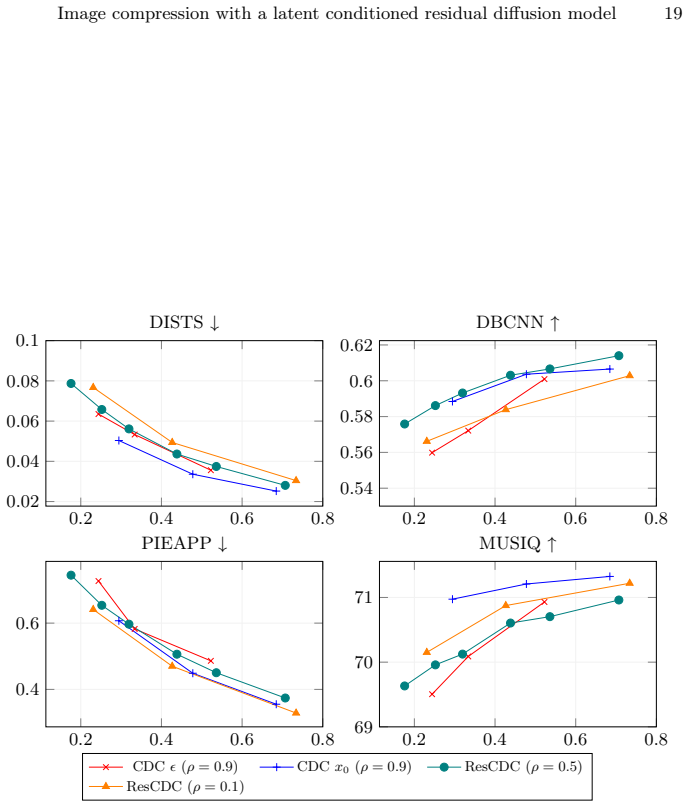
The paper's central claim is that a latent-conditioned residual denoising diffusion model, trained jointly with a conventional decoder, can recover most of the distortion performance of pure autoencoder codecs while retaining the perceptual gains of diffusion-based generative compression. The decoder output is refined by adding a predicted residual, so the diffusion model only needs to model the difference between the autoencoder reconstruction and the ground truth, which the authors argue is approximately Gaussian and therefore cheap to sample. Compared with the conditional diffusion codec (CDC) baseline, the resulting scheme, ResCDC, reports up to +2 dB PSNR on Kodak and DIV2K at comparable LPIPS and FID, with BD-rate savings of about 13–17% against the noise-predicting CDC variant; applied to pretrained video codecs such as Scale-Space Flow and DVC, it improves LPIPS substantially at some PSNR cost.
Load-bearing premise
The residual between the decoder reconstruction and the original image is close enough to a Gaussian that a single DDIM sampler with fixed noise level and 100 steps can reconstruct it well across bitrates and content.
Editorial extensions
If this is right
- Diffusion-based codecs can close the fidelity gap to autoencoder codecs without sacrificing perceptual metrics, making them viable for bandwidth-sensitive applications that require both low bitrate and faithful detail.
- Residual prediction reduces the required number of sampling steps, lowering the decoding cost that has limited diffusion codecs in practice.
- Because the recipe works on top of pretrained video codecs, it offers a plug-in perceptual enhancement path for existing learned video compression systems.
- At higher bitrates the PSNR advantage grows, so the hybrid design is most attractive for quality-focused streaming scenarios.
Reading between the lines
- If the residual Gaussianity assumption is the real driver, then content with highly structured residuals (e.g., text, sharp edges) should show smaller gains; one could test by measuring residual kurtosis on such images and correlating it with the PSNR gap.
- The video results suggest that a large share of perceptual improvement can be obtained by post-processing a frozen codec, which may make the method practical as an enhancement layer rather than a full replacement codec.
- The paper leaves open whether the decoder and diffusion could be trained with a single unified noise schedule; a joint optimization with a learned initialization might further reduce steps.
- The method's dependence on a fixed gamma=0.8 suggests that content-adaptive initialization noise could squeeze out additional quality.
Signed reviews
Editorial analysis
A structured set of objections, weighed in public.
Referee Report
Summary. This paper proposes ResCDC, a hybrid learned image/video compression scheme that combines a distortion-optimized decoder with a latent-conditioned residual denoising diffusion model. The decoder produces an initial reconstruction, and the diffusion model, conditioned on the encoder latent, predicts a residual that is added to the decoder output for perceptual refinement. Training uses a weighted combination of bitrate, l2 decoder, l1 diffusion, and LPIPS losses, with a rho parameter trading off distortion and perceptual terms; inference uses DDIM sampling with a tunable starting noise scale gamma. On the Kodak and DIV2K benchmarks, the authors report up to +2 dB PSNR over CDC while maintaining comparable LPIPS and FID scores. The method is also extended to video by training the diffusion model on top of pretrained video codecs, with results on UVG.
Significance. If the reported results hold, ResCDC is a useful contribution to diffusion-based perceptual compression: it demonstrates that a jointly trained decoder plus residual diffusion can recover much of the PSNR lost by generative decoders while retaining perceptual quality. The public implementation, the clear algorithmic description, and the ablation studies on sampling steps and rho are strengths. The central image-compression claim is plausible and supported by the plotted rate-distortion curves, but the generalization of the claim is weakened by hyperparameter selection on the evaluation datasets, the absence of error bars, and an inconsistency between the abstract's video claims and the reported video PSNR results.
major comments (3)
- [Sections 4.3 and 4.4, Figures 3-6] The headline +2 dB PSNR improvement and the 'comparable LPIPS/FID' claim rest on point estimates on Kodak and DIV2K, with rho (0.1, 0.5), gamma (0.8), and the number of DDIM steps (100) explicitly selected using those same datasets. No validation split, multiple seeds, or error bars are reported, so the reported gains may reflect tuning to these specific benchmarks rather than a general property of the method. Please provide a held-out evaluation, a sensitivity analysis over the tuned hyperparameters, or at least error bars across retraining runs to support the generalizability of the central claim.
- [Section 4.5, Figure 7, and Abstract] The abstract states that the video extension 'achieves similar results' and the title claims 'higher fidelity' compression, but Figure 7 shows PSNR degradation of more than 2 dB relative to the base codecs in several settings, and the conclusion explicitly acknowledges 'scoring lower on distortion metrics such as PSNR.' This contradiction is load-bearing for the paper's generalized claim. Please either report video results that support a fidelity improvement, or revise the abstract and framing to present the video extension as a perceptual-quality enhancement that trades off PSNR.
- [Section 3, Algorithm 2] The method assumes the residual r = x - dec(y) is approximately normally distributed, which motivates the DDIM initialization x_T ~ N(0, gamma I). No empirical evidence for this assumption is provided (e.g., histograms or normality statistics of residuals at the tested bitrates), and no sensitivity analysis with respect to gamma is shown for the image model. If the residual model is inaccurate, the reconstruction quality could degrade on other content or bitrates. Please add a distributional analysis or an ablation varying gamma to substantiate this design choice.
minor comments (5)
- [Abstract] The phrase 'increasingthedistortion' in the abstract contains a missing-space typo; it should read 'increasing the distortion.'
- [Section 4.5, footnote 5] The footnote refers to 'DVCV-FM'; this appears to be a typo for 'DCVC-FM,' which is the model name used in the text and references.
- [Section 3.3] The text states that gamma = 0.8 gives the best results for models finetuned for perceptual quality, but Section 4.5 later reports gamma = 0.1 for the video models with 10 sampling steps; please clarify why the optimal gamma differs and whether this is content- or step-dependent.
- [Tables 1 and 2] The video models show large parameter increases over the base codecs (e.g., DVC from 11.8M to 96.1M), but the paper does not discuss the associated memory or decoding-time overhead; a brief note on runtime and complexity would help practitioners assess the trade-off.
- [Figure 2] The qualitative comparison would be easier to interpret if the figure included the LPIPS/PSNR values for each panel and indicated which rho setting corresponds to the 'ours' images numbered (d)-(f), since the caption lists these but the text does not discuss the visual differences.
Circularity Check
No circular derivation found; only minor non-load-bearing self-citations.
full rationale
The central claim, that ResCDC improves PSNR by up to +2 dB over CDC while maintaining comparable LPIPS and FID, is an empirical comparison against external baselines (BPG, HiFiC, CDC) on Kodak, DIV2K, and UVG, with models trained on Vimeo90k. The residual formulation r = x - dec(y), the diffusion noise-prediction objective, and the final reconstruction x_rec = dec(y) + r_t define the method rather than presuppose the claimed improvement; the reported PSNR gain is a measured outcome, not an identity. The assumption that residuals are approximately normal is a modeling assumption and not circular. Hyperparameters such as rho = 0.5, gamma = 0.8, and 100 sampling steps are chosen using the same evaluation datasets, which raises test-set selection concerns but does not make the result true by construction. The self-citations to Timofte co-authored works ([2] for DIV2K and [46-48] for video compression) are background or dataset citations and are not load-bearing for the main comparison, which relies on the external CDC and HiFiC baselines. No uniqueness theorem or ansatz is imported from the authors' prior work to force the architecture choice. Therefore, no circular step is present.
Assumptions & free parameters
free parameters (4)
- rho =
0.5 (main), 0.1 (fidelity variant)
- gamma =
0.8 (image), 0.1 (video)
- lambda =
1e-5 warmup, then set per bitrate
- sampling_steps =
100 (image), 10 (video)
assumptions (4)
- standard math DDPM forward process q(x_t|x_0) = N(x_t; sqrt(alpha_t) x_0, (1-alpha_t) I) and DDIM reverse sampling.
- domain assumption The residual r = x - dec(y) is approximately Gaussian across images and bitrates.
- domain assumption LPIPS and FID are valid perceptual quality measures for training and evaluation.
- domain assumption Training on Vimeo90k 256x256 crops transfers to Kodak 512x768 and DIV2K 768x768 resolutions.
Cite this review
Pith. "Pith review of Higher fidelity perceptual image and video compression with a latent conditioned residual denoising diffusion model." pith.science (2026). https://pith.science/paper/WDTNWGX3
@misc{pith2026250513152,
  author       = {Pith},
  title        = {Pith review of: Higher fidelity perceptual image and video compression with a latent conditioned residual denoising diffusion model},
  year         = {2026},
  howpublished = {\url{https://pith.science/paper/WDTNWGX3}},
  note         = {Machine review of arXiv:2505.13152}
}
read the original abstract
Denoising diffusion models achieved impressive results on several image generation tasks often outperforming GAN based models. Recently, the generative capabilities of diffusion models have been employed for perceptual image compression, such as in CDC. A major drawback of these diffusion-based methods is that, while producing impressive perceptual quality images they are dropping in fidelity/increasing the distortion to the original uncompressed images when compared with other traditional or learned image compression schemes aiming for fidelity. In this paper, we propose a hybrid compression scheme optimized for perceptual quality, extending the approach of the CDC model with a decoder network in order to reduce the impact on distortion metrics such as PSNR. After using the decoder network to generate an initial image, optimized for distortion, the latent conditioned diffusion model refines the reconstruction for perceptual quality by predicting the residual. On standard benchmarks, we achieve up to +2dB PSNR fidelity improvements while maintaining comparable LPIPS and FID perceptual scores when compared with CDC. Additionally, the approach is easily extensible to video compression, where we achieve similar results.
Figures


Figures from the paper (6 more)


Reference graph
Works this paper leans on
-
[1]
In: Proceedings of the IEEE/CVF Conference on Computer Vision and Pattern Recognition
Agustsson, E., Minnen, D., Johnston, N., Balle, J., Hwang, S.J., Toderici, G.: Scale-space flow for end-to-end optimized video compression. In: Proceedings of the IEEE/CVF Conference on Computer Vision and Pattern Recognition. pp. 8503– 8512 (2020)
work page 2020
-
[2]
In: The IEEE Conference on Computer Vision and Pattern Recognition (CVPR) Workshops (July 2017)
Agustsson, E., Timofte, R.: Ntire 2017 challenge on single image super-resolution: Dataset and study. In: The IEEE Conference on Computer Vision and Pattern Recognition (CVPR) Workshops (July 2017)
work page 2017
-
[3]
https://doi.org/10.48550/ arXiv.1802.01436
Ballé, J., Minnen, D., Singh, S., Hwang, S.J., Johnston, N.: Variational image compression with a scale hyperprior (May 2018). https://doi.org/10.48550/ arXiv.1802.01436
-
[4]
Bansal, A., Borgnia, E., Chu, H.M., Li, J.S., Kazemi, H., Huang, F., Goldblum, M., Geiping, J., Goldstein, T.: Cold Diffusion: Inverting Arbitrary Image Transforms Without Noise (Aug 2022).https://doi.org/10.48550/arXiv.2208.09392
-
[5]
Bellard, F.: Bpg image format.https://bellard.org/bpg/
-
[6]
Bjontegaard, G.: Calculation of average psnr differences between rd-curves. ITU SG16 Doc. VCEG-M33 (2001)
work page 2001
-
[7]
In: Proceedings of the IEEE conference on computer vision and pattern recognition
Blau, Y., Michaeli, T.: The perception-distortion tradeoff. In: Proceedings of the IEEE conference on computer vision and pattern recognition. pp. 6228–6237 (2018)
2018
-
[8]
In: Proceedings of the IEEE/CVF conference on computer vision and pattern recognition
Chan, K.C., Zhou, S., Xu, X., Loy, C.C.: Basicvsr++: Improving video super- resolution with enhanced propagation and alignment. In: Proceedings of the IEEE/CVF conference on computer vision and pattern recognition. pp. 5972–5981 (2022)
work page 2022
Show all 53 references
-
[9]
Advances in Neural Information Processing Systems 35, 25683–25696 (2022)
Chung, H., Sim, B., Ryu, D., Ye, J.C.: Improving diffusion models for inverse problems using manifold constraints. Advances in Neural Information Processing Systems 35, 25683–25696 (2022)
2022
-
[10]
Company, E.K.: Kodak lossless true color image suite.https://r0k.us/graphics/ kodak/
-
[11]
Delbracio, M., Milanfar, P.: Inversion by Direct Iteration: An Alternative to De- noising Diffusion for Image Restoration (Mar 2023)
2023
- [12]
-
[13]
Ghouse, N.F., Petersen, J., Wiggers, A., Xu, T., Sautière, G.: A Residual Diffusion Model for High Perceptual Quality Codec Augmentation (Mar 2023)
2023
-
[14]
In: Proceedings of the IEEE/CVF Conference on Computer Vision and Pattern Recognition
He, D., Yang, Z., Peng, W., Ma, R., Qin, H., Wang, Y.: Elic: Efficient learned im- age compression with unevenly grouped space-channel contextual adaptive coding. In: Proceedings of the IEEE/CVF Conference on Computer Vision and Pattern Recognition. pp. 5718–5727 (2022)
2022
-
[15]
In: Proceed- ings of the IEEE/CVF Conference on Computer Vision and Pattern Recognition
He, D., Yang, Z., Yu, H., Xu, T., Luo, J., Chen, Y., Gao, C., Shi, X., Qin, H., Wang, Y.: Po-elic: Perception-oriented efficient learned image coding. In: Proceed- ings of the IEEE/CVF Conference on Computer Vision and Pattern Recognition. pp. 1764–1769 (2022)
2022
-
[16]
Advances in neural information processing systems30 (2017) 16 J
Heusel,M.,Ramsauer,H.,Unterthiner,T.,Nessler,B.,Hochreiter,S.:Ganstrained by a two time-scale update rule converge to a local nash equilibrium. Advances in neural information processing systems30 (2017) 16 J. Brenig, R. Timofte
2017
- [17]
-
[18]
Hoogeboom, E., Agustsson, E., Mentzer, F., Versari, L., Toderici, G., Theis, L.: High-fidelityimagecompressionwithscore-basedgenerativemodels.arXivpreprint arXiv:2305.18231 (2023)
2023 arXiv
-
[19]
arXiv preprint arXiv:2110.02037 (2021)
Hoogeboom, E., Gritsenko, A.A., Bastings, J., Poole, B., Berg, R.v.d., Salimans, T.: Autoregressive diffusion models. arXiv preprint arXiv:2110.02037 (2021)
2021 arXiv
-
[20]
In: Proceedings of the IEEE/CVF Conference on Computer Vision and Pattern Recognition
Hu, Z., Lu, G., Xu, D.: Fvc: A new framework towards deep video compression in feature space. In: Proceedings of the IEEE/CVF Conference on Computer Vision and Pattern Recognition. pp. 1502–1511 (2021)
2021
- [21]
-
[22]
Kawar, B., Song, J., Ermon, S., Elad, M.: JPEG Artifact Correction using Denois- ing Diffusion Restoration Models (Nov 2022)
2022
-
[23]
arXiv preprint arXiv:2402.08934 (2024)
Li, B., Liu, Y., Niu, X., Bai, B., Deng, L., Gündüz, D.: Extreme video compression with pre-trained diffusion models. arXiv preprint arXiv:2402.08934 (2024)
2024 arXiv
-
[24]
Advances in Neural Information Processing Systems34, 18114–18125 (2021)
Li, J., Li, B., Lu, Y.: Deep contextual video compression. Advances in Neural Information Processing Systems34, 18114–18125 (2021)
2021
-
[25]
In: Pro- ceedings of the IEEE/CVF Conference on Computer Vision and Pattern Recogni- tion
Li, J., Li, B., Lu, Y.: Neural video compression with feature modulation. In: Pro- ceedings of the IEEE/CVF Conference on Computer Vision and Pattern Recogni- tion. pp. 26099–26108 (2024)
2024
-
[26]
In: Proceedings of the IEEE/CVF conference on computer vision and pattern recognition
Lu, G., Ouyang, W., Xu, D., Zhang, X., Cai, C., Gao, Z.: Dvc: An end-to-end deep video compression framework. In: Proceedings of the IEEE/CVF conference on computer vision and pattern recognition. pp. 11006–11015 (2019)
2019
-
[27]
In: European Conference on Computer Vision
Mentzer, F., Agustsson, E., Ballé, J., Minnen, D., Johnston, N., Toderici, G.: Neu- ral video compression using gans for detail synthesis and propagation. In: European Conference on Computer Vision. pp. 562–578. Springer (2022)
2022
- [28]
-
[29]
In: Proceedings of the 11th ACM Multimedia Systems Conference
Mercat, A., Viitanen, M., Vanne, J.: Uvg dataset: 50/120fps 4k sequences for video codec analysis and development. In: Proceedings of the 11th ACM Multimedia Systems Conference. pp. 297–302 (2020)
2020
-
[30]
Minnen, D., Ballé, J., Toderici, G.: Joint Autoregressive and Hierarchical Priors for Learned Image Compression (Sep 2018)
2018
-
[31]
Nichol, A., Dhariwal, P.: Improved Denoising Diffusion Probabilistic Models (Feb 2021)
2021
-
[32]
Pan, Z., Zhou, X., Tian, H.: Extreme Generative Image Compression by Learning Text Embedding from Diffusion Models (Nov 2022)
2022
-
[33]
2022 ieee
Rombach, R., Blattmann, A., Lorenz, D., Esser, P., Ommer, B.: High-resolution image synthesis with latent diffusion models. 2022 ieee. In: CVF Conference on Computer Vision and Pattern Recognition (CVPR). pp. 10674–10685 (2021)
2021
-
[34]
Rombach, R., Blattmann, A., Lorenz, D., Esser, P., Ommer, B.: High-Resolution Image Synthesis with Latent Diffusion Models (Apr 2022)
2022
-
[35]
In: ACM SIGGRAPH 2022 Confer- ence Proceedings
Saharia, C., Chan, W., Chang, H., Lee, C., Ho, J., Salimans, T., Fleet, D., Norouzi, M.: Palette: Image-to-image diffusion models. In: ACM SIGGRAPH 2022 Confer- ence Proceedings. pp. 1–10 (2022)
2022
-
[36]
IEEE transactions on pattern analysis and ma- chine intelligence 45(4), 4713–4726 (2022)
Saharia, C., Ho, J., Chan, W., Salimans, T., Fleet, D.J., Norouzi, M.: Image super- resolution via iterative refinement. IEEE transactions on pattern analysis and ma- chine intelligence 45(4), 4713–4726 (2022)
2022
-
[37]
In: International Conference on Learning Representations (2021) Image compression with a latent conditioned residual diffusion model 17
Salimans, T., Ho, J.: Progressive distillation for fast sampling of diffusion models. In: International Conference on Learning Representations (2021) Image compression with a latent conditioned residual diffusion model 17
2021
-
[38]
arXiv preprint arXiv:1409.1556 (2014)
Simonyan, K., Zisserman, A.: Very deep convolutional networks for large-scale image recognition. arXiv preprint arXiv:1409.1556 (2014)
2014 arXiv
- [39]
-
[40]
arXiv preprint arXiv:2011.13456 (2020)
Song, Y., Sohl-Dickstein, J., Kingma, D.P., Kumar, A., Ermon, S., Poole, B.: Score- based generative modeling through stochastic differential equations. arXiv preprint arXiv:2011.13456 (2020)
2020 arXiv
-
[41]
Theis, L., Salimans, T., Hoffman, M.D., Mentzer, F.: Lossy Compression with Gaussian Diffusion (Dec 2022)
2022
-
[42]
Communications of the ACM 34(4), 30–44 (1991)
Wallace, G.K.: The jpeg still picture compression standard. Communications of the ACM 34(4), 30–44 (1991)
1991
-
[43]
In: The Thrity-Seventh Asilomar Conference on Signals, Systems & Computers, 2003
Wang, Z., Simoncelli, E.P., Bovik, A.C.: Multiscale structural similarity for im- age quality assessment. In: The Thrity-Seventh Asilomar Conference on Signals, Systems & Computers, 2003. vol. 2, pp. 1398–1402. Ieee (2003)
2003
-
[44]
Whang, J., Delbracio, M., Talebi, H., Saharia, C., Dimakis, A.G., Milanfar, P.: Deblurringviastochasticrefinement.In:ProceedingsoftheIEEE/CVFConference on Computer Vision and Pattern Recognition. pp. 16293–16303 (2022)
2022
-
[45]
International Journal of Computer Vision127, 1106–1125 (2019)
Xue, T., Chen, B., Wu, J., Wei, D., Freeman, W.T.: Video enhancement with task- oriented flow. International Journal of Computer Vision127, 1106–1125 (2019)
2019
-
[46]
In: Proceedings of the IEEE/CVF Conference on Computer Vision and Pattern Recognition
Yang,R.,Mentzer,F.,Gool,L.V.,Timofte,R.:Learningforvideocompressionwith hierarchical quality and recurrent enhancement. In: Proceedings of the IEEE/CVF Conference on Computer Vision and Pattern Recognition. pp. 6628–6637 (2020)
2020
-
[47]
IEEE Transactions on Circuits and Systems for Video Technology 33(5), 2410–2423 (2022)
Yang, R., Timofte, R., Van Gool, L.: Advancing learned video compression with in-loop frame prediction. IEEE Transactions on Circuits and Systems for Video Technology 33(5), 2410–2423 (2022)
2022
-
[48]
In: IJCAI
Yang, R., Timofte, R., Van Gool, L.: Perceptual learned video compression with recurrent conditional gan. In: IJCAI. pp. 1537–1544 (2022)
2022
-
[49]
Advances in Neural Information Processing Systems36 (2024)
Yang, R., Mandt, S.: Lossy image compression with conditional diffusion models. Advances in Neural Information Processing Systems36 (2024)
2024
-
[50]
In: Proceedings of the IEEE conference on computer vision and pattern recognition
Zhang, R., Isola, P., Efros, A.A., Shechtman, E., Wang, O.: The unreasonable effectiveness of deep features as a perceptual metric. In: Proceedings of the IEEE conference on computer vision and pattern recognition. pp. 586–595 (2018)
2018
-
[51]
In: Proceedings of the IEEE/CVF Conference on Computer Vision and Pattern Recognition
Zheng, M., Xing, Q., Qiao, M., Xu, M., Jiang, L., Liu, H., Chen, Y.: Progressive training of a two-stage framework for video restoration. In: Proceedings of the IEEE/CVF Conference on Computer Vision and Pattern Recognition. pp. 1024– 1031 (2022)
2022
-
[52]
arXiv preprint arXiv:2211.08428 (2022)
Zhou, Q., Li, R., Guo, S., Dong, P., Liu, Y., Guo, J., Xu, Z.: Cadm: Codec- aware diffusion modeling for neural-enhanced video streaming. arXiv preprint arXiv:2211.08428 (2022)
2022 arXiv
-
[53]
In: Proceedings of the IEEE/CVF Conference on Computer Vision and Pattern Recognition
Zhou, S., Yang, P., Wang, J., Luo, Y., Loy, C.C.: Upscale-a-video: Temporal- consistent diffusion model for real-world video super-resolution. In: Proceedings of the IEEE/CVF Conference on Computer Vision and Pattern Recognition. pp. 2535–2545 (2024) 18 J. Brenig, R. Timofte A...
2024
Reviewed August 15, 2026 · model on record in the stance chip above.
Discussion (0). Continue with ORCID to comment.