REVIEW 4 major objections 7 minor 48 references
FlowCut: Unsupervised Video Instance Segmentation via Temporal Mask Matching
T0 review · 4 major / 7 minor · reviewed 2026-08-15 · deepseek-v4-flash
Pith's one-line read FlowCut claims that a three-stage pipeline—DINO and optical-flow pseudo-masks, IoU-based two-frame curation, and VideoMask2Former training—achieves state-of-the-art unsupervised video instance segmentation on YouTubeVIS-2019/2021 and…
desk verdict FlowCut has a genuinely simple pseudo-labeling recipe and honest DAVIS results, but its YouTubeVIS SOTA claim is undermined by training and evaluating on the same split—likely a data-domain effect, not a method win. read the letter →
The pith
A machine-rendered reading of the paper's core claim, the machinery that carries it, and where it could break.
The reading
What carries the argument
The load-bearing object is the flow-augmented affinity matrix $W$ from Eq. (3) combined with the iterative mask-removal update of Eq. (4). $W$ makes pairwise patch similarity depend on both DINO RGB features and DINO features of the optical-flow visualization, balanced by $\alpha$, and normalized cuts on $W$ produce one foreground/background split per iteration; multiplying $W$ by inverted masks from previous iterations forces subsequent cuts to find new instances. The curation algorithm is the second mechanism: it computes an IoU matrix over instances of two frames up to four time steps apart, matches by row-wise argmax, and discards any match with IoU $\le 0.5$, turning noisy per-frame masks into consistent two-frame pseudo-annotations. These two mechanisms together make the training signal for VideoMask2Former.
What would settle it
Evaluate FlowCut on the YouTubeVIS-2021 validation split after training only on pseudo-labels built from a disjoint set of videos, and compare its AP against VideoCutLER evaluated on the same held-out split. If the advantage shrinks or reverses, the claimed state-of-the-art on YouTubeVIS reflects in-domain training rather than unsupervised generalization.
Extended reading notes
Core claim
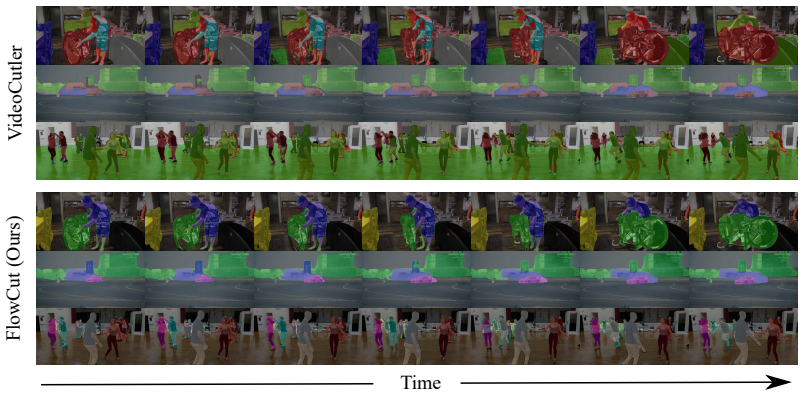
The central claim is that high-quality pseudo-labels for video instance segmentation can be produced by combining appearance and motion cues in a single affinity matrix and then enforcing temporal consistency with a simple IoU matching rule. Specifically, the affinity between patches is $w_{ij}=1$ when $\alpha\langle h^{\text{rgb}}_i,h^{\text{rgb}}_j\rangle+(1-\alpha)\langle h^{\text{of}}_i,h^{\text{of}}_j\rangle>\tau$ and $\epsilon$ otherwise, where $h^{\text{rgb}}$ and $h^{\text{of}}$ are DINO features of the frame and of the optical-flow visualization; the resulting graph is cut with generalized eigenvalue decomposition. The per-frame masks are iteratively removed from the affinity (as in CutLER) to discover several instances. A curation step computes the IoU matrix between instances in two nearby frames, matches each instance in one frame to its argmax partner in the other, and keeps the pair only when the IoU exceeds 0.5. Training VideoMask2Former on the resulting two-frame clips yields the reported state of the art on YouTubeVIS-2019/2021 and DAVIS-2017/Motion, with ablations attributing a substantial part of the gain to the optical-flow term.
Load-bearing premise
The headline YouTubeVIS results assume that it is fair to train and evaluate on the same videos; if unseen videos are required for a fair unsupervised evaluation, the size of the reported gains is unverified.
Editorial extensions
If this is right
- No manual video annotations enter the FlowCut training loop: self-supervised features plus optical flow replace human masks.
- The optical-flow term in pseudo-mask estimation contributes a consistent gain in the ablations: +3.1 AP on YouTubeVIS-2019 and +1.8 AP on YouTubeVIS-2021.
- The curation recipe transfers across datasets: pseudo-labels built from YouTubeVIS-2021 frames train a model that also sets reported state-of-the-art scores on DAVIS-2017 and DAVIS-2017 Motion.
- Training on pseudo-labels drawn from the same distribution as the evaluation set gives the largest improvements, which the paper reads as evidence that in-domain pseudo-labels matter.
Reading between the lines
- A natural extension the paper does not test is chaining pairwise matches across frames to build clips longer than two frames; the paper itself lists full-sequence pseudo-mask estimation as future work.
- The IoU-matching curation step is feature-agnostic, so swapping DINO for a stronger self-supervised backbone would likely improve pseudo-mask quality without changing the pipeline.
- A decisive stress test the paper does not report is evaluating on a YouTubeVIS split disjoint from the videos used to build pseudo-labels, which would separate in-domain training gains from true generalization.
Signed reviews
Editorial analysis
A structured set of objections, weighed in public.
Referee Report
Summary. FlowCut is a three-stage unsupervised video instance segmentation method. In the first stage it generates per-frame pseudo instance masks by combining DINO feature affinities for RGB frames and RAFT optical-flow visualizations (LOCATE-style convex combination) with iterative Cutler-style mask extraction. In the second stage it curates two-frame training clips by matching pseudo-masks across frames through an IoU threshold of 0.5, discarding unmatched instances. In the third stage it trains a VideoMask2Former with a ResNet-50 backbone on these curated clips extracted from the YouTubeVIS-2021 training set, supplementing with ImageNet pseudo-labels for the DAVIS experiments. The authors report state-of-the-art results on YouTubeVIS-2019, YouTubeVIS-2021, DAVIS-2017, and DAVIS-2017-Motion, and present ablations showing that optical-flow information improves AP consistently. The main claim is that automatically curated pseudo-labeled video clips are sufficient to train a competitive video instance segmentation model without any manual supervision.
Significance. If the evaluation protocol were valid, this would be a useful contribution: the pipeline is simple, combines existing components in a clean way, is compute-efficient (a single 3090 Ti and 5000 iterations for the main model), and the ablation evidence that optical flow improves pseudo-mask quality is consistent across four training/evaluation combinations. The idea of building a pseudo-labeled video dataset from real video frames and then distilling it into a video segmentation model is potentially valuable. However, the YouTubeVIS state-of-the-art claim is currently undermined by direct training/evaluation overlap on the YouTubeVIS-2021 training set, and the DAVIS margins are small, reported from a single run with no error bars or significance tests. As a result, the empirical contribution is not yet established to the standard required for the headline claims. The method itself is defensible and the issues are addressable, but the current evidence does not support the reported SOTA conclusions.
major comments (4)
- [Sec. 4.1 (Test Data), Tables 3 and 5] The YouTubeVIS-2021 results in Table 3 are not a valid held-out comparison. The model is trained on the YouTubeVIS-2021 training set and evaluated on the same YouTubeVIS-2021 training set, as stated in Sec. 4.1. Because VideoCutler* is a fixed checkpoint trained on ImageNet, the comparison conflates method quality with access to the target-domain videos. The paper's own ablation in Table 5 shows that switching training data from YouTubeVIS-2019 to YouTubeVIS-2021 raises YouTubeVIS-2021 AP from 16.7 to 18.0 (+1.3), while the reported AP advantage over VideoCutler* in Table 3 is only +0.6. Thus the entire reported margin on this benchmark can be explained by in-domain training alone. The statement in Sec. 4.1 that 'the evaluation remains unsupervised' does not address the fact that the model has seen the exact evaluation frames during training. Please re-evaluate on a held-out validation set, or at least report validation-set numbers, and restrict the SOTA claim to comparisons that are not confounded by training/evaluation overlap.
- [Sec. 4.1, Tables 2 and 4 (YouTubeVIS-2019)] The YouTubeVIS-2019 evaluation in Table 2 is also performed on the training split of 2,238 videos rather than on a held-out set. Although the model is not trained on those exact frames, it is trained on the same dataset domain, and Table 4 shows that training on YouTubeVIS-2019 itself raises YouTubeVIS-2019 AP from 24.3 (training on YouTubeVIS-2021) to 25.1, a +0.8 gain. Consequently, the claim of state-of-the-art performance on YouTubeVIS-2019 relies on an unconventional evaluation protocol. Please also evaluate on the YouTubeVIS-2019 validation set, and report both the standard benchmark numbers and any training-set numbers separately.
- [Sec. 4.2, Table 1] The DAVIS results are reported from a single run with no error bars or significance tests. The J&F margin over VideoCutler* is +1.1 on DAVIS-2017 and +3.7 on DAVIS-2017-Motion, and on DAVIS-2017 the F score actually decreases (45.2 vs 45.6). Without multiple seeds or variance estimates, these small margins do not establish a reliable improvement. Please report standard deviations across at least three seeds, or perform an appropriate significance test, before claiming a DAVIS state-of-the-art result.
- [Sec. 4.1, Eq. (3)] The value of the fusion weight α used in the main experiments is not reported; the ablation section only states that α=1 corresponds to removing optical flow. Since α controls the core contribution of the method, this omission prevents reproduction of the reported numbers. Please state the α value used for each reported model, together with the other hyperparameters already listed in Sec. 4.1.
minor comments (7)
- [Sec. 3.3 heading] The heading 'Automated Dateset Curation' should read 'Automated Dataset Curation'.
- [Throughout] The benchmark name is written inconsistently as 'DA VIS-2017' and 'DAVIS-2017'; please use 'DAVIS' throughout.
- [Sec. 3.4] The cross-reference 'described in Sec. 3.2 and Sec. 3.2' should refer to Sec. 3.2 and Sec. 3.3.
- [Introduction and Sec. 2] The claim of being 'the first attempt to curate a video dataset with pseudo-labels for unsupervised video instance segmentation' should be qualified, since VideoCutler also trains on pseudo-labeled video data constructed from single images; if the intended distinction is the use of real video frames, that should be stated explicitly.
- [Fig. 2 caption] The caption mentions a 'synthetic image pair', but no synthetic image is generated; the figure appears to illustrate the two-frame clip construction, so the caption should be reworded for clarity.
- [Algorithm 1] The greedy matching in Algorithm 1 does not prevent two first-frame instances from being matched to the same second-frame instance; the effect of this potential collision on the curated dataset is not discussed.
- [Sec. 4.1 and reproducibility] Code is not released; given the evaluation-protocol issues, releasing the code and the pseudo-label generation scripts would substantially strengthen reproducibility and trust in the reported numbers.
Circularity Check
YouTubeVIS SOTA claim is confounded by training on the same split used for evaluation; the paper's own ablations show the entire reported margin over VideoCutler* could be explained by in-domain data access.
-
fitted input called prediction
[Sec. 4.1 Training Data and Test Data; Sec. 4.2 Tables 2-3; Sec. 4.3 Table 5]
"Our method is trained on a dataset of 167,365 two-frame short video segments, which are generated from the frames of the YouTubeVIS-2021 training set [45]... We evaluate our model on the training sets of YouTubeVIS-2019 [46] (2,238 videos) and YouTubeVIS-2021 [45] (2,985 videos)... It is important to note that while the YouTubeVIS-2021 training set is used for both training and evaluation, the evaluation remains unsupervised, as our method relies solely on pseudo-masks during training."
The headline YouTubeVIS-2021 result is produced by a model trained on the exact frames it is later scored on, so the reported AP is not an independent held-out prediction. The VideoCutler* baseline is a fixed pretrained checkpoint not trained on YouTubeVIS, so the comparison conflates method quality with access to the target-domain videos. The paper's own Table 5 shows that switching the training data from YouTubeVIS-2019 to YouTubeVIS-2021 changes YouTubeVIS-2021 AP from 16.7 to 18.0 (+1.3), whereas the entire reported margin over VideoCutler* in Table 3 is only +0.6 AP. Thus the claimed SOTA advantage can be accounted for by in-domain training-data exposure alone, making the YouTubeVIS 'prediction' largely a fitted-input result rather than a generalization result.
full rationale
The pseudo-mask estimation pipeline itself is not definitionally circular: it combines DINO features and optical flow through normalized cuts (TokenCut/LOCATE/Cutler) to produce pseudo-masks, curates two-frame clips by IoU matching, and trains VideoMask2Former. None of these stages uses the evaluation ground-truth labels as inputs, and the DAVIS-2017 and DAVIS-2017-Motion evaluations are held-out and therefore provide independent external evidence. The circularity concern is limited to the YouTubeVIS benchmark claims: the model is trained and evaluated on the same YouTubeVIS-2021 training frames, and the paper explicitly acknowledges this overlap. Because the comparison baseline VideoCutler* was not trained on YouTubeVIS, and because the paper's own cross-domain ablation shows an in-domain gain (+1.3 AP) larger than the total reported SOTA margin (+0.6 AP), the YouTubeVIS headline result is at least partially a consequence of test-set exposure rather than the proposed method. No additional self-citation or uniqueness-theorem circularity was found: self-citations to the authors' prior work are not load-bearing for the main derivation.
Assumptions & free parameters
free parameters (5)
- alpha =
not reported
- affinity threshold tau =
0.15
- max instance masks =
3
- IoU match threshold =
0.5
- evaluation score thresholds =
0.8 (YTVIS), 0.3 (DAVIS)
assumptions (5)
- domain assumption DINO self-supervised features encode object-level semantic structure that can be partitioned into instances via normalized cuts.
- domain assumption Optical flow visualizations provide complementary motion cues that improve pseudo-mask quality.
- standard math Normalized cuts on the thresholded affinity matrix yield meaningful foreground instance masks.
- domain assumption High IoU between masks in consecutive frames implies the same instance, and 50% IoU is sufficient for reliable matching.
- domain assumption Training and evaluating on the same video frames is a valid unsupervised evaluation protocol.
Cite this review
Pith. "Pith review of FlowCut: Unsupervised Video Instance Segmentation via Temporal Mask Matching." pith.science (2026). https://pith.science/paper/EYK56AKU
@misc{pith2026250513174,
  author       = {Pith},
  title        = {Pith review of: FlowCut: Unsupervised Video Instance Segmentation via Temporal Mask Matching},
  year         = {2026},
  howpublished = {\url{https://pith.science/paper/EYK56AKU}},
  note         = {Machine review of arXiv:2505.13174}
}
read the original abstract
We propose FlowCut, a simple and capable method for unsupervised video instance segmentation consisting of a three-stage framework to construct a high-quality video dataset with pseudo labels. To our knowledge, our work is the first attempt to curate a video dataset with pseudo-labels for unsupervised video instance segmentation. In the first stage, we generate pseudo-instance masks by exploiting the affinities of features from both images and optical flows. In the second stage, we construct short video segments containing high-quality, consistent pseudo-instance masks by temporally matching them across the frames. In the third stage, we use the YouTubeVIS-2021 video dataset to extract our training instance segmentation set, and then train a video segmentation model. FlowCut achieves state-of-the-art performance on the YouTubeVIS-2019, YouTubeVIS-2021, DAVIS-2017, and DAVIS-2017 Motion benchmarks.
Figures


Figures from the paper (1 more)

Reference graph
Works this paper leans on
-
[1]
Cuvler: Enhanced unsupervised object discoveries through exhaustive self-supervised transformers
Shahaf Arica, Or Rubin, Sapir Gershov, and Shlomi Laufer. Cuvler: Enhanced unsupervised object discoveries through exhaustive self-supervised transformers. In CVPR, pages 23105– 23114, 2024
work page 2024
-
[2]
Self-supervised object-centric learning for videos
Görkay Aydemir, Weidi Xie, and Fatma Guney. Self-supervised object-centric learning for videos. NeurIPS, 36:32879–32899, 2023
work page 2023
-
[3]
Emergence of object segmentation in perturbed generative models
Adam Bielski and Paolo Favaro. Emergence of object segmentation in perturbed generative models. NeurIPS, 32, 2019
work page 2019
-
[4]
Move: Unsupervised movable object segmentation and detection
Adam Bielski and Paolo Favaro. Move: Unsupervised movable object segmentation and detection. NeurIPS, 35:33371–33386, 2022
work page 2022
-
[5]
Unsupervised learning of visual features by contrasting cluster assignments
Mathilde Caron, Ishan Misra, Julien Mairal, Priya Goyal, Piotr Bojanowski, and Armand Joulin. Unsupervised learning of visual features by contrasting cluster assignments. NeurIPS, 33:9912–9924, 2020
work page 2020
-
[6]
Emerging properties in self-supervised vision transformers
Mathilde Caron, Hugo Touvron, Ishan Misra, Hervé Jégou, Julien Mairal, Piotr Bojanowski, and Armand Joulin. Emerging properties in self-supervised vision transformers. In ICCV, pages 9650–9660, 2021
work page 2021
-
[7]
Rethinking atrous convolution for semantic image segmentation
Liang-Chieh Chen, George Papandreou, Florian Schroff, and Hartwig Adam. Rethinking atrous convolution for semantic image segmentation. arXiv preprint arXiv:1706.05587, 2017
arXiv 2017
-
[8]
A simple framework for contrastive learning of visual representations
Ting Chen, Simon Kornblith, Mohammad Norouzi, and Geoffrey Hinton. A simple framework for contrastive learning of visual representations. In ICML, pages 1597–1607. PMLR, 2020
work page 2020
Show all 48 references
-
[9]
Mask2former for video instance segmentation.arXiv preprint arXiv:2112.10764, 2021
Bowen Cheng, Anwesa Choudhuri, Ishan Misra, Alexander Kirillov, Rohit Girdhar, and Alexan- der G Schwing. Mask2former for video instance segmentation.arXiv preprint arXiv:2112.10764, 2021
2021 arXiv
-
[10]
Per-pixel classification is not all you need for semantic segmentation
Bowen Cheng, Alex Schwing, and Alexander Kirillov. Per-pixel classification is not all you need for semantic segmentation. NeurIPS, 34:17864–17875, 2021
2021
-
[11]
Guess what moves: Unsupervised video and image segmentation by anticipating motion
Subhabrata Choudhury, Laurynas Karazija, Iro Laina, Andrea Vedaldi, and Christian Rupprecht. Guess what moves: Unsupervised video and image segmentation by anticipating motion. arXiv preprint arXiv:2205.07844, 2022
2022 arXiv
-
[12]
Imagenet: A large-scale hierarchical image database
Jia Deng, Wei Dong, Richard Socher, Li-Jia Li, Kai Li, and Li Fei-Fei. Imagenet: A large-scale hierarchical image database. In CVPR, pages 248–255. Ieee, 2009
2009
-
[13]
Unsupervised semantic segmentation by distilling feature correspondences
Mark Hamilton, Zhoutong Zhang, Bharath Hariharan, Noah Snavely, and William T Freeman. Unsupervised semantic segmentation by distilling feature correspondences. arXiv preprint arXiv:2203.08414, 2022
2022 arXiv
-
[14]
Masked autoencoders are scalable vision learners
Kaiming He, Xinlei Chen, Saining Xie, Yanghao Li, Piotr Dollár, and Ross Girshick. Masked autoencoders are scalable vision learners. In CVPR, pages 16000–16009, 2022
2022
-
[15]
Momentum contrast for unsupervised visual representation learning
Kaiming He, Haoqi Fan, Yuxin Wu, Saining Xie, and Ross Girshick. Momentum contrast for unsupervised visual representation learning. In CVPR, pages 9729–9738, 2020
2020
-
[16]
Deep residual learning for image recognition
Kaiming He, Xiangyu Zhang, Shaoqing Ren, and Jian Sun. Deep residual learning for image recognition. In CVPR, pages 770–778, 2016
2016
-
[17]
Segment anything in high quality
Lei Ke, Mingqiao Ye, Martin Danelljan, Yu-Wing Tai, Chi-Keung Tang, Fisher Yu, et al. Segment anything in high quality. NeurIPS, 36, 2024
2024
-
[18]
Motion trajectory segmentation via minimum cost multicuts
Margret Keuper, Bjoern Andres, and Thomas Brox. Motion trajectory segmentation via minimum cost multicuts. In ICCV, pages 3271–3279, 2015
2015
-
[19]
Motion segmen- tation & multiple object tracking by correlation co-clustering
Margret Keuper, Siyu Tang, Bjoern Andres, Thomas Brox, and Bernt Schiele. Motion segmen- tation & multiple object tracking by correlation co-clustering. IEEE TPAMI, 42(1):140–153, 2018. 10
2018
-
[20]
Segment anything
Alexander Kirillov, Eric Mintun, Nikhila Ravi, Hanzi Mao, Chloe Rolland, Laura Gustafson, Tete Xiao, Spencer Whitehead, Alexander C Berg, Wan-Yen Lo, et al. Segment anything. arXiv preprint arXiv:2304.02643, 2023
2023 arXiv
-
[21]
Efficient inference in fully connected crfs with gaussian edge potentials
Philipp Krähenbühl and Vladlen Koltun. Efficient inference in fully connected crfs with gaussian edge potentials. NeurIPS, 24, 2011
2011
-
[22]
Decoupled weight decay regularization
Ilya Loshchilov and Frank Hutter. Decoupled weight decay regularization. arXiv preprint arXiv:1711.05101, 2017
2017 arXiv
-
[23]
Deep spectral meth- ods: A surprisingly strong baseline for unsupervised semantic segmentation and localization
Luke Melas-Kyriazi, Christian Rupprecht, Iro Laina, and Andrea Vedaldi. Deep spectral meth- ods: A surprisingly strong baseline for unsupervised semantic segmentation and localization. In CVPR, pages 8364–8375, 2022
2022
-
[24]
Dinov2: Learning robust visual features without supervision
Maxime Oquab, Timothée Darcet, Théo Moutakanni, Huy V o, Marc Szafraniec, Vasil Khalidov, Pierre Fernandez, Daniel Haziza, Francisco Massa, Alaaeldin El-Nouby, et al. Dinov2: Learning robust visual features without supervision. arXiv preprint arXiv:2304.07193, 2023
2023 arXiv
-
[25]
The 2017 davis challenge on video object segmentation
Jordi Pont-Tuset, Federico Perazzi, Sergi Caelles, Pablo Arbeláez, Alex Sorkine-Hornung, and Luc Van Gool. The 2017 davis challenge on video object segmentation. arXiv preprint arXiv:1704.00675, 2017
2017 arXiv
-
[26]
U2-net: Going deeper with nested u-structure for salient object detection
Xuebin Qin, Zichen Zhang, Chenyang Huang, Masood Dehghan, Osmar R Zaiane, and Martin Jagersand. U2-net: Going deeper with nested u-structure for salient object detection. PR, 106:107404, 2020
2020
-
[27]
Sam 2: Segment anything in images and videos
Nikhila Ravi, Valentin Gabeur, Yuan-Ting Hu, Ronghang Hu, Chaitanya Ryali, Tengyu Ma, Haitham Khedr, Roman Rädle, Chloe Rolland, Laura Gustafson, et al. Sam 2: Segment anything in images and videos. arXiv preprint arXiv:2408.00714, 2024
2024 arXiv
-
[28]
Sempart: Self-supervised multi-resolution partitioning of image semantics
Sriram Ravindran and Debraj Basu. Sempart: Self-supervised multi-resolution partitioning of image semantics. In ICCV, pages 723–733, 2023
2023
-
[29]
U-net: Convolutional networks for biomedical image segmentation
Olaf Ronneberger, Philipp Fischer, and Thomas Brox. U-net: Convolutional networks for biomedical image segmentation. In Medical Image Computing and Computer-Assisted Intervention–MICCAI 2015: 18th International Conference, Munich, Germany, October 5-9, 2015, Proceedings, Part ...
2015
-
[30]
Multi-object discovery by low-dimensional object motion
Sadra Safadoust and Fatma Güney. Multi-object discovery by low-dimensional object motion. In ICCV, pages 734–744, 2023
2023
-
[31]
Boosting unsupervised segmentation learning
Alp Eren Sari, Francesco Locatello, and Paolo Favaro. Boosting unsupervised segmentation learning. arXiv preprint arXiv:2404.03392, 2024
2024 arXiv
-
[32]
Bridging the gap to real-world object-centric learning
Maximilian Seitzer, Max Horn, Andrii Zadaianchuk, Dominik Zietlow, Tianjun Xiao, Carl- Johann Simon-Gabriel, Tong He, Zheng Zhang, Bernhard Schölkopf, Thomas Brox, et al. Bridging the gap to real-world object-centric learning. arXiv preprint arXiv:2209.14860, 2022
2022 arXiv
-
[33]
Normalized cuts and image segmentation
Jianbo Shi and Jitendra Malik. Normalized cuts and image segmentation. IEEE TPAMI, 22(8):888–905, 2000
2000
-
[34]
Unsupervised salient object detection with spectral cluster voting
Gyungin Shin, Samuel Albanie, and Weidi Xie. Unsupervised salient object detection with spectral cluster voting. In CVPR, pages 3971–3980, 2022
2022
-
[35]
Localizing objects with self-supervised transformers and no labels
Oriane Siméoni, Gilles Puy, Huy V V o, Simon Roburin, Spyros Gidaris, Andrei Bursuc, Patrick Pérez, Renaud Marlet, and Jean Ponce. Localizing objects with self-supervised transformers and no labels. In BMVC, 2021
2021
-
[36]
Unsupervised object localization: Observing the background to discover objects
Oriane Siméoni, Chloé Sekkat, Gilles Puy, Antonín V obeck`y, Éloi Zablocki, and Patrick Pérez. Unsupervised object localization: Observing the background to discover objects. In CVPR, pages 3176–3186, 2023
2023
-
[37]
Locate: self- supervised object discovery via flow-guided graph-cut and bootstrapped self-training
Silky Singh, Shripad Deshmukh, Mausoom Sarkar, and Balaji Krishnamurthy. Locate: self- supervised object discovery via flow-guided graph-cut and bootstrapped self-training. arXiv preprint arXiv:2308.11239, 2023. 11
2023 arXiv
-
[38]
Raft: Recurrent all-pairs field transforms for optical flow
Zachary Teed and Jia Deng. Raft: Recurrent all-pairs field transforms for optical flow. In ECCV, pages 402–419. Springer, 2020
2020
-
[39]
Cut and learn for unsupervised object detection and instance segmentation
Xudong Wang, Rohit Girdhar, Stella X Yu, and Ishan Misra. Cut and learn for unsupervised object detection and instance segmentation. In CVPR, pages 3124–3134, 2023
2023
-
[40]
Videocutler: Surprisingly simple unsupervised video instance segmentation
Xudong Wang, Ishan Misra, Ziyun Zeng, Rohit Girdhar, and Trevor Darrell. Videocutler: Surprisingly simple unsupervised video instance segmentation. In CVPR, pages 22755–22764, 2024
2024
-
[41]
Segment anything without supervision
Xudong Wang, Jingfeng Yang, and Trevor Darrell. Segment anything without supervision. NeurIPS, 37:138731–138755, 2025
2025
-
[42]
Tokencut: Segmenting objects in images and videos with self- supervised transformer and normalized cut
Yangtao Wang, Xi Shen, Yuan Yuan, Yuming Du, Maomao Li, Shell Xu Hu, James L Crowley, and Dominique Vaufreydaz. Tokencut: Segmenting objects in images and videos with self- supervised transformer and normalized cut. IEEE TPAMI, 2023
2023
-
[43]
Segmenting moving objects via an object-centric layered representation
Junyu Xie, Weidi Xie, and Andrew Zisserman. Segmenting moving objects via an object-centric layered representation. NeurIPS, 35:28023–28036, 2022
2022
-
[44]
Self-supervised video object segmentation by motion grouping
Charig Yang, Hala Lamdouar, Erika Lu, Andrew Zisserman, and Weidi Xie. Self-supervised video object segmentation by motion grouping. In ICCV, pages 7177–7188, 2021
2021
-
[45]
The 3rd large-scale video object segmentation challenge - video instance segmentation track, June 2021
Linjie Yang, Yuchen Fan, Yang Fu, and Ning Xu. The 3rd large-scale video object segmentation challenge - video instance segmentation track, June 2021
2021
-
[46]
Video instance segmentation
Linjie Yang, Yuchen Fan, and Ning Xu. Video instance segmentation. In ICCV, 2019
2019
-
[47]
Deformable sprites for unsupervised video decomposition
Vickie Ye, Zhengqi Li, Richard Tucker, Angjoo Kanazawa, and Noah Snavely. Deformable sprites for unsupervised video decomposition. In CVPR, pages 2657–2666, 2022
2022
-
[48]
Unsupervised semantic segmentation with self-supervised object-centric representations
Andrii Zadaianchuk, Matthaeus Kleindessner, Yi Zhu, Francesco Locatello, and Thomas Brox. Unsupervised semantic segmentation with self-supervised object-centric representations. arXiv preprint arXiv:2207.05027, 2022. 12
2022 arXiv
Reviewed August 15, 2026 · model on record in the stance chip above.
Discussion (0). Continue with ORCID to comment.