REVIEW 2 major objections 5 minor 38 references
Magnetised Bounds for Conformal Field Theories
T0 review · 2 major / 5 minor · reviewed 2026-08-15 · deepseek-v4-flash
Pith's one-line read This paper shows that a parity-preserving three-dimensional CFT in a large background magnetic field, when gapped, must satisfy $c_0 \le 0$, forcing diamagnetic large-field response and positive background monopole dimensions.
desk verdict A careful, honest EFT-positivity paper where the central bounds are conditional on an explicit mass-gap assumption; the free scalar checks out, and the cleanest next step is an interacting gapped example. read the letter →
The pith
A machine-rendered reading of the paper's core claim, the machinery that carries it, and where it could break.
The reading
What carries the argument
The load-bearing object is the generalised dispersion relation for retarded Green’s functions of the operator $O(x)=\partial_0 J_\mu(x)V^\mu + T_{\mu\nu}(x)U^{\mu\nu}$, evaluated at momentum $k=\omega(1,\vec\xi)$ with $|\vec\xi|<1$. In a gapped phase the retarded correlator is analytic in the upper-half $\omega$-plane and grows like $\omega^d$, so contour integration yields a positive spectral sum rule, $G_R^{(\ell)}(0)\ge 0$ for even $\ell>d$, which translates into positive semi-definiteness of an $8\times 8$ matrix built from current and stress-tensor two-point functions. Demanding that the $\omega^4$, $\omega^6$ and $\omega^8$ coefficients of this matrix be positive semi-definite for all $|\vec\xi|<1$ produces the inequalities (5.30)–(5.39): $c_0\le0$, $c_{2,3}\le0$, and a sequence of quadratic and cubic bounds whose regions in coefficient space have piecewise boundaries.
What would settle it
Take any concrete parity-preserving 3D CFT, put it on a three-sphere with large magnetic flux $Q$, and compute the free energy, or equivalently the monopole scaling dimension, by exact diagonalisation or Monte Carlo: if a theory with a demonstrable gap gives $\Delta<0$ or coefficients outside the region (5.55), the dispersive bound is wrong; conversely, violations in a gapless theory, such as the free Dirac fermion, do not test the bound because the premise fails.
Extended reading notes
Core claim
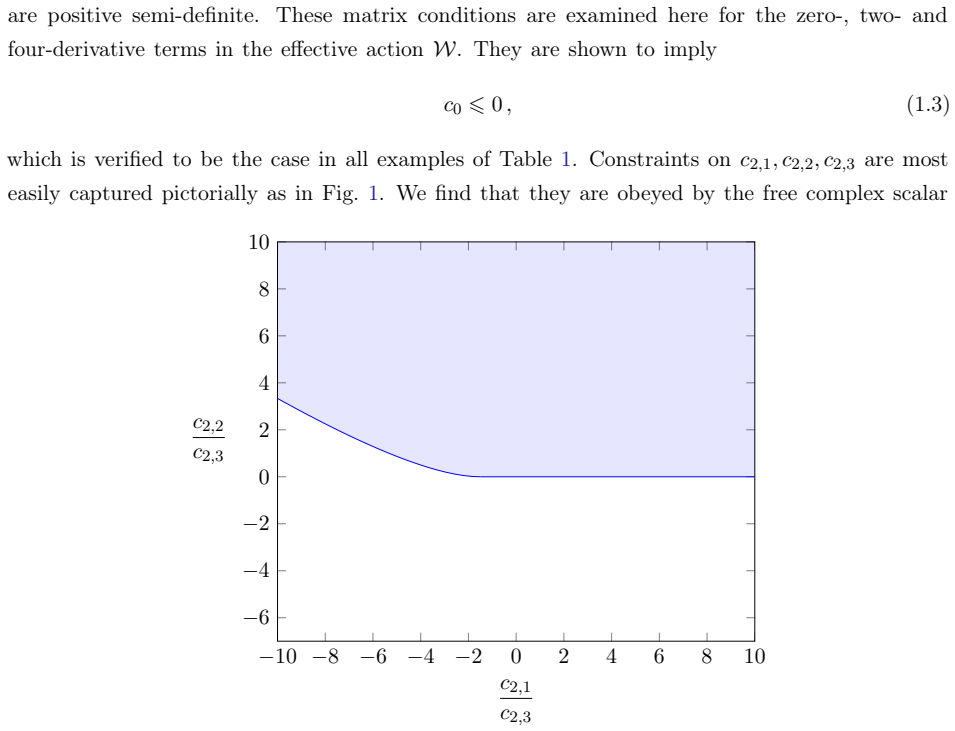
Weyl invariance forces the low-energy effective action $W[A,g]$ of a gapped magnetised CFT to be built from the hatted metric $\hat g_{\mu\nu}=g_{\mu\nu}F$ and a rescaled field strength, giving one zero-derivative term, three two-derivative terms, and twenty-eight four-derivative terms. Computing the current and stress-tensor two-point functions from this action and imposing a generalised Kramers–Kronig positivity condition on the retarded Green’s functions yields $c_0\le 0$ and the inequalities (5.30)–(5.39). In the $c_{2,1}/c_{2,3}$–$c_{2,2}/c_{2,3}$ plane the allowed region has a boundary with a kink at $(-3/2,0)$. The paper computes all second-order Wilson coefficients for the free complex scalar, the free four-component fermion, and a holographic model with a Maxwell field and negative cosmological constant; only the scalar satisfies the bounds, and the paper ties the fermion’s and holographic model’s violations to their gapless lowest Landau level and extremal horizon degeneracy, respectively.
Load-bearing premise
The magnetic field opens a real mass gap, so no massless excitations survive and the retarded Green’s function is analytic away from a mass threshold; without this, the positive spectral sum rule and all derived inequalities can fail.
Editorial extensions
If this is right
- The large-field free energy satisfies $E(B)\sim -\sqrt{2}\pi c_0 Q^{3/2}/L$ with $c_0\le0$, so $E(B)$ grows with $B$: parity-preserving gapped 3D CFTs are diamagnetic at large field.
- Background monopole operators have positive scaling dimension at large flux, $\Delta \sim -\sqrt{2}\pi c_0 Q^{3/2}>0$, connecting analyticity of current and stress-tensor correlators to unitarity in the monopole sector.
- Two-derivative Wilson coefficients must lie in the kinked allowed region of Fig. 5; the free complex scalar sits inside while the free fermion and holographic model sit outside, consistent with the gap assumption identifying when the EFT applies.
- The EFT is universal to second order: only $c_0,c_{2,1},c_{2,2},c_{2,3}$ control long-distance response, and the paper fixes all four for three concrete theories.
Reading between the lines
- The same positivity matrix can be used as a diagnostic: if a proposed gapped description of a magnetised CFT yields Wilson coefficients outside the allowed region, that is evidence the description has missed a light mode, even when no explicit zero mode has been found.
- The kink at $(-3/2,0)$ in the allowed region is a natural place to look for extremal or solvable theories that saturate the bounds; computing three-point functions of $J_\mu$ and $T_{\mu\nu}$ could tighten the allowed island and test whether any known theory sits exactly at the corner.
- Adding a small chemical potential should preserve the EFT structure while shifting the coefficients; for $0<\mu<\sqrt{2|B|}$ the paper’s free-fermion analysis suggests only occupied Landau levels change, so the same positivity inequalities should hold with modified $c_{2,i}$, which is directly checkable in a proper-time computation.
Signed reviews
Editorial analysis
A structured set of objections, weighed in public.
Referee Report
Summary. The paper constructs a derivative expansion for the effective action of a parity-preserving 3d CFT with a global U(1) symmetry in a background magnetic field, assuming that the magnetic field drives the theory into a gapped phase. It builds the action to fourth order in derivatives, evaluates it in flat, monopole, squashed-sphere, and spinning-sphere backgrounds, computes current and stress-tensor two-point functions, and derives dispersive positivity constraints on the Wilson coefficients, including c0 ≤ 0 and an allowed region for the two-derivative coefficients shown in Fig. 1. It then computes these coefficients for the free complex scalar, the free Dirac fermion, and a holographic Einstein–Hilbert–Maxwell model. The free scalar obeys the bounds; the fermion and holographic examples violate them, and the authors attribute the violations to the absence of the assumed mass gap.
Significance. If the mass-gap assumption holds, the dispersive bounds provide a new universal input to the EFT of magnetized CFTs, with concrete falsifiable consequences: positivity of background monopole operator dimensions at large flux and diamagnetic response at large B. The derivation follows the standard analyticity-plus-unitarity route, and the free-scalar coefficients are cross-checked by several independent methods (flat-space derivative expansion, monopole background, S3 partition function, and current correlator). The paper is notably transparent about failure modes: the free fermion's gapless lowest Landau level and the extremal black hole's non-zero entropy are explicitly identified as violating the gap premise. The main limitation is that only one fully gapped example is computed, and the gap assumption for interacting theories rests on external arguments rather than on a worked interacting example.
major comments (2)
- [Abstract and Introduction] The abstract and Section 1 present the results as 'universal predictions' for parity-preserving 3d CFTs, but the derivation of (5.30)–(5.39) relies on the mass-gap assumption stated in Section 2 as 'A critical assumption.' The paper's own examples show that the free Dirac fermion (gapless lowest Landau level, Section 7.1) and the extremal holographic model (non-zero entropy, Section 8.2) violate the bounds precisely because the gap is absent. The claims are therefore universal only within the class of CFTs that actually enter the assumed gapped phase, and I recommend that every occurrence of 'universal' in the abstract, introduction, and conclusion be accompanied by this conditionality.
- [Section 2 and Section 9] The only fully gapped worked example in the paper is the free complex scalar; the fermion and holographic examples fail the gap premise, as the authors explain. The expectation that weakly interacting CFTs develop a gap in a magnetic field is attributed to reference [1], but no interacting gapped example is computed here. Since this premise is load-bearing for the central claim, I recommend either adding a nontrivial interacting test of the assumed phase (for example the O(2N) model in a 1/N expansion) or stating plainly in the conclusion that the applicability of the bounds to interacting CFTs remains an assumption.
minor comments (5)
- [Section 5, around Eq. (5.25)] The step in which the delta-function term in (5.25) is dropped when expanding around ω = 0 is cited to reference [5] as 'rigorously argued'; since this step is essential for the positivity bound (5.26), a one-sentence justification (support at |ω| ≥ m for a gapped spectrum) would make the paper self-contained.
- [Sections 3.2 and 6.2] The matching between the free-energy sum (6.2), the logarithm of the partition function (6.36), and the effective-action results (3.11) and (3.15) involves conventions for the sphere radius L, the thermal circle β, and the flux Q that are not stated explicitly; adding these conventions would help the reader verify the coefficient comparisons.
- [Section 8.1] The matched asymptotic expansion used in the extremal background is only sketched; since the matching is delicate because the horizon becomes an essential singularity, a brief outline of the matching conditions or a more precise reference for the boundary-layer method would improve reproducibility.
- [References] Reference [23] is listed as 'To appear' and is used to justify leaving the derivation of some holographic coefficients to future work; since it is an unpublished self-citation, the authors should either supply the missing computation or mark the citation more clearly as a forthcoming paper.
- [Section 6.1] In matching the free-scalar correlator (6.15) to the EFT form factors (4.28), the sign and factor conventions between the Euclidean calculation and the Lorentzian EFT are not spelled out; a sentence clarifying this correspondence would prevent confusion.
Circularity Check
No circularity: dispersive bounds are derived independently of the fitted examples, and the only self-citations are non-load-bearing.
full rationale
The central derivation is not circular. The bounds (5.30)-(5.39) follow from a spectral positivity sum rule, Eq. (5.20)-(5.23), obtained from analyticity of the retarded Green's function under the explicitly stated mass-gap assumption, and are then applied to the low-energy Taylor coefficients of the time-ordered contact-term correlators via Eq. (5.26). The Wilson coefficients c0, c2,1, c2,2, c2,3 are not fitted to the bounds; they are computed independently from Landau-level spectra, partition-function sums on spheres, current two-point functions, and a holographic on-shell action in Sections 6-8, and then compared with the bounds. The fact that the free scalar obeys the bounds while the free fermion and extremal holographic example violate them is explained by the absence of a gap, as the paper itself states. The gap premise is labeled 'A critical assumption' and is an input, not a consequence of the derivation, so it does not make the derivation circular. The only self-citations are [13], used for standard Ward-identity/holography conventions, and [23], a 'To appear' citation used only for future directions and preliminary speculation about dissipative odd-derivative terms; neither is load-bearing for the bounds or the example computations. No constructed prediction is equivalent to a fitted input, and no uniqueness claim is imported from the authors' own prior work. The derivation is self-contained conditional on its stated assumptions.
Assumptions & free parameters
assumptions (8)
- domain assumption The magnetized CFT develops a mass gap, so no massless modes appear in the low-energy effective action.
- domain assumption The connected functional W[A,g] is Weyl invariant with A_mu unchanged.
- domain assumption The CFT preserves parity, so only even numbers of derivatives appear in the EFT.
- standard math The retarded Green's function of O = d0 J dot V + T dot U is analytic in the upper half plane and decays for large omega.
- domain assumption The spectral density is positive, so the right-hand side of the sum rule (5.22) is nonnegative.
- standard math Zeta-function regularization and analytic continuation are valid for divergent free-theory sums.
- domain assumption The ground state energy on S2 is identified with the scaling dimension of a background monopole operator of charge Q.
- domain assumption The holographic Einstein-Hilbert-Maxwell action is a consistent truncation with standard AdS/CFT dictionary.
Cite this review
Pith. "Pith review of Magnetised Bounds for Conformal Field Theories." pith.science (2026). https://pith.science/paper/KYTTEIX7
@misc{pith2026250513592,
  author       = {Pith},
  title        = {Pith review of: Magnetised Bounds for Conformal Field Theories},
  year         = {2026},
  howpublished = {\url{https://pith.science/paper/KYTTEIX7}},
  note         = {Machine review of arXiv:2505.13592}
}
abstract
Aspects of parity-preserving, three-dimensional conformal field theories (CFTs) with a global $U(1)$ symmetry in the presence of a background magnetic field are investigated. A local effective action is constructed to four-derivative order, based on an assumption that the magnetic field drives the theory into a gapped phase. This action is evaluated in a variety of backgrounds, and is used to obtain one- and two-point functions of the conserved current and stress-energy tensor. Dispersive arguments are developed and shown to impose powerful constraints on the Wilson coefficients of the effective action, leading to universal predictions for the CFT response at large magnetic field and the scaling dimensions of background monopole operators. These general results are further examined through explicit calculations in the free complex scalar, free Dirac fermion, and a holographic Einstein-Hilbert-Maxwell model.
Figures


Figures from the paper (3 more)


Reference graph
Works this paper leans on
-
[1]
Conformal field theories in a magnetic field
R. Boyack, L. Delacrétaz, E. Dupuis & W. Witczak-Krempa,“Conformal field theories in a magnetic field”, Phys. Rev. Res.6, 043093 (2024), arXiv:2312.12546 [hep-th]
arXiv 2024
-
[2]
Derivative Expansion of the Effective Action and Vacuum Instability for QED in 2+1 Dimensions
D. Cangemi, E. D’Hoker & G. V. Dunne, “Derivative expansion of the effective action and vacuum instability for QED in (2+1)-dimensions”, Phys. Rev. D 51, R2513 (1995), hep-th/9409113
work page Pith review arXiv 1995
-
[3]
Derivative expansion of the effective action for QED in (2+1)-dimensions and (3+1)-dimensions
V. P. Gusynin & I. A. Shovkovy,“Derivative expansion of the effective action for QED in (2+1)-dimensions and (3+1)-dimensions”, J. Math. Phys.40, 5406 (1999), hep-th/9804143
arXiv 1999
-
[4]
Causality, analyticity and an IR obstruction to UV completion
A. Adams, N. Arkani-Hamed, S. Dubovsky, A. Nicolis & R. Rattazzi,“Causality, analyticity and an IR obstruction to UV completion”, JHEP 0610, 014 (2006), hep-th/0602178
arXiv 2006
-
[5]
Positivity bounds on effective field theories with spon- taneously broken Lorentz invariance
P. Creminelli, O. Janssen & L. Senatore,“Positivity bounds on effective field theories with spon- taneously broken Lorentz invariance”, JHEP 2209, 201 (2022), arXiv:2207.14224 [hep-th]
arXiv 2022
-
[6]
On the CFT Operator Spectrum at Large Global Charge
S. Hellerman, D. Orlando, S. Reffert & M. Watanabe,“On the CFT Operator Spectrum at Large Global Charge”, JHEP 1512, 071 (2015), arXiv:1505.01537 [hep-th]
arXiv 2015
-
[7]
Semiclassics, Goldstone Bosons and CFT data
A. Monin, D. Pirtskhalava, R. Rattazzi & F. K. Seibold,“Semiclassics, Goldstone Bosons and CFT data”, JHEP 1706, 011 (2017), arXiv:1611.02912 [hep-th]
arXiv 2017
-
[8]
Generalized Superconformal Index for Three Dimensional Field Theories
A. Kapustin & B. Willett,“Generalized Superconformal Index for Three Dimensional Field Theories”, arXiv:1106.2484 [hep-th]
Show all 38 references
-
[9]
Compressible quantum phases from conformal field theories in 2+1 dimensions
S. Sachdev,“Compressible quantum phases from conformal field theories in 2+1 dimensions”, Phys. Rev. D86, 126003 (2012), arXiv:1209.1637 [hep-th]
2012 arXiv
-
[10]
Monopoles in 2 + 1-dimensional conformal field theories with global U(1) symmetry
S. S. Pufu & S. Sachdev,“Monopoles in 2 + 1-dimensional conformal field theories with global U(1) symmetry”, JHEP 1309, 127 (2013), arXiv:1303.3006 [hep-th]
2013 arXiv
-
[11]
Anomalous Dimensions of Monopole Operators at the Transitions between Dirac and Topological Spin Liquids
E. Dupuis, R. Boyack & W. Witczak-Krempa,“Anomalous Dimensions of Monopole Operators at the Transitions between Dirac and Topological Spin Liquids”, Phys. Rev. X12, 031012 (2022), arXiv:2108.05922 [cond-mat.str-el]
2022 arXiv
-
[12]
Thermoelectric response of an interacting two-dimensional electron gas in a quantizing magnetic field
N. R. Cooper, B. I. Halperin & I. M. Ruzin, “Thermoelectric response of an interacting two-dimensional electron gas in a quantizing magnetic field”, Phys. Rev. B55, 2344 (1997)
1997
-
[13]
Lectures on Holographic Superfluidity and Superconductivity
C. P. Herzog,“Lectures on Holographic Superfluidity and Superconductivity”, J. Phys. A42, 343001 (2009), arXiv:0904.1975 [hep-th]
2009 arXiv
-
[14]
S-matrix positivity without Lorentz invariance: a case study
L. Hui, I. Kourkoulou, A. Nicolis, A. Podo & S. Zhou,“S-matrix positivity without Lorentz invariance: a case study”, JHEP 2404, 145 (2024), arXiv:2312.08440 [hep-th]
2024 arXiv
-
[15]
IR Bounds on Theories with Spontaneously-Broken Lorentz Symmetry
F. Serra & L. G. Trombetta, “IR Bounds on Theories with Spontaneously-Broken Lorentz Symmetry”, arXiv:2412.19745 [hep-th]. 54
-
[16]
Microcausality without Lorentz invariance
L. Hui, A. Nicolis, A. Podo & S. Zhou, “Microcausality without Lorentz invariance”, arXiv:2502.04215 [hep-th]
-
[17]
On gauge invariance and vacuum polarization
J. S. Schwinger,“On gauge invariance and vacuum polarization”, Phys. Rev.82, 664 (1951)
1951
-
[18]
Strong-field physics in QED and QCD: From fundamentals to applications
K. Hattori, K. Itakura & S. Ozaki,“Strong-field physics in QED and QCD: From fundamentals to applications”, Prog. Part. Nucl. Phys.133, 104068 (2023), arXiv:2305.03865 [hep-ph]
2023 arXiv
-
[19]
Quantum field theory in a magnetic field: From quantum chro- modynamics to graphene and Dirac semimetals
V. A. Miransky & I. A. Shovkovy,“Quantum field theory in a magnetic field: From quantum chro- modynamics to graphene and Dirac semimetals”, Phys. Rept.576, 1 (2015), arXiv:1503.00732 [hep-ph]
2015 arXiv
-
[20]
Large N field theories, string theory and gravity
O. Aharony, S. S. Gubser, J. M. Maldacena, H. Ooguri & Y. Oz,“Large N field theories, string theory and gravity”, Phys. Rept.323, 183 (2000), hep-th/9905111
2000 arXiv
-
[21]
N=6 superconformal Chern-Simons- matter theories, M2-branes and their gravity duals
O. Aharony, O. Bergman, D. L. Jafferis & J. Maldacena,“N=6 superconformal Chern-Simons- matter theories, M2-branes and their gravity duals”, JHEP0810, 091 (2008), arXiv:0806.1218 [hep-th]
2008 arXiv
-
[22]
Hydrodynamics of cold holographic matter
R. A. Davison & A. Parnachev,“Hydrodynamics of cold holographic matter”, JHEP 1306, 100 (2013), arXiv:1303.6334 [hep-th]
2013 arXiv
-
[23]
C. P. Herzog & R. Sinha, To appear
-
[24]
Ohm’s Law at strong coupling: S duality and the cyclotron resonance
S. A. Hartnoll & C. P. Herzog,“Ohm’s Law at strong coupling: S duality and the cyclotron resonance”, Phys. Rev. D76, 106012 (2007), arXiv:0706.3228 [hep-th]
2007 arXiv
-
[25]
Emission of charged particles from four-dimensional and five-dimensional black holes
S. S. Gubser & I. R. Klebanov, “Emission of charged particles from four-dimensional and five-dimensional black holes”, Nucl. Phys. B482, 173 (1996), hep-th/9608108
1996 arXiv
-
[26]
Hamilton-Jacobi and Schrodinger separable solutions of Einstein’s equations
B. Carter, “Hamilton-Jacobi and Schrodinger separable solutions of Einstein’s equations”, Com- mun. Math. Phys.10, 280 (1968)
1968
-
[27]
Rotating, charged, and uniformly accelerating mass in general relativity
J. F. Plebanski & M. Demianski,“Rotating, charged, and uniformly accelerating mass in general relativity”, Annals Phys.98, 98 (1976)
1976
-
[28]
Thermodynamics of Kerr-Newman-AdS black holes and conformal field theories
M. M. Caldarelli, G. Cognola & D. Klemm,“Thermodynamics of Kerr-Newman-AdS black holes and conformal field theories”, Class. Quant. Grav.17, 399 (2000), hep-th/9908022
2000 arXiv
-
[29]
Revisiting the Logarithmic Corrections to the Black Hole Entropy
L. V. Iliesiu, S. Murthy & G. J. Turiaci,“Revisiting the Logarithmic Corrections to the Black Hole Entropy”, arXiv:2209.13608 [hep-th]
-
[30]
Exact Electromagnetic Response of Landau Level Electrons
D. X. Nguyen & A. Gromov,“Exact Electromagnetic Response of Landau Level Electrons”, Phys. Rev. B95, 085151 (2017), arXiv:1610.03516 [cond-mat.str-el]
2017 arXiv
-
[31]
xAct: Efficient Tensor Computer Algebra for Mathematica
J. Martín-García, “xAct: Efficient Tensor Computer Algebra for Mathematica” , http://www.xact.es. 55
-
[32]
Eigenvalue estimates for the mag- netic Hodge Laplacian on differential forms
M. Egidi, K. Gittins, G. Habib & N. Peyerimhoff, “Eigenvalue estimates for the mag- netic Hodge Laplacian on differential forms”, Journal of Spectral Theory 13, 1297 (2024), arXiv:2211.08019
2024 arXiv
-
[33]
Vacuum Stress Tensor for a Slightly Squashed Einstein Universe
R. Critchley & J. S. Dowker,“Vacuum Stress Tensor for a Slightly Squashed Einstein Universe”, J. Phys. A14, 1943 (1981)
1981
-
[34]
Higher Dimensional Selfconsistent Solution With Deformed Internal Space
T. C. Shen & J. Sobczyk,“Higher Dimensional Selfconsistent Solution With Deformed Internal Space”, Phys. Rev. D36, 397 (1987)
1987
-
[35]
On the Eigen functions of the Dirac operator on spheres and real hyperbolic spaces
R. Camporesi & A. Higuchi,“On the Eigen functions of the Dirac operator on spheres and real hyperbolic spaces”, J. Geom. Phys.20, 1 (1996), gr-qc/9505009
1996 arXiv
-
[36]
Parallel Spinors
N. Hitchin, “Parallel Spinors”, Adv. in Math14, 1 (1974)
1974
-
[37]
Effective actions on the squashed three sphere
J. S. Dowker,“Effective actions on the squashed three sphere”, Class. Quant. Grav.16, 1937 (1999), hep-th/9812202
1999 arXiv
-
[38]
Localisation of the M2-brane
F. F. Gautason & J. van Muiden,“Localisation of the M2-brane”, arXiv:2503.16597 [hep-th]. 56
Reviewed August 15, 2026 · model on record in the stance chip above.
Discussion (0). Continue with ORCID to comment.