REVIEW 4 major objections 5 minor 16 references
ResQue Greedy: Rewiring Sequential Greedy for Improved Submodular Maximization
T0 review · 4 major / 5 minor · reviewed 2026-08-15 · deepseek-v4-flash
Pith's one-line read ResQue Greedy claims a local curvature trigger can steer sequential greedy to better solutions while keeping its worst-case guarantee.
desk verdict A practical greedy tweak that keeps the standard worst-case bound, but the trigger that is supposed to make it better is unproven and the experiments lack statistical support. read the letter →
The pith
A machine-rendered reading of the paper's core claim, the machinery that carries it, and where it could break.
The reading
What carries the argument
The load-bearing object is the set curvature $$\gamma(S \mid A) = 1 - \min_{e \in A} \frac{f(S \cup \{e\}) - f(S)}{f(\{e\}) - f(\emptyset)},$$ a local version of total curvature that quantifies how much adding elements from $A$ to the already-chosen set $S$ is worth relative to adding them to the empty set. Along a sequential construction it generates two running statistics: expansion curvature $\gamma_e(S_i)$, the maximum set curvature encountered so far, and path curvature $\gamma_p(S_i)$, the maximum curvature of the individual chosen elements. The mechanism that carries the argument is the pair of Definitions 4 and 5: the trigger law fires when $\gamma(S_i \mid A_i) \le \gamma_e(S_i)$, declaring that an earlier element has harmed the current expansion, and the step-back policy removes the element corresponding to the largest historical set curvature before running one more greedy iteration. Curvature is used as a cheap, query-free predictor of which past choices are worth undoing.
What would settle it
One concrete test: on every monotone submodular instance over a small ground set (for example $|P| \le 7$, enumerated exhaustively), run the ordinary greedy algorithm and ResQue Greedy and record every trigger firing; if any instance has a firing after which the final ResQue Greedy value is strictly below the ordinary greedy value, or a firing where deleting the element identified by the step-back policy and re-greedying yields no value gain at that stage, the claimed work of the trigger is not happening.
Extended reading notes
Core claim
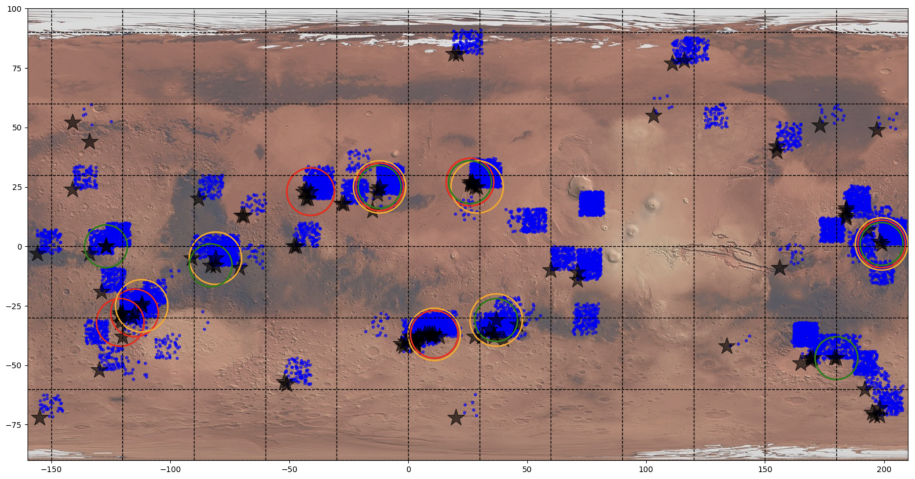
On the paper's own terms, the discovery is that local curvature can be used online to correct the shortsightedness of sequential greedy. For a set $S$ and a permissible expansion $A$, set curvature $\gamma(S \mid A)$ measures how much marginal gains of elements in $A$ have already been diminished by the choice of $S$. Along the greedy path the paper tracks the expansion curvature $\gamma_e(S_i)$, the maximum set curvature seen so far, and declares an anomaly at stage $i+1$ when $\gamma(S_i \mid A_i) \le \gamma_e(S_i)$, because a past element appears responsible for the erosion of future gains. The step-back policy then discards the element that produced that historical maximum and re-runs one greedy selection from the smaller set. Theorem 4.1 proves that Algorithm 2 retains the worst-case bound $f(S_{\mathrm{RSG}}) \ge (1 - 1/e)f(S^*)$ regardless of the trigger or step-back rule, and Theorem 4.2 gives an if-and-only-if path-curvature condition under which the rewired path stays at least as good as the ordinary greedy path. The two experiments report average normalized coverage rising from $0.7823$ for greedy to $0.8874$ for ResQue Greedy, and Mars features found rising from $6{,}658$ to $7{,}714$, while a random-rewiring control scores $0.7439$ and $6{,}853$, respectively.
Load-bearing premise
The load-bearing premise is that the curvature trigger identifies past greedy choices whose removal improves the eventual solution; the paper motivates this with intuition but does not prove it, and the random-rewiring baseline shows that an uninformative trigger can make rewiring worse than plain greedy.
Editorial extensions
If this is right
- Any instance that can be fed to sequential greedy can instead be passed to ResQue Greedy without losing the $(1 - 1/e)$ worst-case guarantee, since Theorem 4.1 holds for arbitrary later-stage trigger and step-back rules.
- When the trigger fires rarely, the extra cost is one additional greedy pass per rewiring, so the method remains polynomial-time; in the two experiments it used roughly 14–18 percent more oracle queries than plain greedy.
- Ordinary greedy is not a lower bound on the rewired path in general: the paper's random-rewiring control (0.7439 normalized coverage) lands below plain greedy (0.7823), so the curvature trigger, not the act of rewiring, is what must do the work.
- For functions with low total curvature, the paper expects little gain because the trigger rarely fires; in such cases ResQue Greedy behaves essentially like sequential greedy.
Reading between the lines
- One implication the authors leave implicit: the trigger compares curvatures but never checks whether the suspected element's actual marginal contribution at the current stage is small, so a variant that fires only when the gap $\gamma_e(S_i) - \gamma(S_i \mid A_i)$ exceeds a tuned margin might buy larger gains per extra query.
- Because a rewiring at the final step re-selects a best element from the reduced set, it cannot lower the value at that step; a cheaper variant that skips curvature monitoring and always performs one final re-greedy pass is a natural baseline the paper does not isolate.
- The midpoint update for curvatures after a step-back, equation (12), is an approximation, so over multiple rewires the trigger's statistics drift from the true ones; tracking exact curvatures after each rewire would test whether the heuristic's performance degrades on long horizons.
Signed reviews
Editorial analysis
A structured set of objections, weighed in public.
Referee Report
Summary. The paper proposes ResQue Greedy, a modification of the standard sequential greedy algorithm for monotone submodular maximization under a cardinality constraint. The algorithm adds a rewiring step: when a curvature-based trigger condition (Definition 4) fires, it removes one previously selected element according to a step-back policy (Definition 5) and performs an additional greedy selection. The paper claims that this procedure preserves the standard (1 - 1/e) worst-case approximation guarantee while empirically obtaining higher objective values than standard greedy on two coverage problems. Theorem 4.1 proves the worst-case bound for any trigger and step-back rule, and the argument in that proof is correct. The claimed improvement over greedy, however, rests on the heuristic trigger law and is not established theoretically; Theorem 4.2 is the only theoretical statement about improvement, and it has notational and logical problems. The experimental section provides two coverage examples with no error bars, significance tests, or comparison to standard submodular maximization baselines.
Significance. If the empirical improvement is real, the paper offers a simple, drop-in heuristic that preserves the standard worst-case guarantee and may improve solution quality in practice at modest computational cost. The idea of using local curvature as a trigger for rewiring is interesting and the preservation of the (1 - 1/e) bound for arbitrary trigger and removal rules is a useful robustness property. The theoretical contribution is otherwise modest: Theorem 4.1 reproduces the standard greedy bound, and no result in the paper proves that the proposed trigger law improves the final solution. The paper would be strengthened by releasing code and data, by reporting variance and significance statistics, and by clearly positioning the improvement claim as empirical rather than as a proven tighter bound.
major comments (4)
- [Section IV-B, Theorem 4.2] Theorem 4.2 uses the undefined quantity γ_p(S^SG_{m-1} | s^SG_m). Definition 3 defines path curvature γ_p(S_i) only for a whole sequential construction, not for a set-element pair. In addition, the derived condition involves γ(S^RSG_{m-1} | A^SG_{m-1}), whereas the preceding calculation requires γ(S^RSG_{m-1} | {s^SG_m}). Since γ(S|A) ≥ γ(S|{e}) for any e in A, the displayed condition is merely sufficient, not necessary. The 'if and only if' claim is therefore not justified, and the proof also silently assumes that s^SG_m belongs to P \ S^RSG_{m-1}, which may fail after a rewiring. This theorem needs to be restated with correct notation and a correct logical status.
- [Section IV-A, Definition 4] The trigger law is the load-bearing component of the claimed improvement, but the paper gives no proof that the condition γ(S_i|A_i) ≤ γ_e(S_i) identifies elements whose removal raises the final objective. The motivating argument in Section IV-A assumes that γ(S_i|A_i) grows as elements are added, yet Lemma 3.1 is stated only for a fixed permissible set A; because A_i shrinks at each step, γ(S_i|A_i) can decrease simply because the element attaining the minimum marginal ratio has already been selected. The random-rewiring control in Table I shows that rewiring without an informative trigger can degrade performance, so the trigger law is not a cosmetic detail. The authors should either prove a property of the trigger law that relates it to the condition in Theorem 4.2 or substantially strengthen the empirical case.
- [Section V, Tables I and II] The experimental evidence does not statistically support the central claim. Table I reports averages over 100 Monte Carlo runs without error bars, confidence intervals, or significance tests, and Table II is a single instance. There is no comparison to standard baselines such as lazy greedy, local search, or a simple restart heuristic. Moreover, in Table II the random-rewiring greedy achieves 6,853 coverage versus 6,658 for standard greedy, which undermines the narrative that uninformed rewiring necessarily hurts performance. The improvement of ResQue Greedy over greedy needs to be demonstrated with variance statistics and, preferably, with multiple problem classes.
- [Abstract and Section I] The abstract and introduction claim that ResQue Greedy 'achieves tighter near-optimality bounds' than sequential greedy. As stated, this is not established: Theorem 4.1 gives exactly the standard (1 - 1/e) bound, and no theorem proves that the algorithm's solution value dominates that of standard greedy. The only support for the tightness claim is empirical. The paper should either prove a formal improvement condition that is actually satisfied by the trigger law, or explicitly reword the contribution as an empirically effective heuristic with a preserved worst-case guarantee.
minor comments (5)
- [Section III, Definition 2] The paper uses the term 'normal' for f but never states the normalization condition; it should explicitly say f(∅)=0.
- [Lemma 3.2 proof] There is a typo in the proof of part (b): 'γ(Sℓ|{ℓℓ+1})' should be 'γ(Sℓ|{s_{ℓ+1}})'.
- [Section IV-B, Eq. (12)] The update rule in Eq. (12) uses A'_ℓ without defining it; please define the permissible set after a step-back.
- [Section V, Table II] The 'Queries' column in Table II appears to report total value-query counts, but this is not stated; please clarify how queries are counted and consider reporting standard deviations for the Monte Carlo results.
- [Conclusion] The conclusion states that numerical experiments 'confirmed' the effectiveness of the method; given the lack of statistical tests, a softer formulation such as 'suggest' would be more appropriate.
Circularity Check
No significant circularity: the rewiring heuristic is evaluated empirically, and the theoretical results are standard or conditional rather than self-referential.
full rationale
The central claim — that ResQue Greedy improves on sequential greedy — rests on an algorithmic heuristic (Definitions 4 and 5) whose trigger and step-back are defined directly from the value oracle f and the resulting set/expansion/path curvatures. No parameter is fitted to the experimental outcomes, and the Monte-Carlo coverage gains in Tables I and II are direct evaluations of the objective, not inversions of a fitted constant. Theorem 4.1 is the standard (1-1/e) induction and holds for any rewiring because greedy re-expansion from S'_i guarantees f(S_{i+1}) >= f(bar S_{i+1}); this proof does not assume the conclusion. Theorem 4.2 is an algebraic comparison of the two algorithms' marginal decompositions; it is conditional and contains undefined notation (gamma_p(S^{SG}_{m-1} | s^{SG}_m) is not defined in Definition 3), so it is a correctness risk rather than a circular step: it does not smuggle the desired inequality in as an input, and the paper does not claim this theorem alone proves the experimental improvement. Self-citations [12] and [13] are used for background and for the standard inequality (1-1/kappa)^kappa <= e^{-1}; they are not load-bearing for the paper's central claim. The heuristic trigger law is motivated by the lower bound f(S_i) >= (1-gamma_p(S_i)) sum f(s), but the paper does not present that bound as a proof that the trigger must improve every instance; the experiments provide external, oracle-based evidence. Therefore the derivation chain is self-contained against the stated value-oracle model, and no step reduces by construction to its own inputs.
Assumptions & free parameters
assumptions (3)
- domain assumption f is monotone, normal, submodular, and accessed via a value oracle.
- ad hoc to paper The trigger law (Definition 4) identifies harmful elements: if γ(S_i|A_i) ≤ γ_e(S_i), then an earlier element caused an anomaly and should be removed.
- ad hoc to paper The step-back policy (Definition 5) and the mean-value update (Eq. 12) preserve enough curvature information for subsequent triggers.
Cite this review
Pith. "Pith review of ResQue Greedy: Rewiring Sequential Greedy for Improved Submodular Maximization." pith.science (2026). https://pith.science/paper/ERSS7W2M
@misc{pith2026250513670,
  author       = {Pith},
  title        = {Pith review of: ResQue Greedy: Rewiring Sequential Greedy for Improved Submodular Maximization},
  year         = {2026},
  howpublished = {\url{https://pith.science/paper/ERSS7W2M}},
  note         = {Machine review of arXiv:2505.13670}
}
read the original abstract
This paper introduces Rewired Sequential Greedy (ResQue Greedy), an enhanced approach for submodular maximization under cardinality constraints. By integrating a novel set curvature metric within a lattice-based framework, ResQue Greedy identifies and corrects suboptimal decisions made by the standard sequential greedy algorithm. Specifically, a curvature-aware rewiring strategy is employed to dynamically redirect the solution path, leading to improved approximation performance over the conventional sequential greedy algorithm without significantly increasing computational complexity. Numerical experiments demonstrate that ResQue Greedy achieves tighter near-optimality bounds compared to the traditional sequential greedy method.
Figures


Figures from the paper (1 more)
Reference graph
Works this paper leans on
-
[1]
Submodularity of optimal sensor placement for traffic networks,
R. Li, N. Mehr, and R. Horowitz, “Submodularity of optimal sensor placement for traffic networks,”Transportation Research Part B: Methodological, vol. 171, p. 29–43, May 2023. Fig. 4:Feature points (blue dots) and potential deployment points (black⋆). Agent deployments: standard sequential greedy (red),ResQue Greedyallocations (orange), and random rewirin...
work page 2023
-
[2]
A sub-modular receding horizon solution for mobile multi-agent persistent monitoring,
N. Rezazadeh and S. S. Kia, “A sub-modular receding horizon solution for mobile multi-agent persistent monitoring,”Automatica, vol. 127, p. 109460, 2021
work page 2021
-
[3]
Online submodular resource allocation with applications to rebalancing shared mobility systems,
P. G. Sessa, I. Bogunovic, A. Krause, and M. Kamgarpour, “Online submodular resource allocation with applications to rebalancing shared mobility systems,” inProceedings of the 38th International Conference on Machine Learning(M. Meila and T. Zhang, eds.), vol. 139 ofProceedings of Machine Learning Research, pp. 9455–9464, PMLR, 18–24 Jul 2021
work page 2021
-
[4]
Liu,A Review for Submodular Optimization on Machine Scheduling Problems, p
S. Liu,A Review for Submodular Optimization on Machine Scheduling Problems, p. 252–267. Springer International Publishing, 2020
work page 2020
-
[5]
An analysis of approximations for maximizing submodular set functions—i,
G. L. Nemhauser, L. A. Wolsey, and M. L. Fisher, “An analysis of approximations for maximizing submodular set functions—i,” Mathematical Programming, vol. 14, no. 1, pp. 265–294, 1978
1978
-
[6]
Submodular set functions, matroids and the greedy algorithm: tight worst-case bounds and some generalizations of the Rado-Edmonds theorem,
M. Conforti and G. Cornu ´ejols, “Submodular set functions, matroids and the greedy algorithm: tight worst-case bounds and some generalizations of the Rado-Edmonds theorem,”Discrete applied mathematics, vol. 7, no. 3, pp. 251–274, 1984
1984
-
[7]
J. V ondr ´ak, “Submodularity and curvature: The optimal algorithm (combinatorial optimization and discrete algorithms),”Research Institute for Mathematical Sciences Kyoto University, vol. 23, pp. 253–266, 2010
work page 2010
-
[8]
On bounds for greedy schemes in string optimization based on greedy curvatures,
B. Li, B. Van Over, E. K. P. Chong, and A. Pezeshki, “On bounds for greedy schemes in string optimization based on greedy curvatures,” inIEEE Conference on Decision and Control, (Milan, Italy), 2024
work page 2024
Show all 16 references
-
[9]
Sampling from probabilistic submodular models,
A. Gotovos, S. H. Hassani, and A. Krause, “Sampling from probabilistic submodular models,” inNeural Information Processing Systems, 2015
2015
-
[10]
Gradient methods for submodular maximization,
H. Hassani, M. Soltanolkotabi, and A. Karbasi, “Gradient methods for submodular maximization,”Advances in Neural Information Processing Systems, vol. 30, 2017
2017
-
[11]
Distributed submodular maximization with limited information,
B. Gharesifard and S. Smith, “Distributed submodular maximization with limited information,”IEEE transactions on control of network systems, vol. 5, no. 4, pp. 1635–1645, 2017
2017
-
[12]
Optimality gap of decentralized submodular maximization under probabilistic communication,
J. Vendrell and S. S. Kia, “Optimality gap of decentralized submodular maximization under probabilistic communication,” inIEEE Conference on Decision and Control, (Milan, Italy), 2024
2024
-
[13]
Submodular maximization subject to uniform and par-tition matroids: From theory to practical applications and distributed solutions,
S. S. Kia, “Submodular maximization subject to uniform and par-tition matroids: From theory to practical applications and distributed solutions,” 2025.https://arxiv.org/abs/2501.01071
2025 arXiv
-
[14]
An exemplar-based approach to individualized parcellation reveals the need for sex specific functional networks,
M. Salehi, A. Karbasi, X. Shen, D. Scheinost, and R. T. Constable, “An exemplar-based approach to individualized parcellation reveals the need for sex specific functional networks,”NeuroImage, vol. 170, p. 54–67, Apr. 2018
2018
-
[15]
Submodular Point Processes with Applications to Machine learning,
R. Iyer and J. Bilmes, “Submodular Point Processes with Applications to Machine learning,” inInternational Conference on Artificial Intelligence and Statistics, vol. 38, (San Diego, California), pp. 388–397, 2015
2015
-
[16]
Domars16k: A diverse dataset for weakly supervised geomorphologic analysis on mars,
T. Wilhelm, M. Geis, J. P ¨uttschneider, T. Sievernich, T. Weber, K. Wohlfarth, and C. W ¨ohler, “Domars16k: A diverse dataset for weakly supervised geomorphologic analysis on mars,”Remote Sensing, vol. 12, p. 3981, Dec. 2020
2020
Reviewed August 15, 2026 · model on record in the stance chip above.
Discussion (0). Continue with ORCID to comment.