REVIEW 4 major objections 5 minor 25 references
ReSW-VL: Representation Learning for Surgical Workflow Analysis Using Vision-Language Model
T0 review · 4 major / 5 minor · reviewed 2026-08-15 · deepseek-v4-flash
Pith's one-line read Prompt-trained CLIP image encoder improves surgical phase recognition on three laparoscopic video datasets.
desk verdict An incremental but sensible application of CLIP prompt learning to surgical phase recognition, undermined by a missing control cell that leaves the reported gains unassigned between prompt learning and CLIP initialization. read the letter →
The pith
A machine-rendered reading of the paper's core claim, the machinery that carries it, and where it could break.
The reading
What carries the argument
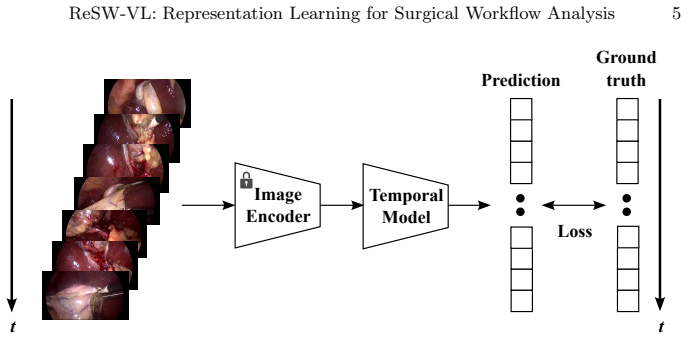
The central mechanism is prompt learning on a CLIP model. A CLIP image encoder converts each frame into a $d$-dimensional feature vector, and a frozen text encoder converts $P$ learned prompt vectors into $P$ text features; the inner products of image and text features produce phase logits, and weighted cross-entropy trains the image encoder and the prompt tokens together. For ReSW-VLo, only $n$ reference phase tokens are learned and the remaining phase tokens are obtained by linear interpolation, which preserves the ordering of phases in text-embedding space. This prompt-learning objective is what the paper credits for reshaping the spatial feature space, and the same frozen features are later paired with a causal TCN for temporal modeling.
What would settle it
Retrain the proposed pipeline on Cholec80 with the CLIP ResNet-50 but use fixed random prompts (or no text branch at all) while keeping the same loss; if test accuracy stays at the ReSW-VLo level of about 85.6 percent, prompt learning is not what drives the improvement.
Extended reading notes
Core claim
ReSW-VL claims that fine-tuning a CLIP image encoder under a prompt-learning objective produces spatial features that are better suited to phase recognition than features from a conventionally fine-tuned CNN, under the same temporal model. Each surgical phase is assigned a prompt whose first token is a learnable embedding of the phase number; ReSW-VLo interpolates between a small set of learned reference tokens to encode the ordered progression of phases, while ReSW-VLi learns the phase tokens independently. After training, the image encoder is frozen and a causal TCN maps the frame-feature sequence to phase predictions. The reported results on Cholec80, Autolaparo, and m2cai16 show consistent improvements over the conventional ImageNet-pretrained ResNet-50 baseline, ranging from roughly 1.0 to 4.3 percentage points in accuracy, 3.7 to 6.1 points in Jaccard index, and 2.4 to 3.9 points in F1 score, with the best prompt variant depending on whether the dataset's phases advance monotonically.
Load-bearing premise
The claimed gain is attributed to prompt learning, but the experiments compare a CLIP-pretrained ResNet-50 to an ImageNet-pretrained ResNet-50, so the improvement could come entirely from the different pretrained weights rather than from the prompt-learning procedure.
Editorial extensions
If this is right
- On Cholec80, ReSW-VLo raises F1 from 77.89 to 81.81 and Jaccard from 62.36 to 68.45, the largest gains reported in the paper.
- On m2cai16, both prompt variants improve F1 by about 2.3 to 2.4 points and Jaccard by about 3.5 to 5.7 points, showing the benefit is not limited to one dataset.
- On Autolaparo, ReSW-VLi beats ReSW-VLo, which suggests the ordered-prompt prior only helps when phase numbers actually progress monotonically.
- Because the image encoder is frozen in the second stage, the learned representation can be plugged into LSTM, TCN, or Transformer temporal models without retraining the spatial features.
- The method provides an alternative to Transformer-only surgical phase recognition, keeping a CNN-plus-temporal-model design while improving the feature extraction stage.
Reading between the lines
- A decisive control experiment would decouple pretraining from training method: apply the same prompt-learning objective to an ImageNet-pretrained ResNet-50, and apply plain fine-tuning to the CLIP ResNet-50, to see whether the reported gains come from prompt learning, CLIP initialization, or their interaction.
- The ordered-prompt idea could generalize to non-linear phase graphs, for example by learning a phase-transition matrix or a low-dimensional manifold of phase tokens instead of linear interpolation.
- Since the text encoder stays frozen and only a small number of prompt tokens are trained, the method may transfer to other procedural video domains (endoscopy, cataract surgery) with modest labeled data, almost by rewriting the phase vocabulary.
- The paper evaluates on 1 fps frames; applying the same representation at higher frame rates or with a different temporal model might interact non-trivially with the frozen features, which the current experiments do not address.
Signed reviews
Editorial analysis
A structured set of objections, weighed in public.
Referee Report
Summary. The paper proposes ReSW-VL, a two-stage method for surgical phase recognition. In the first stage, a CLIP ResNet-50 image encoder is fine-tuned with learned prompts while the text encoder is frozen; the logit is the inner product of the image feature with text features derived from phase prompts. Two variants are introduced: ReSW-VLi, which learns each phase's first prompt token independently, and ReSW-VLo, which learns a small number of reference tokens and interpolates the remaining phase tokens to preserve phase order. In the second stage, the image encoder is frozen and a causal TCN is trained on the resulting frame features. The method is evaluated on Cholec80, Autolaparo, and m2cai16 against a conventional baseline consisting of an ImageNet-pretrained ResNet-50 fine-tuned on the same datasets with the same TCN second stage. The reported results show consistent improvements in accuracy, Jaccard index, and F1 score for at least one proposed variant on each dataset.
Significance. If the reported gains were attributable to the proposed prompt-learning procedure, this would be a useful contribution: it is, to my knowledge, the first application of vision-language prompt learning to surgical phase recognition, and it addresses a genuine gap in the literature on representation learning for the spatial feature extractor. The evaluation uses three standard public datasets and multiple phase-wise video-wise metrics, and the two-stage protocol is described with enough detail to be reproduced. A notable strength is that the authors explicitly report standard deviations, although those deviations are over phases rather than over training runs. The main reason the significance is not yet established is that the central comparison confounds the pretrained weights with the prompt-learning objective, and no repeated-run statistics are provided to support the magnitude of the reported differences.
major comments (4)
- [Section 4, Table 3] The comparison between the proposed methods and the conventional method changes two variables at once: the pretrained weights (CLIP versus ImageNet) and the first-stage training objective (prompt learning with a text-encoder logit head versus plain cross-entropy classification). Because the proposed method always starts from CLIP initialization, the reported gains of roughly 1.0-4.3 accuracy points, 3.7-6.1 Jaccard points, and 2.4-3.9 F1 points could be entirely due to the richer CLIP representation rather than to the prompt-learning procedure. The paper needs a missing control cell: a CLIP-pretrained ResNet-50 fine-tuned with the same cross-entropy objective and no prompt learning, run under otherwise identical hyperparameters. Without this cell, the central claim that prompt learning improves surgical phase recognition is not supported.
- [Section 4, Table 3] The reported standard deviations are over phases, not over training runs, and the manuscript provides no repeated-seed variance or significance tests. On Autolaparo, ReSW-VLi achieves an accuracy of 75.69 versus 75.68 for the conventional method, a difference of 0.01 percentage points that the text nevertheless summarizes as consistent outperformance. At minimum, the authors should report means and standard deviations over at least three training runs and perform a paired per-video significance test (for example, a paired bootstrap or Wilcoxon test) to establish that the observed gaps are not noise.
- [Section 3 and Section 4] The only stated justification for setting n=3 in ReSW-VLo is 'Based on preliminary experiments,' with no details of those experiments, and the number m of learned prompt tokens is never reported anywhere in the manuscript. Since the relative advantage of ReSW-VLo over ReSW-VLi is dataset-dependent and is attributed to the sequentiality assumption, the paper should include a sensitivity analysis for n (for example, n=2, 3, and 5) and a stated value for m. Without this, the mechanism behind the proposed method and its dataset-dependent behavior remain unsupported.
- [Section 1 and Section 4] The conclusion that the proposed method 'consistently surpassed conventional methods' is broader than the evidence in Table 3, which compares only against the authors' reimplemented ImageNet ResNet-50 plus TCN baseline. Since Cholec80, Autolaparo, and m2cai16 are standard datasets with published results, the paper should include at least one comparison with a prior published method from Table 1 (for example, TeCNO or Trans-SVNet) under the same evaluation protocol, or should explicitly state why such a comparison is omitted. As it stands, the claimed superiority over 'conventional methods' is calibrated only against a single baseline.
minor comments (5)
- [Abstract] The abstract expands CLIP as 'Convolutional Language Image Model'; the correct expansion is 'Contrastive Language-Image Pre-training'.
- [Section 3 heading] The heading 'Propose Method' should be 'Proposed Method'.
- [Section 4] The text refers to the 'M2cai dataset' while Table 2 uses 'm2cai16'; please use consistent naming throughout.
- [Section 4] The paper does not state which specific CLIP checkpoint was used (for example, OpenAI's CLIP ResNet-50); this information is needed for reproducibility.
- [Figures 3 and 4] The captions of Figures 3 and 4 contain garbled text such as 'C ... R ...' and 'P ...'; these appear to be rendering artifacts and should be regenerated.
Circularity Check
No significant circularity: the method is evaluated against external benchmarks and no load-bearing result reduces to its own inputs.
full rationale
The paper's chain is an empirical evaluation, not a derivation. The proposed ReSW-VL method fine-tunes a CLIP image encoder with learned prompts and then freezes it while training a causal TCN on public surgical phase datasets (Cholec80, Autolaparo, m2cai16). The reported metrics are measured on held-out test splits, and the learning rate is selected on validation data, which is standard practice. The comparison baseline is an ImageNet-pretrained ResNet-50 with the same TCN temporal stage; this may confound pretrained initialization with prompt learning, but that is an experimental attribution concern, not circularity, because the test numbers are not produced by the method's own definitions or by a fitted parameter renamed as a prediction. The use of OrdinalCLIP's interpolation for ordered prompts is adopted from an external prior work and is not invoked as a self-supporting uniqueness theorem. There is no equation in which the claimed output is equivalent to the input by construction, and no load-bearing self-citation chain. Accordingly, no circular step is present, and the appropriate score is 0.
Assumptions & free parameters
free parameters (3)
- n (number of learned reference tokens in ReSW-VLo) =
3
- m (number of learnable prompt tokens) =
not reported
- TCN architecture settings =
8 layers, 256 channels, config 1
assumptions (3)
- standard math CLIP image and text embeddings can be compared by inner product after pretraining
- domain assumption Phase labels are strings that map to integers, and the integer order is meaningful for the ordered variant
- domain assumption Frame-level phase annotations in the datasets are correct
Cite this review
Pith. "Pith review of ReSW-VL: Representation Learning for Surgical Workflow Analysis Using Vision-Language Model." pith.science (2026). https://pith.science/paper/JRUZVMHS
@misc{pith2026250513746,
  author       = {Pith},
  title        = {Pith review of: ReSW-VL: Representation Learning for Surgical Workflow Analysis Using Vision-Language Model},
  year         = {2026},
  howpublished = {\url{https://pith.science/paper/JRUZVMHS}},
  note         = {Machine review of arXiv:2505.13746}
}
read the original abstract
Surgical phase recognition from video is a technology that automatically classifies the progress of a surgical procedure and has a wide range of potential applications, including real-time surgical support, optimization of medical resources, training and skill assessment, and safety improvement. Recent advances in surgical phase recognition technology have focused primarily on Transform-based methods, although methods that extract spatial features from individual frames using a CNN and video features from the resulting time series of spatial features using time series modeling have shown high performance. However, there remains a paucity of research on training methods for CNNs employed for feature extraction or representation learning in surgical phase recognition. In this study, we propose a method for representation learning in surgical workflow analysis using a vision-language model (ReSW-VL). Our proposed method involves fine-tuning the image encoder of a CLIP (Convolutional Language Image Model) vision-language model using prompt learning for surgical phase recognition. The experimental results on three surgical phase recognition datasets demonstrate the effectiveness of the proposed method in comparison to conventional methods.
Figures


Figures from the paper (1 more)

Reference graph
Works this paper leans on
-
[1]
Czempiel, T., Paschali, M., Keicher, M., Simson, W., Feus sner, H., Kim, S.T., Navab, N.: Tecno: Surgical phase recognition with multi-st age temporal con- volutional networks. In: Medical Image Computing and Compu ter Assisted Intervention–MICCAI 2020: 23rd International Conference , Lima, Peru, October 4–8, 2020, Proceedings, Part III 23. pp. 343–352. S...
work page 2020
-
[2]
Czempiel, T., Paschali, M., Ostler, D., Kim, S.T., Busam, B., Navab, N.: Opera: Attention-regularized transformers for surgical phase re cognition. In: Medical Im- age Computing and Computer Assisted Intervention–MICCAI 2 021: 24th Interna- tional Conference, Strasbourg, France, September 27–Octo ber 1, 2021, Proceed- ings, Part IV 24. pp. 604–614. Spring...
work page 2021
-
[3]
Demir, K.C., Schieber, H., Weise, T., Roth, D., May, M., Ma ier, A., Yang, S.H.: Deep learning in surgical workflow analysis: a review of phas e and step recognition. IEEE Journal of Biomedical and Health Informatics 27(11), 5405–5417 (2023) ReSW-VL: Representation Learning for Surgical Workflow Ana lysis 9
work page 2023
-
[4]
In: 2009 IEEE conferenc e on computer vision and pattern recognition
Deng, J., Dong, W., Socher, R., Li, L.J., Li, K., Fei-Fei, L .: Imagenet: A large- scale hierarchical image database. In: 2009 IEEE conferenc e on computer vision and pattern recognition. pp. 248–255. Ieee (2009)
work page 2009
-
[5]
arXiv preprint arXiv:2010.11929 (2020)
Dosovitskiy, A., Beyer, L., Kolesnikov, A., Weissenborn , D., Zhai, X., Unterthiner, T., Dehghani, M., Minderer, M., Heigold, G., Gelly, S., et al .: An image is worth 16x16 words: Transformers for image recognition at sc ale. arXiv preprint arXiv:2010.11929 (2020)
arXiv 2020
-
[6]
In: Proc eedings of the IEEE in- ternational conference on computer vision
Eigen, D., Fergus, R.: Predicting depth, surface normals and semantic labels with a common multi-scale convolutional architecture. In: Proc eedings of the IEEE in- ternational conference on computer vision. pp. 2650–2658 ( 2015)
work page 2015
-
[7]
arXiv preprint arXiv:2305.13961 (2023)
Funke, I., Rivoir, D., Speidel, S.: Metrics matter in surg ical phase recognition. arXiv preprint arXiv:2305.13961 (2023)
arXiv 2023
-
[8]
Gao, X., Jin, Y., Long, Y., Dou, Q., Heng, P.A.: Trans-svne t: Accurate phase recognition from surgical videos via hybrid embedding aggr egation transformer. In: Medical Image Computing and Computer Assisted Interven tion–MICCAI 2021: 24th International Conference, Strasbourg, France, Septe mber 27–October 1, 2021, Proceedings, Part IV 24. pp. 593–603. Sp...
work page 2021
Show all 25 references
-
[9]
In: Proceedings of the IEEE conference on computer vision and pa ttern recognition
He, K., Zhang, X., Ren, S., Sun, J.: Deep residual learning for image recognition. In: Proceedings of the IEEE conference on computer vision and pa ttern recognition. pp. 770–778 (2016)
2016
-
[10]
Neural computation 9(8), 1735–1780 (1997)
Hochreiter, S., Schmidhuber, J.: Long short-term memor y. Neural computation 9(8), 1735–1780 (1997)
1997
-
[11]
IEEE transactions on medical imaging 37(5), 1114–1126 (2017)
Jin, Y., Dou, Q., Chen, H., Yu, L., Qin, J., Fu, C.W., Heng, P.A.: Sv-rcnet: work- flow recognition from surgical videos using recurrent convo lutional network. IEEE transactions on medical imaging 37(5), 1114–1126 (2017)
2017
-
[12]
In: Computer visio n–ECCV 2016 work- shops: Amsterdam, the Netherlands, October 8-10 and 15-16, 2016, proceedings, part III 14
Lea, C., Vidal, R., Reiter, A., Hager, G.D.: Temporal con volutional networks: A unified approach to action segmentation. In: Computer visio n–ECCV 2016 work- shops: Amsterdam, the Netherlands, October 8-10 and 15-16, 2016, proceedings, part III 14. pp. 47–54. Springer (2016)
2016
-
[13]
Adva nces in Neural Informa- tion Processing Systems 35, 35313–35325 (2022)
Li, W., Huang, X., Zhu, Z., Tang, Y., Li, X., Zhou, J., Lu, J .: Ordinalclip: Learning rank prompts for language-guided ordinal regression. Adva nces in Neural Informa- tion Processing Systems 35, 35313–35325 (2022)
2022
-
[14]
Artificial I ntelligence Review 57(11), 291 (2024)
Li, Y., Zhao, Z., Li, R., Li, F.: Deep learning for surgica l workflow analysis: a survey of progresses, limitations, and trends. Artificial I ntelligence Review 57(11), 291 (2024)
2024
-
[15]
Medical Image Analysis 99, 103366 (2025)
Liu, Y., Boels, M., Garcia-Peraza-Herrera, L.C., Verca uteren, T., Dasgupta, P., Granados, A., Ourselin, S.: Lovit: Long video transformer f or surgical phase recog- nition. Medical Image Analysis 99, 103366 (2025)
2025
-
[16]
In: Proceedings of the IEEE/CVF International Conference o n Computer Vision
Liu, Y., Huo, J., Peng, J., Sparks, R., Dasgupta, P., Gran ados, A., Ourselin, S.: Skit: a fast key information video transformer for online su rgical phase recognition. In: Proceedings of the IEEE/CVF International Conference o n Computer Vision. pp. 21074–21084 (2023)
2023
-
[17]
arXiv preprint arXiv:1711.05101 (2017)
Loshchilov, I., Hutter, F.: Decoupled weight decay regu larization. arXiv preprint arXiv:1711.05101 (2017)
2017 arXiv
-
[18]
In: Interspeech
Mikolov, T., Karafiát, M., Burget, L., Cernock` y, J., Khu danpur, S.: Recurrent neu- ral network based language model. In: Interspeech. vol. 2, p p. 1045–1048. Makuhari (2010)
2010
-
[19]
In: International conferen ce on machine learning
Radford, A., Kim, J.W., Hallacy, C., Ramesh, A., Goh, G., Agarwal, S., Sastry, G., Askell, A., Mishkin, P., Clark, J., et al.: Learning transfe rable visual models from natural language supervision. In: International conferen ce on machine learning. pp. 8748–8763. PmLR (2021) ...
2021
-
[20]
Me dical Image Analysis 94, 103126 (2024)
Rivoir, D., Funke, I., Speidel, S.: On the pitfalls of bat ch normalization for end-to- end video learning: A study on surgical workflow analysis. Me dical Image Analysis 94, 103126 (2024)
2024
-
[21]
arXiv preprint arXiv:1610.09278 (2016)
Stauder, R., Ostler, D., Kranzfelder, M., Koller, S., Fe ußner, H., Navab, N.: The tum lapchole dataset for the m2cai 2016 workflow challeng e. arXiv preprint arXiv:1610.09278 (2016)
2016 arXiv
-
[22]
IEEE transactions on medical imaging 36(1), 86–97 (2016)
Twinanda, A.P., Shehata, S., Mutter, D., Marescaux, J., De Mathelin, M., Padoy, N.: Endonet: a deep architecture for recognition tasks on la paroscopic videos. IEEE transactions on medical imaging 36(1), 86–97 (2016)
2016
-
[23]
Advances in ne ural information pro- cessing systems 30 (2017)
Vaswani, A., Shazeer, N., Parmar, N., Uszkoreit, J., Jon es, L., Gomez, A.N., Kaiser, Ł., Polosukhin, I.: Attention is all you need. Advances in ne ural information pro- cessing systems 30 (2017)
2017
-
[24]
In: International Conference on Medical Image Com- puting and Computer-Assisted Intervention
Wang, Z., Lu, B., Long, Y., Zhong, F., Cheung, T.H., Dou, Q ., Liu, Y.: Autolaparo: A new dataset of integrated multi-tasks for image-guided su rgical automation in laparoscopic hysterectomy. In: International Conference on Medical Image Com- puting and Computer-Assisted Inter...
2022
-
[25]
Computer Methods in Biomechanics and Biomedical Engineering: Imaging & Visual ization 11(4), 1012– 1018 (2023)
Zou, X., Liu, W., Wang, J., Tao, R., Zheng, G.: Arst: auto- regressive surgical transformer for phase recognition from laparoscopic video s. Computer Methods in Biomechanics and Biomedical Engineering: Imaging & Visual ization 11(4), 1012– 1018 (2023)
2023
Reviewed August 15, 2026 · model on record in the stance chip above.
Discussion (0). Continue with ORCID to comment.