Convergence Analysis of an Adaptive Nonconforming FEM for Phase-Field Dependent Topology Optimization in Stokes Flow
Pith reviewed 2026-05-22 13:32 UTC · model grok-4.3
The pith
An adaptive nonconforming finite element method converges to optimality conditions for phase-field topology optimization in Stokes flow.
A machine-rendered reading of the paper's core claim, the machinery that carries it, and where it could break.
Core claim
The sequence of minimizers of the discrete problems contains a subsequence that converges to a solution of the first-order optimality system of the continuous problem, and the associated subsequence of discrete pressure fields converges as well. The proof hinges on a new discrete compactness result for nonconforming linear finite elements on adaptively generated meshes.
What carries the argument
The new discrete compactness result for nonconforming linear finite elements over a sequence of adaptively generated meshes, which allows passing to the limit in the variational inequalities and equations defining the optimality system.
If this is right
- The adaptive algorithm can be applied with confidence that its outputs approximate true optimal configurations.
- Local mesh refinement is justified without compromising convergence properties.
- The pressure approximation converges along with the design and velocity fields.
- Numerical tests confirm faster convergence or better accuracy than uniform mesh refinement for example problems.
Where Pith is reading between the lines
- This compactness technique may apply to adaptive methods for other nonconforming discretizations in optimization or fluid problems.
- Similar analysis could be developed for different phase-field models or time-dependent flows.
- Extensions to three-dimensional domains would test the method's scalability in practical engineering settings.
Load-bearing premise
The analysis requires a discrete compactness property to hold for the nonconforming elements on the particular adaptive mesh sequences produced by the refinement strategy.
What would settle it
Finding an adaptive mesh refinement sequence where the discrete minimizers fail to have any convergent subsequence satisfying the continuous optimality system would disprove the convergence claim.
Figures


read the original abstract
In this work, we develop an adaptive nonconforming finite element algorithm for the numerical approximation of phase-field parameterized topology optimization governed by the Stokes system. We employ the conforming linear finite element space to approximate the phase field, and the nonconforming linear finite elements (Crouzeix-Raviart elements) and piecewise constants to approximate the velocity field and the pressure field, respectively. We establish the convergence of the adaptive method, i.e., the sequence of minimizers contains a subsequence that converges to a solution of the first-order optimality system, and the associated subsequence of discrete pressure fields also converges. The analysis relies crucially on a new discrete compactness result of nonconforming linear finite elements over a sequence of adaptively generated meshes. We present numerical results for several examples to illustrate the performance of the algorithm, including a comparison with the uniform refinement strategy.
Editorial analysis
A structured set of objections, weighed in public.
Referee Report
Summary. The manuscript develops an adaptive nonconforming finite-element algorithm for phase-field topology optimization of Stokes flow. Conforming linears approximate the phase field, Crouzeix-Raviart elements approximate the velocity, and piecewise constants approximate the pressure. The central claim is that the sequence of discrete minimizers admits a subsequence converging to a solution of the continuous first-order optimality system, with the associated discrete pressures also converging; the proof rests on a new discrete compactness result for the nonconforming elements on the adaptively generated mesh sequence. Numerical examples compare the adaptive strategy with uniform refinement.
Significance. If the convergence result is established, the work supplies the first rigorous justification for adaptive mesh refinement in this class of phase-field Stokes topology optimization problems, which is practically important for resolving fine-scale features without excessive degrees of freedom. The new discrete compactness statement for Crouzeix-Raviart elements on adaptively refined meshes constitutes an independent technical contribution that could be reused in other nonconforming discretizations of incompressible flow.
major comments (1)
- [Analysis section (compactness result)] The discrete compactness result (stated in the analysis section and invoked to pass to the limit in the weak form of the Stokes equations and the variational inequality) is load-bearing for the central convergence claim. The proof must explicitly confirm that the sequence of adaptively generated meshes produced by the marking and bisection algorithm satisfies the mesh-regularity hypotheses (bounded aspect ratios, controlled hanging-node configurations) required for strong L² convergence of the velocity and uniform control of the jumps; these properties are not automatically inherited from standard adaptive strategies and are not verified in the provided sketch.
minor comments (2)
- [Section 2] Notation for the discrete spaces and the discrete optimality system should be introduced with explicit reference to the mesh sequence index to avoid ambiguity when passing to the limit.
- [Numerical results] The numerical examples would benefit from a table reporting the number of degrees of freedom and the objective value at each adaptive step to quantify the efficiency gain over uniform refinement.
Simulated Author's Rebuttal
We thank the referee for the careful review and for recognizing the significance of the discrete compactness result for Crouzeix-Raviart elements on adaptive meshes. We address the single major comment below and will incorporate the requested verification into the revised manuscript.
read point-by-point responses
-
Referee: [Analysis section (compactness result)] The discrete compactness result (stated in the analysis section and invoked to pass to the limit in the weak form of the Stokes equations and the variational inequality) is load-bearing for the central convergence claim. The proof must explicitly confirm that the sequence of adaptively generated meshes produced by the marking and bisection algorithm satisfies the mesh-regularity hypotheses (bounded aspect ratios, controlled hanging-node configurations) required for strong L² convergence of the velocity and uniform control of the jumps; these properties are not automatically inherited from standard adaptive strategies and are not verified in the provided sketch.
Authors: We agree that an explicit verification of the mesh-regularity hypotheses is necessary for the compactness argument to be complete. In the revised version we will insert a new auxiliary result (Lemma 4.3) immediately preceding the discrete compactness statement. The lemma establishes that the sequence of meshes generated by the standard Dörfler marking strategy combined with newest-vertex bisection, starting from a shape-regular initial triangulation, satisfies (i) a uniform bound on the aspect ratios of all elements and (ii) a controlled number of hanging-node configurations per edge. The proof follows the standard arguments of Carstensen et al. (2014) adapted to the nonconforming setting and will be referenced explicitly when the compactness result is invoked to pass to the limit in the Stokes weak form and the variational inequality. This addition removes the gap identified by the referee without altering the overall structure of the convergence proof. revision: yes
Circularity Check
No significant circularity; convergence proof relies on newly introduced discrete compactness result
full rationale
The paper's central claim is the convergence of the adaptive nonconforming FEM sequence to a solution of the first-order optimality system for the phase-field Stokes topology optimization problem. This is achieved by establishing a new discrete compactness result for nonconforming linear (Crouzeix-Raviart) elements on adaptively generated meshes, which is presented as an independent contribution within the analysis. No steps reduce by construction to fitted parameters, self-citations, or prior ansatzes; the compactness result supplies the necessary strong convergence and jump control to pass to the limit in the weak form, objective, and variational inequality without circular reduction. The derivation is therefore self-contained against external benchmarks.
Axiom & Free-Parameter Ledger
axioms (2)
- domain assumption Existence of a solution to the first-order optimality system for the continuous phase-field topology optimization problem.
- standard math The adaptive mesh sequence satisfies the conditions needed for the new discrete compactness property of the nonconforming elements.
Reference graph
Works this paper leans on
-
[1]
N. Aage, T. H. Poulsen, A. Gersborg-Hansen, and O. Sigmund. Topology optimization of large scale Stokes flow problems. Struct. Multidiscip. Optim. , 35(2):175– 180, 2008
work page 2008
-
[2]
M. Ainsworth and J. T. Oden. A Posteriori Error Estimation in Finite Element Analysis . Wiley-Interscience, John Wiley & Sons, New York, 2000
work page 2000
-
[3]
J. Alexandersen and C. S. Andreasen. A review of topology optimisation for fluid-based problems. Fluids, 5(1):29, 2020
work page 2020
-
[4]
D. H. Alonso, L. F. N. de S´ a, J. S. R. Saenz, and E. C. N. Silva. Topology optimization applied to the design of 2D swirl flow devices. Struct. Multidiscip. Optim. , 58(6):2341–2364, 2018
work page 2018
-
[5]
D. H. Alonso, J. S. R. Saenz, and E. C. N. Silva. Non-newtonian laminar 2D swirl flow design by the topology optimization method. Struct. Multidiscip. Optim. , 62(1):299–321, 2020
work page 2020
-
[6]
R. Becker and S. Mao. Quasi-optimality of adaptive nonconforming finite element methods for the Stokes equations. SIAM J. Numer. Anal. , 49(3):970–991, 2011
work page 2011
- [7]
-
[8]
T. Borrvall and J. Petersson. Topology optimization of fluids in Stokes flow. Int. J. Numer. Meth. Fluids , 41(1):77–107, 2003
work page 2003
-
[9]
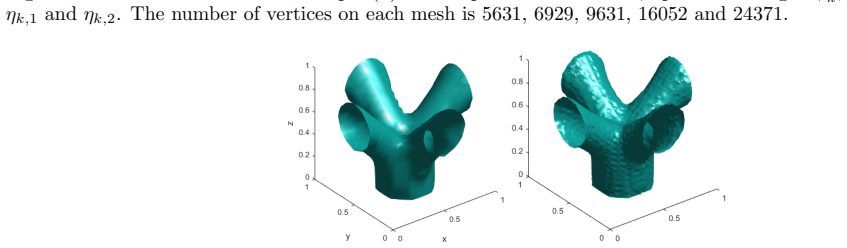
S. C. Brenner. Poincar´ e-Friedrichs inequalities for piecewise H1 functions. SIAM J. Numer. Anal. , 41(1):306– 324, 2003. 24 k = 0 k = 1 k = 2 k = 3 k = 4 Figure 7: Numerical results for Example (d) from top to bottom: mesh, optimized designs ϕ∗ k, and the estimators ηk,1 and ηk,2. The number of vertices on each mesh is 5631, 6929, 9631, 16052 and 24371....
work page 2003
-
[10]
S. C. Brenner and L. R. Scott. The Mathematical Theory of Finite Element Methods . Springer, New York, third edition, 2008
work page 2008
-
[11]
A. Buffa and C. Ortner. Compact embeddings of broken Sobolev spaces and applications. IMA J. Numer. Anal., 29(4):827–855, 2009
work page 2009
-
[12]
C. Carstensen, M. Feischl, M. Page, and D. Praetorius. Axioms of adaptivity. Comp. Math. Appl. , 67(6):1195– 1253, 2014
work page 2014
-
[13]
C. Carstensen, D. Peterseim, and H. Rabus. Optimal adaptive nonconforming fem for the Stokes problem. Numer. Math., 123(2):291–308, 2013
work page 2013
-
[14]
J. M. Cascon, C. Kreuzer, R. H. Nochetto, and K. G. Siebert. Quasi-optimal convergence rate for an adaptive finite element method. SIAM J. Numer. Anal. , 46(5):2524–2550, 2008
work page 2008
-
[15]
L. Chen. iFEM : an integrated finite element method package in MATLAB. Technical report, University of California at Irvine, 2009. Available at https://github.com/lyc102/ifem
work page 2009
-
[16]
P. G. Ciarlet. The Finite Element Method for Elliptic Problems . SIAM, Philadelphia, PA, 2002
work page 2002
-
[17]
M. Crouzeix and P.-A. Raviart. Conforming and nonconforming finite element methods for solving the stationary Stokes equations. RAIRO Anal. Num´ er., 7(3):33–76, 1973
work page 1973
-
[18]
E. Dari, R. Dur´ an, and C. Padra. Error estimators for nonconforming finite element approximations of the Stokes problem. Math. Comp., 64(211):1017–1033, 1995
work page 1995
-
[19]
Y. Deng, Y. Wu, and Z. Liu. Topology Optimization Theory for Laminar Flow: Applications in Inverse Design of Microfluidics. Springer, Singapore, 2018
work page 2018
-
[20]
L. C. Evans and R. F. Gariepy. Measure Theory and Fine Properties of Functions . CRC Press, Boca Raton, FL, revised edition, 2015
work page 2015
- [21]
-
[22]
G. Gantner and D. Praetorius. Plain convergence of adaptive algorithms without exploiting reliability and efficiency. IMA J. Numer. Anal. , 42(2):1434–1453, 2022
work page 2022
-
[23]
H. Garcke and C. Hecht. A phase field approach for shape and topology optimization in Stokes flow. In A. Pratelli and G. Leugering, editors, New Trends in Shape Optimization , pages 103–116. Birkh¨ auser, New York, 2015
work page 2015
-
[24]
H. Garcke and C. Hecht. Applying a phase field approach for shape optimization of a stationary Navier-Stokes flow. ESAIM Control Optim. Calc. Var. , 22(2):309–337, 2016
work page 2016
-
[25]
H. Garcke and C. Hecht. Shape and topology optimization in Stokes flow with a phase field approach. Appl. Math. Optim., 73(1):23–70, 2016
work page 2016
- [26]
-
[27]
A. Gersborg-Hansen, O. Sigmund, and R. B. Haber. Topology optimization of channel flow problems. Struct. Multidiscip. Optim., 30(3):181–192, 2005
work page 2005
-
[28]
V. Girault and P. A. Raviart. Finite Element Methods for Navier-Stokes Equations . Springer-Verlag, Berlin, 1986
work page 1986
-
[29]
J. K. Guest and J. H. Pr´ evost. Topology optimization of creeping fluid flows using a Darcy-Stokes finite element. Int. J. Numer. Meth. Engng. , 66(3):461–484, 2006. 26
work page 2006
- [30]
-
[31]
B. Jin, J. Li, Y. Xu, and S. Zhu. An adaptive phase-field method for structural topology optimization. J. Comput. Phys., 206:112932, 27 pp., 2024
work page 2024
- [32]
- [33]
- [34]
- [35]
-
[36]
S. Kreissl, G. Pingen, and K. Maute. Topology optimization for unsteady flow. Int. J. Numer. Methods Engrg. , 87(13):1229–1253, 2011
work page 2011
-
[37]
M. G. Larson and F. Bengzon. The Finite Element Method: Theory, Implementation, and Applications . Springer, Heidelberg, 2013
work page 2013
- [38]
-
[39]
J. Li, Y. Xu, and S. Zhu. Adaptive computation of elliptic eigenvalue topology optimization with a phase-field approach. J. Numer. Math. , 2025. https://doi.org/10.1515/jnma-2024-0060
- [40]
- [41]
-
[42]
D. A. Nield and A. Bejan. Convection in Porous Media . Springer, Cham., fifth edition, 2017
work page 2017
-
[43]
R. H. Nochetto, K. G. Siebert, and A. Veeser. Theory of adaptive finite element methods: an introduction. In Multiscale, Nonlinear and Adaptive Approximation , pages 409–542. Springer, Berlin, 2009
work page 2009
-
[44]
L. H. Olesen, F. Okkels, and H. Bruus. A high-level programming-language implementation of topology opti- mization applied to steady-state Navier–Stokes flow. Int. J. Numer. Methods Engrg. , 65(7):975–1001, 2006
work page 2006
-
[45]
C. Ortner and D. Praetorius. On the convergence of adaptive nonconforming finite element methods for a class of convex variational problems. SIAM J. Numer. Anal. , 49(1):346–367, 2011
work page 2011
-
[46]
I. P. A. Papadopoulos. Numerical analysis of a discontinuous Galerkin method for the Borrvall-Petersson topology optimization problem. SIAM J. Numer. Anal. , 60(5):2538–2564, 2022
work page 2022
-
[47]
I. P. A. Papadopoulos and E. S¨ uli. Numerical analysis of a topology optimization problem for Stokes flow. J. Comput. Appl. Math. , 412:114295, 21 pp., 2022
work page 2022
-
[48]
L. F. N. S´ a, J. S. Romero, O. Horikawa, and E. C. N. Silva. Topology optimization applied to the development of small scale pump. Struct. Multidiscip. Optim. , 57(5):2045–2059, 2018
work page 2045
- [49]
-
[50]
K. G. Siebert. A convergence proof for adaptive finite elements without lower bound. IMA J. Numer. Anal. , 31(3):947–970, 2011. 27
work page 2011
-
[51]
F. Stummel. Basic compactness properties of nonconforming and hybrid finite element spaces. RAIRO Anal. Num´ er., 14(1):81–115, 1980
work page 1980
-
[52]
C.-J. Thore. Topology optimization of Stokes flow with traction boundary conditions using low-order finite elements. Comput. Methods Appl. Mech. Engrg. , 386:114177, 14 pp., 2021
work page 2021
-
[53]
C. Traxler. An algorithm for adaptive mesh refinement in n dimensions. Computing, 59(2):115–137, 1997
work page 1997
-
[54]
Verf¨ urth.A Posteriori Error Estimation Techniques for Finite Element Methods
R. Verf¨ urth.A Posteriori Error Estimation Techniques for Finite Element Methods . Oxford University Press, Oxford, 2013
work page 2013
- [55]
discussion (0)
Sign in with ORCID, Apple, or X to comment. Anyone can read and Pith papers without signing in.